Introduction
A previous study of the use of contacts and informal networks in the judiciary in post-communist states concluded that their use was fairly common – though less widespread than in other sectors of society. To some extent the use of such informal mechanisms was facilitated by general disregard for the law, and to some extent by shortcomings within the judiciary itself. As findings were based on elite in-depth interviews (IDIs) – although numerous – we were not in a position to claim that they were generally representative.Reference Grødeland1 The IDIs were therefore complemented with quota-based elite surveys, thus allowing us to (a) further explore issues raised in the IDIs; and (b) compare our qualitative findings against more representative quantitative findings.
Our qualitative findings to some extent contradict the paradigm that the new EU member states, by adhering to the acquis communautaire, are ridding themselves of informal practices rooted in communism that have the potential to facilitate corruption. As the acquis were predominantly formal in content, they have largely failed to address behaviour that is more deeply embedded in people's minds and therefore also more difficult to change, than formal institutional frameworks, laws, rules and regulations.Reference Kühn2
For anti-corruption reform to be effective, institutional reform and legislative measures are not sufficient on their own. They should, as a minimum, be accompanied by efforts to enhance public awareness of, and compliance with, reform. Reform also requires political commitment, independent and efficient judicial structures as well as specialised anti-corruption bodies possessing the necessary powers and the will to use these. This article focuses on one key actor in efforts to curb corruption, namely the judiciary. It does so by exploring (1) the attitudes of elites to the rule of law more generally; (2) their trust in courts; (3) their perceptions of how the courts ‘work’; (4) the working conditions and living standards of prosecutors and judges, as they themselves perceive them; and (5) the type of favours that are granted within the judiciary.
First, it is assumed that informal practice3 conducive to corruption is more common in societies characterised by widespread disregard for the law than in societies where people are largely law-abiding.Reference Grødeland4 Second, people approaching the courts may be more likely to try to influence those working there to secure a desired outcome if their trust in courts is low. Conversely, prosecutors and judges are likely to be less inclined to provide clients with favours if they perceive the courts as just and fair than if they hold the opposite view. Third, work-related factors such as poor job security, low salaries and difficult living conditions, inadequate job instructions, poor, unclear and/or outdated legislation, inadequate control and wide discretionary powers, are more likely to facilitate if not outright corrupt, then at least ethically unsound, behaviour on the part of those working within the judiciary. These assumptions will be tested below.
Methodology
This article draws on quantitative and qualitative findings from a project investigating the link between informal practice – notably the use of contacts and informal networks – and corruption in the Czech Republic, Slovenia, Bulgaria and Romania.5 Data were collected in three stages: (1) elite in-depth interviews (2003–04); (2) elite round-table discussions (2004); and (3) national elite quota-based quantitative surveys (2005). For the quantitative surveys we interviewed eight different types of elites:6 we aimed for 75 respondents per category – i.e. a total of 600 respondents per country. Sampling was conducted by local pollsters according to a detailed scheme prepared by NIBR. Interviews were conducted face-to-face in accordance with a structured and close-ended questionnaire and lasted on average one hour. One third of the interviews were carried out in the capital and the remaining two thirds in large cities and towns at NUTS II level7 (see appendix for details).
Surveying elites is more complicated than surveying members of the general public. Refusal rates tend to be higher and organising the actual interviews tends to be more difficult from a logistical point of view due to time constraints on the part of the respondents. Added to this, the topic of our survey – informal practice and corruption – is rather sensitive. Refusal rates in all countries except Bulgaria were therefore fairly high.Reference Gel'man and Steen8
Still, given the relatively large number of respondents in each country – as well as the geographical spread of our sample – we are confident that our survey design is sufficiently robust and that the views expressed by the respondents are likely to be representative of the types of elites they represent as such. However, we cannot rule out the possibility of certain biases in the sample.Reference Lieber9
The total number of interviews conducted in some countries slightly exceeded the 600 interviews aimed for. We therefore weighted each national sample down to N=600 (i.e. 75 respondents × 8 categories) prior to conducting the actual analysis.10 Findings presented in the first part of the article are based on a comparison of national data for all elites as such. While the second part focuses on the perceptions and personal experiences of the respondents working within the judiciary. Whenever appropriate, quantitative findings are illustrated by verbatims from IDIs.11 As the quota sample is not drawn according to the principle of random selection, statistical significance tests are not entirely accurate and therefore not referred to in the text. Nevertheless, significance tests were performed to give an indication of the robustness of the results in the survey. Normally, only differences between countries that are statistically significant at the 10% level are commented on in the text.12
States in Transition and the Status of the Rule of Law
Above, we assumed that corruption is more likely to flourish if respect for the rule of law is low. To some extent this relates to the (formal) status of the law in society as such, and to some extent to how people perceive and behave in regard to the law. The supremacy of the law – or rule of law – is a core principle of modern democracyReference MacFarlane13 and the EU accession process has strengthened the formal status of the law in post-communist states aspiring to EU membership.
Informal practice was widespread in the new EU member states during communism.Reference DiFranceisco and Gitelman14 While it would be naïve to assume that such practices did not (and still do not) occur in EU's old member states, the manner in which they were used was qualitatively different. In communist states, such practices were often used to circumvent laws that were either inefficient or not working altogether.Reference Goldman15 Besides, and more importantly, as politics were above the law, circumventing laws could in some cases be justified, for instance to keep taut monthly or annual plans.Reference Nove16 Informal practice was also used for personal benefit – in the sense of helping people to cope with scarcity and shortages typical of communist society.
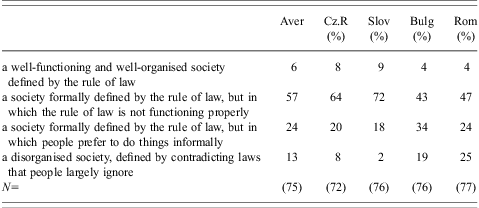
To establish whether the EU accession process – as a result of institutional and legal reform – has had a positive impact on people's behaviour, we asked our respondents how they would describe the status of the law in their country. Respondents were given the following four alternatives: (1) a well-functioning and well-organised society defined by the rule of law; (2) a society formally defined by the rule of law, but in which the rule of law is not functioning properly; (3) a society formally defined by the rule of law, but in which people prefer to do things informally; or (4) a disorganised society, defined by contradicting laws that people largely ignore. Answer categories (1) and (2) apply to societies in which the law takes precedence over informal practice, whereas categories (3) and (4) characterise societies in which informal practice is not only widespread but where its use is so extensive that it undermines the rule of law altogether.
As can be seen in Table 1, the large majority of the respondents in the Czech Republic and Slovenia, as well as a sizeable number of respondents in Bulgaria and Romania, opted for the second option – i.e. ‘a society formally defined by the rule of law, but in which the rule of law is not functioning properly.’17 This is what we would expect given that the intention behind the acquis communautaire was to put in place the formal framework required for the market economy to function properly and to establish viable democratic institutions and a politically independent judiciary. Some time will obviously be required for this new framework to start functioning as intended – even in the Czech Republic and Slovenia, which joined EU in May 2004.
If you were to describe [COUNTRY] as it is today, would you say that it is…

Notes: The table does not include answers coded as ‘don't know’ or ‘no reply’ – or 4% of the respondents in total.
It is perhaps more surprising – and also more worrying – that roughly one fifth of the Czech and Slovenian, a quarter of the Romanian and a third of the Bulgarian respondents thought people in their country ‘prefer to do things informally even though society is formally defined by the rule of law’, as this would suggest at best a reluctance to give up old habits with the potential to facilitate corruption, and at worst a lack of commitment to institutional and legal reform altogether. In addition, close to one fifth of the Bulgarian respondents and a quarter of the Romanians opted for the fourth answer, describing their countries as ‘a disorganised society, defined by contradicting laws that people largely ignore’. This suggests that the process of adjusting to the EU is not necessarily reducing legal contradictions and opportunity structures for corruption but, on the contrary, preserving or possibly even reinforcing them.
Elite Attitudes towards the Rule of Law
The formal status of the law in society is one matter, people's attitudes towards the law, and consequently also their behaviour – quite another. The majority of statements made by respondents interviewed for the qualitative part of our study (in all countries except Bulgaria) suggested that people in East Central and South East Europe are generally law-abiding:Reference Grødeland1
the majority of people are trying to get along with the law. (Lb-1, Cz 18)
Slovenes obey the law. They are more obedient than the pope!… (Pr-1, Sl)
people in Bulgaria respect the law because they fear [the] sanctions [of not respecting it]. (Go-2, Bu)
generally speaking, Romanians do respect the rule of law. The law is dodged by those who hold political power and by businessmen… (Me-10, Ro)
Still, a fairly large number of statements in all countries suggested the opposite and that, in most cases, transition is to blame. Transition causes bureaucratic obstacles, red tape, frequent legal change and confusion:
people circumvent the rule of law. On the one hand, [there is an] effort to obtain personal benefit, and on the other hand, the level of red tape [ensures] that at the moment when you want to respect the rule of law you will not be able to go on at all. (Me-3, Cz)
frequent amendments of the legislation … are creating ‘chaos. (NGO-2, Bu)
you see there is a process of harmonisation going on, which is like a revolutionary process for Romanians. Many laws are not explained the way they should be, people cannot understand them, and so laws become confusing to them… (EU-1, Ro)
A fair share of the respondents in all countries thought attitudes to the law more generally – and consequently also behaviour – had been carried over from the previous system (i.e. communism). During communism, it was considered acceptable to steal from the state and generally enhance one's own benefits by cheating the state:
from communist times people here are used to steal from the state. (El-3, Cz)
in the past it was useful to navigate around the law in order to benefit a certain region or certain companies… (PP-2, Sl)
citizens look upon the law as a door in the middle of an open field. This attitude has been inculcated for a long time… (Pr-8, Bu)
we have a tradition of seeking ways to avoid the law … in certain spheres of society, the [ability] to deceive the authorities is even a matter of pride. (Pr-6, Ro)
The largest share of the respondents who took part in our quantitative survey thought people were neither less, nor more law-abiding than they were during communism. As we did not ask them how law-abiding people were during communism, it is difficult to say something about how law-abiding people are as such. There is, however, abundant evidence – both anecdotal and statistical – that laws were frequently broken during communism, and often out of real need.Reference Grødeland1, Reference Nove16
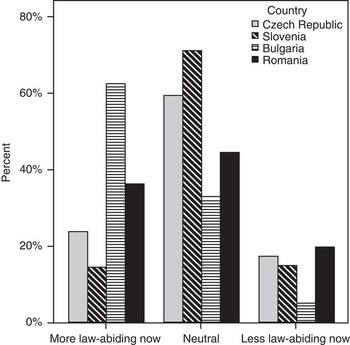
Figure 1 shows that Bulgaria is the only country in which a majority of the respondents believe that people are more law-abiding now than they were during communism. In addition, almost twice as many Romanian respondents think people are more, rather than less, law-abiding now. In the Czech Republic the difference between the two is considerably smaller and in Slovenia there is almost no difference.
Views on people's law-abidingness now vs. during communism.19

One explanation may be that Slovenian and Czech politicians more willingly rejected communism as an idea than Bulgarians and Romanians at the onset of transition. Slovenians often make the point that during the Yugoslav period their country was more west-leaning and less integrated in the socialist fold than the other Yugoslav republics.Reference Grødeland4 The Czechs, for their part, unsuccessfully tried to liberalise the political and economic system in 1968. Czech and Slovenian elites may therefore have had higher expectations for transition than Bulgarians and Romanians. Consequently, they may be rather disappointed with the pace of reform and therefore inclined to make a rather pessimistic, but not necessarily accurate, assessment of the impact of transition.
Bulgarian and Romanian elites may have emphasised positive rather than negative aspects of reform initiated locally – i.e. by the national governments – as well as by international organisations such as the EU and other international organisations, attaching conditionality requirements to their financial and other assistance. Another – and equally plausible explanation – relates to the EU. Both Bulgaria and Romania were, during the run-up to EU membership, heavily criticised by the European Commission for not doing enough to enhance the independence of the judiciary and to improve the way in which it works.Reference Grødeland4 Elites are perhaps more sensitive to such criticism than ordinary people, which in turn may explain the relatively high percentages suggesting that ordinary people are more law-abiding now than during communism.
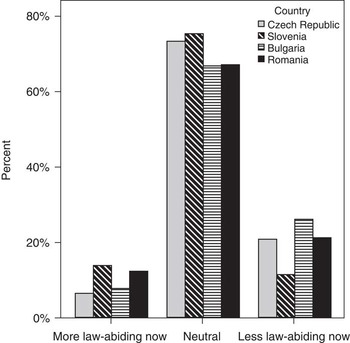
Given that EU accession had been high on the agenda not only in the Czech Republic and Slovenia, but also in Bulgaria and Romania, at the time of interviewing, one would expect more significant changes in elite attitudes towards the law to occur during more recent stages of transition, as accession got closer. However, Figure 2 shows that the large majority of the respondents in all countries thought there had been no major change in terms of general law-abidingness from 2000 to 2005. To the extent the public had become less law-abiding, the deterioration was perceived as having been less extensive in Slovenia than in the other countries. In addition, it had been more pronounced in Bulgaria and the Czech Republic, compared with Romania.
Views on people's law-abidingness now (2005) vs. five years ago (2000).21

In Bulgaria, corruption and organised crime were heavily debated at this time. The 2005 corruption scandal in the Czech Republic was given high-profile media coverage. In Romania, on the other hand, Former Minister of Justice (2004–07) Monica Macovei succeeded in reducing levels of corruption. However, Macovei was so successful that she was immediately removed from her position once EU membership had been attained.Reference Trandafir20
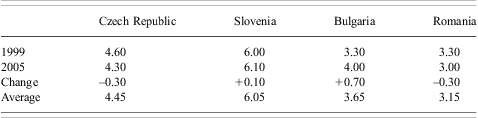
High levels of corruption in European post-communist states might suggest widespread disregard for the law. To find out whether perceived corruption had decreased or increased during the past five years, we compared the scores of each country included in our study in the Transparency International corruption perception indices for 1999 (first year in which all four countries included) and 2005 (i.e. the year in which our quantitative survey was carried out), and found that there had been little improvement in any of the countries. On a scale from 1 to 10, where 1 represents high levels, and 10 represents low levels, scores were as given in Table 2.
Country scores, corruption perception index
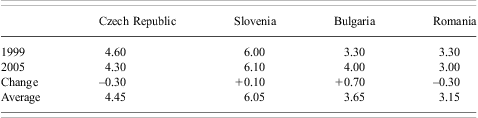
Source: Transparency International, www.transparency.org
Transparency International's corruption perception index is compiled with aggregated data and should be treated with some caution. Still, it does lend some support to our assumption that Romanian respondents may have been down-playing problems in their country, for fear that more honest responses would jeopardise EU accession.
In any case it appears that the perceived increase in law-abidingness that has taken place in East Central and South East Europe since the collapse of communism – although to a considerably lesser extent in the former than in the latter – occurred during the earlier stages of transition.Reference Gibson22 Consequently, adjustments carried out with a view to EU membership – although they have facilitated extensive changes in legislation and institutional frameworks – appear to have had a lesser impact on (perceived) law-abidingness.
Respondents in all countries – particularly in Bulgaria (81%) and Romania (64%), but also in the Czech Republic (52%) and Slovenia (37%) – held the view that EU membership would make people in their country more law-abiding. Whether this will actually be the case, remains to be seen. On the one hand, respondents may genuinely have believed that people would pay more attention to the law once inside the EU. There is of course also the possibility that they felt that this was the politically correct view to hold – especially in Romania and Bulgaria, given that these countries were further away from EU membership at the time of interviewing. Both countries have been heavily criticised by the EU for not doing enough in terms of judicial reform.
Support for EU membership is fairly high, at least on the part of the elites.23 Although we did not explicitly put this question to the IDI respondents, some of them still expressed views on the issue when answering other questions. A few of them thought EU membership would change things for the better. However, most respondents held the opposite view and thought EU membership would either have no impact or even make matters worse:
after the Czech Republic's entrance into EU the situation will change … because corruption and clientelism is not so widespread in EU countries. (Pr-10, Cz)
through the frameworks and patterns of the EU regulations that we are building into our system, I believe that we will be increasingly more transparent and clear. (El-5, Sl)
when we will be a member of EU they [i.e. the EU] will control us more. (Go-4, Sl)
our accession to the EU will lead to a decline in corruption. (EU-3, Bu)
Romania is a captive state … the system will not reform itself from the inside. I hope the European institutions will force … the … Romanian institution(s) to work properly. (NGO-7, Ro).
The impact of EU membership on law-abidingness could go either way: ordinary people may, as a result of EU membership, become more mobile and consequently more exposed to countries where law-abidingness is higher.24 Or, the opposite might happen: control in the post-communist EU member states may become more relaxed now that membership has been attained and consequently, people may continue to behave in much the same way as before, either out of habit, or because the likelihood of being punished for it will remain slim. Recent developments in Bulgaria and Romania, suggests the latter.25
Trust in Courts
It seems reasonable to assume that people living in societies characterised by a high level of law-abidingness are more inclined to trust legal institutions than those living in societies where violations of the law are commonplace. Similarly, people whose trust in courts is high are probably less inclined to try to influence prosecutors and judges than those whose trust in courts is low. The latter may hold the view that a ‘just’ outcome may only be attained informally – i.e. by sidestepping laws, rules and regulations that are in their view not adhered to by the courts themselves. Our IDIs lend some support to this view.
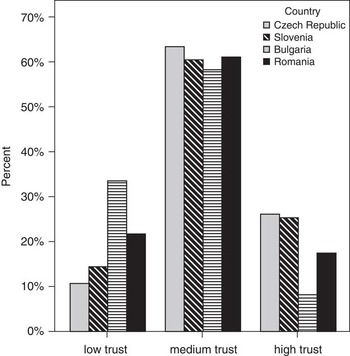
We asked the respondents of our quantitative survey to indicate, on a scale from one to seven, where one represented ‘no trust’ and seven ‘great trust’, to what extent they trusted the courts. As seen in Figure 3,27 low trust in the courts was more common amongst elites in the then EU applicant states Bulgaria (33%) and Romania (22%) than in EU member states Czech Republic (11%) and Slovenia (14%). Added to this, respondents in the Czech Republic and Slovenia (more than one quarter) had high trust in the courts, while this was the case only amongst 17% of the Romanian and a meagre 8% of the Bulgarian respondents.28 On average, only 14% of the elites not working within the judiciary said their trust in the courts was high. In comparison, 58% of the judges and prosecutors surveyed held the same opinion. Only 2% of them expressed low trust in the courts. The corresponding figure for other categories was 23%. These findings are in line with our previous findings to the effect that officials receive better treatment from officials working in their field than from other types of officials.Reference Miller, Grødeland and Koshechkina29
Trust in courts.26

How Legal Institutions ‘Work’
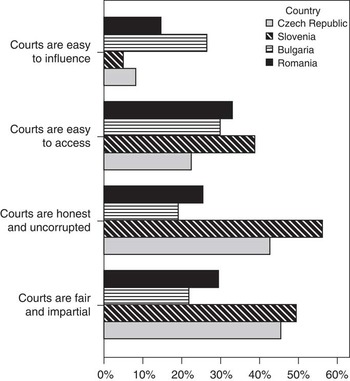
Reports on the court system in former communist states have identified a number of weaknesses inherent in the courts.Reference Anderson and Gray30 Courts often suffer from low capacity and back-logs, are not sufficiently independent or do not always pass objective verdicts and/or sentences.31 As our main topic of interest is the potential for corruption in the judiciary, we asked our respondents whether they thought courts are (i) easy to influence; (ii) easy to access; (iii) honest and uncorrupted; and (iv) fair and impartial.32 A high score for influence and low scores on the other variables would suggest a considerable potential for corrupt behaviour. Conversely, a low score for influence and high scores on the other variables would suggest the opposite. Findings are depicted in Figure 4.
Assessment of how legal institutions work. Percentage indicating ‘always’ or ‘mostly’.35

On average 31%, and fewer than 40% of the respondents in each individual country covered by our quantitative survey thought courts were easily accessible. The differences between countries were not so pronounced. Differences in views between legal ‘insiders’ (i.e. judges and prosecutors) and legal ‘outsiders’ (i.e. respondents that did not work in the judiciary) were more clear-cut: Slovenian judges and prosecutors were almost twice as likely as those in the Czech Republic to believe that courts in their country were easy to access. And – rather surprisingly – there was more than 20% difference between Romania (69%) and the Czech Republic (43%). Judges and prosecutors in Bulgaria expressed views more similar to those of the Czech elites (44%).
A Western observer might be inclined to think that courts are easier to access when regulated by clear and concise rules and regulations and when properly funded and staffed, as this would reduce the scope for backlogs. However, it is also possible that people who are able to ‘buy their way’ think that courts are easy to access even if access is not properly regulated or courts are suffering from heavy backlogs. Thus, the reasons why respondents in the different countries find courts easy to access may therefore differ. Our IDIs shed some light on this issue. Respondents point out that staff shortages, backlogs and generally disorganised judiciaries are causing serious problems:
the court is at present having 50% of the employees it should have. [It is] understaffed … people complain, want to find out how they could get [proceedings] moving… (Le-6, Cz)
we have an extreme amount of backlogs in courts… (Go-2, Sl)
the disorder of our judicial system … leads to delays in court orders… (El-5, Bu)
it's almost like being robbed. It is an arrangement actually designed as an obstacle for getting in front of a court. One has to pay this tax before the trial starts. So you pay 80 million lei with your own money and then the trial might last for years. (Lb-8, Ro)33
Respondents in East Central Europe were more inclined than respondents in South East Europe to say that courts are fair and impartial. Roughly half of the former, but only between 20 and 30% of the latter, held this view. Those working in the judiciary were generally more favourable: some 81% of the Czech respondents thought courts are always or mostly fair and impartial, as did 91% of the Slovenian, 67% of the Bulgarian and Romanian respondents, respectively. These findings are to some extent confirmed by our IDIs:34
chances to influence us are awfully slim. (Le-8, Cz)
now, when everything is computerised, it is very hard to use contacts in the judiciary… (Le-8, Sl)
it has been most difficult for me when I have had to explain to people that they can only solve things in court … they say to me ‘but in the past they would help us when we went to so-and-so, he would make a phone call and the work was done.’ I tell them, ‘yes, but things are different now’. (El-4, Bu)
in my view there are very few judges, if any, who would sacrifice the right of one living person for the right of another living person. (Le-10, Bu)
those from the Court of Accounts are very good [and] professional in the commercial aspects… (Pr-5, Ro)
As expected, respondents in East Central Europe were also more inclined than respondents in South East Europe to think that courts are mostly or always honest and uncorrupted. Some 43% of the Czechs and 56% of the Slovenians held this view, compared with some 25% of the Romanian, and only 19% of the Bulgarian respondents. As expected, this view was even more prevalent amongst respondents working within the judiciary (96% in Slovenia, 78% in the Czech Republic, 70% in Romania and 67% in Bulgaria). Such views were also expressed by some of the IDI respondents:
I think that courts at present are more honest institutions than others. (Le-1, Cz)
judges, they are quite honest. I'd say they are extremely … law [abiding]… (Go-2, Sl)
judges are not corrupted, they obey the law. (Pr-3, Sl)
Only a small number of respondents (all countries) said that courts are easy to influence. Some 27% of the Bulgarian and 15% of the Romanian respondents held this view, compared with 9% of the Czech and 5% of the Slovenian respondents. Judges and prosecutors, for their part, were even more sceptical: less than 10% of them agreed (all countries).36
Slovenian courts have a high degree of independence, and judges have actively – and so far successfully – opposed suggestions on the part of some politicians to limit their tenure. In comparison, Czech courts are more dependent on political structures and the Czech parliament has actually been reluctant to enhance their independence. Lower courts depend on local administration for assistant judges, and one of our IDI respondents pointed out, this causes problems for court employees:
…we need to be in contact with the district [authorities] … they arrange assistant judges for us … and so I must be on good terms with them … here it is just, wherever you come, immediately everyone says to you, ‘look, I have this [problem] and could I come to see you with that’ … it is the problem of the organisation here that we are forced to communicate with the district … they are supposed, for example, to arrange assistant judges for us, they don't bother doing it, and I must go to see the Mayor and talk to him, convince him that it is good that we must have it and again, it is quid pro quo… (Leg-6, Cz)
As noted above, those working within the judiciary were less inclined than other categories of respondents to claim that courts are easy to influence, and much more inclined to say that courts are easy to access, that they are honest and uncorrupted and that they are fair and impartial. It should not be forgotten, however, that between 14 and 16% of those of our respondents who work within the judiciary held the opposite view – i.e. that courts are not honest and uncorrupted and that they are not fair and impartial. The remaining part of the article will look into the reasons why this is the case.
The Judiciary: Working Conditions
Whether somebody will engage in corrupt activities to quite some extent depends, among other things, on his/her ‘bargaining power’.Reference Miller, Grødeland and Koshechkina29 By ‘bargaining power’ we mean person A's access to resources of importance to person B. The more in need of these resources is person B, the higher the bargaining power of person A. In addition, the more in need the former is of these resources, the more willing he/she may be to do something irregular – such as engaging in corrupt activities – to obtain them. Prosecutors and judges have a high level of ‘bargaining power’ in that they decide what cases to bring before the court (prosecutors), determine what cases to hear and what cases to dismiss, and whether to issue strict or lenient sentences (judges).
The extent to which person A controlling resources considered particularly important to person B is willing to provide these to the latter, depends on a number of factors. In addition to the former's personal ethics, the general work culture, the attitudes of his/her colleagues, job security, salary size and living standards (perceived, as well as real) seem to play a role, as do job instructions, discretionary powers, and the possibility of being caught and punished for unlawful behaviour. External factors, such as public attitudes towards the law and corruption – as well as the extent of corruption in society as such – are also of importance.
Below, we examine the general working conditions of those working in the judiciary to find out whether they encourage or discourage illegitimate behaviour. In terms of work-tenure, the judges and prosecutors who took part in our survey37 had held their positions for a considerably longer period of time than the other categories of elites. The median response for those working in the judiciary was six to ten years, compared with one to five years for the other categories. As a country approaches EU membership and adapts laws intended, amongst other, to reduce the scope for nepotism and favourable treatment in hiring procedures, informal employment practices may become less pronounced. The relatively long tenure of respondents working in the judiciary, however, probably to some extent limits this ‘EU accession’-effect.
It should be noted that staff in the Czech judiciary, compared with similar staff in Slovenia,38 Bulgaria and Romania, have undergone significant changes as a result of lustration.Reference Bertschi39 The main aim of the Czech lustration law was to prevent former high-ranking Communist Party officials from holding key positions in society for a fixed number of years – on the grounds that they constitute a (potential) threat to the new, democratic order. Lustration has also affected the judiciary in that many – though not all the affected judges and prosecutors (the Czech judiciary would simply collapse if all this had been the case) – were forced out of office or transferred to more junior positions after the Velvet Revolution. As a result, several former judges have set up their own private law firms or joined private businesses.40 Differences in views between judges and prosecutors in the Czech Republic and the other countries included in our study, may in part reflect the impact of lustration on the judiciary.
Judges in most post-communist states are appointed to their positions, although in some instances also elected.41 Among those who took part in the quantitative survey, the only ones to admit that they had received their position through somebody they knew were respondents from the Czech Republic: 4% of these said they had obtained their positions in this way. Data from our IDIs, however, suggest that dubious hiring procedures, even nepotism, also occur in the judiciary in other post-communist states:
I had even cases of an MP who phoned me to tell me the name of the person who should be appointed by me as a judge in Samokov … He told me: ‘I am elected in that region, I must know what's going on there in the judiciary. So, if possible, [it would be better] to appoint a girl of ours [there].’ This is within my competence, but I refused … and told him that [it] is not within his powers to interfere in the recruitment policy of the court… (Le-9, Bu)
immediately after 1989, doors for entrance into the Magistrate were wide open, selection was not that thorough … so many people who shouldn't belong … were taken in, like people coming from the former militia and even from the former Securitate. Most of them are still on those positions and this is still a problem… (Go-4, Ro)
you just need to take a look around … how Victor Ciorbea42 appointed to a high position his former law faculty colleague. At the local level this can also be seen … the general prosecutor Mircea Cristea appointed his former colleagues and friends from faculty as county prosecutors. (Le-5, Ro)
the judicial system is closed because of the purely professional criteria for recruitment. But probably … between equal candidates, the one who is familiar is chosen. (Pr-7, Bu)
A majority (55%) of the judges and prosecutors asserted that their working conditions had improved during the past five years. In contrast, 22% thought they remained unchanged and 24% claimed they had worsened.43 As far as fear of losing one's current position was concerned, the difference between those working in the judiciary and the other categories of elites was negligible (12 vs. 15%). Those working within the judiciary in the Czech Republic and Slovenia were less positive in their assessment of their own working conditions than those representing the judiciary in Bulgaria and Romania. To some extent this may reflect high expectations that had failed to materialise in the former two countries in the immediate aftermath of EU accession. On the other hand, working conditions in the judiciary in both the Czech Republic and Slovenia at the time, were difficult, especially in Slovenian district courts.44 Working conditions in Romania and Bulgaria are not much better.45 Contrary to what one might expect, however, respondents in these countries were far happier with developments in their working conditions than respondents in the Czech Republic and Slovenia. Bulgarian judicial staff was particularly positive – some 79% of them thought conditions had improved over the last five years. The Bulgarian judiciary has undergone extensive reform in recent years, which in turn is likely to have given people working within it a (bigger) relative sense of improvement. In contrast, 41% of the Slovenian respondents hold the view that their working conditions deteriorated in the same period.
Judges and prosecutors predominantly held the view that their work tasks are adequately and clearly defined (87%, compared with 82% of the other categories of elites interviewed as part of our survey). Differences across countries are fairly small (in the range of 81–93%). Although both groups are restricted by the law, the law sometimes leaves room for interpretation. In this sense both have discretionary powers. The quality of the law, on the other hand, affects interpretation: clear and concise laws leave less room for manoeuvre than badly written, unclear or contradicting laws. The latter is a bigger problem in post-communist states than in stable and wealthy old democracies.46
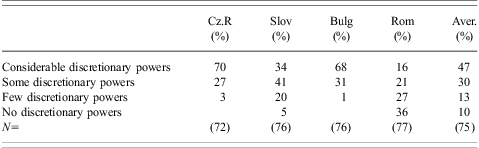
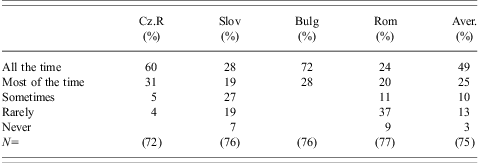
In Bulgaria and the Czech Republic almost all respondents working within the judiciary say they have at least some discretionary powers (Table 3). In Slovenia, and particularly in Romania, on the other hand, a significant number of the respondents say they have few or none. A similar pattern can be observed with regard to respondents making use of their discretionary powers (Table 4). Again, Bulgaria stands out in that all respondents who work in the judiciary and who said they had considerable or some discretionary powers reported that they make use of these all or most of the time. The large majority of the Czech respondents said the same.
Would you say that in your current position you have…
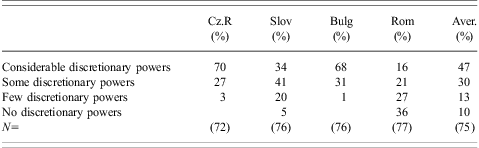
Note: The table does not include answers coded as “don't know” or “no reply” – or 1 per cent of the respondents in total.
How often do you rely on your discretionary powers when making decisions at work?
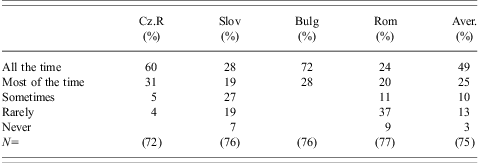
Note: The table does not include answers coded as ‘don't know’ or ‘no reply’. Only those respondents who said they had discretionary powers were asked this question. The 9% who said they had no discretionary powers – as well as the 1% who answered ‘don't know/depends’ – have therefore not been included in this table.
Our findings may, to some extent, be explained by different approaches to the law in the first place. In Continental Europe, for instance, the law is interpreted in the strict sense, i.e. by the letter. Romania has traditionally followed the Continental approach, which may – at least to some extent – explain why the percentage of judges and prosecutors who say they do not make use of their discretionary powers, is higher there than elsewhere.
As noted above, due to lustration, many older judges and prosecutors have been forced to leave their posts and have been replaced by younger and more recently educated people. Still, as far as the use of discretionary powers is concerned, however, our data suggest that younger and older judges and prosecutors use these in equal measure. Some generational differences may also be observed within countries. Přibán suggests that ‘older Czech judges cite the law in decision-making, while younger judges are likely to make greater use of constitutional principles.’47 In other words, younger judges are more likely to follow the spirit of the law.
We can of course not exclude the possibility that some respondents have equalled discretionary powers with the right to interpret the law, whereas others have equalled the term with the right to make autonomous decisions on other issues. There may also be more systematic differences between countries with regard to how respondents understand this term. Added to this, it is possible that Romanian respondents, due to the criticisms the Romanian government has met with on the part of the EU in terms of judicial reform, have had their discretionary powers reduced. The Romanian Strategy for the Reform of the Judiciary 2005–2007 lists a number of measures aimed at increasing accountability, aligning all legislative acts, simplifying procedures and eliminating inadvertences and parallelisms in legislation, thus preventing ‘often inconsistent enforcement of the current legislation.’48
There is some evidence to the effect that the higher the levels of discretionary powers in the public and corporate sectors, the more likely corruption is to occur.49 It therefore seems reasonable to assume that in countries where corruption is widespread and where judges and prosecutors enjoy wide discretionary powers, the scope for, if not outright corrupt, then at least ethically unsound, practices is higher than in similar countries where judges and prosecutors have more limited discretionary powers – although the latter presupposes that laws and regulations are clear, limiting the scope for their interpretation. It appears that judges and prosecutors in the Czech Republic and Bulgaria are in a better position to make their own, independent decisions than those in Slovenia and Romania.
Czech judiciary staff, to a much greater extent than judiciary staff elsewhere, reported that they enjoy good living standards. Some 82% assessed their own living standard as good, compared with only 22% of the Slovenian, 20% of the Bulgarian and 19% of the Romanian respondents. The salaries of judges are relatively high in the Czech Republic, compared with elsewhere. In 2000, for instance, the average monthly salary for employees in the public sector was 9000 crowns ($257 at the time), compared with 52,000 crowns ($1486) for judges. Former Deputy Minister of Justice, Josef Baxa, justified the higher salaries of Czech judges by stating that ‘judges must receive high salaries to compete with what lawyers earn in the private sector.’44 According to the Czech Judges Union, however, ‘permanent attempts’ are made to reduce the salaries of judges in their country.50
In contrast, poor remuneration for judicial staff in Slovenia, Bulgaria and Romania has been an issue of debate for several years. The OECD, for instance, has deemed the salaries of Bulgarian judges to be inadequate.51 The Romanian Strategy for the Reform of the Judiciary 2005–2007 listed higher salaries for legal staff as one of its priorities.52 Slovenian judges, for their part, have also encountered salary problems: in 1999, for instance, courts were so short of funds that some judges failed to receive their salaries altogether.44 Even though the salaries of Slovenian judges have improved considerably in recent years, they are still relatively low.
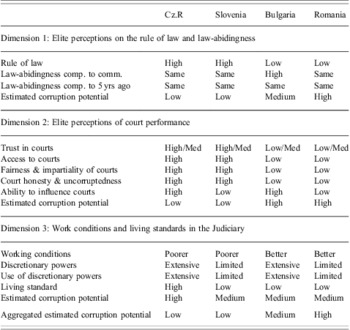
Estimated Relative Corruption Potential
The factors analysed above cover three major dimensions likely to affect not only court performance as such, but also the scope for corruption in courts: (1) elite perceptions on the rule of law and law-abidingness; (2) elite perceptions of court performance; and (3) the work conditions and living standards of judges and prosecutors – as they themselves perceive them. We have estimated the relative corruption potential for each country included in our study based on our findings on each of these dimensions. Table 5 shows that the potential for at best unethical, at worst corrupt, practice appears to be highest in Romania, somewhat lower in Bulgaria, even lower in the Czech Republic and the lowest in Slovenia.
Estimated relative corruption potential.

Notes:
Estimates are based on findings presented in the earlier parts of the article.
We only compared the percentages for high and low trust in the courts. High trust was more widespread in the Czech Republic and Slovenia than in Bulgaria and Romania.
As there were no major differences in percentages between countries as far as job safety and definitions of job tasks were concerned, these two factors are left out of the analysis.
We then compared our country estimates with each country's position on Transparency International's corruption perception indices for 1999 and 2005. As noted above, Slovenia received a considerably better score than the other countries. Perceived levels of corruption dropped somewhat more in the Czech Republic than in Bulgaria and Romania during this period, but were rather similar in the Czech Republic and Bulgaria (the Czech Republic receiving a better score than Bulgaria).
Our estimates for relative corruption potential in the Czech Republic, Slovenia, Bulgaria and Romania correspond to the order in which these countries’ appear when an average corruption score is calculated for each country, based on the scores given in Transparency International's corruption perception index from 2001 to 2005. If our estimates and the TI rankings are accurate, corrupt practices in the judiciary should be more widespread in Bulgaria, Romania and to some extent also the Czech Republic, than in Slovenia. We will test this assumption below, by assessing the impact of our three dimensions on the willingness of judges and prosecutors to provide various types of favours. But we will provide a general overview of the types of favours judges and prosecutors do provide.
The Judiciary: Types of Requests
Corruption in the judiciary may either be initiated by the general public or by judicial staff. As corruption is a sensitive issue, there is a chance that judicial staff will be reluctant to talk about it, even when given guarantees of full anonymity. For this reason, it is useful to avoid the term ‘corrupt’, when discussing this issue. Our solution to the problem was to provide respondents with a list of different types of requests. These were as follows: (1) information that is publicly available but difficult to get hold of; (2) advice; (3) help to speed things up; (4) a job for someone; (5) access to your colleagues or superiors; (6) access to people in other institutions; (7) access to powerful and influential people; (8) access to funds or other resources; (9) information that is not publicly available; and (10) something to which the requester is not entitled by law.
Some of these requests are typical of countries in transition: frequent and wide-ranging institutional and legal reform as well as red tape makes it more difficult for citizens to obtain relevant information and interact with public institutions. Thus, (1) and (3) are typical responses to transition, as is to some extent (2): then the institutional capacity of the judiciary in the Czech Republic, Slovenia, Bulgaria and Romania is still fairly low. While some of these requests are legitimate, others are illegitimate. What is more, such requests may be legitimate in some situations, but illegitimate in others.Reference Grødeland4 We will return to this issue in more detail below.
The use of contacts was widespread in all these countries during communism and there is evidence that their use is still fairly common.Reference Miller, Grødeland and Koshechkina29 They may partly be used out of habit, partly in response to difficulties caused by transition. Other types of requests, such as (4), (5), (7), (8) and (9) are unlawful and may in some instances also be labelled corrupt. Requests for (6) and (10) are more ambivalent. Figure 5 shows that the large majority of requests obtained by judges and prosecutors are for advice: 41% of our respondents said they (very) often received this type of request.
Types of requests received by Judges and Prosecutors.53 Percentage indicating ‘often’ or ‘very often’.

Different types of attempts to influence the respondent.57

A fair share of the respondents had also (very) often been asked for help to get information that is publicly available but difficult to get hold of (15%). Requests for advice are considerably less frequent in Slovenia than elsewhere: 29% of the Slovenian respondents said they had (very) often received requests for advice, compared with 51% in Bulgaria, 46% in the Czech Republic and 39% in Romania. The percentage of the respondents who are (very) often asked for information that is publicly available but difficult to get hold of, varies from 12% in the Czech Republic and Slovenia to 19% in Romania. Our IDIs shed some light on what kind of information or advice prosecutors and judges are asked for:
[requests] regard … the procedure, speed, and elementary information about the processes in … criminal proceedings … the … public naturally knows nothing about that… (Le-8, Cz)
information about procedures. (Le-8, Sl)
essentially they need information so they can feel confident that they are on solid ground. Because ours is not a normal country where you know who is who … here people don't have this information and they need to make sure. (Le-4, Bu)
I was being asked for information… (Le-1, Ro)
Requests for information and advice may be completely harmless in that people are having difficulties finding their way within the judiciary. Besides, some people may prefer contacting someone who can tell them what to do, rather than spending time figuring out by themselves how to go about things. However, as our IDIs revealed, seemingly harmless requests for advice or information may in reality be hidden requests for favours:
they want something they believe they are entitled to, but in reality want something they are not entitled to or even something that is to the detriment of a third party… (Le-5, Cz)
they ask you who is a good lawyer and similar things. In the beginning (i.e. when I started working) I was advised that this kind of help is not appropriate. (Le-5, Sl)
very often, they want information to make sure they won't make a mistake … they approach me as friends, colleagues … in this respect our job is very difficult. We are not supposed to offer consultations, and if we do, it means we can't get involved in decision-making on the disputes… (Le-4, Bu)
Speeding up slow or cumbersome procedures was widespread during communism, and previous research suggests that owing to the extensive bureaucracy and inherent slowness of the state machine, such efforts were considered generally acceptable.Reference Miller, Grødeland and Koshechkina29 Delays are also common in the judiciary at present. While speeding things up might be a practical solution for those gifted with the ability of persuasion or who are able to provide court employees with sufficient incentives to rush a case through the court system, it is a problem for those who lack either, and whose cases are consequently (further) delayed. Just over 14% of the respondents said they had (very) often been asked to speed things up. Our IDIs revealed that speeding things up usually implied that a case would reach court quicker than stipulated:
they are most concerned with their case not lying here for long … the court is at present having [only] 50 per cent of the employees it should have, it is understaffed, so really the proceedings are a pitiful sight, people complain, want to find out how they could get things moving, it is natural… (Le-6, Cz)
especially requests [for] how to speed up cases… (Le-5, Sl)
to speed up some court procedure… (Le-7, Bu)
Requests for outright illegal favours such as information that is not publicly available, something to which the requester is not entitled by law, and also for access to funds or other resources were fairly uncommon. Less than 5% (very) often received such requests. Country differences were small – although Czech respondents to a slightly larger extent than respondents elsewhere reported that they had been approached for information that is not publicly available.
Requests to facilitate access to colleagues, superiors or people in other institutions (less than 6% for each of them) and requests for jobs (4%) were also not particularly widespread and country differences were small. To the extent there were any significant differences between countries, the Czech Republic stood out in that such requests are more common there than elsewhere.54 Again, the IDIs shed some light on such types of requests:
sometimes they ask if I … know somebody higher [up]. (Le-7, Sl)
…they ask if I know a person who is in charge of their case and if I could approach that person. (Le-9, Sl)
there are … people who are not acquainted with the law and they want us to cancel court decisions, which are of course impossible… (Le-8, Bu)
I have been asked … to appoint people to whatever positions … people, due to their low education, believe that if you occupy a particular position, you are almighty. (Le-5, Bu)
for finding a job … there are cases when some contact is sought with other people, but such cases are very limited in number… (Le-7, Bu)
people usually request a good solution from a judge … very few accept that they are mistaken when they show up with a case and their request is rejected – with good reason. In this case, inevitably one may get to corruption… (Le-3, Ro)
Receiving a request is one thing – the manner in which one responds to the request, quite another. The correlation between requests received and favours granted is fairly high. Some 41% of the respondents in the judiciary said that they had given people advice and 15% had helped people gain access to information that is publicly available but difficult to get hold of. Providing assistance was more common amongst elites not working within the judiciary. Some 65% of these more generally give advice and 32% help people speed things up (very) often. Only 2% of the other elites admitted to having given people something to which they were not entitled by law. For the other types of favours, it appears that respondents who received such requests also complied with them.
Requests for assistance were usually accompanied by attempts to influence them. Friendly behaviour, persistence and appeals to one's good nature were most common (56, 46 and 43% respectively) – though considerably less so in Slovenia than in the other countries.55 Our IDIs shed some light on how this was done:
argument, threat – not that, but otherwise all [ways] … the friendlier [they are], the more dangerous it is. (Le-5, Cz)
they just ask. (Le-3, Sl)
they only appeal – and always to my feelings: ‘oh, this is such an injustice, I feel so hurt, I suffer so much. Well, I might deserve it, but look at me now, I am so unhappy’. (Le-10, Bu)
A fairly large percentage of the respondents had also experienced arguments (25%), been promised something in return for help provided by them (21%), a small present (14%), money or an expensive present (6% each). Arguments and promises of reciprocity were considerably more widespread in the Czech Republic than elsewhere.56 The IDIs shed some light on how the public approach those working within the judiciary:
besides bribes, people naturally … try everything on us, either in writing, over the phone or verbally… (Le-7, Cz)
they typically approach me in connection with cases where I am an arbiter … they want to explain, they want me to hear them out and tell me what the dispute is about … the second stage involves indirect and direct offers of money and the third stage [consists of] physical threats of beating and murder. On one occasion they tried to offer me a position. They said ‘let's get this case over with and we'll appoint you as a lawyer with us.’ They'll employ you to make sure the dispute will be settled in their favour. (Le-4, Bu)
there are threats. This is part of the profession. (Le-5, Bu)
there are political pressures… (Le-10, Ro)
there have been cases! … I … know some prosecutors who received threatening letters … I have received some phone calls but that was all. (Le-9, Ro)
Turning down requests for assistance appeared to be easier for those working in the judiciary than for other elite groups. This is also what we would expect. Judges and prosecutors who had received requests reported that they found it most difficult to turn down family members (55%) or friends (48%) and least difficult to say no to members of the general public (19%) and people from their own home place (20%). Our qualitative data provide more detail as to how this was done:
to refuse your acquaintance is always more difficult. (Le-2, Cz)
it is more difficult to refuse relatives, family members … now and then you cannot … refuse to help. (Le-7, Cz)
I feel obliged to help only really good friends… (Le-7, Sl)
it is more difficult to turn down a friend. (Le-5, Sl)
it is more difficult because they are angry afterwards and unpleasant things occur… (Le-1, Bu)
it is more difficult because it is easy to say whatever to the other people, while you have to be less rude with these people… (Le-2, Bu)
I find it more difficult to turn down acquaintances than ordinary people, because I have certain feelings for relatives and friends. (Le-1, Ro)
More worryingly, however, 42% of judges and prosecutors said they found it difficult to turn down requests from powerful and influential people, and the IDIs suggested why:
I think it would probably be more difficult. (Le-1, Cz)
to turn down powerful and influential people you need more arguments, whatever you do you may suffer consequences. (Le-6, Sl)
I would turn down influential people more carefully. (Le-7, Sl)
it is more difficult since they could influence your superiors. (Le-5, Bu)
it is more difficult because it takes more wasted nerves and always leads to a negative accumulation in your organism … there are people who never forget such refusals… (Le-2, Bu)
sometimes I felt a shiver when turning down somebody influential, but this was only in the first two years of practice. (Le-1, Ro)
Some 58% of those who had provided people with favours reported that they often or very often were thanked for these, and 12% were told that the favour would be returned or received offers for help at some point in the future. Only 5% said they had often or very often been given a small present, while 9% had sometimes been given such presents. Five per cent that they had been given an expensive present at least sometimes, while 4% that they had been given money in return for the favour provided.
The Impact of Attitudes to the Rule of Law, Trust in Courts and Working Conditions on Willingness to provide Favours
Above, we have – amongst other things – looked at various factors that are likely to impact on somebody's likelihood to provide favours more generally, and to provide ethically unsound and in some instances even corrupt, favours more specifically. However, we have also investigated the extent to which attitudes towards the rule of law, trust in courts and general working conditions affect willingness amongst judges and prosecutors to provide favours. Our findings, which are presented in more detail below, are based on aggregated data for favours, given the relatively small number of respondents who admitted their willingness to provide favours.
Trust has a very clear impact on respondents’ willingness to provide favours. Those respondents whose trust in the courts is high, are also the least likely to render favours often or very often.58 Added to this, the more objective and ‘clean’ respondents perceived the courts to be (i.e. fair and impartial, honest and uncorrupted, easy to access), the less forthcoming their response to various requests for favours.59
Those who thought courts are always or mostly easy to influence, on the other hand, provided people with favours (very) often to a larger extent than those who thought courts could seldom or never be influenced.
Perceptions of law-abidingness had little impact on the extent to which our respondents provided people with various favours. Those who (very) often provided people with help to speed things up to a larger extent than those who rarely or never provided people with such help, thought people are generally more law-abiding now than during communism. Our IDIs to some extent explain why this is the case: transition has resulted in huge back-logs and other problems in the judiciary and people therefore often resort to contacts or pay for procedures to be sped up.
In terms of the impact of EU membership, those who most often granted various requests were much more likely than those who did not, to hold the view that people will become more law-abiding in the EU than those who provided various requests the least. This to some extent supports the view that transition is largely to blame for the problems that cause people to put their requests to judges and prosecutors in the first place. In this sense, respondents who hold this view probably think that the problems are likely to decrease once their country has adjusted fully to and joined the EU.
Respondents, whose working conditions had improved during the last five years, predominantly said they rarely or never provided assistance to speed things up or provide people with information not publicly available.
Finally, the respondents who most frequently granted requests said they enjoyed a good standard of living to a larger extent than those who granted requests the least. The impact of living standard on those who (very) often or rarely/never provided help to speed things up, was insignificant. Those with a good standard of living were much more likely to rarely or never provide something to which the requester is not entitled by law. Thus, it appears that those whose living standard is high, may take pity on people who have fallen victim of the system rather than helping people for their own, personal gain. However, it could also be that such people have a high living standard exactly because they receive bribes on a regular basis.
Our analysis suggests that judges and prosecutors are more willing to provide the public with favours if:
• their trust in courts is low;
• their perception of courts is negative (i.e. courts are perceived as mostly unfair and partial; mostly dishonest and corrupt; mostly difficult to access, and as easy to influence);
• they have experienced deteriorating working conditions during the last five years;
• they will become more law-abiding within the EU;
• they enjoy a high standard of living.
Put differently, judges and prosecutors appear to provide favours for two major reasons: (i) a wish to help citizens who are generally law-abiding find their way through complicated and unreliable institutions; and (ii) that they themselves benefit from providing people with favours.
Conclusions
Above we hypothesised that corruption in the judiciary is more likely to occur in societies where there is widespread disregard for the law, where trust in courts is low and where those working in the courts lack job security, suffer poor living standards, have to cope with inadequate job instructions and wide discretionary powers. We also implicitly assumed that the rule of law is better observed, that trust in courts is higher and that working conditions for those working in the courts are better in the Czech Republic and Slovenia, which joined the EU in 2004, than in Bulgaria and Romania, which joined the EU three years later. Our findings largely confirmed our assumption – as regards the potential for corruption.
In terms of actual corruption, respondents from the judiciary (all countries) said they only rarely provide illegitimate favours. Contrary to what we would expect, Czech respondents more readily admitted that they provided such favours than respondents elsewhere, although country differences are fairly small and in most cases not statistically significant.
Respondents whose level of trust in the courts is high are less willing to provide favours than those whose level of trust in the courts is low. In addition, respondents who hold the view that the courts are always or mostly fair and impartial, honest and uncorrupted or easy to access, provide favours less often than respondents holding the opposite view. Finally, respondents who say they enjoy a good standard of living are also the most inclined to provide people with favours – although much less likely than those with poorer living standards to provide something to which the requester is not entitled by law.
Our IDIs suggest that judges and prosecutors often take pity on ordinary people and help them deal with a court system perceived as cumbersome and unfair. They are considerably less willing to help powerful and influential people. The fact that the respondents who grant various favours the most often, are also the most likely to think that people will become more law-abiding once in the EU, should be taken as an indication that favours in the judiciary are granted predominantly to help people cope with the difficulties of transition rather than for personal gain – although the one does of course not exclude the other.
As already noted, our data suggest that the rendering of illegitimate favours in the judiciary (with the exception of speeding things up) is rather limited in scope. Our previous research on low-level corruption suggests that there is usually a discrepancy between public perceptions of corruption, on the one hand, and personal experiences, on the other.Reference Miller, Grødeland and Koshechkina29 Although institutional weaknesses in the judiciary in East Central and South East Europe are well documented and although several cases of wrongdoing on the part of judges and prosecutors have been reported in the media, it could well be that both groups are more law-abiding than their tarnished public image suggests. Our elite IDIs to some extent support this view. The judiciary is generally considered more law-abiding than most other public and private institutions.Reference Grødeland1 However, we can of course not exclude the possibility that judges and prosecutors have more to lose than other groups in society by admitting to taking bribes and engaging in other types of unethical or corrupt practices. To the extent the latter is the case, respondents may have chosen to underreport such incidents. Slovenia, for instance, is a small country. As interview locations – though major towns – are fairly small in terms of population, there were relatively few prospective respondents within each elite category in each of them. Respondents might for this reason have feared that their identity might be disclosed despite the reassurances they were given by the pollsters to the contrary.
Although the new EU member states in East Central and South East Europe have largely complied with the acquis communautaire, they still have some way to go in terms of (1) enhancing court independence and efficiency; and (2) making the public more aware of and respectful of the law in general and of the necessity to abandon certain informal practice in particular. While efforts are currently being taken to ensure (1), less has been done to facilitate (2). In this sense, the occurrence of unethical and corrupt practices in the judiciary – though perhaps less widespread than one might expect – is particularly problematic in that it not only undermines trust in the courts and in justice as such, but also provides the general public with a disincentive to follow the law in the first place. Consequently, illegitimate behaviour on the part of prosecutors and judges undermines not only judicial reform, but also the rule of law more generally and ultimately the transition process itself.
Åse B. Grødeland is senior researcher at the Fafo Institute for Applied International Studies. Her research interests include informal practice and corruption, legal culture, and civil society. Geographically, Grødeland's main focus is on post-communist states in transition. Most of her research combines large-scale qualitative and quantitative data. Grødeland is currently heading two international research projects – both funded by the Research Council of Norway: ‘Legal Cultures in Transition – the Impact of European Integration’ (2007–12) and ‘Legal Cultures and Anti-Corruption Reform in the West Balkans’ (2010–14).
Aadne Aasland is senior researcher at the Norwegian Institute for Urban and Regional Research. His research interests include ethno-politics, social exclusion and inclusion, migration, and informal networks. Geographically he mainly focuses on Russia and other post-communist countries. Currently Aasland is the leader of research projects on HIV prevention in North-West Russia and local government reform in Ukraine. He has vast experience from the organisation and analysis of large-scale social surveys.
Appendix: The Study Design