Acquisition of nonnative speech categories is a difficult learning task in adulthood (Iverson et al., Reference Iverson, Kuhl, Akahane-Yamada, Diesch, Tohkura and Kettermann2003). In the real world, speech learning often occurs under pressure-filled conditions. For example, a learner might feel pressure to perform well when attempting to communicate in a foreign country. Although laboratory training paradigms have yielded successful speech learning in adulthood (Bradlow, Akahane-Yamada, Pisoni, & Tohkura, Reference Bradlow, Akahane-Yamada, Pisoni and Tohkura1999; Chandrasekaran, Sampath, & Wong, Reference Chandrasekaran, Sampath and Wong2010; Lim & Holt, Reference Lim and Holt2011), to our knowledge the influence of performance pressure on speech learning has not been examined directly. An examination of the effects of performance pressure on speech learning is the goal of the current research.
An extensive behavioral, neuropsychological, and neuroscience literature using visually presented stimuli and laboratory defined category structures suggests that the learning of different types of category structures is mediated by different cognitive and neural systems (Ashby, Alfonso-Reese, Turken, & Waldron, Reference Ashby, Alfonso-Reese, Turken and Waldron1998; Ashby & Ennis, Reference Ashby, Ennis, Ross and Markman2006; Ashby & Maddox, Reference Ashby and Maddox2005, Reference Ashby and Maddox2010; Maddox & Ashby, Reference Maddox and Ashby2004; Poldrack & Foerde, Reference Poldrack and Foerde2008; Seger, Reference Seger2008; Smith et al., Reference Smith, Berg, Cook, Murphy, Crossley and Boomer2012). A dual-learning systems (DLS) model has been proposed that argues for a reflexive and a reflective learning system. The reflexive system is implicit, procedural, relies on processing in the striatum, and is thought to mediate the learning of “information-integration” categories. The reflective system is explicit, hypothesis-driven, relies heavily on frontal processes, and is thought to mediate the learning of “rule-based” categories.
Performance pressure has been shown to have a strong impact on the strategies learners use, with performance pressure enhancing processing in the reflexive system at the expense of processing in the reflective system (DeCaro, Thomas, Albert, & Beilock, Reference DeCaro, Thomas, Albert and Beilock2011; Maddox & Markman, Reference Maddox and Markman2010; Markman, Maddox, & Worthy, Reference Markman, Maddox and Worthy2006; McCoy, Hutchinson, Hawthorne, Cosley, & Ell, Reference McCoy, Hutchinson, Hawthorne, Cosley and Ell2014). Thus, pressure enhances reflexive-optimal (information-integration) category learning and attenuates reflective-optimal (rule-based) category learning. Unfortunately, all of this work uses visually presented stimuli and experimenter constructed category learning problems.
Over the past several years, we have begun to explore the possibility that the DLS approach, originally developed in vision, might be applicable to the auditory domain, in particular the behaviorally relevant task of speech learning. We recently interpreted speech category learning within the DLS framework and across multiple measures provided evidence that speech learning is often dominated by a procedurally based reflexive learning system (Chandrasekaran, Koslov, & Maddox, Reference Chandrasekaran, Koslov and Maddox2014; Chandrasekaran, Yi, & Maddox, Reference Chandrasekaran, Yi and Maddox2014; Maddox, Chandrasekaran, Smayda, & Yi, Reference Maddox, Chandrasekaran, Smayda and Yi2013; Maddox et al., Reference Maddox, Chandrasekaran, Smayda, Yi, Koslov and Beevers2014) that relies upon dopamine-mediated reward learning in the striatum (Chandrasekaran, Yi, Blanco, McGeary, & Maddox, Reference Chandrasekaran, Yi, Blanco, McGeary and Maddox2015; Yi, Maddox, Mumford, & Chandrasekaran, Reference Yi, Maddox, Mumford and Chandrasekaran2014).
This article takes the obvious next step by exploring the influence of performance pressure on nonnative speech learning using Mandarin tones as stimuli. Combining the pressure results in the visual domain with the DLS applications in speech, we hypothesize that performance pressure should enhance speech category learning by shifting the balance from reflective to reflexive learning processes. We test, and find strong support for, this prediction behaviorally and through the application of neurocomputational models.
In the next section we elaborate on the DLS approach developed in the visual domain and review the behavioral as well as neuroscience evidence in support of these two learning systems. In the third section we review the literature examining pressure effects on learning, with nearly all of this work focused on visually present stimuli and experimenter defined categories. In the fourth section we review the literature that extends the DLS approach (developed in vision) to the auditory domain (in the context of nonnative speech learning) and provide evidence to suggest that speech learning is dominated by the reflexive learning system. In the fifth section we generate predictions regarding the effects of performance pressure on speech learning. We then turn to a presentation of the experimental task and results and some final conclusions.
DLS IN VISION
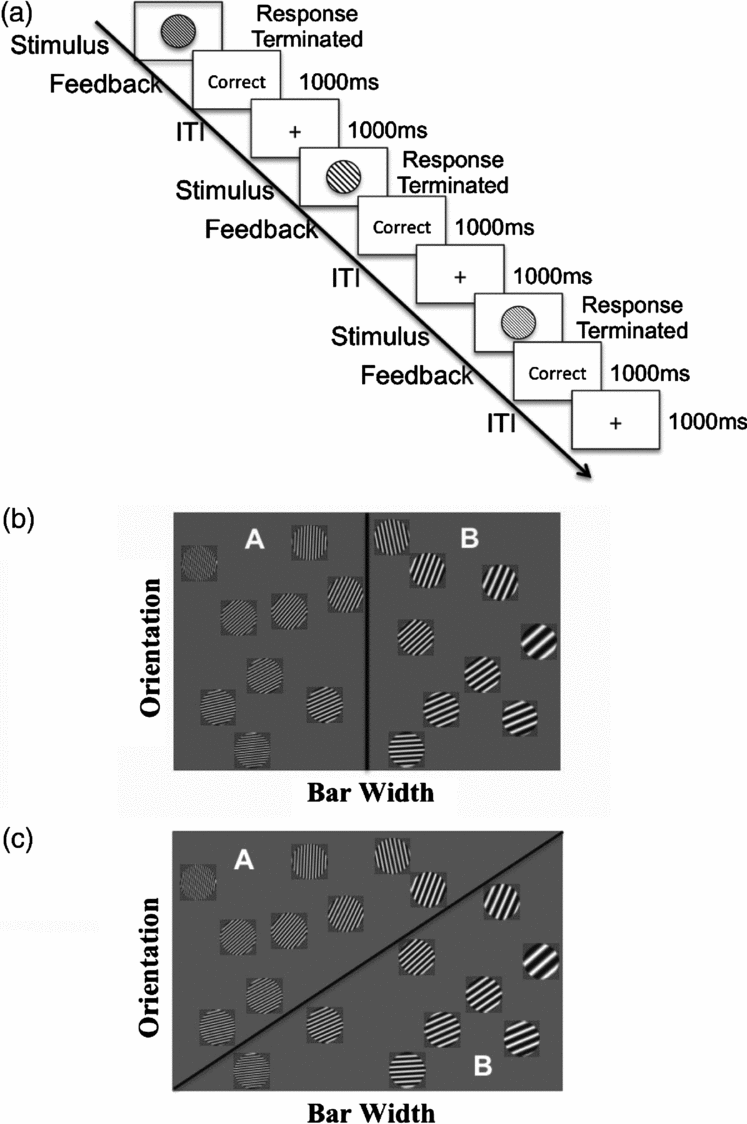
In a typical laboratory-based category learning task, the participant is presented with a single stimulus on each trial. The participant's task is to determine which category is associated with that stimulus by pressing a button on the computer keyboard. Following their response, the participants receive corrective feedback. Generally, the participants receive several hundred trials in the task, and learning curves are constructed. An example of three trials from a visual category learning task that uses Gabor patches (sine-wave gratings that vary across trials in bar width and orientation) is presented in Figure 1a.
(a) Example of trials in which subjects are shown a stimulus until responding, then given 1000 ms of feedback, followed by a 1000-ms intertrial interval. Three trials are shown. (b) Example of a rule-based category learning task in which narrow bar width Gabor patches are in Category A and wide bar width Gabor patches are in Category B. (c) Example of an information-integration category learning task in which no verbalizable rule can be used to describe the strategy that maximizes accuracy.

Over the past 20 years, a growing body of behavioral research supports the notion that human visual category learning is mediated by multiple category-learning systems (Allen & Brooks, Reference Allen and Brooks1991; Ashby et al., Reference Ashby, Alfonso-Reese, Turken and Waldron1998; Brooks, Reference Brooks1978; Erickson & Kruschke, Reference Erickson and Kruschke1998; Love, Medin, & Gureckis, Reference Love, Medin and Gureckis2004; Maddox & Ashby, Reference Maddox and Ashby2004; Nosofsky, Palmeri, & McKinley, Reference Nosofsky, Palmeri and McKinley1994; Regehr & Brooks, Reference Regehr and Brooks1993). One of the strongest pieces of evidence comes from an examination of the two category structures depicted in Figure 1b and c, and the learning profiles associated with each category structure. Figure 1b denotes a rule-based category learning problem. Each of the Gabor patches in the figure denotes a stimulus to be presented to the participant. The solid black vertical line denotes the decision boundary that separates Gabor patches in Category A from those in Category B. The strategy that maximizes accuracy is to place Gabor patches with narrow bars into Category A and Gabor patches with wide bars into Category B. This is a reflective strategy because it involves a strategy that is verbalizable and available to conscious awareness. Figure 1c denotes an information-integration category learning problem. Each of the Gabor patches in the figure denotes a stimulus to be presented to the participant. The solid black tilted line denotes the decision boundary that separates Gabor patches in Category A from those in Category B. The strategy that maximizes accuracy is not easily verbalizable, so an information-integration strategy implemented via the reflexive system is most optimal for categorizing these stimuli. If one were to attempt to verbalize this rule, it would be akin to saying something like “If the orientation exceeds the bar width say A, otherwise say B.” Because orientation and bar width are measured in different units, this is like mixing apples and oranges. Thus, although one could describe the optimal strategy as a “rule,” this strategy is not verbalizable, is not available to conscious awareness, and is qualitatively different from the optimal rule for Figure 1b.
It is critical that humans show very different learning profiles and introspection when asked to solve these tasks. When faced with the verbalizable rule-based task depicted in Figure 1b, participants start out near chance and then at some point “get it” and perform nearly optimal. In other words, participants’ learning profile is characterized as a step function. In addition, participants are able to describe the strategy that they used explicitly and accurately. When faced with the information-integration task depicted in Figure 1c, participants start out at near chance and then show gradual, incremental learning. Participants are unable to describe the strategy that they used accurately and often say that they went with their “gut” feeling or “gut reflex.” In other words, learning is more implicit.
This qualitative difference in performance led to a number of interesting studies that revealed strong empirical dissociations between the learning of these two category structures, and a plethora of research examining the neural basis of category learning and the development of neurobiologically grounded theories (Ashby et al., Reference Ashby, Alfonso-Reese, Turken and Waldron1998; Filoteo, Maddox, Simmons, et al., Reference Filoteo, Maddox, Simmons, Ing, Cagigas and Matthews2005; Folstein & Van Petten, Reference Folstein and Van Petten2004; Keri, Reference Keri2003; Knowlton & Squire, Reference Knowlton and Squire1993; Knowlton, Squire, & Gluck, Reference Knowlton, Squire and Gluck1994; Maddox & Filoteo, Reference Maddox and Filoteo2001, Reference Maddox, Filoteo, Cohen and Lefebvre2005; Nomura et al., Reference Nomura, Maddox, Filoteo, Ing, Gitelman and Parrish2007; Poldrack et al., Reference Poldrack, Clark, Pare-Blagoev, Shohamy, Creso Moyano and Myers2001; Poldrack & Foerde, Reference Poldrack and Foerde2008; Reber, Gitelman, Parrish, & Mesulam, Reference Reber, Gitelman, Parrish and Mesulam2003; Seger, Reference Seger2008; Seger & Cincotta, Reference Seger and Cincotta2002, Reference Seger and Cincotta2005, Reference Seger and Cincotta2006; Seger & Miller, Reference Seger and Miller2010; Shohamy et al., Reference Shohamy, Myers, Grossman, Sage, Gluck and Poldrack2004; Shohamy, Myers, Onlaor, & Gluck, Reference Shohamy, Myers, Onlaor and Gluck2004; Zeithamova, Maddox, & Schnyer, Reference Zeithamova, Maddox and Schnyer2008). One of the theories of visual category learning that specifies the constraints imposed by the underlying neurobiology is the competition between verbal and implicit systems (COVIS; Ashby et al., Reference Ashby, Alfonso-Reese, Turken and Waldron1998; Ashby & Maddox, Reference Ashby and Maddox2005, Reference Ashby and Maddox2010; Ashby, Paul, & Maddox, Reference Ashby, Paul, Maddox and Wills2011) model. COVIS postulates two learning systems, one reflective and one reflexive.Footnote 1 The reflective system is an explicit learning system in the sense that it formulates and tests specific categorization rules using cognitive control processes such as executive attention and working memory. The critical neural structures include the prefrontal cortex, anterior cingulate, and anterior caudate nucleus (Ashby, Ell, Valentin, & Casale, Reference Ashby, Ell, Valentin and Casale2005; Ashby & Valentin, Reference Ashby, Valentin, Cohen and Lefebvre2005; Filoteo, Maddox, Simmons, et al., Reference Filoteo, Maddox, Simmons, Ing, Cagigas and Matthews2005; Lombardi et al., Reference Lombardi, Andreason, Sirocco, Rio, Gross and Umhau1999; Monchi, Petrides, Petre, Worsley, & Dagher, Reference Monchi, Petrides, Petre, Worsley and Dagher2001; Nomura et al., Reference Nomura, Maddox, Filoteo, Ing, Gitelman and Parrish2007; Schnyer et al., Reference Schnyer, Maddox, Ell, Davis, Pacheco and Verfaellie2009; Seger & Cincotta, Reference Seger and Cincotta2006). The reflective system mediates rule-based category learning. In contrast, the reflexive system is implicit and procedural and learns to associate stimuli lying in different regions of perceptual space with specific motor outputs as a result of reinforcement via trial feedback. Learning in this system does not rely on working memory and executive attention, and the critical structures are the posterior caudate, putamen, and the supplementary motor area (Aron et al., Reference Aron, Shohamy, Clark, Myers, Gluck and Poldrack2004; Ashby & Crossley, Reference Ashby and Crossley2011; Ashby & Waldron, Reference Ashby and Waldron1999; Filoteo, Maddox, Salmon, & Song, Reference Filoteo, Maddox, Salmon and Song2005; Maddox & Filoteo, Reference Maddox and Filoteo2001, Reference Maddox, Filoteo, Cohen and Lefebvre2005; Nomura et al., Reference Nomura, Maddox, Filoteo, Ing, Gitelman and Parrish2007; Seger & Cincotta, Reference Seger and Cincotta2002, Reference Seger and Cincotta2005). The reflexive system mediates information-integration category learning.
COVIS assumes that the reflective and reflexive learning systems compete throughout category learning with an initial bias toward reflective dominance. Individuals explicitly test category rules and adjust the weight given to each rule depending on its success or failure. The success or failure of rules is assessed by explicit processing of the feedback. After each trial, the utility of a particular rule is updated. Through this method of hypothesis testing, relevant decision boundaries are learned. The explicit nature of the reflective system requires working memory and executive attention to remember which rules have been used, to process the success or failure of these decision bounds, and to switch between rules. COVIS posits that an accurate reflective system prevents the transfer of control to the striatally mediated reflexive system (Ashby & Maddox, Reference Ashby and Maddox2010). Learners will therefore continue to use the reflective system until the reflexive system is more accurate.
In comparison, during reflexive learning, a striatal unit implicitly associates an abstract cortical–motor response with sensory cells in the sensory association cortex. Learning occurs at cortical–striatal synapses. Such synaptic plasticity is enhanced by a dopamine-mediated reinforcement signal. The timing of feedback in a categorization experiment is crucial to the effectiveness of the reflexive learning system but not the reflective system, while working memory and executive attention are critical to learning in the reflective system but not the reflexive system. This set of predictions has been tested extensively using experimenter-defined categories with visually presented stimuli. To examine the influence of feedback timing on rule-based and information-integration category learning, researchers have manipulated the time between the participants response and presentation of the feedback. Because corticostriatal synaptic learning is critical to the reflexive system, delaying the feedback should adversely affect information-integration learning because synaptic activity will decay with time. In contrast, because executive attention and working memory can be used to hold a representation of the stimulus and response in memory during a delay period, delaying the feedback should not affect rule-based learning. These predictions are supported by the data from several studies (Maddox, Ashby, & Bohil, Reference Maddox, Ashby and Bohil2003; Maddox & Ing, Reference Maddox and Ing2005; Worthy, Markman, & Maddox, Reference Worthy, Markman and Maddox2013). To examine the influence of working memory and executive attention on rule-based and information-integration category learning, researchers have manipulated the availability of these resources during task completion or during the time available to process the feedback. Specifically, using dual task procedures, or procedures in which the time available to process the feedback is brief, it has been shown that both of these manipulations adversely affect rule-based learning but not information-integration learning (Filoteo, Lauritzen, & Maddox, Reference Filoteo, Lauritzen and Maddox2010; Maddox, Ashby, Ing, & Pickering, Reference Maddox, Ashby, Ing and Pickering2004; Waldron & Ashby, Reference Waldron and Ashby2001; Zeithamova & Maddox, Reference Zeithamova and Maddox2006, Reference Zeithamova and Maddox2007).
PERFORMANCE PRESSURE AND DLS IN VISION
People enter learning environments with trait personalities that affect their learning state (e.g., Grimm, Markman, & Maddox, Reference Grimm, Markman and Maddox2012; Grimm, Markman, Maddox, & Baldwin, Reference Grimm, Markman, Maddox and Baldwin2009; Higgins, Reference Higgins1997), and learning environments often contain situational factors that affect learning (Higgins, Reference Higgins2000). One factor that is often prevalent is performance pressure (Cooper, Worthy, Gorlick, & Maddox, Reference Cooper, Worthy, Gorlick and Maddox2013; Markman et al., Reference Markman, Maddox and Worthy2006; Worthy, Markman, & Maddox, Reference Worthy, Markman and Maddox2009a, Reference Worthy, Markman and Maddox2009b). Sometimes we feel pressure because completing a task is a team effort and everyone needs to “carry their weight.”
One popular theory of the pressure–cognition relation is the “distraction hypothesis” (Beilock, Bertenthal, McCoy, & Carr, Reference Beilock, Bertenthal, McCoy and Carr2004; Beilock & Carr, Reference Beilock and Carr2005; Markman et al., Reference Markman, Maddox and Worthy2006). The distraction hypothesis assumes that pressure reduces working-memory capacity by delegating some capacity to worrying about the pressure. This effectively reduces available working-memory capacity for task learning. Within the framework of DLS, and because of the proposed competition between systems, this suggests that performance pressure should attenuate reflective-learning processes and thus should be detrimental to rule-based category learning. Analogously, this suggests that performance pressure should accentuate reflexive-learning processes and thus should accentuate information-integration category learning. Markman et al. (Reference Markman, Maddox and Worthy2006) and others (DeCaro et al., Reference DeCaro, Thomas, Albert and Beilock2011; McCoy et al., Reference McCoy, Hutchinson, Hawthorne, Cosley and Ell2014) applied the distraction hypothesis to rule-based (Figure 1b) and information-integration (Figure 1c) visual category learning and found that pressure did attenuate rule-based category learning while accentuating information-integration category learning. The goal of the current study is to explore the effects of performance pressure on nonnative speech learning. Before we can do that, though, we need to determine the viability of applying DLS in the auditory domain. We address that in the next section.
DLS IN AUDITION: SPEECH LEARNING IN ADULTHOOD IS REFLEXIVE
One exciting possibility that we and others are beginning to explore is the possibility that the DLS approach developed in vision might apply fairly directly to the auditory domain (Chandrasekaran, Koslov, et al., Reference Chandrasekaran, Koslov and Maddox2014; Chandrasekaran, Yi, et al., Reference Chandrasekaran, Yi and Maddox2014; Holt & Lotto, Reference Holt and Lotto2008, Reference Holt and Lotto2010; Maddox & Chandrasekaran, Reference Maddox and Chandrasekaran2014). In a recent review, we showed that the brain regions associated with auditory processing are interconnected with the brain regions associated with reflective and reflexive category learning, suggesting that the neurobiology associated with COVIS is plausible in the auditory domain (Chandrasekaran, Koslov, et al., Reference Chandrasekaran, Koslov and Maddox2014). We have also begun to explore some of the cognitive processing correlates of auditory reflective and reflexive category learning. In one study, Maddox, Ing, and Lauritzen (Reference Maddox, Ing and Lauritzen2006) examined reflective-optimal and reflexive-optimal category learning using Gabor patches (i.e., frequency and orientation) as visual stimuli and compared it with reflective-optimal and reflexive-optimal category learning using frequency and duration of a tone as auditory stimuli. The category structures (reflexive-optimal or reflective-optimal) remained the same across the visual and auditory applications; only the specific dimensions changed (from frequency and orientation of a Gabor patch in vision to frequency and duration of a tone in audition). Participants showed similar learning profiles across the visual and auditory versions of the reflective-optimal and reflexive-optimal tasks, suggesting that similar mechanisms were in place (see Smith et al., Reference Smith, Johnston, Musgrave, Zakrzewski, Boomer and Church2014). In a second test, we examined whether individual differences in working-memory capacity were predictive of individual differences in reflective-optimal and reflexive-optimal nonspeech auditory category learning using simple auditory tones that varied in frequency and duration. In line with the vision work (DeCaro, Thomas, & Beilock, Reference DeCaro, Thomas and Beilock2008; Tharp & Pickering, Reference Tharp and Pickering2008), we found that a strong positive correlation between working-memory capacity and reflective-optimal learning with these auditory stimuli, but no correlation between working-memory capacity and reflexive-optimal learning with these auditory stimuli (Chandrasekaran, Koslov, et al., Reference Chandrasekaran, Koslov and Maddox2014).
This work with simple auditory tones that vary in frequency and duration is important, but one advantage of the auditory domain is that it is rich with natural category learning problems such as the adult learning of nonnative speech categories. Nonnative speech category learning is an excellent starting point for applying theoretical approaches developed in vision to naturalistic problems in audition. Nonnative speech category learning is one of the most difficult human category learning problems and involves taking multidimensional and highly variable acoustic signals and parsing them into discrete phonological representations. Not all nonnative speech categories are difficult to learn in adults, but some categorical distinctions (e.g., /r/ vs. /l/ in Japanese listeners and tone categories in nontone language speakers) are known to be challenging (Bradlow, Pisoni, Akahane-Yamada, & Tohkura, Reference Bradlow, Pisoni, Akahane-Yamada and Tohkura1997; Lively, Pisoni, Yamada, Tohkura, & Yamada, Reference Lively, Pisoni, Yamada, Tohkura and Yamada1994; Wang, Jongman, & Sereno, Reference Wang, Jongman and Sereno2003; Wang, Spence, Jongman, & Sereno, Reference Wang, Spence, Jongman and Sereno1999). Why are these categorical distinctions difficult to learn? Several reasons have been proposed. These include the possibility of interference caused by existing long-term stored representations of native speech categories (Best & Tyler, Reference Best, Tyler, Bohn and Munro2007) as well as interference as a consequence of a “warped” auditory-perceptual space (Francis, Ciocca, Ma, & Fenn, Reference Francis, Ciocca, Ma and Fenn2008). Laboratory-based training in adults has been shown to be successful in ameliorating difficulties in acquiring new tone categories (Chandrasekaran, Yi, et al., Reference Chandrasekaran, Yi and Maddox2014; Maddox et al., Reference Maddox, Chandrasekaran, Smayda, Yi, Koslov and Beevers2014; Wang, Jongman, et al., Reference Wang, Jongman and Sereno2003; Wang, Sereno, Jongman, & Hirsch, Reference Wang, Sereno, Jongman and Hirsch2003; Wong & Perrachione, Reference Wong and Perrachione2007). Training paradigms that have used “high-variability” training approaches have been largely successful in improving tone category learning (Wang, Jongman, et al., Reference Wang, Jongman and Sereno2003; Wang, Sereno, et al., Reference Wang, Jongman and Sereno2003). The thought behind this approach is that high-variability training results in robust category representations that are largely resistant to talker variability. Specifically, they may aid in orienting the focus of attention to relevant dimensions, which shows less variability across talkers. In addition to high-variability training, prior approaches examining tone learning have used trial-by-trial feedback to allow participants to monitor errors and learn from prior trials (Chandrasekaran, et al., Reference Chandrasekaran, Yi, Blanco, McGeary and Maddox2015; Smayda, Chandrasekaran, & Maddox, Reference Smayda, Chandrasekaran and Maddox2015). In the proposed training paradigm, we employ elements of both these approaches (high-variability training and trial-by-trial feedback).
The multidimensional and highly variable (due to talker variability) characteristics of speech signals make speech learning a “difficult” categorization problem, especially for individuals learning novel speech categories in adulthood (Bradlow & Bent, Reference Bradlow and Bent2008). This means that generating and testing hypotheses can be resource intensive. Because the reflective system is dependent on working memory and attention, generating rules/hypotheses for multiple dimensions may not be efficient. Further, the redundancy and variability of cues available during speech perception prevents a simple one-to-one mapping of cues to categories. These suggest that reflexive learning may be most optimal for speech categories. Our hypothesis is therefore that speech learning is reflexive-optimal.
Several lines of evidence support this claim, but we review two that are most relevant to the present discussion. First, in a recent behavioral dissociation study, we (Chandrasekaran, Yi, et al., Reference Chandrasekaran, Yi and Maddox2014) showed that delaying the presentation of feedback impairs nonnative speech category learning using the same Mandarin tone learning task used in the present study (described in detail below). As outlined above, delaying feedback interferes with the timing of dopamine release relative to corticostriatal synaptic activation, reducing the effectiveness of the association of stimulus–response with reward (Maddox et al., Reference Maddox, Ashby and Bohil2003; Maddox & Ing, Reference Maddox and Ing2005). In this same study we also showed that rich, informational, “full” feedback that provides the correctness of the response on each trial as well as information about which category was present attenuates Mandarin tone learning. Full feedback promotes the generation and testing of rules that are critical to reflective learning but disrupts the transfer of control to the reflexive system (Maddox, Love, Glass, & Filoteo, Reference Maddox, Love, Glass and Filoteo2008). Second, in a recent imaging study, we showed that greater final block accuracy and greater use of reflexive strategies, as determined from computational modeling (described in detail in the Results section), were associated with increased activation in the putamen (a substructure within the striatum) that is a central brain structure within the reflexive system (Yi et al., Reference Yi, Maddox, Mumford and Chandrasekaran2014). Taken together, these data suggest that nonnative speech category learning, at least with Mandarin tones, is mediated by the reflexive learning system.
PERFORMANCE PRESSURE AND MANDARIN TONE LEARNING: PREDICTIONS
The visual category learning literature suggests that pressure attenuates reflective-optimal visual category learning and enhances reflexive-optimal visual category learning via a mechanism that reduces available executive function resources (DeCaro et al., Reference DeCaro, Thomas, Albert and Beilock2011; Markman et al., Reference Markman, Maddox and Worthy2006; McCoy et al., Reference McCoy, Hutchinson, Hawthorne, Cosley and Ell2014). Recent work suggests that Mandarin tone learning is reflexive optimal. Thus, we predict that performance pressure will enhance nonnative speech category learning. We tested this hypothesis by having adult, native speakers of American English learn to classify Mandarin tones into one of four linguistically relevant categories under performance pressure or no pressure. In addition to simple measures of accuracy, we utilized a neurobiologically inspired computational modeling approach derived for DLS theory that provides a window onto the nature of learning strategies that is not available through an examination of simple performance measures such as accuracy (Chandrasekaran, Koslov, et al., Reference Chandrasekaran, Koslov and Maddox2014).
EXPERIMENT
Adult native speakers of American English were trained to learn Mandarin tone categories with feedback and multiple talkers. Mandarin Chinese has four tone categories that differ primarily on the basis of pitch pattern described phonetically as “high-level” in Tone 1 (T1), “low-rising” in Tone 2 (T2), “low-dipping” in Tone 3 (T3), and “high-falling” pitch patterns in Tone 4 (T4). In Mandarin, tone variation within the syllable (for example, /ma/) can change word meaning (ma1 “mother” [T1], ma2 “hemp” [T2], ma3 “horse” [T3], ma4 “scold” [T4]), making the tonal distinction as phonetically salient as vowels or consonants. Two dimensions (pitch height and pitch direction) serve as primary cues in categorizing tones (Gandour & Harshman, Reference Gandour and Harshman1978). Although these primary cues explain a large amount of variance per multidimensional scaling studies (Chandrasekaran, Gandour, & Krishnan, 2007; Chandrasekaran et al., Reference Chandrasekaran, Sampath and Wong2010; Francis et al., Reference Francis, Ciocca, Ma and Fenn2008), it is important to note that there are several other cues that may aid in tone categorization. For example, Whalen and Xu (Reference Whalen and Xu1992) showed that accurate classification is possible on the basis of amplitude contour and duration (in the absence of pitch-related cues).
Participants were randomly assigned to one of three experimental conditions: a no-pressure control condition or one of two performance pressure conditions. The pressure conditions differed only in the target performance level. Performance pressure influences behavior when the target performance level is not too easy and not too hard (Maddox & Markman, Reference Maddox and Markman2010; Markman et al., Reference Markman, Maddox and Worthy2006). Average performance in our previous work reached asymptote at 65%–70% accuracy (Chandrasekaran, Koslov, et al., Reference Chandrasekaran, Koslov and Maddox2014). Thus, we examined the effects of performance pressure across two conditions: a target performance level of 65% accuracy in the final block (P65), and a target performance level of 70% in the final block (P70). Including two target performance levels tests the generality of performance pressure effects.
METHOD
Participants
Seventy-five participants were recruited using flyers and Internet advertisements, were paid $8 for their participation, and were randomly assigned to three groups. This sample size was based on previous work from our lab, and data collection stopped once 75 participants had been tested. Because music training has been shown to enhance speech category learning (Lee & Hung, Reference Lee and Hung2008), individuals with 6 years or more of continuous musical training at any time in life were not allowed to complete the study, as well as those with hearing loss or any significant exposure to tone languages. Participants were divided into the P65 (N = 22), P70 (N = 24), and the no-pressure control (N = 29) conditions. Stimuli were presented at comfortable suprathreshold levels. The participants who did not reach the learning criterion of 30% (chance = 25%) during the final block of trials were excluded from the final analysis: P65 (N = 2), P70 (N = 3), and no-pressure control (N = 3). This research was approved by the University of Texas at Austin Institutional Review Board.
Stimulus characteristics
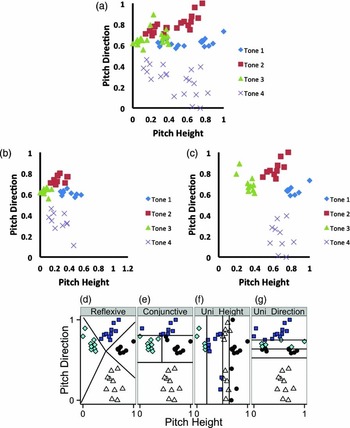
Stimuli consisted of natural native exemplars of the four Mandarin tones (T1, T2, T3, and T4) in the context of five monosyllabic Mandarin Chinese words (bu, di, lu, ma, and mi), produced in citation form by native speakers (N = 4, 2 females) of Mandarin Chinese originally from Beijing. The five syllables also exist in the American English inventory, circumventing the need to learn phonetic structures additional to the tone distinction. By using different segments and multiple talkers, our aim was to expose learners to variability inherent in natural language. Stimuli were root mean square amplitude and duration normalized (70 dB, 0.4 s; Perrachione, Lee, Ha, & Wong, Reference Perrachione, Lee, Ha and Wong2011) using the software Praat (Boersma & Weenink, 2015). The stimuli were rated as highly natural and accurately identified (>95%) by five native speakers of Mandarin. Behavioral studies as well as multidimensional scaling analyses have shown that dimensions related to pitch, especially height and direction, are used primarily to distinguish tone categories (Francis et al., Reference Francis, Ciocca, Ma and Fenn2008). A scatter plot of the 80 stimuli (4 tones × 4 talkers × 5 words) in the pitch height–pitch direction space is displayed in Figure 2a. Scatter plots of the 40 stimuli spoken by a two male and two female speakers are displayed in Figure 2b and c, respectively.
Scatter plots of (a) all stimuli from the experiment, (b) male-talker stimuli, and (c) female-talker stimuli. Stimuli dimensions (pitch height and pitch direction) were normalized between 0 and 1. Scatter plots of the responses along with the decision boundaries that separate response regions from a hypothetical participant using a version of the (d) reflexive, striatal pattern classifier; (e) reflective, conjunctive rule-based; (f) reflective, unidimensional_height rule-based; and (g) reflective, unidimensional_direction rule-based models as applied to the female-talker stimuli shown in (c).

Procedure
Participants were asked to give informed consent and were seated at a computer in an experimental testing room. All participants were told that they were going to be presented with a speech sound on each trial and that their task was to categorize that sound into one of four categories by pressing one of four buttons labeled 1, 2, 3, and 4. Participants were instructed that high levels of accuracy were possible but that the task would be difficult at first. Participants were informed that they would receive corrective feedback on each trial. Feedback was presented for 1000 ms on the computer screen and consisted of the word “Correct” or “No” followed by the label of the tone that was actually presented. For example, on a correct T2 trial the feedback display was as follows: “Correct, that was a category 2.” On an incorrect response trial where T3 was the correct response, the feedback display was as follows: “No, that was a category 3.” A 1-s intertrial interval followed the feedback. Participants listened to each of the 80 unique stimuli (4 tone categories × 5 syllables × 4 talkers) once in each block in a random order, and completed a total of six blocks of training.
The participants in the P65 and P70 conditions were given additional instructions that were modeled directly after those from a number of other published studies (Markman et al., Reference Markman, Maddox and Worthy2006). Participants were informed that they had a chance to earn an extra $8 monetary bonus for good performance. Participants were informed that they would earn points for correct responses and that each correct response would increment a point meter on the right side of the screen. In the P65 and P70 conditions, progress was tracked with a black, 720-pixel tall point meter, which vertically filled with green pixels as subjects categorized tones. With each correct response, the meter was vertically filled by 9 pixels. The point meter remained unchanged following an incorrect response. The bonus criterion was indicated by a line through the point meter that said “Bonus,” and was set at 468 pixels, or 65% of the total possible pixels, for the P65 condition and 504 pixels, or 70% of total possible pixels, for the P70 condition. Participants were informed that they must exceed the “Bonus” line on the point meter to be eligible for the bonus, and that they must exceed this in the final block of trials, although they were not informed of the number of blocks to complete. Critically, participants were then informed that they had been paired with a (fictitious) partner, and that each had to complete the task and each had to independently exceed a performance criterion in order for both to receive the monetary bonus. They were informed that should one of them not exceed the performance criterion, then neither would receive the bonus. The participant was then informed that his or her partner had just completed the task and had exceeded the performance criterion. At this point, each participant was asked to rate on a 7-point scale: “How much pressure do you feel to perform well on this task?” In the no-pressure control condition, no instructions pertaining to the monetary bonus or the fictitious partner.Footnote 2
RESULTS
Pressure manipulation check
The average perceived pressure ratings were 3.08, 3.74, and 4.43 in the no-pressure control, P65, and P70 conditions, respectively (95% confidence interval [CI]: 2.353, 3.800 for control; 2.891, 4.583 for P65; 3.624, 5.234 for P70). As expected, the pressure manipulation led to an increase in perceived pressure, F (2, 63) = 3.121, p = .05, partial η2 = 0.090. Post hoc analyses suggested that the perceived pressure in the P70 condition was significantly higher than that in the control condition (p = .015), but the perceived pressure in the P65 condition was not significantly higher than that in the control condition (p = .241). The perceived pressure in the P65 and P70 conditions did not differ (p = .251).
Proportion exceeding target performance criterion
Participants in the pressure conditions were required to meet a target performance level in the final block in order to earn a bonus for them and their (fictitious) partner. In the P65 condition, this target was associated with a proportion correct of .65 in the final block. In the P65 condition, 65% of participants reached the target performance level. Although no performance criterion was operative in the no-pressure control condition, we calculated the percentage of participants whose proportion correct in the final block reached .65. Whereas 65% of participants reached this goal in the P65 condition, only 46% of participants reached the same criterion in the no-pressure condition. In the P70 condition, 62% of participants reached the target performance level of .70 proportion correct in the final block. This was compared with only 42% of participants in the no-pressure condition who reached the same criterion. Thus, approximately 20% more participants in each of the pressure conditions reached the relevant performance criterion as compared with participants in the no-pressure condition. Even so, a chi-square test on the control versus P65, χ2 (1) = 1.275, p = .25, and on the control versus P70 frequencies were nonsignificant, χ2 (1) = 1.785, p = .18.
Accuracy results
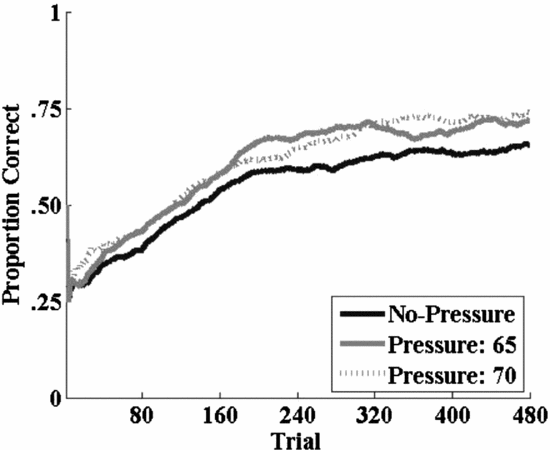
Figure 3 shows the learning curves across the control, P65, and P70 conditions. Learning performance difference across conditions was assessed using a mixed effects modeling analysis with binomial logit link, using the lme4 package implemented in R (Bates, Maechler, & Bolker, Reference Bates, Maechler and Bolker2012). The dependent variable was trial-by-trial accuracy outcome (correct vs. incorrect: reference level) for each participant. The fixed effects were the between-subjects pressure condition (P70, P65, and no-pressure: reference level), trial number (1 to 480; mean-centered and divided by 100), and their interaction term. The most complex random effects structure as justified the data was by-subject and by-item random intercepts (p < 2.2 × 10⁻¹⁶):
 $$\begin{equation*}
{\rm{outcome}}\sim{\rm{condition }} \times {\rm{trial}} + ({1|{\rm{subject}}}) + ({1|{\rm{item}}}).
\end{equation*}$$
Learning curves across the P70 (dotted line), P65 (solid gray line), and no-pressure control (solid black line) conditions. Each data point on each curve was generated by averaging the accuracy across the previous 80 trials of data (i.e., using a sliding 80-trial uniform kernel). For example, the accuracy rate associated with trial 100 was generated by averaging the accuracy rates on trials 21–100. The only exceptions are the trials prior to trial 80. For those, we used a cumulative average. For example, the accuracy rate associated with trial 60 was generated by averaging the accuracy rates on trials 1–60.

We looked at the simple effect of trial on logit odds of producing an accurate response. A positive estimate would indicate that the accuracy increased over successive trials, whereas a negative estimate would indicate the opposite. Because the no-pressure group served as the reference level, the magnitude of the trial effect would pertain to the learning rate in the no-pressure group. The trial effect was significant (b = 0.003, SE = 1.5 × 10⁻⁴, z = 20.36, 95% CI = 0.003, 0.003; p < 2 × 10–16), indicating that accuracy increased over time for the no-pressure group. Next, we looked at the Trial × Condition interaction effects, which would indicate whether the learning rate was different from that of the no-pressure group. The Trial × P70 Condition interaction was positive significant (b = 7.1 × 10⁻⁴, SE = 2.3 × 10⁻⁴, z = 3.09, 95% CI = 2.64 × 10⁻⁴, 1.2 × 10⁻³; p = .002), indicating that the learning rate was higher for the P70 condition than for the no-pressure control condition. The Trial × P65 Condition interaction was not significant (b = 2.7 × 10⁻⁴, SE = 2.3 × 10⁻⁴, z = 1.19, 95% CI = –1.8 × 10⁻⁴, 7.3 × 10⁻⁴; p = 0.233), suggesting that the learning rate for the P65 condition was not different from the no-pressure control condition. Next, we looked at the condition simple effects, which would indicate the degrees to which accuracies in the P70 and P65 conditions differed from those in the no-pressure condition. Because the trial numbers were mean-centered, the inference would apply to the 240th trial, which is the midpoint in the course of learning. The P70 condition effect was not significant (b = 0.136, SE = 0.281, z = 0.483, 95% CI = –0.415, 0.686; p = .629), and the P65 condition effect was also not significant (b = 0.23, SE = 0.285, z = 0.81, 95% CI = –0.327, 0.788; p = .418), suggesting that learning performance in the two pressure groups did not significantly differ with the no-pressure group at the midpoint of the learning task. The intercept, which coded how much the logit odds of producing a correct response in the no-pressure condition at the midpoint in learning differed from 0 (equivalent to 50% probability), was not significant (b = –0.35, SE = 0.201, z = –1.74, 95% CI = –0.743, 0.043; p = .081). Because the chance level for each trial is 25%, we did not consider the implications of the intercept to be important.
Because the previous analysis did not provide a direct comparison between the two pressure conditions, an additional analysis was performed without the no-pressure condition. The design was identical with trial as a fixed effect and condition as another (P70 vs. P65: reference level). The trial effect was significant (b = 0.003, SE = 1.8 × 10⁻⁴, z = 19.22, 95% CI = 0.003, 0.003; p < 2 × 10–16), replicating the positive learning rate in the P65 condition. The Trial × P70 Condition interaction was marginally significant (b = 4.4 × 10⁻⁴, SE = 2.5 × 10⁻⁴, z = 1.77, 95% CI = –4.6 × 10⁻⁵, 9.2 × 10⁻⁴; p = .076), presenting a trend in which the learning rate was higher for the P70 condition than for the P65 condition. The P70 condition effect was not significant (b = –0.095, SE = 0.291, z = –0.327, 95% CI = –0.665, 0.475; p = .743), suggesting that the performance did not differ in the midpoint in learning. The intercept was not significant (b = –0.119, SE = 0.221, z = –0.537, 95% CI= –0.551, 0.314; p = .591).
Computational modeling
The accuracy-based analyses suggested a performance advantage for individuals under pressure. To investigate the processing locus of this performance pressure advantage, we applied computational modeling techniques that provide the necessary window onto cognitive processing. We predicted that the performance advantage was due to a faster shift from reflective to reflexive strategy use in the pressure conditions.
Computational modeling details
We fitted a series of decision-bound models on a block-by-block basis at the individual participant level because of problems with interpreting fits to aggregate data (Maddox, Reference Maddox1999). We assumed that the two-dimensional space (pitch height vs. pitch direction) displayed in Figure 2a accurately describes the perceptual representation of the stimuli. Based on the results from our earlier work (Chandrasekaran, Koslov, et al., Reference Chandrasekaran, Koslov and Maddox2014) that showed that participants can categorize by the sex of the speaker (male/female) with greater than 95% accuracy with no feedback, we also assumed that participants applied category learning strategies separately to the male (Figure 2b) and female (Figure 2c) perceptual spaces. Note that as long as the major dimensions are known, these modeling procedures can be applied to any type of speech category structure, so this offers an exciting new approach to the study of speech category learning. As discussed earlier, there are several secondary cues to tone categorization that are not examined here. However, with the goal of understanding the locus of the pressure effect on speech learning, we use the two-dimensional space as a starting point in estimating the perceptual space in nonnative listeners. Several prior studies have shown that this two-dimensional space (pitch height and direction) is capable of explaining significant variance in native English speakers discriminating tone categories (Chandrasekaran et al., 2007, Reference Chandrasekaran, Sampath and Wong2010; Francis et al., Reference Francis, Ciocca, Ma and Fenn2008).
Here we provide a brief description of each model, as well as an interpretation of the model results. Details are available in numerous previous publications (e.g., Chandrasekaran, Koslov, et al., Reference Chandrasekaran, Koslov and Maddox2014). Each model assumes that decision bounds were used to classify stimuli into each of the four Mandarin tone categories (T1, T2, T3, or T4). We applied three classes of models: reflexive, reflective, and random responding. The first class is computational models of the reflexive procedural learning system. This is instantiated with the Striatal Pattern Classifier (SPC; Ashby & Waldron, Reference Ashby and Waldron1999; Maddox, Molis, & Diehl, Reference Maddox, Molis and Diehl2002). The SPC is a computational model whose processing is consistent with what is known about the neurobiology of the procedural-based category learning system thought to underlie reflexive-optimal classification performance (Ashby et al., Reference Ashby, Alfonso-Reese, Turken and Waldron1998; Ashby & Ennis, Reference Ashby, Ennis, Ross and Markman2006; Maddox et al., Reference Maddox, Molis and Diehl2002; Nomura et al., Reference Nomura, Maddox, Filoteo, Ing, Gitelman and Parrish2007; Seger & Cincotta, Reference Seger and Cincotta2005; Yi et al., Reference Yi, Maddox, Mumford and Chandrasekaran2014). The second class is reflective, rule-based, and instantiate hypothesis-testing strategies, such as the application of unidimensional or conjunctive rules. These are verbalizable strategies. The third model is a random responder model that assumes that the participant guesses on each trial. The models were fit to the Mandarin tone category learning data from each trial by maximizing negative log-likelihood. In brief, the goal of maximum likelihood parameter estimation is to identify the set of model parameter for which the observed probability of responding tone categories T1–T4 across a set of trials is as similar as possible to the predicted probability of responding tone categories T1–T4 from the model. To determine the best fitting model, the maximum negative log-likelihood value was converted into an Akaike information criterion (AIC) value (Akaike, Reference Akaike1974). For each model i, the AIC is defined as
 $$\begin{equation*}
{\rm{AI}}{{\rm{C}}_i} = 2{\rm{ln}}{L_i} + 2{V_i},
\end{equation*}$$
where Li is the maximum likelihood for model i and Vi is the number of free parameters in the model. Note that AIC penalizes models with more free parameters. Smaller AIC values indicate a better fit to the data. The best fitting model was defined as the model with the smallest AIC value. Another goodness of fit measure that is based on maximum likelihood is called the Bayesian information criterion. We replicated all of the model fits with the Bayesian information criterion, and none of the patterns in the data changed. Thus, we focus the presentation below on AIC. We provide the specifics of each model in the next section.
SPC
The SPC assumes that stimuli are represented perceptually in higher level auditory areas, such as the superior temporal gyrus. Because of the massive many-to-one (~10,000:1) convergence of afferents from the primary and secondary sensory cortices to the striatum (Ashby & Ennis, Reference Ashby, Ennis, Ross and Markman2006; Wilson, Reference Wilson1995), a low-resolution map of the perceptual space is represented among the striatal units. Within the auditory domain, it is well known that there are direct projections from secondary auditory areas such as the superior temporal gyrus and supratemporal plane to the caudate (Arnauld, Jeantet, Arsaut, & Desmotes-Mainard, Reference Arnauld, Jeantet, Arsaut and Desmotes-Mainard1996; Hikosaka, Sakamoto, & Usui, Reference Hikosaka, Sakamoto and Usui1989; Yeterian & Pandya, Reference Yeterian and Pandya1998). During feedback-based learning, the striatal units become associated with one of the category labels so that, after learning is complete, a category response label is associated with each of a number of different regions of perceptual space. In effect, the striatum learns to associate a response with clumps of cells in the auditory cortex. In fitting behavioral data we utilize a computational version of the SPC that is inspired by what is known about the neurobiology of the striatum. The version of the SPC that we fit to data assumes that there is one striatal “unit” in the pitch height–pitch direction space for each category, and a single “noise” parameter that represents the noise associated with the placement of the striatal units. Stimuli are assigned probabilistically (because of the noise in the striatal unit placement) into the category with the nearest striatal unit. Responses from a hypothetical participant using the SPC are displayed in Figure 2d.
Conjunctive rule-based model
Rule-based models assume that the participant generates hypotheses regarding category assignment. Rule generation, selection, storage, and application recruit a network of brain regions including the anterior cingulate, head of the caudate nucleus, and the prefrontal cortex (Ashby et al., Reference Ashby, Alfonso-Reese, Turken and Waldron1998; Chandrasekaran, Koslov, et al., Reference Chandrasekaran, Koslov and Maddox2014). A conjunctive rule-based model that assumes that the participant sets two criteria along the pitch direction dimension and one criterion along the pitch height dimension was applied to the data. The model assumes that the two criteria along the pitch direction dimension are used to separate the stimuli into those that are of low, medium, or high pitch direction. Low pitch direction items are classified into tone category 4 (T4), and high pitch direction items are classified into tone category 2 (T2). If an item is classified as having a medium pitch direction, then the pitch height dimension is examined. The single criterion along the pitch height dimension is used to separate the stimuli into low and high pitch height. Stimuli that have medium pitch direction and low pitch height are classified into tone category 3 (T3), and medium pitch direction items of high pitch height are classified into tone category 1 (T1). Responses from a hypothetical participant using a conjunctive strategy are displayed in Figure 2e.
Unidimensional rule-based model
A unidimensional height rule-based model that assumes that the participant sets three criteria along the pitch height dimension was also applied to the data. The model assumes that the three criteria along the pitch height dimension are used to separate the stimuli into those that are of low, medium-low, medium-high, or high pitch height, with each of these being associated with one of the four tone categories. Note that this model completely ignores the pitch direction dimension. Although 24 versions of the model are possible given four category labels, some are highly unrealistic (e.g., a model that assumes that tone category 1 [T1] was the lowest in pitch height). We examined the 8 most reasonable variants of the model. A unidimensional direction rule-based model that assumes that the participant sets three criteria along the pitch direction dimension was also applied to the data. The model assumes that the three criteria along the pitch direction dimension are used to separate the stimuli into those that are of low, medium-low, medium-high, or high pitch direction with each of these being associated with one of the tone categories. Note that this model completely ignores the pitch height dimension. We examined the two most reasonable variants of the model. Responses from a hypothetical participant using a unidimensional strategy along pitch height are displayed in Figure 2f, and responses from a hypothetical participant using a unidimensional strategy along pitch direction are displayed in Figure 2g.
Random responder model
The random responder model assumes a fixed probability of responding Tone 1, Tone 2, Tone 3, and Tone 4 but allows for response biases. The model has three free parameters to denote the predicted probability of responding “1,” “2,” or “3” with the probability of responding “4” equal to one minus the sum for the other three categories.
Computational modeling results
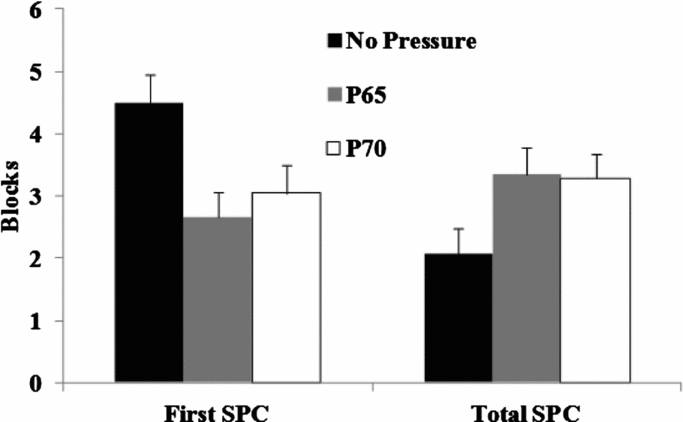
The accuracy-based analyses provide support for the prediction that performance pressure leads to enhanced speech learning. We hypothesize that this is because pressure leads to enhanced reflexive processing. We argue that this can come in two forms. First, pressure should enhance reflexive processing by speeding the transition from reflective to reflexive processing. As a direct test of this hypothesis, we determined the first block of trials for which the SPC (a model of reflexive processing) provided the best fit of the data. If performance pressure speeds the transition from reflective to reflexive processing, then the first block of trials for which the SPC fits best should occur sooner in learning (i.e., during an earlier block of trials) than in the no-pressure control condition. Second, once the transition from reflective to reflexive processing occurs, reflexive processing should remain stable. As a direct test of this hypothesis, we determined the total number of block of trials for which the SPC provided the best fit of the data. If individuals under performance pressure use reflexive strategies sooner and with more regularity, then they should use reflexive strategies in more blocks of trials than individuals in the no-pressure control condition. Data from these two measures are displayed in Figure 4 (with 95% confidence intervals).
(Left) Block during which no-pressure control, P65, and P70 participants first used a strategy consistent with reflexive processing (i.e., the SPC). (Right) Total number of blocks during which no-pressure control, P65, and P70 participants used a strategy consistent with reflexive processing. Standard error bars included. Confidence intervals (95%): first SPC block: no-pressure control = 3.681, 5.319; P65 = 1.716, 3.584; and P70 = 2.136, 3.959. Confidence intervals (95%): total SPC block: no-pressure control = 1.308, 2.846; P65 = 2.473, 4.227; and P70 = 2.430, 4.142.

Comparing across all three conditions, a one-way analysis of variance on the first block of trials best fit by the SPC revealed a significant effect of condition, F (2, 64) = 5.114, p = .009, partial η2 = 0.138. Post hoc tests using a Bonferroni correction for multiple comparisons suggested that a reflexive strategy: (a) was used significantly sooner (p = .012) in the P65 condition (mean = 2.65) than in the no-pressure control condition (mean = 4.50), t (44) = 2.954, p = .005, partial η2 = 0.166; (b) was used marginally significantly sooner (p = .063) in the P70 condition (mean = 3.05) than in the no-pressure control condition; and (c) showed no difference between the P65 and P70 conditions in first block best fit by the SPC (p = 1.00). A comparison of the no-pressure control with the aggregate of the two pressure conditions was significant, F (1, 65) = 9.953, p = .002, partial η2 = 0.133. Next, we conducted a one-way analysis of variance on the total number of blocks best fit by the SPC and found a significant effect of condition, F (2, 64) = 3.180, p = .048, partial η2 = 0.090. Post hoc tests using a Bonferroni correction for multiple comparisons suggested that a reflexive strategy: (a) was used marginally significantly more often (p = .099) in the P65 condition (mean = 3.35) than in the no-pressure control condition (mean = 2.08); (b) was not used significantly more often (p = .119) in the P70 condition (mean = 3.29) than in the no-pressure control condition; and (c) showed no difference between the P65 and P70 conditions in total number of SPC blocks (p = 1.00). A comparison of the no-pressure control with the aggregate of the two pressure conditions was significant, F (1, 65) = 6.447, p = .014, partial η2 = 0.090. These findings establish that individuals under performance pressure use reflexive strategies sooner and with greater regularity than individuals under no-pressure conditions but that there are no performance differences between the two pressure conditions.
GENERAL DISCUSSION
This is the first study to examine the effects of performance pressure on nonnative speech category learning. Within a DLS framework, and based on a growing body of evidence (Chandrasekaran, Koslov, et al., Reference Chandrasekaran, Koslov and Maddox2014; Chandrasekaran, Yi, et al., Reference Chandrasekaran, Yi and Maddox2014; Maddox & Chandrasekaran, Reference Maddox and Chandrasekaran2014; Maddox et al., Reference Maddox, Chandrasekaran, Smayda and Yi2013, Reference Maddox, Chandrasekaran, Smayda, Yi, Koslov and Beevers2014; Yi et al., Reference Yi, Maddox, Mumford and Chandrasekaran2014), we posited that nonnative speech (Mandarin tone) category learning is mediated by an automatic, procedural reflexive system. A successful theory of the effects of pressure on cognitive processing is the distraction hypothesis (Beilock et al., Reference Beilock, Bertenthal, McCoy and Carr2004; Beilock & Carr, Reference Beilock and Carr2005; Markman et al., Reference Markman, Maddox and Worthy2006). The distraction hypothesis suggests that performance pressure shifts the balance between reflective and reflexive processing toward reflexive processing by reducing available executive function processes, and thus the effectiveness of reflective processing. The distraction hypothesis predicts that pressure should attenuate reflective-optimal (rule-based) learning but should enhance reflexive-optimal (information-integration) learning. This pattern has been observed with experimenter-defined category structures and simple perceptual stimuli presented in the visual domain (e.g., Gabor patches that vary in frequency and orientation; DeCaro et al., Reference DeCaro, Thomas, Albert and Beilock2011; Markman et al., Reference Markman, Maddox and Worthy2006; McCoy et al., Reference McCoy, Hutchinson, Hawthorne, Cosley and Ell2014). Support for the distraction hypothesis in the visual category learning literature, along with recent evidence to suggest that nonnative speech learning is mediated by the reflexive system, led us to predict that performance pressure would enhance nonnative speech (Mandarin tone) category learning through early and more frequent use of reflexive strategies. As predicted, we found an advantage in Mandarin tone category learning for individuals under performance pressure. Neurobiologically motivated computational model-based analyses suggested that the locus of this performance advantage was due to faster, and more frequent, use of reflexive-processing strategies. The implications of this work are many. We briefly discuss some of these below.
Individual differences in learning success
Laboratory speech training research often attributes the large individual differences in learning success to perceptual abilities, genetics, cognitive factors, and listening experience (Chandrasekaran et al., Reference Chandrasekaran, Yi, Blanco, McGeary and Maddox2015; Perrachione et al., Reference Perrachione, Lee, Ha and Wong2011). We demonstrate that situational factors, such as performance pressure, can also significantly alter learning strategies and, consequently, performance, contributing to the individual differences in speech learning success. The proposed role of situational factors may explain how a videogame paradigm could achieve robust nonnative speech learning comparable with a much longer multiweek laboratory-based training paradigm (Lim & Holt, Reference Lim and Holt2011), which may reflect a combination of greater performance pressure, incentive to learn, mediating faster shift to optimal procedural-based learning strategies.
Although we found robust effects of pressure on performance, we found few performance differences between the P65 and P70 conditions. This was not unexpected. We chose these two values because average performance in our previous work reached asymptote at 65%–70% accuracy (Chandrasekaran, Koslov, et al., Reference Chandrasekaran, Koslov and Maddox2014). Even so, performance in the P70 condition was slightly worse than that in the P65 condition. Performance pressure influences behavior when the target performance level is not too easy and not too hard (Maddox & Markman, Reference Maddox and Markman2010; Markman et al., Reference Markman, Maddox and Worthy2006). It is likely that the P65 condition satisfies these conditions slightly better than the P70 condition, leading to slightly better performance in the P65 condition. More work is needed, though, that explores a broader range of performance levels.
Other manipulations of performance pressure and performance
Although the present study is the first to examine the effects of pressure on speech category learning, it represents one of several that have explored the effects of pressure and stress on the balance of processing in the reflexive and reflective systems (DeCaro et al., Reference DeCaro, Thomas, Albert and Beilock2011; Markman et al., Reference Markman, Maddox and Worthy2006; McCoy et al., Reference McCoy, Hutchinson, Hawthorne, Cosley and Ell2014). Recent work by DeCaro et al. (Reference DeCaro, Thomas, Albert and Beilock2011) and McCoy et al. (Reference McCoy, Hutchinson, Hawthorne, Cosley and Ell2014) suggests that the nature of the performance pressure manipulation has a large effect on the balance of reflective and reflexive processing. In particular, whereas they found that the performance pressure manipulation used here does lead to enhanced reflexive processing, they found that other pressure manipulations, in particular those that enhance explicit monitoring, were more likely to enhance reflective processing. Thus, it is important to be clear that the effects of pressure are complex and depend upon the specifics of the pressure manipulation as well as the nature of the learning system that optimizes performance. Future work should examine a broader range of pressure manipulations and explore their effects on Mandarin tone learning as well as on other speech category learning domains.
Implications for education
Although the results presented in this research report are intriguing, it is highly premature at this stage to make any strong claims about the implications of this work for educational settings. The present study used a well-vetted laboratory manipulation of pressure and a highly studied form of nonnative speech learning (Mandarin tone learning) for which strong evidence exists to suggest that learning is optimally mediated by the reflexive system. Other pressure manipulations can have different effects on system-level processing, and other learning tasks (including other forms of speech learning) may not be so simply characterized as reflexive-optimal or reflective-optimal. Even so, with more basic and applied research, we may be able (in the future) to identify conditions under which certain forms of pressure (even high stakes testing) are advantageous.
Individual differences in trait variables
The research presented here completely ignores personality and trait factors of the individual. Clearly these factors influence how individuals approach a task as well as their inherent balance of reflexive and reflective processing. We have begun to explore this in our speech learning work with some interesting consequences. As just one example, we argued that the presence of elevated depressive symptoms leads to a shift in balance toward the reflexive system. Thus, just as we predicted for performance pressure, we predicted, and found support for the claim, that elevated depressive symptoms should lead to enhanced speech learning (Maddox et al., Reference Maddox, Chandrasekaran, Smayda, Yi, Koslov and Beevers2014). Future research should extend this to other populations that differ in personality traits and should incorporate situational manipulations such as performance pressure (Maddox & Markman, Reference Maddox and Markman2010).
Pressure and motivation
Early in this paper we stated that performance pressure affects “motivation” but that we wanted to avoid that term and instead focus on performance pressure. In this section, we want to briefly discuss the implications of our work for motivation. Motivation, broadly defined, is critical to nearly all behavior. It follows that motivation is highly complex and as such is not well understood. We argue that pressure is a form of “global” situational motivation. Previous research suggests that a person's global motivational focus interacts with the local trial-by-trial motivation (Higgins, Reference Higgins2000; Maddox & Markman, Reference Maddox and Markman2010). For example, when the global motivation is to approach something positive (such as a monetary bonus) and the trial-by-trial motivation is to obtain positive things (such as points), there is a regulatory match. Previous research suggests that this leads to enhanced processing in the reflective system (Maddox & Markman, Reference Maddox and Markman2010). However, if the global motivation is to avoid losing something desirable (such as an already obtained bonus, or disappointing a partner who did their job) and the trial-by-trial motivation is to obtain points, there is a regulatory mismatch that leads to enhanced processing in the reflexive system (Maddox & Markman, Reference Maddox and Markman2010). Maddox and Markman argue that pressure represents a mixture of a global situational approach motivation (to obtain a monetary bonus) with a global social avoidance motivation (not to disappoint the partner). Future work should disentangle these global motivational effects and examine how they interact with local motivational effects. This would lead to a more complete understanding of the broader motivational framework and its effects on speech learning.
Motivation and second language learning
Seminal work by Gardner (Reference Gardner1985, Reference Gardner2007) and others (Dornyei, Reference Dornyei1994; Dornyei & Otto, Reference Dornyei and Otto1998) have examined the relationship between motivation and second language learning. For example, Gardner (Reference Gardner2007) posits four stages of language acquisition (elemental, consolidation, conscious expression, and automaticity) and two types of motivational processes (language learning motivation and classroom motivation). Although a detailed discussion of this important work is beyond the scope of this paper, some integration of our results into this broader framework is possible. Gardner argues for the importance of motivation in second language learning and states explicitly that its effect is more complex than simply wanting to learn the language. Our work examining the effects of pressure, and the broader motivation framework incorporating global and local aspects of motivation outlined above, clearly supports this claim. In our view, “wanting to learn” something implies the goal of “trying harder.” Trying harder most likely involves conscious effort and utilization of working memory and executive attention; in other words, reflective learning processes. Our study suggests that the form of social pressure utilized here shifts the balance of processing away from reflective toward reflexive processing. Future work should explore how pressure in general, and social pressure in particular, influences the various stages of language acquisition. It is possible that the effects are quite different if pressure is introduced at the elemental stage versus the conscious expression stage.
Conclusions
This represents the first study to examine the effects of performance pressure on speech category learning. As predicted from our application of DLS theory to speech category learning and from the extensive literature suggesting that pressure enhances reflexive processing, we predicted that performance pressure would enhance speech category learning. In support of our prediction, we found that pressure enhanced speech category learning with the computational modeling, suggesting that this performance advantage was due to faster and more frequent use of reflexive category learning strategies.