INTRODUCTION
Children with specific motor skills deficits are referred to as displaying developmental coordination disorder (DCD; American Psychiatric Association, 1994). Children with DCD manifest motor deficits in virtually every motor domain. They tend to work more slowly than their typically developing peers (Missiuna & Pollock, 1995; Schoemaker et al., 2001), and their performance on tasks that require rapid or accurate goal-directed movements is often impaired (Huh et al., 1998; Johnston et al., 2002; Schoemaker et al., 2001). Children with autism spectrum disorders (ASD) and attention deficit hyperactivity disorder (ADHD) have also been found to display a variety of motor skills deficits similar to those displayed by children with DCD, including deficits in motor planning, motor coordination, fine motor skills, and gross motor skills (Ghaziuddin & Butler, 1998; Ghaziuddin et al., 1994; Gillberg, 1989; Green et al., 2002; Hauck & Dewey, 2001; Hughes, 1996; Manjiviona & Prior, 1995; Miyahara et al., 1997; Page & Boucher, 1998; Piek et al., 1999; Pitcher et al., 2003). Recent studies have indicated that the overlap of ADHD and DCD ranges from 30 to 50% (Kadesjo & Gillberg, 1998; Pitcher et al., 2003). Few studies, however, have examined whether children with various neurodevelopmental disorders display similar levels of motor impairment. However, Green et al. (2002) have compared children with Asperger's syndrome (AS) and children with specific developmental disorders of motor function (SDDMF; World Health Organization, 1992), which is similar to the Diagnostic and Statistical Manual of Mental Disorders, Fourth Edition (DSM-IV; American Psychiatric Association, 1994) diagnostic category of DCD, and found that they did not differ in severity of motor impairment.
A related area of motor functioning is the performance of gestures. In ordinary usage, gestures refer to nonverbal communicative motor actions (e.g., waving goodbye). In developmental neuropsychology, however, the term gesture is used to connote the ability to perform skilled motor acts or sequences of purposeful motor movements and the ability to use tools (Dewey, 1995; Hill, 1998; Kaplan, 1968). Developmental dyspraxia is a disorder in gestural performance (Denckla & Roeltgen, 1992; Dewey, 1995). It is associated with deficits in the performance of meaningful gestures (i.e., gestures related to meaningful or familiar acts such as waving goodbye), nonmeaningful gestures (i.e., gestures related to nonmeaningful acts such as imitating postures), and gesture sequences (i.e., a series of gestures that result in the appropriate completion of an action) to verbal command and imitation. Research in children with DCD has reported that they perform less well than typically developing children on tasks involving the performance of gestures to verbal command and imitation (Dewey, 1993; Hill, 1998; Zoia et al., 2002). Empirical studies of children with ASD have also found that they display impairments on various tasks associated with gesture production, including performance of gestures to verbal command, the imitation of manual and oral gestures, and the imitation of tool use (Green et al., 2002; Rogers et al., 2003; Stone et al., 1997; Williams et al., 2004). To the best of our knowledge, no studies have examined gestural performance in children with ADHD (Williams et al., 2004).
The few studies that have examined the gestural performance of children with various neurodevelopmental disorders have reported that children with autism were more impaired than children with other disorders. Rogers et al. (2003) found that children with autism were more impaired on gestural imitation compared to children with developmental delay and fragile X syndrome. Green and colleagues (2002) reported that the gestural performance of children with AS was significantly poorer than that of children with SDDMF.
These studies and others that have investigated gestural performance in various groups of children (e.g., Dewey & Kaplan, 1992; Zoia et al., 2002) have typically focused on the level or accuracy of performance. However, children with neurodevelopmental disorders could display impairments in gestural performance for different reasons. It is possible that the deficits could be attributable to motor impairments. As the performance of all gestures involves some type of action, it is reasonable to assume that difficulties in motor functioning could have an impact on gestural performance. However, in addition to the problems in gestural performance associated with motor impairment, deficits in gestural performance could also represent impairments in other domains, such as impairments in language or sensory processes (cf. Denckla & Roeltgen, 1992).
To better understand the nature of gestural impairments in children with neurodevelopmental disorders, two avenues of research must be pursued. First, the severity of the motor impairments displayed by children with neurodevelopmental disorders needs to be taken into account when examining gestural performance. Second, the types of errors made by these children need to be examined. For example, a high frequency of body-part-as-object responses would not be an expected pattern of errors attributable to purely motor dysfunction. Also, errors such as performing an incorrect action would indicate that problems in motor coordination alone could not account for the impairment. To date, only Green et al. (2002) have examined the profile of errors types made during gestural performance by children with AS and SDDMF. They found that children with AS made marginally more spatiotemporal errors than children with SDDMF but that this difference was not statistically significant. No other differences between groups in the pattern of errors were noted.
In summary, past research has demonstrated associations of motor deficits with DCD, ASD, and ADHD, as well as associations of impairments in gestural performance with DCD and ASD. However, demonstrations of these impairments have been limited in large part to studies comparing these clinical groups with typically developing children. Assessment of the motor skills and gestural performance in each of these clinical groups would increase our understanding of the differences among these neurodevelopmental disorders and would determine the extent to which deficits in gesture reflect impairments in motor skills. The main purpose of the present study was to make these comparisons, as well as to examine differences between these disorders in specific types of gestural errors. Because of the significant overlap of ADHD and DCD (Kadesjo & Gillberg, 1998; Pitcher et al., 2003), a further aim was to distinguish between children with ADHD who also met criteria for DCD and children with ADHD who did not meet these criteria, as it is possible that problems in motor coordination could have an impact on gestural performance. On the basis of the limited data available from previous research, we hypothesized that children with ASD, DCD, and DCD+ADHD would display similar levels of motor impairment compared with typically developing children and children with ADHD that did not meet the criteria for DCD. We additionally hypothesized that the children with ASD would display significantly poorer gestural performance than children with DCD and/or ADHD and typically developing children; however, the pattern of the gestural errors would be similar among children with ASD, DCD, and/or ADHD.
METHODS
Participants
Children 5 to 18 years of age with DCD, ASD, and ADHD were referred to our project by public and private schools and agencies for children with disabilities. Typically developing control children were recruited from public schools in communities that the children with neurodevelopmental disorders resided. Parents of typically developing control children and children with DCD, ASD, and ADHD were provided information about the study, and those families that indicated an interest in participating signed a consent form indicating their willingness to volunteer. Participants were 49 children with ASD, 38 children with DCD+ADHD, 46 children with DCD only, 27 ADHD only, and 78 typically developing control children.
Children were identified as displaying DCD on the basis of their performance on standardized measures of motor functioning (i.e., Short Form of the Bruininks–Oseretsky Test of Motor Proficiency; (BOTMP; Bruininks, 1978), the Movement Assessment Battery for Children (MABC; Henderson & Sugden, 1992), and the Developmental Coordination Disorder Questionnaire (DCDQ; Wilson et al., 2000) using criteria described in previous studies (Dewey et al., 2002; Kaplan et al., 1998)). For the BOTMP, impairment was a standard score ≤ 42 as specified in the test manual. For the MABC, a score at or below the 15th percentile was used as recommended by the authors (Henderson & Sugden, 1992). For the DCDQ, impaired performance was defined as a score at least one standard deviation below the mean (Wilson et al., 2000). As there was no statistical or theoretical reason to believe that one measure would be more influential than another, all measures received equal weighting in the criteria used to classify each child. Children who had at least two scores in the impaired range on the above motor measures were classified as DCD.
Children in the ASD group had been diagnosed with autism (N = 22), pervasive developmental disorder-not otherwise specified (PDD-NOS; N = 15), or AS (N = 12) based on DSM-IV criteria by a licensed psychologist, psychiatrist, or behavioral pediatrician (American Psychiatric Association, 1994). The Childhood Autism Rating Scale (CARS; Schopler et al., 1986), which has been shown to have a high level of agreement with the Autistic Diagnostic Interview–Revised (ADI-R; Lord et al., 1994; Pilowsky et al., 1998; Saemundsen et al., 2003), was also completed for children in the ASD group. On the CARS, the children diagnosed with autism obtained a mean score of 36.1 (SD = 5.9; range = 30.5 to 51), the children diagnosed with PDD-NOS obtained a mean score of 35.6 (SD = 7.6; range = 25.5 to 48.5), and the children diagnosed with AS obtained a mean score of 29.6 (SD = 6.9; range = 20.5 to 42). According to the CARS manual, autism is defined by a score > 30. All of the children who had been diagnosed with autism obtained scores above this cutoff. The CARS does not have specific cutoffs for children diagnosed with PDD-NOS or AS. Children diagnosed with these disorders may display fewer and less severe behavioral symptoms than children diagnosed with prototypical autism. Therefore, the scores they obtain on the CARS may fall below the cutoff score specified for the diagnosis of autism. In this study, the children diagnosed with PDD-NOS or AS obtained scores on the CARS approaching or above a cutoff as defined by scores of ≥ 24. Such scores indicated that they displayed many of the behaviors of children on the autism spectrum, which would be consistent with their DSM-IV diagnosis. The only exception was a child with a score of 20, whose classification as AS was based on his/her diagnosis on DSM-IV criteria by an experienced licensed medical practitioner. For children with ASD, performance on the BOTMP was quite variable but the majority (59%, N = 29) would have been classified as impaired in terms of motor functioning using a score of ≤ 42 on the Short Form of the BOTMP.
The Diagnostic Interview Schedule for Children (DISC; Costello et al., 1985) was used to identify children with ADHD. Children in the DCD+ADHD group met the above criteria for both DCD and ADHD. All of the children in the DCD, ASD, ADHD, and DCD+ADHD groups obtained IQ scores above 70 on a short form of the Wechsler scales (i.e., Block Design, Vocabulary) except for five children in the ASD group who had IQ scores that ranged from 53 to 68.
None of the typically developing control children had been diagnosed with ASD or other neurodevelopmental disorder by a licensed psychologist, psychiatrist, or behavioral pediatrician. All of these children were assessed using the Short Form of the BOTMP to obtain a measure of their motor skills, and all obtained scores > 42. Each child was also assessed with the DISC. None were found to meet criteria for ADHD. Finally, all of the typically developing controls were assessed on a short form of the Wechsler scales (i.e., Block Design, Vocabulary) and obtained IQ scores above 70.
Procedure
The study was reviewed and approved by the appropriate institutional review boards for the ethics of human research. Parents of children participating in this study signed a consent form indicating their willingness to volunteer. This study is part of a larger research program that is investigating learning, motor, and attention problems in children with neurodevelopmental disorders. The tests administered for this study were the BOTMP and the Gestures Test. Each child was evaluated individually by testers who were blind to the diagnosis of the child. Testing was completed in two sessions. The Gestures Test was administered in the first session, and the Short form of the BOTMP was administered in the second session.
Measures
The BOTMP short form was used to assess fine and gross motor functioning. It is composed of 46 items and has been standardized on children 4.5 to 14.5 years of age. Test–retest reliability has been found to be satisfactory (r = .86).
The Gestures Test included six transitive gestures (i.e., with objects) and six intransitive gestures (i.e., without objects) that had been used previously by Dewey and colleagues in research with children with developmental motor disorders 4 to 11 years of age (Dewey & Kaplan, 1992; Dewey et al., 1988; see Appendix). Gestures were performed to verbal command and to imitation. For gestures to verbal command, children were asked to show how a specific gesture was performed, e.g., “Show me how you brush your teeth with a toothbrush.” For gestures to imitation, the children were asked to watch the examiner and do the same thing with their hand.
Before commencing this test, the examiner asked the children to write/print their names. The children were then asked to do each of the gestures with the hand that they used for writing/printing. Gestures to verbal command were given first followed by gestures to imitation. For gestures to verbal command, the examiner gave the following instructions: “I am going to ask you to do some things with your hands. With some I would like you to pretend to hold the object.” For gestures to imitation, the examiner sat opposite the child and gave the following instructions “Watch what I do with my hands, and when I'm finished, do the same thing with your hands.” The examiner used the same hand that the child wrote/printed with to demonstrate each gesture.
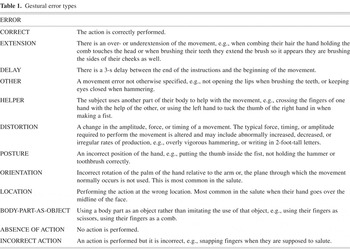
Participants were videotaped, and gestural performance was scored from videotapes by a rater blind to the diagnoses of the children. A score of 0 was given if an incorrect gesture was performed or if the children indicated where the gesture was to be performed (e.g., pointing to the mouth for brushing teeth); a score of 1 if the children demonstrated body-part-as-object (e.g., using the index finger extended to make brushing movements against the teeth), or if an orientation (e.g., incorrect plane of movement), posture (e.g., incorrect hand posture), location (e.g., gesture performed in incorrect spatial location), or distortion (e.g., distortion in timing of the movement) error was made; a score of 2 if there were minor inaccuracies in performing the gesture (e.g., extension error, helper error); and a score of 3 if the action was performed correctly. Total scores were calculated for gestures performed to command and to imitation and could range from 0 to 36. Previous research has demonstrated that this method of scoring gestural performance had a high degree of reliability (Dewey & Kaplan, 1992) in children with developmental motor problems. A system similar to that developed by Dewey (1993) was used to classify the gestural errors, as defined in Table 1. It was possible for the children to exhibit more than one type of error for a particular gesture. The total number of errors overall for gestures to command and gestures to imitation was calculated, as well as the total number of errors to command and imitation for each error type.
Gestural error types

Statistical Analyses
Analysis of variance (ANOVA) revealed group differences in age [F(4,233) = 3.59, p = .007] and IQ [F(4,216) = 15.88, p < .001]. Scheffe post hoc group comparisons indicated that children in the ASD group were significantly younger than the children in the ADHD only group. The ASD group obtained significantly lower IQ scores than the other groups except the DCD+ADHD group; and the ASD group, DCD only group, and DCD+ADHD group all obtained significantly lower IQ scores than the typically developing control group (see Table 2). There was a significant association between gender and group [χ2(4, N = 238) = 14.784, p = .005], with significantly fewer girls in both the ASD and ADHD only groups compared with the other three groups.
Demographic variables by group

Performance on the measures of motor and gestural skills was not associated with severity of ASD as measured by the CARS covarying for IQ. Furthermore, motor and gestural performance were not found to differ between males and females. However, age and IQ were associated with these skills (IQ and BOTMP, r = .42, p < .001; IQ and gestures to command, r = .35, p < .001; IQ and gestures to imitation, r = .35, p < .001; age and BOTMP, r = .30, p < .001; age and gestures to command, r = .30, p < .001; age and gestures to imitation, r = .33, p < .001). As these correlations were at least .30 or greater, they were considered as potential covariates in subsequent analyses of covariance (ANCOVAs) as recommended by Pedhazur (1982).
Group differences in motor skills were examined using ANCOVA. IQ was included as a covariate in the analysis; age was not controlled for as the BOTMP is standardized for age. Group differences in gestural performance were also examined using ANCOVAs. Preliminary analyses failed to reveal a significant effect for gesture type (i.e., transitive vs. intransitive), so to maximize power, transitive and intransitive gestures were combined into a total score for gestures to command and a total score for gestures to imitation in all subsequent analyses. Total scores for gestures to command and gestures to imitation were then examined. We also examined group differences in the overall number of errors and the total number of errors for each error type for gestures to command and gestures to imitation. IQ and age were included as covariates in all ANCOVAs. In some additional analyses, motor skills were also included as a covariate. Significant group differences in ANCOVAs were followed by tests of simple univariate group contrasts using covariate-adjusted means to determine which groups differed significantly from each other on the variable in question. For each ANCOVA, all assumptions were met, including nonsignificant interactions of the covariates. Given the exploratory nature of the study and the number of comparisons conducted, only those results significant at p < .01 are discussed.
RESULTS
Motor Skills Performance
An ANCOVA with IQ as a covariate revealed significant group differences on BOTMP Short Form scores [F(4,211) = 49.59, p < .001, partial η2 = .485] (see Table 3). Post hoc group contrasts indicated that the children with ASD scored significantly lower than children in the other four groups. Children with DCD and DCD+ADHD also obtained significantly lower scores than the typically developing children and the children with ADHD only. When gender was included as a factor in this analysis, the overall group differences remained significant; no other significant effects were noted.
Mean motor and gesture test scores and standard errors by group

Gestural Performance
An ANCOVA with IQ and age included as covariates revealed significant group differences on gestures to command [F(4,199) = 20.38, p < .001, partial η2 = .291]. Post hoc contrasts indicated that the ASD group scored significantly lower than the other four groups on these tasks (see Table 3). When gender was included as a factor in this analysis, the overall group differences remained significant; no significant effects for gender or gender by group interactions emerged. Significant group differences were also found for gestures to imitation [F(4,202) = 25.23, p < .001, partial η2 = .333], with the ASD group scoring significantly lower than the other four groups. Additionally, the DCD+ADHD group scored significantly lower than the typically developing group for gestures to imitation. When gender was included as a factor in this analysis, the overall group differences remained significant; no other effects emerged. Repeated measures analysis showed that all groups displayed better performance on gestures to imitation than gestures to command [Wilk's Lambda F(1,212) = 62.65, p < .001].
To determine whether the group differences in gestural performance were attributable to differences in motor skills, we examined gestural performance to command and imitation with motor skills entered as a covariate in addition to age and IQ. Results indicated that group differences on gestures performed to command remained significant [F(4,201) = 11.28, p < .001; partial η2 = .183]. Post hoc group contrasts revealed that the ASD group scored significantly lower than the other four groups. Group differences for gestures to imitation also remained significant [F(4,199) = 18.19, p < .001; partial η2 = .268], with the ASD group scoring significantly lower than the other four groups on this task.
Analyses of Errors in Gestural Performance
ANCOVAs with IQ, age, and motor skills as covariates were used to examine group differences in the total number of errors made and the number of errors made for each of the gesture error types (see Table 4). Results showed significant group differences on total errors for gestures to command [F(4,194) = 20.42, p < .001; partial η2 = .296]. Post hoc group contrasts indicated that the ASD group made significantly more errors overall than the other four groups. Significant differences among groups also emerged on total errors for gestures to imitation [F(4,192) = 28.41, p < .001; partial η2 = .372]. Again, the ASD group made significantly more errors on gestures to imitation than the other four groups.
Means and standard errors for gestural errors by group adjusted for age, IQ, and motor skills

For gestures to command, significant group differences were found for five types of errors: delay [F(4,196) = 4.23, p < .01, partial η2 = .079], distortion [F(4,195) = 11.07, p < .001, partial η2 = .185], orientation [F(4,195) = 8.47, p < .001, partial η2 = .148], body-part-as-object [F(4,195) = 10.80, p < .001, partial η2 = .181], and incorrect action [F(4,195) = 13.49, p < .001, partial η2 = .217]. In each case, post hoc group contrasts showed that the ASD group made significantly more errors than the other four groups.
For gestures to imitation, significant group differences were found for extension [F(4,195) = 5.27, p < .001, partial η2 = .098], distortion [F(4,194) = 34.52, p < .001, partial η2 = .416], orientation [F(4,195) = 12.85, p < .001, partial η2 = .209], body-part-as-object [F(4,195) = 11.32, p < .001, partial η2 = .188], and other errors [F(4,195) = 9.59, p < .001, partial η2 = .164]. Post hoc group contrasts revealed that the ASD group made significantly more errors than the other four groups for distortion, orientation, and body-part-as-object errors. The ASD group made significantly more extension errors than the typically developing control children and the DCD only group. For other errors, the ASD group made significantly more errors than the DCD only group, the DCD+ADHD group, and the typically developing control children.
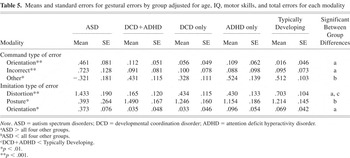
ANCOVAs were conducted comparing groups on each type of error using age, IQ, motor skills, and total number of errors to command or imitation as covariates (see Table 5). Including the total number of errors as an additional covariate controlled for associations between frequency of performance of specific error types and level of overall performance. Results indicated that, for gestures performed to command, significant group differences were found for orientation errors [F(4,193) = 5.49, p < .001, partial η2 = .102], incorrect action errors [F(4,193) = 5.35, p < .001, partial η2 = .100], and other errors [F(4,193) = 3.95, p = .004, partial η2 = .076]. Post hoc group contrasts showed that the ASD group made significantly more orientation and incorrect action errors than the other four groups and significantly fewer other errors. For gestures performed to imitation, significant group differences emerged for distortion errors [F(4,191) = 10.07, p < .001, partial η2 = .174], orientation errors [F(4,191) = 4.16, p = .003, partial η2 = .080], and posture errors [F(4,191) = 3.39, p = .01, partial η2 = .066]. Post hoc group contrasts revealed that the ASD group made significantly more distortion and orientation errors and significantly fewer posture errors than the other four groups. Children in the DCD+ADHD group made significantly fewer distortion errors than the typically developing control children.
Means and standard errors for gestural errors by group adjusted for age, IQ, motor skills, and total errors for each modality

DISCUSSION
This study sought to examine motor and gestural difficulties in children with ASD, DCD, and ADHD and to determine the extent to which deficits in gesture reflect impairments in motor skills. One objective of this study was to compare the severity of the motor difficulties displayed by children with ASD, DCD, and ADHD. Our findings were consistent with previous studies by Smith and Bryson (1994), Dewey et al. (2002), Piek et al. (1999), and others that have reported that children with ASD, DCD, and ADHD display deficits in motor skills compared with typically developing children. It is important to note, however, that not all children diagnosed with ADHD displayed impairments in motor functioning. This finding is consistent with previous research that has reported that approximately 30 to 50% of children with ADHD meet criteria for DCD (Kadesjo & Gillberg, 1998; Kaplan et al., 1998; Pitcher et al., 2003).
Examination of the severity of the motor impairments indicated that, overall, children with ASD were substantially more impaired than children with specific motor skills deficits. There was considerable variability among the children with ASD, however, and 41% of the children with this disorder did not meet criteria for motor impairment on the BOTMP. The few studies that have examined prevalence of motor deficits in children with AS have suggested that motor impairments are found in at least 80% or possibly in all children diagnosed with this disorder (Ghaziuddin et al., 1994; Green et al., 2002; Miyahara et al., 1997). The findings of this study suggest, however, that across the spectrum of ASD, motor deficits are common but they are not universal. It is important to note that we used only the BOTMP Short Form to assess the motor skills of children with ASD. It is possible that if we had used other measures such as the Movement Assessment Battery for Children (Henderson & Sugden, 1992), we might have obtained different results. It is also possible that specific patterns of motor functioning may be associated with a particular constellation of ASD symptoms. Additional research is needed to uncover such relationships.
Another study objective was to examine gestural performance in children with ASD, DCD, and ADHD. Although children with ASD, DCD, and DCD+ADHD displayed impairments in motor skills relative to typically developing controls, only the children with ASD showed deficits in the performance of gestures. Furthermore, this deficit was evident in gestures performed to verbal command and to imitation when level of motor functioning was taken into account. These results are consistent with those of Green et al. (2002), who reported that children with AS did less well than children with SDDMF on measures of gestural performance. The findings of this study were also consistent with those of Green et al. (2002) in showing that children with ASD made significantly more gestural errors than children with other neurodevelopmental disorders. In contrast to Green et al. (2002), however, we found differences in the types of errors that accounted for the higher number of total errors in children with ASD.
The fact that children with ASD displayed deficits in performing gestures to command and imitation even when overall level of motor skills was controlled for suggests that the gestural impairments found in these children are not just due to deficits in motor coordination. This suggestion is further supported by the finding that children with ASD made significantly more incorrect action and orientation errors and fewer other errors to command, and significantly more distortion and orientation errors and fewer posture errors to imitation than children with other neurodevelopmental disorders when level of motor functioning and total number of errors were taken into account. It has been suggested that the impairments in imitation seen in children with ASD reflect a deficit in the neural substrate for self–other mapping (Rogers & Pennington, 1991; Williams et al., 2004). This concept is supported by research that has found reversal errors on imitation in children with autism (i.e., the basic components of the imitation are correct, but the children are unable to alter their perspective accordingly; Hobson & Lee, 1999; Ohta, 1987; Whiten & Brown, 1999). Our finding that children with ASD displayed significantly more reversal errors (i.e., orientation errors) than typically developing control children and children with DCD and/or ADHD when performing gestures to imitation is consistent with the contention that deficits in self–other mapping could contribute to the deficits in gestural imitation noted in children with ASD. Williams and colleagues suggest that the neural mechanism for a deficit in self–other mapping might be based on mirror neurons (Williams et al., 2001, 2006). Recent neuroimaging studies of individuals with ASD have found evidence of diminished activation of mirror neurons in Broca's area, which could be involved in representing the meaning of movements (Nishitani et al., 2004), as well as in the right parietal cortex (Williams et al., 2006), which may contribute to coding of the kinesthetic aspects of movement (Iacoboni et al., 1999).
Dysfunction in the mirror neuron system, however, cannot account for all of the gestural deficits noted in the children with ASD. Deficits in sensory processes could also be responsible for some of the gestural problems (Piek & Dyck, 2004), particularly the inaccuracies in the force, timing, and amplitude noted in the gestures performed to imitation. To clarify the influence of sensory functioning on the performance of gestures in children with ASD, research that includes measures of movement force, timing, and amplitude needs to be conducted.
Deficits in the internal representation of movement could also underlie some of the problems in gestural performance seen in children with ASD (Smith & Bryson, 1994). Impairment in the internal representation of gesture has been associated with gestural deficits in children with DCD (Ayres, 1985; Denckla & Roeltgen, 1992; Wilson et al., 2001). Further research is needed, however, to reach more definitive conclusions concerning the contribution of impairments in internal representation to gestural performance in children with ASD.
It is also possible that deficits in language processes could contribute to the gestural deficits of children with ASD. Research suggesting a link between language and gestural performance in children with ASD includes work by Stone et al. (1997), who reported that motor imitation skills in children with autism improved from 2 to 3 years of age and that imitation of body movements was associated with expressive language. Rogers et al. (2003) also found that the verbal development quotient on the Mullen Scales of Early Learning (Mullen, 1989) was a significant predictor of imitative ability in young children with autism. Research that has reported that dysfunction in Broca's area is associated with deficits in language and imitation suggests a shared neural basis for these impairments. Our finding that children with ASD made more incorrect action errors to verbal command is consistent with the idea that impairments could exist in mechanisms that link the meaning of language to that of action (Rizzolatti & Arbib, 1998; Rizzolatti et al., 2001). Longitudinal studies that include a neuroimaging component could assist in determining if a causal relationship exists between language and gestural impairments, the direction of such a relationship, or whether the cause of language and gestural deficits in children with ASD is due to some other common factor, and if these deficits share the same neural underpinning.
Research has showed that the normal development of gestures proceeds along an orderly continuum from ages 2 to 12 years, at which time gestural abilities reach adult levels (Kaplan, 1968). Consistent with this finding, Dewey (1993) reported a linear improvement in gestural performance from 6 to 11 years of age in children with developmental motor deficits. Associations of better gestural performance with older age in the present study also support developmental changes in gestural skills. Studies of typically developing children have also suggested that gestural errors are developmental in nature (Kaplan, 1968). For example, 3-year-old children point to the area where an action should take place without making the correct gesture (e.g., they point to their mouth for brushing teeth), whereas, 4 year olds frequently displayed body-part-as-object errors. By 12 years of age, manipulation of the object of the action and body-part-as-object errors are made very infrequently. Research that has examined gestural errors in children with developmental motor deficits has found that the number and types of errors made were similar to those seen in younger control children (Dewey, 1993; Hill, 1998), suggesting that children with DCD display a delay in the development of gesture. The fact that the present study found few differences in the number and types of gestural errors made by children with DCD, ADHD, and DCD+ADHD compared with typically developing control children of a similar age suggests that, in these older groups of children with neurodevelopmental disorders, gestural skills have matured to normal levels. The presence of significantly more gestural errors in children with ASD, however, could be due to a delay in the development of these skills or an actual deficit. Williams et al. (2004) have suggested that autism is characterized by a delay in the normal development of imitation, that would impact gestural performance. This conclusion is based on evidence of no differences in gestural imitation among children with autism and control groups matched on verbal mental age (Libby et al., 1997; Morgan et al., 1989), and on findings that group differences in imitative skills diminished as children matured (Royeurs et al., 1998). However, prospective longitudinal studies that examine gestural development in children with ASD are needed to confirm this conclusion.
In summary, children with ASD, DCD, and DCD+ADHD were significantly impaired on motor coordination skills; however, only children with ASD showed a generalized impairment in gestural performance. Longitudinal studies investigating the sensory, language, and general neurocognitive abilities of children with these neurodevelopmental disorders could provide us with further insight into the mechanisms or processes that underlie these impairments. Such investigations need to consider that children with neurodevelopmental disorders are constantly changing due to their development and experiences and that they may display different patterns of deficits over their lifespan (Ahonen, 1990; Biederman et al., 2004; Hellgren et al., 1994). For example, studies of children with DCD have reported that many of these children outgrow their motor problems at adolescence (Cantell et al., 2003; Visser et al., 1998). Similarly, longitudinal studies of children diagnosed with ADHD have reported that only approximately one third continue to display ADHD into adulthood (Kessler et al., 2005). Thus to better understand the motor and gestural deficits displayed by children with neurodevelopmental disorders, studies that clearly chart the developmental profile of these skills are needed.
ACKNOWLEDGMENTS
The authors thank the Scottish Rite Charitable Foundation, Alberta Mental Health Research Fund, and the Alberta Children's Hospital Foundation for supporting this research. The authors also acknowledge the help of Bernadette Benson, Demetra Mylonas, Loretta Biasutti, and Debra Busic for their invaluable assistance with the conduct of the study. The information in this manuscript and the manuscript itself is new and original and is not currently under review by any other publication, and has never been published either electronically or in print.
Appendix
The gestures are as follows, following the verbal command “Show me how you”:
Brush your teeth with a toothbrush.
Comb your hair with a comb.
Eat ice cream with a spoon.
Hit a nail with a hammer.
Cut paper with scissors.
Write with a pencil.
Salute.
Pinch your nose.
Cross your fingers.
Make a fist.
Wave goodbye.
Snap your fingers.