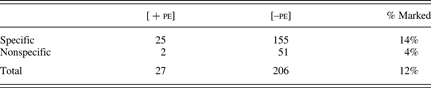
Differential object marking (DOM) refers to variation within a language as to whether or not a direct object is overtly marked; DOM is observed in a wide range of typologically diverse languages (cf., e.g., Aissen, Reference Aissen2003; Bossong, Reference Bossong1985a; Comrie, Reference Comrie1989; de Swart, Reference de Swart2007). The examples in (1) illustrate DOM in Paraguayan Guaraní, a Tupí-Guaraní language spoken by about four million people in Paraguay and surrounding countries. In (1), both (bold-faced) noun phrases are direct objects of the verb o-hecha (A3-see) ‘s/he/it saw’: in (1a), the coordinated direct object noun phrase Juán-chi ha Pirúlo ‘Juanito and Pirulo’ is marked with the suffix –pe; in (1b), on the other hand, the direct object ju'i ‘frog’ is not marked with –pe.Footnote 1
(1)
a. Context: While the frog was there,
o-hecha Juán-chi ha Pirúlo-pe o-ñe-moĩ o-hupi i-po ichupe.
A3-see Juan-dim and Pirulo-pe A3-je-put A3-raise B3-hand pronO.3
‘it saw Juanito and Pirulo getting ready to say good-bye.’
b. Context: As the little boy was preparing a bath for him and his dog,
o-hecha ju'i o-po-po o-hó-vo h-apykuéri-kuéra.
A3-see frog A3-jump-jump A3-go-when B3-behind-pl
‘he saw the frog coming, jumping and jumping behind them.’
In the cross-linguistic literature on DOM, a number of factors have been observed to condition whether a direct object is marked or not, including animacy (e.g., Kannada [Dravidian: de Swart, Reference de Swart2007], Romanian [Indo-European: Mardale, 2008]), definiteness and specificity (e.g., Hebrew [Afro-Asiatic: Aissen 2003], Kiswahili [Niger-Congo: Morimoto, 2002]), topicality (e.g., Persian [Indo-European: Shokouhi & Kipka, 2003], Spanish [Indo-European: Leonetti, 2004]), telicity (Spanish: García García, Reference García García, Heusinger, Kaiser and Stark2005), and whether nonmarking would result in ambiguity (e.g., Yongren Lolo [Sino-Tibetan: Gerner, Reference Gerner2008], Malayalam [Dravidian: de Swart, Reference de Swart2007]). Languages with DOM also differ in whether the conditions on DOM are categorical or not (cf., e.g., von Heusinger & Kaiser, Reference von Heusinger, Kaiser, Kaiser and Leonetti2007; Tippets & Schwenter, Reference Tippets and Schwenter2007). In Kannada, for example, animate direct objects, such as sekretari ‘secretary’ in (2a), must occur with the accusative marker –yannu (a categorical condition on marking) but inanimate objects, such as pustaka ‘book’ in (2b), may or may not be marked (a noncategorical condition), cf. de Swart (Reference de Swart2007:178–9), citing Lidz (Reference Lidz2006:11).Footnote 2
(2) Kannada (adapted from Lidz, Reference Lidz2006:11)
a. Naanu sekretari*(-yannu) huDuk-utt-idd-eene.
I.nom secretary-acc look.for-npst-be-1sg
‘I am looking for a secretary.’
b. Naanu pustaka(-vannu) huDuk-utt-idd-eene.
I.nom book-acc look.for-npst-be-1sg
‘I am looking for a book.’
This paper explores the synchrony and diachrony of DOM in Paraguayan Guaraní (henceforth Guaraní). The factors that condition DOM in the modern language are examined on the basis of a quantitative study of a corpus of naturally occurring data of modern Guaraní. Our approach thus differs from Bossong (Reference Bossong and Plank1985b), the only other extensive discussion of DOM in Guaraní, which was based, as far as we can tell, on a nonquantitative study of texts and consultants’ judgments of isolated examples.Footnote 3 The quantitative approach proves useful in identifying actual usage patterns and shows that topicality, an inherently discourse-based property not considered by Bossong, is a factor for DOM in Guaraní. We furthermore illustrate that conditions on DOM in this language are not categorical: Although Bossong claimed, for example, that definite direct objects that denote humans are categorically marked with –pe, our corpus as well as our consultants’ judgments show that such direct objects are acceptable both with and without the direct object marker –pe,Footnote 4 as illustrated in (3).
(3) Kuehe Juan o-hecha pe pa’í(-pe).
yesterday Juan A3-see that priest-pe
‘Yesterday Juan saw that priest.’
Our study shows that both animacy and topicality, but not definiteness, affect whether a direct object is marked in modern Guaraní. The study furthermore demonstrates that quantitative methods, which are underutilized in the exploration of DOM cross-linguistically (but see Aissen, Reference Aissen2003; von Heusinger & Kaiser, Reference von Heusinger, Kaiser, Kaiser and Leonetti2007; Tippets & Schwenter, Reference Tippets and Schwenter2007), can provide insight into, for example, subtle differences between noncategorical constraints on DOM.
The diachrony of DOM in Guaraní is explored on the basis of a study of a 17th-century Guaraní catechism. We find support for Bossong's (Reference Bossong and Plank1985b, Reference Bossong2009) claim that Guarani did not have differential object marking when it came into contact with Spanish. The paper concludes with a discussion of the hypothesis that DOM in Guaraní resulted from contact with Spanish.
ARGUMENT REALIZATION AND ARGUMENT MARKING IN gUARANÍ
This section introduces relevant aspects of argument realization and argument marking in Guaraní. Transitive and intransitive verbs in Guaraní are obligatorily inflected for person/number by either a set A or a set B cross-reference marker (cf. n. 1). Guaraní is a split-S language; the single argument of an intransitive verb, referred to as the S-argument following Dixon (Reference Dixon1979), is cross-referenced either by a set A or a set B marker, depending on whether the verb is active or stative. With transitive verbs, either the A- or O-argument is cross-referenced on the verb, depending on which one is higher on the person hierarchy (1 > 2 > 3); see Mithun (Reference Mithun1991) and Velázquez-Castillo (Reference Velázquez-Castillo2002) for details on argument marking in Guaraní. Verbal arguments in Guaraní need not be realized by independent pronouns or full noun phrases, as illustrated by the examples in (4). In (4a), the first-person S-argument is realized only by the first-person singular set A cross-reference marker a– on the verbal stem jeroky ‘dance’. In (4b), the first-person singular (direct object) O-argument of the transitive verb stem hecha ‘see’ (here realized as recha) is expressed with the first-person set B cross-reference marker che–; the (third-person) A argument is expressed by the overt noun phrase Felípa. In (4c), the direct object of the transitive verb stem topa ‘find’ is realized neither by a cross-reference marker (the third-person set A prefix o– cross-references the A-argument) nor by an overt noun phrase: The individual who is found is the (contextually salient) surgeon.
(4)
a. Context: What did you do at the party yesterday?
A-jeroky.
A1sg-dance
‘I danced.’
b. Context: The speaker was hiding from a group of women including Felipa, but made a noise.
Felípa che-recha.
Felipa B1sg-see
‘Felipa saw me.’
c. Context: They went to the health station to see if the surgeon was there.
O-topa hikuái ha o-mbyvy chupe.
A3-find pronS.3pl and A3-stitch pronO.3
‘They found him and he stitched her.’
As illustrated above, direct objects can be marked in Guaraní with the suffix –pe. The suffix is realized as –pe in oral environments, such as after pa'i ‘priest’ in (3), and as –me in nasal environments, such as after kuña ‘woman’:
(5) Kuehe a-hecha peteĩ kuñá-me.
yesterday A1sg-see one woman-pe
‘Yesterday I saw a woman.’
Similar to the marker used for DOM in other languages (e.g., Spanish a), this suffix also occurs with indirect objects and spatiotemporal dependents (where it expresses meanings such as ‘at’, ‘in’, ‘on’, and ‘to’; Gregores & Suárez, Reference Gregores and Suárez1967:236), as illustrated in (6a) and (6b), respectively. The suffix is glossed as pe regardless of its function, but the direct objects relevant to our study are bold-faced in the examples throughout the paper.
(6)
a. Ña María, ña María, rei-kuaa-ko mba’é-pa o-jehu Rossáni-pe?
Doña Maria doña Maria A2sg-know-emph thing-qu A3-happen Rossani-pe
‘Doña Maria, doña Maria, do you know what happened to Rossani?’
b. Che-váje-pe o-ĩ va'ekue peteĩ karai.
B1sg-town-pe A3-be back.then one gentleman
‘In my town, there used to be a gentleman.’
The direct objects of interest for this paper are those that are contained in transitive or ditransitive clauses where the direct object is or could have been marked with –pe, as in (1) and (3). Thus, we exclude from consideration indirect objects and spatiotemporal dependents, because they are not direct objects, proposition-denoting and incorporated objects, because they are never marked with –pe, as well as direct object arguments of verbs that require those arguments to be marked with a different object marker, such as –rehe ‘at, through, by, with, by means of’ (Gregores & Suárez, Reference Gregores and Suárez1967:240) or –gui ‘–abl’.
ANNOTATION OF THE GUARANÍ CORPUS
The corpus we annotated consists of nine Guaraní texts;Footnote 5 the total word count is about 6,500 words, which corresponds to about 20,000 English words as Guaraní is mildly polysynthetic. There were 233 clauses with (nonpronominal) direct objects in the corpus that conform to the inclusion criteria given in the previous section (pronominal direct objects are a special case, as discussed below). We annotated the direct objects of these clauses according to the four main factors that have been identified to play a role in DOM cross-linguistically, namely animacy, definiteness, specificity, and topicality.Footnote 6 This section illustrates the factors in detail and identifies, for each factor, how we annotated the Guaraní corpus.
Animacy
In languages where animacy is a factor in DOM, direct objects higher on the animacy hierarchy in (7) are more likely to be marked than ones lower on the hierarchy (e.g., Aissen, Reference Aissen2003; Comrie, Reference Comrie1989; de Swart, Reference de Swart2007).
(7) Animacy hierarchy: Human > Animate > Inanimate
An example of a language where animacy plays a role in DOM is Kannada (de Swart, Reference de Swart2007). As illustrated in the introduction, animate direct objects in Kannada must take an accusative marker, whereas inanimate objects may or may not take a marker. Other languages for which animacy has been reported to play a role in DOM include Hindi (Indo-European: Comrie, Reference Comrie1989), Hup (Makú: Epps, Reference Epps2008), Russian (Indo-European: Comrie, Reference Comrie1989), and Spanish (Indo-European: von Heusinger & Kaiser, Reference von Heusinger, Kaiser, Heusinger, Kaiser and Stark2003).
We determined the animacy of the 233 nonpronominal direct objects in our corpus on the basis of the denotation of the direct object. The examples in (8) illustrate a human direct object in (8a), a nonhuman animate direct object in (8b) and an inanimate direct object in (8c).
(8)
a. Context: After the woman gave birth, …
I-memby o-heja.
B3-child A3-leave
‘She left her child.’
b. Ro-gueru la ore-ñakyrã.
A1pl.excl-bring the B1pl.excl-cricket
‘We brought our cricket.’
c. Context: When the boy and his dog came to the pond, …
O-mbo-guejy i-mbayru-kuéra.
A3-caus-low B3-pack-pl
‘They lowered their packs.’
Because our corpus consists to a large extent of fables, where animals have humanlike abilities, anthropomorphized animals were categorized as human. Direct objects denoting body parts were annotated as animate.
Topicality
Topicality also has been shown to play a role in DOM cross-linguistically; more topical direct objects are more likely to be marked than less topical ones. Mardale (Reference Mardale2008) and Leonetti (Reference Leonetti2004), for example, argued that DOM in Spanish is not only conditioned by animacy, but also by topicality. It is claimed that although the Spanish differential object marker a cannot be realized with nontopical inanimate direct objects, as in (9a), it is optional when such objects are topicalized, as in (9b).
(9) Spanish (Mardale, Reference Mardale2008:451, glosses added)
a. Un buen sablazo de sol traspasaba (*a) la sacristia.
a good cut of sun pierced the vestry
‘A good cut of sun pierced the vestry.’
b. (A) la sacristiai lai traspasaba un buen sablazo de sol
the vestry 3.fem pierced one good cut of sun
‘A good cut of sun pierced the vestry.’
Although postverbal direct objects are more topical in Guaraní than preverbal ones (Velázquez Castillo, 1995), we did not rely on the position of the object relative to the verb for the encoding of topicality, but instead annotated the direct objects in the corpus for topicality using Givón's (1983) topicality measure, which has proven useful in previous research on Guaraní (e.g., Tonhauser & Colijn, Reference Tonhauser and Colijn2010; Velázquez-Castillo, Reference Velázquez-Castillo, Downing and Noonan1995). The topicality of a particular noun phrase is determined on the basis of two measures—referential distance and topic persistence. The first is a count of the number of clauses intervening between the noun phrase in question and the previous mention of its referent. The second is a count of consecutive subsequent clauses in which a mention of the referent of the noun phrase under consideration appears. Low referential distance is assumed to indicate high topicality, as is high topic persistence. We established the referential distance and topic persistence value for each of the 233 direct object noun phrases in the corpus. Following Givón (Reference Givón and Givón1983), we only considered the discourse referent of a noun phrase to be mentioned elsewhere if that referent was explicitly denoted by another noun phrase or was an implicit argument of another proposition, like the direct object in the first clause of (4c). Thus hypernym/hyponym pairs were not considered mentions of the same referent.
Definiteness and specificity
In languages where definiteness plays a role in DOM, direct objects that are more definite are more likely to be marked than those that are less definite (e.g., Aissen, Reference Aissen2003; de Swart, Reference de Swart2007). We assume the definiteness hierarchy of Aissen (Reference Aissen2003, 437,444):
(10) Definiteness hierarchy:
Personal pronoun
> Proper name
> Definite descriptive noun phrase
> Indefinite specific noun phrase
> Nonspecific noun phrase:
Definiteness plays a role in DOM in Hebrew, as illustrated in (11) with data from Aissen (Reference Aissen2003:453). The preposition ’et- (glossed ‘acc’, for accusative case) is obligatorily used with definite direct objects (e.g., those marked with the definiteness marker ha-), as in (11a), but may not occur with indefinite ones, as in (11b).
(11) Hebrew
a. Ha-seret her'a ’et-ha-milxama
the-movie showed acc-the-war
‘The movie showed the war.’
b. Ha-seret her'a (*’et-)milxama
the-movie showed acc-war
‘The movie showed a war.’
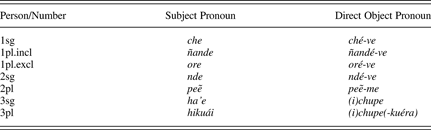
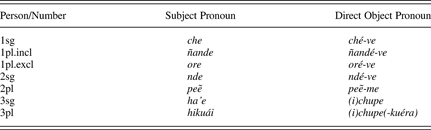
Our annotation of the definiteness of direct objects relies on the semantics of Guaraní noun phrase types, following Tonhauser and Colijn (Reference Tonhauser and Colijn2010). The first type of noun phrase in Aissen's hierarchy in (10) are pronouns. Whether direct object pronouns are part of the DOM system in Guaraní is an open question. As illustrated in Table 1, the direct object pronouns consist of the corresponding subject pronouns and the suffix –ve, not –pe, with two exceptions: the second-person plural direct object pronoun is marked with –me, the nasal allomorph of –pe, and the third-person object pronoun is the suppletive form (i)chupe.Footnote 7 The suffix –kuéra on the third-person plural direct object pronoun is the (optional) plural marker.
Subject and direct object pronouns
Gregores and Suárez (Reference Gregores and Suárez1967:109,141) argued that the suffix –ve is an allomorph of –pe (cf. also Dietrich (Reference Dietrich1986:128) on Chiriguano [Tupí-Guaraní, Bolivia]). Support for this analysis is that the second-person plural pronoun is marked with (the nasal allomorph of) –pe. The analysis furthermore would allow for a parallel treatment of pronominal and nonpronominal direct objects in that they are both marked. One could, however, also take a position according to which –ve is not an allomorph of –pe (and the suffix –me of the second-person plural direct object pronoun is an allomorph of –ve). Support for this position is that the suffix –ve only occurs with object pronouns, hence its realization is not phonologically conditioned. Ultimately, the question of whether –ve is an allomorph of –pe cannot be resolved in this paper. Our quantitative analysis is restricted to nonpronominal direct objects, direct objects that exhibit variation in marking. If –ve is an allomorph of –pe, direct object pronouns are categorically marked; if –ve is not an allomorph, direct object pronouns are not part of the DOM system of Guaraní. We entertain these two options at the relevant places in the remainder of the paper.
The corpus included several proper names, next on Aissen's hierarchy, such as Juan and Pirúlo, which we coded as such. The next class of noun phrases on the definiteness hierarchy is definite noun phrases. Following Tonhauser and Colijn (Reference Tonhauser and Colijn2010), we assume that, in Guaraní, this class is defined as those noun phrases that refer to discourse- or hearer-old entities (Gundel, Hedberg, & Zacharski, Reference Gundel, Hedberg and Zacharski1993; Prince, Reference Prince1981; Roberts, Reference Roberts2003). This class includes possessive noun phrases, as in (12a), demonstrative noun phrases, as in (12b), and noun phrases with the determiner la (borrowed from Spanish), as in (12c). The fourth type of Guaraní noun phrase that can be definite is bare noun phrases: noun phrases that only consist of nominal or adjectival predicates, but no other markers, as illustrated in (12d) and (12e). These noun phrases can refer to an entity previously introduced in discourse (discourse-old), as in the example in (12d), or to entities that had not been explicitly mentioned but are salient to the interlocutors in the discourse context (hearer-old), such as múndo ‘the world’ in the example in (12e).
(12)
a. O-ñami piko ñande-vaka Libória ra'e?
A3-milk qu.emph B1pl.incl-cow Liboria yet
‘Did Liboria milk our cow yet?’
b. Hasypevé-ko peina o-j-arreglá-ta ko asúnto.
finally-emph here A3-je-resolve-prosp this matter
‘Finally, here this matter is getting resolved.’
c. Context: A woman is talking about her grandmother's past chores.
Ha upéi o-vende-pá-rire la kamby …
and then A3-sell-complete-after the milk
‘And then, after she had sold all of the milk …’
d. Context: The boy arrives at a pond and climbs on a tree to see what he could catch.
O-hasá-vo upéi o-hecha ju’í-pe o-guapy y mbyté-pe peteĩ yrupẽ-’ári.
A3-pass-when then A3-see frog-pe A3-sit water middle-pe one sieve-one
[…] Ha o-ñe-moĩ i-kuã chã’i-haguã-icha hese. […] Juán-chi
and A3-je-put B3-finger bent-purp-like at.pronO.3 Juan-dim
nd-o-jurá-i ju’í-pe.
neg-A3-grab-neg frog-pe
‘In passing, he saw a frog sitting in the middle of the water on a water lily. […] And he started to grab at the frog. […] Juan didn't get the frog.’
e. Ja-korre múndo.
A1pl.incl-run world
‘We run the world.’
Guaraní has two types of indefinite noun phrases—noun phrases that denote entities that are discourse- and hearer-new: noun phrases marked with peteĩ ‘a/one’ and bare noun phrases. Both types of indefinite noun phrases can have a specific referent (indefinite specific noun phrase) or denote nonspecifically (nonspecific indefinite noun phrase). We follow Enç (Reference Enç1991) in assuming that proper names and definite noun phrases are necessarily specific. We annotated an indefinite noun phrase as specific if the speaker/writer could reasonably be assumed to have a particular individual in mind when uttering/writing the indefinite noun phrase (Donellan, Reference Donellan1966; Hintikka, Reference Hintikka, Hintikka, Suppes and Moravcsik1973; Ioup, Reference Ioup1977; Partee, Reference Partee, Davidson and Harman1972). The examples in (13) illustrate the two types of indefinite specific noun phrases. The noun phrase in (13a) is marked with peteĩ ‘a/one’ and is considered specific in this discourse context because the boy had a particular dog. The bare noun phrase in (13b) is also indefinite, despite its lack of the overt indefinite determiner peteĩ, because it introduces the individual frog into the discourse (cf. the context of (12d)), and nothing about the context of utterance would render the frog familiar to the discourse participants. Example (13b) was furthermore classified as specific, because the boy sees a specific frog.
(13)
a. Context: There once was a man who had a son called Juan.
O-guereko avei peteĩ jagua.
A3-have also one dog
He also had a dog.’
b. Context: The boy arrives at a pond and climbs on a tree to see what he could catch.
O-hasá-vo upéi o-hecha ju’í-pe o-guapy y mbyté-pe peteĩ yrupẽ-’ári.
A3-pass-when then A3-see frog-pe A3-sit water middle-pe one sieve-on
‘In passing, he saw a frog sitting in the middle of the water on a water lily.’
The examples in (14) illustrate the two types of indefinite nonspecific noun phrases. The indefinite noun phrase peteĩ mbatara ‘a vagabond’ in the antecedent of the conditional in (14a) does not denote a specific vagabond. The indefinite noun phrase in (14b) is nonspecific because the speaker did not want to catch a particular cricket.
(14)
a. A-mono’õ-rire pe tapé-rupi peteĩ mbatara…
A1sg-collect-after that path-through one fickle
‘After I take in a vagabond off the street …’
b. Context: When we were staying at my grandmother's house, we often went into the forest.
Ro-heka ñakyrã ha oi-me-raẽ-va vyra-’i ro-juga-haguã
A1pl.excl-search cicada and A3-exist-still-rc bird-dim A1pl.excl-play-purp
hese.
with.pronO.3
‘We looked for cicadas and any birds there in order to play with them.’
RESULTS OF THE SYNCHRONIC STUDY OF DOM IN GUARANÍ
Of the 233 nonpronominal direct objects, 27 were marked with –pe or its allomorph –me. The results of the quantitative study suggest that animacy and topicality, but not definiteness, are factors relevant for DOM in Guaraní. After presenting our findings, we compare them to those reported in Bossong (Reference Bossong and Plank1985b) and discuss their implications for cross-linguistic theories of DOM. In the following sections, statistical significance regarding binary feature values was determined via Fisher's exact test for independence. Statistical significance of the differences in scalar feature values, such as topicality measurements, was determined using the unpaired t test. All p values presented here are two-tailed; we assume a maximum p value for significance of .05.
Relevance of the individual factors
Animacy
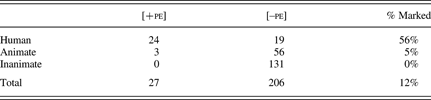
Table 2 gives the distribution of direct objects that are marked with –pe ([+pe]) and those that are not marked with it ([–pe]) across the three animacy categories. Over one-half of the human direct objects were marked with –pe (56%) in contrast to only 5% of animate noun phrases and no inanimate noun phrases. Humans are more frequently marked than animates and inanimates to a statistically significant degree (p < .001 for both), and there is also a statistically significant difference in marking frequency between animates and inanimates (p = .029).
Animacy and DOM
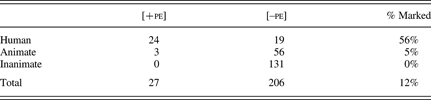
Because human direct objects are much more likely to be marked than animate and inanimate direct objects, animacy seems to be a factor relevant for DOM in Guaraní. Note also that of the 27 direct objects that are marked with –pe in the corpus, 24 are human.
The corpus data might also suggest that there is a categorical constraint against marking inanimate direct objects with –pe because no inanimate direct objects are marked. However, we have been able to identify examples of –pe-marked inanimate direct objects in texts not included in the corpus:
(15)
a. Pe tahachi n-oi-pysyrõ-i kuri pe mohenda-há-pe.
that police.officer neg-A3-save-neg back.then that locate-nmlz-pe
‘That police officer didn't save the computer.’
b. Pe tahachi piko n-oi-nupã-i ra'e peteĩ mba'eyru-guatá-pe?
that police.officer qu.emphneg-A3-hit-neg one cart-walk-pe
‘Didn't the police officer hit a car?’
Furthermore, Guaraní speakers we consulted accepted utterances where an inanimate direct object is –pe-marked:
(16)
a. Kuehe Aníta o-hupi pe kysé-pe.
yesterday Anita A3-lift that knife-pe
‘Yesterday Anita lifted that knife.’
b. E-ma’ẽ! Pe ita oi-nupa ko kasõ-me.
A2sg.IMP-look that stone A3-hit this pants-pe
‘Look! That stone hit these pants.’
Although all four speakers we consulted preferred the variants of (16) where the direct objects were unmarked, the acceptability of the examples in (16), along with attestation of sentences like those in (15) in Guaraní texts, demonstrates that there is no categorical constraint in Guaraní against the marking of inanimate direct objects.Footnote 8
Topicality
Table 3 gives the figures for the relation between topicality and DOM. The mean referential distance value for direct objects marked with –pe is significantly lower than that of direct objects not marked with –pe (9.37 versus 15.3) and the mean topic persistence value of direct objects marked with –pe is significantly higher than that of direct objects without –pe (3.26 versus .45).
Topicality and DOM

According to these figures, direct objects marked with –pe are more topical than direct objects not marked with –pe, which suggests that topicality is a factor in DOM in Guaraní: The more topical a direct object is, the more likely it is to be marked with –pe.
Definiteness and specificity
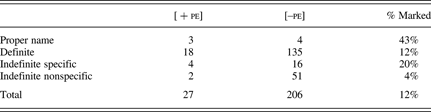
Whether definiteness is relevant for DOM in Guaraní is less clear. If definiteness played a role in DOM in Guaraní, we would expect to observe a relationship between the rank of a direct object on the definiteness hierarchy and frequency of marking. This is not obviously the case, as shown in Table 4, because, for example, both proper names and indefinite specific noun phrases are more frequently marked than the definite ones.
Definiteness and DOM
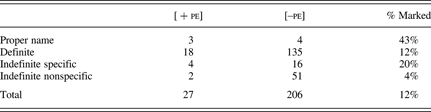
Rather than dismiss definiteness as a relevant factor for DOM in Guaraní on the basis of the data in Table 4, we entertain the hypothesis that the definiteness hierarchy as given in (10) is not suitable for Guaraní because it makes too many subdivisions among noun phrases. An alternative classification of Guaraní noun phrases groups together proper names and definite noun phrases as definite noun phrases, and specific and nonspecific indefinite noun phrases as indefinite noun phrases:
(17) Proper name > Definite NP > Indefinite specific NP > Nonspecific NP
Definite > Indefinite
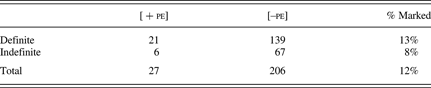
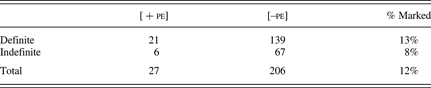
Table 5 gives the figures of definite and indefinite noun phrases that are (not) marked with –pe according to this new classification. The difference in –pe-marking between definite and indefinite noun phrases (13% versus 8%) is not statistically significant (p = .378), which again suggests that definiteness is not a factor relevant to DOM in Guaraní.
(Revised) Definiteness and DOM
Our data annotation also allows us to examine whether specificity rather than definiteness is a factor for DOM in Guaraní. A language where specificity plays a role in DOM is Turkish (Turkic: Enç, Reference Enç1991). We explored this hypothesis by comparing the marking of specific noun phrases (proper names, definite noun phrases, and specific indefinite noun phrases) to that of nonspecific noun phrases:
(18) Proper name > Definite NP > Indefinite specific NP > Nonspecific NP
Specific > Nonspecific
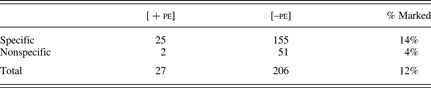
As shown in Table 6, 14% of specific noun phrases and 4% of nonspecific ones are marked with –pe. Although the difference in marking between specific and nonspecific noun phrases is statistically significant (p = .05), pointing to specificity playing a role in DOM in Guaraní, the p value suggests caution against overinterpreting this result. In the following section, we find further evidence that specificity is not a factor for DOM in Guaraní.
Specificity and DOM
Weighing the factors
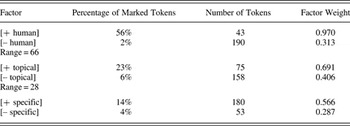
We used a variable rule analysis (Varbrul; Cedergren & Sankoff, Reference Cedergren and Sankoff1974) to examine the relative importance of the three factors identified as potentially playing a role in DOM in Guaraní— animacy, topicality and specificity—with binary oppositions of the three factors as factor groups: [+/– human], [+/– topical], and [+/– specific]. With the factor group [+/– human], we distinguish direct objects that denote humans ([+ human]) from those that denote nonhuman animate or inanimate entities ([− human]), because the latter two form a natural group in that –pe marking is quite rare for them (cf. Table 2). Whereas topicality is a gradual notion for Givón (Reference Givón and Givón1983), we transformed our topicality measures into a binary opposition for the purpose of the Varbrul analysis. We considered direct objects with a referential distance of 15 or lower as topical ([+ topical]) and those with a referential distance greater than 15 as nontopical ([− topical]), with the cutoff point of 15 being the mean referential distance value of direct objects.Footnote 9 The weight columns in Table 7 show the factor weight of the two binary factors for each factor group tested. A weight closer to 1 indicates that the factor favors marking, and a weight closer to 0 indicates that the factor disfavors marking; the range is the difference between the highest and lowest factor weights for each factor group, multiplied by 100. As shown in the table, both humanness and topicality (referential distance) contribute significantly to the model of variation, with humanness a stronger contributing factor than topicality (referential distance). Specificity did not contribute significantly to the model of variation. We, therefore, conclude that humanness and topicality (referential distance), but not specificity, condition DOM in Guaraní.
Variable rule analysis results for humanness, specificity, and topicality

Corrected mean = .03; Total N = 233, Log likelihood = –42.639
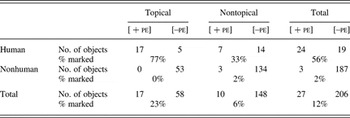
Humanness and topicality (referential distance) cannot be reduced to one or the other. As shown by the cross tabulation in Table 8, there is a statistically significant difference in marking frequency between human and nonhuman topics (p < .001), as well as a statistically significant difference in marking frequency between topical and nontopical humans (p < .01). Thus, stating the analysis strictly in terms of topicality (referential distance) or humanness alone would miss important generalizations.
Humanness, binary topicality (referential distance), and DOM

As none of the topical nonhuman direct objects are marked with –pe, our data also suggest that Guaraní does not provide support for Laca's (2006:431) finding that global constraints, such as topicality, can lead to a marked inanimate object, that is, can override the inherent unmarkedness of such objects that is due to local factors, such as animacy and definiteness.
Interim conclusions
The results of the preceding two sections motivate the following conclusions about the distribution of DOM in Guaraní:
(19) The distribution of DOM in Guaraní:
a. If a direct object denotes an inanimate entity, it strongly disfavors marking.
b. If a direct object denotes an animate entity, it disfavors marking, but it is more frequently marked than direct objects denoting inanimate entities.
c. Whereas direct objects denoting humans are already marked with above-average frequency regardless of topicality, those direct objects that denote highly topical humans favor marking more strongly than those that denote less topical humans.
Comparison with Bossong's (Reference Bossong and Plank1985b) analysis of DOM in Guaraní
A detailed discussion of DOM in Guaraní and related Tupí-Guaraní languages is found in Bossong (Reference Bossong and Plank1985b). His analysis was based on data reported in grammars of Guaraní (e.g., Bottignoli, Reference Bottignoli1926; Dessaint, Reference Dessaint1981; Gregores & Suárez, Reference Gregores and Suárez1967; Guasch, Reference Guasch1976), texts contained in these grammars, a translation of the Bible, and native speaker judgments. Bossong assumed that the position of a particular direct object on the two hierarchies in (20), which he took to be universal, affects whether it is marked with –pe or not. The “Skala der Belebtheitsmerkmale” in (20a) is a version of the animacy hierarchy; it ranks pronouns (deix) above proper names (propr) above NPs denoting humans (hum) above NPs denoting personified animals (pers), above NPs denoting discrete entities (discr), above NPs denoting concrete entities (concr). The “Skala der Referenzmerkmale” in (20b) is a hierarchy of referential properties; it ranks objects whose referents are identifiable to both speaker and hearer above objects with referents identifiable only to the speaker, above objects with referents identifiable to neither.
(20) Bossong (Reference Bossong and Plank1985b:3)
a. Skala der Belebtheitsmerkmale:
[+/– deix] < [+/– propr] < [+/– hum] < [+/– pers] < [+/– anim] < [+/– discr] < [+/– concr]
b. Skala der Referenzmerkmale:
[+ ident ego ∧ + ident tu] < [+ ident ego ∧ – ident tu] < [- ident ego ∧ – ident tu]
We have organized Bossong's (Reference Bossong and Plank1985b:17–25) claims about the (non-)marking of different kinds of direct objects in Guaraní in (21) according to whether the direct object is obligatorily marked (21a), optionally marked (21b), or never marked (21c).
(21)
a. Obligatorily marked:
i. Definite direct objects denoting humans are always marked (p.20),Footnote 10 as are personal pronouns and proper names (p.19f.).
ii. Direct objects that denote animals that are identifiable individuals ([+pers], ‘mit einer ‘Persönlichkeit” (with a personality)) are always marked (p. 17) as are direct objects that denote anthropomorphized animals ([+pers, – hum, + anim]) when the object is definite (p. 22).
b. Optionally marked:
i. A direct object that is the theme and realized preverbally can be marked even when the object denotes an animate (nonhuman) entity (p. 18).
ii. Indefinite direct objects can be marked if they denote a human ([+hum]) or an individually identifiable entity ([+pers]) (p. 23f.).
iii. Indefinite direct objects denoting humans can be marked but are usually not (p. 21).
iv. If the denotation of a direct object is not individually identifiable, the direct object is typically not marked even if it denotes a human (p. 17–18).
v. Direct objects that denote anthropomorphized animals ([+pers, –hum, + anim]) are usually unmarked when the object is indefinite (p. 22).
c. Obligatorily unmarked:
i. Direct objects that denote inanimate entities are never marked, regardless of whether they are definite or not (p. 24).
ii. Nondiscrete or nonconcrete entities are never marked (p. 24).
Bossong's analysis of DOM in Guaraní agrees with ours with respect to the types of direct object in (21b) for which the conditions on marking are noncategorical. However, our quantitative study provides counterexamples both for Bossong's claim that certain direct objects are obligatorily marked (21a) and his claim that certain direct objects are obligatorily unmarked (21c). The corpus data in (22) are empirical evidence against the first claim as both the definite direct object pe mitã ‘that child’ in (22a) and the proper name in (22b) are unmarked, contrary to (21ai).
(22)
a. Context: A child had been abandoned by its mother.
O-mo-ngakuaa karai pe mitã.
A3-caus-grow gentleman that child
‘The gentleman raised that child.’
b. A-topa upépe Libória o-guapy.
A1sg-find there Liboria A3-sit.down
‘There I found Liboria sitting down.’
Bossong's claim that direct objects that denote animals with a personality or anthropomorphized animals are obligatorily marked (21aii) is harder to assess because Bossong did not give principled criteria that would allow one to decide whether a particular animal has a personality or is anthropomorphized. Thus, one could take the position that the indefinite direct object peteĩ jagua ‘a dog’ in (23) is not anthropomorphized and does not have a personality, and hence is not marked with –pe. At the same time, one could argue that this particular dog has a personality (it has been given a name) and is anthropomorphized, as indicated by the fact that the dog later in the story chats with Juan and has independent thoughts, for example; it critiques Juan for not being able to catch the frog. If this is the case, we would expect the noun phrase to be marked on the basis of (21aii)—whether it is unmarked because the dog does not have a personality or is anthropomorphized, or because marking would go against (21biii), cannot be resolved given the criteria Bossong provided.
(23) Context: There once was a boy called Juan.
O-guereko peteĩ jagua h-éra-va Pirúli.
A3-have one dog B3-name-rc Piruli
‘He had a dog whose name was Piruli.’
Our consultants’ judgments of such examples again varied, as illustrated with the discourse in (24), in which a toad, a frog, and a turtle are personified:
(24) Mbohapy mymba o-jo-topa y rembe’ý-pe o-ñemongeta-haguã:
three animal A3-recip-meet water beach-pe A3-chat-purp
peteĩ kururu, peteĩ ju'i ha peteĩ karumbe. Kururu i-pire-vai-éterei
one toad one frog and one turtle toad B3-skin-bad-very
o-karu heta-íterei-gui. O-hechá-vo ju’í-pe, oi-nupa chupe.
A3-eat much-very-abl A3-see-when frog-pe A3-hit pronO.3
Karumbe o-ja'o kururú-pe. Ju'i o-ñañuã karumbé-pe.
turtle A3-chastize toad-pe frog A3-hug turtle-pe
‘Three animals met at the side of a lake to chat: a toad, a frog, and a turtle. The
toad was in a bad mood since he had eaten too much. When he saw the frog,
he hit him. The turtle chastised the toad. The frog hugged the turtle.’
The (bold-faced) direct objects in these utterances are definite and denote either animals with a personality or anthropomorphized ones, but the three consultants we asked only judged the first of the three (ju'i ‘frog’) to be obligatorily marked, whereas marking was optional or even dispreferred for the other two (kururu ‘toad’ and karumbe ‘turtle’). This again suggests that Bossong's claim in (21aii) may be too strong.
Bossong also argued that direct object pronouns are always –pe-marked. As discussed previously, this argument rests on the assumption that the suffix –ve is an allomorph of –pe. If this is the case, then direct object pronouns are obligatorily marked; in fact, they are the only kind of direct object that is obligatorily marked. If, on the other hand, direct object pronouns should not be considered –pe-marked versions of the subject pronoun series, then Guaraní has no direct objects that are obligatorily marked.
Evidence against Bossong's claim that the direct object types in (21c) are obligatorily unmarked comes both from our consultants’ judgments and from the corpus. For example, three of our four consultants judged example (25) with the direct object pe ita ‘that stone’ to be acceptable both with the object marker –pe and without it.
(25) Kuehe Juan o-nupã pe itá(-pe).
yesterday Juan A3-hit that stone(-pe)
‘Yesterday Juan hit that stone.’
Likewise, the definite and the indefinite direct object noun phrases in (15) denote inanimate entities but are marked with –pe. Thus, both consultants’ judgments and naturally occurring examples empirically falsify Bossong's claim in (21ci) that direct objects that denote inanimate entities are never marked.
Bossong also argued that direct objects that denote nonconcrete or nondiscrete entities are never marked with –pe, cf. (21cii). Nonconcrete referents are those that are not physical or tangible, but abstract (Hopper & Thompson, Reference Hopper and Thompson1980), and include “things like air, voice, wind, and other intangibles,” according to, for example, Zaenen, Carletta, Garretson, Bresnan, Koontz-Garboden, Nikitina, O'Connor, and Wasow (Reference Zaenen, Carletta, Garretson, Bresnan, Koontz-Garboden, Nikitina, O'Connor, Wasow, Webber and Byron2004:121). Bossong (Reference Bossong1983–1984) assumed that discrete entities are countable and that “discrete entities form a subclass of the concrete ones” (p. 9). Our corpus does not contain examples with such noun phrases, but the Guaraní speakers we consulted with about such examples gave somewhat mixed judgments. None of the three speakers considered (26a) with the nonconcrete direct object mborayhu ‘love’ or (27a) with the nondiscrete direct object aramirõ ‘mandioka flour’ acceptable with –pe (or its nasal allomorph –me). In contrast, only two of the three speakers did not consider (26b) with the nonconcrete direct object yvytu ‘wind’ or (27b) with the nondiscrete direct objects aro ‘rice’ acceptable with –pe, but one speaker judged both of these examples to be better with –pe than without.
(26)
a. Ai-pota mborayhu.
A1sg-need love
‘I need love.’
b. A-heka yvytú(-pe).
A1sg-search wind-pe
‘I search for wind.’
(27)
a. María oi-kotevẽ aramirõ.
Maria A3-need mandioka.flour
‘Maria needs mandioka flour.’
b. María o-hecha aró(-pe).
Maria A3-see rice-pe
‘Maria sees rice.’
The acceptability of (26b) and (27b) with –pe-marking to at least one of the three speakers suggests that a categorical rule such as Bossong's (21cii) may be too restrictive. However, a more systematic study using naturally occurring data might be better suited to shed light on this matter.
In conclusion, though we agree with Bossong that Guaraní has DOM, our study shows that the categorical constraints on DOM in Bossong's analysis are not empirically supported and that topicality plays a role in DOM in Guaraní. Our study also illustrates the value of using quantitative methods in the study of DOM (cf. also Aissen, Reference Aissen2003; von Heusinger & Kaiser, Reference von Heusinger, Kaiser, Kaiser and Leonetti2007; Tippets & Schwenter, Reference Tippets and Schwenter2007). In contrast to the methodology used by Bossong, that is, elicitation of (binary) judgments of grammaticality (see also, e.g., Comrie, Reference Comrie1989; Leonetti, Reference Leonetti2004; Morimoto, Reference Morimoto, Butt and King2002; Næss, Reference Næss2004; Schwenter & Silva, Reference Schwenter and Silva2002; de Swart, Reference de Swart2007), our study, which combines both methods, reveals both that the constraints are not categorical as well as subtle differences between noncategorical constraints on DOM in Guaraní (cf. Table 8 and the analysis in (19)).
Implications for cross-linguistic theories of DOM
Our quantitative analysis of DOM in Guaraní shows that topicality plays a role in determining whether a direct object is marked or not; cf. also, for example, Iemmolo (Reference Iemmolo2010), Laca (Reference Laca and Pensado1995), Leonetti (Reference Leonetti2004), and Shokouhi and Kipka (Reference Shokouhi and Kipka2003) for the relevance of topicality for DOM in a variety of other languages. Cross-linguistic theories of DOM, however, do not typically include topicality as a factor. The theory developed in Aissen (Reference Aissen2003), for example, relies on animacy and definiteness: Prototypical direct objects are assumed to be inanimate and indefinite, with the result that atypical objects, those that are definite and human, are the most likely to be marked in a language with DOM. Another cross-linguistic theory of DOM is based on Hopper and Thompson's (1980) idea that, cross-linguistically, certain morphosyntactic and semantic features of a clause correspond to varying degrees of transitivity (cf., e.g., Næss, Reference Næss2004, Reference Næss2007; de Swart, Reference de Swart2007). Topicality also plays no role in this theory of DOM according to which clauses containing definite/animate objects are more prototypically transitive and thus more amenable to morphosyntactic realizations of transitivity, such as overt object marking. Though we are not the first to identify topicality as a relevant factor in DOM, our finding that topicality plays a role in DOM in Guaraní further emphasizes the need to include topicality in cross-linguistic theories of DOM. In the context of Aissen's theory, for example, the results of our study might suggest that typical direct objects denote nonhuman, nontopical entities, and that direct objects that denote human and/or topical entities are atypical and hence most likely to be marked; in terms of Hopper and Thompson (Reference Hopper and Thompson1980), the Guaraní results might suggest that clauses containing direct objects that denote human, topical entities are more prototypically transitive (see Shain, Reference Shain2009, for further discussion).
THE DIACHRONY OF DOM IN GUARANÍ
This last section explores Bossong's hypothesis that Guaraní did not have DOM at the time it came into contact with Spanish in the 16th century,Footnote 11 but that “the formation of DOM with all its semantic properties, was actualized by language contact” with Spanish (Bossong, Reference Bossong2009:13). We focus here on the first part of the hypothesis, namely that Guaraní did not have DOM at the time it came into contact with Spanish. Bossong's evidence for this claim is his observation that several grammars of Guaraní written by Jesuits during the 16th and 17th centuries, such as de Anchieta (Reference de Anchieta1595), de Aragona (ca. Reference de Aragona and Meliá1625), and de Montoya (Reference de Montoya1640a) did not mention the possibility of marking a direct object with –pe.Footnote 12 This was the case even for examples with proper name direct objects, such as (28), which de Montoya (Reference de Montoya1640a) claimed is ambiguous as to which noun phrase functions as the direct object.
(28) Peru o-mbo'e Chua.
Pedro A3-teach Juan
‘Pedro teaches Juan’ or ‘Juan teaches Pedro’ (de Montoya, Reference de Montoya1640a:35)
Bossong argued that if a direct object marker had been available to disambiguate examples such as (28), it is likely that one of these 16th- and 17th-century grammar writers would have mentioned it.
We agree with Bossong that this silence is suggestive, but we show here that his hypothesis can be strengthened by examining the marking of direct objects in early Guaraní texts. The text we exhaustively surveyed to identify whether there is any evidence for DOM is one of the earliest published in Guaraní, namely de Montoya's 17th-century catechism (de Montoya, Reference de Montoya1640b).Footnote 13 Our findings support Bossong's claim in two ways. First, we found no instances of direct objects marked with –pe or upe, even though the language already used –pe (and its allomorph –me) at the time to mark spatiotemporal dependents and upe to mark indirect objects. Second, we found several instances of direct objects that would be very likely be marked in modern Guaraní, such as human and topical direct objects, that were not marked in the 17th-century text. Some of these are given in (29) together with the referential distance (RD) and topic persistence (TP) value of the direct object referent; we added glosses as needed.
(29)
a. Ere-ayhu Tupã-ne mba'e pãvẽ asoce. [RD = 2, TP = 1]
you-love God-will thing
‘Love God more than all other things.’ (de Montoya, Reference de Montoya1640b:10)
b. A-rovia ave Jesu Christo. [RD = 2, TP = 9]
I-believe Jesus Christ
‘I believe also in Jesus Christ.’ (de Montoya, Reference de Montoya1640b:5)
c. Hũmãme Tupã aipo Angeles i-mõñãngi ra'e? [RD = 1, TP = 17]
where God those angels he-create
‘Where did God create those angels?’ (de Montoya, Reference de Montoya1640b:72)
d. Ha'e-nia o-hecha Tupã ne. [RD = 1, TP = 1]
he he-see God will
‘He will see God.’ (de Montoya, Reference de Montoya1640b:33)
The direct objects in these examples denote God (28a,d), Jesus Christ (28b), or angels (28c). Their RD value is very low, indicating their high topicality. Despite denoting (super-)human entities and being highly topical, none of these direct objects are marked,Footnote 14 thus strongly suggesting that 17th-century Guaraní did not have DOM. To conclude, our analysis of a 17th-century Guaraní text has provided further support for the hypothesis, originally formulated by Bossong, that Guaraní did not have DOM when it came into contact with Spanish.
Against this background, one can now explore the second part of Bossong's hypothesis, which is that the contact with Spanish led to DOM developing in Guaraní. This hypothesis is motivated especially because the two languages have been in contact for over 500 years, which has led to lexical and other grammatical borrowings in both languages (e.g., Choi Reference Choi2000; Dietrich Reference Dietrich1993, Reference Dietrich and Zimmerman1995; Giménez Caballero Reference Giménez Caballero1966; de Granda Reference de Granda1996; Usher de Herreros Reference Usher de Herreros1976). We cannot explore this hypothesis here but offer two points for consideration. The first point is that some but not all Tupí-Guaraní languages closely related to Guaraní also have DOM systems: Mbyá Guaraní does (Bossong, Reference Bossong2009, Reference Bossong and Plank1985b; Martins, Reference Martins2003), but not, for example, Chiriguano (Dietrich, Reference Dietrich1986:127f.). An investigation of the extent of contact between Spanish and these languages might provide insight into whether it is reasonable to conclude that Guaraní and Mbyá Guaraní, but not Chiriguano, developed DOM systems as a result of this contact. Relevant in this regard is the finding that Spanish already had DOM when it came into contact with Guaraní in the 16th century (cf. von Heusinger & Kaiser, Reference von Heusinger, Kaiser, von Heusinger, Kaiser and Stark2005; Laca, Reference Laca and Company2006).
This also relates to our second point, which concerns the set of conditions on DOM, which differ in the three modern languages (Guaraní, Spanish, and Mbyá Guaraní). In both Guaraní and Spanish, animacy and topicality are relevant to DOM, but the two factors do not play the same roles (e.g., because human direct objects may be marked in Guaraní, and are more likely to be marked if topical, but must be marked in Spanish, regardless of their topicality), and constraints on DOM that are claimed to be categorical in Spanish (e.g., the marking of human direct objects) are not in Guaraní, although they may also not have been categorical in Spanish at the time the two languages came into contact, cf. Laca (Reference Laca and Company2006). The conditions on DOM in Mbyá Guaraní seem to again be different: Martins (Reference Martins2003) argued that the object marker is to disambiguate transitive utterances where there is an indeterminacy as to which noun phrase is the subject and which is the object (cf. the 17th-century Guaraní example in (28)), whereas Bossong (Reference Bossong and Plank1985b) argued that –pe is used in Mbyá Guaraní to mark only definite animate direct objects. Why are the conditions on DOM in Guaraní and Mbyá Guaraní different? One hypothesis is that DOM is borrowed for one particular type of direct object and then spreads to other types over time. According to this hypothesis, DOM in the two languages would be different because Guaraní has been in contact with Spanish longer than Mbyá has, see also Bossong (Reference Bossong and Plank1985b:13), or because the two languages may have borrowed DOM for different kinds of noun phrase types. An alternative hypothesis is that perhaps the conditions on DOM in 16th-/17th-century Spanish, which Guaraní came in contact with, were different from those of the Spanish that Mbyá Guaraní came in contact with, such that DOM in Guaraní and Mbyá differs because the contact languages differ.