In 1972 Robert Christgau reviewed the album Catch Bull at Four by Cat Stevens, devoting his review, entirely and unusually, to a single song, the second of 10 songs divided equally between the record's two vinyl sides:
Reading the lyric of ‘The Boy with the Moon and Star on His Head’, I was impressed by how unpretentiously it simulated early English poetry. But when I listened – a widely recommended method for that perception of songs – I noticed affectations like ‘the naked earth beneath us and the universe above’, and winced at the next-to-last couplet, which ends with a weak word for the sake of a weak rhyme. Then I browsed in Norman Ault's [1928] anthology of Elizabethan lyrics. Forget it, Cat. CFootnote 1
Beginning with an article first published in 1967 and entitled ‘Rock lyrics are poetry (maybe)’,Footnote 2 Christgau occasionally wrote about words in songs using the same terms, directly so, as poems on the printed page, as though he was working out which of the two word-forms, song and poem, was the more important,Footnote 3 and there is a retrospective sense that this may have been a rare historical moment when words in song, on the one hand, and page poetry, on the other, could so directly be compared. The moment passed and Christgau's text-based criticism became concerned more with internal conversations within recorded rock and pop music: connections, allusions, references. Among the 83 words of this review, there are three or four illustrations of how Christgau went about evaluating the words to this song: first, and again unusually, he reads the words on the album cover before listening to the track; secondly, he makes comparisons, with early English and Elizabethan verse, which are external to the songFootnote 4; finally, the song is criticised in two ways, for the ‘affectations’ of a particular line, and for a technical failing in a particular couplet. The album is then given its low grade: Christgau's C grade described at the time ‘a record of clear professionalism or barely discernible inspiration, but not both’.Footnote 5
In this paper, I suggest that this particular song was a good one to focus on, and for reasons similar to those of Christgau, that the words in songs are in some ways similar to those of poetry; however, I differ from Christgau in the method of demonstration. My focus is on this particular song, whereas Christgau's currency was almost always the album.Footnote 6 I aim to suggest that this song is compelling as an example of a particular moment in what was at the time a musical form gaining in importance: the singer-song, where, as well as inventing the music and performing the song, words are also invented by the one person. In so doing, I shall present what I claim to be an accurate transcription of the words to this song, one which balances the presentation of words arranged to look like a poem with the presentation of words as they appear in sheet music. The paper is concerned with formal aspects of words in song, so that details of biography, reception and cultural impact are barely examined,Footnote 7 and I fear that Christgau would find this approach ‘evasive if not effete’.Footnote 8 The register adopted in the paper varies between close textual analysis and passages of a more critical or discursive nature, especially concerning the song's subject matter, while evidence found in the song gives rise in the final section to a degree of speculation, intended as a prompt to further work.
In considering more closely the status of words in song alongside terms taken from the analysis of poetry, I build on the work of Simon Frith and, in transcription, on the work of Johan Fornäs and Barbara Brady and my own work. Frith has written extensively and with increasing pincer accuracy on the relationship between words in songs and poetry. Perhaps as someone for whom words are ‘the least of my musical pleasures’ (Frith Reference Frith1996, p. 326), Frith tends to deflect from words as such towards musical contexts, notably an emphasis on voice in musical performance, and was directly influential on Christgau in this regard.Footnote 9 Where Frith discusses aesthetic principles with a vigorous and erudite range of reference, Fornäs's work is useful in thinking through exact meanings for terms such as words, lyrics and music. More so than Frith, Fornäs also engages in close discussion of specific texts, and includes an illuminating discussion of modes of transcription of passages from two tracks (‘Tictoc’ and ‘Rodney King’) by a rap band, LPC (Fornäs Reference Fornäs2003). Bradby included brief transcriptions of girl-group records as early as 1990 (Bradby Reference Bradby, Frith and Goodwin1990, pp. 361–3) and, in a later article, a full transcription of ‘In the Still of the Nite’ by the Five Satins (Bradby Reference Bradby2002, pp. 66–7). My own published chapter contained two aspects, a historical schema (‘lyric to anti-lyric’) and a taxonomy or analytical methodology relating to various categories of sound (rhyme, alliteration) and rhythm (‘verbal space’). Where the chapter gathered examples from a wide historical range, I applied and extended the analytical methodology in a monograph on a specific songwriter, Elvis Costello (Griffiths Reference Griffiths and Moore2003; Reference Griffiths2007, pp. 106–19). A full transcription of ‘Midnight Train to Georgia’ by Gladys Knight and the Pips appears in Griffiths (forthcoming).
Catch Bull at Four was the fourth album issued by Cat Stevens on Island Records since 1970, all produced by Paul Samwell-Smith. It followed upon the commercial success enjoyed by its immediate precursors, Tea for the Tillerman (Reference Stevens1970) and Teaser and the Firecat (Reference Stevens1971). ‘The Boy with a Moon and Star on his Head’Footnote 10 lasts 5 minutes 55 seconds, and consists of 24 lines of words sung to a repeated chord progression. The recorded performance consists mainly of, and builds upon Stevens's voice and an acoustic guitarFootnote 11; as the recording progresses, backing vocals and other instruments are added.
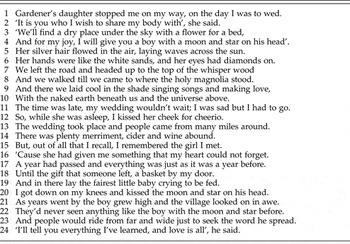
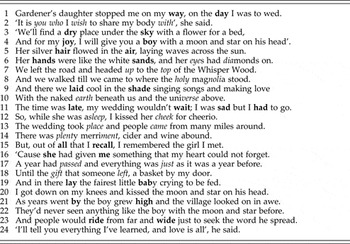
In Table 1 the words to the song are arranged as 24 lines, with hard left-hand margin and variable right, corresponding to our familiar image of the printed poem. The lines are numbered for reference.
Words to ‘The Boy with a Moon and Star on His Head’.

The song's subject matter
This brief discussion of the song's subject matter is strictly outside the paper's chief concern, but is included in order to prompt further consideration of this song in particular.
I think that the first and salient question is: what does it mean to be a ‘boy with a moon and star on his head’? It could be any boy on a clear night; it could be the boy found on Stevens's painting for the front cover of Teaser and the Firecat,Footnote 12 which included the familiar song ‘Moon Shadow’; more realistically, it could be a boy wearing a hat which happens to include badges of a moon and star (like those found on the berets sported by the singer Richard Thompson). Children's books often feature the moon and stars.Footnote 13 Perhaps astronomical gazes also prompt religious thoughtsFootnote 14: appearing twice in the Stevens song, in line 4 the boy is mystic, tied to the promise of free love – the magnolia of line 8 is ‘holy’ – but, by line 22, the boy has grown and bears some similarity to Jesus Christ, as people flock to hear him proclaim his one message: ‘Love is all’.Footnote 15 ‘Love is all you need’: the Beatles in 1967.Footnote 16
The timescale of the song is disjointed. The first 12 lines must happen on the morning of the singer's wedding day since, at line 11, ‘the time was late’ and the singer hurries to reach the wedding, which takes place presumably that afternoon, and in only two lines (13–14). Like Stanley Holloway in My Fair Lady, I'm concerned about getting him to the church on time, if church it was, not least since he would need possibly to clean or change his clothes, scuffed from sitting or lying on the ‘naked earth’ of line 10. I imagine the songs sung in line 9 as up-tempo numbers rather than time-consuming ballads, unisons rather than complicated two-part arrangements, and it's unlikely that he or she should have a guitar to hand in order to provide harmonic support. The wedding swiftly over, lines 15–16 find the singer ruminating, possibly later on the wedding day itself. After this things run more equably in the distribution of lines: lines 17–20 take place one year later, leaving the final four lines (21–24) to take place after an unspecified number of years that ‘went by’.
I have to suggest that what we learned to call the ‘gender politics’ of the song are troublesome. This is the song of a heterosexual man, involving a wedding and procreation, and its first 12 lines are a shining example of ‘free love’, as defined in The Hippie Dictionary: ‘the practice of making love freely, whenever and with whomever one wishes’ (McCleary Reference McCleary2002, p. 185). That said, there must be few times when such giddy confidence would be as inappropriate as on a wedding day.Footnote 17 The singer's wife is notably absent in the song: even at the wedding, having arrived there with some reluctance, the singer is more interested in the drinks and guests (lines 13–14). Presumably, when the ‘fairest little baby’ is left at the singer's door, ‘crying to be fed’ (line 19), his wife has to accept him and become a foster-mother: the timing of ‘one year’ leads us to think that this baby was conceived on the wedding day, so that ‘making love’ in line 9 describes sexual intercourse rather than courting.Footnote 18 With this in mind I suggest the following couplet between lines 20 and 21 as recompense, a way of bringing the singer to his senses and down to earth, and another image of stars above the head:Footnote 19
My wife was happy to change his nappy, but otherwise saw red.
A whack so hard that cartoon stars appeared above my head.
Unlike the mute, invisible wife, the ‘gardener's daughter’,Footnote 20 on the other hand, is given considerably more attention and a voice and, one might argue, is a woman suitably ‘empowered’, within the uncommon and tangled triangle of free love on a wedding day. However, even she is abandoned only with a kiss, ‘for cheerio’, while fast asleep; not much, one would think. She is described in lines 5–6 with three visual metaphors: ‘silver hair’, hands ‘like the white sands’ and eyes with ‘diamonds on’, and such pretty magic also informs the ‘flower for a bed’, the gently alliterative ‘whisper wood’ of line 7 and, again and of course, the title and its childhood innocence.
Thus do we hear the song both as Cat Stevens himself in 1972, reflecting the mores of the day, and as Cat Stevens affecting a persona belonging to an unspecific past.
The song's musical structure
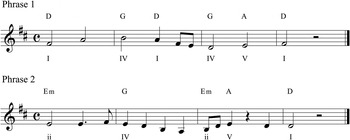
In the key of D major, the music to the song consists of two recurring chord sequences, found in the first example, which shows the outline melody with chords (Example 1). Both sequences end in perfect cadences. However, there are various variants and extensions.
Outline Melody with chords

There are two types of variation within the chord sequences themselves: one is a rhythmic augmentation within the line (effectively a pause mark), found in the penultimate chord of line 10, and in two chords of line 24, including its penultimate chord. The other variation within the line is the substitution of B minor for G as the approach to the dominant at line 11, corresponding, in the manner of word-painting, to the word ‘sad’.
At the end of the musical line, extensions are found in lines 4, 5, 9, 17 and 20. These are of three types: the ones at lines 4 and 20 consist of the repetition of the bar made up of E minor leading A, three times rather than once. The one at line 5 consists of the chord F sharp minor as an interruption to the perfect cadence, linking the A to the following D. Finally, lines 9 and 17 consist of an extended cadence, which also starts from the interruption of the perfect cadence by F sharp minor, but now commencing a ‘circle of fifths’ progression through B minor and E minor (G the second time round) to the inevitable perfect cadence.
There is also considerable variety, more than one might perceive at first hearing, in the time taken by the tonic chord (D) before the commencement of the following line: this is shown by emboldened numbers in the transcription introduced below. The numbers compress from a steady ‘norm’ of three bars (or 12 beats) in lines 1–8 to the more frequent use of 2.5 (or 10 beats) in lines 16–24. The sense that the performance is ‘speeding up’ corresponds to brief accelerandi, felt often at the start of the ‘odd-numbered’ lines, perhaps most palpably ‘the wedding took place’ (at 2ʹ54), slowing again notably at the following line (at 3ʹ06), although this passage has special properties to which we will return. Both of these variants – the unpredictable time taken by the tonic chord and the brief pushes forward in performance – remind us of the recording conditions at the time: we have the sense that a basic track of voice and guitar was first recorded, with other instruments and backing vocals added as the track developed.
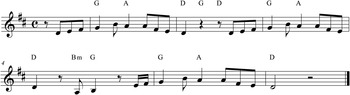
In addition, there are three wordless interludes between lines, found at lines 10, 13 and 16: the first and third of these are similar, and also provide the basis for the song's wordless conclusion; however, the first interlude (after line 10) is whistled, while the one after line 16 and the conclusion are both sung. The interludes after lines 10 and 16 appear after a variable period of the tonic chord, and are followed by the tonic chord, preparing the following sung line (Example 2). The second interlude (after line 13) follows directly after the dominant chord as its perfect cadence, and ends suddenly before the next line begins: at 3ʹ03 one senses the guitar marking a strong beat to bring things back to normality. This interlude illustrates the wedding in sound and adopts a lilting rhythm that divides the four beats into (3 + 3 + 2): it also introduces the only ‘secondary dominants’ found in the song (B and E), en route to another perfect cadence (Example 3).
Interlude one and three

Interlude two

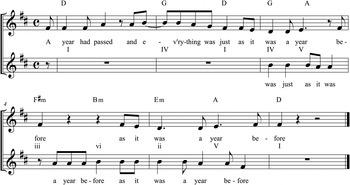
The addition of a second voice, a pair of voices in fact, added to the extended line 17, necessitates its own musical transcription, and its own presence in the transcription of words (Example 4).
Two-voice passage

There are many other small but effective details in the recording, painterly colours added in recording to the song's template, often serving to extend the registral dimension of pitch: occasional doubled guitar parts (such as the one between 1ʹ18 and 1ʹ20), a mystic organ first heard at 0ʹ46–50, boomy bass drums (as at 1ʹ04) or low tonic notes in the bass (as at 1ʹ05), and backing vocals (as at the word ‘love’ at 1ʹ51–56).
Finally, the song is woven together by a little figure in the guitarFootnote 21: in fact, the variations in the time taken by the tonic chord turns on the slight curtailing of this figure by a half-bar (or two beats), as shown in the musical example (Example 5).
Guitar figure

A transcription of the words to the song
The words to the song appeared on the inner sleeve of the album Catch Bull at Four, and were also transcribed and included as an integral part of the sheet music to the album, which appeared in the same year.Footnote 22 Characteristic of the sheet music of the time, the guitar part was arranged for piano, in a manner quite unrepresentative of a track based on the guitar. However, a further transcription has been adapted into a version for guitar, as tablature and as treble-clef notation: occupying 13 pages of print, this transcription corrects a few errors in the earlier version.Footnote 23 These two versions usefully bring out the variations in the time taken by the tonic chord between verses, alluded to above, by inserting bars of 2/4 within the prevailing norm of 4/4. A third version can also be found, electronically at the time of writing, consisting of words with chords and guitar patterns added: this is perhaps designed for guitar-playing singers who know the music and want a rough version focussed mainly on the words.
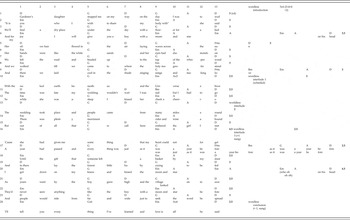
To be clear, we now have two versions of the words to this song: the version that makes it look like a poem, included above, and the version where the words are included beneath musical notation, in the sheet music.Footnote 24 I advocate a via media in which the words, qua words, and removed from musical notation, are transcribed in a way which continues to respect and represent their musical origin. Table 2, produced in Excel, transcribes the words of the song. Musical notation is better for rhythmic micro-precision and, in the transcription, as well as following familiar principles of text underlay, I use differences in font size to accommodate words in particular instances. The chief difference between this transcription and the version included above, looking like a poem, could be described as the addition of a hard (if in this case variable) right margin, in addition to the hard left margin familiar in page poetry: taken together, both margins define the ‘verbal space’ of the songFootnote 25 – effectively its repeated pair of chord sequences – so that the transcribed words derive from their precise place in the song. That said, the 24-line poem-version is more appropriate than is sometimes the case, in that the song is sung by the single voice (apart from the intervention in line 17), and the line is by and large consistent, albeit leaving the various extensions to one side. Nevertheless, I'd claim that my transcription is both more useful and accurate, and constitutes a claim that, in themselves, the words of songs are neither poems nor the words as they appear in sheet music, but lie somewhere precisely in between.Footnote 26
Words to ‘The Boy with the Moon and Star on His Head’: Microsoft Excel transcription.
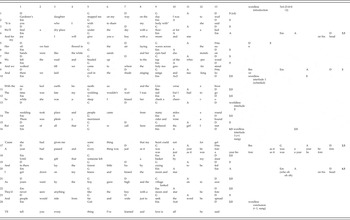
The words to the song
The printed line is variable in syllabic quantity, but gathers at a ‘norm’, of seven beats or feet, that corresponds to the underlying beat of the melody: six crotchets and a minim. The length of the line is important in enabling the internal rhyme scheme.
There is a clear and consistent couplet pattern of end-rhymes: a/a, b/b, and so on. However, certain sound groups recur: the first four lines all rhyme with the first line ‘wed’, and this sound returns both for lines 19–20 and the final couplet (lines 23–24). Rhymes with ‘before’ are found in both lines 17–18 and 21–22. Taken together, the recurrence of sound groups set off the section from lines 5–16 as containing six separate sound groups: sun/on, wood/stood, love/above, go/cheerio, around/abound and met/forget. One of the two specific lines that dismayed Robert Christgau ended with ‘above’, but is also part of a familiar rhyme with ‘love’.Footnote 27 He also disliked the penultimate couplet, which rhymed ‘awe’ and ‘before’, on the technical grounds that ‘before’ was a ‘weak word’ used to generate a ‘weak rhyme’: he might on the same grounds have disliked the earlier rhymes of ‘sun’ and ‘diamonds on’ (lines 5–6) as well as, possibly, ‘before’ to rhyme with ‘door’ in lines 17–18. To my ears, the most striking rhyme is one already observed: ‘cheerio’ to rhyme with ‘go’ as lines 11–12.
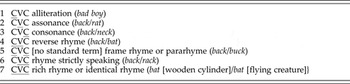
Technically, however, allowing for such individual preferences, the end rhymes do seem to be internally consistent. In order to support this claim, I use a method derived from T.V.F. Brogan's chapter on rhyme for The New Princeton Encyclopaedia of Poetry and Poetics (Preminger and Brogan Reference Preminger and Brogan1993, p. 1054). Table 3 presents the basic schema where C = consonant and V = vowel.
Brogan methodology for analysis of rhyme (Preminger and Brogan Reference Preminger and Brogan1993, p. 1054).

In ‘The Boy with a Moon and Star on his head’, we have the following type-6 rhymes: wed/said/bed/head (lines 1–4), wood/stood (lines 7–8), love/above (lines 9–10), around/abound (lines 13–14), met/forget (lines 15–16), before/door (lines 17–18), fed/head (lines 19–20) and spread/head (lines 23–24). Of these, three pairs bring together a monosyllable and disyllable: love/above (lines 9–10), met/forget (lines 15–16), and before/door (lines 17–18), while one pair consists of two disyllables: around/abound (lines 13–14). This leaves three rhymes: sun/diamonds on (lines 5–6) qualifies as type 5. Depending on how one pronounces them, in awe/before (lines 21–22) could be type 6 or type 5, the latter more likely, and Stevens sings the vowels to bring out their difference. Go/cheerio (lines 11–12) brings together a monosyllable and trisyllable, and rhymes at the vowel, but also rhymes CV (go) with CVV (cheerio): an unusual type 6 might be the best proposal.
In addition to its end rhymes, the song has a recurring pattern of internal rhymes, corresponding to type 2a of the four listed in The New Princeton Encyclopaedia. This is referred to in German as Binnenreim or in English as ‘sectional rhyme’,Footnote 28 a pair of rhymes within the line and separate from the end rhyme.Footnote 29 The background scheme of the Stevens song is shown in Table 4.
Internal rhyme model for ‘The Boy with the Moon and Star on His Head’ (Preminger and Brogan Reference Preminger and Brogan1993, p. 613).

Table 5 is an analysis of the internal rhyme found in ‘The Boy with a Moon and Star on His Head’: bold indicates type 6 (‘rhyme, strictly speaking’) while italic is saved for other forms of rhyme, or other less clear decisions. Note that both types appear in both odd-numbered and even-numbered lines, and are sung to both musical lines. Eleven of the 13 type-6 rhymes bring together monosyllables, the exceptions being all/recall (line 15) and lay/baby (line 19). The italicised rhymes vary in category. Lines 8 and 14 bring together a pair of type-6 rhymes made up of a disyllable and trisyllable: in line 8 ‘holy magnolia’ are contiguous words, the rhyme embedded inside the second word. The same could be said of the pair in line 14, ‘plenty merriment’. There are three examples of type-2 assonance, at: line 10 (earth/universe), 12 (asleep/cheek) and 13 (place/came) and a further three examples of type-3 consonance, at: line 7 (up/top), 17 (passed/just) and 18 (gift/left). Lines 2 and 6 both contain two pairs of rhymes: in line 2, ‘you who’, contiguous words rhyme as vowels and constitute another version of type 6, while the other pair (wish/with) qualifies as type 4, reverse rhyme. As well as the type-6 rhyme (hands/sands), line 5 contains a type-3 consonance (eyes/diamonds). This analysis leaves only three lines (20, 22 and 24) bereft of internal rhymes. To return to the whole, the blunt division of full rhyme (bold) and ‘near’ rhyme (italic) reveals, as a proportion of lines: 50% full internal rhyme, 37.5% ‘near’ internal rhyme and 12.5% no internal rhyme. While this is a tiny drop in an ocean of analysing rhymes in songs, it is a start.Footnote 30
Internal rhyme in ‘The Boy with a Moon and Star on His Head’.

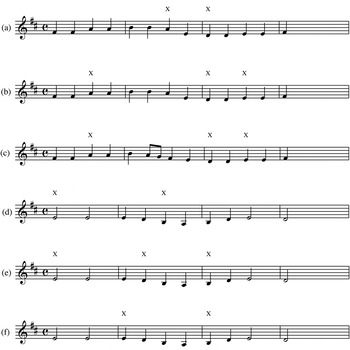
An important aspect of the internal rhyme scheme is that the rhymed words vary in their position of correspondence to the sung melody. Example 6 illustrates the various models found within the line, now rendered as an outline melody, with ‘X’ marking the position of the rhyming word. Models a–c show the odd-numbered musical lines, d–f the even-numbered lines. For the full rhymes, the same pattern of correspondence, model b, is found in lines 3, 5, 9, 11, 15, 19, 21 and 23: in this pattern the rhyming words both correspond to the note A in the first half of the sung line. In fact the same pattern can be found in one of the half rhymes, at line 13. The two exceptions to this pattern among the odd-numbered full rhymes are the very first line, model a, where the word corresponding to the second such A links to the note D in the second half of the sung line, and model c, which contains two full rhymes in the one line, the first pair in the first half of the line, the second pair in the second half. The full rhymes in the even-numbered lines (4 and 6) are close but different in position from each other, as shown in models d and e. Model f shows line 12, and crosses between the first and second half of the line. Otherwise, the near rhymes vary more consistently in their position in the sung line.
Varying positions of internal rhymes

Internal rhyme in context
This final section positions internal rhyme in ‘The Boy with a Moon and Star on his Head’ in a series of contexts, but the underlying theme is to suggest ways of discussing with a degree of accuracy the relationship between words in song and the words of poetry, by grounding the two approaches in concrete examples and specific principles. The examples are taken from three divergent locations: the singer-songwriter song, the musical theatre, and page poetry.
Stevens was not alone in essaying internal rhyme in the singer-song, although the particular model found in ‘The Boy with a Moon and Star on his Head’ is rare, as it is more generally in page poetry. For the song's model of internal rhyme to occur, lines likely need to be long, and some such can be found in the early work of Bob Dylan, who was also influential on many singer-songwriters at the time. To take an example, in ‘The Lonesome Death of Hattie Carroll’ (Reference Dylan1963), with its slow and languorous line, we find occasional internal alliterations and rhymes – ‘provide and protect him’, ‘sneering and his tongue it was snarling’, ‘slain by a cane’, ‘spoke through his cloak’ – but these are exceptions in a structure that makes rhyme a matter for the end of the line and appears to value prosaic hardness within the line. The song ‘John Brown’ (1962)Footnote 31 adopts the model where the inner word rhymes with the word found at the end of the line, a model also followed in ‘Where Are You Tonight? (Journey Through Dark Heat)’ (1978). Other types of example are found in ‘All I Really Want To Do’ (1964) which contains rapid internal rhymes, to a repeated word at the line end: such as ‘I don't want to fake you out/Take or shake or forsake you out’; similar piled inner rhymes can be found in ‘Mr Tambourine Man’ (1964). Even so, these valuable examples are still exceptions in Dylan's considerable quantity of recorded songs.
Another comparison, contemporaneous with the Stevens song, could be made with the songs co-written and recorded between 1970 and 1975 by Pete Atkin with Clive James as poet-cum-lyricist.Footnote 32 If their collection of recorded songs lacks an internal rhyme exactly like the one under discussion,Footnote 33 there are many examples of tricky rhyme schemes, and James has written extensively and usefully about their approach. Clive James is furthermore an interesting figure in this regard since, even as a published poet, his work has often gone unnoticed, to his disappointment,Footnote 34 and serves as a useful reminder that in all comparisons of words in song and poetry, the question of how poetry is defined, especially in relation to verse, is ever present.Footnote 35
However, we can imagine a musical mind, in 1972, formed not only by Bob Dylan, but also a track such as ‘Flash, Bang, Wallop!’, recorded by Tommy Steele in Reference Steele1963 and written with Steele in mind for the musical Half a Sixpence, both words and music by David Heneker. At just over two minutes, the recording presents musicians working at full pelt, while the words feature saucy tales for Steele to ham up, and comic lines galore, none better perhaps than the run of rhymes to the chorus end: ‘the big bass drum’, ‘your family album’ and, in between, ‘rum tiddly um, pum, pum, pum, pum’.
‘Flash, Bang, Wallop!’ leads us to the kind of song where one might more readily expect to find internal rhyme: songs written for the musical theatre, or in the tradition of Tin Pan Alley.Footnote 36 If we now consider an example from The Wizard of Oz in 1939, where words and music are by different writers (words ‘Yip’ Harburg, music Harold Arlen), we find that the internal rhyme (the same pattern as the Stevens song) is consistent in terms of position in the sung melody:
I could while away the hours conferring with the flowers, consulting with the rain.
And my head I'd be scratching, while my thoughts were busy hatching, if I only had a brain.
So marked are the attentions within the line to its internal correspondences that the lines could be rendered differently:
I could while away the hours
Conferring with the flowers
Consulting with the rain.
And my head I'd be scratching
While my thoughts were busy hatching
If I only had a brain.
A similar observation could be made of the verse of ‘Mad Dogs and Englishmen’ (1931), as an example where Noël Coward wrote both words and music. Separated by intervening lines we have the couplet:
In tropical climes there are certain times of day
It's one of the rules that the biggest fools obey
Discussing the Tin Pan Alley song, Philip Furia traces the ‘poetic wit’ of the ‘verbal wizard’ who wrote the words to such songs back to an anthology of Vers de société verse edited by Carolyn Wells (Wells Reference Wells1907; Furia Reference Furia1992, pp. 8–9, 6–7). Furia also quotes P.G. Wodehouse asserting, in a suggestive comment bringing together words in song and light verse, that ‘If I write a lyric without having to fit it to a tune, I always make it too much like a set of light verse, much too regular in meter’.Footnote 37 These are helpful pointers, and the comparison might be extended to the two Oxford anthologies of light verse edited by W.H. Auden (Reference Auden1938) and Kingsley Amis (Reference Amis1978a).Footnote 38 Amis is especially interesting in this regard, since he further edited two anthologies, The Faber Popular Reciter (Amis Reference Amis1978b) and The Great British Songbook (Amis and Cochrane Reference Amis and Cochrane1986), indicating that he had a particular interest in the point at which poetry is clearly marked for recitation, or where song lyrics stand as poems on the page (the songbook is a collection of words rather than music).Footnote 39 We might borrow a phrase for the Cat Stevens example, from Amis's introduction to The New Oxford Book of Light Verse (Amis Reference Amis1978a): ‘the effective surmounting of self-imposed technical obstacles that is characteristic of light verse’ (Amis Reference Amis1978a, p. xx), and Clive James also describes ‘ambitious feats of sustained construction’.Footnote 40 However, whether Amis would have any sympathy for the Stevens example is debatable, or Pete Atkin for that matter, since he and Cochrane also thought that ‘guillotines descended in 1945 and whichever year in the 1960s marked the final demise of the song as a thing of the present’ (Amis and Cochrane Reference Amis and Cochrane1986, p. 10).Footnote 41
Finally, to take an example from page poetry,Footnote 42 Philip Larkin's poem, ‘Love Songs in Age’ (Larkin Reference Larkin1964, p. 12), while employing his characteristic and colloquial tone or voice, is contained by a tight rhyming scheme (a, b, a, c, b, c, d, d), as well as tightly controlled variants in the length of its eight lines across three verses (line 2 is shortest, line 6 longer, while the remainder are equal). One observes these aspects with pleasure to the eye and only in detail perhaps in retrospect. Set next to Larkin's poem, ‘The Boy With the Moon and Star on His Head’ begins to follow the technical demands of words found in page poetry, and perhaps sets up the expectation of follow-through, but gives up, or carries out the technical demand only fitfully.
The analysis of internal rhyme in ‘The Boy with a Moon and Star on his Head’ prompts me both to agree and disagree with Robert Christgau: there is a direct comparison with ‘page poetry’ to be made less, I think, as Christgau does, in terms of genre or historical period in poetry,Footnote 43 more by reference to a technical aspect of the words to the song. Thus, lines taken from ‘The Boy With the Moon and Star on His Head’ could in theory appear as examples in a primer of verse, such as Philip Hobsbaum's (Reference Hobsbaum1996) Metre, Rhythm and Verse Form or John Hollander's (Reference Hollander2001) Rhyme's Reason. However, while this may be true of individual lines in the Stevens song, we cannot claim that the song is a sustained demonstration of internal rhyme. It appears that the Stevens internal rhyme could be seen either as forgetful and inconsistent, by comparison with Larkin, or as a device more flexible than the rigidities of the musical, by comparison with the example from The Wizard of Oz.Footnote 44 Whereas Larkin was a poet writing for the page, Stevens was a songwriter, but a particular sort of songwriter, circa 1972. Stevens controls both words and music, marks his presence in the song, notably but not only by singing it, and adopts a certain position towards the words in their choice and composition, a combination of precision (in the choice of end rhyme, for example) and flexibility (in the position of internal rhymes in relation to the sung line, for example).
That the Cat Stevens song appeared in 1972 is germane, positioning it as an anomaly in the song of the day, not the exception that proves the rule but an exception that helpfully suggests a rule. In defining songs where music and words were invented by the one person, and often sung by the same, the prevailing approach is to understand them in the close relationship in subject matter suggested by authorship (songwriter), performance (the singer's voice) and biography (proximity to life often termed authenticity). For example, by focussing on individuals and their confession, Stephen Holden has to dismiss Neil Young as a singer-songwriter because he once played in a band, while Elton John is also dismissed, this time as being not ‘introspective or confessional’ enough (Holden Reference Holden, DeCurtis, Henke and George-Warren1992, p. 482), whereas I should be wary of including John in this context only because he supplied music alone, the words often written by Bernie Taupin. The technical properties of these songs are more elusive: their music is certainly tonal, but allows much diversity under that capacious heading, and the words may seem similarly diverse. However, with ‘The Boy With the Moon and Star on His Head’ we have a boundary, that ‘singer-songs’ tended in their words to avoid technical devices such as the internal rhyme: this reinforces the sense that the key attentions of words are directed, as also in this song, towards end rhymes, or towards the variables of syllabic density arising from verbal space (Griffiths Reference Griffiths and Moore2003). This is not to say that the formal pleasures of a song reside only in its words, and this might explain Stevens's distraction from the properties of the words in this particular instance.
Permission was secured for use of ‘The Boy with a Moon and Star on His Head’, which is copyright Chrysalis Music Limited, administered through BMG Rights Management (UK) Limited.