Dry bean is a high-value crop grown in various regions of the world. Globally, countries with the highest dry bean production include Myanmar (3.68 million tonnes), Brazil (3.05 million tonnes), United States (1.32 million tonnes), Mexico (940,000 tonnes), China (920,000 tonnes), Argentina (340,000 tonnes), and Canada (258,000 tonnes) (Statista 2017). In the United States, major dry bean growing regions include North Dakota (38%), Michigan (14%), Nebraska (11%), Minnesota (10%), Idaho (7%), California (4%), Washington (4%), and Colorado (3%) (USDA 2017). In Canada, dry beans are grown primarily in Ontario (39%), Manitoba (32%), and Alberta (19%) (Statistics Canada 2015).
Popular market classes of dry bean grown in North America include pinto bean, navy (white) bean, kidney bean (red, white, light red), black bean, and Great Northern bean (USDA 2017). Dry bean plants have short physical stature and do not successfully compete with weeds (Urwin et al. Reference Urwin, Wilson and Mortensen1996). Weeds compete with dry beans for moisture, light, and essential nutrients, and if not adequately controlled, can substantially reduce yield (Chikoye et al. Reference Chikoye, Weise and Swanton1995; Malik et al. Reference Malik, Swanton and Michaels1993; Radosevich et al. Reference Radosevich, Holt and Ghersa2007; Sikkema et al. Reference Sikkema, Robinson, Nurse and Soltani2008; Soltani et al. Reference Soltani, Van Eerd, Vyn, Shropshire and Sikkema2007, Reference Soltani, Nurse, Van Eerd, Shropshire and Sikkema2010; Urwin et al. Reference Urwin, Wilson and Mortensen1996). In addition, weeds can reduce harvest efficiency and cause staining of the beans, which can substantially reduce dry bean quality (Radosevich et al. Reference Radosevich, Holt and Ghersa2007; Urwin et al. Reference Urwin, Wilson and Mortensen1996).
Dry bean yield loss due to weed interference can be variable in different growing areas of the United States and Canada, mainly as a result of weed species present, weed density, and environmental conditions (Harker Reference Harker2001; Harker and O’Donovan Reference Harker and O’Donovan2013; Oerke Reference Oerke2006; Walker Reference Walker1983, Reference Walker1987). However, despite these variabilities, decision makers in government and regulatory agencies, grower groups, and industry personnel need accurate information on crop yield losses due to weeds when allocating resources and financial support for weed science research (Swanton et al. Reference Swanton, Harker and Anderson1993). Also, yield loss information can help in arriving a cost–benefit rationale so as to increase applied weed research with the aim of boosting food production and helping to feed an ever-increasing world population (Bridges Reference Bridges1992; Swanton et al. Reference Swanton, Harker and Anderson1993). Earlier weed loss estimates have depended in large part on expert opinions and their observations in the field (Bridges Reference Bridges1992), which can sometimes be influenced by their proximity to certain fields and observations made in the most recent field season. In recent years, crop improvements have resulted from the use of cultivars developed to provide higher yields, as well as from changes in local agronomic practices such as crop rotation, reduced or no-tillage, seeding rates, row spacing, soil fertility, and pest management. Such improvements have resulted in higher yield potential and changes in the weed communities in different regions of North America (Oerke et al. Reference Oerke, Dehne, Schonbeck and Weber1994; Oerke Reference Oerke2006). Past reports (Bridges Reference Bridges1992; Chandler et al. Reference Chandler, Hamill and Thomas1984; Swanton et al. Reference Swanton, Harker and Anderson1993) have consisted mainly of yield loss estimates that the experts observed after weed control measures were implemented; such figures dramatically underestimate the actual yield loss due to weed interference.
It has been nearly 25 years since the last WSSA Weed Loss Committee report was published in dry bean (Swanton et al. Reference Swanton, Harker and Anderson1993). Recent improvements in crop cultivars and agronomic practices may influence yield loss changes. It is of interest to assess whether yield loss estimates due to uncontrolled weeds have changed in primary dry bean growing areas of the United States and Canada.
The objective of the present WSSA Weed Loss Committee study is to provide a summary of potential yield loss in dry bean crops based on quantitative data (from replicated, small-plot research studies) when local agronomic practices for optimal dry bean yield with excellent weed control management programs were used in primary dry bean growing regions of North America over a 10-year period (2007 to 2016). This study will also examine the monetary cost of the potential yield loss due to weed interference in dry bean crops in various states/provinces within the United States and Canada.
Materials and Methods
Research and/or extension weed specialists in primary dry bean growing areas of the United States and Canada were requested to provide data on dry bean yield loss due to weed interference in their states and provinces (listed in Table 1). Data requested included results from weed control studies in dry bean from up to 10 individual studies conducted within each calendar year during 2007 to 2016 (10 years).
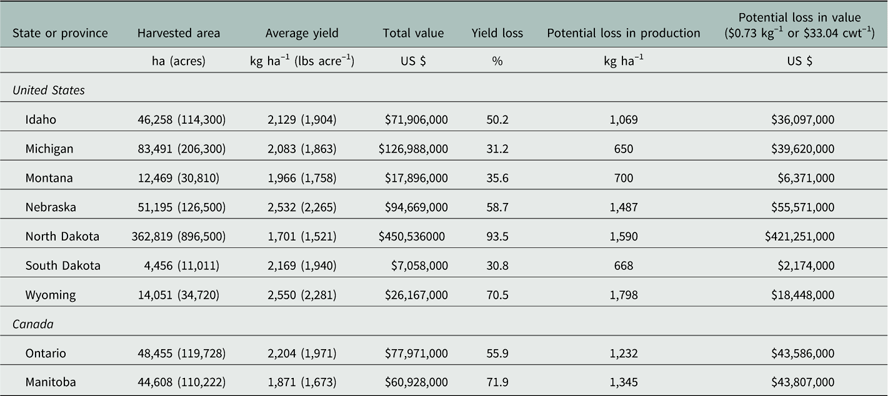
Potential annual average dry bean area harvested, yields, and total value as well as estimated yield loss (%), losses in dry bean production (kg ha–1) and in value (US$) from weed interference for each state or province that provided data for the period of 2007 to 2016.

Each researcher/specialist was asked to provide the “weedy dry bean yield,” which was defined as the mean dry bean yield from the weedy control plot (based on normal agronomic practices for optimal dry bean yield when no weed control management tactics were used), and “weed-free dry bean yield,” which was defined as the mean yield from plots with >95% weed control (based on normal agronomic practices for optimal dry bean yield with excellent weed control management programs). These plots were essentially weed-free for the entire growing season.
To determine potential dry bean yield loss for each state or province, percent yield loss (YL%) was determined for each individual study, then averaged within a year, and averaged across the 10 years (2007–2016) as follows:
 $$\eqalignno{&{\rm Potential}\,{\rm YL}\,\%\,{\equals} \cr \,\,\,\left( {{\rm weed{\minus}free}\,{\rm yield}-{\rm weedy}\,{\rm yield}} \right)\,/\,{\rm weed{\minus}free}\,{\rm yield}{\times}100$$
Information on total dry bean harvested (hectares and acres), dry bean yield (kg ha–1 and lbs acre–1), total dry bean production (kg and cwt), and yearly average commodity prices (US $/cwt) for each state or province were obtained from USDA-AMS (2017) and AAFC (2017) reports.
Because dry bean production among the states or provinces was variable, yield and the monetary loss were weighted by the quantity of dry bean production within each state or province. The potential value of loss for each state or province was based on the product of the estimated amount of dry bean yield loss due to weed interference multiplied by the mean dry bean price for 2007 to 2016. Average dry bean price for the period of 2007 to 2016 was US $730 tonnes–1 ($33.04 cwt–1) and was used to determine potential monetary loss (AAFC 2017; USDA-AMS 2017).
Results and Discussion
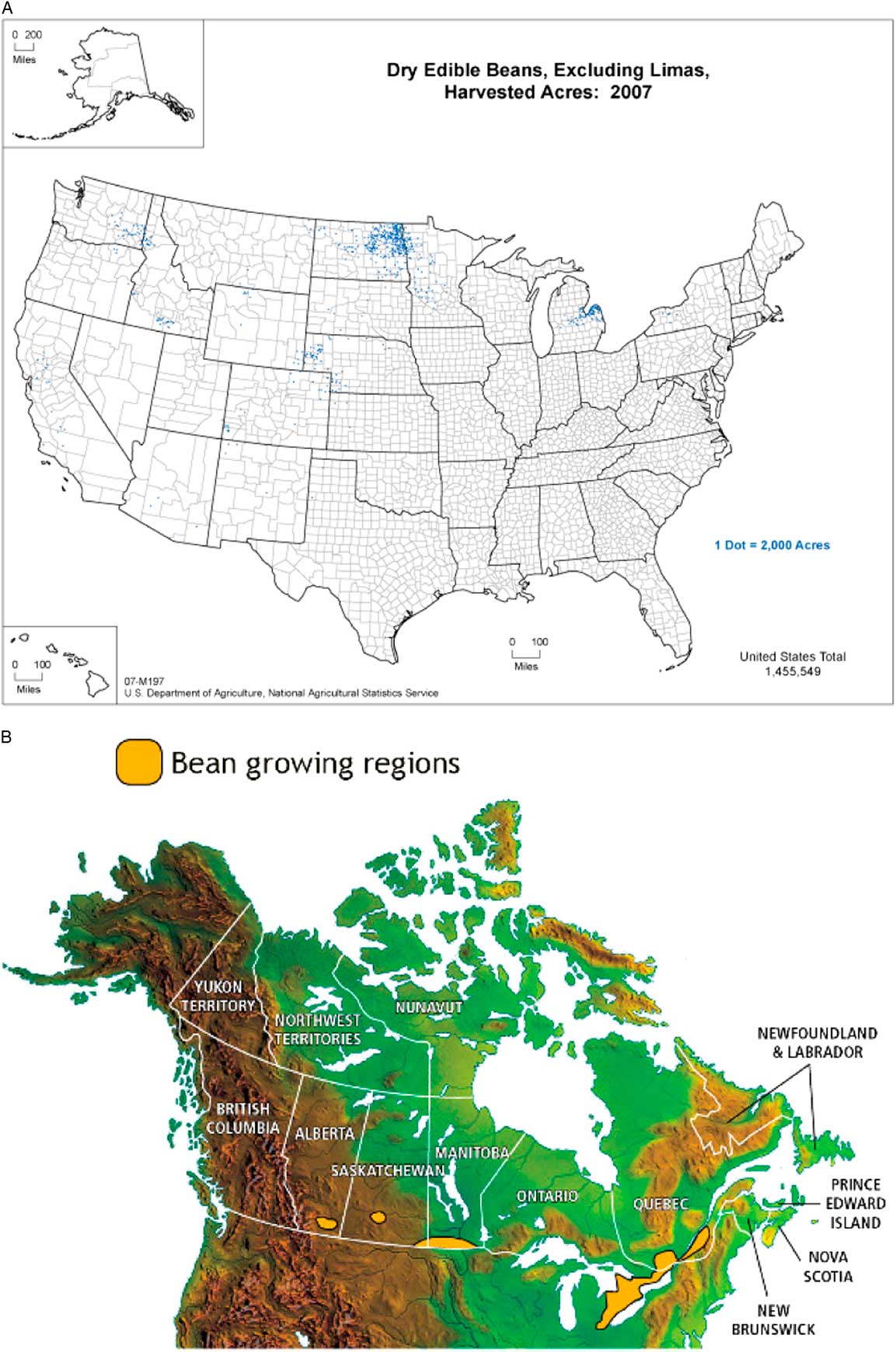
Yield loss data were received from nine major dry bean growing areas of North America, including Idaho, Michigan, Montana, Nebraska, North Dakota, South Dakota, and Wyoming in the United States and Ontario and Manitoba in Canada. These nine areas collectively represent >90% of dry beans grown in North America (Table 1; Figure 1). Table 1 shows data averaged over the 10-year period (2007 to 2016) from these seven US states and the two Canadian provinces.
Dry bean growing regions within the United States (A) and Canada (B). Images from (A) http://www.agcensus.usda.gov/Publications/2007/Online_Highlights/Ag_Atlas_Maps/Crops_and_Plants/Field_Crops_Harvested/07-M197.gif for United States and (B) http://www.pulsecanada.com/media/bean_map.jpg for Canada.

Data collected indicate that in North America, dry bean yield loss due to weed interference was 71.4% if no weed management tactics were implemented (Table 1). This study found that uncontrolled weeds in dry bean crops grown in North America reduced dry bean production nearly 1.13 billion kg (out of the 1.58 million total production), which is a loss of approximately US$722 million to dry bean producers (Table 2).
Annual total dry bean production (metric tonnes) and value (US $), and annual potential loss in production (metric tonnes) and value (US $) from weed interference for the United States and Canada based on 2016 production data.Footnote a

a Statista, https://www.statista.com/statistics/194283/us-bean-production-since-2000/ and https://www.statista.com/statistics/449320/farm-cash-receipts-of-dry-beans-canada/ (USDA-AMS 2016).
b Abbreviation: YL, Yield loss.
c C Sprague and P Sikkema, personal communications.
In the United States, North Dakota farmers grew the vast majority of dry beans produced during 2007 to 2016 (averaged), followed by Michigan, Nebraska, Idaho, Wyoming, Montana, and South Dakota, respectively (Table 1). Dry bean growers in North Dakota harvested nearly 363,000 hectares and produced nearly 620,000,000 kg of dry beans valued at US $451 million, which was approximately US$106 million greater than dry bean produced in all other states combined. Based on agronomic practices for optimal dry bean yield when no weed control management tactics were used, the potential dry bean yield loss was 50%, 31%, 36%, 59%, 94%, 31%, and 71%, valued at US$36, 40, 6, 56, 421, 2, and 18 million in Idaho, Michigan, Montana, Nebraska, North Dakota, South Dakota, and Wyoming, respectively (Table 1). In 2016 in the United States, at an average yield loss of 71.4%, dry bean production would be reduced nearly 941,000,000 kg (valued at US $622 million) in the absence of any weed management tactics from a total production of 1,318,000,000 kg (Table 2). The earlier WSSA Weed Loss Committee reports by Chandler et al. (Reference Chandler, Hamill and Thomas1984) and Bridges (Reference Bridges1992), which were based mainly on experts’ opinions, found much lower dry bean yield losses of 35% and 14%, respectively, because of uncontrolled weeds in dry bean fields in the United States. Bridges (Reference Bridges1992) reported that dry bean growers in Idaho, Michigan, Montana, North Dakota, and Wyoming can potentially lose an average of 30%, 50%, 15%, 20%, and 30%, respectively, of their dry bean yield even if they used their best agronomic management practices without any weed management tactics.
In Canada, Ontario farmers grew the majority of dry beans produced during 2007 to 2016 (averaged), followed closely by growers in Manitoba (Table 1). Ontario dry bean growers harvested 48,455 ha and produced 107,000,000 kg of dry beans valued at US $78 million, and Manitoba growers harvested 44,608 ha and produced 83,000,000 kg of dry beans valued at US $61 million. If weeds were left uncontrolled, using local agronomic practices for optimal dry bean yield, Ontario dry bean production would be reduced 1,232 kg ha–1 or 56% of their dry bean yield, which equates to a loss of nearly US $44 million (Table 1). Similarly, Manitoba production would be decreased by 1,345 kg ha–1 or 72% of their dry bean yield valued at US $44 million due to uncontrolled weeds (Table 1). In 2016, at the average yield loss of 71.4% for North America, dry bean producers in Canada could potentially lose 184,000,000 kg out of their total production of 258,000,000 kg valued at approximately US $100 million to uncontrolled weeds (Table 2). The earlier WSSA Weed Loss Committee reports by Chandler et al. (Reference Chandler, Hamill and Thomas1984) and Swanton et al. (Reference Swanton, Harker and Anderson1993) reported 14% and 10% dry bean yield loss due to uncontrolled weeds in Canada, respectively. Swanton et al. (Reference Swanton, Harker and Anderson1993) reported that dry bean growers in Ontario and Manitoba could potentially lose 6% and 14% of their dry bean yield, equal to a monetary loss of US $2,281,000 and US $855,000, respectively, if they used their best agronomic practices without any weed management tactics.
This study provides quantitative information on dry bean yield loss due to weeds in the context of local agronomic practices for optimal dry bean yields in the absence of any weed control management tactics. Data showed greater yield loss in dry beans due to weed interference than what was reported in earlier studies; one reason for this result could be that most of the data collected for this study are from research plots, which frequently have higher weed densities than producer fields. Yield loss in dry bean crops due to weed interference was also significantly greater than the 50% yield loss observed in corn (Zea mays L.) (Soltani et al. Reference Soltani, Dille, Burke, Everman, VanGessel, Davis and Sikkema2016) and the 52% yield loss observed in soybean [Glycine max (L.) Merr.] (Soltani et al. Reference Soltani, Dille, Burke, Everman, VanGessel, Davis and Sikkema2017) based on similar sources of quantitative data. Higher yield losses in dry bean crops due to weed interference than in corn and soybean may be partly due to reduced seedling vigor, slower early crop growth, and a smaller crop stature.
Based on this study, dry bean growers in the United States and Canada would potentially lose 71% of their crop valued at US $622 million in the United States and US $100 million in Canada if they follow their current local agronomic practices for optimal dry bean yield without using any weed management tactics. Growers can recover most of this potential monetary loss by investing in weed management. Assuming an herbicide cost of US $75.00 ha–1 (C Sprague and P Sikkema, personal communications) for optimum weed control in dry beans (Table 2), every US $1.00 invested in weed management would result in a US $12.00 return. This figure highlights the tremendous return on investment realizable in weed management. As this study shows, the economic cost of weed interference in dry bean production is considerable, emphasizing the need for continued applied weed science research to find new weed management solutions for dry bean growers in North America.
Acknowledgments
We would like to thank the members of the WSSA Weed Loss Committee for their valuable input.