INTRODUCTION
Improved coral cultivation has a variety of potential benefits including: preservation of biodiversity; rehabilitation of disturbed coral reefs (e.g. Rinkevich, Reference Rinkevich1995, Reference Rinkevich2000, Reference Rinkevich2005); reversing coral–algal phase shifts (e.g. McManus & Polsenberg, Reference McManus and Polsenberg2004); and reduction of wild harvesting for the aquarium and curio trades. Coral restoration projects have widely varying efficacy (Edwards & Clark, Reference Edwards and Clark1998; Rinkevich, Reference Rinkevich2005) that could be improved by more cost-effective means of ‘farming’ coral at a larger scale (Clark & Edwards, Reference Clark and Edwards1995; Delbeek, Reference Delbeek2001; Rinkevich, Reference Rinkevich2005). Coral farming not only has the potential to benefit a wide variety of studies that use corals as model experimental organisms, the process of cultivation itself is likely to provide important insights to coral ecology and organismal biology.
One of the first steps of cultivating any organism is to determine a range of physical and biological parameters that optimize growth and survivorship. Compared to many terrestrial organisms of similar economic, cultural, or scientific interest, corals have a relatively recent history of cultivation (Delbeek, Reference Delbeek2001). Scleractinian corals primarily receive their nutrition from symbiotic photosynthetic dinoflagellates (zooxanthellae) (Goreau et al., Reference Goreau, Goreau and Yonge1971; Buddemeir & Kinzie, Reference Buddemeir and Kinzie1976; Muscatine, Reference Muscatine and Dubinsky1990). Even though phototrophy is often the primary nutritional mode, at least some scleractinian corals are capable of heterotrophy to varying degrees (e.g. Wellington, Reference Wellington1982; Sebens et al., Reference Sebens, Vandersall, Savina and Graham1996; Bak et al., Reference Bak, Joenje, de Jong, Lambrechts and Nieuwaland1998; Anthony, Reference Anthony1999; Ferrier-Pagès et al., Reference Ferrier-Pagès, Witting, Tambutté and Sebens2003; Grotolli et al., Reference Grotolli, Rodriguez and Palardy2006).
Studies have shown that for some coral species, nutritional modes of heterotrophy versus phototrophy can be plastic (e.g. Anthony & Fabricius, Reference Anthony and Fabricius2000; Titlyanov et al., Reference Titlyanov, Titlyanova, Yamazoto and van Woesik2001). Heterotrophic and phototrophic plasticity is suggested to aid in maintaining carbon energy requirements when environmental stressors affect corals. For example, Goniastrea retiformis increased its heterotrophic capacity with decreased light availability (Anthony & Fabricius, Reference Anthony and Fabricius2000), Stylopora pistillata required zooplankton to acclimate to low light (Titlyanov et al., Reference Titlyanov, Titlyanova, Yamazoto and van Woesik2001) and Montipora capitata recovered from bleaching faster when fed (Grotolli et al., Reference Grotolli, Rodriguez and Palardy2006). It is not yet clear to what degree phototrophic and heterotrophic capacities are affected by environmental conditions, morphology and taxonomy (i.e. phylogenetic history).
Live food has been shown to be important for increasing growth and survivorship for a variety of scleractinian coral genera (e.g. Grotolli et al., Reference Grotolli, Rodriguez and Palardy2006; Goldman, Reference Goldman2007; Sawall et al., Reference Sawall, Teichberg, Seemann, Litaay, Jompa and Richter2011), but far less is known about artificial foods. Artificial foods have the potential to be less expensive and labour-intensive than live food and are the only option available to many aquarists. However, artificial foods from the aquarium trade contain a wide variety of formulations that are poorly or not regulated, and are rarely evaluated for efficacy, with a few exceptions (e.g. Toonen et al., Reference Toonen, Batchelor and Mai2002). Artificial foods, if not consumed, can decay and have undesirable consequences such as supplying nutrients for bacteria and algae (Larned, Reference Larned1998; Stambler et al., Reference Stambler, Popper, Dubinsky and Stimson1991). It is therefore not surprising that coral aquarists have a variety of experiences and opinions regarding artificial food supplements.
The purpose of this study was to examine a range of basic physical parameters and commercially available artificial (non-living) food supplements from the hobby trade for Porites compressa, Montipora capitata and Pocillopora damicornis. All three species are abundant throughout the Hawaiian Archipelago and are among the most abundant reef building genera in the Pacific. These corals can reproduce asexually via fragmentation with very high survivorship (Highsmith, Reference Highsmith1982; Forsman et al., Reference Forsman, Rinkevich and Hunter2006), which is an experimental advantage that can provide large sample sizes of genetically identical fragments of uniform size. We conducted three experiments to examine the interaction between light and water motion (Experiment 1), the effects of artificial foods on coral growth (Experiment 2) and the effects of increased doses of artificial food (Experiment 3). Our explicit null hypotheses were that there were no differences in each species response to light and water flow (Experiment 1), that artificial foods have no effect on growth (Experiment 2) and that increasing the dose of artificial foods will have no effect on growth (Experiment 3).
MATERIALS AND METHODS
Experiment 1: light and water motion
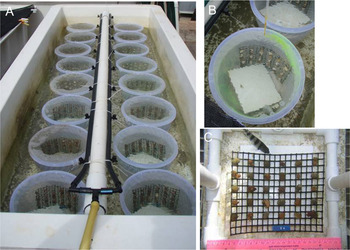
Sixteen clear plastic buckets (18 l capacity) were arrayed in a 10 cm deep seawater bath in a 1 m × 3 m fibreglass holding tank (Figure 1A). The seawater supply was filtered with a 500 micron nylon bag filter in a housing (Aquatic Ecosystems) and distributed by irrigation tubing with 16 micro-sprinkler-emitters arrayed to inject water to provide constant circular flow (Figure 1B). A total of 480 1 cm2 nubbins, 240 from P. compressa and 240 from M. capitata, were arrayed onto 1 cm2 plastic mesh and held in place with the weight of 15 cm × 15 cm glossy white ceramic tiles (Figure 1C). The experiment included two replicates of a two-factor design (light and water motion), with four levels for light (0X, 1X, 2X and 3X layers of 50% shade cloth) and two levels for flow (high and low). Each bucket contained 30 nubbins (15 per species), taken from three colonies per species. The nubbins were arrayed on each mesh in 5 rows by 6 columns, alternating by species, then by colony of origin. The experiment had two replicate buckets for each treatment, and the position of each treatment was assigned by pseudo-random numbers generated in MS Excel 2003. The buckets were cleaned and each nubbin array was photographed weekly. Bi-weekly flow rates were measured with 2 methods: (1) time to fill 10 ml graduated cylinder; and (2) time for one rotation of a drop of 10 mg/ml fluorescein dye. Water motion over the nubbins was estimated by dividing the time in seconds per rotation of dye, by the bucket circumference (74 cm).
Experiment 1 (light and water motion) set up. (A) Plastic buckets with layers of shade cloth removed; (B) water flow measured by fluorescein dye; (C) close-up of an array of coral fragments.

Photosynthetically active radiation (PAR) was measured bi-weekly at noon, for each of the shade treatments with a Li-Cor PAR omnidirectional quantum light sensor and light meter. The area covered by coral tissue was measured with the program Image J, V 10.2, from top-down digital images calibrated to scale with the ruler attached to a photo framer. Area measurements were taken after the experiment was set up on 7 October 2006, at 19 days (26 October 2006), and at 41 days (17 November 2006). Four Hobo pennant temperature loggers (Onset Computer Corporation) recorded temperature at 10 minute intervals for the duration of the experiment. Statistical analysis was performed in SPSS 17.0
Experiment 2: effects of artificial foods
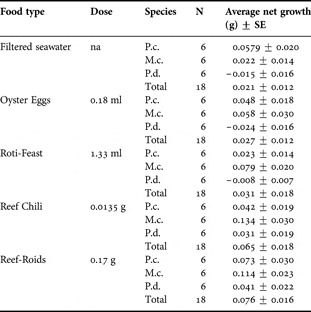
Ten nine gallon tanks were set up in natural light with Hydor Koralia 1 (~200 gph) water pumps to maintain water flow and circulation. Feeder tubes supplied 5 micron filtered water into each of the tanks at a rate of 0.38 l per hour (0.1 gph) creating a flow through system. Tanks were conditioned for two days before adding coral fragments. Thirty coral fragments of each species (P. compressa, M. capitata and P. damicornis) were collected from fringing reef surrounding Coconut Island (N = 90). For each species, five fragments were taken from each of six different colonies. A random number generator in MS Excel was used to determine the treatment in each tank and each fragment was placed in a Latin square randomized design within each treatment tank. Fragments of coral were set into plastic mesh at the bottom of each of the ten plastic tanks. One fragment from each of three different colonies was placed into each replicate tank for each species, totalling 6 fragments per species per treatment. Four foods were tested (Oyster Eggs, Roti-Feast, Reef Chili and Reef-Roids), as well as a control (filtered seawater), and each treatment had two replicates. Corals were fed four times a week, at the food manufacturers' recommended dosages (Table 1). Tanks were also cleaned weekly to control algal growth. Corals were fed for 12 consecutive weeks. During the first month of the experiment, the tanks were in direct sunlight, and subsequently placed under shade cloth to decrease the algal growth in the tank. The water and pumps were turned off for 2–3 hours each day to allow corals to feed. A species of nudibranch (Phestilla sp.) was found inhabiting several of the tanks. This nudibranch specifically feeds on Porites coral species, eating its outer tissues (Gochfeld & Aeby, Reference Gochfeld and Aeby1997) and was removed from tanks when seen. Measurements of wet weight (g) and displacement (ml) were taken at the start of the experiment, and again at the end of the three month period. Weight of fragments was measured using an electronic balance and displacement was measured by a graduated cylinder. Weight and displacement data were analysed as percentage increase, to account for relationships between growth rate and size of fragment.
Food type, dosage and average growth (g) over a 12 week period.

P.c., Porites compressa; M.c., Montipora; capitata P.d., Pocillopora damicornis.
Experiment 3: increased doses of artificial foods
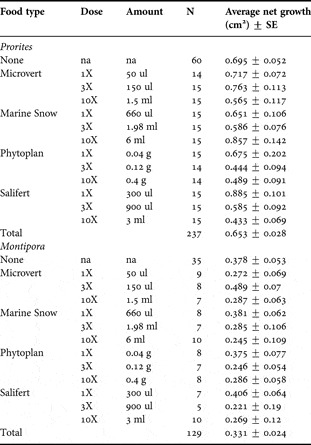
The experiment was conducted between October and December 2006 at Kewalo Marine Laboratory in Honolulu Hawaii. Sixteen grey plastic buckets (18 l capacity) were arrayed in a fibreglass water table and supplied with seawater filtered through a 500 micron bag filter (Aquatic Ecosystems). The seawater table was shaded with garden-variety 50% shade cloth, and water motion and aeration was supplied to each bucket by irrigation tubing, micro-sprinkler emitters and aquarium tubing. Each bucket contained a 6 × 6 inch glossy white ceramic tile with nubbins attached with Z-spar splash-guard marine epoxy. A total of 480 ~1 cm2 nubbins, 240 from P. compressa and 240 from M. capitata, were arrayed onto the tiles. Each tile contained 30 nubbins (5 nubbins from three donor colonies for each species, alternating between species and donor colonies). A stand-pipe was constructed out of 3 inch PVC, with a 3 inch sleeve, such that water levels could be raised above the level of the buckets (to allow water circulation between buckets), or below the level of the buckets to allow dosing of different commercial coral foods (Figure 2). The experimental treatments consisted of four foods (MicroVert, MarineSnow Plankton Diet, Phytoplan and Salifert Coral Food) and four doses (0X = filtered seawater, 1X = manufacturers' recommended dosage, 3X = 3 times recommended dosage, 10X = 10 times recommended dosage) (Table 2). The plastic buckets were cleaned and each nubbin array was photographed weekly. Each week, the position of each treatment was randomized using the pseudo-random number generator in MS Excel. The area covered by coral tissue was measured with the program Image J, V 10.2, from digital images calibrated to scale with the ruler attached to the photo framer. Area measurements were taken after the experiment was set up on 7 October 2006 and at 45 days (21 November 2006).
Diagram of dosing compartment (Experiment 3).

Food type, dose and average net tissue increase over 41 days (Experiment 3).

na, not applicable.
RESULTS
Experiment 1: light and water motion
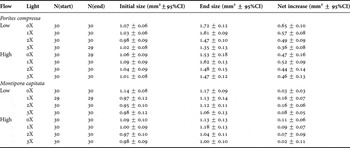
This experiment resulted in high overall survivorship (99.4%, N = 480) for both species over a period of 41 days (Table 3). Overall net tissue increase was ~50% for P. compressa and 9% for M. capitata. Average light (PAR) values and 95% confidence intervals (CI) for the shaded treatments were as follows; 0X = 1252 ± 371 µ mol m−1 s−1, 1X = 457 ± 110 µ mol m−1 s−1, 2X = 145 ± 30µ mol m−1 s−1 and 3X = 82.86 ± 19.20 µ mol m−1 s−1. Average fill rates and rotation rate of fluorescein dye had an inverse relationship (r2 = 0.8798, P < 0.001, data not shown), and the two measures showed consistent differences among treatments; the dye travelled on average 3.93 ± 0.37 cm s−1 for the low flow treatments, and 11.10 ± 0.69 cm s−1 for the high flow treatments (average ± 95% CI). Temperature logger data were only available for four of the 16 treatments. Average temperature differences between these treatments over the course of the experiment only differed by a tenth of a degree C (the lowest average was 26.81 ± 0.01°C for a high flow 1X shade cloth treatment, and the highest average was 26.98 ± 0.02°C for a full sun, low flow treatment).
Growth and survivorship in light by flow treatments.

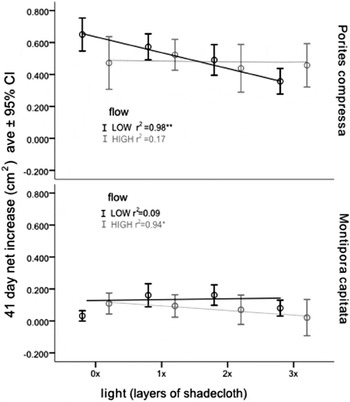
Higher water motion resulted in slightly less tissue growth, in both species, for both 19 and 41 day measurements; however, the comparisons were not statistically significant. Levene's statistic indicated that the high flow treatments resulted in significantly higher variance in net tissue growth (for all comparisons except Porites on day 19, not shown). The relationship between light and net tissue increase, is approximately linear in Porites (Figure 3). Average P. compressa tissue area increased by approximately 40% in the lowest light treatments, and was greater than 60% in the highest light treatments over 41 days. There was no evidence of bleaching of the P. compressa nubbins, despite exposure to full sunlight in only a few inches of water. Montipora capitata, on the other hand, exhibited bleaching of the upper surfaces in the full sun treatments, and this resulted in less growth (Figure 3), in the full sun treatment (0X shade cloth).
Species responses to light and flow treatments (Experiment 1).

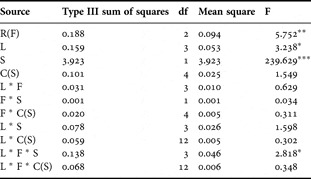
An analysis of variance (ANOVA) across light and flow treatments indicated significant differences between species, light treatments, flow treatments (within replicates), and a significant interaction between light, water motion and species (Table 4). In other words, each species responded differently to the light and flow treatments, and light, water motion and species interacted. The growth response for the two species clearly differed in response to light and water flow (Figure 3). Montipora capitata grew poorly and bleached in high light and low flow, while P. comressa did the best under these same conditions. High flow resulted in greater variation within most of the treatments.
Analysis of variance of light, flow and species interactions after 41 days of net growth (Experiment 1).

L, light; F, flow; S, species; R, replicate; c, colony. *, P<0.05; **, P < 0.01; ***, P < 0.001.
Experiment 2: effects of artificial foods
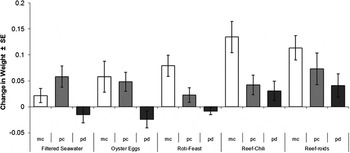
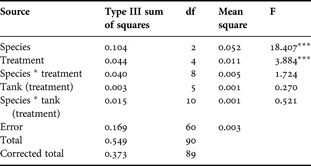
The average overall (pooled across species) weight increase for the control (filtered seawater) was 2.1%, which was lower than all other treatments. The tanks fed with Oyster Eggs, and Roti-Feast had slightly higher overall mean weight increase (2.7% and 3.1% respectively), but these differences were not significant according to post-hoc tests. Reef Chili and Reef-Roids on the other hand show a comparatively large overall weight increase (6.5% and 7.5% respectively). When the contribution of each species was examined, it became clear that M. capitata showed the highest increase in weight, followed by P. damicornis, with Reef Chili and Reef-Roids showing the largest increases (Figure 4). Porites compressa however did not appear to be influenced by feeding, with similar growth between the control and artificial food treatments. An ANOVA indicated significant differences between food types and coral species (Table 5).
Species-specific change in weight by artificial foods (Experiment 2). mc, Montipora capitata; pc, Porites compressa; pd, Pocillopora damicornis.

Analysis of variance of percentage weight increase for corals feed on an artificial diet (Experiment 2).

R Squared = 0.548 (adjusted R squared = 0.329). *, P<0.05; **, P < 0.01; ***, P < 0.001.
The fastest growing fragment according to weight increase was a fragment of M. capitata which had a 24% increase in a tank being treated with Reef Chili. According to increase in displacement, the fastest growing fragments were two M. capitata fragments which had a 47% increase in displacement, and were also in the same replicate of the tank being treated with Reef Chili. Water displacement generally showed similar overall patterns as weight (not shown); however, weight had much lower variance and was presented here.
Experiment 3: increased doses of artificial foods
Overall survivorship was high for P. compressa (98.7%), however nearly half (49%) of M. capitata nubbins died shortly after they were fixed onto the ceramic tiles, most likely due to excessive handling time. The feeding experiment was set up following the light/flow experiment (Experiment 1), which resulted in a long delay between fragmentation and attachment which is most likely the cause for the higher mortality. The two experiments were performed with the same randomized pool of nubbins, so that inferences could be made about the relative importance of light, flow and doses of artificial foods. In spite of high initial mortality, overall net tissue area increase was high (P. compressa 65% and M. capitata 35%).
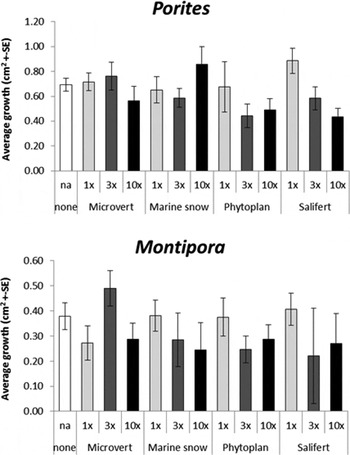
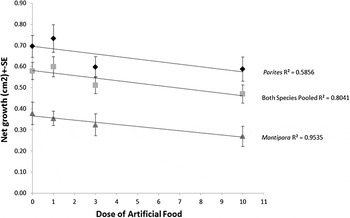
Adding food supplements (MicroVert, MarineSnow Plankton Diet, Phytoplan, and Salifert) at the manufacturers' recommended dosages, resulted in no significant difference to the controls (ANOVA, P = 0.604). Unlike the feeding experiments in filtered seawater above, these comparisons among the types of coral food (pooled over dose) indicated no significant differences with controls (ANOVA: M. capitata P = 0.30, P. compressa P = 0.368). Adding either 3 or 10 times the recommended dose generally resulted in a decrease in growth (Figure 5). There was a significant trend towards decreased growth with increasing dosage (pooled over food types) for M. capitata (r2 = 0.95, P < 0.024). Although the trends for P. compressa (r2 = 0.59, ns) and for both species pooled together (r2 = 0.80, ns) were not significant (Figure 6), the trends were in the same direction and had a similar slope. Phytoplan and Salifert treatments consistently had the lowest growth rates for both species although these differences were not significant.
Effects of artificial food type and dose on growth of Porites and Montipora in an open system (Experiment 3).

Effects of dose of artificial foods pooled by food type (Experiment 3).

DISCUSSION
This study examined species-specific responses to light, water motion, and supplementation with artificial foods using relatively simple metrics such as changes in weight or top-down area measurements. We were able to gain insights in a relatively short time, with minimal cost, by exploiting the clonal nature of corals in a series of straightforward and inexpensive experiments.
Experiment 1: light and water motion
This experiment illustrated that light and water motion interact to effect growth, and that different species respond differently to changes in these parameters. Porites compressa grew best in high-light, low-flow conditions, while M. capitata did the worst under these same conditions. These differences were unlikely to be due to morphology (e.g. Jokeil, Reference Jokiel1978; Lesser et al., Reference Lesser, Weis, Patterson and Jokiel1994) since the small fragments were very similar in size and shape. The interaction between light and water motion has been a subject of study in a variety of corals (e.g. Dennison & Barnes, Reference Dennison and Barns1988; Kuffner, Reference Kuffner2000, Reference Kuffner2002; Fabricius, Reference Fabricius2006), although most of these studies have focused on manipulations involving a single species per study. Species-specific effects of light and water motion are not particularly surprising however, since these factors are thought to play an important role in species zonation patterns (e.g. Wellington, Reference Wellington1982; Titlyanov & Titlyanova, Reference Titlyanov and Titlyanova2002; Vermeij & Bak, Reference Vermeij and Bak2002; Anthony & Connolly, Reference Anthony and Connolly2004, but see Titlyanov et al., Reference Titlyanov, Leletkin, Ermak and Voskoboinikov1990 for an example of three Pacific species with largely overlapping light ranges).
Interestingly, the high flow treatments (~11 cm s−1) consistently resulted in slightly less (though not significant) growth for both species. These experimental flow conditions are highly artificial and likely to be far more unidirectional and less variable than natural conditions; nevertheless the flow conditions in this experiment are relatively slow; for example lagoons fluctuate between 1 and 16 cm/sec, while exposed reefs can be far higher (Sebens & Done, Reference Sebens and Done1992). Constant rates of unidirectional flow in such a small circular volume may have hydrodynamic properties that prevent suspension feeding or otherwise inhibit coral growth. Increased flow at high light levels reduced the effects of bleaching for M. capitata, which has been seen in previous studies on photo-inhibition (Finelli et al., Reference Finelli, Helmuth, Pentcheff and Wethey2005; Nakamura et al., Reference Nakamura, van Woesik and Yamasaki2005). This reduction could be due to a variety of factors such as decreased irradiance from increased surface turbulence, an increased rate of gas exchange, or a slight decrease in temperature (although temperature loggers showed only slight differences between treatments).
Experiment 2: effects of artificial foods
This study demonstrated that some commercially available artificial coral foods can have a large positive effect on the growth of some species of scleractinian corals. These foods can be fairly expensive, although they are generally less expensive and labour intensive than live food. According to the growth data (by weight and displacement), Roti-Feast, Reef Chili and Reef-Roids increased the average growth rates of the M. capitata and P. damicornis fragments (Figure 4). Although being one of the more expensive and natural products, the tanks fed with the Oyster Eggs did not differ significantly from the control tank. According to the product labels, Reef Chili contains zooplankton, copepods and rotifers; Reef-Roids contains zooplankton, Roti-Feast contains rotifers and rotifer eggs, and Oyster Eggs contain actual oyster eggs.
The three test species clearly responded quite differently to foods (Figure 4). Porites compressa did not appear to benefit from feeding, because growth rates did not vary significantly among any of the treatments. Montipora capitata, however, was much more sensitive to the addition of food and all treatments resulted in increased growth relative to the controls. Finally, P. damicornis showed variable responses, losing weight in the controls and with two of the foods, whereas there was significant growth in tanks treated with Reef Chili and Reef-Roids. These species-specific differences most likely correspond to differences in heterotrophic ability. Porites compressa may rely more on phototrophy, which would also explain why this species did so well in the highest light treatments in Experiment 1. Montipora capitata shows the opposite trend in each experiment and appears amply capable of using heterotrophy to fuel growth. Although the coral fragments of M. capitata and P. damicornis grew faster in the Reef-Roids and Reef Chili treatments, it is important to note that there was also an abundance of algal growth in these treatment tanks relative to other treatments. There is likely to be a fine line between feeding and overfeeding. Regardless of the dose, coral fragments that are fed nutrient rich foods will require more herbivores or frequent cleaning to prevent algal overgrowth.
Experiment 3: increased doses of artificial foods
This experiment was designed to examine the effects of increasing doses of artificial foods on coral growth. For this experiment, we chose readily available and widely distributed coral foods with long shelf lives as opposed to the specialty foods with limited distribution used in the previous experiment. According to the product labels Microvert contains spirulina and kelp; Marine Snow contains phytoplankton, (Nannochloropsis, Tetraselmis, Isochrysis, Spirulina, Schyzochitrium, dried seaweed meal and zooplankton); Phytoplan contains a spray-dried blend of phytoplankton; and Salifert contains encapsulated and dissolved fatty acids, carbohydrates, proteins, vitamins and minerals. At the manufacturers' recommended dose we saw no effect of these foods on coral growth above the negative control (filtered seawater). It is important to note that this experiment took place in an open system, with coarsely filtered seawater, and these results may differ in a closed system. Interestingly, although no food treatments were significantly different from the negative control (filtered seawater) the consistent trend was decreased coral growth with increased feeding across both species and all food products (Figure 6). At concentrations higher than the manufacturers' recommended levels, the foods appear to inhibit coral growth, although this trend is only statistically significant for M. capitata. This result is surprising, because even the highest doses of foods were relatively dilute (6 ml in 18 l), and dosing only occurred overnight, followed by flushing with fresh seawater each morning. Although there were few consistent patterns aside from decreased growth with increasing dose, the Phytoplan and Salifert coral food treatments contained noticeably higher algal growth, and the lowest coral growth when averaged over all doses for the coral species we tested.
Overall conclusions
This study shows that light and water motion interact and have species-specific effects on coral growth rates and that some artificial coral foods clearly have the potential to increase coral growth rates in some coral species, while having little or even negative effect on others. Some of the most commonly available and inexpensive coral foods in the aquarium trade were found to have no significant effect on coral growth at recommended dosage, and increased doses resulted in decreased coral growth. Effects of light, water motion and food were in some cases species-specific: P. compressa appears to grow best in bright light regardless of supplemental feeding, whereas M. capitata and P. damicornis showed significant growth in response to some (but not all) artificial foods, and M. capitata tended to grow faster at lower light levels. Strong species-specific effects imply that corals are adapted to specialize on a particular niche in a highly heterogeneous environment. Further studies are needed to explain the mechanisms behind these differences (such as polyp and particle size, tentacle and or nematocysts size and arrangement, or zooxanthellae type and density). The overall implication from this study is that abiotic conditions and artificial feeds can be optimized to have large beneficial effects on coral growth. A systematic examination of the requirements for a given species of reef building coral can result in more successful cultivation of that variety, and may yield interesting insights into basic ecology and organismal biology in the process.
ACKNOWLEDGEMENTS
We would like to thank the members of the Toonen-Bowen Laboratory at the Hawaii Institute of Marine Biology, and the staff at Kewalo Marine Laboratory, with special thanks to Ross Shaw and the URM class for assistance in setting up Experiment 2. Z.H.F. was supported by a fellowship from NOAA National Marine Sanctuaries Partnership MOA#2005-008/66882, and from a grant from the Hawaiian Coral Reef Initiative. B.K.K. was supported as an intern under an Undergraduate Research Mentoring in Biological Sciences (URM) grant (National Science Foundation grant #0829272), and NSF (OCE#06-23678) awarded to R.J.T. This is SOEST contribution number 8371 and HIMB contribution number 1461.