Implications
This study presents the genetic background of feed efficiency and BW gain in mink. This study suggests that extra genetic gain can be obtained by selection for feed efficiency and BW gain at growing along with furring period. Feed is the single largest cost in mink production, while environmental impact is an important and often limiting factor for increased production at least in Scandnavia. Therefore, residual feed intake as a feasible measure to improve feed utilization efficiency can be a valuable tool to decrease costs as well as environmental impact of mink production.
Introduction
Improvement in feed efficiency is of primary research interest in mink breeding to increase economic and environmental sustainability of mink fur production and to use limited resources efficiently. Feed efficiency in mink has been studied by determining feed conversion ratio (FCR, feed : gain; or gain : feed) (e.g. Berg and Lohi, Reference Berg and Lohi1992; Sørensen, Reference Sørensen2002; Nielsen et al., Reference Nielsen, Møller, Hansen and Berg2011 and Reference Nielsen, Møller, Hansen and Berg2012). However, selection for FCR has shown to result in disproportional or unpredictable genetic gain for feed intake and BW gain (Gunsett, Reference Gunsett1984 and Reference Gunsett1986). Therefore, in the current study residual feed intake (RFI) has been estimated as the measure of feed efficiency by adjusting cumulative feed intake for BW of the animal. RFI has been shown to be heritable with favourable positive genetic correlation with FCR and lean growth in pigs (Cai et al., Reference Cai, Casey and Dekkers2008; Saintilan et al., Reference Saintilan, Merour, Brossard, Tribout, Dourmad, Sellier, Bidanel, van Milgen and Gilbert2013). To the best of our knowledge, this is the first study to investigate genetic background of RFI in growing-furring mink.
The mink has a strict annual production cycle in which, kits are born around mid-spring (1st May), weaned and separated for growth around 1st July, and pelted when the winter fur is prime at the beginning of November (Basset and Llewellyn, Reference Basset and Llewellyn1949; Møller and Sørensen Reference Møller and Sørensen2003). The main economic valuable criteria for selection of mink is litter size, BW and pelt quality (Lagerkvist, Reference Lagerkvist1997). Although the genetic value for reproduction is known earlier, the final selection of mink is based on the full grown BW and the quality of the pelt, which cannot be taken until the beginning of November when the winter coat is prime. The BW of mink at this time is the major factor determining the pelt size (Møller, Reference Møller1999). Therefore, mink are often weighed when the pelt quality is graded on live animals. However, the majority of the BW gain is achieved from July to September along with the full body length (Hansen, Reference Hansen1997; Damgaard et al., Reference Damgaard, Dalgaard, Larsen, Hedemann and Hansen2012). The period from July to 2nd September is hereafter referred to as the body length ‘growing period’. Mink develop their fur coat in the period from September till early November, hereafter referred to as fat deposition ‘furring period’; as this period has been known to be associated with fat deposition (Charlet-Lery et al., Reference Charlet-Lery, Fiszlewich, Morel and Allain1980). The biological differences in growth of BW during the course of life for juvenile mink indicate a benefit by analysing BW gain longitudinally. Furthermore, phenotypic correlations for FCR (feed : gain) between growth stages in mink have been reported to be low to moderate by Berg and Lohi (Reference Berg and Lohi1992) (–0.07 to 0.33) and Møller et al. (Reference Møller, Hansen and Nielsen2007) (0.28); this indicates that feed efficiency in farmed mink is dependent on the growth stages due to the changes in biological requirements for skeletal growth and fat deposition.
Feed intake and growth traits have been analysed longitudinally using random regression in animal breeding as reviewed by Schaeffer (Reference Schaeffer2004). However, to our knowledge no study has put the context of feed efficiency in a longitudinal aspect using random regression in mink. Use of random regressions can be advantageous by better adjustment for temporal environmental effect on the traits and taking into account changes in the genetic variances during growth (Jensen, Reference Jensen2001). In the current study random regression using Legendre polynomials is used due to advantages of orthogonal polynomials in standardized units of time in order to reduce correlations among the estimated coefficients (Kirkpatrick et al., Reference Kirkpatrick, Lofsvold and Bulmer1990). Bayesian analyses have been shown to improve the inference of model parameters and facilitating large scale analyses (Jensen, Reference Jensen2001). Therefore, the Gibbs sampling algorithm was used in this study to compute properties of the posterior distribution of each (co)variance parameter.
Based on the above findings, it is expected that the genetic characteristics of RFI and BW gain differ between the growing and the furring period. Therefore, a random regression model can be useful to investigate the genetic background of these traits. The objective of this study was, therefore, to determine the genetic characteristics of RFI and BW gain in male and female mink during the growing-furring period; and to identify the optimum selection and recording strategies for feed efficiency and growth. This was achieved by using random regression models involving orthogonal polynomial regression for multiple random effects along with heterogeneous residual variances.
Material and methods
Design and animals
The data were available from a previous experiment by Møller et al. (Reference Møller, Hansen and Nielsen2007) and Nielsen et al. (Reference Nielsen, Møller, Hansen and Berg2011). Four lines were established for the experiment consisting of one control and three selection lines each with 100 female and 20 male breeders. The control line was a line where breeding animals were chosen at random. A maximum of two males from the same sire and two offspring from the same litter were used for breeding. The first selection line was selected based on ad libitum feeding; second selection line was based on restricted feeding which was fed about 80% of ad libitum feeding. Finally the third line was based on FCR which was established in generation two from the ad libitum feeding line. After the normal selection (selection without taking into account FCR) in the ad libitum feeding line in generation one, 10 males and 50 females with the lowest FCR were selected for breeding in the FCR line. The data of the current study was collected during the years 2003 to 2005 as part of the above experiment. Animals were kept in pairs: one male and one female per cage. In total, BWs of 4278 juvenile mink were available of which half were male and half female. Feed intake was measured per cage and records of 2139 mink cages were available.
Data
BW was measured 8 times for each of 4278 animals during the growing (63 to 126 days of age) and furring period (147 to 210 days of age). Individual weights were recorded over two days, every third week. The accumulated feed intake was calculated for the three week intervals between weighing, based on the daily feed allowance (from a Palm Pilot controlling the feeding machine) and feed left-overs (removed daily) (Møller et al., Reference Møller, Hansen and Nielsen2007; Nielsen et al., Reference Nielsen, Møller, Hansen and Berg2011). In the current study, cumulative feed intake in 6 intervals during the growing-furring period from 105 to 210 days of age (15 to 30 weeks of age) from all 2139 cages was used.
Statistical analyses
The genetic parameters for BW gain of males and females were estimated using univariate random regression models. The following random regression models for each male and female BW are using:
 $$y_{{ijkm}} =YL_{i} {\plus}q(t)'r_{i} {\plus}q(t)'a_{k} {\plus}q(t)'p_{k} {\plus}e_{{ijkm}} $$
 $$y_{{ijlm}} =YL_{i} {\rm }{\plus}q(t)'r_{i} {\plus}q(t)'a_{l} {\plus}q(t)'p_{l} {\rm }{\plus}e_{{ijlm}} $$
where y ijkm and y ijlm are the BW record for each male (k) and female (l) mink on age j in year and line of i, respectively; YL i is the effect of year and line interaction; t is the age (days) for each male mink; q is a vector valued function with appropriate standardized Legendre polynomials of age, t, with second order polynomials for each male mink; r i is the vector of regressions on Legendre polynomials for YL i ; a k and a l are vectors of additive genetic effects of animal k and l, respectively, with second order Legendre polynomials; p k and p l are vectors of permanent environmental effect of litter for animal k and l, respectively, with second order Legendre polynomials; and e ijklm and e ijlm are the residuals of the models fitted for male and female BW with heterogeneous variance in eight classes for each time period that BW was recorded, respectively. The genetic (co)variance matrix (G) and the permanent environmental (co)variance matrix (P) each had an order of (q+1). Heterogeneous residual variance was estimated in 8 classes for each time that BW was measured.
The genetic parameters for RFI were estimated using a univariate random regression model for cumulative feed intake of each cage that included, besides other systematic effects, BW of the male and of the female mink. The following random regression model was fitted:
 $$\eqalignno{ y_{{ijklm}} = & YL_{i} {\plus}b_{1} ({\rm BWM}_{k} ){\plus}b_{2} ({\rm BWF }_{l} ){\plus}q(t)'r_{i} {\plus}lp(t)'a_{k} \cr & {\plus}lp(t)'a_{l} {\plus}lp(t)'p_{k} {\plus}lp(t)'p_{l} {\plus}e_{{ijklm}} $$
where y ijklm is the feed intake record for each cage with animal k and l on age j in year and line of i; YL i is the effect of year and line interaction; b 1 is the regression coefficient for BW of male mink k; BWM k is the BW for male mink k; b 2 is the regression coefficient for BW of female mink l; BWF l is the BW for female mink l; t is the average of age for male and female mink in each cage; q and lp are vector valued functions with appropriate standardized Legendre polynomials of age, t, with second (q) and first (lp) order Legendre polynomials for fixed and random part, respectively, for each cage; r i is the vector of regressions on Legendre polynomials for YL i ; a k and a l are vectors of additive genetic effects of animal k and l, respectively, with first order Legendre polynomials; p k and p l are vectors of permanent environmental effect of litter for animal k and l, respectively, with first order Legendre polynomials; and e ijklm is the residual of the model fitted with heterogeneous variance in six classes for each time period that cumulative feed intake was obtained. The genetic (co)variance matrix (G) and the permanent environmental (co)variance matrix (P) each had order of 2×(lp+1) because the effects are estimated for both males and females. The model allows prediction of separate effects for each animal even though records were based on cages containing two animals.
Bayesian estimation method using Gibbs sampling was used to estimate all parameters including G, P and the residual variance of each classes for RFI and BW. The Gibbs sampler was run for 2 M rounds with first 50 K considered as burn-in and every 500th sample saved for posterior analysis. Coda package (Plummer et al., Reference Plummer, Best, Cowles and Vines2006) of R program was used to evaluate convergence to the posterior distribution of the (co)variance parameters. Furthermore, covariance functions were used to obtain genetic parameters for BW gain from 63 to 210 days of age along with RFI from 105 to 210 days of age. In addition, genetic parameters for BW gain and RFI during growing period, during furring period and during the entire growing-furring period was estimated using covariance functions. DMU software package (Madsen and Jensen, Reference Madsen and Jensen2010) was used for the univariate random regression model using Gibbs sampling.
Selection index
The accuracy of selection based on different recording strategies for RFI and BW were compared based on estimating the accuracy of index using the following:
 $$r_{{a,I}} ={{\sqrt {{\bf b'}\,{\bf P}_{{\bf s}} \, {\bf b}} } \over {\sqrt {{\bf a'}\,{\bf G}_{{\bf s}} \,{\bf a}} }}$$
where r a,I is the accuracy of index; b the n×1 vector of weighing factors for each record used in making selection decisions; P s the n×n matrix of phenotypic (co)variance among records of each trait; a the n×1 vector of relative economic values for each record with only the pelting RFI and BW (day 210) considered to have one economical weight and other time points to be zero; and G s the n×n matrix of genetic (co)variance among all records of each trait. P s and G s matrices were obtained from P and G matrices while only considering (co)variances for the time points that cumulative feed intake records were available for RFI analysis and BW records for BW analysis. The weighing factor for each record was considered zero except record on day 210 which was considering one. This is due to the fact that only final record is used for selection in mink breeding.
For RFI, six scenarios were compared for each male and female; first, all six records during the growing-furring period were included in the index (RFI6: days 105, 126, 147, 168, 189 and 210), subsequently second to last RFI estimates were dropped (RFI5: days 105, 126, 147, 168 and 210; RFI4: days 105, 126, 147 and 210; RFI3: days 105, 126 and 210; and RFI2: days 105 and 210) to the point where only the last RFI estimate (day 210) remained (RFI1). Regarding the BW, eight scenarios were tested for each male and female; with all eight records obtained during the growing-furring period included in the index (BW8; days 63, 84, 105, 126, 147, 168, 189 and 210); and sequentially the second to last BW record was dropped (BW7: days 63, 84, 105, 126, 147, 168 and 210, BW6: days 63, 84, 105, 126, 147 and 210; BW5: days 63, 84, 105, 126 and 210; BW4: days 63, 84, 105 and 210; BW3: days 63, 84 and 210; BW2: days 63 and 210) till only the last BW measurement (day 210) remained (BW1).
Results
Characteristic of RFI and BW growth
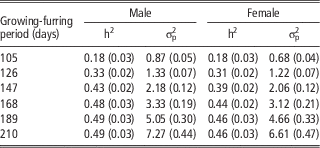
Heritabilities and phenotypic variances of RFI estimates for male and female during the growing-furring period are presented in Table 1. The heritability of RFI for males and females in each day of growing-furring period is presented in Supplementary Figure S1 and S2. RFI showed to have low to high heritabilities in male and female mink and increased with the age of animals. The heritability of RFI increased by 2.72 and 2.56-fold compared to the 8.36 and 9.72-fold increase in phenotypic variance from 105 to 210 days of age in male and female mink, respectively.
Heritability estimates (h2) and phenotypic variances (σp 2) of residual feed intake (RFI) for male and female mink at six time points during the growing (105 to 126 days of age) and furring period (147 to 210 days of age) with posterior standard deviations of posterior means in parentheses

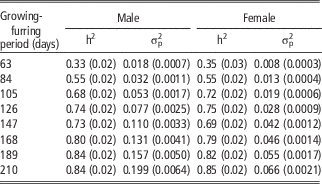
The heritability of male and female BW showed to be moderate to high and increase with age (Table 2). The heritability of BW for males and females in each day of the growing-furring period is presented in Supplementary Figure S3 and S4. The heritabilities for BW in the growing period (63 to 126 days) were moderate to high in males (0.33 to 0.74) and females (0.35 to 0.75); in the furring period (126 to 210 days) heritabilities were constantly high for males (0.73 to 0.84) and females (0.69 to 0.85). The heritabilities for male and female BW were not markedly different from each other at any time point. However, the phenotypic variances of BW in males and females differed significantly from each other and increased substantially with age (11.06 and 8.25-fold, respectively).
Heritability estimates (h2) and phenotypic variances (σp 2) of BW for male and female mink at eight time points during the growing (63 to 126 days of age) and furring period (147 to 210 days of age) with posterior standard deviations (PSD) of posterior means in parentheses

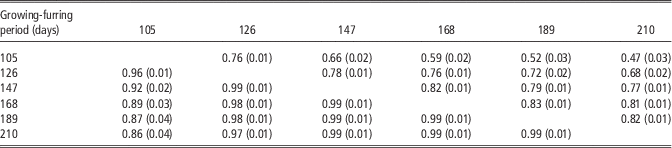
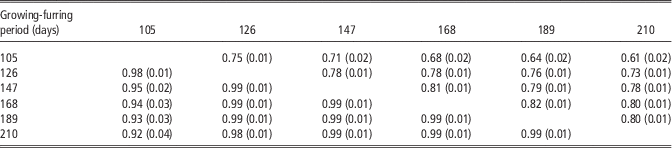
Genetic and phenotypic correlations between each RFI estimate during the growing-furring period (105 to 210 days) for male and female mink are presented in Tables 3 and 4, respectively. The genetic correlations of RFI estimates at different ages were positive and close to unity in both genders. The genetic correlations tend to decrease marginally with an increase in distance between RFI estimates with the lowest correlation between 105 and 210 days of age in both genders. In addition, the phenotypic correlations between RFI estimates were positive and ranging from moderate to high and decreased with increases in the distance between RFI estimates in both genders. In general, both genetic and phenotypic correlations between RFI estimates were mostly higher for females than for males.
Posterior means of genetic (below diagonal) and phenotypic correlations (above diagonal) of residual feed intake (RFI) at six time points during the growing-furring period (105 to 210 days) in male mink with posterior standard deviation (PSD) of posterior means in parentheses

Posterior means of genetic (below diagonal) and phenotypic correlations (above diagonal) of residual feed intake (RFI) estimates for six time points during the growing-furring period (105 to 210 days) in female mink with posterior standard deviation (PSD) of posterior means in parentheses

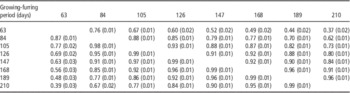
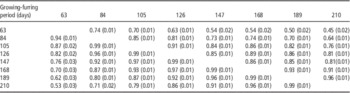
Tables 5 and 6 present the genetic and phenotypic correlations of male and female BW during the growing-furring period (63 to 210 days), respectively. The genetic correlations between each two adjacent BW records were close to unity in both males and females. BW at weaning (63 days) showed slightly lower genetic correlations with other recorded BW within the growing (0.87 to 0.69) and furring (0.63 to 0.39) periods, especially with pelting BW (210 days) in males (0.39, 0.03 SD). However, the BW at the end of the growing period (126 days) showed substantially high genetic correlations with pelting BW (0.84 and 0.86) in both male and female mink. Furthermore, the phenotypic correlations were following the same trend as genetic correlations albeit with a slightly lower magnitude.
Genetic (below diagonal) and phenotypic correlations (above diagonal) of male BW for eight time points during the growing-furring period (63 to 210 days) with PSD of posterior means in parentheses

Genetic (below diagonal) and phenotypic correlations (above diagonal) of female BW for eight time points during the growing-furring period (63 to 210 days) with PSD of posterior means in parentheses

Selection index
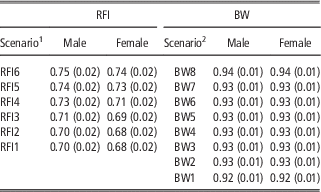
Changes in selection index accuracy for different recording scenarios are presented in Table 7. Subsequent reductions in RFI estimates in selection indices (from RFI6 to RFI1) decreased accuracy of the selection index by 1.27% to 6.98% in male and 1.84% to 8.36% in female mink. RFI4 and RFI3 showed to have the largest drop in the accuracy of selection compared to the previous scenario by 2.08% and 2.10% in males and 2.71% and 2.46% in females, respectively. In addition, no significant reduction in accuracy of selection index was observed by removing the RFI estimate at 126 days of age. Reduction in BW records showed that by going from the BW8 to BW1 scenario, in total, the loss in accuracy of the selection index would be 2.45% in males and 1.45% in females. The accuracy of the selection index for BW was mainly reduced by going from the BW2 to BW1 scenario in males 0.98% and females 0.89%.
Accuracy of selection index for six residual feed intake (RFI) scenarios and eight BW growth scenarios during growing-furring period in male and female mink with posterior standard deviation (PSD) of posterior means in parentheses

1 RFI6 to RFI1=accuracy of selection index for scenarios with RFI estimates at 6 time point (105, 126, 147, 168, 189 and 210 days of age) and scenarios with subsequent omitting the second last RFI estimate until only pelting RFI estimate (210 days of age) remains (RFI1).
2 BW8 to BW1=accuracy of selection index for scenarios with BW records at 8 time point (63, 84, 105, 126, 147, 168, 189 and 210 days of age) and scenarios with subsequent omitting the second last BW records until only pelting BW record (210 days of age) remains (BW1).
Discussion
This study showed substantial genetic variation for feed efficiency and BW gain in mink, especially at the end of the furring period, indicating considerable potential for increasing genetic gain by selection towards pelting time. Furthermore, genetic correlations, which were obtained for feed efficiency, suggest that substantial genetic gain can be obtained by selection for this trait at pelting time. However, lower genetic correlations between RFI at pelting with RFI at growing period suggest different genes involved in the regulation of nutrient utilization in mink in different periods of growth, that is for body length growth and fat deposition. The large deviation from unity in genetic correlation in BW records in growing and furring suggests different biological mechanisms and genes are regulating the BW gain at different stages of growth in mink.
Heritabilities
The estimated heritability for RFI increased from 0.18 to 0.49 with age, along with the phenotypic variance indicating a rise in the genetic variation. To our knowledge no heritability for RFI has been reported in mink. Sørensen (Reference Sørensen2002) reported a heritability of 0.30 for feed efficiency (gain : feed) in July which is the early growing period of mink. This time period was not available in the current study, and is higher than the heritability estimate for RFI on August (105 days of age). In addition, Kempe et al. (Reference Kempe, Koskinen, Mantysaari and Stranden2010) obtained a heritability of 0.28 for feed efficiency (gain : dry mater intake) for the total period from mid-August to mid-October period in blue fox. The differences between the above studies and the current study could be due to the method of estimating feed efficiency, with RFI explaining the proportion of feed intake that is independent of BW gain compared to feed efficiency as a ratio trait that contains the genetic properties of feed intake and BW gain. Andersen and Pedersen (Reference Andersen and Pedersen1996) modelled weight as a function of feed intake using longitudinal data to estimate feed efficiency in pigs. However, this model has drawbacks as it reduces the variation in BW resulting in reduction on potential genetic gain in production as discussed by Schaeffer (Reference Schaeffer2004). Furthermore, the range of heritability for RFI in pigs is 0.10 to 0.44 (Gilbert et al., Reference Gilbert, Bidanel, Gruand, Caritez, Billon, Guillouet, Lagant, Noblet and Sellier2007; Cai et al., Reference Cai, Casey and Dekkers2008; Saintilan et al., Reference Saintilan, Merour, Brossard, Tribout, Dourmad, Sellier, Bidanel, van Milgen and Gilbert2013; Shirali et al., Reference Shirali, Doeschl-Wilson, Duthie, Knap, Kanis, van Arendonk and Roehe2014). In addition, Drouilhet et al. (Reference Drouilhet, Gilbert, Balmisse, Ruesche, Tircazes, Larzul and Garreau2013) reported a heritability of 0.16±0.05 for RFI in rabbits. In the present study, substantial genetic variance at the end of the fat deposition in the furring period could be due to different underlying factors such as different quantitative trait loci with different modes of inheritance influencing the trait along with more pronounced animal’s genetic effect compared to the early body length growing period. This suggests that higher selection response can be achieved by selecting for feed efficiency during fat deposition in the furring period. In addition, lower genetic variance of RFI for males (0.15) and females (0.12) in the early growing period can be due to lower variation in components of RFI such as cumulative feed intake and BW in this time period compared to the later stages. The variance of such cumulative traits rises with increases in the number of elements; hence, the variance of RFI will increase. The substantial increase in genetic and phenotypic variances in the furring period compared to growing indicates that the furring period is associated with a reduction in feed efficiency. The heritability patterns of RFI in male and female mink were similar, indicating a similar pattern for genetic and phenotypic variances for male and female mink. However, the genetic variances of RFI in males were 13% to 19% higher than in females during the growing-furring period. This indicates a higher genetic gain for feed efficiency in male mink.
The heritability estimates for BW increased from 0.33 to 0.85 with age in male and female mink. This was in line with the 8.36 and 9.72-fold-increases in phenotypic variances in males and females respectively. This indicates large genetic variance for BW in the furring period suggesting high genetic gain by selection for BW at later stages of this period. Nielsen et al. (Reference Nielsen, Møller, Hansen and Berg2012) reported heritabilities of August BW for males 0.44 to 0.55 and females 0.57 to 0.64 along with November BW for males 0.52 to 0.73 and females 0.51 and 0.68 for different selection lines using the same dataset as in the current study. The August and November BW of Nielsen et al. (Reference Nielsen, Møller, Hansen and Berg2012) corresponds to the late growing period (105 to 126 days of age) and late furring period (189 to 210 days of age) in the current study, respectively. The differences in heritability estimates can be due to using different methods of analysis as in the current project random regression has been used compared with the bivariate animal model of Nielsen et al. (Reference Nielsen, Møller, Hansen and Berg2012). Moreover, Sørensen (Reference Sørensen2002) reported large heritability (0.64) for BW in November in mink, which is in agreement and slightly lower than estimates obtained in the current study. In pigs, Huisman et al. (Reference Huisman, Veerkamp and van Arendonk2002) using random regression models obtained 0.14 to 0.19 heritabilities for live BW during growth. Furthermore, the current study showed a notable increase in genetic variance by age for BW which is in agreement with results of Nielsen et al. (Reference Nielsen, Møller, Hansen and Berg2012). The heritabilities of BW for males and females did not differ within each time point, however, the phenotypic variances were greatly different ranging from 55% to 67% and consequently the genetic variances were also different. This similarity in genetic variance patterns in male and female BW indicates possible high genetic correlations between genders; the high genetic correlations could be one of the underlying reasons for similar heritabilities for RFI in both genders, as BW is the main component trait of RFI.
Genetic and phenotypic correlations
The positive and close to unity genetic correlations for RFI estimates between growing and furring period suggests that animals with better feed efficiency at the early growth period also tend to be efficient at the end of the growth period. However, 10% to 15% smaller correlations between the growing and the furring period indicate the presence of different genes regulating the efficiency of nutrient utilization during the body length growing period and the fat deposition furring period. This further suggests that extra genetic gain can be obtained by selecting for feed efficiency at growing along with furring period. Contrary to our results, Berg and Lohi (Reference Berg and Lohi1992) reported low (–0.07) to medium (0.33) residual correlations between feed efficiency (gain : feed) at different stages of the growing-furring period (July, August, September and October) in mink. This difference can be due to different definitions of feed efficiency and different methods of estimating correlations. Furthermore, feed efficiency has been shown to have different genetic backgrounds at different stages of growth in other species, for example in pigs (Shirali et al., Reference Shirali, Doeschl-Wilson, Duthie, Knap, Kanis, van Arendonk and Roehe2014) and different genes responsible for efficiency of feed utilization at different stages of growth (Shirali et al., Reference Shirali, Duthie, Doeschl-Wilson, Knap, Kanis, van Arendonk and Roehe2013). The phenotypic correlations between the growing and furring periods were positive and moderate to high and generally smaller than the genetic correlations, suggesting the effect of residual variance on the feed efficiency. The posterior means of residual variances obtained considering heterogeneous residual variance analysis showed large residual variances at the furring period ranging from 0.41±0.02 posterior standard deviation (PSD) to 1.39±0.08 PSD compared with the residual variances in the growing period ranging from 0.14±0.01 PSD to 0.25±0.01 PSD. This further confirms the environmental influences on the phenotype of feed efficiency. Møller et al. (Reference Møller, Hansen and Nielsen2007) reported low (0.28) Pearson correlation for FCR (feed : gain) between early and late growing-furring period in mink, which is lower than phenotypic and genetic estimates obtained in the current study. This could be due to investigating cumulated traits in the present study, while Møller et al. (Reference Møller, Hansen and Nielsen2007) investigated the FCR for each 3-week period; in addition to using different methods of analysis.
The moderate to high genetic correlations between BW records at the growing period with the furring period suggests that selection for pelting BW has resulted in larger animals in the growing period. In addition, high genetic correlations between each subsequent BW estimate suggest that recordings for BW can be performed in longer intervals. Furthermore, lower genetic correlations between BW at the growing period with pelting BW in male (61% to 16%) and female (47% to 14%) suggests that extra genetic gain can be obtained by selection for BW at the growing period along with the pelting BW. In addition, it suggests that different biological mechanisms are responsible for BW gain in the growing and furring periods. This can further be observed from substantially larger genetic and phenotypic variance in the furring compared to the growing period, suggesting that genes responsible for BW gain are switch on and off during growing-furring period. In agreement with genetic correlations obtained in the current study, Nielsen et al. (Reference Nielsen, Møller, Hansen and Berg2012) reported genetic correlations between August and November BW in male (0.77 to 0.90) and female (0.86 to 0.94) mink using the same data set as in the current study for different selection lines. Sørensen (Reference Sørensen2002) estimated the growth curve of mink using multiphasic models and observed that the growing period is associated with mainly lean BW growth and the furring period is associated with fat deposition and fur development. This can further explain the biological background of BW growth in mink in agreement with the genetic correlations obtained in the current study. The phenotypic correlations between BW estimates were following the genetic correlations but relatively lower in magnitude. The large genetic and phenotypic correlations between RFI estimates could be due to using cumulative records of feed intake, as accumulated feed intakes have part-whole correlations from one record to the next. This could be one of the main reasons for large correlations between BW records as well.
Optimum recording and selection strategies
Substantial reduction in selection index accuracy for RFI suggests that to achieve high genetic gain, therefore, feed efficiency should be analysed longitudinally and recording should take place in different time points especially the furring period. However, selection index accuracy for BW suggests that inclusion of different BW records does not increase the genetic gain noticeably. The underlying reason for no substantial genetic gain by inclusion of extra feed intake and BW records could be due to the fact that in the current study accumulated BW and feed intake has been used; therefore, the variation in the above time points are also included in the RFI and BW estimate at pelting time. This indicates that RFI estimation and BW measure at pelting would be desirable for selection in mink breeding. However, under practical conditions it would be more feasible for farmers to obtain the genetic potential of animals at the late growing period (September). RFI estimation and BW measure at September time point have high genetic correlation with feed efficiency and BW gain at the pelting time, respectively. This would allow mink farmers to perform breeding animal selection (grading) at the pelting time by considering the genetic potential of animals for reliable September BW gain and feed efficiency. In the current study, the genetic correlations between RFI and BW for males and females could not be obtained using multivariate animal models due to large number of parameters to be estimated. Therefore, the accuracy of selection indices is estimated assuming no significant genetic correlations between feed efficiency and BWs. These correlations are expected to be small because RFI is expressed conditional on BW.
Conclusion
Feed efficiency and BW in mink have moderate to high heritabilities and heritabilities increase with age. RFI and BW can be substantially improved by genetic selection at or close to pelting. Feed efficiency and BW gain in the growing period suggests having different biological background than the furring period. Therefore, feed efficiency in mink should be analysed longitudinally and random regression models have been shown to be suitable for dissecting the genetic background of RFI.
Acknowledgements
The authors gratefully acknowledge the financial support from the Danish Ministry of Food, Agriculture and Fisheries and Kopenhagen Research for this research.
Supplementary material
To view supplementary material for this article, please visit http://dx.doi.org/10.1017/S1751731115000956