The terrorist attacks on 11 September 2001 on the United States marked a watershed for counterterrorist policies in Western countries. The collapsing towers of the World Trade Center in New York City raised doubts about the security of Western citizens not in some faraway dangerous foreign land but on their own domestic soil—doubts that policy-makers needed to address quickly, convincingly, and effectively. Yet, while the attacks had the expected demand side shockFootnote 1 in that voters in all Western countries were willing to accept restrictions on liberties and freedoms in the form of stricter counterterrorist policies, the regulatory response to the 9/11 attacks was markedly heterogeneous and uneven, with some countries enacting new policies comprehensively, while others did comparatively little.Footnote 2 In this article, we study why this was the case, focusing on cross-country spillover effects that gave rise to peer-group-specific spatial dependence in counterterrorist policies.
That one country's counterterrorist policies are affected by other countries' policies—the definition of spatial policy dependence—is not a new insight. Counterterrorist policies undertaken in one country exert externalities onto other countries. In a series of papers, Sandler and coauthors have drawn a distinction between preemptive policies such as dismantling terrorist training camps or freezing their assets on the one hand, and defensive policies such as protecting airports and other infrastructure and cross-referencing passport details with previously collected databases on the other hand.Footnote 3 By proactively seeking to destroy terrorist groups, preemptive policies undertaken by one country generate positive externalities for all other countries faced by the same terrorist threat, rendering all affected countries safer. When one country invests more, other countries have an incentive to invest less such that preemptive policies are likely to be undersupplied globally. In contrast, by exclusively protecting domestic targets against terrorist threats, defensive counterterrorist policies impose some negative externalities onto other countries.
Another major contribution in terms of understanding governments' incentives to invest in distinct stylized categories of counterterrorist policies comes from Bueno de Mesquita who argues that, in response to electoral pressures, governments oversupply observable policies aimed at defending specific targets at the expense of unobservable policies aimed at combating terrorist threats in general.Footnote 4 Since observable policies such as airport security measures largely overlap with defensive policies—and unobservable policies such as the infiltration of terrorist cells and other intelligence measures tend to be preemptive policies—the two major existing accounts of counterterrorist policy choice converge in some of their central predictions, if for different reasons.
We provide an alternative theoretical account of defensive counterterrorist policies in the wake of 9/11. Negative externalities do not create a general “race to the top” with all countries resorting to increasingly stringent policies over time. While such externalities do indeed result in regulatory competition,Footnote 5 countries are not equally and indiscriminately affected by counterterrorist policies from all other countries. The existence of heterogeneous threat levels alters the strategic game between governments. Governments do not compare their national counterterrorist policies to those of all other countries. Instead, they look toward policies of their peers in terms of other countries with a similar level of threat from international terrorism, and they ignore policies undertaken by countries outside their peer group. Rather than avoiding falling behind all other countries in terms of counterterrorist policies, countries merely avoid falling behind the policies of their peers. In other words, we develop a theory that predicts peer-group-specific spatial dependence in counterterrorist policies among countries of similar threat level.
Empirically, our contribution provides the first quantitative evidence of spatial dependence in counterterrorist policies. The existing literature is either game-theoretical citing only casual empirical evidence in support of its propositions,Footnote 6 or it provides only qualitative and descriptive evidence on convergence/divergence in counterterrorist policies.Footnote 7 Employing a new data set originally constructed by one of the authors,Footnote 8 we provide evidence largely consistent with our hypotheses and robust to a range of changes to model specification in an empirical analysis of counterterrorist policies in Western developed-country democracies over the period 2001 to 2008.
A Theory of Peer-Group-Specific Spatial Policy Dependence in Counterterrorist Policies
In this section we explain why some of the marked variation in the regulatory response to the 9/11 attacks is a consequence of peer-group-specific spatial dependence in counterterrorist policies. Our empirical analysis focuses on international terrorism as opposed to purely domestic terrorism. Over the period of our study, the terrorist threat to Western democracies, or at least the perception of threat by the governments of these countries, was dominated by internationally operating Islamist terrorist groups.
The Counterfactual Political Equilibrium in a World of Independent Policy Choices
The spatial dependence literature typically assumes that policies are in equilibrium and are propelled out of equilibrium by an increase in interdependence—for example, the abolition of international capital controls.Footnote 9 In this case, we cannot make this simplifying assumption because all governments in Western democracies had an incentive to change their counterterrorist regulations after the shock of 9/11. We therefore have to first explain the counterfactual political response to international terrorism in the absence of spatial policy dependence. In doing so, we explore reasons behind the differential policy response of Western democracies to the events of 9/11 in a counterfactual world of independent policy choices.
The micro-foundations of our theory are in line with recent political economy models of counterterrorist policies.Footnote 10 These models assume governments to be opportunistic and responsive to shifts in voter preferences. Since voters shifted their preferences toward security after 9/11, governments had an incentive to increase counterterrorist activities. While Bueno de Mesquita is mainly interested in the choice of counterterrorist instruments, we aim to explain cross-country variation in countries' shifts toward tighter counterterrorist policies.
Opportunistic models of counterterrorist policy choices assume that these policies are beneficial to voters. They increase what one might call “homeland security.” However, these policies do not come for free. The costs of counterterrorist policies are partly budgetary, as in Bueno de Mesquita's model. For example, the official annual budget of the U.S. Department of Homeland Security is $57 billion.Footnote 11 Security is costly and voters ceteris paribus favor lower taxes. Therefore, counterterrorist policies are subject to a budget constraint.
This is not the only cost, however. Counterterrorist policies also affect voters' lives in many ways, some subtle, others less so. Delays at airports caused by increased security checks or the nuisance of having to take off one's shoes and belt and the loss of creams, perfumes, and other liquids at security checks represent a burden to citizens. Other policies such as the use of full body-scanners, the installation of a comprehensive DNA database, the extensive use of closed circuit television (CCTV), or the introduction of biometric passports all restrict civil rights and liberties. In addition, counterterrorist policies conflict with the ideological preferences of some voters.
As a consequence of counterterrorist policies being costly, voters will support such policies only to the extent that they see themselves in need of a marked improvement in their security because otherwise there is little benefit from tightened counterterrorist policies. This, in turn, depends on the level of the terrorist threat to which citizens of a country are exposed. Voters are more willing to accept the costs of counterterrorist policies if the threat from international terrorism and consequently the need for increased security is high and less so if the threat from international terrorism is low.
We do not deny that counterterrorist policies that are burdensome and severely restrict civil rights and liberties can find support among an electorate that is eager to see decisive government action against the terrorist threat, given that such policies represent a clearly visible counterterrorist strategy. Nor do we deny that in certain circumstances they can even be preferred by the electorate to less visible, but also less intrusive (for citizens) general preemptive counterterrorist policies, just as Bueno de Mesquita argues. However, we contend that governments are more likely to implement a broad set of burdensome and rights-restricting counterterrorist policies when the threat level from terrorism is high.
Causes of Peer-Group-Specific Spatial Policy Dependence in Counterterrorist Policies
So far, we have developed a theory of the legislative response to international terrorism that assumes governments act independently of each other. Of course, this assumption is not realistic. Sandler and coauthors have long pointed out that counterterrorist policies create externalities.Footnote 12 Some of these are positive externalities, increasing security in other countries, thus providing them with a public good. For example, if one country infiltrates and destroys an international terrorist cell, other countries will become slightly safer. Unfortunately, when preemptive counterterrorist policies generate positive externalities, governments have an incentive to undersupply them.Footnote 13
Predominantly defensive counterterrorist policies, on the other hand, generate negative externalities. An increase in the effectiveness of policies aimed at the defense of domestic targets in one country may increase the risk level in other countries. This happens if terrorist groups regard potential targets as functional substitutes for the purpose of furthering their strategic objectives, seeking out the weakest link among similarly attractive targets for terrorist attacks. In this case, a significant increase in the effectiveness of counterterrorist policies in, say, the United States may instigate terrorist groups to seek softer targets in other countries, for example, the United Kingdom.
Because terrorist groups, ceteris paribus, have an incentive to attack the softest target, the existence of negative externalities creates regulatory competition in which governments have an incentive not to fall behind and to make sure they do not have significantly fewer or less effective counterterrorist policies in place than other countries that international terrorists would regard as equally attractive potential targets. Accordingly, negative externalities have the potential to generate a “race to the top” in counterterrorist regulations with “laggard” governments willing to surrender civil rights and liberties beyond what they would have deemed optimal in the counterfactual optimal policy case without externalities.
However, regulatory competition in counterterrorist policies does not lead to a general “race to the top.” Terrorist groups' ultimate objective is a fundamental change in policy or even regime change in their own countries or regions.Footnote 14 Some Western countries take on a much more active role than others in thwarting, stalling, and possibly defeating this objective in places such as Afghanistan, Iraq, and elsewhere. These Western countries provide more military aid, station more troops, train more security personnel, export more arms, and supply more economic and political support to governments embattled in a fight with terrorists who want to seize political control and power away from them. Also, the ultimate objective of policy or regime change notwithstanding, which is typically unachievable in the short run, terrorist groups' short-term strategic goals revolve around gaining peer support, recruiting new members, and attracting media attention.Footnote 15 Here as well, attacking citizens from some Western countries proves much more attractive and effective in furthering these short-term goals than attacking citizens from other countries. Simply stated, harming or killing a British or American citizen is much more valuable to terrorists than killing a Swedish or Portuguese national.Footnote 16 Not all potential targets are equally relevant for achieving the terrorists' short-term strategic goals or long-term ultimate policy objectives. Thus, targets in different countries are not perfect substitutes to terrorist groups: the threat level in different countries varies because attacking nationals from different countries has varying strategic value for terrorist groups.
In sum, the negative externalities inflicted by effective defensive counterterrorist policies in one country onto other countries does not generate a general “race to the top” because sufficiently strong externalities only exist between countries that are functional substitutes for international terrorist groups. As a consequence, regulatory competition leads to spatial policy dependence within groups of countries with similar propensities to become the target of specific international terrorist groups. With the threat of international terrorism to Western democracies in the post-9/11 era dominated by essentially the same internationally operating Islamist groups, regulatory competition occurs mainly among countries that have similar propensities to become the target of international terrorism. A country with a very low propensity, such as, for example, Finland or New Zealand, has no need to orient itself toward the counterterrorist policies of countries such as the United States and the UK, which are much more threatened by international terrorism.
Summary of Predictions
Our theory allows us to make a number of predictions regarding counterterrorist policies in Western democracies in the wake of the 9/11 attacks. Our first prediction follows from our argument that counterterrorist policies impose costs on citizens and that governments in countries exposed to a greater level of threat from international terrorism find it easier to enact stricter policies because this raises the expected benefits of such policies than governments in countries where the threat level is lower. The perceived threat level thus affects whether security or civil rights and liberty concerns dominate. This leads to our first testable hypothesis:
H1: Countries with higher exposure to the threat from international terrorism enact more counterterrorist policies than countries with lower exposure.
Countries do not enact counterterrorist policies independently of each other, however. Instead, negative externalities result in regulatory competition and spatial policy dependence. However, a universal “race to the top” is unlikely to occur in counterterrorist policies. Western countries are not fully substitutable for each other in the strategic decision making of international terrorists. Negative externalities from defensive counterterrorist measures affect only countries that are at roughly the same level of threat from international terrorism. Switzerland can safely ignore US counterterrorist decision making, but British politicians cannot. We therefore formulate as our second hypothesis:
H2: Countries spatially depend in their counterterrorist policy decisions on only those countries with a similar level of exposure to the threat from international terrorism, not on countries with a different level of exposure.
Negative externalities are the dominant cause of peer-group-specific spatial policy dependence for the predominantly defensive measures that are the focus of our empirical analysis. But there also exist other potential causes of spatial counterterrorist policy dependence such as learning and power. Like others before us, we cannot neatly separate one causal mechanism from the other in our empirical analysis. However, if our argument is correct then one testable implication of regulatory competition as the dominant source of spatial policy dependence is that countries that are lagging behind the mean of policies within their group should respond more strongly to any spatial policy stimulus from other countries within their group than countries above the mean. Such conditional spatial policy dependenceFootnote 17 is the consequence of laggards being more exposed to negative externalities than front-runners, who are already ahead of the pack. Our third and final prediction is the following:
H3: Countries that are below the average policy level within their group will respond more strongly to the spatial policy effect from their peer countries than countries above the mean policy level.
Research Design
The Dependent Variables and Estimation Technique
One of the present authors has introduced an originally coded database on the legislative response to international terrorism in twenty Western developed-country democracies over the period 2000 to 2008.Footnote 18 She codes thirty potential regulations governments can implement, covering restrictions to privacy rights, restrictions to procedural rights, and restrictions to the rights enjoyed by immigrants and foreigners. Restrictions to privacy rights encompass restrictions of the right to physical, informational, or spatial privacy. Compulsory biometric passport information and the establishment of a DNA database are examples of restrictions to physical privacy; the tracking, acquisition, and retention of information on the communication and movement patterns of people exemplify restrictions to informational privacy; while surveillance tools such as CCTV or number plate recognition systems are examples of restrictions to spatial privacy. Restrictions to procedural rights are those policies that introduce new crimes relating to the glorification, support, or recruitment of terrorism as well as policies that limit the rights and liberties of suspects, for example, exceptional procedural measures such as detention for a prescribed period without a formal charge and restrictions on the personal freedom of suspects such as house arrest and restrictions on movement within a country or the right to leave the country. Restrictions to rights of immigrants and foreigners cover policies such as the refusal of entry, the revocation of naturalized citizens' citizenship, and the deportation of foreigners.
As our dependent variable we take the total number of restrictions in place in any one country-year. By taking the number of restrictions in place we make the simplifying assumption that regulations are substitutes for each other—which they are but not perfectly so—and that the larger the number of regulations the stricter are counterterrorist policies. This is certainly incorrect if one is to take this assumption literally, but one has to keep in mind that the number of implemented regulations after 9/11 varies largely. There is no reason to assume that a couple of regulations offer as effective a counterterrorist strategy as twenty or twenty-five regulations. Therefore, we claim that the number of regulations is a good proxy for the strictness of counterterrorist regulations. This variable will suffer from some random measurement error, but its inferential information is far larger than the data uncertainty. In looking at the legislative counterterrorist response, we focus on the regulatory aspect of counterterrorist policies. Our measures do not capture counterterrorist policies in the form of larger spending on police, military, and secret service. Nor do they capture preemptive policies such as undercover surveillance and intelligence operations. True, CCTV, biometric passport information, and other regulations could assist intelligence operations, but the measures we look at are clearly predominantly defensive in nature.
Our dependent variable is the number of regulations in place. With the data showing no signs of significant overdispersion, we use a Poisson rather than negative binomial estimator with standard errors clustered on countries. We restrict the sample to the period from 2001, that is, from the year of the 9/11 attacks onward, to 2008, the latest year for which we have data on the dependent variables. The sample is fully balanced, covering twenty countries over eight years, resulting in 160 observations. Figure 1 shows graphs on the development of the number of policies in place in each country (grouped by threat level) over the sample period together with transformations of the two spatial lag variables, the construction of which we now describe.Footnote 19
Patterns of counterterrorist policies by country together with transformed peer and nonpeer spatial lag variables
Note: To distinguish peer groups: 1 refers to low threat; 2 to medium threat, and 3 to high threat.

Peer-Group-Specific Spatial Policy Dependence
Western democracies in the post-9/11 period spatially depend on their peer groups, defined in terms of similar exposure to the threat from international terrorism. The propensity to become the target of international terrorists is a latent variable and cannot be directly observed. One way of measuring it is to simply take a country's actual experience with international terrorism as a proxy for its latent propensity to become a target. An arguably better way is to take the predictions from a structural estimation model of the determinants of international terrorism.
Whether one takes actual or predicted values, another question is whether it is terrorist incidents that matter or the number of people killed. We believe incidents to be more informative because they capture all attacks deliberately planned by terrorist groups and undertaken with the intention to inflict death or at least serious harm, whereas the number of people killed is somewhat random given that few terror plots succeed in creating fatalities, even fewer succeed in killing many people, and the majority of attacks do not result in fatalities. Another more pragmatic reason is that because our data source does not individually identify the nationality of all persons killed, we need to attribute the entire death toll of an attack to the nation whose citizens were the primary victims. What speaks for looking at killings, however, is that voter perception may be more affected by the death toll of terrorism than the total number of attacks and policy makers need to take voter perception into account.
Table 1 reveals that despite the importance of these theoretical considerations, from a practical perspective it does not matter all that much which proxy we rely on to identify the unobservable propensity to become the target of international terrorists. The second column of Table 1 shows the rounded predicted number of terrorist incidents derived from a negative binomial regression model based on a specification informed by an opportunistic and strategic theory of international terrorism.Footnote 20 Specifically, the total number of terrorist incidents over the period 2001 to 2008 in which a country's nationals were either the only victims or, in case of victims from multiple nations, were the principal victims,Footnote 21 as identified by the International Terrorism: Attributes of Terrorist Events (ITERATE) database,Footnote 22 was regressed on a country's income, income per capita, share of Muslim population, the log of number of troops sent to Afghanistan and Iraq, respectively, military expenditures per gross domestic product (GDP), and total number of military alliances. Countries of larger size, richer countries, and countries with a larger share of Muslim population provide greater opportunity for international (Islamist) terrorists, whereas military interference in foreign countries provides terrorists with greater strategic incentive to target a specific country. Higher military expenditures per GDP function as a proxy for preemptive counterterrorist measures, which may reduce the risk of becoming victimized. Note that the data on terrorism covers attacks against nationals of a country independently of where the attack took place. This is important—simply because, for example, US homeland security has managed to keep the number of attacks on American soil extremely low does not change the fact that the United States is a country whose nationals are at high risk of becoming victimized.
Potential classification schemes for grouping countries into levels of threat from international terrorism

Notes: Relevant period is 2001 to 2008. See text for details on source and computation. Predicted incidents and killings rounded to next integer.
If we take predicted incidents as our proxy, then clearly countries differ quite dramatically in the extent to which their nationals are exposed to the threat of international terrorism. There are three clusters of countries discernible, as the second column of Table 1 shows. First, there is the group of countries with low threat, defined as those with less than 10 predicted incidents over this period, namely Austria, Denmark, Finland, Greece, Ireland, New Zealand, Norway, Portugal, Sweden, and Switzerland. A second group of countries with intermediate exposure, exhibiting more than ten but less than fifty predicted incidents consists of Australia, Canada, France, Germany, Italy, Netherlands, and Spain. Two countries clearly stick out, namely the highly exposed UK with more than fifty predicted incidents and the United States with several hundred predicted incidents. The predicted number of incidents tracks the actual number of terrorist incidents suffered by a country's nationals remarkably well (column 3). Country classification does not change very much if we use a model that predicts killings (column 4).Footnote 23 Compared to predicted incidents, Australia, Germany, and the Netherlands move from the medium- to the high-risk group, whereas Belgium, New Zealand, and Sweden move from low to medium risk. The predicted number of killings tracks the number of actual killings sufficiently well for the classification not to be dramatically different either (column 5). Accordingly, the clustering of countries into distinct peer groups does not depend much on the proxy for exposure to terrorism.
Note that Table 1 assumes the propensity to become the target of international terrorists to be constant over the period 2001 to 2008. Given the relatively short time period, we believe this is justified as a first approximation. Also note that single events that happened between the 9/11 attacks and 2008—such as the Madrid, London, or Bali bombings or the events following the publication of caricatures of the Prophet Mohammed—affected all Western countries, not just the ones most immediately involved in these events, such that the grouping of countries does not necessarily shift during this period as a result of these events.
In our main estimations, we take the country classifications from predicted incidents as the basis for determining peer groups, but we show in robustness tests that our inferences uphold if we assume one of the three alternative country classifications instead or use a classification based on data from before our period of study. The fact that our inferences are robust to using any one of these five different country-group classifications should also provide reassurance that our results are not driven by any particular way in which we categorize countries into peer groups.
To test our hypothesis that spatial policy dependence emanates only from other peer countries with a similar level of exposure, we constructed separate spatial lag variables, one in which only countries of the same group are presumed to have an effect on the country of observation (spatial lag (peers)) and another one in which only countries outside the same group are presumed to have an effect (spatial lag (nonpeers)). The spatial lags are row-standardized and represent the average level of policies in the peer group and nonpeer group of countries, respectively, but exclude the country under observation.
Hays and Franzese show that using spatially lagged observed counts as regressors in Poisson estimation leads to inconsistent estimates.Footnote 24 They provide Monte Carlo evidence suggesting that a Poisson estimation model in which ln(y + 1) rather than the count of y itself, enters the spatial lag variable performs well in terms of bias and root mean squared error. In fact, this “naïve” spatial count data model performs almost as well as computationally much more demanding nonlinear least squares and generalized method of moments estimators, which fully incorporate the simultaneity arising from the spatial dependence. For these reasons, we use ln(y + 1) in the generation of the spatial lag variables in our Poisson regressions.
Other Explanatory Variables
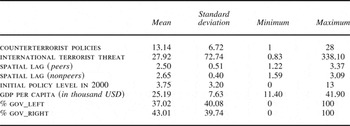
Our first hypothesis predicts that the level of exposure to the threat of international terrorism directly affects counterterrorist policies, independently of spatial policy dependence. We measure the variable international terrorist threat by the predicted number of incidents over the 2001 to 2008 period, as listed in the second column of Table 2.Footnote 25
Descriptive statistical variable information

The regulatory response to international terrorism after the 9/11 attacks is also influenced by other factors and there are potentially other causes of spatial policy dependence as well. To start with, political institutions may influence the counterterrorist response to 9/11. Many observers argue that international terrorism opened a window of opportunity for right-wing governments to shift the balance between security and civil freedom toward security.Footnote 26 In contrast, liberal and possibly left-wing parties pay more attention to defending the civil rights of their citizens. We therefore include two variables measuring the share of government cabinet portfolios held by, respectively, right-wing and left-wing parties (as opposed to centrist parties) with data taken from the Comparative Political Data Set III 1990–2008.Footnote 27
Second, some countries, especially Spain, the UK, Germany, and Italy experienced organized domestic terrorism long before 9/11. Some countries even had experience with international terrorism from extremist Islamist groups on their own soil, such as Germany in 1972, the United States in 1993, and France in 1994. These countries already had regulations in place to counter potential terrorist attacks. We therefore control for “initial conditions”—the level of counterterrorist policies in place in 2000 in the countries under observation.
Third, governments may learn from each others' policies, which could result in spatial policy dependence independent of regulatory competition caused by negative externalities. Also, the targets most affected by international terrorism can exert pressure or even coercion on laggards to ratchet up their counterterrorist policies. Some have noted how the United States and other large donor countries have used aid to buy stricter and better enforced counterterrorist policies in recipient countries.Footnote 28 However, the prospects for pressure is limited among Western developed countries who do not receive aid from the United States and are not easily bullied into adopting policies they do not want. There can be exceptions, of course. The automatic transmission of detailed passenger information to US authorities before departure for trans-Atlantic flights was imposed on many European nations against their will. The exceptional nature of this example is immediately apparent as well, however: the United States had great leverage since the flights in question land on its territory. For almost any other counterterrorist measure there is no direct leverage that the United States, or any other country for that matter, has over other countries. In robustness tests, we control for learning as a cause of spatial dependence with an unweighted spatial lag variable and for power/coercion with a power-weighted spatial lag variable.
Finally, as a further control variable, we include a country's gross domestic product per capita (in thousands of real US dollars), given that richer countries are likely to have a stronger preference for civil rights and liberties than poorer countries.Footnote 29 We also control for a general tendency toward stricter counterterrorist policies by including a linear year variable. Table 2 provides summary descriptive variable information.
Results
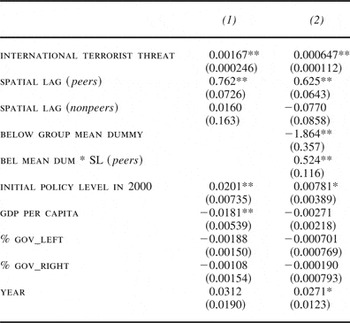
We present coefficients, which in Poisson regression can be interpreted as semi-elasticities.Footnote 30 In Model 1 of Table 3, we estimate one unconditional peer-group-specific spatial policy effect, whereas in Model 2 we allow this effect to be different for countries below the mean of their group compared to countries above the mean. Consistent with our first two hypotheses, we find that countries with a higher exposure to the threat from international terrorism have more policies in place and spatial policy dependence affects only countries within the same peer group, whereas the spatial lag variable of the nonpeer group has no statistically significant effect. Richer countries have fewer counterterrorist policies in place, whereas the political orientation of governments has no statistically significant influence.
Estimation Results

Notes: Poisson regressions on number of counterterrorist policies in place. N = 160. Standard errors clustered on country are in parentheses. Coefficient of constant is not reported.
* p < .05;
** p < .01.
Representing semi-elasticities, the results can be interpreted as indicating that, for example, every one thousand dollar increase in GDP per capita reduces the number of counterterrorist regulations a government implements by 1.81 percent. Likewise, a one unit increase in the value of the peer-group-specific spatial lag variable increases it by 76.2 percent. However, these semi-elasticities do not facilitate an assessment of the substantive importance of effects. This is particularly the case for the spatial lag variables, which were constructed using the spatially lagged ln(y + 1) rather than y for reasons we explained earlier. For substantive effects, we therefore interpret the change in predicted counts following a specified change in the variable of interest, holding all other variables at mean values. Moving the peer-group-specific spatial lag variable from its 25th to its 75th percentile value increases the predicted count of counterterrorist policies in place by slightly more than seven and thus by a little more than the sample standard deviation in counterterrorist policies. This suggests the existence of a substantively important spatial effect. In comparison, the threat from the international terrorism variable has a much smaller effect on predicted counts of policies if one looks at the same shift from the 25th to the 75th percentile of this variable, which increases the predicted number of counterterrorist policies by only around one third of a policy. Note, however, that this variable is highly skewed and that it has a standard deviation almost three times larger than its mean. The substantive effect becomes much stronger if we move this variable from the 25th percentile to the more extreme 95th percentile. This results in a change in predicted counts of counterterrorist regulations of around 4.5, which is still much smaller than the substantive effect of spatial policy dependence. Note also that this effect occurs almost exclusively on the right side of the distribution: at very high levels of threat.
Model 2 tests our third hypothesis, which is based on an implication of regulatory competition as the dominant source of spatial policy dependence in defensive counterterrorist policies. We find that countries with policy levels below the mean of their peer groups are estimated to be more responsive to the spatial effect than countries above the mean. This can be discerned from the positive and statistically significant interaction effect between the dummy variable indicating below mean policy status within their respective groups and the peer group spatial lag variable. In substantive terms, a move from the 25th to the 75th percentile in the peer-group-specific spatial lag variable increases the predicted count of terrorist policies by roughly 6.5 policies for the ones above average policy level within their group, but by almost nine policies for the laggard countries. Note that this model also contradicts an explanation for peer-group-specific spatial policy dependence that potentially rivals our theory based on negative externalities, namely that governments learn from their peers. Learning theories of spatial policy dependence can be distinguished into two types. The first type claims that governments facing a problem intentionally learn from more successful governments. This would suggest that countries that experience more international terrorism than expected implement the policies and regulations of governments that experience less terrorism than expected. These theories cannot explain why countries with below-mean levels of regulation relative to their peers implement more additional regulations than their peers above the mean. The second type of learning theories assumes that governments unintentionally learn from each other—by government officials talking to each other and learning about the policies in other countries. These theories would predict a general convergence of counterterrorist policies because after 9/11 the number of international conferences and meetings on international terrorism increased sharply. Yet, no such convergence can be observed in the data. In sum, the evidence from the data and the results from Model 2 are consistent with an externality-based causal mechanism, but at odds with a learning-based mechanism.
Robustness
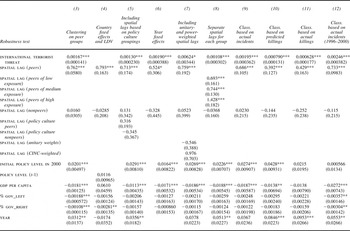
Table 4 explores whether our inferences are robust to plausible changes in model specification. To start with, given that our theory predicts peer-group-specific spatial policy dependence, one may wish to cluster observations at the estimation stage at the peer-group rather than country level. All inferences remain intact if we employ such alternative clustering in Model 3, resulting in smaller standard errors throughout compared to the baseline Model 1.
Estimation results from robustness tests

Notes: Poisson regressions on number of counterterrorist policies in place. N = 160. Standard errors clustered on country are in parentheses. Coefficient of constant is not reported.
* p < .10;
** p < .05;
*** p < .01.
Note that our theory is not formulated in a way that is suitable for fixed effects regression. For example, our first hypothesis makes predictions about the level of threat from international terrorism on counterterrorist policies, not predictions about comparatively minor changes to this threat over the short period from 2001 to 2008. In other words, it makes little sense to throw away all between-variation in the data. However, for spatial lag variables there is always the risk that spatial clustering and spatial heterogeneity create spuriously significant results and such clustering and heterogeneity is best dealt with by including country fixed effects.Footnote 31 In Model 4, we therefore include such fixed effects together with a temporally lagged dependent variable in lieu of the time-constant initial policy level variable, which additionally allows us to control for catch-up dynamics. Most importantly, the fixed effects model tests whether alternative explanations invalidate our externalities theory. For example, the variation we observe and explain could possibly also be explained by theories that categorize Western countries into “families of nations,” namely Anglo-Saxon, Scandinavian, and continental European countries. While such theories have been formulated to explain variation in welfare policies as path-dependent phenomena, they could, in principle, also be used to explain antiterrorist policy styles. Because types of policy-making are path-dependent and therefore stable over time, they will be captured by the fixed-effects specification since the fixed-effects model ignores the between-variation entirely using only within-variation to estimate parameters and therefore controls for cultural differences across countries.Footnote 32 Another example for a theory that exploits predominantly cross-sectional variation would be the proposition that a military-industrial-security complex determines security policies such as antiterrorist regulations. Again, the potential influence of this factor would be approximately absorbed in the country fixed effects.Footnote 33
The negative sign of the share of government cabinet portfolios held by right-wing parties in Model 4 suggests that while we find no partisan effects on the level of counterterrorist policies, a move toward more right-wing parties over time results, unexpectedly, in fewer rather than more policies. Most importantly, however, given that the fixed-effects model was estimated with this variable in mind, we continue to find a positive and statistically significant effect for the peer-group-specific spatial lag variable that is also not dramatically different in size compared to the estimations without country fixed effects. Though we doubt that a fixed effects model represents a correctly specified model here, our main result still holds if we disregard all between-variation in the data.
It is possible to argue that cultural factors not only result in the spatial clustering of countries, which can be controlled for in the fixed-effects specification of Model 4, as we argued earlier, but also explain different adjustments to shocks and therefore different dynamic trajectories. We tested this possibility by generating spatial lag variables based on grouping countries into Anglo-Saxons (Australia, Canada, Ireland, New Zealand, United Kingdom, United States), Scandinavians (Denmark, Finland, Norway, Sweden), central continental Europeans (Austria, Belgium, France, Germany, Netherlands, Switzerland), and southern Europeans (Greece, Italy, Portugal, Spain). These spatial lag variables have no statistically significant effect on counterterrorist regulations if added to our set of explanatory variables in Model 5, leaving the results hardly affected.Footnote 34
Figure 1 demonstrates that there is no consistent common trend of countries increasing their regulatory level over time. Nevertheless, we further test the robustness of our results to dealing with common trends. First, in Model 6 we replace the linear-year-trend variable with the year-specific fixed effects, which leaves our inferences about a peer-specific spatial policy effect intact: even if the estimated coefficient is now statistically significantly different from zero merely at the 10 percent level, the coefficient from Model 6 is not statistically significantly different from the one of baseline Model 1. Second, in Model 7 we include an additional spatial lag based on unitary weights, in which the policies of all other countries count equally. This spatial lag can control for the possibility that countries simply adjust their policies in line with what all other countries do, possibly as the result of diffuse or unintentional learning discussed earlier. Additionally, we include a further spatial lag variable based on the Composite Index of National Capability (CINC), taken from the Correlates of War project, as weights.Footnote 35 The CINC is often taken as a proxy for the power of a country. Hence, this spatial lag variable is supposed to capture any pressure that more powerful states might exert on other countries to bring their policies more in line with their own. We find no evidence for pressure effects as cause for spatial policy dependence or that countries simply follow what all the other countries do, whereas our main results fully uphold.
In Model 8, we disaggregate the peer-group spatial lag variable, allowing for separate spatial effects from peers of low exposure, medium exposure, and high exposure, respectively. We do not find statistically significant differences in the strength of peer-group spatial dependence for the groups of low and medium exposure. However, there is a significantly stronger degree of spatial policy dependence among the group of high-exposure countries (the UK and the United States). Yet, the positive and statistically significant coefficients of the spatial lag variables for peers of low and medium exposure clearly demonstrate that the effect of peer-group-specific spatial policy dependence is not exclusively driven by the group of high exposure. Not surprisingly therefore, the single peer-specific spatial lag variable remains statistically significant even if the UK and the United States are dropped from the sample (results not shown).
In Models 9 to 11, we employ the three alternative classification schemes, introduced above, for placing countries into their respective peer groups. As can be seen, the estimated degree of peer-group-specific spatial policy dependence decreases across the different classification schemes employed compared to the main estimation model, going down to 0.392 in Model 10 and thus about half the value of Model 1, while standard errors increase. However, despite these changes in the estimate, the peer effect we are interested in remains positive and significant at conventional levels so that our inferences remain intact. Uncertainty about the correct classification of countries does not change the fundamental inference that countries spatially depend in their counterterrorist policy choices on the choices of their peer-group countries only and ignore the policy choices of countries outside their peer group.
In Model 12, we deal with the issue that the terrorist threat level is also affected by counterterrorist policies, which creates some reverse causality. While a higher threat level leads to more stringent counterterrorist policies, these in turn should lower the threat level. However, the evidence suggests that the first causal mechanism must be much stronger than the second one. Generally, the countries with higher threat tend to have higher counterterrorist policies, corroborating the first causal mechanism, whereas if the second causal mechanism dominated they would face lower threat. This is not to say that counterterrorist policies do not affect terrorist threat at all. They do, but not strongly enough to change the relative ranking of countries into low, medium, and high threat level. In other words, the stringent American counterterrorist policies, for example, are likely to have lowered the threat level faced by Americans, but predominantly so on American soil with little effect on terrorist threat abroad and not sufficiently so to catapult the United States out of the group of high threat level. Nevertheless, to disperse any endogeneity concerns, we estimated Model 11 based on spatial lag variables, in which countries are classified into threat levels based on actual incidents in the pre-9/11 period, namely 1996 to 2000. Again, our results uphold.
Conclusion
Predominantly defensive counterterrorist measures create negative externalities, but they do not result in an unconditional global “race to the top,” in which all countries converge toward the highest-possible regulatory level. Instead, the negative externalities and their policy effects are confined to groups of countries at a similar level of threat from international Islamist terrorism. Spatial dependence in counterterrorist policies thus exclusively stems from these peer countries, whereas governments can safely ignore regulations enacted by countries outside their peer group. The spatial effect in defensive counterterrorism is confined to peers.
We have found broad support for these predictions in our empirical analysis of counterterrorist regulations enacted by Western developed-country democracies in the wake of the 9/11 attacks. Our inferences are robust to plausible changes in model specification. In particular, we continue to find evidence for the peer effect even if we control for learning and pressure from powerful countries as alternative mechanisms of spatial policy dependence and independently of how we sort countries into peer groups. The peer effect also persists in a model with country fixed effects, which is not well suited to test our theory but indicates that the peer effect is not spuriously driven by spatial clustering and unobserved spatial heterogeneity or alternative theories that make predictions about factors whose influence is predominantly time-invariant over the period of our study.
Our analysis suggests that the peer effect is crucial for a better understanding of the heterogeneous response of Western countries to the shock of 9/11. Spatial policy dependence within groups of similar countries together with no spatial policy dependence emanating from countries outside a country's peer group is a phenomenon likely to exist well beyond counterterrorist policies. For example, we speculate that peer effects are prevalent in environmental policies, economic policies in general and fiscal policies during contagious debt crises in particular, as well as in many other policies. Our research, thus, has wider implications for stimulating future research in other policy areas and makes contributions that go beyond the narrow case of counterterrorist regulations that we have analyzed in this study.