Culbersonia Essl. is a monotypic genus originally based on C. americana Essl., a taxon described from Arizona, United States of America (Esslinger Reference Esslinger2000). Soon after publication, it was realized that this species had already been described in 1980, as Pyxine nubila Moberg, from Africa (Moberg Reference Moberg1980). Consequently, the combination Culbersonia nubila (Moberg) Essl. was made (Nash et al. Reference Nash, Ryan, Gries and Bungartz2002). The species combines characters of Pyxine Fr. with those of Physconia Poelt. It is widely distributed in dry subtropical regions around the world but is most common in Africa and Central America, where it grows on trees and rocks (Swinscow & Krog Reference Swinscow and Krog1988; Moberg Reference Moberg2004; Obermayer et al. Reference Obermayer, Kalb, Sipman and Nash2009).
Culbersonia is currently thought to belong in the Physciaceae Zahlbr. because it morphologically resembles the genus Physconia Poelt (Esslinger Reference Esslinger2000), but this position has not yet been confirmed by genetic analysis (Lücking et al. Reference Lücking, Hodkinson and Leavitt2016). The type species was originally described in the genus Pyxine Fr., which is currently classified in a different family, Caliciaceae Chevall (Prieto & Wedin Reference Prieto and Wedin2017). These two families constitute the order Caliciales Bessey in the current sense. Almost all species in both families are lichenized. Both families contain crustose, foliose and a small number of fruticose growth forms, and together contain c. 600 known species. Non-mazaedioid genera, previously classified in the Physciaceae or Buelliaceae Zahlbr., have been added to the family Caliciaceae (which previously contained only mazaedioid taxa) after molecular work (Wedin et al. Reference Wedin, Baloch and Grube2002). Many genera classified for a long time in the Caliciales (see e.g. Tibell Reference Tibell1984) are now relocated in other families, orders, and classes following molecular work. However, it is worth noting that all six genera that Tibell (Reference Tibell1984) classified in the Caliciaceae still remain in that family in the present sense.
Culbersonia nubila was identified by us among lichens collected in South Africa (Maphangwa et al. Reference Maphangwa, Sipman, Tekere and Zedda2018). As the phylogenetic position of this monotypic genus is uncertain, we produced genetic data from our specimens and generated a phylogenetic tree to establish the most suitable taxonomic status of Culbersonia.
Total DNA was extracted from dry specimens employing a modified protocol based on Murray & Thompson (Reference Murray and Thompson1980). PCR amplification was performed with the primers ITS1F and ITS4 (White et al. Reference White, Bruns, Lee, Taylor, Innis, Gelfand, Sninsky and White1990; Gardes & Bruns Reference Gardes and Bruns1993) for the rDNA internal transcribed spacer 1, 5.8S and internal transcribed spacer 2 (collectively referred to as ITS), and LR0R and LR5 (Vilgalys & Hester Reference Vilgalys and Hester1990; Cubeta et al. Reference Cubeta, Echandi, Abernethy and Vilgalys1991) were used to amplify the 28S rDNA of the nuclear ribosomal repeat. PCR reactions were performed under a program consisting of a hot start at 95 °C for 5 min, followed by 35 cycles at 94 °C, 54 °C and 72 °C (45, 30 and 45 s respectively) with a final 72 °C step for 10 min. PCR products were checked in 1% agarose gels and positive reactions were sequenced with one of the PCR primers.
BLAST (Altschul et al. Reference Altschul, Gish, Miller, Myers and Lipman1997) of 5.8S-ITS2 and 28S rDNA sequences was used to select the most closely related taxa; 5.8S-ITS2 and 28S rDNA were the only regions amplified from the samples. ITS only or 28S rDNA only phylogenies produced significant support for some clades, such as that including Culbersonia, Dirinaria and Pyxine, but failed to recover significant support values at the family level. Therefore, a 5-gene phylogeny was produced to add some resolution at the supraspecific level. Thus, 5.8S-ITS2, 28S rDNA, mtSSU rDNA, Mcm7 and β-tubulin sequences of representative members of the Caliciaceae were downloaded from GenBank, mainly originating from Schmull et al. (Reference Schmull, Miadlikowska, Pelzer, Stocker-Wörgötter, Hofstetter, Fraker, Hodkinson, Reeb, Kukwa and Lumbsch2011) and Prieto & Wedin (Reference Prieto and Wedin2017), including most sequences available for the genus Pyxine when all five loci were available for the species. Rusavskia elegans was used as outgroup, following Prieto & Wedin (Reference Prieto and Wedin2017). Sequences were first aligned in MEGA 5.0 (Tamura et al. Reference Tamura, Peterson, Peterson, Stecher, Nei and Kumar2011) with the ClustalW application and then corrected manually. Ambiguous regions were not removed from the alignment. ITS1 was excluded because of the insertions/deletions making alignment difficult. Gblocks (Castresana Reference Castresana2000) was employed to remove ambiguous positions from 5.8S-ITS2, 28S rDNA and mtSSU, while introns were manually removed from Mcm7 and β-tubulin datasets. The final alignment included 116/254 variable sites in the 5.8S and ITS2 regions, 219/642 in the 28S rDNA, 212/513 in the mtSSU rDNA, 221/444 in the Mcm7 gene, and 228/624 in the β-tubulin gene. The aligned loci were loaded as independent partitions (Mcm7 and β-tubulin each split into three partitions, one for each codon position) in PAUP* 4.0b10 (Swofford Reference Swofford2001) and subjected to MrModeltest 2.3 (Nylander Reference Nylander2004). The model GTR+Γ+I was implemented for all partitions (except the 2nd position of β-tubulin, for which HKY+ Γ+I was employed) in MrBayes 3.1 (Ronquist & Huelsenbeck Reference Ronquist and Huelsenbeck2003), where a Bayesian analysis was performed (two simultaneous runs, six chains, temperature set to 0·2, sampling every 100th generation) until convergence parameters were met after c. 890 000 generations (on which the Bayesian analysis is based), standard deviation having fallen below 0·01. A total of 8900 trees were sampled but the first 25% (2225) was discarded as burn-in; the others were used to produce a consensus tree. Finally, a full search for the best-scoring maximum likelihood tree was performed in RAxML (Stamatakis Reference Stamatakis2006) using the standard search algorithm (data partitioned, GTRMIX model, 2000 bootstrap replications). The significance threshold was set above 0·95 for posterior probability (PP) and 70% bootstrap proportions (BP).
Specimens sequenced (Culbersonia nubila)
South Africa: Gauteng Province: Pretoria, Arcadia, Stanza Bopape Street, c. 25°44′41″S, 28°12′30″E, 1332 m, 20 vii 2016, Maphangwa & Zedda [KWM_0205] (PRE), no. 205 = ALV 14225, GenBank MH121318 (ITS) & MH121320 (LSU); Pretoria, Pionier Museum, Keuning Dr, c. 25°44′07″S, 28°18′36″E, 1317 m, 14 xi 2016, Maphangwa [KWM_0103] (PRE), no. 103 = ALV 14224, GenBank MH121317 (ITS) & MH121319 (LSU).
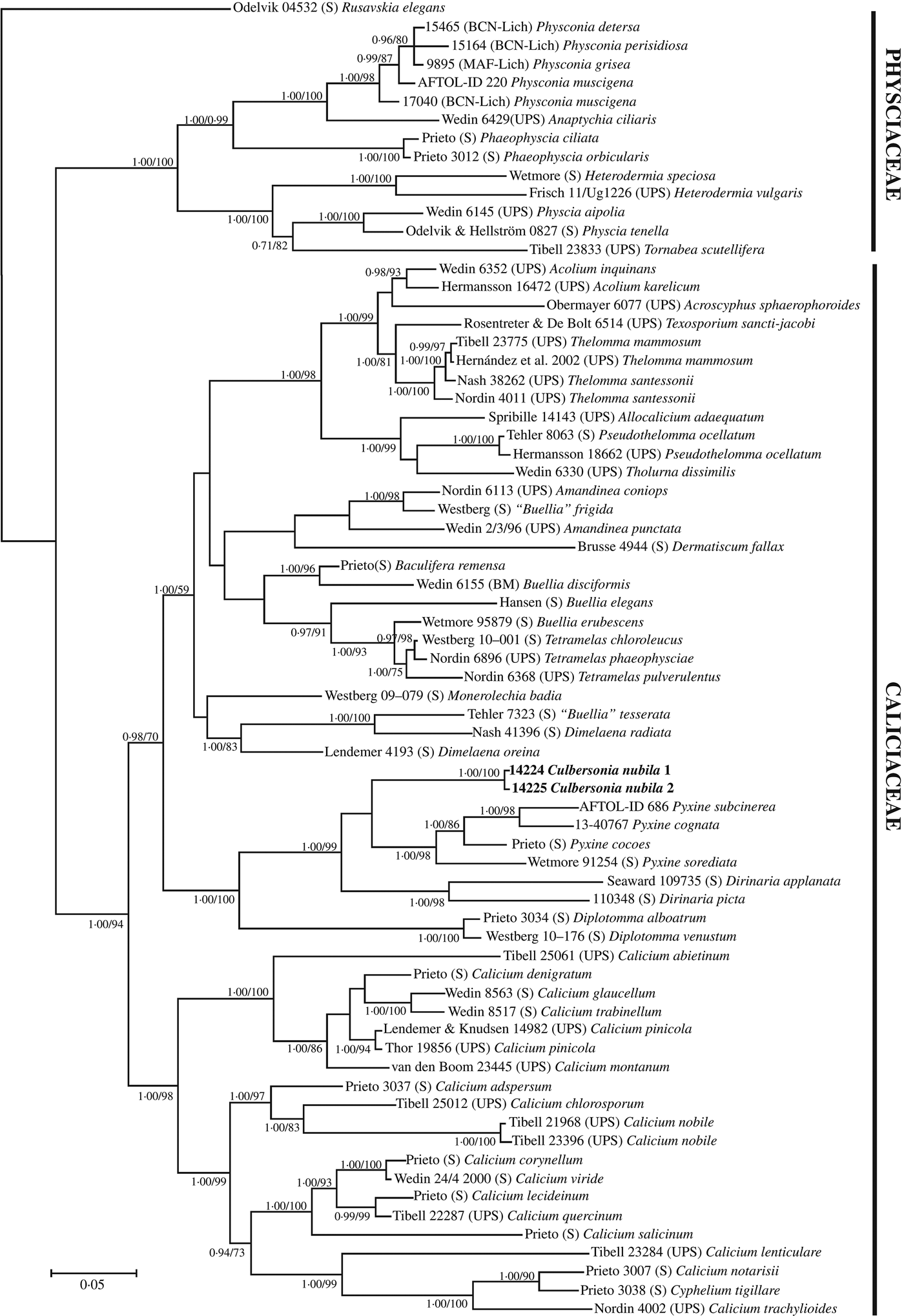
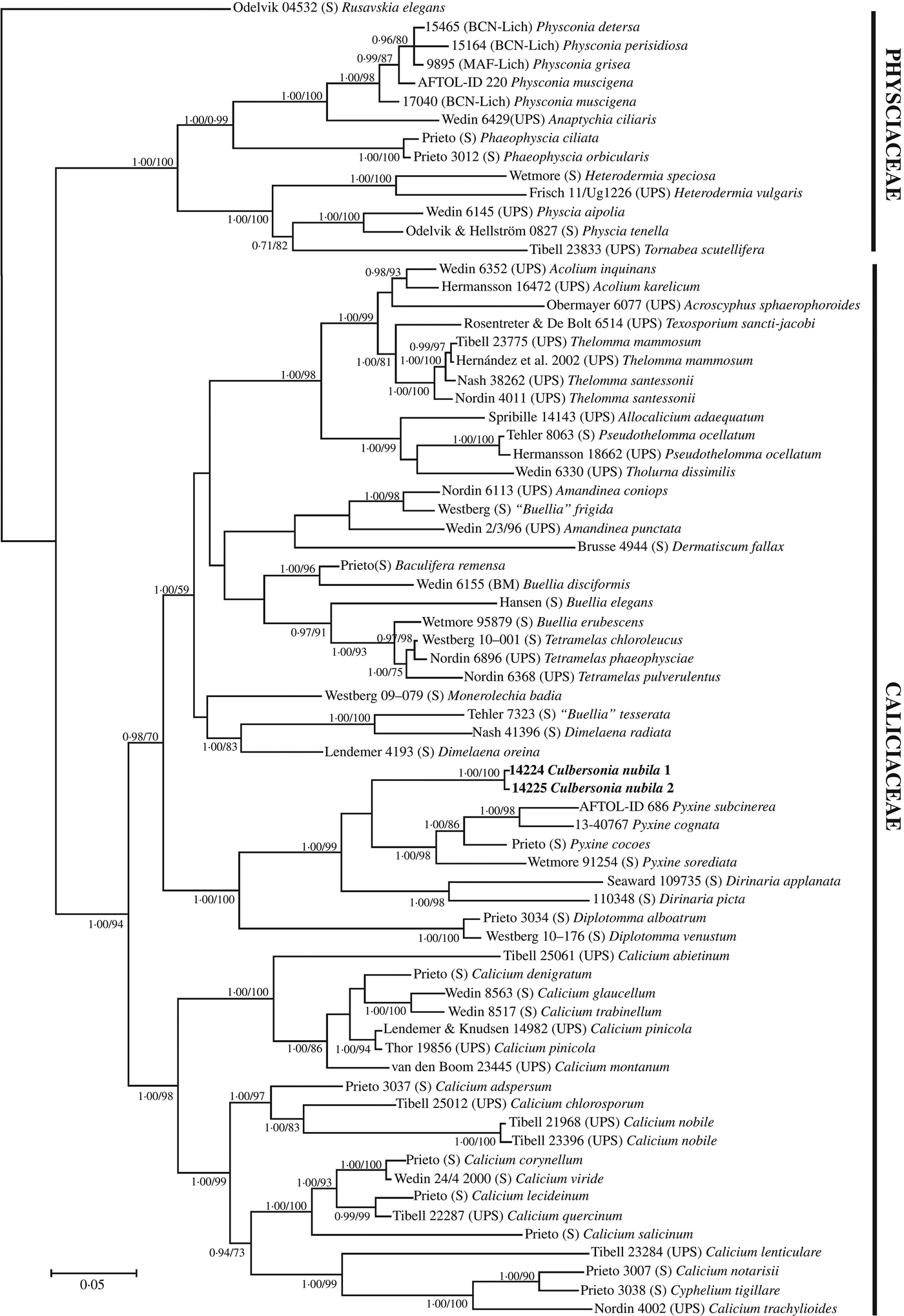
The two analyzed specimens of Culbersonia nubila clustered together with only a small number of different base pairs (Fig. 1). They clustered with significant statistical support with the monophyletic genera Pyxine and Dirinaria (Tuck.) Clem., nested deep within the family Caliciaceae, and they are unrelated to the Physciaceae. Therefore, we propose to classify the genus Culbersonia in the Caliciaceae in the current sense.
Consensus phylogram produced in MrBayes after the analysis of a combined ITS + nuLSU rDNA + mtSSU rDNA + Mcm7 + β-tubulin-alignment of species in the families Caliciaceae and Physciaceae demonstrating the phylogenetic position of Culbersonia nubila nested within the Caliciaceae. Values next to nodes represent Bayesian PP and maximum likelihood bootstrap proportions (BP); only those nodes supported by >0·95 PP or >70% BP are annotated. Taxon names are preceded by the collectors of the voucher specimen and herbarium location for specimens not mentioned in the text. Further details of the species included in the tree can be found in Schmull et al. (Reference Schmull, Miadlikowska, Pelzer, Stocker-Wörgötter, Hofstetter, Fraker, Hodkinson, Reeb, Kukwa and Lumbsch2011) and Prieto & Wedin (Reference Prieto and Wedin2017).
Morphologically, Culbersonia is quite distinct from other foliose lichens in the Caliciales. The upper surface is thickly pruinose, grey with a bluish tint, K+ rose-violet, and green when wet. The lower surface is pale tan, with the same bluish tint as on the upper surface in a broad marginal zone. Culbersonia shares with Pyxine the presence of an internal stipe in the apothecia. However, apothecia are extremely rare in Culbersonia and currently only one apothecium has been reported (Moberg Reference Moberg1980). Conidia are cylindrical to fusiform, but also rare and again only reported from one specimen (Nash et al. Reference Nash, Ryan, Gries and Bungartz2002). The overall aspect of the thallus, however, mostly resembles that of the genus Physconia, with which it also shares the pale lower surface which is almost invariably black in all species of Pyxine and Dirinaria.
The monophyletic group formed by Culbersonia, Pyxine and Dirinaria is morphologically distinguished from the other Caliciaceae by the appressed foliose growth form and the absence of a mazaedium, and ecologically by its predominance in the (sub-) tropics.
Almost all other genera in the two families Physciaceae and Caliciaceae that are represented in Fig. 1 are shown to be monophyletic. These results agree with those produced by Wedin et al. (Reference Wedin, Baloch and Grube2002), Helms et al. (Reference Helms, Friedl and Rambold2003), Gaya et al. (Reference Gaya, Högnabba, Holguin, Molnar, Fernández-Brime, Stenroos, Arup, Søchting, van den Boom and Lücking2012), Miadlikowska et al. (Reference Miadlikowska, Kauff, Högnabba, Oliver, Molnár, Fraker, Gaya, Hafellner, Hofstetter and Gueidan2014) and Prieto & Wedin (Reference Prieto and Wedin2017), where the lineages comprising the families of Physciaceae and Caliciaceae were shown to be significantly different. Three main clades were found within Caliciaceae, those of Calicioideae, Buellioideae s. str. and the clade containing Dirinaria, Pyxine and Diplotomma Flot., also in agreement with previous authors. The exception is the genus Buellia De Not., which contains many species that should be reclassified into other genera. Such species are marked as “Buellia” in Fig. 1.
Author ORCIDs
André Aptroot 0000-0001-7949-2594.
The City of Tshwane Metropolitan Municipality and the Pionier Museum are thanked for allowing research to be carried out in the park of their Museum and within Pretoria. This work was kindly supported by the University of South Africa (UNISA).