

Rant #6 (2025), an hour-long immersive dance performance created by choreographer and visual artist Ralph Lemon, marked the end of his retrospective “Ceremonies Out of the Air” held at MoMA PS1 in New York. In reference to Lemon’s acts of creativity— daily drawings, poetry, sculptures, and movement phrases— the retrospective highlighted the many rituals or ceremonies that Lemon has created “out of the air” in response to his decades-long examination of Black history, death, and regeneration. Closing out the exhibit in March of 2025, Rant #6 constructed a three-dimensional experience for audience members surrounded by performers on various stages that danced in continuous references to Lemon’s previous works. As Lemon shouted into a microphone, sharing a speech on liberation, Rant #6 represented a closure. Its use of trance, repetition, and duration, with flashes of Lemon’s vast movement repertoire, enveloped viewers in a whirlwind of his artistic gestures.
As an audience member, watching Rant #6 conjured clear memories of another event. Embedded within Rant #6, I re-encountered choreography from Lemon’s Chorus (#2 Oculus) (Reference Lemon, Low, Hamilton, Pittman, Williams and Hunter2015), a ten-minute dance film inspired by the 1970s music-television program Soul Train that showcased Black popular dance forms on national television. I had first seen Chorus at a conference on postmodern dance at UC Santa Barbara in Reference Lemon2017, eight years prior to the retrospective; five dancers in the film grooved to Amy Winehouse’s “Back to Black” staring out at the audience gathered around their pop-up performance with deadpan expressions. The Oculus Plaza in which they danced in New York appeared luminous, vast, and transitory—a space of commerce and commuting where some people failed to notice the chorus and others watched, entertained. The observational filming strategies of Chorus drew attention to the process of watching spectators watch dancers in deadpan. In one of the boldest performances of his career—sampling his creative rituals in a new composition—Chorus called out scholars’ and dancers’ preoccupation with pioneers of postmodern dance of the 1960s.Footnote 1 While Rant #6 signaled a closure at MoMA PS1, marking the end of the retrospective, the performance still operated within the museum’s modernist ecosystem of housing art objects.Footnote 2 Watching Rant #6 at MoMA PS1 affirmed the impact of Chorus at UCSB, a gesture with higher stakes that seemingly went unnoticed by spectators.
Standing at a podium at UCSB, Lemon used personal memories to construct an oral history of postmodern dance, in which he himself participated, to question the legacies of Simone Forti, Anna Halprin, and Yvonne Rainer who gathered at the event organized in their honor. He crafted a love letter to his mentors at the conference in the form of a lecture entitled “Circling Around Postmodernism like Weather” that critiqued the radical nature of their work and ended with the film Chorus (#2 Oculus). The lecture and filmed dance, full of double-meanings and diversions, threatened the foundations of an exclusive dance conference built upon appreciation and nostalgia for white postmodernism of the 1950s and 1960s in the U.S. Lemon constructed history as he reflected on it.
At the conference, Lemon produced a prime example of what I term trickster historiographies: he not only used tricks as a compositional strategy—evidenced, for example, through deadpan—but utilized these tricks at the right moment to make the audience aware of their participation in unsettling practices. Lemon’s speech wavered between adoration and accusation to encourage an awareness of the dangers of nostalgia that, in the case of the dance conference, re-inscribed a fascination with the 1960s as a stimulating period of time in which white women pioneered innovative dance forms. Lemon deployed an arsenal of drawings, notes, and films—tools of tricksters that diligently work over time—to candidly confront his predecessors in their eighties and nineties at the time of the artist-talk.Footnote 3 As a result, the lecture and film unsettled an exclusive dance space and, in effect, positioned nostalgia as a disconcerting practice. Lemon demonstrated the pitfalls of trusting an overarching narrator, conference theme, or feelings of celebration that commemorations stir.
To unpack the significance of this event and further establish Lemon’s contribution to the field of dance history as he confronted a room of distinguished scholars and artists, I first address my role as a spectator-turned-into-narrator through this account of the artist-talk I witnessed, and the alienation that propelled my approach to analysis. I then examine the methods and functions of tricksters as storytellers that can challenge their strongest opponents through cunning and wit. Multiple tools of the trickster appear in Lemon’s presentation that push and pull viewers: the use of deadpan, an “aesthetic of the cool” in African dance traditions that counter sentimentality, and the recreation of nostalgia (Dixon-Gottschild Reference Dixon-Gottschild1996, 17). The name Chorus, for example, draws attention to compositional strategies in music: an act of repetition that creates familiarity with lyrics, melodies, and rhythms. Lemon’s goal to gain the trust of an audience he tricked drew upon the arresting power of nostalgia and demonstrated the ease with which it can be manufactured.
I provide additional details of the event’s magnitude to emphasize the risks that Lemon took in addressing Forti, Halprin, and Rainer, critical to my suggestion that trickster historiographies rely on a moment of delivery, as important as the preparation of a trick. I subsequently conduct a close reading of the lecture and film, analyzing Black popular dance forms and postmodern dance strategies within this work. I use the short title “Circling” to refer to the lecture, Chorus to refer to the film, and “Circling/Chorus” to refer to Lemon’s complete choreographic composition. While I was present at the conference, I also utilized a videorecording of the artist-talk shared with me by one of the conference organizers and gathered posters, programs, and press releases to confirm and contextualize my memory of the event.
Critical Fabulation & Speculation: Spectators as Narrators
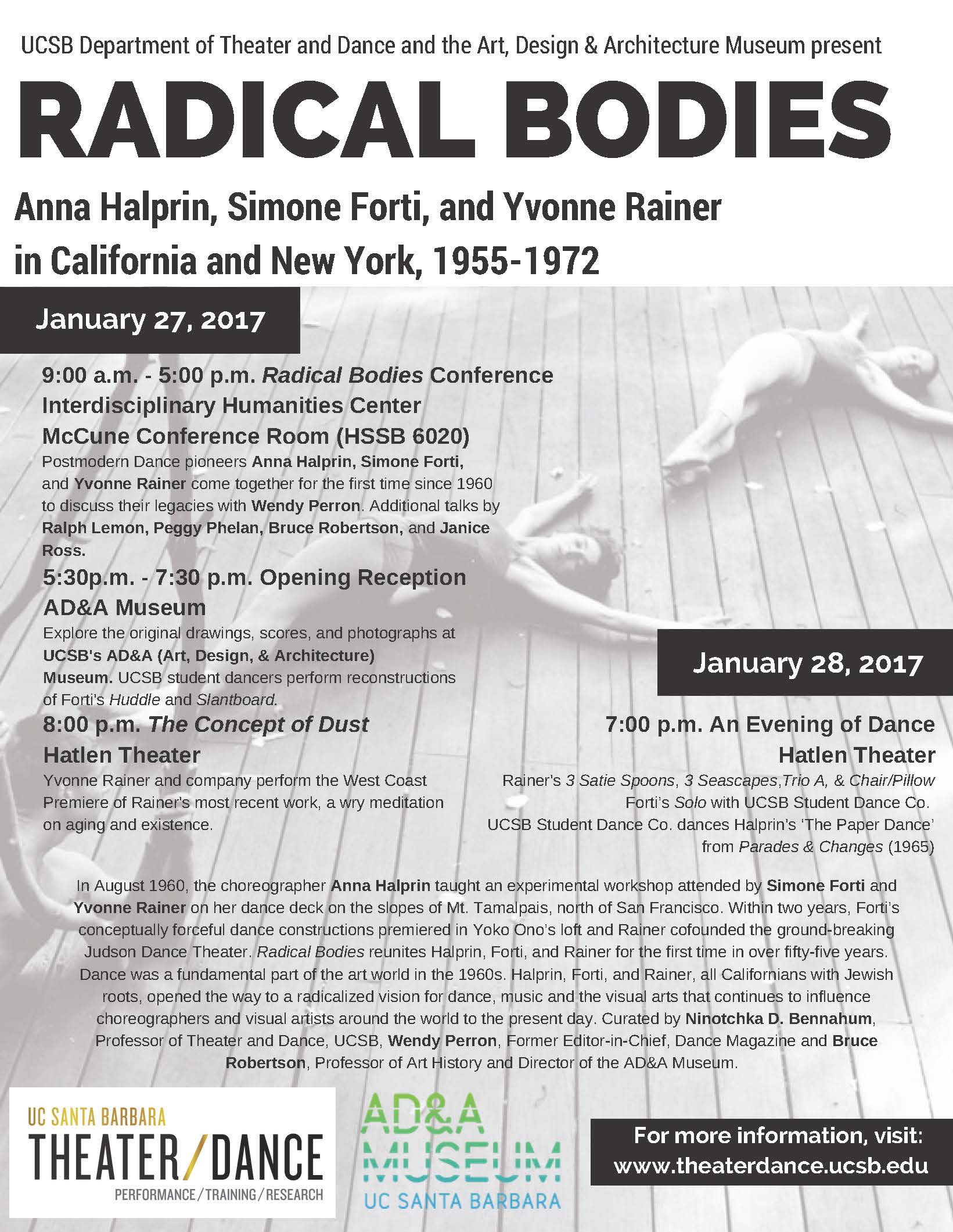
Invited to speak at UCSB in 2017, Lemon’s artist-talk formed part of a two-day symposium Radical Bodies: Anna Halprin, Simone Forti, and Yvonne Rainer in California and New York, 1955-1972 that honored their formative contributions to postmodern dance on the west coast of the United States. As a graduate student at the time, I witnessed the labor expended in anticipation of the event; curators prepared the museum space on campus, professors looked for student volunteers to help with the conference, and dancers in the BFA program rehearsed for their performances of Forti’s Dance Constructions (Reference Forti1960-1961), Rainer’s Chair Pillow (Reference Rainer1969), and Halprin’s Paper Dance from Parades and Changes (Reference Halprin1965), an opportunity to work with the protagonists of the Radical Bodies catalog published by UC Press in conjunction with the exhibit (Bennahum, Perron, and Robertson, Reference Bennahum, Perron and Robertson2017). These performances marked a significant milestone in their formation, directly mentored by Forti, Rainer, and Halprin who passed down their knowledge to a new cohort of dancers. Outside of the studio, a graduate course in Art History taught by one of the conference curators focused on the relationship between visual art and postmodern dance. At large, postmodern dance history and practices settled into multiple spaces at UCSB.Footnote 4
I enumerate and revisit data at the time of this writing to substantiate the importance of the event; however, sensation more immediately instigated this analysis of encounters. Amidst acts of reverence toward Forti, Halprin, and Rainer, I recognized my inclination to focus on dynamics of political economies that uphold elite dance spaces.Footnote 5 In various formats, scholars revisited archival footage of artists that danced outside in nature, attuned to their bodies and their environment, their wisdom revisited for new insights on their radical work. I found myself at a distance from exaltation as presentational formats on postmodern dance seemed to suppress the expression of doubt. This familiar instinct, necessary to name even as I aim to create objectivity in research through the collection of archival materials, arrived in expected settings: conference rooms with podiums, proscenium theaters, and galleries that spotlight a point of view or method of expression. Lemon, then, approached a podium to express distrust in this space, not through the absolute condemnation of a dominant narrative, but with the artistic craft of tricksters that center ambiguity in opposition to the certainty that these spaces facilitate.
This paper, thus, enacts what Saidiya Hartman frames as a critical fabulation: to speculate as to what Lemon might have said with his artist-talk-turned-into-oral history, further encouraged by my private observations of exclusion in response to enchantment that “Circling/Chorus” seemed to recognize in public space.Footnote 6 Lemon’s career, invested in the study of events he did not directly witness during his lifetime in the case of lynchings in the U.S., for example, envisions the content that lies beyond archives, records, and testimony, applicable to narratives constructed by storytellers at dance conferences. The creation of a counter-archive, in this case, also creates a counter-lineage, to share experiences that remain on the margins of dance histories. The Radical Bodies catalog, for example, details Forti’s departure from Halprin’s methods in efforts to listen to and cultivate her own artistic instincts (Perron Reference Perron, Bennahum, Robertson and Perron2017a, 94-96). This exposition shares useful linear chronologies: a dancer learns from a teacher, accepts, rejects, and reinvents approaches to dance. Trickster historiographies, instead, offer the possibility to unravel influence within a dance lineage and subvert its authority.
I apply the tricksters of Black and African folkloric traditions to Lemon who has recognized this figure as a core character in his work. While the imaginative spaces of folktales imbue tricksters with expansive capabilities, the designation of a human being as a trickster, grounded on earth, understands Lemon’s narration to bear consequences for an artist’s relationships with the living. As such, I underscore the honesty that escapes human tricksters who reveal their concerns in the tedious work necessary to devise and share their tricks. This skillful method of composition does not produce a fatalistic end to the study of postmodern dance; such argumentation would reproduce the judgement that tricksters challenge. “Circling/Chorus” provides an example of the time, labor, and craft with which dancers and writers might construct their stories as the subjects of future archives.
I navigate my role as a spectator-turned-into-narrator in my analysis and recollection of the event and understand the stakes of disclosure: I explain tricks, place them in writing, and dispel magic that risks speaking for another person. As such, I propose this narration of the event to constitute one point of view, a case study of how dance history operates or fails to capture discord in gathering. This analysis also contains gaps; the artist talk, film, and encounters may have multiple lives outside of the Radical Bodies conference. With this context in mind, I additionally consider that Lemon might agree or disagree with my narration of this story, however, his body of work suggests that such stark assessments detract from the process of building knowledge. The Geography Trilogy (Reference Lemon1997-2004) and Untitled (The greatest [Black] art history story ever told. Unfinished) (Reference Lemon2015–present), for example, are commemorative, decade-long projects that place value on the routine interrogation of Black history.Footnote 7 Lemon sits with a research question for years, revisits memory, challenges recollection, and anticipates its further transformation over time. I take these artistic works as invitations to wrestle with my memory of the artist-talk as an audience member.
Trickster Historiographies Combat “the Weather”
Lemon has skillfully transformed the concept of historiography beyond the study of how histories are written. He disrupts divisions of the body and mind—of labor and intellect—to push forth what Ariel Nereson describes as “the how of historical production,” or rather, dance as historiography (Reference Nereson2022, 14). As an unconventional historiographer, he utilizes the methods of tricksters in performance and does not hand the audience his message. The ambiguity of personal memory at the conference combatted the collective memory-building exercises of a commemorative event that subjected attendees to a dominant affect of nostalgia. Standing before friends and colleagues that he recognized through asides, laughed with, and thanked in speech revealed his humanity in public space, built trust with the audience, and exposed Lemon’s concerns as a choreographer who often evades questions about his work.Footnote 8
The numerous forms that trickster methods take in Lemon’s performances create counter-memorials to reflect on the history of racial violence in the U.S. This active form of remembrance defies the passive consumption of physical monuments that impose national myths upon its viewers (Young Reference Young2002; Profeta Reference Profeta2015). Lemon and members of his company dress in rabbit suits, impersonate singers including Amy Winehouse, share riddles in performance, and withhold information from the audience. They create rabbit holes for scholars and viewers; a single performance may sample Lemon’s previous works, proliferating beyond the control of a single point of observation in time. Discretion as one trickster method drives the structure of Lemon’s canonical work Come home Charley Patton (Reference Lemon2004a). The final installment of Lemon’s decade-long project, the Geography Trilogy grapples with the legibility of violence in performance; informed by research on lynchings in the U.S., the dancers in Patton avoid the use of the word “lynching” on stage (Profeta Reference Profeta2015, 49). Instead, they use phrases associated with the murders of Black men and activists in the 1960s as prompts for movement.Footnote 9 When Lemon later dances against a fire hose, he also takes a physical risk and submits his body to the forces of history in a clear visual reference to the Birmingham Campaign of 1963. At the end of Patton, a drawing of James Baldwin that hovers over the stage breaks the sharp tension created by Lemon’s perilous dance. He poses cryptic questions to the audience, “an animated Buddha…koanic,” writes Lemon in his documentation of Patton, that speaks of the “unreadable presence” of Africa on stage (Reference Lemon2013, 192).Footnote 10 Baldwin, who pauses and tilts his head as he muses, prompts the viewer to reflect on explicit and implicit references to racial violence. These ominous strategies establish the oratory structures that compel the audience to contemplate what they have heard, seen, or conversely, failed to see on stage.
Trickster figures as orators hold a sacred position in Black and African histories of survival. Parts of Lemon’s lectures, “rants,” and oral histories are “double-voiced”—a tradition of the deity Eshu-elegba of West Africa, for example, who, in some tales, wears a cap that is black on one side and white on the other. An observer on one side of Eshu might faithfully declare his cap to be a single color, when it is, in fact, two colors (Gates Reference Gates1989, 21). In the tale of Eshu shared by Henry Louis Gates in The Signifying Monkey: A Theory of African- American Literary Criticism, Gates emphasizes the conflict that ensues between two friends who disagree over the color of Eshu’s cap that escalates to the point of an altercation (Reference Gates1989). Gates points to the reparation that is possible when subjects expand their points of view to consider all sides of Eshu’s cap, a process that requires dialogue and pause.
Folkloric epistemologies champion the function of the unreliable narrator that tricks and deceives the students it hopes to teach. Dramaturg Katherine Profeta details the generative results of this literary approach to storytelling that plays with truth and deception in performance. Lemon increasingly applied this device in his work over time to craft “a ‘web’ of tales that mixed fact and fiction, past and present, allowing him to create a world where all his research subjects had some relation to one another” (Profeta Reference Profeta2005, 27). Webs invoke the multiple trickster figures of West Africa, Latin America, and the Caribbean that inspire Lemon, including Eshu, Anansi the trickster spider, and Brer Rabbit, the latter figure of African American folklore explicitly referenced in How Can You Stay in the House All Day and Not Go Anywhere? (2011).
Trickster methods are effective because they teach their audience to question their own assumptions. They oppose the overt messaging of modern dancers of the early twentieth century, for example, whose overwrought emotional expression imposed upon the audience a dominant feeling that postmodern dancers would later challenge. Folkloric tricksters also combat the “newness” of postmodern dance strategies that claimed to defy linear storytelling and hold multiple stories and truths at once. Most importantly, tricks are strategies of survival that constitute what Christina Sharpe names “produced ecologies” (Reference Sharpe2016, 106). These tactics used to navigate adverse climates combat systems of anti-blackness that Sharpe refers to as “the weather.”Footnote 11 Sharpe posits that “antiblackness is pervasive as climate” (106). In histories of Black dance traditions, the “Cakewalk” serves as one example of produced ecologies; enslaved Africans mocked the mannerisms of slaveholders in plain sight. Tricksters know their audience, disrupt social order, and may go unnoticed by their oppressors, leaving unscathed. While Lemon’s action at the conference engaged in a stark critique of white postmodernism, it utilized disorientation to confuse the audience that might have wondered: does he love or resent the postmodern dancers who are seated in front of him? Is he making this declaration, here, now? Viewers may have also left the conference uncertain about Lemon’s message even as “Circling/Chorus” generated an ominous sensation through the dancers’ use of deadpan.
Tina Post’s theorization of deadpan as gesture, a deliberate action, rather than a passive expression, helps to elucidate acts of analysis that “Circling/Chorus” prompts viewers to undertake, related to trickster methods. When confronted with inexpression, Post argues, a viewer must study the environment that surrounds a subject to glean information about their encounter with that subject. As an undercurrent in Lemon’s artist-talk, ambiguity and deadpan initiate this process; the viewer can look to their surroundings—the postmodern dance pioneers, scholars, and dancers that sit next to them—to make sense of what they are witnessing. Post’s refusal to paint deadpan as resistance, a perspective that constrains Black subjects to narratives of suffering or protest, can be applied to an interpretation of ambiguity in Lemon’s ode. Post writes, “deadpan might enact deference or denial, quietude or aggression, resistance or acquiescence” (Reference Post2022, 19). The range of these actions inhabited Lemon’s elegy for his teachers, alive at that moment to hear his message.
The Right Moment for a Trickster to Strike: Halprin, Forti, and Rainer Reunite for the First Time in Decades
The monolithic influence of postmodern dance of the 1960s on contemporary performance, along with its history of racial exclusion, has been explored by various scholars who advocate for the application of these insights to curatorial projects. Rebecca Chaleff’s close reading of Rainer’s Trio A (Reference Rainer1978) and Trisha Brown’s Locus (1975), for example, underscores the ways in which biopower operated in postmodern dance, championing ordinary bodies, or rather, white bodies, as neutral (Reference Chaleff2018, 72). Chaleff additionally understands the ability of bodies to “activate” spaces in which they move, placing responsibility on dancers that reconstruct postmodern dance practices and subsequently engage in the process of “activating whiteness.” Jose Luis Reynoso also highlights the incongruous philosophies of Judson Dance Theater’s approach to democratic forms of dance-making and asks, “Can there be a more inclusive democracy’s body when some conceptions of contemporary post/modern performance continue to reproduce violent exclusions and erasures of the so-called traditional and ethnic?” (Reference Reynoso2019, 60). Reynoso recognizes the multiple ways in which postmodern dancers coopted a desire for equality as a guiding principle in their creative work during the Civil Rights Movement, situating their artistic practices within a global capitalist structure of property and ownership. These histories haunt contemporary dance spaces.Footnote 12 That Chaleff and Reynoso separately analyze these tensions demonstrates that mechanics of biopower persist in the ongoing contemplation and commemoration of postmodern dance histories. Lemon understands the racial exclusions of postmodern dance: he has experienced them and asks the audience to place their bodies in relationship to his memories of “discovering” the world of modern and postmodern dance with fascination and reverence.
Commemoration for the pioneers of postmodern dance at the Radical Bodies Conference risked reproducing nostalgia for their utopian visions during the 1960s. Attended by Forti, Halprin, and Rainer, the curators of the event achieved an impressive feat: posters and press releases announced that these “radical bodies” had not been in the same room in “over fifty-five years” (“Radical Bodies” 2016). Their presence, along with prolific dance scholars and artists, established the context for commemoration: experts, dance professionals, and creative luminaries filled this space.Footnote 13 The Radical Bodies Conference included scholarly presentations on postmodern dance, a dance concert at the Hatlen Theater in which Rainer and Forti also performed, and an exhibition at the Art, Design, & Architecture Museum (AD&A) that displayed their films, photos, and choreographic notes. In their configuration of items, the curators encouraged viewers to look back on the works of the radical bodies they celebrated. Dance lineage reaffirmed, spectators intently watched Forti’s Dance Constructions (Reference Forti1960-1961) at the AD&A in appreciation of dance outside of the center of a proscenium stage.Footnote 14
Halprin, Forti, and Rainer arrived at UCSB and engaged in a panel discussion at the top of the conference, their humanity clear in a way that literature obfuscates, pooled under the umbrella of postmodern dance and artistic rebellion of the 1950s and 1960s. Lemon entered this forceful weather in an act of public intellectual labor that risked offending living legacies in the room.Footnote 15 In the line-up of artist-talks, he followed Rainer. Lemon stood at a podium, equipped with a microphone, and held papers in his hands, reading his work in a conference room large enough to seat one hundred people.Footnote 16 A large projection behind him displayed photos, drawings, and film excerpts of his previous dances, as he read his writing. The audience sat in rows of chairs. Positioned behind the audience, a videographer recorded the artist-talk. In the video recording, Lemon stands at the left side of the frame with his presentation on display in the center. Armed with a podium and audience, he provided his testimony.
In an act of self-reflection—what manifested as an oral history of postmodern dance that included his experiences as a Black artist learning from white women—Lemon enacted what Tina Campt refers to as “a Black gaze,” a viewpoint that allows a spectator to frame their vantage point from the positionality of the artist, rather than produce a generalized view of Black experiences (Reference Campt2021). Darby English’s (Reference English2007) study of visual art of the 1970s to the 1990s also challenges the broad categorization of “Black Art” as a label that places obligations on artists to represent Black experiences in ways that are palatable to an audience. He refers to the impact of black silhouettes in Kara Walker’s The End of Uncle Tom and the Grand Allegorical Tableau of Eva in Heaven (1995) that narrate the atrocities of slavery through graphic, cartoon-like figures of children’s books. English argues that Walker’s use of life-size silhouettes make the well-known story of Uncle Tom’s Cabin, and more broadly, life on plantations, unfamiliar, painting an American landscape that the viewer inhabits.
Studies in visuality support Lemon’s use of nostalgia in his oral history that recounts racializing interactions with his teachers. This lens invites viewers to revisit the well-known tale of postmodern dancers that heroically altered the course of American dance. Activated by bodies and their memories in space, nostalgia circulates as weather does. Its uses vary and can shape climate with enduring repercussions: minstrel performers of the nineteenth century, for example, wielded nostalgia, a longing and sentimentality for the past, to produce imaginaries of the South as a simpler, timeless landscape, or “lost home,” that revealed anxieties toward the threats of the modern city and emancipation (Lott Reference Lott1993, 190). These performance practices also looked longingly on the institutions of slavery. Nostalgia, however, also holds an important place in Black popular dance forms that utilize call-and-response and rhyming schemes that depend upon collective embodied memory. Naomi Bragin describes a “shared sense of rhythm” required of improvisational dance practices that have united Black communities, including those that regularly watched Soul Train on television (Reference Bragin2024, 27, 109). “Circling/Chorus” showcased nostalgia’s multiple uses to defy sentimentality and redirect the audience to the action of self-awareness.
Setting up the Audience: Postmodern Dancers are No Different from Mary Wigman
To strip radical labels attributed to postmodern dancers of the 1950s and 1960s, “Circling,” the lecture, highlighted centuries of cyclical patterns in dancers’ departures from their mentors. Lemon referred to another generation of dance pioneers during his artist-talk—Merce Cunningham, Martha Graham, and Mary Wigman “circling around postmodernism like weather”—that haunted their defiant successors in postmodern dance (Reference Lemon2017). Positioning Cunningham, Graham, and Wigman as omnipotent forces that continue to dominate dance discourse, Lemon articulated the appropriation of cultural traditions by dancers firmly rooted in his artistic lineage.
He opened the artist-talk with a recording of Wigman’s Hexentanz (1926) layered with the song “Don’t Destroy Me” (1968) by Carol Jones.Footnote 17 The juxtaposition of funk music and Expressionist dance placed Forti, Halprin, and Rainer in Wigman’s ether, orientalism inseparable from her contributions to Ausdruckstanz. With Wigman at a historical distance—her appropriative methods of the early twentieth century now consistently addressed by dance scholars—Lemon allowed the audience to consider how the passage of time would affect interpretations of dance pioneers.Footnote 18 With white funk layered on top of Wigman, Lemon seemed to indicate that the “Witch Dance” was, in fact, a ruse: a white woman’s fascination with “the other” that she mimics and uses as spiritual and creative property.
With Wigman’s orientalist practices as the first “event” in the chronology that he built through speech, Lemon established a lens through which we might understand the teachers that directly or indirectly influenced his artistic formation. Lemon has previously published timelines that present a context for his identity, impacted by Black U.S. history and white postmodern dance history before and after his birth. In a book that Lemon published on Patton, he opens the text with “An Incomplete Chronology” and lists the Civil Rights Acts of 1957 and 1964 in this timeline (Reference Lemon2013). Lemon also includes the premiere of Forti’s Huddle (1961), Judson Dance Theater’s first concert in 1962, and Rainer’s Trio A (1966). “Circling” weaved a messier creation mythology and offered additional entries for this timeline: he worked with Meredith Monk in Recent Ruins and was fired from her company after an audience member said he looked like an Alvin Ailey dancer. He shared that he sat with Viola Farber in 1998 before she passed away. Lemon also presented a black-and-white photograph that he took of Farber, previously published in Tree: Belief/Culture/Balance with a note: “Like that first dance she offered me in 1977, she opened up my body to another position of moving, profound. Thank you.” (Reference Lemon2004b, 109). As an homage, Lemon painted bright flowers on her image.
Lemon’s gaze at these women, his artistic “mothers,” was placed before the audience, in plain sight. Nadine George-Graves’s discussions of ancestry, specifically within the context of the African Diaspora, uses the term “diasporic spidering” to suggest that an individual’s search for genealogical origins imagines a false fixity in identity formation (Reference George-Graves, DeFrantz and Gonazlez2014). In the process of citing past odes to white women and presenting Farber’s picture, Lemon offered an acceptance of his own complex dance history.Footnote 19 He expressed his desire to dance with Cunningham, or rather, gain acceptance into a coveted dance company of which Farber was a member. He studied with Bessie Schonberg, “another white woman from Germany, Dresden,” he added, who would walk around his dances to see them from different angles, a tactic later attributed to Simone Forti. Lemon uncovered, through his speech, that he had also been tricked, a characteristic of Anansi’s stories. He traced his dance lineage and shared pivotal moments of learning and discovery in dance to reveal, as if recognizing with the audience as his witness, his and our colonized educations.
Lemon’s dissonant, offhand remarks in his homage to Forti, Halprin, and Rainer materialized in a casual, amiable voice. Racially-charged, routine interactions filled in more of his chronology. Amidst his reflections, for example, Lemon played an audio recording of Scaffold Room (Reference Lemon2014), a performance that explicitly explores the representation of Black women in popular culture. Lemon provoked laughter from the audience at the conference when he stated that Rainer had previously walked out of a performance of Scaffold Room in New York to escape the intensity of this noise. The audience laughed as Rainer listened to the scream reproduced at the conference. “Word has it there was a lot of screaming in the 60s, certainly in Yoko Ono’s loft,” he remarked, which could refer to the Civil Rights Movement as one possible reading of this comment (Reference Lemon2017). In a similar gesture, Lemon read a statement from his book Geography: Art/Race/Exile, the first installment of his Geography Trilogy, that detailed his work with Meredith Monk, another mentor who studied with Halprin and offered him one of his first dance jobs. Provoking more laughter, he shared that she had fired him from her company because “dance technique…had robbed me of my ‘true soul’” (Reference Lemon2000, 33). Both memories encapsulated the dead-ends that Lemon encountered with white women: the uncompromising scream of a Black woman seen as too much for Rainer juxtaposed with his loss of “soul,” a code for blackness, that training in modern dance eroded.
Lemon later recalled another racializing comparison that a dancer made between an improvisational section in How Can you Stay in the House All Day and Not Go Anywhere? (2011), and Steve Paxton’s Magnesium (1972).Footnote 20 He detailed the interaction:
Were you re-enacting Magnesium? I even called Steve, Steve Paxton and asked if he had given permission to someone to reconstitute Magnesium. No, I said…but now that you mention it, it is a bit of a redo, isn’t it? With a different organization of our body, culture…Judson hovering around contemporary dance, like weather (Reference Lemon2017).
The repetition of dancers falling to the floor, colliding, and causing one another to fall again filled the room with sounds of their effort and exhaustion in a clip that Lemon shared. The gaze of the spectator, who asked questions on dance-as-property, epitomized the haunting of Judson, now positioned as “the weather” in Lemon’s statement. As Lemon closed in on accusation, he tugged, once again, at the audience, redirecting them to a significant moment in his career when Forti thanked him for his work at the end of one of his performances. A touching memory followed an offense, characteristic of the entire speech that would not convey one emotion for too long.
Evidenced in the dancers’ blank expressions, the film Chorus dissolved any conviviality generated through Lemon’s artist-talk. With Winehouse’s “Back to Black” serving as a musical score, Malcolm Low, Paul Hamilton, Angie Pittman, Marcus Williams, and yaTande Whitney V. Hunter sampled popular dance forms from Soul Train. Footnote 21 In contrast to the joy that Soul Train transmitted to its audiences, the dancers in Chorus rarely smiled, grinning in a few fleeting moments towards one another. The dancers flattened the Soul Train line, shedding its sociality. Kevin Beasley, a DJ stationed behind the dancers, created an loop of Winehouse’s track for the chorus line to exhaust its dance. In their performance of a choreographed sequence of steps that accented musicality, the chorus forced the audience at the conference to contend with soul, funk, and mechanisms of appropriation in relationship to postmodern dance. Against the bright energy of their choreography and subtle traces of seventies fashion, the performance generated contradictions. The dissonance created by the dancers’ inexpression grew sharper as the film progressed: from multiple angles, the camera recorded the audience at the transportation hub in New York City that eagerly watched the chorus of dancers. As Chorus surveilled the audience at the World Trade Center, the audience at the conference also became subject to scrutiny. Layers of looking generated by “Circling/Chorus,” the lecture and film, created a reflective method of engaging with dance histories.
Black Protest as a Foil to the Inventions of Postmodern Dance
The postmodern dancers and mentors that form part of Lemon’s broader dance genealogy worked with neutral facial expressions to draw attention to the physicality of movement. “No to moving or being moved,” characterized Rainer’s performance aesthetics, acutely visible in the perfunctory steps of her 1978 filmed version of Trio A, choreographed in 1966 (Reference Rainer1965, 178). Rainer moves with indifference, even as she executes a series of carefully planned movements (1978). Within the context of the Civil Rights Movement, however, inexpression and emotional restraint became tactics of survival for activists that held a range of philosophies and approaches to organizing social movements. Protestors trained in methods of non-violence, a philosophy imparted by leaders including Medgar Evers of the NAACP and Dr. Martin Luther King, Jr. Dance scholar Susan Foster has additionally theorized the physical efficiency of non-reactivity utilized by students during the Greensboro lunch-counter protests of the 1960s. Committed to their task, to occupy space, students ignored praise or criticism that they received from audiences that observed their actions (Foster Reference Foster2003). Fred Hampton, a leader of the Black Panther Party (BPP) and former member of the NAACP, also articulated the mechanisms of racism. Without education, Hampton argued that neocolonial practices could be instigated by any political group, led by people that “get caught up in their emotions” (Alk and Gray Reference Alk and Gray1971). With this statement, Hampton advocated for measured approaches to toppling oppressive structures to achieve Black liberation. Evers, Dr. King, and Hampton were all murdered in the 1960s for taking a firm and vocal position on racial oppression. These histories demonstrate the ways in which a calm and collected face could become a matter of survival during the Civil Rights Movement and Black Power Era.
With these histories of protest underway, dancers on Soul Train, produced by Don Cornelius, grooved to music in a large dance hall, united by rhythms of Black artists that regularly performed on set.Footnote 22 Cornelius interviewed activists who shared insights to boost morale; in one episode Jesse Jackson stated that if youth could “balance soul and science, beat and balance… then just as the generation twenty years ago brought us public accommodations and the right to vote, this generation of young people can salvage us economically, politically, and spiritually as well” (Jesse Jackson, Reference Jacksonn.d.). Dancers, thus, participated in the politics of Black joy, surrounded by musicians, activists, and friends. In spite of the political and racial representation achieved on the show, Cornelius and the Soul Train dancers dealt with frequent comparisons to American Bandstand—a perspective that initially bothered Cornelius, but over time, faded as he realized that the “blackness of it all is what made it different” (The Best of Soul Train, Volume 1, 2010). According to Cornelius, the Soul Train line came from house parties in Chicago and was not his invention (The Best of Soul Train, Volume 2, 2010). Cornelius noted, however, that trends on the show spread quickly, with the designers, choreographers, and dancers replicating the fashions and movements they saw on the program (The Best of Soul Train, Volume 1, 2010).
An issue of Ebony magazine in 1961, ten years before the premiere of Soul Train, reveals the trajectory of dance steps in the Soul Train line, rooting them on American plantations. Leon James and Al Minns, famous dancers of the Savoy Ballroom during the 1930s and 1940s, demonstrate The Shimmy, Camel Walk, Cakewalk, Mess Around, and Snake Hips. In their article, James and Minns demonstrate these steps and call Americans “great faddists” eager to “try something new” (James and Minns Reference James and Minns1961, 32). Caught in motion, James’ and Minns’ still images present a collection of movements central to the vocabularies of Black social dance traditions on Soul Train. In some of these photographs, James and Minns smile widely for the camera as they dance. In others, they provoke the spectator; as Minns models “The Snake Hips,” he thrusts his pelvis to the right, holds out his arms, and looks straight out at the camera with a deadpan expression.
The audience may view Chorus as an embodiment of shifts in approaches to nonviolence taken by Civil Rights activists between the 1950s and 1970s. The dancers pull from a range of protest strategies rooted in the Black Panther Party’s stark image of self-defense and Soul Train’s joyous social dancing. They draw upon practices in nonviolence emblematic of the Civil Rights Movement, dancing peacefully in public space. They disassemble their formation, walk offstage, and become part of the crowd in a series of actions that parallel those of Black activists in BPP rallies of the 1970s (Black Panther 1969).
In Lemon’s treatment of the chorus as a sculpture, the frame jumps to close-ups of the dancers’ faces, torsos, feet, and hands from various angles to emphasize the gaze of the spectator. This filming strategy can mimic and cite what viewers may recognize as Forti’s methods of walking around dance, quoted by Lemon in an earlier section of his lecture; his experimentation with point-of-view in film might also evoke recordings of dance parties on Soul Train and the immersive documentation of BPP rallies. Throughout the progression of the dance, brief moments of affect present red herrings for the audience that further destabilize perspective. Traveling side to side in a chorus line with their arms extended, all dancers briefly smirk at one another, withholding information from the audience. In another section of the performance, Hamilton’s neutrality falters: he narrows his eyes at the audience and taunts them. Low sings along to “Back to Black,” not unlike the original Soul Train dancers. At the center of the chorus line, Pittman pounds the floor. This specific action mimics Soul Train veteran Damita Jo Freeman’s dancing with Don Campbell, a pioneer of locking on the West Coast.Footnote 23 In contrast to Freeman’s and Campbell’s fluid movements, Pittman’s reenactment of the step appears arduous against her impassive gaze.
Winehouse’s intonation in Chorus communicates a desire to emulate blackness through what scholar Daphne Brooks terms “sonic bluesface” (Reference Brooks2010, 37-60). Winehouse engages in a vocal practice that recalls the strategies used by white minstrel performers who carefully studied the plantation life they sought to depict on stage (Lott Reference Lott1993, 50-54).Footnote 24 The sounds of bluesface, through Winehouse, lament the loss of love. Beasley plays with Winehouse’s voice, creating a continuous beat that transforms into David Bowie’s “Space Oddity” and evokes the trajectory of funk and disco that replaced live music with electronic rhythms (Bragin Reference Bragin2024, 149). Beasley’s incorporation of Bowie, who made an appearance on Soul Train in 1975, introduced themes of Afrofuturism, a recurring motif in Lemon’s work that considers possibilities for Black life in creative spaces of future time and imagination.
With nostalgia as its driving tactic, Lemon did not spare a single audience member. I remember hearing the first chords of “Back to Black” as Chorus began and the dancers walked into their performance space in the Oculus in the film. Initially, I was unable to pinpoint the song with its familiar opening. As the verses began, I realized that the song belonged to Winehouse, a white blues singer, and subsequently had to reconcile this voice against histories of appropriation and Soul Train presented by Lemon. While my perspective as an audience member constitutes one of many at the conference, this moment of recognition demonstrated the many ways viewers could lose their footing against these devices. Lemon trapped spectators in their seats through a three-dimensional presentation of tricks in sounds, images, and physical gestures.
To conclude their dance, the dancers walked off without looking at the audience in New York, transmitting their indifference to the attendees at the Radical Bodies conference in California. In the dancers’ rejection of the audience, unaffected by their applause or praise, the neutrality of postmodern expression collided with “an aesthetic of the cool” defined by Robert Farris Thompson as the ability “to reveal no emotion in situations where excitement and sentimentality are acceptable” (Perron Reference Perron2002; Thompson Reference Thompson1973, 41). The dancers used blank faces to mirror ambivalent viewers that did not detect or understand the depth of their rage. At the conclusion of “Circling/Chorus,” Lemon remained hesitant to talk about his dance with an audience that asked a few questions about the film. “Circling/Chorus” required a deep understanding of artifacts used in his work—Wigman, Patton, and Soul Train—legible to the dance scholars in the room at this public event. The curators, who invited Lemon, acknowledged that his talk opened up conversations on race and then proceeded with the schedule, showing a video of Trisha Brown. Political economies at play, the conference continued with receptions, reconstructions of Huddle in a museum, and performances by Forti and Rainer’s company at the Hatlen Theater. A verbal recognition of racial exclusion in white postmodern dance during the conference did not seem to hear the dancers in the film that pounded the floor.
Elegies for the Living and the Dead: A Call to Circle
Lemon’s retrospective at MoMA PS1 contained a nod to Halprin, who passed away in Reference Lemon2021, Forti, and Rainer in a book published in conjunction with the exhibit. The publication cites Forti’s Handbook in Motion as its blueprint (Butler Reference Butler, Butler, Lax, Rittenbach and Graf2024, 20). In the text, a clear acknowledgment of white postmodern dancers appears: “He is indebted to Brown, Forti, Anna Halprin, Steve Paxton, Yvonne Rainer, and others, lifting up that radical, antiheroic set of body-based parameters that forever changed modern dance,” writes Connie Butler (Reference Butler, Butler, Lax, Rittenbach and Graf2024, 25). While not prominent in the exhibit’s physical items, Lemon’s paintings in Untitled (The greatest [Black] art history story ever told. Unfinished) (Reference Lemon2015–) showcased hundreds of sketches, including a drawing of the five dancers in Chorus. A note at the entrance of the exhibit listed the “no-dance” as one of his central concerns, a potential reference to Rainer.
Upholding the framework of Jennifer C. Nash, who positions critique as love, or a deep investment in the subject of critique in black feminist thought, Lemon offered possibilities for the audience at the conference, rather than pose a threat to its worldview (Reference Nash2018). Lemon declared a rejection of postmodernism with “great, great love” before he shared Chorus (Reference Lemon, Low, Hamilton, Pittman, Williams and Hunter2015). The use of the word “love” conveyed principles of understanding associated with the Civil Rights Movement and evoked Don Cornelius’s signature phrase “love, peace, and soul” that the host proclaimed at the end of each Soul Train episode (Cornelius n.d., Don Cornelius Reference Cornelius and Cornelius1936-2012). As Lemon spoke to a generation of dancers that included Halprin, the artist-talk made space for the nuances of feeling: Lemon rejected his predecessors without participating in the total condemnation of their work. Moved by their dancing and longevity, Lemon described Forti as “deeply wise,” shared a painting of Rainer that he created, and stated that Halprin’s work “changed everything about dance that I mostly care about, argue about now” (Reference Lemon2017). His acts of devotion to their work, painting them, writing about these dancers, raised the stakes of his departure from their methods.
What does a dancer say to his predecessors who can never physically inhabit the same space again? What does a choreographer do with the historiographical methods he has steadily shaped through performance? Opting for a dialogue, Lemon tapped into the methods of trickster figures that do not spare their elders. Beyond revisionist histories, “Circling/Chorus” opened up the possibility that celebrated dance pioneers might catch themselves in the fabrication of their power and legacy in a room, facilitated by their audience. In a double-voiced tale of dance lineage, a case study on the transmission of knowledge, Lemon demonstrated how an artist can take up space in the center and resist subjection to the authority bestowed by a spotlight. Again, speculation as critical fabulation, what might have been said in this talk, advances pathways for dancers, living archives, to speak to one another and address the “unmentionable.” Trickster historiographies vocalized doubt and countered the forms of remembrance that dominated the space: scholarly presentations that pondered the endurance of Rainer’s “No Manifesto,” re-stated the significance of natural materials on Halprin’s dance deck in Marin County, and theorized the wisdom of Forti’s non-linear storytelling. In his greatest trick, Lemon revealed a clarity of position; he took a stance that, in many ways, moved beyond his routine evasion of a direct message and highlighted the facility with which nostalgia can deter our active participation in historiography.
I remember walking through the museum prior to the conference, seeing Halprin, Forti, and Rainer in black-and-white footage with time and resources to experiment with dance and liberation; in a film, Halprin, nude, grooved under the sun on a dance deck with slow movements and eyes closed, connected to her spiritual practice. I left the conference at ease after experiencing “Circling/Chorus” that seemed to respond to these archival materials on the museum’s walls. The artist-talk reassured me that Lemon might also grapple with watching others consume art objects that reaffirm the legacy of postmodern dance of the 1960s. Lemon’s trickster historiographies cautioned spectators to remain vigilant of the dangers of nostalgia, with the responsibility to challenge these forces through a critique with love.