1. The Issue
The human mind is not a general problem-solving machine. Instead of deliberately and analytically processing all available information to calculate which action will provide the greatest expected utility, people can and do rely on routines, rules, roles, or affect when deciding what to do in a given situation. They can also bring in information technology or experts to provide advice. Alternative processes used to arrive at a decision would not be of much general interest if the outcome of our decisions were not influenced by the mode in which we arrive at them. However, there is incontrovertible evidence that how we decide often determines what we decide (see, e.g., Weber and Lindemann, Reference Weber, Lindemann, Plessner, Betsch and Betsch2007). This explains why institutional designers frequently attempt to influence the choice of the problem-solving or decision-making mode. To show how this can be brought about, we develop a conceptual framework that allows us to define access points for institutions.
There are two potential counter-arguments against our claim that institutions change behaviour by influencing people's choice of decision mode: one pragmatic, the other one normative. On pragmatic terms, some have argued that institutions are ill-equipped to bring about change or social betterment. According to Clarence Ayres, all institutions are merely ‘ceremonial’, whereas, by contrast, technology is ‘instrumental’ (Ayres, Reference Ayres1944). We need, however, a very narrow definition of institutions to uphold this claim (Hodgson, Reference Hodgson2004a: 359).Footnote 1 While institutions frequently buttress status and power, it is also true that this purpose is best served if the institution indeed helps solve a social problem (Knight, Reference Knight1992). At any rate, we restrict ourselves to institutions that have more than a ceremonial function and make the (modest) claim that the decision of how to decide is not fully determined by other (and merely ceremonial) institutions.
On normative grounds, we may regard interventions that target mental mechanisms as manipulative. If the ultimate goal of such intervention is to improve the welfare of individual decision-makers, we may also classify it as paternalistic. While acknowledging this normative point (for a summary account of the philosophical discourse see Dworkin, Reference Dworkin2005), this paper simply attempts to demonstrate that institutions have an effect on the decision how to decide, and that such influence can have an impact on the ultimate behaviour of the decision-maker. We are not offering a general theory of when such intervention might be desirable, but only want to demonstrate that institutions can and do effectively target the decision of how to decide.
There have been many attempts to define institutions, and to explain their social function (Hodgson, Reference Hodgson1988; DiMaggio and Powell, Reference DiMaggio, Powell, Powell and DiMaggio1991; Rutherford, Reference Rutherford1994; Hall and Taylor, Reference Hall and Taylor1996; DiMaggio, Reference DiMaggio1998; Nee, Reference Nee, Brinton and Nee1998; Peters, Reference Peters1999; Mantzavinos, Reference Mantzavinos2001; Ostrom, Reference Ostrom2005; Hodgson, Reference Hodgson2006). Douglas North's definition serves our purposes well: ‘Institutions are . . . the humanly devised constraints that shape human interaction’ (North, Reference North1990: 3). Since we only address the behaviour of individuals and not of collective or corporate actors, this definition coincides with Geoffrey Hodgson's: ‘Institutions [are] systems of established and prevalent social rules that structure social interaction’ (Hodgson, Reference Hodgson2006: 2), with a rule defined as ‘a socially transmitted and customary normative injunction or immanently normative disposition, that in circumstances X do Y’ (Hodgson, Reference Hodgson2006: 3). For us, it is particularly helpful to stipulate that a rule must (only) be ‘potentially codifiable’ (Hodgson, Reference Hodgson2006: 3). The people whose behaviour the institution is designed to shape may have only tacit, not explicit knowledge of them, and the institution may not be purposefully designed, but may emerge instead (Hodgson, Reference Hodgson2006: 11). We have no reason to quarrel with the claim that persons and institutions, in a reflective manner, constitute each other (Tool, Reference Tool1979: 52; Lawson, Reference Lawson2003: 40; Tool and Bush, Reference Tool and Bush2003: 10; Hodgson, Reference Hodgson2004a). For our purposes, we only need one of these two directions: from institutions to individuals.
The remainder of the article is organized as follows. Section 2 summarizes the multitude of tools people possess for decision-making and problem-solving. Section 3 provides an overview of previous work related to the arguments of the present paper. Section 4 develops a conceptual framework that explains how different problem-solving modes relate to characteristics of different decision-making tasks that people face. Section 5 uses this framework to suggest access points for institutions. Section 6 concludes.
2. Deciding how to decide: multiple modes of making decisions
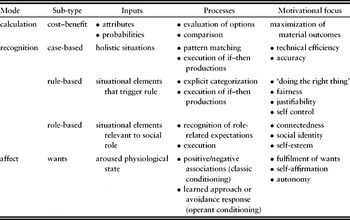
Attempting to influence someone's decision about how to decide only makes sense if decision-makers possess more than one mental tool for the purpose. A large body of behavioral decision research has documented a broad range of qualitatively different ways in which people have been shown to decide on a course of action. Table 1 summarizes one suggested taxonomy of decision modes (Weber, Reference Weber1998; Weber and Lindemann, Reference Weber, Lindemann, Plessner, Betsch and Betsch2007).
Decision modes

The taxonomy distinguishes between three classes of decision modes: calculation-based, affect-based, and recognition-based ways of making decisions, captured colloquially as decisions made by the head, by the heart, and by the book. These three classes of decision modes encode and utilize different situational inputs and apply different psychological processes. Calculation-based decisions involve analytical thought. Affect-based decisions are based on immediate, holistic, affective reactions (Epstein, Reference Epstein1994; Damasio, Reference Damasio2000). In recognition-based decision-making, the decision-maker recognizes a decision situation as a member of a class for which a satisfactory action is known (Simon, Reference Simon1990).
Recognition-based decisions come in different variants. In case-based decisions, the decision-maker is typically an expert in the domain under question, with a memory store of specific decision situations and their associated appropriate actions. These mental representations can be thought of as IF–THEN productions, where the IF element is a set of conditions that must be met in order to trigger the resultant action represented by the THEN part of the production. The expert decision-maker is able to unconsciously apply these production rules, which have been developed through repeated experience, as demonstrated in research with experts such as firefighters and jet pilots (Klein, Reference Klein1998).
Another type of recognition-based decisions is rule-based decisions. These rules may be laws (IF you are driving and come to a red light, THEN you must stop) or other types of regulations (parental rules, self-imposed admonishments, societal norms, or company rules) (Prelec and Herrnstein, Reference Prelec, Herrnstein and Zeckhauser1991). In role-based decisions, the decision context elicits a rule of conduct that derives from one of the social roles of the decision-maker (March and Heath, Reference March and Heath1994). As a mother, IF your child is very ill, THEN you must stay home and care for him.
Weber and collaborators (Weber, Reference Weber1998; Weber and Lindemann, Reference Weber, Lindemann, Plessner, Betsch and Betsch2007) propose that these different modes of making decisions coexist because each mode is better suited than others to address some human needs and motives. Calculation-based modes are best suited to maximize material consequences. Someone wanting to justify her decisions to a supervisor would be well-served by making her decision in a rule-based fashion. Role-based decisions satisfy the motives of connectedness and affiliation. The need for autonomy may be best met by using an affect-based decision mode, as a way of affirming that personal desire for an action suffices.
Multiple modes of decision making have been well-documented for a wide variety of tasks. The adaptive decision-maker program by Payne, Bettman, and Johnson showed that people strategically employ a wide range of decision strategies in the context of multi-attribute choice, e.g. when deciding which car to purchase (Payne et al., Reference Payne, Bettman and Johnson1988; Payne et al., Reference Payne, Bettman and Johnson1993). More recent work has demonstrated the strategic use of decision modes in inference tasks (Gigerenzer and Selten, Reference Gigerenzer and Selten2001) and for risky decision-making tasks (Weber and Hsee, Reference Weber and Hsee2000; Weber et al., Reference Weber, Ames and Blais2004). The idea of multiple mental tools is also captured by a broad range of recent dual-process theories (Evans and Over, Reference Evans and Over1997; Chaiken and Trope, Reference Chaiken and Trope1999; Stanovich and West, Reference Stanovich and West2000; Bohner, Reference Bohner, Hewstone and Stroebe2001), which hypothesize that the human mind has two processing modes, one more analytic and reflective, the other more automatic and impulsive, that operate in parallel and can both compete and cooperate with each other (Strack and Deutsch, Reference Strack and Deutsch2004).
The agenda of this paper goes beyond previous psychological research in its assumptions about the social context of decisions and actions. Some exceptions notwithstanding (Bandura, Reference Bandura1986), psychological studies typically concentrate on behaviour in abstract or standardized contexts. In reality, however, context is often shaped or even provided by institutions. Another shortcoming of existing versions of models of adaptive decision-mode selection is that they address the implicit selection of one or more ways of deciding between a set of choice options, rather than the more ill-defined situations more commonly encountered outside of the laboratory, which are better described as problem-solving tasks. When describing the work of managers, scientists, engineers, or lawyers, Simon (Reference Simon1986) distinguished between decision-making and problem-solving in the following way. He referred to the activities of fixing agendas, setting goals, and generating possible actions as problem-solving, and to the activities of evaluating and choosing between specified alternative actions as decision-making.
3. Previous work on the influence of institutions on decision-mode selection
Some work has foreshadowed the present paper by also aiming to understand how institutions affect the mental processes by which behaviour is generated, though none of it has been particularly similar. Closest in intention and coverage is work that explores the effect of institutions on behaviour that is not generated by deliberate reasoning, particularly the work that has focused on routines or habits (James, Reference James1893: 143; Veblen, Reference Veblen1898: 390; Hodgson, Reference Hodgson1988: 123–134; Vanberg, Reference Vanberg2002; Hodgson, Reference Hodgson2004b). Given that this is also the angle from which economists are most likely to approach the topic, we will discuss similarities and dissimilarities between this work and our framework. We start with the work of the founding father of this approach, John Dewey.Footnote 2
Our approach agrees with Dewey on the following observations. People do not tend to employ formal logic when thinking. Deliberation is a much richer mental activity, although its product is frequently presented in logical terms. The presentation of the results of thought does not necessarily reflect the deliberative processes that generated the results. The deliberative process taps subconscious abilities and is chiefly concerned with the generation of meaning. It is driven by observation, guided by and dependent upon previous experience, and hence open to training (Dewey, Reference Dewey1933; further see Margolis, Reference Margolis1990: chapters 4–5). We further agree that deliberation is not the only tool the human mind offers for decision-making. Many if not most decisions are guided by either habit or impulse. Since habit is by definition acquired, the process of habit formation provides an important point of access for institutional designers into the way people make decisions. Frequently, it is easier to bring about a change in habits by changing the decision than by changing the way in which the decision is made (Dewey, Reference Dewey1922).
In other respects, however, we depart from Dewey's positions. We use a less encompassing definition of habitual decision-making, equating it neither with personality (cf. Dewey, Reference Dewey1922: I.II[38]) nor with disposition (cf. Dewey, Reference Dewey1922: I.III[44]), attitude (cf. Dewey, Reference Dewey1922: I.II[41]), or will (cf. Dewey, Reference Dewey1922: I.II[42]). We reserve the term for a description of one distinct mental tool, without any wish to deny that experience plays a role in other decision-making tools. Even for acquired tastes that are habits of some sort, a decision to buy a cone of ginger ice-cream for its sensory value will be based on affect. While habit, broadly speaking, might ‘operate all the time of waking life’ (Dewey, Reference Dewey1922: I.II[37]), we argue that only some, not all decisions are based on routine. While we do not deny a certain degree of flexibility in routine decision-making (chiefly due to the schematic delineation of the proper scope of a given routine), we do not conceptualize routines as permanently in active competition with each other (cf. Dewey, Reference Dewey1922: I.II[38 f.]). Normatively, we do not depreciate a routine as mechanical and dull, as opposed to an ‘intelligent habit or art’ (cf. Dewey, Reference Dewey1922: I.V[77]). While we agree that it is next to impossible to generate or change a habit on the spot, we suggest that habits can be changed through purposeful intervention (cf. Dewey, Reference Dewey1922: I.V[80]). More generally, while we agree that there may be interactions between habit, impulse, and deliberation, we do not think that the only sensible way to employ those three is as elements of one unitary process (cf. Dewey, Reference Dewey1922: IV.I[278]; Margolis, Reference Margolis1990: 4 and passim). Instead, we provide examples of situations where it seems plausible that any one of them is used in isolation.
Most importantly, however, the questions and goals of our research differ from those of Dewey, whose arguments are normative and explicitly address implications for morality (Dewey, Reference Dewey1922) and education (Dewey, Reference Dewey1933). If institutional designers want to turn our analysis into a piece of advice for policy-making, they too must answer a normative question, namely whether it is desirable to bring about the changes in behaviour that can be effected by changing people's use of decision mode, a normative question that differs from that posed by Dewey, who was a philosopher and philanthropist, not a social engineer. He had no interest in increasing the probability that decisions in one specific domain of practical life be made with the help of one mental tool rather than another, but studied the abstract way in which people make decisions, independent of their domain or content. We concur with Dewey's caveat about the difficulties for policy-making due to the fact that most behaviour has a habitual component, and habit is hard to change, but are less sceptical about deliberate institutional design (cf. Dewey, Reference Dewey1922: I.V[80]).
Modern writers have also looked into issues bordering on our topic. The legal literature on addiction normally assumes that institutions are needed to overcome socially or individually detrimental decision modes, yet is not concerned about how this is or can be done; a symposium bringing together psychologists and legal philosophers on this topic is one interesting exception (Corrado, Reference Corrado1999). Some of the literature on consumer protection also touches on the topic of this paper (Hanson and Kysar, Reference Hanson and Kysar1999a, Reference Hanson and Kysar1999b; Camerer et al., Reference Camerer, Issacharoff, Loewenstein, O'Donoghue and Rabin2003). Recently, there has been interest in the interaction between heuristic decision-making and the law (Gigerenzer and Engel, Reference Gigerenzer and Engel2006), and in institutional arrangements that increase predictability. Predicting the behaviour of an interaction partner is difficult precisely because the human mind is not just one general problem-solving machine, but a modular device, which utilizes a variety of decision modes (Engel, Reference Engel2005). The literature on heuristics and biases, with recommendations for debiasing (for a summary account see Jolls and Sunstein, Reference Jolls and Sunstein2006), considers a related issue, but typically focuses on the direct effect of institutions on behaviour, not on the more indirect strategy of targeting the mental mechanism by which this behaviour is generated. Earl's work (Earl, Reference Earl and Wakeley2005) is one exception and argues that buying routines can make consumers vulnerable to seller manipulation.
Finally, the topic of our paper is linked to an interest of evolutionary economists in (what they have called) the meso level, i.e. generic rules and their population of actualizations (Dopfer et al., Reference Dopfer, Foster and Potts2004). This literature argues that the apparently stable behaviour of groups of individuals may have been generated by very different mental activity. Consequently, in future instances aggregate behaviour may be different even if the environment remains stable, and small changes in the environment may trigger apparently disproportionate changes in behaviour.
4. Problem-solving modes
The basic framework
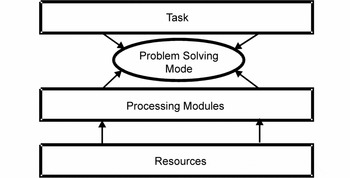
Institutional designers are not necessarily interested in the processes by which people generate behaviour, but care about the resulting behaviour. In order to be useful for institutional analysis and design, our framework must therefore link the ultimate goal of behavioural change aimed at social betterment to the proximate goal of changing the decision about how to decide. Consequently, our framework is not confined to mental activity; it also has a task component. It defines problem-solving modes as tools for matching mental machinery to (perceived) task features, as shown in Figure 1 and further described in this section.
Problem-solving modes

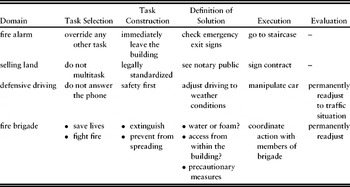
Individuals call on problem-solving modes when faced with a problem situation. While the problem-solving mode used in a given situation may be designed on the spot, we assume that it is usually preconfigured (see Table 2 below for some illustrations; in that table, each row is a problem-solving mode). If so, the decision about how to solve the problem at hand converts to the choice of an appropriate mode from the stock of existing problem-solving modes.
Problem-solving modes rely on processing modules. Standard modules include informational input, the design of a response, and the generation of an output. Each of the modules is assumed to have access to the appropriate resources needed to fulfil its functional task. For instance, if information is visual, the eye and brain regions needed for processing the sensory input are activated to translate the picture on the retina into meaningful information about the environment.
Different problem-solving tasks have different characteristics, needs, and constraints. If you spot a poisonous snake twenty yards away, it is paramount that you react fast. If your boyfriend has proposed to you, a spontaneous yes with a happy smile is good policy – but only if you have been expecting the proposal and have already carefully deliberated on whether this is the person that you want to spend the rest of your life with. Consequently, appropriate problem-solving modes selectively draw on input, processing, and output modules in light of the features of the task at hand. The problem-solving mode thus is the link between capabilities and task requirements.
Resources
Resources are listed as a separate component in our framework since they need not be internal. Technical progress has not left a single internal resource without an external substitute. Moreover, external resources often are not just substitutes, but are superior to internal resources. Take the task of adding up a series of large numbers, where a calculator will outperform the human brain, both in speed and reliability. Normally, internal and external resources have their comparative strengths and weaknesses. A computer may have higher storage capacity than human memory, but it is worse at reconfiguring its stock of knowledge according to changes in interest or in the environment.
There are two principal sources of external resources: technology and people. Technical resources that facilitate decision-making or problem-solving are as old as writing and printing. Four eyes see more than two, and experts can bring their specialized knowledge and professional experience to a task. Groups are able to exploit the power of averaging out random error if each member reports an independent observation. Organized groups can extend the gains from specialization to task-specific interaction.
Processing modules
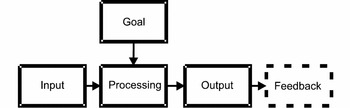
While there are a great variety of internal and external resources, the number of processing modules is strictly confined. Figure 2 provides a complete list.
Processing modules

Input from the environment is mentally processed in light of the goal to generate an output. Optionally, feedback informs the individual about consequences resulting from the output.
The operations of these modules vary widely. At the most basic level, an individual hears the horn of a car and jumps back on to the sidewalk. A single sound triggers the simple decision rule ‘flee to safety’, which the individual executes on the spot. At the opposite end of the range of complexity, an individual may read in the newspaper that, due to demographic change, the pay-as-you-go pension system is no longer sustainable. This piece of information induces her to consider alternative sources of retirement income. She consults some relevant literature, asks the human resources department about the pension plan of her company, and calculates her freely available income. With this information in mind, she gains an understanding of the problem of intertemporal choice she faces. How much consumption today is she willing to sacrifice for greater comfort after retirement? How long is she likely to earn a regular income? How long will she live? Is it important to pass money on to her children? How should today's savings be best invested? She thus goes through a complex process of generating further input and producing the criteria that ultimately direct her choice among alternative investments.
Tasks
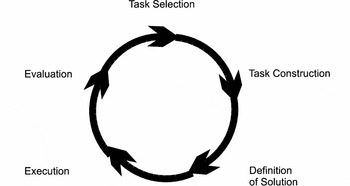
Ideas similar to the task component of our framework have been developed in the analysis of individual and corporate decision-making (Simon, Reference Simon1965: 54–56; Loasby, Reference Loasby1976: 88–91; Earl, Reference Earl2005: 8 f.; Blackwell et al., Reference Blackwell, Miniard and Engel2006: 77; also see Dewey, Reference Dewey1933: chapter 6). For a much more aggregate actor, namely the legislator, political science faces the same conceptual challenge. It must single out the necessary components of the decision-making process, which are placed in the policy cycle. While there are many versions of this cycle, a fairly stylized version (May and Wildavsky, Reference May and Wildavsky1978) has stood the test of time and lends itself to the analogy we propose to the processes faced by individual decision-makers. Figure 3 translates it into what we call the problem-solving cycle.
Problem-solving cycle

The cycle starts on the top, with task selection. On a normal day, we make hundreds, if not thousands of decisions. Should I turn right or left on my way to the train station? Should I help myself to another cup of coffee? Should I speak up at the business meeting? Should I prepare now for tomorrow's seminar? Should I extend my gym membership? Should I buy a new car? Should I accept the offer for a new job? Should I undergo elective surgery? Even with the help of external resources, considering all of them immediately can be beyond the individual's capacity, necessitating task selection.
In essence, task selection is about answering the question: Which of the many issues deserving of my attention should I consider at this point in time?Footnote 3 This decision is influenced by both the current situation and by my values, needs, and goals. But the precise nature of the most pressing issue at hand is usually far from clear. Since problem definition therefore is not mechanical, our framework speaks of task construction. Is there a choice between exogenously specified alternatives, or is the solution space open? What are the relevant constraints? Is there a benchmark for a good solution, or is defining a benchmark part of the task? Are the relevant facts known or at least knowable, or must the decision be taken under uncertainty? Task construction is not just dictated by external task characteristics. Due to the severe limitations of logical reasoning, individuals often construct a problem as a decision under uncertainty when, in fact, it might be solved by formal logic (Oaksford and Chater, Reference Oaksford and Chater1994). For instance, in situations of strategic interaction, people often do not engage in backward induction to determine their rational response to complex game trees, but simply ask: Is this person trustworthy? The fact that people can construct a given task in different, and often simpler ways makes it possible for them to rely on simple heuristics to make decisions or inferences (Payne et al., Reference Payne, Bettman and Johnson1993; Gigerenzer et al., Reference Gigerenzer and Todd1999).
Once the task has been construed, the decision-maker is left with three questions: Is it worthwhile to produce any output on the issue at hand? If so, what are the available options? Which of these options is to be preferred? Answering these three questions is what we call defining the solution. At this stage, the individual must define the output space. Often she is not confined to choosing among preconfigured options, but can use her creativity to generate new options. In assessing the options, she needs a normative benchmark, which again is not necessarily given or fixed. Often the individual is able to change the benchmark in light of emerging task characteristics (Klein, Reference Klein1998).
Having made a decision to do something is not the same as actually doing it, which makes execution a separate element of the problem-solving cycle. There are a variety of internal implementation deficits (Gollwitzer and Schaal, Reference Gollwitzer and Schaal1998). If individuals delegate execution to technology or to other people, an implementation deficit may also result from technology failure, or from the fact that those entrusted with a task pursue their own agenda (cf. Winter, Reference Winter1975; Mayntz, Reference Mayntz1980 for the parallel question in political science).
The outcomes of a decision are not always evaluated when they have occurred. Negative evaluations reflect badly on the problem-solver and might reduce her social standing and/or self-esteem. In order to avoid this, individuals may even reconstruct the situation so as to reduce the appearance of a negative outcome. However, in order to learn from experiences, it is necessary that some evaluation takes place. In many contexts, the sensory system and memory do not give the individual much choice in the matter, by more or less automatically bringing previous bad experiences to mind when a similar task reoccurs. Moreover, evaluation can be entrusted to technology and to outsiders, if necessary even against the will of the individual, as happens when tax auditors are legally mandated to check the accounting practices of companies.
Explicit execution of all steps of the cycle for each and every problem in a given day would result in cognitive overload. This is avoided by using ready-made tools that automatically activate most, if not all, of the steps of the problem-solving cycle. Marketing research has demonstrated that consumers rely heavily on such ‘ready-mades’, for example in their purchasing behaviour (Olshavsky and Granbois, Reference Olshavsky and Granbois1979; Laaksonen, Reference Laaksonen1994). The problem-solving cycle itself represents an idealized sequence of necessary processes, regardless of the way in which these processes are triggered and instantiated in actual decisions.
Problem-solving modes
In our framework, problem-solving modes link processing modules to task characteristics. Depending on the resources they muster, modules can meet different performance standards. Ideally, the problem-solving mode exactly matches the requirements of the task. Conversely, it is the variation in task characteristics that explains the multitude of problem-solving modes, which, in turn, allows individuals to reach better decisions. By not being confined to the single cognitively effortful all-purpose analytic tool suggested by the rational-economic model, human decision makers are able to economize on internal and external resources. This increases their overall problem-solving capacity.
Strictly speaking, these considerations are not sufficient to justify making problem-solving modes a separate component of our framework. It would be enough to link directly specific processing modules to task characteristics. Problem-solving modes are a necessary component, however, if the normal decision about how to decide does not directly match modules to task characteristics, but merely chooses among preconfigured problem-solving modes. This is precisely our claim. While novel problem-solving modes can be constructed on the spot, this probably does not happen very often. Instead, most people most of the time will select between existing, tried-and-true problem-solving modes for the present task and available resources, and employ the problem-solving mode that provides the best match.
The metaphor of the mental tool box is telling. When we want to hang a painting, we select a hammer and a nail. Only in extraordinary circumstances would we start to construct a new tool. Likewise, when facing a decision task, individuals typically employ the problem-solving modes available to them. Only in exceptional situations will they try to forge a new problem-solving mode. When individuals decide how to decide, the default option is to select the most appropriate preconfigured problem-solving mode, given the characteristics of the task.
Relying on preconfigured problem-solving modes saves mental and external resources. The decision about how to decide reduces to a mere matching task, where the domain of the task at hand is matched against the domains in which existing problem-solving modes have performed well. Problem-solving modes can be classified as skills (Anderson, Reference Anderson2000: chapter 9). A skill is a chain of mental and physical modules that are chunked together. The skill is stored in memory as just one unit. If it is retrieved, it unrolls in its entirety. To a large extent, this is true of problem-solving modes.
Rather than being innate, problem-solving modes are learned and acquired with experience. As a result, not all individuals hold the same set of modes in their mental tool box. The contents of the tool box depend on an individual's problem-solving history. Professional deformation (Langerock, Reference Langerock1915) is an obvious illustration. A trained economist has a proclivity to see strategic interaction everywhere. This may induce her to use her game-theoretical reasoning skills for decision-making where others may rely on intuition. More importantly, to the extent that problem-solving modes are skills, an individual can learn how to make better decisions. Specifically, when our economist learns through evaluation and feedback that the performance of her chosen problem-solving mode was poor, she has one of two options. For one, she can switch to a different problem-solving mode in future instances, something she may do if she has learnt more about the proper domain of the problem-solving mode. Alternatively, she may modify the chosen problem-solving mode in some way to improve its performance in future applications.
No craftsman has an unlimited number of tools. Likewise, the number of problem-solving modes to which a given individual has access is probably limited, even though there is no specific bound on the number of problem-solving modes which human decision-makers may have at their disposal. When task characteristics change over time, or technological or institutional innovations provide new opportunities, human creativity will generate more appropriate problem-solving modes.
Table 2 illustrates the concept of a preconfigured problem-solving mode with its different stages by four examples from different content domains, described in the rows of the table. The examples range from utmost simplicity (responding to a fire alarm in a building) to high complexity (responding to a fire as a member of a fire brigade). The reaction to a fire alarm should be almost automatic. Selling land should be a deliberate affair. The other two examples of problem-solving modes combine deliberate with intuitive components. While the first two problem-solving modes do not involve evaluation, evaluation is crucial in the last two cases. The modes for responding to a fire alarm and for selling land are fairly fixed, while the modes for driving and for a fire brigade are highly plastic. While the mode for selling land heavily relies on external resources, those are at most secondary in the reaction to a fire alarm, and in driving behaviour.
Examples of problem-solving modes

Choice among problem-solving modes
The multitude of problem-solving modes gives humans a rich set of options for solving problems, often with less effort than required by an exhaustive analysis; but this can also be seen as adding to the decision load, as resources must be invested into the meta-decision among problem-solving modes. It is not likely, however, that the brain goes through complex calculations for each of the many meta-decisions about how to decide that an individual takes every day. Instead, we hypothesize that the decision about how to decide is usually taken by default. If the individual has encountered similar problems before, she has a tendency to rely on the problem-solving mode that has proven satisfactory on earlier occasions.
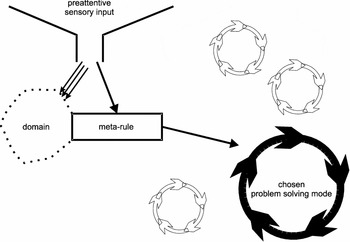
Specifically we argue that the process of choosing a problem-solving mode is similar to heuristic decision-making, as analysed by Engel (Reference Engel, Gigerenzer and Engel2006). Figure 4 displays the hypothesized process, adapted to our problem of meta-choice.
Choice among preconfigured problem-solving modes

Available information about the task and the environment is processed by an ex-ante defined decision rule that maps input conditions to problem-solving modes. Specifically, if the definitional cues specified for a problem-solving mode by the meta-rule are present, the corresponding mode is applied. When selecting a problem-solving mode, the decision-maker typically does not check whether the selected mode is in line with her goal system. This does not mean that goals are irrelevant, but that, in the concrete meta-choice, the checking of goals is incorporated into the matching exercise. Goals are implicit in the ‘domain’ component. For a predetermined problem-solving mode to be applied, its definitional cues must be found in the input provided by the task environment, and the features of the situation must point to the applicability of the problem-solving mode. While the cues are definitional, the domain is described less precisely: The description could be by exemplars (Anderson, Reference Anderson2000: 350–352) or, more likely, by schemas (Bartlett, Reference Bartlett1932: 199–204; Goldstein and Weber, Reference Goldstein, Weber, Goldstein and Hogarth1997: 598) or scripts (Schank and Abelson, Reference Schank and Abelson1977).
For instance, before overtaking another car, a driver would check whether the traffic is ordinary. The schema for ‘ordinary’ traffic might encompass: Am I on the motorway? Are there two or more lanes? Can I look ahead more than 100 yards? Is there no rain or ice on the road? Is there little traffic? Do I know the street? Am I not tired? Not all, but a sufficient number of these questions would have to be answered in the positive. If they were, the two definitional cues would be: Is there traffic on the opposing lane? Are others overtaking at the same time? If both were answered in the negative, the driver would apply her ‘overtaking routine’, which determines all the necessary mental and motor activity.
Consequently, all the individual has to do when faced with a decision task is to check for descriptions of domains stored in memory. If a match is found, then the problem-solving mode is applied, without weighing the pros and cons of this or other problem-solving modes. Individuals only engage in such deliberation if they cannot locate an existing problem-solving mode for tackling the class of tasks at hand. Such deliberation about the pros and cons of different modes may not be done consciously, and it may involve emotions.
5. Access points for institutions
The purpose of our framework has been to map out the access points for institutions. In principle, institutions may impinge upon the use of an internal or external resource, the selection of a specific version of different processing module(s), or of an entire problem-solving mode. Thereby, institutions may in principle have an impact on every element of the problem-solving cycle.
Illustrations from institutional practice
It is relatively easy for institutional designers to make additional external resources available for the problem-solving activities of their addressees. An equal opportunities audit is a case in point. Through such an audit, universities may discover that the proportion of female high school graduates is higher than the proportion of women who enrol at university, and that the proportion of women who achieve tenure is smaller than the proportion of women who get tenure track jobs. The institution thus provides statistical information in a situation where people's intuitive assessments might be faulty (Meadow and Sunstein, Reference Meadow and Sunstein2001). Institutions may also mandate the use of experts. For instance, house owners in some countries are not allowed to maintain their chimneys; they are required to hire a professional chimney sweep. Another graphic example is the ‘super calculator’ offered for download by the Australian Securities and Investment Commission.Footnote 4 It is meant to give consumers guidance in the complex choice of retirement plans, and in freeing them from negative consequences of emotional involvement when thinking about old age and premature death (cf. Laaksonen, Reference Laaksonen1994).
It is more difficult to enhance internal resources by outside intervention, but skill development is one way to do so. Regular fire drills, for example, are meant to inscribe a script in people's memories, which is expected to unroll relatively automatically in an emergency situation.
Other institutions provide their addressees with complete processing modules, as defined in Figure 1: for example the posting of standardized signs for emergency exits, another precautionary measure. In case of an emergency, individuals have no need to orient themselves but just follow the green signs.
Institutions may also have an impact on the module for output. For instance, safety legislation specifies that electric hedge shears have to be designed in such a way that they can only be handled with two hands, reducing the risk that the gardener will negligently injure herself or a bystander. Another piece of legislation makes long checklists mandatory in aircraft maintenance. Such lists make sure that all the safety relevant information is properly processed. Much of criminal law can be read as an attempt to influence the goal module. Individuals are threatened with severe sanctions if they let feelings like vengeance or avidity gain the upper hand. This is where most legal orders draw the line between manslaughter and murder. Finally, institutions may impose an evaluation and feedback module. This is, for instance, part of eco-management and audit schemes (EC OJ 2001 L 114/1).
Institutions can impact on all elements of the problem-solving cycle. The siren of the ambulance is a tool for changing other drivers’ task selection. They no longer concentrate on reaching their destination, but drive to the shoulder. A good example of the impact of institutions on task construction is offered by waste management legislation. This legislation serves two purposes: to protect the environment from emissions on the waste path, and to reduce the use of natural resources. Both purposes are best served if products are designed in a waste friendly manner. Ideally, producers should address this in research and development. Legislation tries to bring this result about by obliging producers to take their products back at the end of the product cycle (Palmer and Walls, Reference Palmer and Walls1999).
There are two strategies institutional designers employ to change how their addressees define the solution to problems. The easier strategy aims at reducing the choice set. Take waste management again. Through advertising campaigns, environmental agencies have tried to establish the social norm ‘do not litter’. Adding a normatively more desirable course of action to the individual's choice set is more demanding. But in some countries, waste management authorities have indeed educated households to separate waste into fractions, like paper or plastics (Ölander and Thogersen, Reference Ölander and Thogersen1995).
Institutions frequently have an impact on the execution of tasks. Again a negative strategy may be distinguished from a positive one. Internal sovereignty implies that government has a monopoly on the exercise of physical power. For ordinary citizens, this excludes a large set of technologies for carrying out their decisions. Conversely, fire fighters are trained to go into burning buildings (something others do at a much greater risk of life and limb). Finally, institutions may require evaluation processes. This is, for instance, done if the university president requires professors to post publicly student evaluations of courses.
Institutional designers do not just try to modify the resources or processing modules used for problem-solving or individual elements of the problem-solving cycle, but frequently attempt to endow their addressees with complete new problem-solving modes or to modify their choice among existing problem-solving modes.
Many institutions have a rationalizing effect, by shifting problem-solving to the use of modes that carefully and deliberately weigh pros and cons. Many have observed that markets have this effect (see only Becker, Reference Becker1962; Plott, Reference Plott, Hogarth and Reder1986). The most important effect of transferring interaction to a market is motivational. Acting on a market visibly raises stakes (Smith, Reference Smith1989, Reference Smith1991, Reference Smith1994). Markets also shape motivations. A strong pro-social motivation is not likely to survive (Hoffman and Spitzer, Reference Hoffman and Spitzer1985). But in markets, outright selfishness or even irrational anti-social behaviour does not pay either. Markets therefore also serve as training grounds for the basic rules of social interaction (Henrich and Boyd, Reference Henrich and Boyd2005; Jankowiak, Reference Jankowiak2005). The cognitive effects of markets result from the fact that transactions occur in a formally or informally organized setting (Engel and Schweizer, Reference Engel and Schweizer2002). The institutional framework thus helps market participants establish mutual expectations.
Other institutions have a routine-building effect. Professionalization does exactly this (Gehlen, Reference Gehlen and Gehlen1960: 71; Goldstein and Hogarth, Reference Goldstein, Hogarth, Goldstein and Hogarth1997: 29), with the legal barrier to market entry as its most important formal component. More and more professions have established such formal requirements. You can only become a doctor, a dispensing chemist, an architect, a structural engineer, an attorney, or a notary public after formal admission, which is preceded by formal training. Moreover, many professions are organized into chambers, which brings professional conduct under the supervision of a formally organized peer group (Battaglini, Benabou et al., Reference Battaglini, Benabou and Tirole2002). Both training and peer group control allow for a dense net of informal rules, dos and don'ts, and standards of best practice. Moreover, within professions, social status is closely linked to obedience to these rules, and to participation in their implementation.
Other institutions, such as a mandatory driving school, bring about automatization. Driving education is meant to endow future drivers with a whole set of very simple automatic behaviours. Stop when the traffic light turns red. Slow down when it starts to rain. Check the mirror before overtaking another car.
Implications for institutional design
While not all institutions are the result of explicit design, and social norms and customary law are typically not the result of purposeful intervention, many institutions are indeed introduced with a very specific goal in mind. How can an institutional designer make it more likely that the targeted decision maker will act in the intended way by changing how she decides to decide?Footnote 5 The answer to this question will depend on how much time the institutional designer has: Must she attain the ultimate goal by a single act of intervention, i.e. ad hoc? At this point, the policy relevance of our main claim becomes visible. Since problem-solving modes are typically preconfigured, ad hoc interventions will usually not be able to target directly a resource, a module, or an element from the problem-solving cycle. If intervention is, or must be, ad hoc, it is usually confined to targeting the choice among preconfigured problem-solving modes.
If the public is scandalized by a social problem, the media may demand that penalties be raised. This is a way of visibly raising stakes, which will have the effect of focusing self-critical attention on the decision-making process (Arkes, Reference Arkes1991). Higher stakes induce people to prepare more intensely (Tetlock, Reference Tetlock1983a), to be more open to facts (Lerner et al., Reference Lerner, Goldberg and Tetlock1998), to take more of the available information into account (Tetlock, Reference Tetlock1983b; Tetlock and Boettger, Reference Tetlock and Boettger1989), to show greater internal consistency (Hagafors and Brehmer, Reference Hagafors and Brehmer1983; Ashton, Reference Ashton1992), and to become more risk averse (Blatt, Reference Blatt1979). All these behavioural effects can be traced back to the fact that higher stakes make addressees switch to deliberate reasoning. A justification requirement has a similar effect. Cognitively, justification makes the individual aware of the actual complexity of the task (Cvetkovich, Reference Cvetkovich1978; Hagafors and Brehmer, Reference Hagafors and Brehmer1983; Weldon and Gargano, Reference Weldon and Gargano1988). Motivationally, the justification requirement makes accountability salient (Hagafors and Brehmer, Reference Hagafors and Brehmer1983) and typically also raises the stakes. If I conform to the pertinent social norm, I do not face much scrutiny. If I ostensibly deviate, however, I am forced to defend myself. I run the risk of social sanctions if the group does not consider my reasons compelling (Earl, Reference Earl and Wiseman1983: 183).Footnote 6 A third option is forced choice. To that end, consumers may be legally required to seek multiple estimates before they sign a contract (Earl, Reference Earl and Wakeley2005: 21), to seek expert advice before they become active (like mandatory vehicle inspection before buying a used car), or they may be required to wait out a cooling off period (Camerer et al., Reference Camerer, Issacharoff, Loewenstein, O'Donoghue and Rabin2003: 1238–1248; Earl, Reference Earl2005: 22). That way, it might, for instance, be more difficult for the providers of funeral services to charge excessive prices, exploiting relatives’ distress and social pressure to pay respect to the deceased. Making decisions more solemn is a related strategy. This is a venerable piece of wisdom, dating back to Keynes (Reference Keynes1936). He recommended that, when buying shares, investors should treat this like marriage, much rather than like a market transaction. In appropriate circumstances, making a decision more costly can have the same effect. That way, counter-speculative devices like the Tobin tax (for a summary account see Tobin, Reference Tobin, Haq, Kaul and Grunberg1996) may also be brought under this rubric.
Deliberate reasoning is not the only, and often perhaps not the best, problem-solving mode that can be triggered when immediate intervention is required. In experiments, psychologists often induce participants to use different decision modes by exerting time pressure (e.g. Maule et al., Reference Maule, Hockey and Bdzola2000) or creating distractions through multitasking (e.g. Bishop, Reference Bishop2001). Institutional designers can learn from these examples, that it is possible to change the situation so that addressees match the task with another preconfigured problem-solving mode. In principle, research on consumer behaviour demonstrates that impulsive, emotional problem-solving is not particularly hard to trigger.Footnote 7 In a democratic country, for normative (and even constitutional) reasons, it might however be hard for policy-makers to defend the use of such tools for social betterment.
Immediate intervention can also exploit the fact that most problem-solving modes are skills. Skills are domain specific. Skills are stored in memory as procedural knowledge. This means that institutional designers can target recall from memory. The likelihood of recalling something from memory is determined by two factors: its base rate of activation, and how recent is the previous recall (Anderson, Reference Anderson2000: chapter 8). The latter can be influenced ad hoc. As research on priming demonstrates, previous activation of a fact or a skill makes its subsequent recall and use more likely. Previous activation does not need to target precisely the same item whose subsequent privileged recall is desired, as memory activation spreads in a network-like manner (Collins and Loftus, Reference Collins and Loftus1975). Shifting purchases from one context to another is one way in which institutional design may exploit this. If trade is over the counter, consumers will mainly rely on trust in the seller's recommendation. If trade is self-service, there will be more comparison shopping. However, shopping routines will matter more (cf. Earl, Reference Earl2005: 20).
It is not always necessary that behaviour be changed ad hoc. It may be enough to change a long-term behavioural trend. This presupposes that society tolerates temporary deviations from the social optimum. Under these more favourable conditions, institutional designers may pursue one of two strategies. The more intrusive strategy aims at endowing addressees with additional problem-solving modes. The less intrusive strategy increases the availability of a previously existing problem-solving mode in a new area.
In the interest of reaching these long-term goals, interventions may be more or less direct. The most direct intervention is imposed training, such as the driving school requirement or the obligation to attend professional schools. A somewhat more complex strategy has been proposed for the renovation of houses. Homeowners are often lured into accepting offers that, were they to properly calculate expected values, would not be affordable. This happens since owners underestimate the risk of unexpected developments that make construction more expensive. It has been suggested that government publish graphic stories, to alert the public to the risk. Those sufficiently sensitive would then become the first to develop more appropriate, issue-specific routines. By observing their (comparative) success, others would gradually follow suit (Earl, Reference Earl2005: 26). Along the same lines, over time patients could be endowed with a set of simple rules that help them decide when a health problem is severe enough that they had better see the doctor.
An even more indirect strategy is applicable if the addressees have the desired problem-solving mode in their tool box, but do not employ it to a socially desirable degree. Problem-solving modes with a pronounced intuitive component are a practically important case, since perceived accountability induces individuals to work harder, but not necessarily smarter (Payne et al., Reference Payne, Bettman and Johnson1988: 200). As a result, the quality of decisions improves for standard tasks, but may deteriorate for unusual tasks (Pelham and Neter, Reference Pelham and Neter1995: 582; Hogarth Reference Hogarth, Gibbs, McKenzie, Marquis, Goldstein and Hogarthet al., 1997: 247–249). Decision makers become more likely to exhibit dominant responses (Lerner and Tetlock, Reference Lerner and Tetlock1999: 259) and focus on that at which they are good (Hogarth et al., Reference Hogarth, Gibbs, McKenzie, Marquis, Goldstein and Hogarth1997: 247). In such a situation, institutions must help addressees establish trust in the power of their intuitions. To that end, institutions often shield addressees from the potentially negative consequences of their action. The business judgement rule from corporate law (Greenfield and Nilsson, Reference Greenfield and Nilsson1997) is a case in point, as are rules that shelter public officials from personal responsibility, or rules that prohibit court intervention into marital affairs, and the parental education of children.
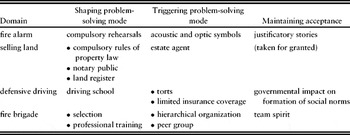
Going back to the examples from Table 2, Table 3 summarizes the access points and the most important elements of the respective institutional arrangements.
Institutional interventions

Conclusion
Our paper has attempted to make the following argument. In many contexts, institutional designers aim to control and modify the way in which addressees solve problems. Reaching this proximate goal is an indirect way of furthering the ultimate goal, i.e. socially more desirable behaviour. This is a demanding, but not impossible endeavour. Institutions have a number of access points available to them for this purpose. Specifically, institutional designers may pursue two different strategies. If ad hoc effects are desired, they may modify the task environment in ways that trigger a different preconfigured problem-solving mode. On a longer-term basis, they may increase the repertoire of problem-solving modes available to addressees, and they may change the likelihood that specific problem-solving modes are used.
Our conceptual framework about how individuals solve problems is intended to show that institutions have a multitude of access points for the purpose. The effect of institutions is not confined to affecting resources, processing modules, or specific elements of the problem-solving cycle. We argue that institutional design is most effective if it targets the meta-selection of an entire problem-solving mode. Such changes can be effected by modifying the task environment in a way that makes the selection of a socially more desirable problem-solving mode more likely.