Introduction
Maternal bonding is the emotional and affective tie that a mother develops toward her children, beginning during pregnancy and continuing into the postnatal period.Reference Condon1–Reference Le Bas, Youssef and Macdonald3 Maternal bonding plays a critical role in establishing early relational health and supports the development of sensitive and responsive caregiving.Reference Condon1–Reference Le Bas, Youssef and Macdonald3 Postpartum maternal bonding is characterized by maternal pleasure in interacting with their children, the sense that their ability and capacity to understand and meet the children’s needs are developing, and their acceptance and tolerance of the demands of the maternal role.Reference Le Bas, Youssef and Macdonald3,Reference Condon and Corkindale4 Previous studies suggest that maternal emotional bonding is associated with early social-affective development in children.Reference Branjerdporn, Meredith, Strong and Garcia5,Reference Le Bas, Youssef and Macdonald6
Bonding difficulty, a subjective experience of emotional distance, is characterized by reduced affection and anger toward, rejection of, and impulse to harm the children.Reference Brockington, Aucamp and Fraser7,Reference Kumar8 Bonding difficulty may reflect underlying perinatal stress, mood disturbances, or unresolved relational trauma.Reference Kinsey and Hogg9 Several tools for assessing bonding difficulty have been reported, one of which is the Mother-to-Infant Bonding Scale (MIBS).Reference Taylor, Atkins, Kumar, Adams and Glover10,Reference Yoshida, Yamashita and Conroy11 The MIBS is a self-reported instrument that captures a mother’s subjective emotional experiences, such as lack of affection, anger, and rejection toward her children.Reference Taylor, Atkins, Kumar, Adams and Glover10,Reference Yoshida, Yamashita and Conroy11
Importantly, maternal bonding difficulty has been associated with reduced caregiving sensitivity, maltreatment of children by mothers, as well as adverse child outcomes, including socio-emotional and developmental delays.Reference Le Bas, Youssef and Macdonald3,Reference Trombetta, Giordano and Santoniccolo12–Reference Nishigori, Obara and Metoki17 However, only a few studies have examined sex differences in children.
Maternal bonding difficulty is associated with postpartum depression.Reference Kokubu, Okano and Sugiyama18–Reference Kasamatsu, Tsuchida and Matsumura20 Previous studies have shown that maternal postpartum psychological distress, including depression and anxiety, is associated with developmental delay in childrenReference Aoyagi and Tsuchiya21–Reference Takahashi, Obara and Kikuchi24 and emphasize the importance of validating maternal bonding as a confounding factor.Reference Aoyagi and Tsuchiya21,Reference Oyetunji and Chandra22 The association of maternal bonding difficulty or maternal postpartum psychological distress with neurodevelopmental delay has been reported in children. However, few studies have explicitly considered maternal bonding difficulty with or without concurrent psychological distress.
The Japan Environment and Children’s Study (JECS), a nationwide birth cohort study in Japan, has been investigating environmental exposures and children’s development.Reference Kawamoto, Nitta and Murata25,Reference Michikawa, Nitta and Nakayama26 Our study used the JECS dataset to examine the association of maternal bonding difficulty with or without psychological distress at 1 year postpartum with neurodevelopmental delay in 2-, 3-, and 4-year-old children and evaluate sex-specific differences.
Methods
Design and participants
The JECS protocol has been published elsewhere.Reference Kawamoto, Nitta and Murata25,Reference Michikawa, Nitta and Nakayama26 JECS recruited pregnant women nationwide between January 2011 and March 2014 from 15 Regional Centers. Written informed consent was obtained from all participants. The present study used the jecs-ta-20190930 and jecs-qa-20210401 datasets. This study only included children from singleton pregnancies; therefore, multiple-birth children were excluded, as were children with congenital anomalies.Reference Mezawa, Tomotaki and Yamamoto-Hanada27
Maternal bonding difficulty
The JECS administered the Japanese version of the MIBS as a mailed questionnaire to assess maternal bonding difficulty at 1 year postpartum.Reference Yoshida, Yamashita and Conroy11 The MIBS, a self-reported scale, contains 10 items, each graded on a 4-point Likert scale. Higher scores indicate a greater severity of bonding difficulty. The optimal cut off scores were ≥5 at 1 month postpartum.Reference Matsunaga, Takauma, Tada and Kitamura16 Because a cutoff value at 1 year postpartum has not been reported, an MIBS total score ≥5 was used in this study, in accordance with previous studies.Reference Tsuchiya, Tsuchiya and Momma28,Reference Tsuchiya, Tsuchiya and Momma29 The MIBS has two subscales: “lack of affection (LA)” (MIBS_LA: items 1, 6, 8, and 10) and “anger/rejection (AR)” (MIBS_AR: items 2, 3, 5, and 7).Reference Yoshida, Yamashita and Conroy11,Reference Kitamura, Takegata and Haruna30 For the subscale cutoffs, we used percentile values similar to those for the MIBS total score ≥5: LA scores ≥2 and AR scores ≥3, in accordance with previous studies.Reference Murakami, Noda and Ishikuro15
Maternal psychological distress
The JECS administered the six-item Japanese version of the Kessler Psychological Distress Scale (K6) as a mailed questionnaire to assess maternal psychological distress at 1 year postpartum. The K6 is widely used to assess psychological distress during the perinatal and postnatal periods.Reference Kessler, Andrews and Colpe31,Reference Kessler, Barker and Colpe32 It is a self-administered questionnaire comprising six questions that evaluate depressive mood and anxiety according to the Diagnostic and Statistical Manual of Mental Disorders, fourth edition, over the preceding 4 weeks on a scale of 0–4. The total score, with a possible range of 0–24, is the sum of the scores for the six items. We used a cutoff of ≥5 for the K6 to identify the cases of psychological distress, according to previous population-based and affected community-based studies in Japan.Reference Furukawa, Kawakami and Saitoh33–Reference Mori, Nishigori and Ogata36
Screening for neurodevelopmental delay in children
The Ages and Stages Questionnaires, Third Edition (ASQ-3), a screening tool for developmental delay in children aged 1–66 months, has high reliability and validity and is widely accepted in clinical settings and research.Reference Mezawa, Aoki and Nakayama37,Reference Schonhaut, Armijo and Schönstedt38 The evaluation was performed for the following five domains: communication, gross motor, fine motor, problem-solving, and personal-social characteristics. For each domain, the parent responded “yes,” “sometimes,” or “not yet,” for specific behaviors of the child. Scores of 10, 5, and 0, respectively, were assigned to the responses, resulting in a total score of 0–60. A score below the specific cutoff for each domain was considered screening positive for neurodevelopmental delay in that domain. The Japanese translation of the ASQ-3 was validated using adjusted cutoff scores for the five domains at ages 1–4 years, as in the study by Mezawa et al.Reference Mezawa, Aoki and Nakayama37 Specifically, the ASQ-3 was administered at ages 0.6, 1, 1.5, 2.0, 2.5, 3.0, 3.5, and 4.0 years. In this study, we evaluated the children at ages 2.0, 3.0, and 4.0 years. The ASQ-3 was administered as a mailed questionnaire.
Statistical analysis
Crude analyses and multivariate logistic regression analyses without / with stepwise method were performed to obtain the odds ratios (ORs) and 95% confidence intervals (CIs).
For MIBS total, mothers were classified into the following four groups: (1) MIBS total score ≤4 and K6 score ≤4, (2) MIBS total score ≤4 and K6 score ≥5, (3) MIBS total score ≥5 and K6 score ≤4, and (4) MIBS total score ≥5 and K6 score ≥5. The reference group was the “MIBS total score ≤4 and K6 score ≤4” group.
For LA, mothers were classified into the following four groups: (1) LA score ≤1 and K6 score ≤4, (2) LA score ≤1 and K6 score ≥5, (3) LA score ≥2 and K6 score ≤4, and (4) LA score ≥2 and K6 score ≥5. The reference group was the “LA score ≤1 and K6 score ≤4” group.
For AR, mothers were classified into four groups: (1) AR score ≤2 and K6 score ≤4, (2) AR score ≤2 and K6 score ≥5, (3) AR score ≥3 and K6 score ≤4, and (4) AR score ≥3 and K6 score ≥5. The reference group was the “AR score ≤2 and K6 score ≤4” group.
The multivariate logistic regression analyses were adjusted for age of the mother at the delivery, unplanned pregnancy, infertility treatment, marital status, maternal highest level of education, paternal highest level of education, maternal smoking history during pregnancy, paternal smoking history during pregnancy, maternal alcohol consumption history during pregnancy, annual household income, maternal history of neuropsychiatric disorders, psychoactive drug use during pregnancy, maternal psychological distress K6 scores ≥5 during pregnancy, psychological intimate partner violence during pregnancy, physical intimate partner violence during pregnancy, pregnancy complications, maternal autism spectrum quotient 10 Japanese version ≥7,Reference Kurita, Koyama and Osada39 obstetric labor complications, mode of delivery, birth weight of the children, gestational age at delivery, exclusive breastfeeding for 6 months postpartum, family structure at child’s age of 6 months, number of children at child’s age of 6 months including current child, attendance at daycare center at age 1 year, and Regional Center at time of registration (during pregnancy). These covariates were mostly selected according to previous studies on postpartum depression/stress and neurodevelopment in children.Reference Murakami, Noda and Ishikuro15,Reference Aoyagi and Tsuchiya21,Reference Oyetunji and Chandra22,Reference Mori, Nishigori and Ogata36 In this analysis, multicollinearity was not found. For reference, parity and number of children (including the current child) showed multicollinearity.
The multivariate logistic regression analyses were also adjusted for variables selected through a stepwise method, with the significance level ificance level of 0.05. To account for the multiple testing, the raw p-values were adjusted by methods that control the false discovery rate (FDR) were described by Benjamini and Hochberg. Raw p-values for 270 null hypotheses were collected (three exposures: MIBS, LA, and AR; three groups: (2) or (3) or (4) versus (1); five outcome domains; ages 2, 3, and 4 years; boys and girls). FDR-adjusted p-values < 0.05 was considered indicative of significance after multiplicity control.
All the analyses were performed using SAS statistical software, version 9.4 (SAS Institute Inc., Cary, NC, USA).
Results
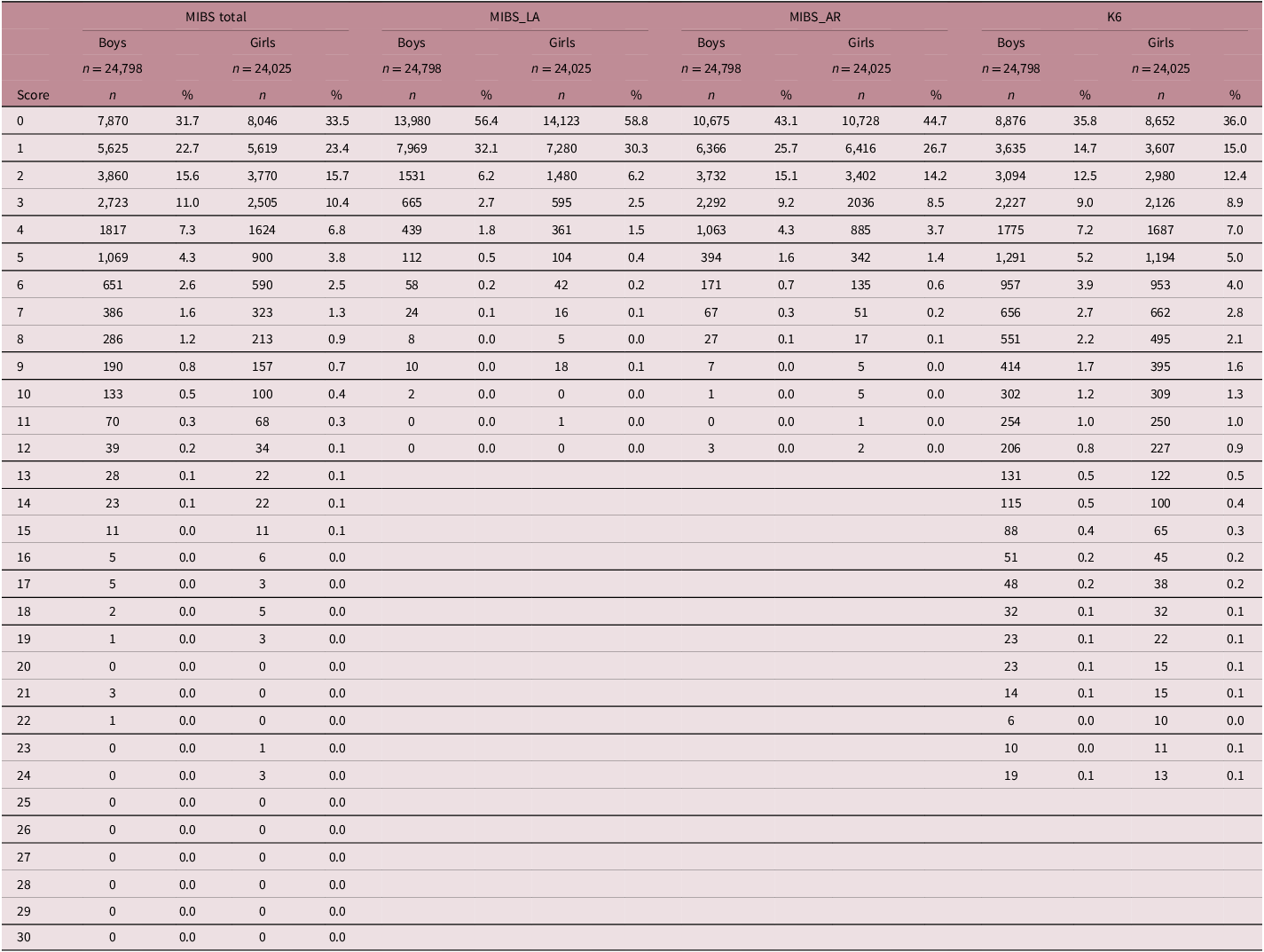
Of 104,059 JECS dataset records, those of 24,798 boys and 24,025 girls were analyzed (Fig. 1). Table 1 shows the participants’ characteristics, including those with single pregnancies and their children, evaluated using ASQ-3 (Table 1). Table 2 shows the distribution of mothers’ MIBS and K6 scores.
Flow chart depicting research participants’ selection.

Characteristics of participants (total, n = 48,823)

Abbreviations: intimate partner violence (IPV), The 6-item Kessler Psychological Distress Scale (K6), Japanese version of Mother-to-Infant Bonding Scale (MIBS), lack of affection (LA), anger / rejection (AR), standard deviation (SD). The Aged & Stages Questionnaires Third Edition (ASQ-3).
Maternal MIBS and K6 scores distribution at 1 year postpartum

Abbreviations: Japanese version of Mother-to-Infant Bonding Scale (MIBS), lack of affection (LA), anger/rejection (AR), the 6-item Kessler Psychological Distress Scale (K6).
Association between the MIBS/K6 score groups and screen-positive result for neurodevelopmental delays in children by sex (Tables 3–7 – see supplementary material)
Here, we reported only the results of groups with FDR-adjusted p-values<0.05 in multivariate logistic regression analysis fulfilling the following conditions: (I) not using the stepwise method; and (II) using the stepwise method.
MIBS total score for boys
The groups with “MIBS total score ≥5 and K6 score ≤4” and “MIBS total score ≥5 and K6 score ≥5” showed association with screen-positive result for neurodevelopmental delay in all five domains (communication, gross motor, fine motor, problem-solving, and personal-social) in boys aged 2, 3, and 4 years, compared with the reference group with “MIBS total score ≤4 and K6 score ≤4.”
LA score for boys
The groups with “LA score ≥2 and K6 score ≤4” and “LA score ≥2 and K6 score ≥5” showed association with screen-positive result for neurodevelopmental delay in all five domains in boys aged 2, 3, and 4 years, compared with the reference group with “LA score ≤1 and K6 score ≤4.”
AR score for boys
The groups with “AR score ≥3 and K6 score ≤4” and “AR score ≥3 and K6 score ≥5” showed association with screen-positive result for neurodevelopmental delay in all five domains in boys aged 2, 3, and 4 years, compared with the reference group with “AR score ≤2 and K6 score ≤4.”
MIBS total score for girls
The group with “MIBS total score ≥5 and K6 score ≤4” showed association with (1) screen-positive result for all five domains at ages 2 years, (2) screen-positive result for gross motor, fine motor, and problem-solving at ages 3 years, (3) screen-positive result for communication, gross motor, fine motor, and personal-social delays in girls at age 4 years, compared with the reference group with “MIBS total score ≤4 and K6 score ≤4.” However, the group with “MIBS total score ≥5 and K6 score ≤4” showed no significant association with screen-positive result for problem-solving delay in girls aged 4 years.
The group with “MIBS total score ≥5 and K6 score ≥5” showed association with screen-positive result for neurodevelopmental delay in all five domains in girls aged 2, 3, and 4 years, compared with the reference group with “MIBS total score ≤4 and K6 score ≤4.”
LA score for girls
The group with “LA score ≥2 and K6 score ≤4” showed association with: (1) screen-positive result for all five domains at age 2 years; (2) screen-positive result for gross motor, fine motor, and problem-solving delays at ages 3 years; (3) screen-positive result for communication, gross motor, fine motor, and personal-social delays at ages 4 years; compared with the reference group with “LA score ≤1 and K6 score ≤4.” However, the group with “LA score ≥2 and K6 score ≤4” did not show a significant association with screen-positive result for problem-solving delay in girls aged 4 years.
The group with “LA score ≥2 and K6 score ≥5” showed association with screen-positive result for neurodevelopmental delay in all five domains in boys aged 2, 3, and 4 years, compared with the reference group with “LA score ≤1 and K6 score ≤4.”
AR score for girls
The group with “AR score ≥3 and K6 score ≤4” showed association with: (1) screen-positive result for all five domains at ages 2 and 3 years; (2) screen-positive result for communication, gross motor, fine motor, and personal-social delays at ages 4 years; compared with the reference group with “AR score ≤2 and K6 score ≤4.” However, the group with “AR score ≥3 and K6 score ≤4” showed no significant association with screen-positive result for problem-solving delay in girls aged 4 years.
The group with “AR score ≥3 and K6 score ≥5” showed association with screen-positive result for neurodevelopmental delay in all five domains in boys aged 2, 3, and 4 years, compared with the reference group with “AR score ≤2 and K6 score ≤4.”
Discussion
Overall, our study revealed that maternal bonding difficulty at the first year postpartum period was associated with screen-positive result for neurodevelopmental delay in the children at age 2 to 4 years.
Maternal bonding difficulty without psychological distress
In boys, maternal bonding difficulty overall, LA, and AR, without psychological distress, were associated with screen-positive result for all five domains of developmental delay (communication, gross motor, fine motor, problem-solving, personal-social characteristics) at ages 2, 3, and 4 years.
In girls, overall maternal bonding difficulty, LA, and AR, without psychological distress, were associated with screen-positive result for developmental delay in all five domains (communication, gross motor, fine motor, problem-solving, personal-social characteristics) at 2 years of age. However, at age 4 years, among the five domains, screen-positive result for problem-solving delay no longer showed a significant association with maternal bonding difficulty in girls. However, currently, it is unknown why in response to maternal bonding difficulty without psychological distress, only girls showed no significant screen-positive result for problem-solving delay at age 4 years. Further research and clarification are needed.
Maternal bonding difficulty with psychological distress
In both boys and girls, maternal bonding difficulty (overall, LA, and AR) with psychological distress was associated with screen-positive results for all five domains of developmental delay at ages 2, 3, and 4 years. Notably, a different pattern was observed in girls when maternal bonding difficulty occurred without psychological distress. Among them, maternal bonding difficulty (overall, LA, and AR) without psychological distress no longer showed a significant association with screen-positive results for problem-solving delay at age 4 years. This discrepancy may be explained by the potential influence of maternal psychological distress. In girls, maternal psychological distress without maternal bonding difficulty (overall, LA, and AR) was associated with screen-positive results for problem-solving delay at age 4 years (Table 6 – Supplementary material).
Previous studies about maternal bonding difficulty and neurodevelopment in children
Previous studies have revealed an association between maternal bonding difficulty and child neurodevelopment, but sex-specific differences were not examined.Reference Le Bas, Youssef and Macdonald3,Reference Le Bas, Youssef and Macdonald14,Reference Murakami, Noda and Ishikuro15,Reference Behrendt, Scharke and Herpertz-Dahlmann40 In addition, these previous studies only included maternal psychological distress, including depression and anxiety, as a covariate factor. Thus, to our knowledge, this is the first report to examine sex-specific differences in the association between maternal bonding difficulty and screen-positive result for child neurodevelopmental delay and the synergistic effects of psychological distress.
Le Bas et al. studied 1,347 pairs using Maternal Postnatal Attachment Scale at 12 months postpartum and the Bayley Scales of Infant and Toddler Development, Third Edition at 12 months, in an Australian study. They reported that bonding predicted infant social-affective development, including social–emotional, behavioral, and temperamental outcomes.Reference Le Bas, Youssef and Macdonald14 Murakami et al. also studied 8,380 pairs using MIBS and ASQ-3 in a Japanese cohort study in the Tohoku region. They reported that maternal bonding difficulty at 1 month postpartum was associated with a screen-positive result for developmental delay in all five domains (communication, gross motor, fine motor, problem-solving, personal-social characteristics) for children aged 3.5 years.Reference Murakami, Noda and Ishikuro15
On a slightly different topic, previous studies using the MIBS reported that maternal bonding difficulty is a risk for maternal child maltreatment.Reference Matsunaga, Takauma, Tada and Kitamura16,Reference Nishigori, Obara and Metoki17 In a previous study, regarding the negative effects of physical, emotional, and sexual maltreatment and neglect, maltreatment in children was associated with changes in brain structure and function.Reference Teicher and Samson41
Limitations
First, the limitation of this study was that the mothers’ self-reported all variables and the high likelihood of inter-dependence among them. The children’s ASQ-3 is a maternal self-administered assessment; therefore, it was not objectively administered by trained evaluators. Thus, the result on maternal bonding difficulty may have led to an underestimation of the outcome of the children’s developmental process.Reference Le Bas, Youssef and Macdonald3,Reference Le Bas, Youssef and Macdonald6,Reference Le Bas, Youssef and Macdonald14 Second, maternal bonding difficulty was not objectively measured or psychologically diagnosed. Third, psychological distress was not medically diagnosed. Fourth, an MIBS total score ≥5 at 1 year postpartum was used in this study, in accordance with previous studies.Reference Tsuchiya, Tsuchiya and Momma28,Reference Tsuchiya, Tsuchiya and Momma29 However, there are issues regarding the significance of this range of scores when compared with the same scores at 1 month postpartum.Reference Matsunaga, Takauma, Tada and Kitamura16 One month postpartum may reflect a time of significant adjustment, physical recovery, and fatigue. The same range score at 1 year may reflect bonding difficulty of a presumably higher magnitude. Therefore, this study has the limitation that MIBS assessments were not conducted during the early postpartum period, such as at 1 month postpartum.
Strengths of the study
To our knowledge, this is the first report to examine sex-specific differences in the association between maternal bonding difficulty and screen-positive result for child neurodevelopmental delay.
Conclusion
Overall, our study revealed that maternal bonding difficulty without psychological distress at the 1 year postpartum was associated with screen-positive result for communication, gross motor, fine motor, and personal-social domains from 2 to 4 years of age in boys and girls. The association between maternal bonding difficulty without psychological distress and screen-positive result for children’s problem-solving delay persisted in boys but did not significantly exist in girls at age 4 years. However, there are limitations, and further studies are required.
Supplementary material
For supplementary material accompanying this paper visit https://doi.org/10.1017/S2040174426100476
Acknowledgments
The authors are grateful to all the participants of the study. Members of the JECS group as of 2023 are as follows: Michihiro Kamijima (principal investigator, Nagoya City University, Nagoya, Japan), Shin Yamazaki (National Institute for Environmental Studies, Tsukuba, Japan), Yukihiro Ohya (National Center for Child Health and Development, Tokyo, Japan), Reiko Kishi (Hokkaido University, Sapporo, Japan), Nobuo Yaegashi (Tohoku University, Sendai, Japan), Koichi Hashimoto (Fukushima Medical University, Fukushima, Japan), Chisato Mori (Chiba University, Chiba, Japan), Shuichi Ito (Yokohama City University, Yokohama, Japan), Zentaro Yamagata (University of Yamanashi, Chuo, Japan), Hidekuni Inadera (University of Toyama, Toyama, Japan), Takeo Nakayama (Kyoto University, Kyoto, Japan), Tomotaka Sobue (Osaka University, Suita, Japan), Masayuki Shima (Hyogo Medical University, Nishinomiya, Japan), Seiji Kageyama (Tottori University, Yonago, Japan), Narufumi Suganuma (Kochi University, Nankoku, Japan), Shoichi Ohga (Kyushu University, Fukuoka, Japan), and Takahiko Katoh (Kumamoto University, Kumamoto, Japan).
Financial support
This study was funded by the Ministry of the Environment, Japan. The findings and conclusions of this article are solely the opinions of the authors, and do not represent the official views of the the above government.
Competing interests
None.
Ethical standard
The authors assert that all procedures contributing to this work comply with the ethical standards of the relevant national guidelines on human experimentation (Ministry of the Environment’s Institutional Review Board on Epidemiological Studies) and with the Declaration of Helsinki of 1975, as revised in 2008, and was reviewed and approved by the Ministry of the Environment’s Institutional Review Board on Epidemiological Studies (no. 100910001), and by the Ethics Committees of all participating institutions. Written informed consent was obtained from all participants.