Self-efficacy is a particularly fertile variable for research and psychological intervention in a wide range of human functioning domains. The results obtained in nine meta-analyses (Bandura, Reference Bandura2006c) underline the central role of efficacy beliefs in people’s lives; their structural, dynamic and functional properties and different applications in personal and social change. Self-efficacy beliefs are of high predictive and explanatory value, significantly contributing to the level of motivation, well-being, performance (Bandura, Reference Bandura2006c) and resilience (Barreira & Nakamura, Reference Barreira and Nakamura2006) across the life cycle. Adolescence is a time of life that is particularly rich in biological and social changes that demand the performance of new roles and the acquisition of new social skills (Del Prette & Del Prette, Reference Del Prette and Del Prette2002). According to Bandura (Reference Bandura, Pajares and Urdan2006a), however, the stereotype associated with the “crisis of adolescence” needs to be deconstructed. On the one hand, this is necessary because this stereotype ends up attributing the possible difficulties adolescents feel to interpersonal and mainly biological variables, consequently taking the responsibility away from the social systems that do not offer the enough support. On the other hand, most adolescents do overcome successfully the transitions and challenges they face (Bandura, Reference Bandura, Pajares and Urdan2006a).
Perceived personal efficacy or trust in one’s abilities to undertake the actions and plans needed to be successful seems to play an important role in this process (Bandura, Reference Bandura, Pajares and Urdan2006a). Adolescence is a privileged study focus in self-efficacy research, not only in specific traditional domains like academic performance or career choice (Coimbra & Fontaine, Reference Coimbra and Fontaine2010; Hackett, Reference Hackett and Bandura1995; Zimmerman & Cleary, Reference Zimmerman, Cleary, Pajares and Urdan2006), but also in more comprehensive and often inseparable domains, like the areas associated with the adoption of a healthy lifestyle or pro-social behavior. The results indicate that self-efficacy beliefs can make a difference in problems that are considered typical of this phase of life, like shyness, social anxiety, depression, transgressive conduct, substance use or risky sexual activity (Bandura, Reference Bandura, Pajares and Urdan2006a; Pajares, Reference Pajares, Pajares and Urdan2006; Pajares & Urdan, Reference Pajares and Urdan2006).
Generalized Self-Efficacy Scale
The Generalized Self-Efficacy Scale (GSE) is an instrument, designed by Schwarzer and Jerusalem (Reference Schwarzer, Jerusalem, Weinman, Wright and Johnston1995) to parsimoniously and comprehensively assess optimistic self-efficacy beliefs to deal with stress-inducing situations. What distinguishes this scale from most scales of optimism is that it explicitly refers to personal agency: the belief that one’s own actions can lead to successful results. A point of distinction from most self-efficacy scales is that it is not context-specific. One of the most important dimensions in the analysis of self-efficacy beliefs’ impact is their generality or the possibility to transfer personal efficacy judgments among tasks or activities in different domains (Bandura, Reference Bandura1997; Maddux, Reference Maddux and Maddux1995; Zimmerman & Cleary, Reference Zimmerman, Cleary, Pajares and Urdan2006). In their original definition and operational use, self-efficacy beliefs were described as context specific, consequently demanding the adoption of a micro-analytic method (Bandura, Reference Bandura1982, Reference Bandura1997; Bandura, Reese, & Adams, Reference Bandura, Reese and Adams1982; Maddux, Reference Maddux and Maddux1995). Bandura continues to defend this method, considering that very comprehensive or global measures can compromise the predictive validity or even the differential definition of self-efficacy when compared to bordering constructs (Bandura, Reference Bandura1997, Reference Bandura, Pajares and Urdan2006b). Bandura (Reference Bandura1997), however, defines three generality levels of self-efficacy beliefs: (1) a more specific level to measure self-efficacy for a specific performance in a set of also specific conditions; (2) an intermediary level, for a performance class in the same activity domains, in a set of situations that share common properties; (3) and a more general level that measures personal efficacy beliefs without specifying the activities or conditions in which they will be performed (Bandura, Reference Bandura1997). In addition, susceptibility to the generalization, transference and mainstreaming of gaining mastery experiences is appointed as one of the reasons that enhance the transformative capacity of self-efficacy gains (Bandura, Reference Bandura, Pajares and Urdan2006a, Reference Bandura2006c).
The GSE originates in Germany and has previously been adapted to different cultures. Translations are available in 30 languages and validation studies exist in 25 nations, with thousands of participants from different socioeconomic origins and age groups, including adolescents. Confirmatory factor analyses (CFA) have demonstrated its one-dimensionality and satisfactory Cronbach’s alpha coefficients ranged between .75 and .90. Other satisfactory indicators exist in terms of test-retest consistency (1 year and after 2 years), convergent, discriminant and predictive validity, showing positive correlations with self-esteem and negative correlations with anxiety or depression for example (Luszczynska, Gutiérrez-Doña, & Schwarzer, Reference Luszczynska, Gutiérrez-Doña and Schwarzer2005; Scholz, Gutiérrez-Doña, Sud, & Schwarzer, Reference Scholz, Gutiérrez-Doña, Sud and Schwarzer2002). The GSE was adapted to the Portuguese population by Coimbra and Fontaine (Reference Coimbra, Fontaine, Soares, Araújo and Caires1999), in a sample of 9th-year students. The one-dimensional structure was confirmed and an internal consistency coefficient of .77 was found. In a subsequent study, among a sample of adolescents and young adults between 15 and 27 years of age, good fit indices were found for the GSE, with an internal consistency coefficient of .76 (Coimbra, Reference Coimbra2008).
In Brazil, Souza and Souza (Reference Souza and Souza2004) undertook a validation study of this scale based on the English, Spanish and Portuguese versions, which they called the Perceived General Self-Efficacy Scale, in a sample of 283 college students. The authors found a satisfactory internal consistency coefficient (α = .81) and verified the instrument’s external validity based on a negative correlation with anomie and a positive correlation with masculinity, femininity and satisfaction with social support. The aim of this study is to assess the construct validity (factorial, convergent and discriminant), internal consistency and cross-cultural invariance of the Portuguese version of the GSE (Escala de Autoeficácia Generalizada - EAG, Coimbra & Fontaine, Reference Coimbra, Fontaine, Soares, Araújo and Caires1999), through three studies. In the first study, the construct validity and internal consistency (α) of the instrument were tested in a sample of Portuguese adolescents. In the second study, the same analyses were developed in a Brazilian sample. In the third study, the invariance of the GSE was examined in the Brazilian sample through multigroup confirmatory factor analysis (MGCFA). In fact, when an assessment instrument is applied in another culture, checking the invariance of the measuring model is fundamental, that is, whether the measures used reflect the same construct and measure it similarly (Marôco, Reference Marôco2010).
STUDY 1 Validation of the Generalized Self-Efficacy Scale-Portugal
Internal consistency was evaluated using Cronbach’s alpha. The factorial, convergent and discriminant construct validity of the instrument were also analyzed (Anastasi & Urbina, Reference Anastasi and Urbina1997).
Method
Participants
In Study 1, participants were 304 Portuguese adolescents (51% male), who were attending either the 10th, 11th or 12th grade of Portuguese secondary education, which corresponds to the first and second year of Brazilian secondary education, at public and private institutions in Porto. These adolescents were aged between 15 and 18 years old (M = 16.70; SD = .80). The distribution of the adolescents was balanced among the low, medium and high socioeconomic levels, based on the parents’ profession and education level.
Instruments
The GSE (Coimbra & Fontaine, Reference Coimbra, Fontaine, Soares, Araújo and Caires1999, Appendix A) consists of 10 items, with a 4-point Likert scale ranging from 1 (I Completely Disagree) to 4 (I Completely Agree), aimed at identifying, as expressed in the introduction, self-efficacy beliefs in view of difficult situations. In order to reduce social desirability bias, the original items 4, 6 and 7 were negatively worded.
The Resilience Scale (Escala de Resiliência-RS) is an instrument aimed at assessing resilience in the sense of an internal resource, perceived as an important protection mechanism against the adversity of life experiences. It was elaborated by Coimbra (Reference Coimbra2008) based on the selection of items from three other scales repeatedly cited in the literature (Block & Kremen, Reference Block and Kremen1996; Jew, Green, & Kroger, Reference Jew, Green and Kroger1999; Wagnild & Young, Reference Wagnild and Young1993), a literature review and the content analysis of 54 interviews. The scale was applied to the Portuguese population, in a sample of adolescents and young adults between 15 and 27 years of age. The scale consists of 13 items, with a 4-point Likert scale ranging from 1 (I Completely Disagree) to 4 (I Completely Agree). Good fit indices were found in a two-factor structure: a) a first factor, called resilience, reflects characteristics like optimism, extroversion and pro-activeness; a second factor, called vulnerability, refers to characteristics of pessimism and susceptibility to be influenced by negative people, situations or emotions. The internal consistency coefficient of the ER was close to reasonable for the first factor (α = .69), and reasonable (α = .70) for the second (Coimbra, Reference Coimbra2008).
Procedure
After the initial presentation of the objective, the general contents of the study and the answering procedures, students were informed about the importance and voluntary nature of their participation. In the case of minors, the legal caregivers’ written or verbal authorization was requested. The second author administered the instrument to groups of students during class hours.
Data analysis
Data were processed and analyzed using SPSS 18.0 software. Factorial validity was determined using Confirmatory Factor Analysis (CFA), with the help of Amos 18.0 software. The estimation of the parameters was based on the correlation matrix, using the maximum likelihood method. The existence of multivariate outliers was analyzed through the squared Mahalanobis distance formula (MD2) (p1 and p2 < .001) and the normality of the variables was verified through the asymmetry (sk) and kurtosis (ku) coefficients, adopting the following reference values for |sk| > 3 indicators of severe asymmetry; |ku| > 10 indicators of severe kurtosis and |ku| > 20 very severe kurtosis (Kline, Reference Kline2011).
Factorial Validity
To determine factorial validity, determined with the help of Confirmatory Factor Analysis (CFA), the global fit of the hypothetic model was evaluated using the following set of indices and respective reference values for acceptable fit (Kline, Reference Kline2011; Schweizer, Reference Schweizer2010): χ2/df ratio < 5 (Arbuckle, Reference Arbuckle2008); Bentler Comparative Fit Index-CFI > .90 (Bentler, Reference Bentler1990), Root Mean Square Error of Approximation-RMSEA < .08 (Arbuckle, Reference Arbuckle2008) and Standardized Root Mean Square Residual-SRMR < .08 (Hu & Bentler, Reference Hu and Bentler1999). Local fit was evaluated through the standardized factor weights and individual reliability coefficients of items scoring higher than .50 and .25, respectively, indicating good fit and, therefore, the factorial validity of the model (Marôco, Reference Marôco2010). When necessary, the model was re-specified using the modification indices produced in Amos 18.0 and based on theoretical considerations. To avoid the capitalization of type I errors, which are frequent in the use of modification indices, trajectories were only altered for modification indices higher than 11 [χ2 (1) = 10.86; p < .001] (Marôco, Reference Marôco2010).
Convergent validity
In this study, two types of convergent validity are presented. The first is the external convergent validity with another instrument. The second relates to the instrument itself. Hence, convergent validity is verified when: a) the construct under study is positive and significantly related to other theoretically parallel constructs; b) the items in the construct present positive and high mutual correlations (Marôco, Reference Marôco2010). In this study, in the first case for the occurrence of convergent validity, the GSE was compared with the Resilience Scale - RS (Coimbra, Reference Coimbra2008), using Pearson’s r correlation between the global GSE score and the resilience score on the ER. To assess the convergent validity with the GSE, the following Pearson’s r correlation coefficients were considered: < .20 = very low; ≥ .20 and < .40 = low; ≥. 40 and < .70 = moderate; ≥ .70 and < .90 = high; > .90 = very high (Bryman & Cramer, Reference Bryman and Cramer2003). To prove the convergent validity of the GSE, in the second case, the Composite Reliability (CR) and Mean Extracted Variance (MEV) were calculated (Fornell & Larcker, Reference Fornell and Larker1981),with CR > .70 and MEV > .50 showing adequate convergent validity (Hair, Anderson, Tatham, & Black, Reference Hair, Anderson, Tatham and Black1998).
Discriminant validity
To evaluate discriminant validity, which is the case when the construct under analysis shows no high correlation with others that reflect different constructs, the correlation between the scale or factor scores was divided by the root of the multiplication of each scale or factor’s internal consistency coefficients. If the result is lower than .85, it can be concluded that discriminant validity exists (Campbell & Fiske, 1959 cited in Anastasi & Urbina, Reference Anastasi and Urbina1997).
Internal consistency
Internal consistency was evaluated using Cronbach’s alpha (α). Coefficients higher than .70 were considered as good internal consistency levels (Anastasi & Urbina, Reference Anastasi and Urbina1997).
Results and Discussion
Construct validity (factorial, convergent and discriminant) and internal consistency
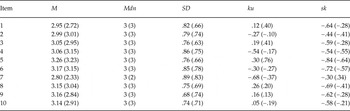
The psychometric sensitivity of the GSE items was analyzed based on their distribution. According to Table 1, the scale items for the Portuguese and Brazilian samples showed asymmetry and kurtosis levels without any noteworthy difference from the Normal Distribution (Kline, Reference Kline2011).
Descriptive statistics of the GSE in the Brazilian and Portuguese samples (values between parentheses)

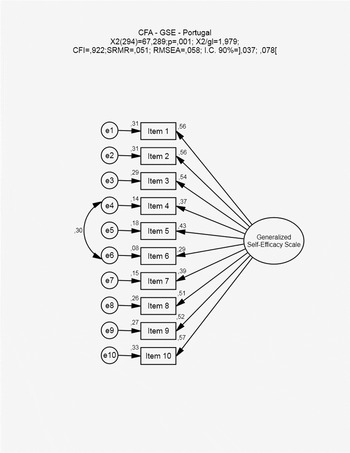
Before running the CFA, the presence of outliers was investigated. Using MD2, 10 outlier observations were found, so that CFA was again run without these cases. Given that results differed from the previously obtained ones, the researchers decided to eliminate these cases from the sample. The specification of the correlations between the GSE items served to be estimated freely, with acceptable fit indices, according to Figure 1.
Confirmatory Factor Analysis of GSE in the Portuguese sample.

As observed in Figure 1, most factor weights and individual reliability coefficients were acceptable. Item 5 showed a coefficient close to acceptable levels. Items 4, 6 and 7 showed low saturation values, which may be associated with the semantic nature of the items. These items were recoded because they express the opposite idea of generalized self-efficacy, and because the individual reliability coefficients of these items remained most distant from desirable levels. Hence, their negative formulation may have compromised their interpretation. In the specific case of item 6, for example, it is understandable that, despite a high self-efficacy level, an adolescent does not consider that the solution to all problems (s)he is confronted with always depends on his/her level of effort. Moreover, the ability to distinguish the nature of problems that may or may not depend on one’s personal control is an important acquisition of adolescence (Bandura, Reference Bandura, Pajares and Urdan2006a).
According to Flammer (Reference Flammer and Bandura1995), during adolescence, the final phase in the structural development of control beliefs is reached, with a progressive distinction among different causes, including the concepts of global and specific aptitude, effort, task difficulty and compensation for effort and aptitude. Therefore, at the end of adolescence, most people are able to better distinguish between the contribution of their personal attributes to the obtained results and what they are able to control or not (Flammer, Reference Flammer and Bandura1995). In fact, it is understandable that even the most self-efficacious people are not sure about how to behave in unexpected situations.
The model showed a global fit close to acceptable (χ2/df = 2.64; CFI = .87; RMSEA = .07; SRMR = .06). To improve the fit of the model, it was re-specified. The modification indices showed that nine correlations existed between measurement errors that were impairing the model’s global fit and which, when introduced, would cause a significant drop in χ2. From a statistical perspective, the modification index that most contributed to the model fit referred to the correlation between the errors of items 6 and 4. One justification for this correlation may lie in the fact that these items showed low factor weights, as a result of their negative formulation and possible role in the above-mentioned interpretation. In view of the importance of the aspects evaluated in items 4 and 6 for generalized self-efficacy, however, the decision was made to maintain them. According to Figure 2, after introducing this correlation, the global fit significantly improved (Δχ2 = 67.29, p < .001), so that the model now showed acceptable fit indices (χ2/df = 1.98; CFI = .92; RMSEA = .06; SRMR = .05). The correlation introduced was significant and moderate (r = .30, p < .001).
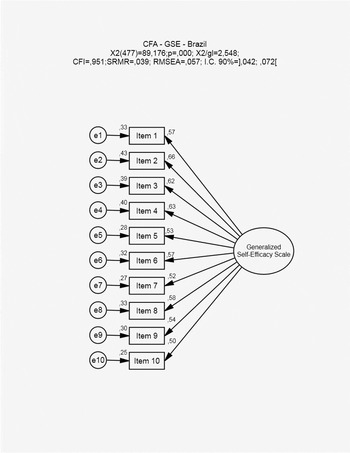
Confirmatory Factor Analysis of GSE in the Brazilian sample.

The convergent validity of the instrument was determined using Pearson’s correlation coefficient between the global GSE score and the resilience score of the RS. The results indicated a significant and moderate correlation between the global EAG score and the resilience score on the RS. In fact, the data indicated that, the higher the self-efficacy level, the greater the resilience (r = .51; p < .01). The CR result (.74) remained within acceptable levels and the MEV (.23) result below acceptable level, suggesting that it only partially explains the behavior of the scale items. This result can be attributed to the fact that this is a generalized and comprehensive scale, which does not dismiss articulation with other more specific self-efficacy scales. In that sense, in accordance with Bandura (Reference Bandura1997, Reference Bandura, Pajares and Urdan2006b), the non-context-specific evaluation of self-efficacy beliefs can negatively affect the predictive value or even the differential definition in relation to bordering constructs.
The discriminant validity result indicated that the correlation between the global GSE score and the vulnerability score on the RS (r = −.90; p < .01) divided by the root of the multiplication between the internal consistency coefficients of the GSE (α = .75) and the vulnerability factor of the RS (α = .68) equaled .83, and was therefore lower than .85. Based on this result, it can be concluded that discriminant validity exists (Campbell & Fiske, 1959, cited in Anastasi & Urbina, Reference Anastasi and Urbina1997). Finally, the scale showed a satisfactory internal consistency coefficient (α = .75).
STUDY 2 Validation and cross-cultural adaptation of the Generalized Self-Efficacy Scale-Brazil
In this part of the study, the researchers evaluated the internal consistency and construct validity of the GSE in a sample of Brazilian adolescents. The same statistical analyses as in Study 1 were applied.
Method
Participants
In study 2, the GSE was administered to a sample of 477 Brazilian adolescents (53.7% female) who attended the first and second years of secondary education at two public schools in a city in the State of Minas Gerais; students were aged between 13 and 17 years (M = 15.33; SD = 0.83). According to data by the Brazilian Association of Research Companies (ABEP, 2011), based on the 2009 Socioeconomic Survey, most adolescents in this study belonged either to class B1 (29%) or B2 (41.1%), corresponding to 25.3% of the population distribution in the State of Minas Gerais (ABEP, 2011).
Instrument
To check the unambiguous understanding and overall adequacy of the GSE items in the Brazilian context, a focus group process was held with 10 Brazilian adolescents. Some semantic adaptations were made to facilitate the clarity of the items (Appendix A).
Procedure
Data were collected in group during class time, as agreed upon with the teachers. The students’ participation was voluntary and preceded by the signing of the Informed Consent Form (ICF). Before each application, the research objective was presented to the students, the confidentiality of the collected data was guaranteed and the voluntary nature of the students’ participation was underlined.
Data analysis
The database was constructed in SPSS 18.0. CFA and MGCFA were developed with the help of Amos 18.0. To assess the models’ fit, the same reference indices and values considered in the previous study were used. The same was true for the verification of outliers and the normality tests. Four outlier observations were detected based on MD2, so that a new CFA was developed without those cases. As the results showed no difference from previous results, the decision was made to keep them in the sample, in accordance with Marôco (Reference Marôco2010). Convergent and discriminant validity and internal consistency were evaluated using the same procedures and reference values as in the previous study.
Results and discussion
Construct (factorial, convergent and discriminant) validity and internal consistency
First, the psychometric sensitivity of the items was assessed based on their distribution. According to Table 1, the asymmetry and kurtosis values of the items showed no noteworthy differences from the Normal Distribution (Kline, Reference Kline2011). Next, construct validity was assessed based on its factorial, convergent and discriminant components. The model showed an acceptable global fit level (χ2/df = 2.55; CFI = .95; RMSEA = .06; SRMR = .04). Regarding local fit, all items presented factor weights and individual reliability coefficients higher than .50 and .25, respectively.
After demonstrating the structural adequacy of the GSE for the Brazilian sample, the convergent validity of the instrument was assessed through Pearson’s r correlation coefficient between the global GSE score and the resilience score on the RS. A significant and moderate correlation was found between the global GSE score and the resilience score in the RS (r = .51; p < .01). The CR score (.83) was satisfactory, and the MEV score (.32) close to acceptable levels. Like the results found for the Portuguese sample, the MEV result suggests that the items of the GSE only partially explain the behavior of the scale. As discussed earlier, it would be interesting to link with other more context-specific self-efficacy scales.
As far as discriminant validity is concerned, the data indicated that the correlation between the global GSE score and the vulnerability score on the RS (r = −.67; p < .01) divided by the root of the multiplication between the internal consistency coefficients of the GSE (α = .83) and the vulnerability factor on the RS (α = .76) equaled .84 and was therefore inferior to .85. This result permits concluding that discriminant validity exists. Finally, the scale showed a satisfactory internal consistency coefficient (α = .83), guaranteeing the reliability of the instrument.
STUDY 3 Multigroup analysis
To check to what extent the meaning of generalized self-efficacy was equivalent in Portugal and Brazil, the factor structure of the GSE in the two samples was subject to the invariance test through Multigroup Confirmatory Factor Analysis (MGCFA, Jöreskog, 1978 cited in Davidov, Schmidt, & Schwartz, Reference Davidov, Schmidt and Schwartz2008; Marôco, Reference Marôco2010). The database was constructed in SPSS18.0 and MGCFA was run using Amos 18.0.
The less demanding invariance level refers to configurational invariance, which demands that items exhibit the same configuration of factor weights in each country (Marôco, Reference Marôco2010). Hence, the intention of this analysis is to confirm whether the same items measure the same construct in the two samples (Horn & McArdle, 1992 cited in Davidov et al., Reference Davidov, Schmidt and Schwartz2008). Therefore, CFA was developed for both countries simultaneously. As opposed to CFA conducted in separate samples, this analysis departs from a basic model that includes the two groups and produces a set of statistics of fit related to which models nested with successive invariance constraints will be compared (Marôco, Reference Marôco2010).
The invariance of the measuring model was then tested by comparing the model with the free parameters with a constrained model in which the following parameters were sequentially fixed in both groups: (1) the factor weights, (2) the correlations between errors, and (3) the errors. The Chi-square difference test was used as the main invariance criterion (Marôco, Reference Marôco2010). Given the sample dimension, however, as an additional invariance criterion, a drop in CFI by no less than .010 and a rise in RMSEA by no more than .015 (Chen, Reference Chen2007; Cheung & Rensvolv, 2002) were used.
Results and discussion
The model for the two countries showed good global and local fit (χ2/df = 2.57; CFI = .93; RMSEA = .04; SRMR = .06), proving configurational invariance. Then, the MGCFA was run, adopting a stepwise procedure, in the sense of an increasing required invariance level, that is, successively setting the factor weights and correlations between the errors, and the errors. The Chi-square test was applied to evaluate the statistical significance of the difference between two models (Marôco, Reference Marôco2010). The results indicated that the constrained model with the factor weights and fixed variances in the Portuguese and Brazilian samples showed no significantly worse fit than the model with free parameters (χ2 dif (9) = 16.86; p = .051), thus demonstrating the invariance of the GSE measuring model.
As observed in Table 2, the changes in CFI and RMSEA levels were inferior to the adopted criterion values, except for the fixed covariances. However, this condition is not indispensable to establishing invariance (Marôco, Reference Marôco2010). In summary, the models with fixed factor weights and covariances between the weights and fixed errors showed no significantly worse fit than the free model. Thus, based on the invariance criterion of a drop in CFI (< .01) and a rise in RMSEA (> .015), the invariance of the measuring model between Portugal and Brazil was also demonstrated.
Invariance Tests of the GSE

General Discussion
Self-efficacy can be better understood when the psychometric qualities of instruments are evaluated for a given culture, as the particularities of the sociocultural context are taken into account. When an assessment instrument is applied in another culture, it is fundamental to check the invariance of the measuring model, that is, whether the measures used reflect the same construct. Thus, in this study, the evaluation of the construct validity (factorial, convergent and discriminant), internal consistency and (cross-cultural) invariance was presented for the Portuguese version of the Generalized Self-Efficacy Scale (GSE). In the first two studies, the construct validity of the GSE was demonstrated in its three components (factorial, convergent and discriminant validity) in a sample of Portuguese adolescents and in a sample of Brazilian adolescents, and the reliability of the scales was confirmed based on satisfactory internal consistency indices. The positive correlation between the GSE and the resilience factor stood out in both samples, in line with the literature (Barreira & Nakamura, Reference Barreira and Nakamura2006), which indicates the predictive and explanatory value of self-efficacy at significant resilience levels. Using MGCFA for the cross-cultural adaptation of the GSE, the third study proved the invariance of the instrument in the sample of Brazilian adolescents.
Nevertheless, some limitations of the study need to be considered. The results found in this study refer to the application of the instrument in a specific sample and not to the instrument itself. Given the cultural diversity in Brazil, it would be interesting to apply the GSE in several samples from different regions. Another important consideration is that, different to other instruments, the GSE is not context-specific, which can compromise its explanatory power and influence its predictive validity and distinction from similar constructs. The advantage of evaluating self-efficacy through a generalized scale, however, is the ability to identify the transformative ability of self-efficacy beliefs in different situations, despite the absence of similar characteristics. A more global assessment of generalized self-efficacy beliefs in adolescents permits an understanding of how the learning and meanings associated with life experiences in progressively broad and diversified contexts are transferred and integrated as the final development phase of perceived control is reached, permitting the distinction between what depends and does not depend on one’s personal agency.
It seems fundamental for parents, teachers and psychologists to enhance reflexive inquiries and the development of standards of trust and optimism, as these are good predictors of future resilient trajectories (Coimbra, Reference Coimbra2008; Pajares, Reference Pajares, Pajares and Urdan2006). Therefore, the assessment of self-efficacy is considered important not only in terms of research, but also in the planning of psychological interventions predominantly targeting adolescence, at a more specific (e.g. academic and professional) as well as a more generalized level. In summary, this study contributes to self-efficacy research, in view of the very satisfactory psychometric coefficients obtained for the GSE, whether for the Portuguese or the Brazilian sample. These results recommend the use of this instrument in research and interventions that involve Brazilian and Portuguese adolescents.
Appendix Brazilian, Portuguese (items between parentheses) and English (items in italics) versions of the Generalized Self-Efficacy Scale