

Introduction
Usually, the history of techniques in Africa Proconsularis is a ‘parente pauvre’,Footnote 1 despite many studies having dealt with the ancient African economy's two main sectors: cereals and olive. For wheat, research has focused on the value of African production and its role in supplying the Urbs as part of the Annona, with all the administrative system that goes with it. For olive oil, the situation is different since there has been considerable research that has dealt with the pressing techniques, equipment and impact this product has had on the Roman economy. However, within a number of these studies on olive pressing, particularly those that focus on the production process, references to the equipment used to crush the fruit, are often mired by inconsistency and errors in the use of specific nomenclature.Footnote 2
In Africa proconsularis,Footnote 3 artefacts of grinding and crushing seem to be very important and attractive. More than 1,300 pieces have been identified,Footnote 4 divided into nine classes whose typology and distribution vary greatly over time and space.
Typo-chronological report
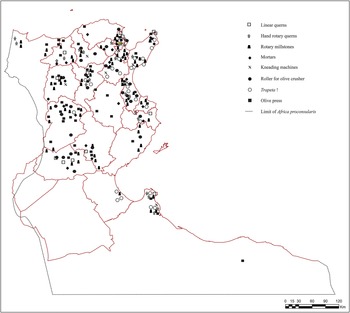
In order to attempt a typo-chronological classification of the different tools used for grinding and crushing cereals and olives that exist in Africa Proconsularis, we are initially faced with great morphological and technical diversity. From linear motion objects to hydraulic machines, grinding and crushing equipment have a long history of use in the ancient, and more recent, world. The evidence from Africa Proconsularis shows that a large variety of existing types of grinding and crushing equipment was in use, unlike other regions in the Roman world, which have a more conservative and distinctly regional range. However, regional variations also exist for the forms in use in Roman N. Africa, which include regional adaptations concerning the material, form and technique of use, resulting in a sort of ‘Africanity’ of these tools. The purpose of this article is to present the first chronological and geographical appearance of certain types of querns and millstones, and to investigate the technical transition between unidirectional and rotary movement. However, in order to do that, the different types of these techniques attested in Africa Proconsularis are listed and described below (Figure 1).
1. Unidirectional quern: we have counted 65 saddle querns (between pounder rubber, tall mortar, shallow mortar and saddlestone-metate variety) and 30 artefacts of Olynthus querns.
2. Hand rotary querns: 78 metae (lower stone) and 121 catilli (upper stone). The diameter of African rotary querns is between 27–42/46 cm and it's about 5–17 cm in width. The grinding surface rarely surpasses 17°.
3. Rotary millstones (animal or man-driven mills): it was the most findable type with 400 artefacts (269 metae and 131 catilli). This type measures between 27–60 cm in diameter and 23–113 cm in height.
4. Hydraulic rotary millstones.
5. Mortars: We have counted 140 artefacts between small objects for daily use and the big mortar. This big instrument was intended mainly for grain crushing, especially wheat and barley.
6. Kneading machines: 9 machines used in bakeries.
7. Roller for olive crusher: we have identified 136 instruments. The height varies between 57 and 160 cm.
8. Olive press with hemispherical mills: It's called also trapetum. This machine is composed of two elements, mortarium (42 artefacts) and orbis (60 artefacts).
9. Olive press with cylindrical mills : we have counted 175 presses and 122 mills.
Map of typo-geographical distribution of grinding and crushing techniques in Africa proconsularis.

The earliest and simplest method of milling grain involved the use of simple querns composed of two parts: a lower stone in the form of a slab, and a mobile upper one called handstone or rubber. A number of quern types have been identified, the most important of which is almond-shaped,Footnote 5 found mainly in Carthage and Kerkouane. This type is also attested in Monte Sirai (Sardinia), Algeria and Morocco.Footnote 6 Moreover, the examples of those found in Carthage, seem to be carved in the ignimbrite rhyolite from Sardinia. This is based on macroscopic identification and comparison with other objects of the same lithological nature. The excavations of a Punic tomb, located on the eastern flank of the Odeon in Carthage, brought to light a small ivory figurine, which represents ‘une femme accroupie en train de broyer le grain ou de pétrir le pain’,Footnote 7 making use of a similar type of hand quern.
This type of saddle quern, which is known in a variety of shapes, is also attested in the interior of the territory. Twelve pieces were discovered at the site of Althiburos, some of which were made of volcanic rock, with dates spanning from the 8th century BC to the Augustan period.Footnote 8 The shift from linear to rotary quern types was slow and gradual, initially adopting a semi-rotary motion, known as Olynthus mill.Footnote 9
It seems that the spread of this lever-operated type was not universal, as its distribution appears limited to the coastal areas of Africa Proconsularis. In Kerkouane, M.-H. Fantar inventoried 29 querns of varying types. These included 03 saddle querns, 25 ‘Olynthus mills’, and 01 manual rotary mill. Several of these objects were not ‘en rapport direct avec un contexte archéologique précis',Footnote 10 since they were collected mostly as surface finds.Footnote 11 We note that until the middle of the third century BC, when the site was abandoned according to J.-P. Morel,Footnote 12 the hopper mill remained the most widely used tool for grinding despite the remarkable persistence of saddle querns. From the examples illustrated, we can deduce that the diffusion of this milling technique did not spread into the far west of the Mediterranean basin, nor beyond the Tunisian coasts, in to the interior of Africa.Footnote 13 Ultimately, we can identify the limit of the distribution area of the so-called Olynthus mills, which seems to pass through the Hérault valley to the north and the Tunisian coasts to the south, consequently intersecting the area of Greek influence in the western Mediterranean basin.
Rotary querns are much rarer. This may be a result of the slow diffusion of this type in the Mediterranean from Iberia, as L. Jaccottey had shown for southern Gaul,Footnote 14 or that the region was more open to Hellenistic influence than further west. The technical transition to the rotary type itself poses a problem, whether chronological or material. First, we do not have a sufficient collection on which to establish reliable interpretations. It should be remembered that the oldest manual rotating querns were discovered in Nord-east of Spain, in the excavations of the Iberian site of Alorda Park (16 catilli and 6 metae).Footnote 15 The oldest example is a catillus which comes from a context of the mid-5th century BC, dated on the basis of Attic pottery.Footnote 16 The oldest meta is found in a context that dates from the second half of the 5th century BC.Footnote 17
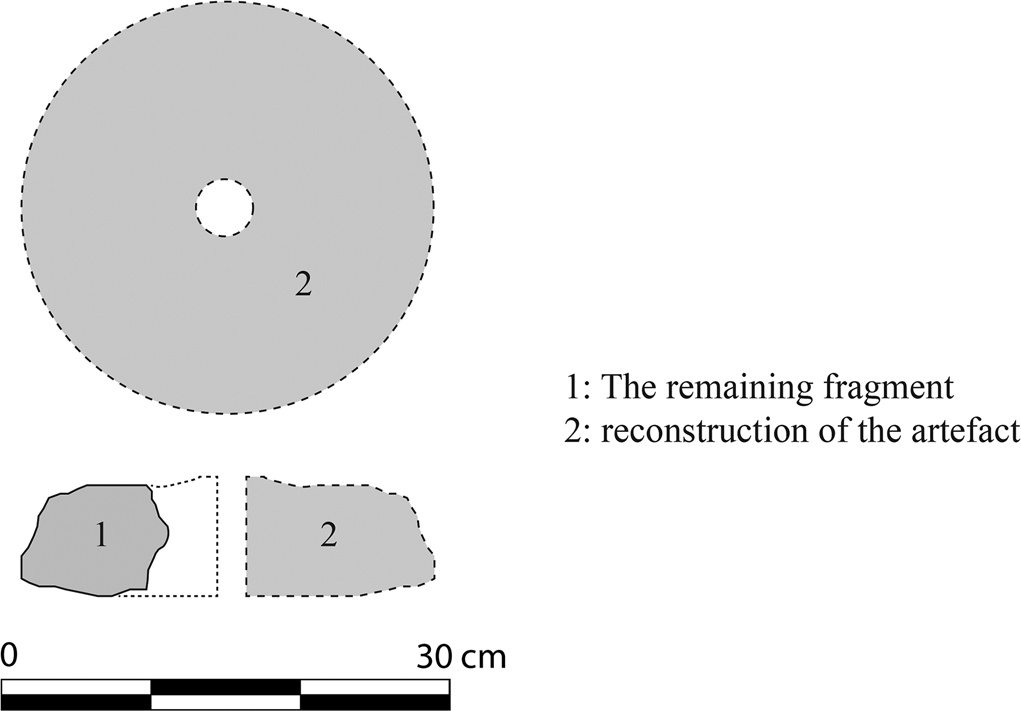
In 2001, Morel published an article in which he claimed that during a development-related excavation on the Byrsa Hill, a Punic tomb had been unearthed.Footnote 18 One of the finds included a piece of volcanic stone that was lodged between the sealing slab and the doorframe of the tomb's opening. The excavator noted that it was ‘donc en place depuis que la tombe avait reçu son unique défunt et que le puits avait été colmaté’.Footnote 19 The funerary furniture of this tomb suggests a date from the last quarter of the 6th century BC or later.Footnote 20 Morel interpreted this worked stone as a fragment of a hand rotary meta ‘récupérée pour bloquer la porte de la tombe’.Footnote 21 According to his assertion, this object is part of a lower quern measuring c. 30 cm by 8–9 cmFootnote 22. This interpretation of the volcanic meta fragment has, however, been questioned by several researchers, either because the fragment of the so-called quern is very small, making it difficult to identifyFootnote 23; or the photo published in the article is insufficient to observe further details.Footnote 24 Attempts to relocate and re-examine the artefact have also been unsuccessful.Footnote 25 In spite of this, according to D. PeacockFootnote 26 and J.-P. BrunFootnote 27 ‘Jean-Paul Morel est un connaisseur dans ce domaine’, prompting us to accept Morel's original interpretation until new evidence comes to light. But in the absence of literary or archaeological evidence, it still remains hypothetical, because one can think that this artefact was the subject of an importation especially since this type did not know a great spread on the Carthaginian territory (Figure 2).
Possible reconstruction drawing of the so-called Carthage quern.Footnote 68

Either way, it is believed that the transition from the unidirectional (i.e. saddle querns or Olyntus mill) to rotary querns took time. This is supported by the evidence from Kerkouane and Carthage, where rotary querns have been identified, alongside hopper millstones, sometimes in considerable numbers. In fact, the first appearance of rotary grinders in Greece dates to the 1st century AD, whilst also continuing to use the Olynthus mill until that time.Footnote 28 Likewise, in Althiburos saddle querns continued to be used for milling grain until the end of the 1st century BC.
It seems that, until the Augustan period, Africa Proconsularis imported rotary querns from Sardinia and Pantelleria, as indicated by the only two dated pieces and the concentration of volcanic material from Carthage.Footnote 29 On the other hand, the diffusion of this type within the Carthaginian territory remained weak for several reasons. To this, it is added that the art of carving rotary materials was probably not known to Africans. Inside this territory, they used models of Neolithic origin. It was not until the Roman period that local artisans learned to cut grinding stones that imitated imported models, particularly Pompeian-style mill; the new technique widely used in Italy. It is possible that this Italian influence can explain the wide distribution of this last type in comparison with the rotary querns. We can trace the coexistence and spread of the artefacts by the presence of four types of mills in Punic levels at Byrsa, all within the same stratigraphic context dating from the 2nd century BC. These mills included the lower stone of a saddle quern;Footnote 30 a fragment of a hopper rubber;Footnote 31 a rotary quern;Footnote 32 and three millstones of the Morgantina type.Footnote 33 The presence of several typologically different millstones in the same context suggests that morphological difference does not necessarily translate into chronological changes, and that the appearance and diffusion of a certain type does not cause the abandonment of the type which precedes it. A similar case can be observed in Sicily, where three types of grinding stones coexist. These include hopper mills, biconical millstones and the cylindrical type.Footnote 34
In the Roman period, there is scant dating evidence for Pompeian mills. The only two examples with sufficient dating evidence date back to late antiquity. These include a 4th century meta from the Oued R'mel;Footnote 35 and a 5th century catillus found in Musti. Footnote 36 However, according to our study,Footnote 37 the large number of this type prompts reflection on the location, and probably the replacement of manual rotary querns.Footnote 38 Our corpusFootnote 39 also includes two small metae Footnote 40 whose dimensions are similar to the manual type, with a diameter of 44 cm and a height of 28 cm. Due to the small size of this mill, we can only speculate on how this form functioned, and how much flour it might have been produced. However, Pompeian-mills domination did not last very long, as seen by the shift in late antiquity and especially medieval period, to a return of manual tools with hemispherical and flat types.
The introduction of hydraulic-powered mills parallels the increase in cereal production, and especially the increased demand for processed product (bread flour). The two known examples of hydraulic-powered mills from Chemtou and Testour, date to the 4th century.Footnote 41 However, it is quite evident that the natural geography of this African territory did not favour the uptake of this type in this region since it requires a flow of water that is lacking in N. Africa. In addition, this type of technique requires a certain investment in knowledge and equipmentFootnote 42 that inhabitants in the countryside where unlikely to possess. But in reality, as has been shown,Footnote 43 the construction of these watermills in arid regions is technically possible, as long as one can exploit the minimal natural and topographical conditions to build rustic models, without sophisticated gears.
For olive crushing machines, the spatial distribution is more clearly marked by the two geographical areas where historical and human factors have played an essential role in the introduction and the spreading of this technique. On the one hand, tools of oriental origin, trapeta and rollers, were especially represented in the part most affected by Greek influence (coastal part); whilst on the other hand, newer techniques, probably of Roman origin, are associated with agricultural settlements dating to the High Empire. Whether in Carthage, Cap Bon, the Sahel, Dougga or in the Numidian towns, all the olive-mills found and listed belong to the types that have a central hole, already attested in the East,Footnote 44 except for a few artefacts where we note the presence of olive-mills with a columella. This last type, and as we had deduced, is very widespread in western Byzacene, and in particular the High Steppes. This result of the typo-chronological distribution of the olive-mills is in fact only a reading of numbers and data that were available. But the potential discovery, for example, of trapeta or orbes within the territory may require a revision of these ideas.
Geographical distribution
Our study area does not constitute a homogeneous geographic and climatic unit: mountains, forests, wetlands, sometimes sub-humid (the extreme north-west of Tunisia), but also semi-arid steppes and areas close to the desert. Did these geographic and climatic factors constitute a natural barrier that influenced the choice of adopting some milling techniques over others?
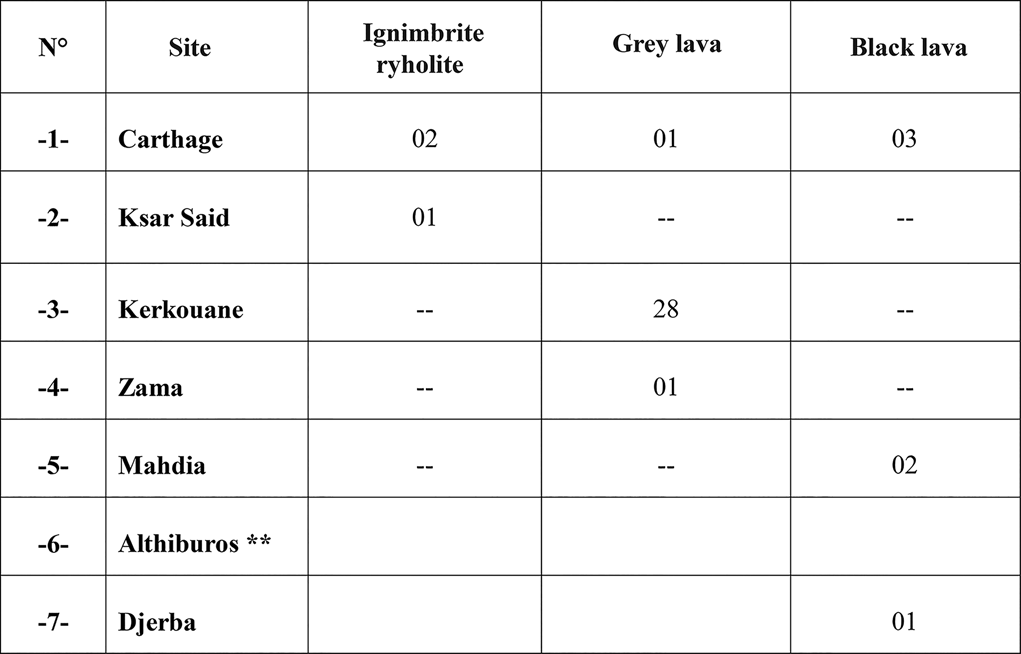
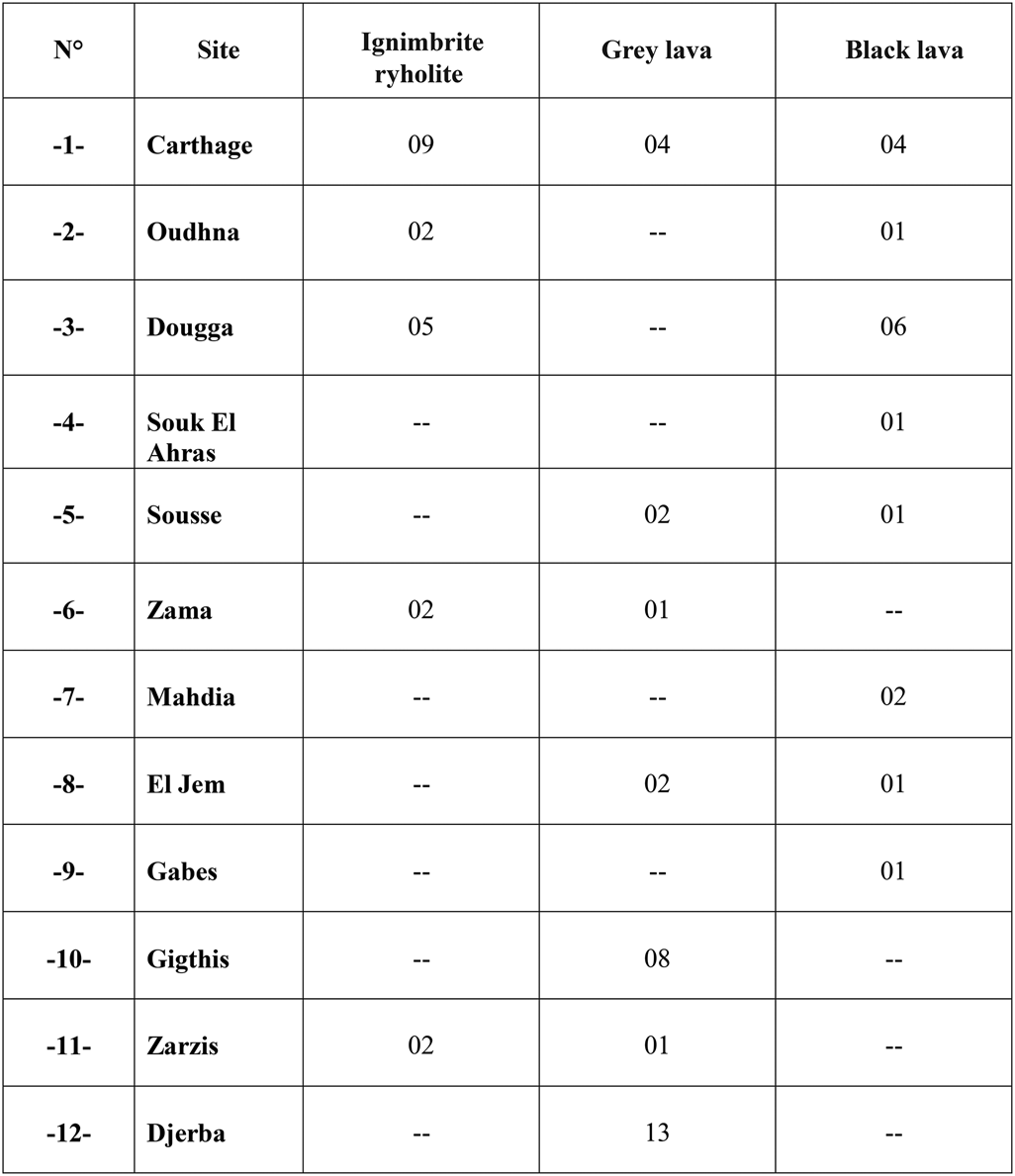
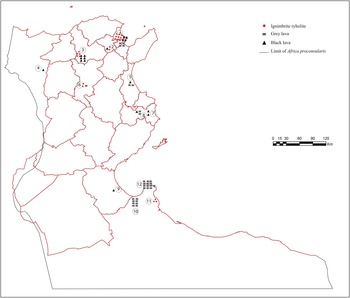
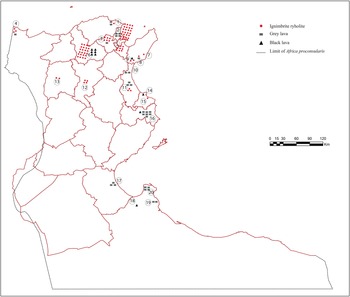
In general, there is an imbalance in the spatial distribution of grinding tools between coastal regions and urban sites on the one hand, and the interior of the country and rural sites on the other. The density of millstones decreases eastwards from the Tunisian coastline and southwards for the Algerian territory of Africa Proconsularis. The regression does not only concern the number of artefacts, but also the shape and technique of the mills. Metae and catilli with ‘des formes canoniques’ are found in the sites of Utica, Carthage, Oudhna, and El Jem, many of which are made of volcanic rockFootnote 45 (Figures 3–5). On the other hand, in the countryside, millstone types appear more uniform, and without noticeable variation. The essential function of these tools is thus to grind the grains, for domestic use or for artisanal production. Likewise, the hopper mills of Greek origin did not exceed the Punic sites (Carthage and Kerkouane) in their spread. In contrast, the west side of Africa Proconsularis, and almost all western parts of Roman Africa lack this type of mill. Another type deserves special mention: the catillus of type 364.Footnote 46 Attested in the excavations of Delos of 1937–1938,Footnote 47 as well as in the mines of Laurion,Footnote 48 this catillus (Figure 6) with its small lateral notches carved in volcanic rock is only found in Carthage and at Thysdrus.
Distribution of volcanic linear artefacts.

Distribution of volcanic querns.

Distribution of volcanic millstones.

Catillus from Delos.Footnote 69

This distribution marks the presence and the limits of Greek influence in the western Mediterranean, which can also be found in the geographic distribution of trapeta. Despite the discovery of some elements in the interior of the country, the trapetum characterizes the regions which were in contact with Mediterranean influences, even though these machines were adapted to local dimensions and African materials. Can we think to the role of the Romanized Africans in the adoption of new techniques, especially with roman domination over the fertile lands and the creation of new towns and colonies? Was this a technical choice, rather a technical adoption of a certain type, in relation to the crushing efficiency and the ‘alleged’ quality of the product?
Another remark concerns the rarity and sometimes the absence of querns in the interior of Africa Proconsularis, especially in rural sites, some of which have been well studied and surveyed. On the other hand, millstones are quite abundant in these sites, where olive production is also documented, certainly in connection with the need to feed many people and employees. Absence of documentation does not mean absence of these types in rural sites where the need to grind grain remained vital; instead the scarcity of finds is possibly due to agricultural and urban destruction, as well as to the reuse and migration of these ‘portable’ tools. The same is possible for mortars and mixing machines (i.e. kneading machines), which are not found in the far west of Africa Proconsularis, despite their usefulness for daily or seasonal tasks. Finally, it should also be noted that this spread of artefacts is not only determined by technical or geographical choices, but also in relation to the nature of the type of material used and the proximity and availability of suitable raw materials.
Rocks and the origin of the grinding stones
The type of stone used is evaluated by the resistance to wear caused by repeated grinding; by its aesthetic appearance, particularly the colour;Footnote 49 as well as by its cost of extraction and transport, in particular when the quarry is located far away. Since the Neolithic period, two types of rocks have been associated with making grinding tools; volcanic (local or imported) and sedimentary rock. In Africa Proconsulairs, according to our study, it appears that volcanic rocks were used since prehistory, becoming increasingly popular during the Roman period. In all ancient mediterranean cities, we can detect artefacts in basalt rocks whose origin varies according to the geographical location of these cities and their proximity to volcanic deposits. These volcanic rock artefacts have been the subject of a ‘transcontinental’Footnote 50 transfer or trade. The archaeological evidence of this movement of raw materials dates back to the 4th century BC, when a boat loaded with forty-two hopper mills and a mill of Morgantina-type (meta and catillus), probably from Nisyros,Footnote 51 was wrecked off Mallorca. A second Greek ship from the same century (c. 290 BC) was discovered on the coast of Kyrenia (Cyprus). In addition to the 375 amphorae and sacks of almonds, the wreck also contains 29 Olynthus mills.Footnote 52
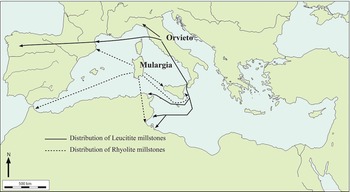
A number of factors controls the production and the trade of volcanic millstones. Generally, to cut and to shape mills, we look for non-friable hard rock. However, lighter rock types were preferred, which would not constitute too heavy a burden during transport and trade. Sources of volcanic rock are numerous in the Mediterranean Basin, however, the most popular types of rock used during the Roman period appears to have been rhyolite from Mulargia, in central Sardinia, and leucitite from Orvieto in north-central Italy. According to Williams-Thorpe, these were the most widely transported rock types, where evidence of Sardinian rhyolite from Tetouan in northern Morocco, shows a travel distance of 1,350 km from its source, whilst a distance of 1,500 km is recorded between the source of a Leucitite millstone and its findspot in Astorga in Spain (Figure 7).Footnote 53
Map showing the distribution of Rhyolite and Leucitite millstones.Footnote 70

In Africa Proconsularis, the earliest imported millstones known date to the 4th century BC, and come from the El Sec shipwreck (Mallorca), which was loaded with a consignment of Morgantina mills in the port of Carthage during its second stopover from Pantelleria.Footnote 54 This type of mill, which was widespread in the Punic world, was also discovered in Carthage in an artisanal context dating from the 2nd century BC,Footnote 55 that is to say even before the pistrinae or bakery mills of Pompeii. The importation and use of millstones made of volcanic rocks continued and extended in Africa until the 5th century, with the catillus found at Mustis.Footnote 56
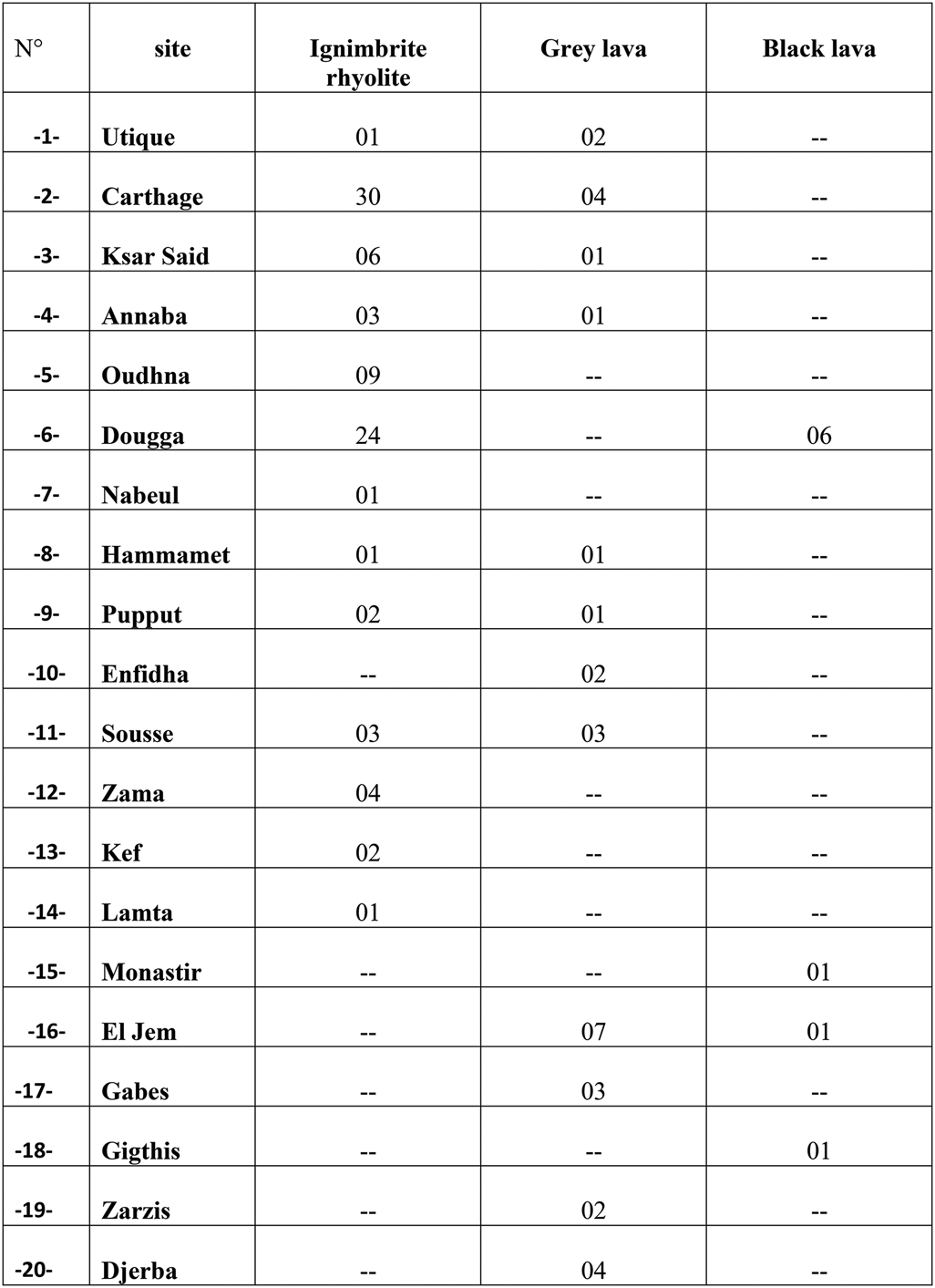
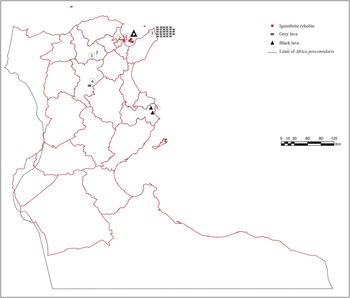
A recent morphological and spatial studyFootnote 57 has shown that out of 146 documented millstones,Footnote 58 volcanic millstones are concentrated mainly in cities near coastal regions (74%), whilst the remaining 26% were located in inland cities, including at Dougga (41 examples), Zama (8 examples), Kef (2 examples) and Souk el Ahras (1 example). This distribution can be partly explained by the proximity of these coastal regions to several major volcanic outcrops, primarily in Sicily,Footnote 59 Pantelleria, Sardinia and Etruria, in addition to the relative ease of maritime access between these areasFootnote 60 (Figures 8 and 9).
Map of distribution of volcanic linear artefacts.

Map of distribution of volcanic querns.

At this point, we should mention the importance of seaports and river navigation in the distribution of mills, especially the Pompeian mills. This is the case with the role played by the Tiber valley in Italy in transporting the mills from the Santa Trinita quarry to Pompeii,Footnote 61 or the role of the Rhône in Gaul with the concentration of mills made from volcanic rocks in the Narbonne region. Carthage had undoubtedly benefited from its geographical position in the Mediterranean with its maritime commercial network well suited to import millstones from different sources.
The diffusion of volcanic millstones in Africa Proconsularis illustrates the theme of circulation across the Mediterranean (Figure 10). It supports the idea of a geographical limit of each quarry, a limit conditioned by natural boundaries and proximity of source material, and technical ability in relation to the capabilities of maritime navigation. However, it also brings to highlights the commercial relationship between two parts of the Mediterranean; that of the eastern and western parts of the basin. Other than the millstones from El Sec shipwreck, which came from Nysiros, or those from the wreck of Mahdia,Footnote 62 there are no recorded millstone examples of eastern origin in the western basin of the Mediterranean. It is true that we know very little about the trade in the East apart from amphorae; however, it is not unreasonable to speculate that if Dressel 1, Lamboglia 2 and Dressel 22 amphorae, both typically western Mediterranean amphorae, are well distributed in the east, then why not mills? Theoretically it is possible, but archaeologically, the discoveries and studies in this field have yet to yield concrete data: O. Williams-Thorpe and R. Thorpe have concluded in their study on the provenance of millstones in the Eastern Mediterranean that all the documented millstones originate from eastern sources, and that these millstones never travelled westwards, beyond the island of Cyprus.Footnote 63
Map of distribution of volcanic millstones.

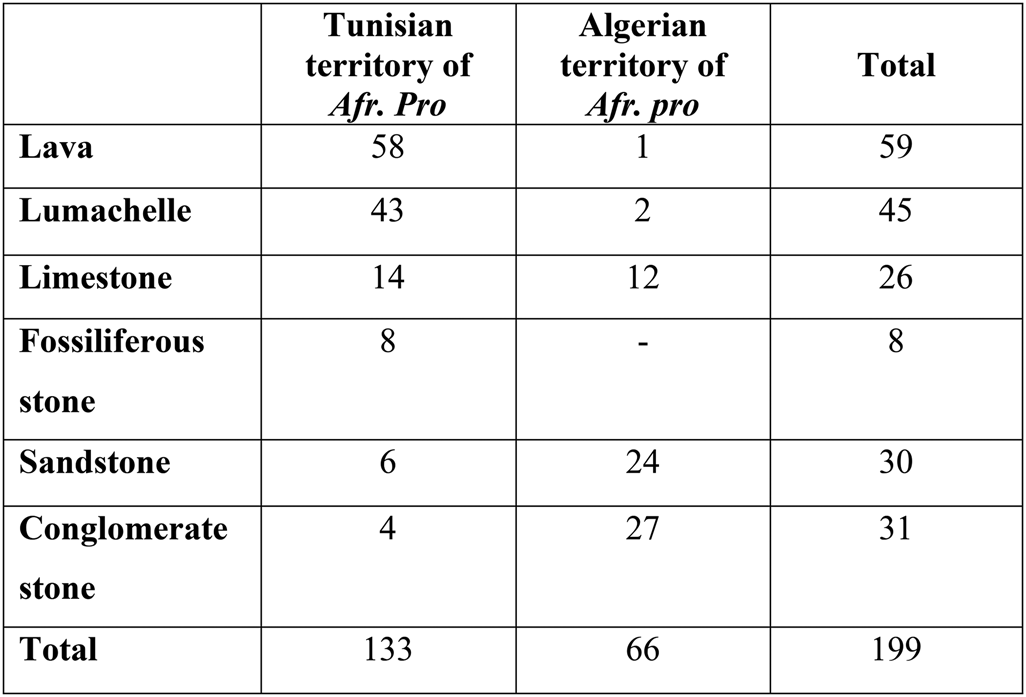
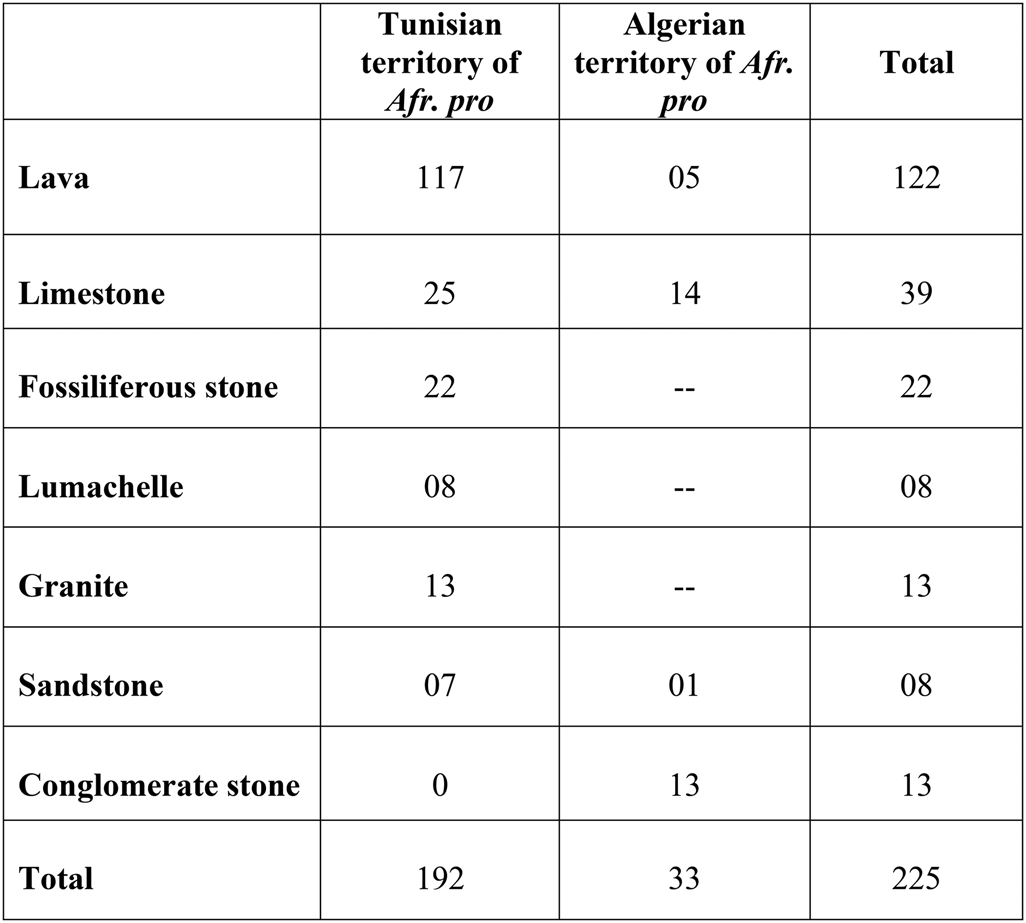
One can also explore the limits of this ‘trade’ in the substitution of the volcanic rock with locally sourced sedimentary rock. Whether in relation to a supply problemFootnote 64 or to the high cost of these imported raw materials, Africans, especially those in the interior of the country appear to have resorted to using other types of rock to manufacture millstones, making use of the fossiliferous limestone, which widespread in Africa Proconsularis, and offered a good lithological replacement (Figures 11 and 12).
Lithological distribution of African rotary querns.

Lithological distribution of African millstones.

This phenomenon of adapting millstones by using locally sourced stone reflects a technical evolution: the mills made in volcanic rock (Figures 13–16), which were well diffused during the 1st and the 2nd century BC are replaced by those manufactured from sedimentary rock in a new morphology. The choice of this type is historical and technical. Imported manual querns and models had until then a standardised general morphology consisting of a cylindrical shape with receptacle, with horizontal active faces or most often concave. But the performance of the work on these parts, as well as the quality of the ground product were not, as it seems, satisfactory, in the sense that the inclined profile of the active face causes the grains to escape before being fully crushed. Thus, with the decline of the artisanal activity of the production of flour, and in order to increase the speed of rotation of the millstones and save more time, users and of course artisans have observed that the wider the grinding mills, the more the grinding capacity can be increased, and the heavier the grinding mills, the finer the flour would become.Footnote 65 This explains the orientation towards flat sedimentary millstones.Footnote 66 Moreover, in our catalogue, it was noted that all the artefacts of this flat typeFootnote 67 (catilli type 280) are made of non-volcanic rocks.
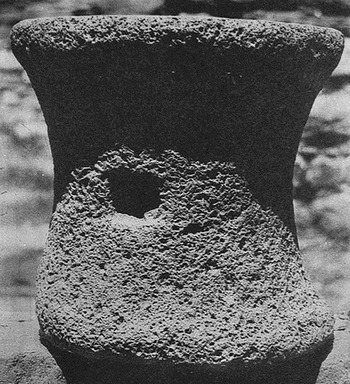
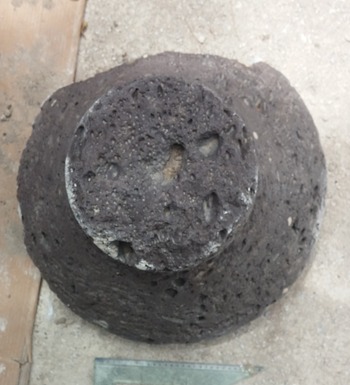
Brown vesicular lava (Musuem of Carthage).

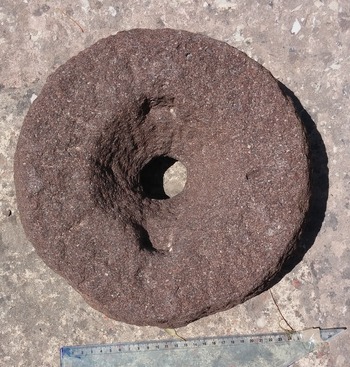
Red lava (Musuem of Carthage).

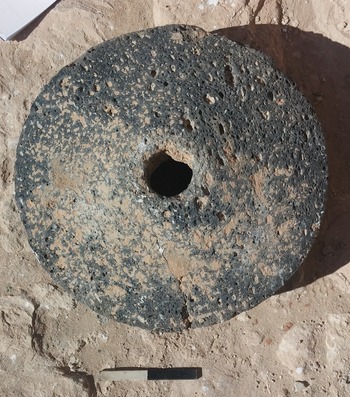
Black lava (Museum of Jerba).

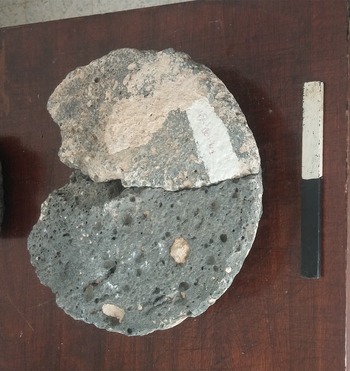
Grey vesicular lava (site of Gightis).

Conclusion
The grinding and crushing tools in Africa Proconsularis have known a technical evolution that appears to parallel other regions bordering the Mediterranean, both during the Hellenistic period or under the Roman Empire. This territory has received, through its maritime connections, all the available types known elsewhere, but sometimes with a kind of African adaptation, which has given rise to local original types. Nevertheless, the question that arises and remains unanswered is whether Africa can be attributed with the origin of the invention and diffusion of manual rotary querns. Despite the few small indications, we are really far from answering this, and we will be satisfied with the results already acquired in this regard. With this, we are very optimistic that a future excavation and prospecting project could give good results and this for two reasons. Firstly, Africa Proconsularis has never been a field of research for this type of artefacts and that systematic excavations and well-targeted prospecting in very specific places (oil mills, ancient sites and cities) will be able to provide more information and clues in everything concerning the grinding or extraction operation. Likewise, Africa Proconsularis includes a wide variety of instruments, which suggests the experience of African artisans in this field.