Introduction
Heat stress is a concern in all kinds of poultry production. Severe heat stress adversely affects feed consumption, growth rate, hatchability, mortality rate and other important traits governing successful rearing (Bartlett and Smith, Reference BARTLETT and SMITH2003). High environmental temperatures lead to a wide range of deleterious impacts on physiological and performance traits in poultry (El-Kholy et al., Reference EL-KHOLY, EL-HINDAWY, ALAGAWANY, ABD EL-HACK and EL-SAYED2017). The thermoneutral region for most poultry species ranges usually between 18 and 20ºC (Ensminger et al., Reference ENSMINGER, OLDFIELD and HEINEMANN1990). In quail, the comfortable ambient temperature ranges between 18 to 30°C with the optimal temperature between 21 to 27°C, and cooling is needed when temperatures exceed 30°C (Shanaway, Reference SHANAWAY1984). When ambient temperature exceeds this range, adverse changes are noted in growth rate, productivity, quality of egg, feed utilisation, meat quality, carcass traits, fertility and hatchability as well as physiological responses (Altan et al., Reference ALTAN, ALTAN, OĞUZ, PABUCCUOĞLU and KONYALIOĞLU2000; Sahin and Kucuk, Reference SAHIN and KUCUK2001). In comparison with chickens, meat quail have higher thermal comfort temperatures and may be more tolerant to heat stress because of a greater surface/volume ratio, suggesting greater ability to dissipate heat generated by metabolism (Sousa et al., Reference SOUSA, TINÔCO, BARRETO, AMARAL, PIRES and FERREIRA2014).
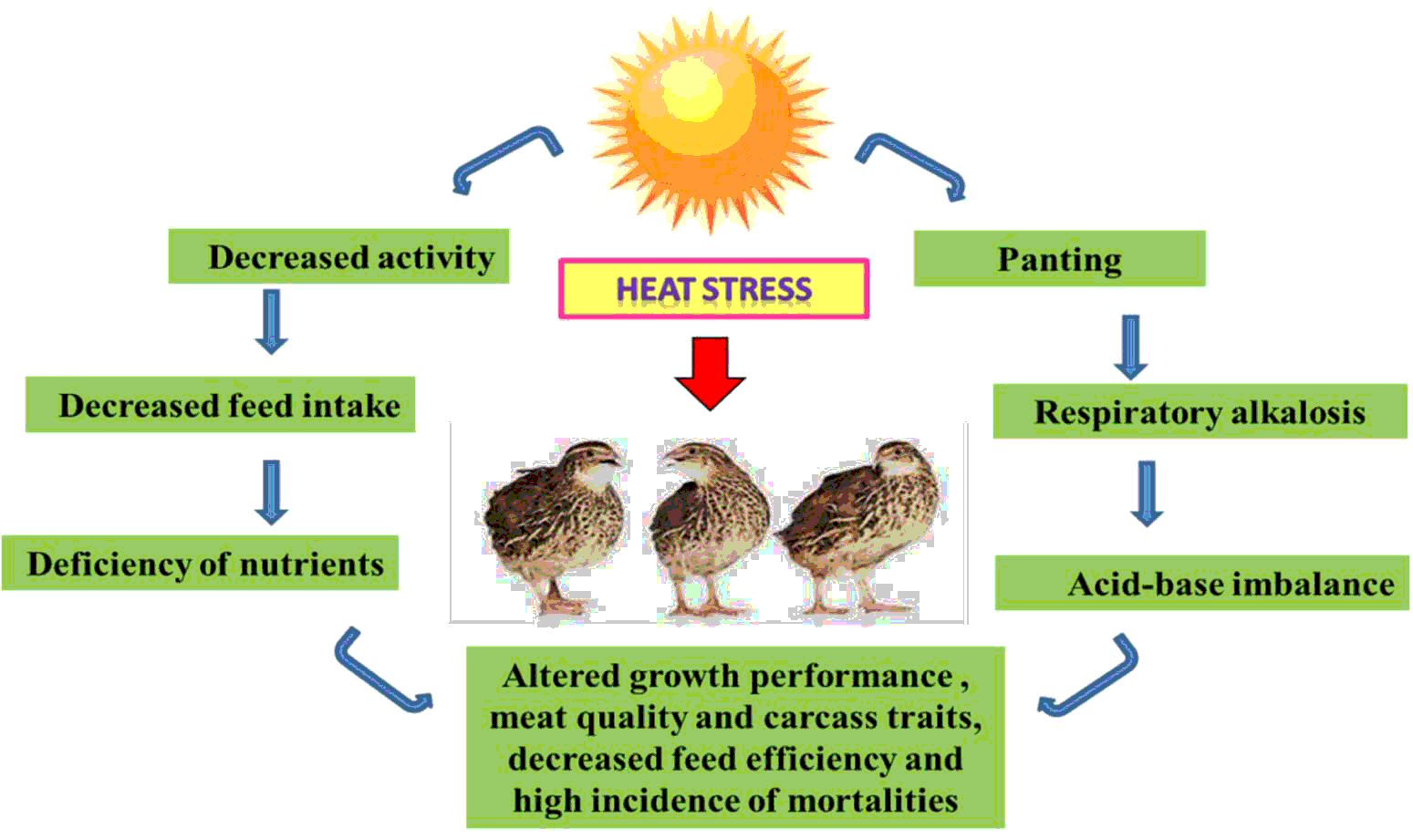
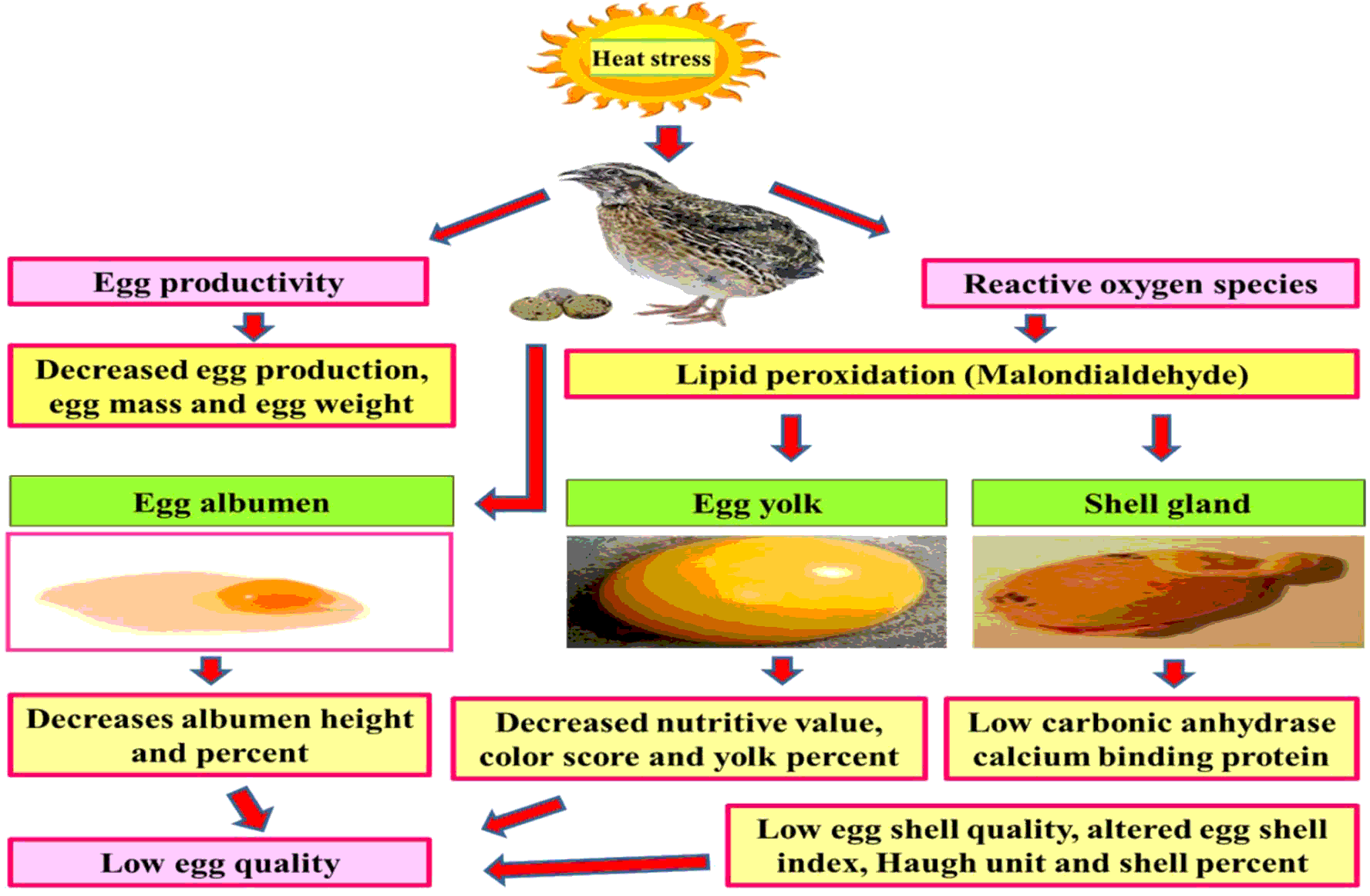
Heat stress occurs when the amount of heat produced by the animal surpasses its capacity to dissipate the extra heat to its surrounding environment. This imbalance may be governed by meteorological factors (thermal irradiation, sunlight, humidity, air temperature and wind movement) as well as animal characteristics (gender, species, body type and rate of metabolism; Lara and Rostagno, Reference LARA and ROSTAGNO2013). Two main categories of heat stress i.e. acute and chronic can be distinguished. The acute type refers to a short and rapid rise in environmental temperature. The chronic type refers to a high environmental temperature for a long period (days to weeks), permitting acclimatisation to the environment. Heat stress elicits several physiological consequences, which have been discussed in other published papers (Syafwan et al., Reference SYAFWAN, KWAKKEL and VERSTEGEN2011; Renaudeau et al., Reference RENAUDEAU, COLLIN, YAHAV, DE BASILIO, GOURDINE and COLLIER2012). These responses can be illustrated as reduced feed intake, increased body temperature, depressed immune response, alteration of blood pH and electrolyte balance, decreased energy bioavailability in cells, poor nutrient digestibility, absorption and metabolism, impairment in endocrine functions, reduced reproductive function, disturbance in the structure and function of intestinal epithelium, alteration in gut microbiota and increased circulatory corticosterone and cortisol (Lara and Rostagno, Reference LARA and ROSTAGNO2013; Loyau et al., Reference LOYAU, BEDRANI, BERRI, MÉTAYER-COUSTARD, PRAUD and COUSTHAM2015). This review paper covers the detrimental impacts of heat stress on growth performance, production and reproduction, feed utilisation, carcass and meat quality of quail (Figures 1, 2 and 3).
Effect of heat stress on growth performance of quails.

Effect of heat stress on productive performance of quails.

Effect of heat stress on reproductive organs of quails.

Effect of heat stress on growth performance
The specific determination between direct and indirect effects of ambient temperature for meat quail can became difficult because the temperature of 26°C is recommended as thermally comfortable (Sousa et al., Reference SOUSA, TINÔCO, BARRETO, AMARAL, PIRES and FERREIRA2014). Sato et al. (Reference SATO, OTA and KAWAMOTO1974) kept growing quail from two to six weeks of age at either 34 ±2°C or 22 ± 2°C and found that body weight at six weeks of age was 73.7 and 83.0 g for male and female quail respectively at high temperature, and 88.2 and 92.4 g under thermo-neutral conditions, representing a reduction of 13.2% body weight. In Japanese laying quail reared under heat stress (34°C) conditions, Sahin et al. (Reference SAHIN, ONDERIC, SAHI, GURSU, VIJAYA and KUCUK2004) recorded a significant decrease in body weight by 7.7% when compared with birds reared at 22°C. Sahin et al. (Reference SAHIN, ONDERIC, SAHI, GURSU, VIJAYA and KUCUK2005) reported that body weight and body weight gain of growing Japanese quail were significantly decreased by 10 and 14.5% respectively under heat stress conditions (34°C for 8 h daily), as compared with a control group (22°C). Onderic et al. (Reference ONDERIC, SAHIN, SAHIN, CIKIM, VIJAYA and KUCUK2005) subjected growing Japanese quail to heat stress conditions (34°C for 8 h daily) and reported a significant decrease in body weight (9.1%) and body weight gain (11.0%) compared with birds reared at 22°C. Even with a narrow difference in temperature, growing Japanese quail reared under natural (32°C) and acclimatised conditions (26°C) had decreased growth rate by 8.19% during the 14-42 days of the trial (Bonfim et al., Reference BONFIM, DE SIQUEIRA, BOMFIM, RIBEIRO, DE OLIVEIRA, NASCIMENTO and DE ARAUJO MELO2016).
Feed utilisation
Reduction in feed intake with increased ambient temperature is well-documented for laying quail (Ozbey and Ozcelik, Reference OZBEY and OZCELIK2004). This can cause economic losses through reduced nutrient utilisation and FCR (Sahin and Kucuk, Reference SAHIN and KUCUK2003). Sahin et al. (Reference SAHIN, ONDERIC, SAHI, GURSU, VIJAYA and KUCUK2004) recorded significant adverse effects on feed intake (28.9 vs. 26.3 g/day; P<0.05) and FCR (2.42 vs. 2.55; P<0.05) in quail reared under heat stress conditions (34°), when compared with birds reared under thermo-neutral conditions (22°C). In growing Japanese quail, Sahin et al. (Reference SAHIN, ONDERIC, SAHI, GURSU, VIJAYA and KUCUK2005) reported that feed intake and FCR were negatively affected under heat stress conditions by 7.1 and 8.6% respectively (34°C for 8 h daily) when compared with the control group (22°C). Onderic et al. (Reference ONDERIC, SAHIN, SAHIN, CIKIM, VIJAYA and KUCUK2005) subjected growing Japanese quail to heat stress (34°C for 8 h daily) and reported a significant (P<0.05) decrease in feed intake by 6% and a significant increase in feed conversion ratio by 4.3% in comparison with birds reared at 22°C ambient temperature.
Japanese quail reared under natural (32°C) and acclimatised conditions (26°C) showed a 5% reduction in feed intake with a numerical decrease of 3.3% in feed efficiency (Bonfim et al., Reference BONFIM, DE SIQUEIRA, BOMFIM, RIBEIRO, DE OLIVEIRA, NASCIMENTO and DE ARAUJO MELO2016). In the same context, feed intake and FCR were decreased under heat stress conditions in broiler chickens (Habibian et al., Reference HABIBIAN, GHAZI and MOEINI2016). Feed intake gradually decreased by 7.8, 12.0, 16.7 and 21.6% when temperature (21°C) was increased to 27, 30, 33 and 36°C (Vercese et al., Reference VERCESE, GARCIA, SARTORI, SILVA, FAITARONE, BERTO, MOLINO and PELÍCIA2012). Poorer FCR may result from alteration in the metabolic utilisation of different nutrients (Geraert et al., Reference GERAERT, PADILHA and GUILLAUMIN1996).
Effects of heat stress on productive performance
Breeding meat quail from 14 to 42 days of age is technically feasible in acclimatised (26°C) and natural (32°C) environments. Compared with quail from an acclimatised ambient environment, those in a natural environment showed higher performance up to 28 days of age, but the performance decreased from this age onward (Bonfim et al., Reference BONFIM, DE SIQUEIRA, BOMFIM, RIBEIRO, DE OLIVEIRA, NASCIMENTO and DE ARAUJO MELO2016). High ambient temperature negatively affects bird performance with reduced feed intake, and consequent reductions in egg weight and mass. A cyclic increase of ambient temperature to 36oC reduced egg production and saleable eggs (Vercese et al., Reference VERCESE, GARCIA, SARTORI, SILVA, FAITARONE, BERTO, MOLINO and PELÍCIA2012). Relative humidity and ambient temperature are other important environmental stressors in quail productivity. Average egg weight was significantly reduced in hens reared at 32°C ambient temperature compared with those reared at 21°C (Nordstrom, Reference NORDSTROM1973).
High ambient temperature causes economic losses through reducing egg production of quail (Sahin and Kucuk, Reference SAHIN and KUCUK2003). On the same context, Sahin et al. (Reference SAHIN, ONDERIC, SAHI, GURSU, VIJAYA and KUCUK2004) reported that egg production and egg weight of laying Japanese quail reared under heat stress conditions (34°) were decreased by 23.3% when compared with control group (22°C). Kilic and Simsek (Reference KILIC and SIMSEK2013) stated that heat stress reduced egg production by 25% in layers reared in hotter climates (25 to 29°C). Vercese et al. (Reference VERCESE, GARCIA, SARTORI, SILVA, FAITARONE, BERTO, MOLINO and PELÍCIA2012) noted that egg production in quail was not significantly affected until 33°C, when compared with 21°C, but was significantly lower by 6.6% at 36°C vs. 21°C. Egg production has been reported to be decreased by 36.2% due to heat stress in laying hens (Deng et al., Reference DENG, DONG, TONG and ZHANG2012).
The impaired productivity of poultry exposed to heat stress has been associated with a number of factors such as reduced appetite and feed intake as a mechanism to mitigate heat increment (Sohail et al., Reference SOHAIL, IJAZ, YOUNUS, SHABBIR, KAMRAN, AHMAD, ANWAR, YOUSAF, ASHRAF, SHAHZAD and REHMAN2013), impaired digestion and metabolism, which may be attributed to damage of intestinal morphology and lowered activity of digestive enzymes and thyroid hormones (Sohail et al., Reference SOHAIL, IJAZ, YOUSAF, ASHRAF, ZANEB, ALEEM and REHMAN2010; Song et al., Reference SONG, XIAO, KE, JIAO, HU, DIAO, SHI and ZOU2014 and Chen et al., Reference CHEN, WANG, XIE and TANG2014) and altered endocrine hormones by increasing corticosterone (Deng et al., Reference DENG, DONG, TONG and ZHANG2012).
Effect of heat stress on egg quality
Consumers select eggs based on their characteristic features including yolk and albumen appearance and volume of air cell which can be confirmed by determining the yolk colour, Haugh units and malondialdehyde (MDA) level. In addition, producers are increasingly aiming to produce eggs with a suitable eggshell thickness, breaking strength and shape index, thereby facilitating the delivery of healthy, intact eggs to consumers. In some quail breeds (Coturnix japonica, Colinus virginianus, Callipepla californica and Colinus gambelii) heat stress adversely affects the economic aspects related to quality of eggs, such as yolk colour, Haugh units, shell thickness, breakage rate, chemical composition, nutritional value and shelf life by promoting yolk lipid peroxidation, which leads to high detectable concentrations of MDA that are associated with an unfavourable taste and low nutritional value (Guthery et al., Reference GUTHERY, LAND and HALL2001; Sahin et al., Reference SAHIN, ONDERIC, SAHI, GURSU, VIJAYA and KUCUK2004; Ma et al., Reference MA, LIN, ZHANG, CHEN, WANG, RUAN and JIANG2014; Fouad et al., Reference FOUAD, CHEN, RUAN, WANG, XIA and ZHENG2016). Compared with a comfortable temperature (21°C), cyclic heat stress of 27, 30, 33 and 36°C resulted in reduction of egg weight of 5.1%, 5.9%; 6.9% and 11.9%, respectively (Vercese et al., Reference VERCESE, GARCIA, SARTORI, SILVA, FAITARONE, BERTO, MOLINO and PELÍCIA2012).
Shell weight was decreased in hens reared at 32°C ambient temperature as compared with those reared at 21°C (Nordstrom, Reference NORDSTROM1973). In line with these findings, Sahin and Kucuk (Reference SAHIN and KUCUK2003) reported that high ambient temperature caused economic losses through poor egg quality in quail. Sahin et al. (Reference SAHIN, ONDERIC, SAHI, GURSU, VIJAYA and KUCUK2004) reported that Japanese quail reared under heat stress (34°) had significantly decreased Haugh units by 10.8% and egg weight by 14.3% in comparison with the control group (reared at 22°C). Eggshell thickness was significantly reduced by 4.3 to 4.4% when birds were submitted to cyclic heat stress of 27°C and 33°C respectively compared with thermoneutral temperature (21°C) in quail (Vercese et al., Reference VERCESE, GARCIA, SARTORI, SILVA, FAITARONE, BERTO, MOLINO and PELÍCIA2012).
Panting is a normal action in birds exposed to heat stress, as it lowers the levels of CO2 and HCO3 in the blood, thereby elevating the respiratory alkalosis by increasing blood pH (Ma et al., Reference MA, LIN, ZHANG, CHEN, WANG, RUAN and JIANG2014). Elevated respiratory alkalosis reduces the concentrations of calcium, which is needed by the eggshell gland to produce eggshell (Ma et al., Reference MA, LIN, ZHANG, CHEN, WANG, RUAN and JIANG2014; Santos et al., Reference SANTOS, AWATI, ROUBOS-VAN DEN HIL, TERSTEEG-ZIJDERVELD, KOOLMEES and FINK-GREMMELS2015). This may explain why heat stress leads to poor quality eggshell and higher numbers of cracked eggs. In laying quail, a high ambient temperature of 34°C caused an increase in MDA and cholesterol levels and decreased trace mineral concentrations (zinc, iron and chromium) in eggs (Sahin et al., Reference SAHIN, ONDERIC, SAHI, GURSU, VIJAYA and KUCUK2004).
Effect of heat stress on carcass traits and meat quality
Heat stress can induce some negative changes in carcasses, breast and thigh meat, protein deposition and increase abdominal fat (Habibian et al., Reference HABIBIAN, GHAZI and MOEINI2016; Zeferino et al., Reference ZEFERINO, KOMIYAMA, PELICIA, FASCINA and AOYAGI2016). Fat and protein deposition in breast meat were decreased in poultry exposed to heat stress due to increased protein breakdown and decreased protein synthesis (Temim et al., Reference TEMIM, CHAGNEAU, GUILLAUMIN, MICHEL, PERESSON and TESSEARAUD2000). Yalcin et al. (Reference YALCIN, OZKAN, ACIKGOZ and OZKAN1998) showed that summer rearing conditions (27.1°C) decreased carcass weight by 120 g and yield of legs and breast parts by 12.2 and 1.3% respectively. Sahin et al. (Reference SAHIN, ONDERIC, SAHI, GURSU, VIJAYA and KUCUK2005) and Onderic et al. (Reference ONDERIC, SAHIN, SAHIN, CIKIM, VIJAYA and KUCUK2005) reported that cold carcass percentage of growing Japanese quail was decreased (between 2.9 to 8.4%) under heat stress conditions (34°C for 8 h daily) in comparison with the control group reared at 22°C. On the other hand, others reported that the carcass and organ yields (except decreased yields of heart and gizzard) of quail were not influenced by environmental temperatures (26°C vs. 32°C), which may be due to a narrow difference in temperature range (Bonfim et al., Reference BONFIM, DE SIQUEIRA, BOMFIM, RIBEIRO, DE OLIVEIRA, NASCIMENTO and DE ARAUJO MELO2016). The quality of meat could be reduced due to heat stress resulting from the generation of free radicals and a reduction in antioxidant vitamins (C and E), which can cause lipid peroxidation of polyunsaturated fatty acids (Sahin et al., Reference SAHIN, ONDERIC, SAHI, GURSU, VIJAYA and KUCUK2005; Onderic et al., Reference ONDERIC, SAHIN, SAHIN, CIKIM, VIJAYA and KUCUK2005). Concentrations of MDA increased in thigh muscles (by 53.2%; Onderic et al., Reference ONDERIC, SAHIN, SAHIN, CIKIM, VIJAYA and KUCUK2005) and liver (by 39.7% to 70.7%; Onderic et al., Reference ONDERIC, SAHIN, SAHIN, CIKIM, VIJAYA and KUCUK2005 and Sahin et al., Reference SAHIN, ONDERIC, SAHI, GURSU, VIJAYA and KUCUK2005) in growing Japanese quail due to heat stress (34°C for 8 h daily vs. 22°C) in Japanese quail.
Effect of heat stress on reproductive performance
Fertility is one of the most important characteristics that need to be re-evaluated in breeder flocks especially under heat stress conditions. In male quail, heat stress causes testicular damage by increasing lipid peroxidation due to generation of reactive oxygen species which adversely affects semen volume, testes weight, sperm concentrations and motility, normal and live sperms, spermatids, spermatocyte and spermatogonia (Turk et al., Reference TURK, SIMSEK, CERIBASI, CERIBASI and KAYA2015, Reference TURK, CERIBASI, SIMSEK, CERIBASI and GUVENC2016; Fouad et al., Reference FOUAD, CHEN, RUAN, WANG, XIA and ZHENG2016). In hens, heat stress causes oxidative injury to the small follicles, oviduct and ovary, consequently decreasing ovary and oviduct weights, length of oviduct and the numbers of mature follicles (Ma et al., Reference MA, LIN, ZHANG, CHEN, WANG, RUAN and JIANG2014; Cheng et al., Reference CHENG, TU, WANG, TANG, CHEN, CHEN and HUANG2015). These results may explain why heat stress decreases the egg number and egg mass in avian species.
Heat stress causes poor well-being in quail, and a complex interplay exists between the environment and reproductive efficiency, since heat stress may affect the rate of secretion of hormones and metabolic clearance rate. Furthermore, it may affect the sensitivity of gonads to metabolic hormones by changing the receptor numbers. These impacts should be considered in future experiments designed to elucidate the mechanism of heat stress on reproductive system and performance in birds, especially those reared in the tropical and sub-tropical regions of the world (Ayo et al., Reference AYO, OBIDI and REKWOT2011). Clark and Sarakoon (Reference CLARK and SARAKOON1967) kept birds at a high ambient temperature (38°C) and recorded a decrease in fertility by 13% compared with a control group reared under thermo-neutral conditions (21°C). Miller and Sunde (Reference MILLER and SUNDE1975) showed that high ambient temperature adversely affected the production of oestrogens, parathyroid, thyroid, gonadotropin and calcitonin hormones. These physiological changes offer an explanation for the changes in the components of egg, particularly the shell, its membrane, albumen and yolk, and consequent reductions in fertility and hatchability. However, other research has shown that fertility and hatchability of eggs produced from Large White female turkeys appeared to be unaffected when the females reared at 12.8, 21.1 or 29.4°C ambient temperature (Thompson et al., Reference THOMPSON, WILSON and VOITLE1976).
Conclusions
Heat stress has undesirable impacts on performance, meat quality, carcass traits, production, egg mass, egg quality, semen quality and reproduction in quail. Furthermore, the detrimental effects of heat stress on reproductive performance and welfare of quail have recently attracted enhancing concern and public awareness. Further studies are still required to increase the information and knowledge of basic mechanisms associated to the detrimental impacts of heat stress in quail.