Introduction
Polyketones exhibit many advantageous properties, including good chemical resistance toward solvents, acids and bases, impermeability to hydrocarbons, and high rigidity and impact strength, and therefore have a wide range of possible applications.Reference Sommazzi and Garbassi 1 – Reference Del, Mensitieri, Nicolais, Sommazzi and Garbassi 3 Furthermore, many of these copolymers exhibit high degrees of crystallinity due to the keto functionality and are even photo- and biodegradable.Reference Sen 4 – Reference Sen 5
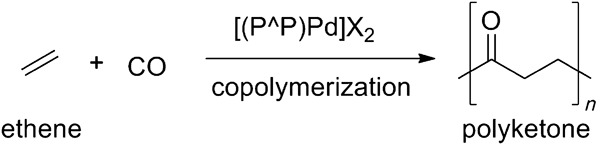
The use of carbon monoxide as a co-monomer for copolymerization with ethylene and other olefins is attractive not only because it is a cheap and easily accessible monomer, but also because incorporation of CO into a polyolefin chain allows tailoring of the resulting aliphatic polyketone properties in a very broad and versatile manner. The copolymerization of olefins and carbon monoxide can be performed in three different ways. Two of these, namely polymerization mediated by γ-rays and by radicals, have not found widespread application because of the harsh reaction conditions needed and the poor control of the structure and properties of resulting copolymers.Reference Sen 4 , Reference Brubaker, Coffman and Hoehn 6 By contrast, a third approach based on catalytic conversion of suitable alkenes and CO to high molecular weight copolymers with late transition metals (Scheme 1) was implemented in industrial pilot plants by Shell and BP in the early 1990s.Reference Shell 7 , 8 This process was realized due to the development of highly active catalytic systems, which afforded excellent control over the copolymerization process through systematic catalyst design.
Reaction scheme for the copolymerization of ethene and carbon monoxide; Pd catalysts have bis-chelating phosphine ligands (P^P) and two weakly coordinating counterions X.
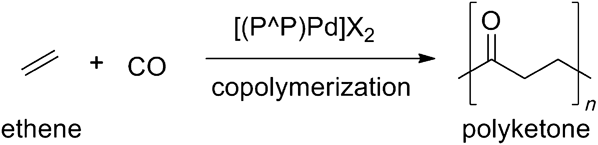
Catalytic copolymerization of olefins with CO of this type results in copolymers that show an exclusively alternating structure. The generally accepted mechanism for the polymer chain propagation reaction has been widely discussed in the literature, revealing that the catalytic cycle initiates most probably with the insertion of ethene in a Pd–H bond, followed by insertion of CO. Chain propagation then proceeds with the strictly alternating insertion of ethene and CO. The main chain termination reaction is via methanolysis.Reference Bianchini and Meli 9 It was demonstrated that the consecutive insertion of two CO monomers is thermodynamically unfavorable, whereas the sequential incorporation of two olefin monomers is unlikely on kinetic grounds. For example, in the absence of CO, a (P^P) chelating palladium bis-phosphine catalyst does not homopolymerize ethene but only dimerizes it to form butenes.Reference Drent, Van Broekhoven and Doyle 10 However, neutral phosphine-sulfonate (P^O)Pd catalysts were shown to incorporate higher levels of ethene (∼30% relative to the alternating polyketone composition) under increased ethene pressure in copolymerization reactions.Reference Hearley, Nowack and Rieger 11 An increased ethene content in the polymer leads to materials with lower stiffness and lower melting transition temperatures, which may be preferred for some applications. Other ways to modulate these important characteristics are based on terpolymerization with higher olefin substrates as well as on regio- and stereo-control of the copolymerization of CO and 1-alkenes.Reference Abu-Surrah, Wursche and Rieger 12
In addition, the ability of catalytic systems based on late transition metals to tolerate various heteroatoms and functional groups allows the synthesis of functionalized polymeric materials by co- and terpolymerization of CO with these monomers, which are typically unsuitable substrates for Ziegler-Natta polymerizations. Among those, polymers bearing dipeptides, saccharides, vitamins, amino acids, mesogenic groups, and others have been prepared.
Functionalized polyketones
Rieger et al. investigated the influence of mesogen type and density on the mesomorphic behavior of side-chain liquid crystal poly(ketone)s.Reference Nieuwhof, Marcelis, Sudholter, Wursche and Rieger 13 The monomers employed were methoxyazabenzene mesogen, methoxybiphenyl mesogen, and cyanobiphenyl mesogen, as shown in Scheme 2 .
Structures of mesogens investigated by Rieger et al. to achieve polyketones with varying liquid crystalline properties.Reference Nieuwhof, Marcelis, Sudholter, Wursche and Rieger 13 Note: n, spacer.

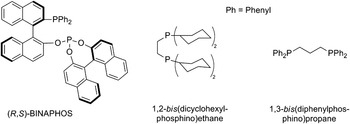
By altering the length of the spacer (n in Scheme 2), the isotropization temperature can be shifted to lower temperatures with the use of shorter spacer lengths. In molecules comprising a spacer of six methylene units or greater, polymers show a glass transition and a smectic E mesophase. This is in contrast to the other two monomers, which exhibit nematic mesophases and therefore lower glass transition temperatures. In terpolymerization reactions, together with 1-hexene, the authors showed that a 1-hexene content of up to 25% was obtained, with the polymer showing liquid crystal behavior with a smectic E mesophase. In 2002, Nozaki et al. were able to synthesize stereoregular polyketones with liquid crystal behavior using a cyanobiphenyl mesogen.Reference Nozaki, Kawashima, Oda, Hiyama, Kanie and Kato 14 , Reference Kawashima, Nozaki, Hiyama, Yoshio, Kanie and Kato 15 With (R)-(2-(diphenylphosphino)-1,1’-binaphthalen-2’-yl)-((S)-1,1’-binaphthalen-2,2’-yl)phosphite ((R,S)-BINAPHOS) (Scheme 3) as the ligand, a highly head-to-tail and isotactic polyketone was prepared. Interestingly, regio- and stereo-irregular polyketones were obtained when 1,3-bis(diphenylphosphino)propane was used as the ligand, whereas utilization of 1,2-bis(dicyclohexylphosphino)ethane resulted in atactic head-to-tail polymers. These changes in the microstructure of the polymer influenced their thermal behavior.
Three different ligand systems used by Nozaki et al. to produce regio- and stereo-specific modified polyketones.Reference Nozaki, Kawashima, Oda, Hiyama, Kanie and Kato 14 , Reference Kawashima, Nozaki, Hiyama, Yoshio, Kanie and Kato 15 Note: (R,S)-BINAPHOS, (R)-(2-(diphenylphosphino)-1,1’-binaphthalen-2’-yl)-((S)-1,1’-binaphthalen-2,2’-yl)phosphite.

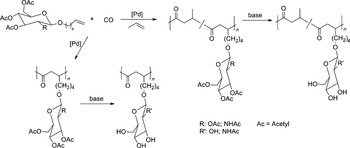
Biocompatibility of polyketones has motivated a series of investigations in which various bioactive molecules were incorporated into the polyketone backbone over the course of polymerization.Reference Reuter, Fuhrmann, Mucke, Voegele, Rieger and Franke 16 , Reference Rohlke, Fuhrmann, Franke, Mucke, Voegele and Rieger 17 For example, Rieger et al. were able to co- and terpolymerize CO with propene and α-olefins bearing glucose or N-acetyl glucosamine moieties, as shown in Scheme 4 , which show great potential for applications as biologically active surfaces or polymeric pharmaceuticals.Reference Malinova and Rieger 18
Synthesis of glucose derivatives with deprotection under basic conditions.Reference Malinova and Rieger 18

In another study, the same authors reported the Pd-catalyzed copolymerization of CO with a variety of differently substituted α-olefins (e.g., with protected tyrosine or several dipeptides and even with vitamin E and testosterone).Reference Malinova and Rieger 19 Polymers synthesized from the terpolymerizations of tyrosine ethyl esters, propene, and CO exhibited high biocompatibility toward urothelial cells.Reference Bartsch, Malinova, Volkmer, Hautmann and Rieger 20
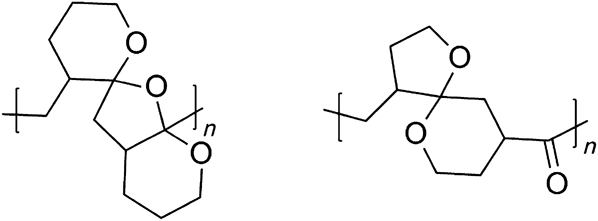
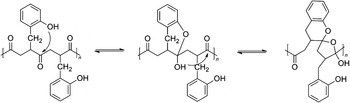
In contrast to Ziegler-Natta catalysts, specifics of catalysis by late transition metals allow the utilization of unprotected alcohols, phenols, and even carboxylic acids bearing an olefinic side-chain in the copolymerization with CO, directly resulting in functionalized polymeric structures. In 1996, Sen et al. presented different CO-containing copolymers of alkenols and alkenoic acids with varying spacer lengths: CH=CH(CH2) x OH (x = 2, 3, 4, 9) or CH=CH(CH2) x COOH (x = 1, 2, 4, 8).Reference Jiang and Sen 21 , Reference Kacker, Jiang and Sen 22 As catalysts [Pd(CH3-DUPHOS)(CH3CN)2](BF4)2 [CH3-DUPHOS = 1,2-bis(2,5-dimethyl-phospholano)benzene] and [Pd(DPPP)(CH3CN)2](BF4)2 [DPPP = 1,3-bis(diphenyl-phosphino)propane] were used, with the latter demonstrating the lowest catalytic activity. The produced polymers showed optical activity and had isotactic sequences in the backbone.Reference Jiang and Sen 21 , Reference Kacker, Jiang and Sen 22 Depending on the co-monomer utilized, the synthesized polymers existed either as poly(1,4-ketone) or as poly(spiroketal) (i.e., 1,6-dioxaspiro-[4.4]nonane) structures. In the case of 4-penten-1-ol and 3-buten-1-ol based copolymers, a spiroketal structure was obtained from participation of terminal OH groups of the incorporated monomers (Scheme 5).Reference Kacker, Jiang and Sen 22 A similar ketalization behavior was observed in the case of copolymers prepared from 2-allyl-substituted phenols (Scheme 6).Reference Wursche and Rieger 23 , Reference Wursche and Rieger 24
Ketalization products of 4/3-penten-1-ol copolymers formed through intramolecular attack of the terminal OH-groups.Reference Kacker, Jiang and Sen 22
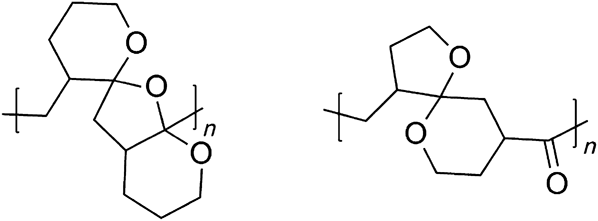
Ketalization of copolymers of 2-allyl-substituted phenols and CO resulting in ketalic structures.Reference Wursche and Rieger 23 , Reference Wursche and Rieger 24

In 1997, Consiglio et al. performed the copolymerization of CO in an enantioselective fashion together with allylbenzene, 1-allyl-4-(trifluoromethyl)benzene, and 1-allyl-4-methoxybenzene.Reference Di Benedetto and Consiglio 25 They determined that the spiroketal structure (similar to the structure shown in Scheme 5) is thermodynamically favored for the isotactic copolymers over the 1,4-keto structure. Atactic polymers, by contrast, did not reveal any keto-to-spiroketal structure transformation. From these findings, the authors concluded that regularity of the chiral centers in the polymer is required for the conversion of the polyketone structure into the spiroketal form. The fluoro-functionalization of a co-monomer for the copolymerization with CO is not limited to the case of 1-allyl-4-(trifluoromethyl)benzene, as fluoroalkenes of general formula CH2=CH-CH2-C n F2n+1 (with n = 4, 8) have been shown to undergo this reaction in the presence of a suitable catalyst.Reference Fujita, Nakano, Yamashita and Nozaki 26
Copolymers of CO and several vinyl epoxides were reported by Alper et al. with [Pd((R,R)-CH3-DUPHOS)(CH3CN)2](BF4)2 as the catalyst.Reference Lee and Alper 27 The copolymerizations proceeded with good yields and moderate molecular weights, whereas the reactive epoxy groups were not attacked in the reaction. The vinyl epoxides depicted in Scheme 7 were copolymerized, resulting in valuable precursor polymers for new polymeric materials (e.g., for further modification or cross-linking via ring opening reactions of the epoxy groups). As promoting agents, the researchers used formic acid and 1,4-naphthoquinone in catalytic quantities. Despite the possibility of palladium-catalyzed rearrangement of epoxides and other reactions such as ring-opening, the selectivity for the olefinic unit in the reaction is highlighted.
Vinyl epoxides copolymerized by Alper et al. with the epoxy groups being totally unaffected during the polymerization.Reference Lee and Alper 27

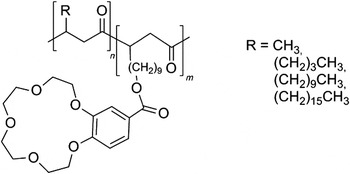
Among all the copolymerizable olefins, those functionalized with crown-ether groups should be mentioned in particular (Scheme 8). The resulting co- and terpolymers with CO and other olefins were utilized in the preparation of ion-conducting membranes, and the properties of such membranes could be modulated by varying the nature of the olefinic co-monomer.Reference Klok, Eibeck, Schmid, Abu-Surrah, Möller and Rieger 28 The thermal behavior of the benzo-15-crown-5 substituted polyketones is significantly affected by the length of the α-olefin side-chain used: R = CH3(CH2)15 shows a melting point (T m) of only 17°C. With shorter side-chains, the resulting polymers (R = octyl or butyl) show exclusively a glass transition point (T g) at −18°C and −76°C, respectively. For R = CH3, both a T g (19°C) and a T m (108°C) could be observed. Furthermore, the NaClO4 flux through the membrane increased with decreasing branch length of the polymer.
Crown-ether functionalized terpolymers with varying length of the alkyl side group, causing a shift in the NaClO4 flux through the polymer.Reference Klok, Eibeck, Schmid, Abu-Surrah, Möller and Rieger 28

Peculiarities of the polymer chain initiation over the course of olefin/CO copolymerization also allowed the synthesis of linear and branched polyketone-block-copolymers upon utilization of macroinitiators such as poly(ethylene glycol) and poly(vinyl alcohol), respectively.Reference Mücke and Rieger 29
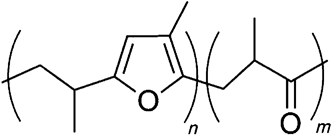
Besides the copolymerization of CO with differently substituted functional α-olefins, another promising and widely employed approach for tailoring the copolymer properties is the postpolymeric modification of alternating aliphatic 1,4-polyketones, which utilizes the reactivity of the keto-groups in certain reactions.Reference Sen 4 , Reference Sen 30 In 1994, Sen et al. transformed the olefin/carbon monoxide polyketones into copolymers possessing thiophene, furan, and alcohol functionalities in the backbone.Reference Jiang, Sanganeria and Sen 31 By modification with Lawesson’s reagent (2,4-bis-(4-methoxyphenyl)-1,3,2,4-dithiadiphosphetane-2,4-disulfide),Reference Pedersen, Scheibye, Nilsson and Lawesson 32 75% of the carbonyl groups in the ethylene-CO copolymer were converted into thiophene units, with a minor side reaction affording the alternative thioketone units and the related tautomer (Scheme 9). The resulting sulphonated polymer retains its solubility in most organic solvents, but after one month in contact with air, the authors observed cross-linking of the thiol groups, which resulted in insolubility of the polymer. For the case of the alternating propylene-CO copolymer, treatment with P2O5 resulted in the formation of furan units in the backbone (conversion up to 90%), as shown in Scheme 10 .Reference Jiang, Sanganeria and Sen 31
Polyketone after reaction with Lawesson’s reagent, which is often used for the conversion of ketones into thioketones.Reference Jiang, Sanganeria and Sen 31
Polyketone with furan units in the backbone via reaction of propylene-CO copolymer with P2O5.Reference Jiang, Sanganeria and Sen 31
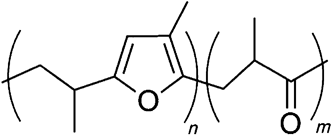

By reduction with LiAlH4, the authors were able to convert 85% of the carbonyl groups into hydroxyl groups to form 1,4-polyalcohols.Reference Jiang, Sanganeria and Sen 31 With increasing amounts of OH groups, a simultaneous rise of the glass transition temperature was observed due to enhancement of intra- and intermolecular hydrogen bonding. By reduction with NaBH4 in THF/CH3OH media, Rieger et al. obtained a similar material showing a shape-memory effect, therefore exhibiting very promising properties for applications such as medical stents or catheters.Reference Pérez-Foullerat, Hild, Mücke and Rieger 33
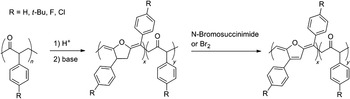
Recently, Brookhart et al. demonstrated postpolymerization reactions of several differently substituted styrene-CO copolymers to form a new class of fully conjugated polymers, as shown in Scheme 11 .Reference Cheng, Guironnet, Barborak and Brookhart 34 The polymers show strong absorption in the visible light region, with the absorption peaks being shifted to the near-infrared region after doping with strong Brønsted acids such as methanesulfonic acid or trifluoromethanesulfonic acid. The tert-butyl substituted polymer shows good solubility in hydrocarbon solvents such as hexane.Reference Cheng, Guironnet, Barborak and Brookhart 34
Postpolymeric modification toward the formation of fully conjugated polymers.Reference Cheng, Guironnet, Barborak and Brookhart 34

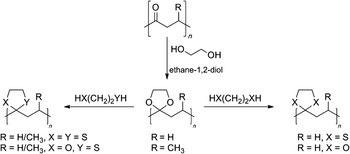
In 1994, Paton et al. converted aliphatic polyketones into alkene-1,3-dioxolane copolymers by reaction with ethane-1,2-diol, which appeared to be a suitable starting material for further functionalization toward heterocyclic polymers.Reference Green, Lucy, Lu and Paton 35 Via transketalisation reactions with ethane-1,2-dithiol, propane-1,3-dithiol, and sulfanylethanol, new dithiolane-, dithiane- and oxathiolane-containing polymers were synthesized, as shown in Scheme 12 .
Postpolymeric functionalization of polyketones to build up heterocyclic polymers by Paton et al.Reference Green, Lucy, Lu and Paton 35

In further work, the authors synthesized polyketoximes from alkene-CO copolymers via oximation with hydroxylamine (Scheme 13).Reference Lu, Paton, Green and Lucy 36 The reactions were conducted with ethene-CO copolymers or ethene/propene-CO terpolymers under neutral conditions. In contrast to the starting material, the resulting polymers exhibited much improved solubility in, for example, dimethylformamide or dimethylsulfoxide. Furthermore, the crystallinity of the material was increased and showed much sharper melting peaks.
Polyketoximes via oximation with hydroxylamine under neutral conditions.Reference Lu, Paton, Green and Lucy 36

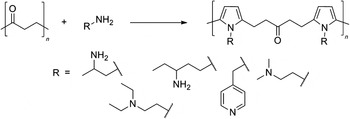
In 2008, Broekhuis et al. modified aliphatic polyketones with different diamines in a Paal–Knorr reaction, which is commonly used to form five membered heterocycles out of 1,4-diketones, affording N-substituted pyrrole rings along the polymer backbone (Scheme 14).Reference Zhang, Broekhuis, Stuart and Picchioni 37 The conversion strongly depends, among other factors, on the steric hindrance of the amine used, with more hindered substrates being less reactive.
Paal–Knorr reaction of a polyketone with diamines with only the primary amino group being reactive in this conversion.Reference Zhang, Broekhuis, Stuart and Picchioni 37

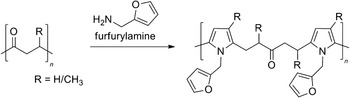
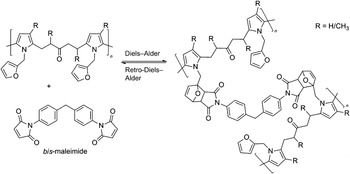
The conversion of the carbonyl group in these polyketones into a pyrrole fragment was 70–80%. After protonation or alkylation, the polymers act as polyelectrolytes or surfactants in aqueous solutions. They manifest fluorescence in the visible range of the spectrum with peculiar concentration dependence. In further work, the authors show the development of thermally self-healing polymers via Diels–Alder/retro-Diels–Alder reactions.Reference Zhang, Broekhuis and Picchioni 38 As a first step, they generate a furan-functionalized polyketone by reaction of the corresponding polyketone with furfurylamine, as shown in Scheme 15 . By further reaction with bis-maleimide, a highly cross-linked polymer is formed (Scheme 16).Reference Zhang, Broekhuis and Picchioni 38 Thermal treatment of this material leads to a de-cross-linking via a retro-Diels–Alder reaction, and the curing/recovering process can be repeated several times without loss in the mechanical properties such as storage and loss moduli.
Paal–Knorr reaction of a polyketone with furfurylamine resulting in furan functionalized polyketones.Reference Zhang, Broekhuis and Picchioni 38

Cross-linking and cleavage of the furfuryl polymer with bis-maleimide via Diels–Alder and retro-Diels–Alder reactions, respectively.Reference Zhang, Broekhuis and Picchioni 38

Broekhuis et al. showed in subsequent work the dependence of the polymer properties on the density of furan groups in the polymer.Reference Toncelli, De Reus, Picchioni and Broekhuis 39 Physical properties of a non-cured polymer are only marginally affected by the amount of furan and maleimide, which are present in the material. Upon curing at 50°C, higher furan amounts and maleimide concentrations cause an increase in the cross-linking density, and the gelation time shortens. The de-cross-linking of such polymers occurs at 120–150°C. The control over cross-linking density allowed the authors to widely modulate the mechanical properties, such as elastic and loss moduli, and the application temperature of these new materials with thermal self-healing behavior. Additionally, it was shown that a complete reversion of the mechanical properties does not necessarily require complete cross-linking or de-cross-linking of all bridging units in the backbone of polymer molecules. This conclusion resulted from the comparison of multiple-cycle differential scanning calorimetry analysis with the dynamic mechanical analysis investigation of recycled samples. The authors also noticed a shape memory effect for a number of materials prepared by this method.
Conclusion
In summary, it is worth highlighting the properties of aliphatic polyketones as functional polymers. Despite failed commercialization attempts in the packaging and engineering of thermoplastic materials, simple access via metal-catalyzed homogeneous co- and terpolymerization of carbon monoxide with common alkenes and functionalized olefins justifies their importance and potential for a wide range of advanced applications. Their biocompatibility and facile functionalization are attractive for applications in the medicinal sector such as drug delivery as well as implant and tissue engineering purposes. Optical activity, liquid crystalline behavior, and other specific functionalization of polyketones may find utilization in various high-tech fields, including the manufacture of sensors, displays, optical devices, ion-conducting, and other membrane-related functions.