Introduction
Otitis media is inflammation of the middle-ear cavity. It is caused by an infection of the mucous membrane of the middle-ear cleft. Both viral and bacterial infections can lead to otitis media: common viruses include respiratory syncytial virus and influenza A virus, while the two commonest bacterial species are Haemophilus influenzae and Moraxella catarrhalis. When organisms invade the mucosal membrane, they cause inflammation and oedema; exudate, and later pus, is secreted.Reference Rea, Graham, Gleeson, Jones, Burton, Clarke and Browning1
Otitis media is one of the commonest diseases of childhood, accounting for approximately one in four of all prescriptions for children under 10 years in the US.Reference Teele, Klein and Rosner2 By the age of one, 62 per cent of children will have had at least one episode of otitis media.Reference Teele, Klein and Rosner2 Many children suffer recurrent otitis media: approximately 46 per cent of children will have more than three episodes by the age of three years.Reference Teele, Klein and Rosner2 Although acute otitis media is often self-limiting (88 per cent of children experience symptomatic relief of pain and fever by four to seven days without taking antibiotics), the condition can affect a child's intellectual, speech and language ability, as well as their school achievement.Reference Teele, Klein, Chase, Menyuk and Rosner3 Studies show that the longer a child has otitis media, the poorer their performance in various tests assessing intelligence quotient and verbal and reading abilities.Reference Teele, Klein, Chase, Menyuk and Rosner3 Therefore, it is important to prevent recurrent otitis media.
Currently, there are three main treatment modalities for recurrent otitis media: prophylactic antibiotics, adenoidectomy and tympanostomy tube insertion.Reference Morris and Leach4 Each of these treatments involves costs and risks. For antibiotics, risks include hypersensitivity and resistance. Surgical intervention carries the risk of anaesthetic complications and haemorrhage, while tympanostomy tube insertion can lead to eardrum scarring or perforation.Reference Casselbrant, Kaleida, Rockette, Paradise, Bluestone and Kurs-Lasky5
This paper systematically reviews recent trials of recurrent otitis media treatment and prevention, with the aim of assessing the efficacy of the three main treatment methods.
Methods
Literature search
We conducted a thorough search of current, evidence-based research on recurrent otitis media, using the PubMed and Scopus search engines. Search terms included ‘recurrent otitis media’ and its synonym ‘recurrent middle ear infection’.
A hand search of the reference lists of relevant articles and textbooks was conducted to identify additional studies missed during the database searches. Non-English language publications and unpublished studies were both excluded. The search was repeated throughout the duration of the study to update the study and to test reproducibility. Studies identified were published between January 1990 and March 2011.
Inclusion criteria
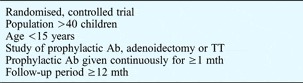
The inclusion criteria for this review are shown in Table I.
Review inclusion criteria

Ab = antibiotics; TT = tympanostomy tube insertion; mth = months
Publications were screened initially for potential relevance and then further assessed according to the preset inclusion criteria.
Outcomes
The first outcome assessed was the effect of different interventions on otitis media recurrence. Selected study data were retrieved, and the numbers or percentages of children who did not develop otitis media recurrence were compared in the intervention and control or placebo groups, to assess the effect of the intervention on this parameter.
The second outcome assessed was the effect of different interventions on the frequency of recurrent otitis media episodes. Again, selected study data were retrieved and the frequency of recurrent otitis media episodes during the follow-up period was compared in the intervention and control or placebo groups, to assess the effect of the intervention on this second parameter.
The third outcome assessed was the total time for which children suffered recurrent otitis media over the follow-up period. This parameter was compared in the intervention and control or placebo groups.
Results
Following an initial screening search, 18 publications were identified. Each was assessed using the preset inclusion criteria. Only seven publications met these criteria.
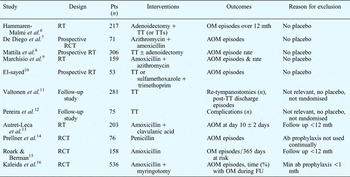
The 11 papers not meeting the inclusion criteria, and the reasons for their exclusion, are summarised in Table II.
Characteristics of excluded studies

Pts = patients; RT = randomised trial; RCT = randomised, controlled trial; TT = tympanostomy tube insertion; OM = otitis media; AOM = acute otitis media; mth = months; Ab = antibiotic; Min = minimum
Description of studies
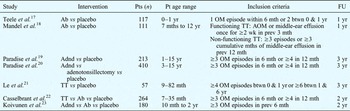
The properties of the seven studies that met the inclusion criteria are summarised in Table III.
Characteristics of included studies

Ab = antibiotics; Adnd = adenoidectomy; TT = tympanostomy tube insertion; yr = years; mth = months; OM = otitis media; AOM = acute otitis media; btwn = between; prev = previous; FU = follow up
Intervention
Mandel et al. investigated the effect of intervention on recurrent middle-ear effusion, but their study also produced data on the effectiveness of acute otitis media treatment.Reference Mandel, Casselbrant, Rockette, Bluestone and Kurslasky18 Relevant data were retrieved from the study for the current review. Paradise and colleagues' 1999 study randomised patients to undergo either adenotonsillectomy, adenoidectomy or placebo treatment.Reference Paradise, Bluestone, Colborn, Bernard, Smith and Rockette20 In this study, only data from the adenoidectomy and placebo arms were used.
Studies investigating the effectiveness of antibiotic prophylaxis differed with regards to antibiotic type, dose and duration. The most commonly used antibiotic was amoxicillin. Teele et al. used sulfisoxazole 50 mg/kg per day and amoxicillin 20 mg/kg per day for six months.Reference Teele, Klein, Word, Rosner, Starobin and Earle17 Koivunen et al. prescribed sulfafurazole 50 mg/kg per day for six months.Reference Koivunen, Uhari, Luotonen, Kristo, Raski and Pokka23 Mandel et al. used amoxicillin 20 mg/kg per day for one year.Reference Mandel, Casselbrant, Rockette, Bluestone and Kurslasky18 Casselbrant et al. used amoxicillin 20 mg/kg per day (once each evening) for the full duration of their study.Reference Casselbrant, Kaleida, Rockette, Paradise, Bluestone and Kurs-Lasky22
Participants
The age range of participants differed between studies, from infancy (Teele et al.) to 15 years (both of Paradise and colleagues' studies).Reference Teele, Klein, Word, Rosner, Starobin and Earle17, Reference Paradise, Bluestone, Rogers, Taylor, Colborn and Bachman19, Reference Paradise, Bluestone, Colborn, Bernard, Smith and Rockette20
The number of participants in different studies varied hugely. All studies included more than 100 patients, apart from Le and colleagues', which randomised 57 patients.Reference Le, Freeman and Fireman21 Of these 57 patients, 13 patients were enrolled due to chronic middle-ear effusion, while 44 were enrolled due to recurrent otitis media. Our review used data from these latter 44 patients. In Paradise and colleagues' earlier study, 213 children were enrolled but only 99 were randomised.Reference Paradise, Bluestone, Rogers, Taylor, Colborn and Bachman19 Our review used data from these 99 randomised children.
Follow up
Both studies by Paradise et al. (1990 and 1999) adopted the same follow-up approach of having bi-weekly enquiries about day-to-day conditions and six-weekly nurse assessments.Reference Paradise, Bluestone, Rogers, Taylor, Colborn and Bachman19, Reference Paradise, Bluestone, Colborn, Bernard, Smith and Rockette20 If otitis media was found, the patient was followed up every one to four weeks. Le et al. followed up their patients two to four weeks after their surgical procedure, and subsequently with three-monthly assessments.Reference Le, Freeman and Fireman21 If otitis media was diagnosed, the patient was followed up monthly until that episode resolved.
Casselbrant et al. followed up patients with monthly examinations.Reference Casselbrant, Kaleida, Rockette, Paradise, Bluestone and Kurs-Lasky22 If symptoms of otitis media or signs of ENT illness were found, the patient was re-examined. Koivunen et al. did not arrange any follow up; rather, any patient who visited their doctor was assessed with reference to that patient's symptom diary and their doctor's notes.Reference Koivunen, Uhari, Luotonen, Kristo, Raski and Pokka23
Teele et al. followed up their patients at enrolment and then every four weeks until week 26.Reference Teele, Klein, Word, Rosner, Starobin and Earle17 In addition, these patients also attended routine ‘well child’ clinics. The patients allocated to the sulfisoxazole arm of this study were asked to attend for an extra visit in week one for additional haematological tests. Mandel et al. examined their patients monthly for one year.Reference Mandel, Casselbrant, Rockette, Bluestone and Kurslasky18 If otitis media was diagnosed, the child was re-examined after 14 days.
Effect of interventions on otitis media recurrence
The first outcome we assessed was the effect of the three different interventions on preventing recurrence of otitis media.
Prophylactic antibiotics
Three studies (Teele et al., Mandel et al. and Casselbrant et al.) assessed the effect of prophylactic antibiotics on the proportion of children not suffering otitis media recurrence.Reference Teele, Klein, Word, Rosner, Starobin and Earle17, Reference Mandel, Casselbrant, Rockette, Bluestone and Kurslasky18, Reference Casselbrant, Kaleida, Rockette, Paradise, Bluestone and Kurs-Lasky22
Teele et al. reported data collected at six and 12 months after entry into the study.Reference Teele, Klein, Word, Rosner, Starobin and Earle17 The group assessed the effects of amoxicillin, sulfisoxazole and placebo. Results from this study are summarised in Table IV.
Absence of otitis media recurrence: effect of antibiotics

*((Treatment group – placebo group)/placebo group) × 100. FU = follow up; mth = months; Pts = patients; rec = recurrence; Amox = amoxicillin group; Sulf = sulfisoxazole group; Placebo = placebo group; – = not done
Mandel et al. reported data collected over the 12 months following entry into the study, for an amoxicillin group and a placebo group.Reference Mandel, Casselbrant, Rockette, Bluestone and Kurslasky18 The results from this study are summarised in Table IV.
Casselbrant et al. investigated the effect of amoxicillin over a two-year follow-up period. Their results are also summarised in Table IV.Reference Casselbrant, Kaleida, Rockette, Paradise, Bluestone and Kurs-Lasky22
Tympanostomy tube
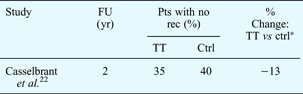
One study, by Casselbrant et al. assessed the effect of tympanostomy tube insertion on prevention of otitis media recurrence over a two-year follow-up period.Reference Casselbrant, Kaleida, Rockette, Paradise, Bluestone and Kurs-Lasky22 The results from this study are summarised in Table V.
Absence of otitis media recurrence: effect of tympanostomy
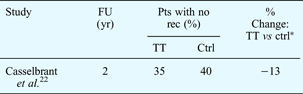
*Calculated as in Table IV. FU = follow up; yr = years; Pts = patients; rec = recurrence; TT = tympanostomy tube group; ctrl = control group
Adenoidectomy
Two studies, both by Paradise and colleagues (1990 and 1999), assessed the effect of adenoidectomy on otitis media recurrence.Reference Paradise, Bluestone, Rogers, Taylor, Colborn and Bachman19, Reference Paradise, Bluestone, Colborn, Bernard, Smith and Rockette20 The first study reported data collected over a three-year follow up; these results are summarised in Table VI.Reference Paradise, Bluestone, Rogers, Taylor, Colborn and Bachman19
Absence of otitis media recurrence: effect of adenoidectomy

*Calculated as in Table IV. FU yr = follow up year; Pts = patients; rec = recurrence; adnd = adenoidectomy group; ctrl = control group; – = not done
Paradise and colleagues' second study had two different groups: patients randomised into a three-way trial and patients randomised into a two-way trial.Reference Paradise, Bluestone, Colborn, Bernard, Smith and Rockette20 Both groups were followed up over three years. The relevant data from this study (i.e. children treated with adenoidectomy, and controls) are summarised in Table VI.
Effect of interventions on otitis media frequency
The second outcome assessed in our review was the effect of the different interventions on the frequency of recurrent otitis media episodes.
Prophylactic antibiotics
Three studies (Mandel et al., Casselbrant et al. and Koivunen et al.) assessed the effect of prophylactic antibiotics on the frequency of otitis media episodes.Reference Mandel, Casselbrant, Rockette, Bluestone and Kurslasky18, Reference Casselbrant, Kaleida, Rockette, Paradise, Bluestone and Kurs-Lasky22, Reference Koivunen, Uhari, Luotonen, Kristo, Raski and Pokka23
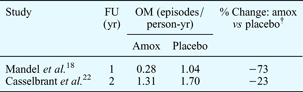
Mandel et al. reported data from children treated with either amoxicillin or placebo, collected over 12 months.Reference Mandel, Casselbrant, Rockette, Bluestone and Kurslasky18 The results from this study are summarised in Table VII, expressed as the rate of otitis media episodes per person-year.
Otitis media recurrence rate*: effect of antibioticsReference Mandel, Casselbrant, Rockette, Bluestone and Kurslasky18, Reference Casselbrant, Kaleida, Rockette, Paradise, Bluestone and Kurs-Lasky22
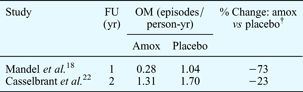
* Number of otitis media episodes per person-year. †((Treatment group − placebo group)/placebo group) × 100. FU = follow up; yr = years; OM = otitis media; amox = amoxicillin group; placebo = placebo group
Casselbrant et al. measured the rate of otitis media episodes per person-year in children treated with either amoxicillin or placebo, over a two-year follow-up period.Reference Casselbrant, Kaleida, Rockette, Paradise, Bluestone and Kurs-Lasky22 The results for the first and second follow-up years did not differ substantially. These results are summarised in Table VII.
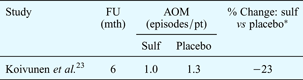
Koivunen et al. reported the number of episodes of acute otitis media in children treated with sulfafurazole and placebo.Reference Koivunen, Uhari, Luotonen, Kristo, Raski and Pokka23 The mean number of episodes was calculated from children who developed treatment failure during the study follow-up period. These study results are summarised in Table VIII.
Acute otitis media recurrence: effect of antibioticsReference Koivunen, Uhari, Luotonen, Kristo, Raski and Pokka23
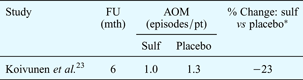
*Calculated as in Table VII. FU = follow up; mth = months; AOM = acute otitis media; pt = patient; sulf = sulfafurazole group; placebo = placebo group
Tympanostomy tube
Two studies (Casselbrant et al. and Le et al.) assessed the effect of tympanostomy tube insertion on the number of otitis media episodes.Reference Le, Freeman and Fireman21, Reference Casselbrant, Kaleida, Rockette, Paradise, Bluestone and Kurs-Lasky22
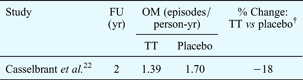
Casselbrant et al. measured the number of otitis media episodes per person-year in children treated with tympanostomy tube or placebo, over two years of follow up.Reference Casselbrant, Kaleida, Rockette, Paradise, Bluestone and Kurs-Lasky22 The results of the first and second follow-up year did not differ substantially. These results are summarised in Table IX.
Otitis media recurrence rate*: effect of tympanostomyReference Casselbrant, Kaleida, Rockette, Paradise, Bluestone and Kurs-Lasky22
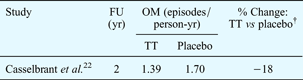
* Otitis media episodes per person-year. †Calculated as in Table VII. FU = follow up; yr = years; OM = otitis media; TT = tympanostomy tube group; placebo = placebo group
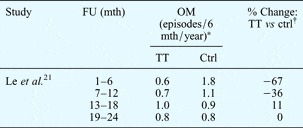
Le et al. investigated the effect of tympanostomy tube insertion on the number of recurrent otitis media episodes, compared with controls, over a two-year follow-up period.Reference Le, Freeman and Fireman21 As the study randomised individual ears rather than patients, the data were presented as mean episodes of otitis media per six months per ear. These study results are summarised in Table X.
Otitis media recurrence rate*: effect of tympanostomyReference Le, Freeman and Fireman21

* Mean number of otitis media episodes per six-month interval per ear. †Calculated as in Table VII. FU = follow up; mth = months; OM = otitis media; TT = tympanostomy tube group; ctrl = control group
Adenoidectomy
Three studies (Paradise and colleagues 1990 and 1999, and Koivunen et al.) assessed the effect of adenoidectomy on the number of otitis media episodes.Reference Paradise, Bluestone, Rogers, Taylor, Colborn and Bachman19, Reference Paradise, Bluestone, Colborn, Bernard, Smith and Rockette20, Reference Koivunen, Uhari, Luotonen, Kristo, Raski and Pokka23
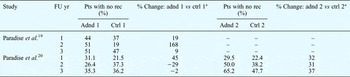
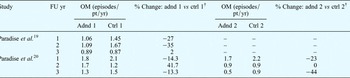
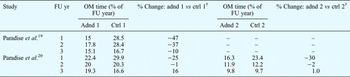
Both of Paradise and colleagues' studies assessed the mean number of otitis media episodes per patient per year in each of three follow-up years.Reference Paradise, Bluestone, Rogers, Taylor, Colborn and Bachman19, Reference Paradise, Bluestone, Colborn, Bernard, Smith and Rockette20 The 1999 study had two patient groups: patients randomised into a three-way trial and patients randomised into a two-way trial.Reference Paradise, Bluestone, Colborn, Bernard, Smith and Rockette20 Only the relevant data (i.e. children treated with adenoidectomy versus controls) are presented. The results from these two studies are summarised in Table XI.
Otitis media recurrence rate*: effect of adenoidectomyReference Paradise, Bluestone, Rogers, Taylor, Colborn and Bachman19, Reference Paradise, Bluestone, Colborn, Bernard, Smith and Rockette20

* Mean number of otitis media episodes per patient per year. †Calculated as in Table VII. FU yr = follow up year; OM = otitis media; pt = patient; adnd = adenoidectomy group; ctrl = control group; – = not done
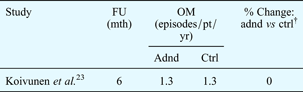
Koivunen et al. measured the number of acute otitis media episodes in children treated with adenoidectomy or placebo.Reference Koivunen, Uhari, Luotonen, Kristo, Raski and Pokka23 The mean number of episodes was calculated from children who developed treatment failure during the study follow-up period. These study results are summarised in Table XII.
Otitis media recurrence rate*: effect of adenoidectomyReference Koivunen, Uhari, Luotonen, Kristo, Raski and Pokka23
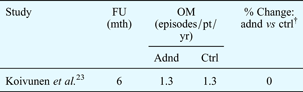
* Mean number of otitis media episodes per patient per year. †Calculated as in Table VII. FU = follow up; mth = months; OM = otitis media; pt = patient; yr = year; adnd = adenoidectomy group; ctrl = control group
Effect of intervention on total time with otitis media
The third outcome assessed in our review was the effect of the three different interventions on the total time each child suffered with otitis media.
Prophylactic antibiotics
Three studies (Casselbrant et al., Mandel et al. and Teele et al.) assessed the effect of prophylactic antibiotics on the total time each child suffered with otitis media.Reference Teele, Klein, Word, Rosner, Starobin and Earle17, Reference Mandel, Casselbrant, Rockette, Bluestone and Kurslasky18, Reference Casselbrant, Kaleida, Rockette, Paradise, Bluestone and Kurs-Lasky22
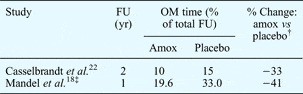
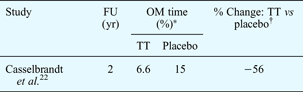
Casselbrant et al. calculated the mean total time for which each child suffered with otitis media, expressed as a percentage of the total time between entry into the study and completion of two-year follow up, according to treatment assignment (amoxicillin or placebo).Reference Casselbrant, Kaleida, Rockette, Paradise, Bluestone and Kurs-Lasky22 These study results are summarised in Table XIII.
Time with otitis media*: effect of antibioticsReference Mandel, Casselbrant, Rockette, Bluestone and Kurslasky18, Reference Casselbrant, Kaleida, Rockette, Paradise, Bluestone and Kurs-Lasky22

* Mean time with otitis media, as percentage of total follow-up time. †((Treatment group − placebo group)/placebo group) × 100. ‡Otitis media indicated by presence of middle-ear effusion. FU = follow up; yr = years; OM = otitis media; amox = amoxicillin group; placebo = placebo group
Mandel et al. measured the percentage of time patients suffered with middle-ear effusion during the one-year follow-up period, and compared their amoxicillin and placebo groups.Reference Mandel, Casselbrant, Rockette, Bluestone and Kurslasky18 These study results are also summarised in Table XIII.
Teele et al. estimated the mean time their patients suffered with middle-ear effusion after entry into the study, expressed as days, and compared those treated with amoxicillin, sulfisoxazole and placebo.Reference Teele, Klein, Word, Rosner, Starobin and Earle17 Data were given for the first six-month follow-up period and the full 12-month follow-up period. These study results are summarised in Table XIV.
Time with otitis media*: effect of antibioticsReference Teele, Klein, Word, Rosner, Starobin and Earle17

* From entry into the study to end of follow up. †Calculated as in Table XIII. ‡Time with otitis media as percentage of total follow-up time. FU = follow up; mth = months; Amox = amoxicillin group; OM = otitis media; Suf = sulfisoxazole group; Placebo = placebo group; SD = standard deviation
Tympanostomy tube
Only one study, by Casselbrant et al. assessed the total time with otitis media for children treated with tympanostomy tube insertion versus placebo, expressed as a percentage, over a two-year follow-up period.Reference Casselbrant, Kaleida, Rockette, Paradise, Bluestone and Kurs-Lasky22 These study results are summarised in Table XV.
Time with otitis media*: effect of tympanostomy
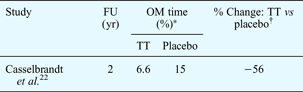
* Time with otitis media as percentage of total follow-up time. †Calculated as in Table XIII. FU = follow up; yr = years; TT = tympanostomy tube group; placebo = placebo group
Adenoidectomy
Two studies, both by Paradise and colleagues (1990 and 1999), assessed the effect of adenoidectomy on the total time with otitis media, expressed as a percentage of the total follow-up period.Reference Paradise, Bluestone, Rogers, Taylor, Colborn and Bachman19, Reference Paradise, Bluestone, Colborn, Bernard, Smith and Rockette20 Both these studies followed up children for three years, and presented a cumulative treatment group proportion (representing total days with otitis media/total days) for each follow-up year. The later study grouped patients into two different groups: patients randomised into a three-way trial and patients randomised into a two-way trial.Reference Paradise, Bluestone, Colborn, Bernard, Smith and Rockette20 Only the relevant data (i.e. children treated with adenoidectomy versus controls) were used. The results from these two studies are summarised in Table XVI.
Time with otitis media*: effect of adenoidectomy

* Time with otitis media as percentage of follow-up year. †Calculated as in Table XIII. FU yr = follow-up year; OM = otitis media; adnd = adenoidectomy group; ctrl = control group
Discussion
Although all the papers included in this review were randomised, controlled studies of otitis media in children and assessed similar outcomes, there were multiple variables that made performing a meta-analysis difficult.
In order to compare the effects of different interventions in the various studies, the percentage change in recurrence prevalence, otitis media frequency and total time with otitis media, for both the treatment group and the control or placebo group, were plotted on bar charts. In some studies investigating the effect of prophylactic antibiotics, children were treated for six months but were followed up for a longer period. The percentage change during the treatment period (or for an approximation of the duration of the treatment period) was used instead of the whole follow-up period, if data were available for the treatment period. When data were not available, the percentage change for the whole follow-up period was used.
Effect of interventions on otitis media recurrence
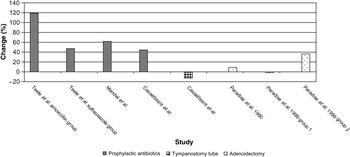
Figure 1 shows the percentage change between the treatment group and the control or placebo group, for the absence of otitis media recurrence in each of the relevant studies.
Effect of different interventions on prevention of otitis media recurrence. The percentage change between the treatment group and the control or placebo group is shown for the relevant studies.

It would appear that prophylactic antibiotics had the highest percentage change. This suggests that, of the three interventions reviewed, prophylactic antibiotics (studied by Teele et al., Mandel et al. and Casselbrant et al.) was the best method for reducing the proportion of children suffering otitis media recurrence.Reference Teele, Klein, Word, Rosner, Starobin and Earle17, Reference Mandel, Casselbrant, Rockette, Bluestone and Kurslasky18, Reference Casselbrant, Kaleida, Rockette, Paradise, Bluestone and Kurs-Lasky22 Adenoidectomy (as studied by Paradise and colleagues in 1990 and 1999) also caused a small reduction in the prevalence of otitis media.Reference Paradise, Bluestone, Rogers, Taylor, Colborn and Bachman19, Reference Paradise, Bluestone, Colborn, Bernard, Smith and Rockette20 Tympanostomy tube insertion (studied by Casselbrant et al.), however, increased the prevalence of recurrence amongst treated children.Reference Casselbrant, Kaleida, Rockette, Paradise, Bluestone and Kurs-Lasky22
Effect of interventions on otitis media frequency
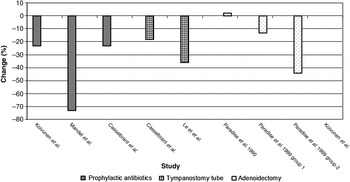
Figure 2 shows the percentage change between the treatment group and the control or placebo group, for the frequency of otitis media episodes in the relevant studies.
Effect of different interventions on the frequency of otitis media episodes. The percentage change between the treatment group and the control or placebo group is shown for the relevant studies.

Different studies produced variable results for this comparison. The most consistent results were found in the studies on prophylactic antibiotics (Mandel et al., Casselbrant et al. and Koivunen et al.).Reference Mandel, Casselbrant, Rockette, Bluestone and Kurslasky18, Reference Casselbrant, Kaleida, Rockette, Paradise, Bluestone and Kurs-Lasky22, Reference Koivunen, Uhari, Luotonen, Kristo, Raski and Pokka23 All these studies showed a reduction in otitis media frequency in the treatment group compared with the control or placebo group. Both studies on tympanostomy tube insertion (Le et al. and Casselbrant et al.) also showed a reduction in otitis media frequency in the treatment group compared with the control or placebo group.Reference Le, Freeman and Fireman21, Reference Casselbrant, Kaleida, Rockette, Paradise, Bluestone and Kurs-Lasky22 The results from the adenoidectomy studies were hard to interpret: one study (Paradise et al. 1999) showed a reduction in otitis media frequency; another (Koivunen et al.) showed no change; and a third (Paradise et al. 1990) showed an increase in otitis media frequency in the treatment group compared with the control or placebo group.Reference Paradise, Bluestone, Rogers, Taylor, Colborn and Bachman19, Reference Paradise, Bluestone, Colborn, Bernard, Smith and Rockette20, Reference Koivunen, Uhari, Luotonen, Kristo, Raski and Pokka23
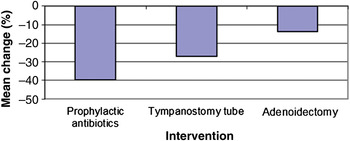
In an attempt to compare the effectiveness of the three types of intervention, the mean percentage change in otitis media frequency was calculated for each type and plotted on a bar chart (Figure 3). This showed that prophylactic antibiotics were the most effective way of reducing otitis media frequency, of the three interventions reviewed. When judged solely on the basis of mean percentage change, tympanostomy tube insertion was superior to adenoidectomy in reducing otitis media frequency.
Mean percentage change (comparing intervention and control or placebo groups) for otitis media frequency, for the three interventions.

Effect of interventions on total otitis media time
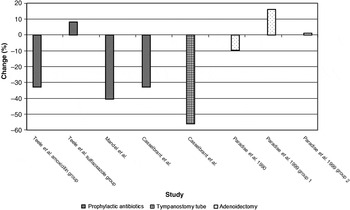
Figure 4 shows the percentage change between the treatment group and the control or placebo group, for the total otitis media time in the relevant studies.
Effect of different interventions on the total time spent with otitis media. The percentage change between the treatment group and the control or placebo group is shown for the relevant studies.

The largest percentage change in total otitis media time was seen for tympanostomy tube insertion (Casselbrant et al.).Reference Casselbrant, Kaleida, Rockette, Paradise, Bluestone and Kurs-Lasky22 In other words, tympanostomy tube insertion seemed to be the best method (of the three interventions reviewed) for reducing the total amount of time a child suffered with recurrent otitis media episodes. Although prophylactic antibiotics (Teele et al., Mandel et al. and Casselbrant et al.) did not show as great an effect compared with tympanostomy tube insertion, they still showed significant percentage changes (except for the sulfisoxazole arm of Teele et al.).Reference Teele, Klein, Word, Rosner, Starobin and Earle17, Reference Mandel, Casselbrant, Rockette, Bluestone and Kurslasky18, Reference Casselbrant, Kaleida, Rockette, Paradise, Bluestone and Kurs-Lasky22 Results from the two studies on adenoidectomy (Paradise and colleagues 1990 and 1999) were hard to interpret.Reference Paradise, Bluestone, Rogers, Taylor, Colborn and Bachman19, Reference Paradise, Bluestone, Colborn, Bernard, Smith and Rockette20 Although the 1990 study indicated that adenoidectomy was not as effective in reducing total otitis media time, compared with tympanostomy tube insertion and prophylactic antibiotics, there was still a beneficial effect in this respect.Reference Paradise, Bluestone, Rogers, Taylor, Colborn and Bachman19 However, Paradise and colleagues' 1999 study indicated that adenoidectomy increased, rather than reduced, the total otitis media time.Reference Paradise, Bluestone, Colborn, Bernard, Smith and Rockette20
Children under two years
It is appropriate to discuss separately the treatment of children under the age of two years. Only two studies investigated children below this age: Teele et al. and Koivunen et al. Reference Teele, Klein, Word, Rosner, Starobin and Earle17, Reference Koivunen, Uhari, Luotonen, Kristo, Raski and Pokka23 Teele et al. compared antibiotics with placebo, and their results contributed to our assessment of our first and third outcomes.Reference Teele, Klein, Word, Rosner, Starobin and Earle17 They found that antibiotic prophylaxis was able to reduce both the recurrence of otitis media and the total otitis media time. However, there were no other data available for these two outcomes, for the other two treatment methods. Koivunen et al. compared antibiotics versus adenoidectomy versus placebo.Reference Koivunen, Uhari, Luotonen, Kristo, Raski and Pokka23 Their results were used in our assessment of our second outcome: they found that antibiotics reduced the frequency of otitis media episodes but adenoidectomy did not, compared with placebo. No data were available on the effect of tympanostomy tube insertion on otitis media frequency, in children under two years.
Based on these studies, we conclude that, in children under two years, antibiotic prophylaxis is useful in reducing the prevalence of otitis media recurrence, the frequency of otitis media episodes, and the total time spent with otitis media. Adenoidectomy failed to show any benefit in reducing otitis media frequency. There were no data supporting the effectiveness of tympanostomy tube insertion in children under two years.
Factors affecting study results and inter-study variation
The effectiveness of treatments in the reviewed studies was inconsistent. While some studies showed a huge beneficial effect, others demonstrated only a modest change. Some studies contradicted each other regarding the effects of a particular treatment.
One reason behind this inconsistency was that the follow-up period was longer than the treatment period in some studies. For example, Casselbrant et al. only reported data from the end of a two-year follow-up period, while the duration of function of a tympanostomy tube is usually six to 12 months.Reference Casselbrant, Kaleida, Rockette, Paradise, Bluestone and Kurs-Lasky22, Reference Hussain24 Therefore, for a certain part of the follow-up period, children treated with tympanostomy tubes were not protected. Thus, this was not a true assessment of the therapeutic effectiveness of tympanostomy tube insertion.
The subject selection also varied between studies. Although many studies used three or more episodes of otitis media in six months as the inclusion criterion, some studies did not. For example, Teele et al. included infants who had had one otitis media episode within six months or two episodes in the first year of life, while Le et al. included children with four or more otitis media episodes before one year of age, or six or more episodes between one and six years of age.Reference Teele, Klein, Word, Rosner, Starobin and Earle17, Reference Le, Freeman and Fireman21 These two studies required fewer otitis media episodes to qualify for study inclusion, compared with the three or more episodes within a six-month period required by other studies. It could be argued that, using stringent inclusion criteria, children who were more prone to recurrence were more likely to be recruited. This could affect the outcome of children receiving placebo treatment. The effectiveness of different interventions could also vary in children with differing tendencies to recurrence. Therefore, the inclusion criteria variation in the various studies reviewed could potentially have affected our results.
Inclusion and exclusion criteria have an important influence on study outcomes. Apart from Teele et al., all the studies had exclusion criteria.Reference Teele, Klein, Word, Rosner, Starobin and Earle17 Various conditions are known to predispose children to otitis media. For example, cleft palate and Down's syndrome patients have impaired eustachian tube function and are known to have a higher incidence of middle-ear diseases.Reference Stool and Randall25, Reference Maheshwar, Milling, Kumar, Clayton and Thomas26 In addition to increasing the risk of otitis media, these anatomical abnormalities may influence how such children respond to treatment. Other conditions such as immunodeficiency, asthma and chronic sinusitis would also increase the risk of otitis media. Many of these conditions were listed as exclusion criteria in some of the studies, but consistency was lacking. Such inconsistent exclusion criteria may mean that children with differing recurrence tendencies are included in different studies, and this may influence treatment effectiveness outcome measures.
Another factor which could lead to inconsistency between study results was the way in which new otitis media episodes were treated. Most studies used antibiotics to treat each new episode of otitis media that occurred during follow up, and in the prophylactic antibiotic group the prophylactic antibiotic was paused. However, the type of antibiotics and the dose and duration of treatment differed in each study. For example, Teele et al. treated otitis media with either co-trimoxazole, cefaclor or erythromycin, while Paradise and colleagues (1990) first treated patients with ampicillin or amoxicillin and used erythromycin ethylsuccinate combined with sulfisoxazole acetyl as an alternative.17,19 Differences in treatment protocols between studies could affect the duration of otitis media episodes, and could thus affect the total otitis media time during the follow-up period. In addition, in surgical treatment groups these antibiotics were given in addition to the original surgical intervention. Therefore, these patients received double protection, which could possibly have affected their otitis media frequency. However, since treatment was only given if a new episode developed, the prevalence of initial otitis media recurrence would not have been affected.
It is also worth mentioning that Le et al. randomised individual ears, instead of individual children, to receive their study treatment.Reference Le, Freeman and Fireman21 The benefit of this method is that variables such as genotype, allergies and environmental factors will be the same in the treatment and control groups. However, if a child developed a new episode of otitis media in one ear, it would be impossible to isolate the affected ear during oral antibiotic treatment.
The nature of otitis media should also come under consideration when comparing study results. Risk factors for otitis media include gender and season.Reference Shott27 Boys have a significantly higher prevalence of both single episode otitis media and recurrent otitis media, compared with girls. However, since all the reviewed studies were randomised, the effect of gender should not have significantly affected their results. Although otitis media occurs throughout the year, it is more frequent during the autumn and winter months. Seasonal variation might affect the results of studies of prophylactic antibiotic effectiveness. Some studies only treated patients with antibiotics for six months. The prevalence of new otitis media episodes could also differ depending on the season in which placebo testing was conducted. If placebo testing was conducted during the summer and active treatment during the winter, the differences in both the prevalence of initial otitis media recurrence and the frequency of recurrent episodes would be smaller, compared with the differences observed if placebo testing was conducted during the winter and active treatment during the summer.
As mentioned above, otitis media is often self-limiting. Eighty-eight per cent of children have symptomatic relief from pain and fever within 4 to 7 days, without taking any antibiotics.Reference Teele, Klein and Rosner2 Follow-up methods varied between studies, with most studies following up their patients at monthly intervals; therefore, it is possible that some otitis media episodes may have occurred in between follow-up appointments, and thus may not have been recorded.
The incidence of otitis media in children also changes as they grow. The peak incidence is found in children aged between six and 18 months, and thereafter gradually reduces.Reference Klein28 The ages of children entered into the reviewed studies varied, as did the study follow-up periods. For some studies with longer follow-up periods, the otitis media incidence changed during the follow-up period as the child grew. This could potentially make the effectiveness of intervention appear to decrease as follow-up progressed, as the otitis media incidence would also fall in the control or placebo group.
Conclusions
Despite the above limitations, it is still safe to make the following conclusions from the data extracted from the seven studies reviewed.
Firstly, we conclude that prophylactic antibiotics are effective in improving all three otitis media outcomes assessed in this review. Treatment with prophylactic antibiotics reduces the prevalence of otitis media recurrence, the frequency of otitis media episodes, and the total time each child spends with otitis media. The effectiveness of prophylactic antibiotics was greater than that of tympanostomy tube insertion and adenoidectomy, in terms of reduction in otitis media recurrence and otitis media episode frequency.
Secondly, tympanostomy tube treatment fails to prevent recurrence of otitis media. However, it is effective in reducing the frequency of otitis media episodes and the total time spent with otitis media.
Thirdly, adenoidectomy is effective in reducing otitis media recurrence. Data on otitis media frequency differed amongst studies, but the mean result from the three relevant studies indicated that adenoidectomy reduces the frequency of otitis media episodes. The two studies assessing the effect of adenoidectomy on total otitis media time had contradictory results, and it was therefore hard to draw a conclusion. Adenoidectomy has no benefit in the treatment of otitis media in children under the age of two years.
In the future, it would be beneficial if a standard protocol were adopted for all studies, with standard inclusion and exclusion criteria (including a narrower inclusion age), a standard treatment protocol for new otitis media episodes, and a standard follow-up method. The adoption of such a protocol would limit the various factors that can affect study results.