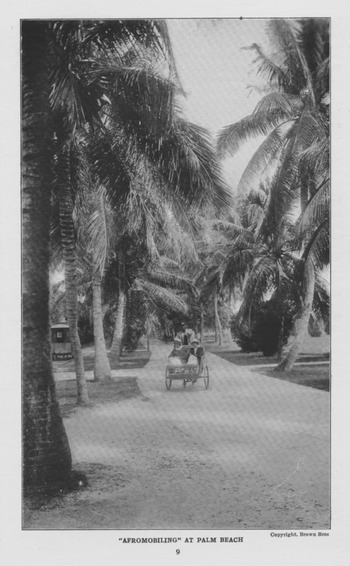
“It is by means of a light perambulator, of ‘adult size’, but constructed of wicker-work, and pendent from a bicycle propelled by a robust negro, that the jungle is thus visited.”Footnote 1 So wrote Henry James in The American Scene (1907), recalling his first wheelchair ride in Palm Beach, Florida. What James described was referred to most commonly by the resort's boosters and guests as an “Afromobile”: a wicker wheelchair fitted for one or two passengers and attached to a bicycle in the rear that was pedalled by a male African American hotel employee.Footnote 2 Despite the vehicle's prominent presence in visual and literary pieces on Palm Beach in the early twentieth century – as well as its present-day exhibition in the Palm Beach County Historical Museum – scholars have yet to analyse the significance of the Afromobile as a cultural artefact of south Florida (see Figure 1).Footnote 3 Drawing on a combination of promotional literature and ephemera, periodicals, and personal narratives, this essay explores the Afromobile as a vehicle and a tourist phenomenon that can illuminate the connections between promotion, tourism, environment, and race in the Florida peninsula, during a period when the region transformed from an underpopulated frontier into a winter haven offering a mild climate, outdoor diversions, and first-class hotels for affluent white Americans. In particular I am interested in the alluring and interlinked messages of environmental exoticism and benign racial hierarchy that infused the Afromobile experience. For black men in south Florida, Afromobiling provided a seasonal form of employment aside from agricultural labour. But in becoming one of the definitive tourist activities in the state's definitive tourist resort of Palm Beach, the Afromobile – for countless white Americans – epitomized south Florida's promise of conspicuous forms of exotic leisure that were enhanced by and inseparable from the tropical environs. Associated with the Orient and the tropics, Afromobiling (as the name suggested) represented a distinctly racialized form of locomotion that supported the creation of Palm Beach and, by extension, south Florida as an imagined tropical paradise for white tourists.
Afromobiles featured prominently in the photographic promotion of Palm Beach from the early twentieth century.

Following railroad and hotel magnate Henry Flagler's founding of Palm Beach in 1892, the Afromobile journey – particularly the verdant “Jungle Trail” described by James that ran for miles through palm-lined gardens – and the vehicle itself developed into iconic symbols of the elite south Florida resort. As part of his vision for a “land of enchantment” for affluent white visitors, Flagler stipulated the prohibition of horse-drawn or motor vehicles, which in his view would disturb the pristine ambience of the setting.Footnote 4 Transportation in and around the resort was restricted to bicycles and wheeled chairs, which quickly assumed an important place in Palm Beach's scene and self-imagery. By the 1920s, a thousand wheelchairs patrolled the grounds, with the Afromobile, as one visitor recognized, having become “the favorite Palm Beach method of locomotion.”Footnote 5
The vehicle's popularity among white sojourners, however, relied upon more than the practicalities of resort travel. Afromobile rides, from their inception at the turn of the century, fed into US fantasies for tropical-style relaxation and experience – fantasies that were enhanced by the US acquisition of actual tropical territories in 1898, when “How to Go to Our New Possessions” became a question for US tourists and travel promoters looking to Hawaii, Puerto Rico, Cuba, and the Philippines.Footnote 6 Feeding into a broader American fascination for tropical leisure, south Florida promoters and developers sold the peninsula and its new resorts as tropical rather than southern.Footnote 7 The Afromobile filled an important role in this exoticized vision of south Florida, playing upon what Jackson Lears has described as a deep-seated desire among elite Americans in the Gilded Age for “antimodern” experiences.Footnote 8 Amid the rapid urbanization, industrialization, and mechanization of US society in the Gilded Age, upper-class Americans craved an alternative to “over-civilized” modernity that, they feared, fostered exhaustion and nervousness.Footnote 9 Direct contact with nature (and especially bountiful tropical nature), combined with observations of or interactions with nonwhite “tropical races” (regarded by many whites as more “primitive” and therefore relatively untouched by modernity's constraints), assumed appealing therapeutic elements: so-called “racial gifts.”Footnote 10 Recurrent images of smiling African American servants and porters in the booster literature of Florida resorts thus conveyed multiple messages to Anglo-American visitors. Not only that black labour enabled white leisure in Florida, but also that an easygoing contentment amounted to a “natural” consequence of the region's tropical climate, environment, and racial characteristics.Footnote 11 The “genial colored man [who] pumps the ‘afromobile’ around Palm Beach” inhabited promotional constructions of south Florida as a perfected playground for tropical-style leisure and pleasure: a domestic (and thus more domesticated) US counterpoint to European colonies in Africa and Asia, or the United States’ own, distant imperialist acquisitions.Footnote 12 Resort promoters thus invoked ostensibly antimodern experiences, exemplified by the Afromobile ride, to attract American visitors curious about the tropics and drive the modern economic development of south Florida through tourism and leisure.
For several reasons, beyond the fact that Palm Beach was founded by northern money and frequented primarily by northern guests, Afromobiling is best understood as an American, rather than a strictly southern, tourist phenomenon. This is not to deny the importance of Jim Crow in the racial and economic structures of Florida tourism, but, rather, to argue that Palm Beach's wheelchair rides reflected white American fantasies and anxieties about race, mobility, and tropical environments that transcended region, while also being used to set south Florida apart from its southern neighbours. Although the success of Florida's beach resorts, as Anthony Stanonis has shown, inspired developers of other southern resorts, the Palm Beach Afromobile was not mimicked elsewhere in the region.Footnote 13 On the contrary, Afromobiling remained, as a fashion magazine writer observed of Palm Beach in 1917, “peculiar to this locality.”Footnote 14 This reflects how Florida – the peninsula especially – conjured distinctive environmental, climatic, and historic associations that distinguished it from the rest of the South. Thus boosters of another leading Florida resort, St. Augustine, as Reiko Hillyer writes, “muted the town's recent Confederate past and linked northern investment in the city to the tradition of European imperial expansion” in the form of earlier Spanish settlement, which worked towards securing Florida's “Spanish rather than southern image.”Footnote 15 Yet further south in the peninsula, in Palm Beach, tropical and oriental “traditions” dominated the promotional literature. South Florida boosters here echoed counterparts in southern California and the Caribbean who, into the early twentieth century, found value in recasting their destinations to North American visitors as “tropical.”Footnote 16 Aided by advances in medical science and horticulture, boosters challenged long-standing negative conceptions of the tropics as debilitating and sickly spaces and marketed them as enticing playgrounds for white Americans.Footnote 17 Often linked to the tropics, the Orient and “orientalist themes,” too, became increasingly “common in the emerging advertising and mass entertainment industries” of the United States.Footnote 18 In south Florida, these promotional constructs included importing royal palms, designing exotic Moorish and Mediterranean-style hotels, and emphasizing in their booster literature the hospitable, unthreatening presence of smiling black servants and children as “typical” tropical peoples. But, specific to Palm Beach, this tropical imagery shaped also the type of locomotion used to traverse the resort: a human- rather than motor-powered vehicle that drew on Anglo-American ideas about the tropics as a realm of racial primitivism and luxuriant leisure.
Furthermore, the one other US resort town that hosted en masse the black-chauffeured wheelchairs – Atlantic City, New Jersey – was in the North. Atlantic City provides a useful comparison to Palm Beach, one that highlights the national rather than regional appeal of Afromobiles while also elucidating the specifically “tropical” associations of the vehicle in its south Florida setting.Footnote 19 In Boardwalk of Dreams, Bryant Simon has explored the immense popularity of Atlantic City's rolling chairs during the resort's heyday from World War I to the 1950s. For Simon, Atlantic City was successfully sold as a “middle-class ‘American Utopia’ … a safe and comfortable place where there was no poverty and where [visitors] could show off by imitating the rich.” The rolling chairs – usually pedalled by blacks – fitted this boosterist dream perfectly. “On the rolling chair,” the middle-class tourist “was transformed into a king, a big man, a real American” (a designation that, of course, also excluded the black driver from this status), the tourist revelling as they journeyed along the boardwalk in a “public performance of racial dominance [and] conspicuous consumption.”Footnote 20
Unsurprisingly, no mention was made of “tropical” leisure on offer in the New Jersey town; in Palm Beach, on the other hand, such geographical and environmental allusions were pervasive. Palm Beach, of course, represented a very different kind of American resort for other reasons too. Less urban and an unashamedly expensive winter retreat for the leisure class, at least before it grew rapidly in the 1920s, Palm Beach resembled more of a tropical, colonial enclave, famous for its exclusive social scene, as opposed to Atlantic City's relatively affordable summer destination for, as Simon puts it, “salesmen from Baltimore.”Footnote 21 Palm Beach's higher cost and pretension attracted no shortage of critics.Footnote 22 In his 1916 short story “Gullible's Travels,” Ring Lardner's Mr. Gullible found Florida and Palm Beach, in particular, an expensive rip-off.Footnote 23 Minnesota Pastor G. L. Morrill castigated Palm Beach as an amoral hive of pretension, gambling, and lewd behaviour. The resort, he found in 1917, was “where the palm is held out for your money as soon as you land.” Tellingly, though, while Morrill refused to “swim, play golf, dance or flirt,” he still felt the need to “get in the ‘push’ by having a negro trundle us in a sort of invalid rattan wheel-chair, variously called a ‘pushmobile’ and ‘Afromobile’.”Footnote 24 Compared to Atlantic City, Palm Beach's dream was less one of “imitating the rich” – for the patrons already qualified – and rather one of imitating European-style leisure in a US tropical and Mediterranean setting. Nevertheless, Palm Beach shared with the New Jersey resort a contemporaneous fascination with wheelchairs pedalled by African American men, indicating how white Americans, whether vacationing in a northern or southern resort, thrilled in a joyride that simultaneously celebrated and constrained African American mobility.Footnote 25
Palm Beach's exotic environs, however, thoroughly distinguished the south Florida Afromobile as a tropical fantasy ride for white Americans. As travel author Harrison Rhodes wrote in a 1914 piece on Florida, “One of the unforgettable romantic adventures of life, on whatever continent it is undertaken, is the first vision of the South, if it be only of the edge of the strange other world which the tropics must always seem to us of the temperate regions of the earth.”Footnote 26 Mixing his orientalist and tropical metaphors, Rhodes painted Palm Beach's climate as “definitely tropical” and its grounds a “very garden spot of the Arabian Nights.” Having fixed Florida at the “edge” of the tropics, Rhodes waxed lyrical about the Afromobile's potential to free industrious white Americans to enjoy the “idle” “life of the resort” traditionally associated with Europeans in sunnier climes.Footnote 27 Popularized around 1900, when the United States embarked on colonial expansion across the Pacific and in the Caribbean, Afromobiling in south Florida offered tropical amusements and “racial gifts” but from within continental US borders – thus adding to Palm Beach's “peculiar” appeal. For promoters and guests alike, the Afromobile became the ideal vehicle for US fantasies of colonial leisure in the exotic garden of south Florida.
JIM CROW FLORIDA AND RACIAL MOBILITY
Although the Afromobile is best understood as “an instrument of cultural power” in the selling of south Florida as a tropical fantasyland for white Americans, it is instructive to locate the emergence of Afromobiling in the 1890s and 1900s alongside two other distinct but related developments in the United States.Footnote 28 First, the hardening of Jim Crow across the South, coincident with Florida's emergence as a renowned tourist destination; and second, the increasing number of automobiles on the road, a small number of which African Americans owned. The reestablishment of racial hierarchy across the South after Reconstruction involved interlinked processes of black disfranchisement and the segregation of the races in public spaces, both designed to constrain the freedom and power of African Americans who had realized a dramatic increase of each in the decade after emancipation.Footnote 29 According to Grace Elizabeth Hale, in the 1880s and 1890s “whites created the culture of segregation in large part to counter black success, to make a myth of absolute racial difference, to stop the rising [of a black middle class].”Footnote 30 Recurrent black resistance to the implementation of Jim Crow (such as Homer Plessy's legal challenge to segregated train cars that culminated in the Supreme Court's 1896 affirmation of the legality of “separate but equal”) ultimately could not stem the white supremacist tide. White violence, including public lynching of blacks, made such resistance – indeed, as little as a misplaced glance – potentially fatal for African Americans.Footnote 31 Florida was no exception in this regard. In Daytona Beach, another Flagler resort town, in 1907, whites paraded on a wagon through the town's black neighbourhood the body of a lynched black man – precisely the kind of spectacle killing that reinforced white dominance.Footnote 32
Indeed, although Florida, as Paul Ortiz observes, “has too often existed on the margins of the literature of the Jim Crow South,” its growth into a tourist paradise by the turn of the century occurred alongside (and abetted by) Democratic Party rule that prioritized Jim Crow as a fundamental plank in the state's social and economic “progress.”Footnote 33 As Flagler and rival Henry Plant constructed railroad lines and luxuriant hotels down the state's Atlantic and Gulf coastlines respectively, they depended upon African American labour – as waiters, porters, barbers, railroad workers, and domestic servants as well as Afromobile drivers – while seeking always to ensure segregation in housing, public spaces, and jobs.Footnote 34 The Afromobile – in which whites were always passengers and blacks drivers – helped to reinforce the message of racial hierarchy that underlay Jim Crow and that New South boosters packaged to the nation.Footnote 35 Much like the separate and unequal spaces assigned to black and white in Jim Crow railroad cars, the Afromobile enabled whites simultaneously to travel alongside, while remaining superior to, African Americans. As Hale has written of segregated trains, “Whites and blacks might set out for the same destination, but en route their difference would be continually reenacted and confirmed.”Footnote 36
Yet even as Jim Crow hardened white rule in the South, the emergence of the automobile as a new mode of transportation potentially threatened this power structure. Transportation – with its promise of what scholars term “automobility, or individual spatial mobility” – represented an important battleground in US race relations in the late nineteenth century.Footnote 37 Across the South, public transportation carriers such as railroads and streetcars became sites of confrontation and enforced segregation in part because of the proximity of the two races therein, which, as Leon Litwack writes, exacerbated “white fears of social equality.”Footnote 38 Jacksonville, Florida was typical of many southern cities in passing a segregated-streetcar ordinance following white complaints about the “attitude” of black passengers. The creation of the “colored” car, notably inferior in quality, served as a reminder of white dominance even while persons were in transit in the region.Footnote 39 The automobile, however, “made racial containment … more problematic,” particularly once a small but growing number of middle-class blacks purchased their own cars in the early twentieth century.Footnote 40 Kathleen Franz has shown how black car owners used automobiles to circumvent rigid segregation and as an expression of racial uplift. But they faced strident white opposition to their expanded locomotive freedom, including Jim Crow policies implemented at automobile parks and a plethora of “tourist narratives, popular fiction, post cards, and automobile advertising [that] all perpetuated minstrel images of blacks as lazy, boastful, and technologically backward.”Footnote 41 In 1905, when African Americans in Nashville responded to the city's ruling that they had to sit at the back of streetcars with a plan to use automobiles to run a passenger service for local blacks, the Little Rock Gazette responded with a patronizing editorial that questioned the capacity of “unskilled negroes” to handle the “delicate mechanism” of modern automobiles: “We don't wish these Nashville negroes any harm, but we believe … that they will realize that the urban transportation game is not one that just anybody can play at.”Footnote 42 African American chauffeurs elsewhere in the South became the targets of white automobile drivers who saw them as a threat to the expected racial order, while the champion black boxer, Jack Johnson, was repeatedly arrested and fined for speeding in his automobiles.Footnote 43 As Cotton Seiler astutely notes, white supremacists “sought to control or curtail those forms and moments of black mobility that they could not exploit for their own purposes.”Footnote 44
The Afromobile – with a name that played self-consciously on the newly coined “automobile” – provided a contrasting form of transportation, one that enabled whites, whether in south Florida or New Jersey, to revel in black locomotion. Unlike the African American automobile owner, who could, in theory at least, drive wherever he wished and potentially escape the controls of white society, the Afromobile driver earned his crust pedalling white employers and patrons. His locomotion became the source of their leisure, and pleasure. Thus his mobility was distinct from the automobile driver's threatening association with black freedom and modernity. Reflecting these broader white anxieties over black automobility, Palm Beach boosters’ depictions of Afromobiles repeatedly presented the black driver as a contented human “engine” – a “motor with a smiling charcoal face,” as travel writer Nevin O. Winter put it – whom whites had paid for and thus implicitly oversaw, even as he drove the bicycle that carried them through the lush gardens.Footnote 45 Re-creating the experience for northern readers, one female tourist in 1924 found it “a delicious thing to ride up and down the well paved highways and side tracks of Palm Beach, pedaled by a white clad, dusky bicyclist, with the sun nicking through the palms.”Footnote 46 For white promoters and tourists, the Afromobile ride was “delicious,” in part because it allowed for interracial proximity and black mobility but without upsetting their ideas of racial hierarchy, and all within a verdant setting that called to mind an escape from modernity, exchanging automobiles and “uppity” African Americans for tropical leisure and the “motor with a smiling charcoal face.”
BLACK DRIVERS, WHITE RIDERS
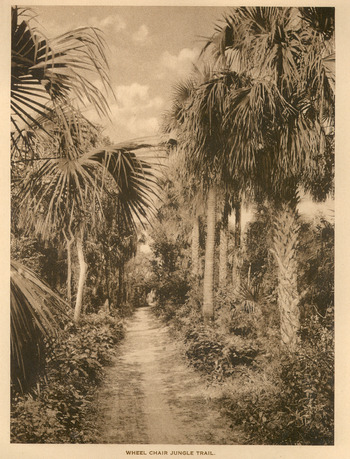
The practice of white tourists in Florida being conveyed to and from the hotel, the beach, the casino, and the jungle in a wheelchair powered by an African American man developed from the final years of the nineteenth century, with the expansion of Standard Oil millionaire Henry Flagler's hotel empire in the Sunshine State. Flagler funded the creation of resorts in Florida that boasted a luxuriant “architecture of leisure” for the Gilded Age elite, combining gardens offering respite from the stresses of modern life alongside up-to-date hotel amenities such as electric lights.Footnote 47 Having constructed the Hotels Alcazar and Ponce de Leon in St. Augustine, Flagler extended his Florida East Coast Railway southward in the 1890s to develop land around Lake Worth, including the barrier island of Palm Beach. Designed to outdo the finest hotel resorts in the Northeast and in Europe, Palm Beach was constructed “exclusively as a beautiful resort and playground for the wealthy,” with West Palm Beach established on the opposite shore of the lake for those unbeautiful necessities such as local shops and worker housing.Footnote 48 The major built attraction was the Hotel Royal Poinciana. A six-storey, five-hundred-room luxury palace, the Royal Poinciana was the largest hotel in the world at the time, lined with gardens of Australian pines and palm trees.Footnote 49 Flagler's resorts emphasized exotic (for Americans, at least) architectural and botanical features, deliberating calling to mind the Orient and the Mediterranean. In St. Augustine, where Spanish and “oriental” references proliferated in the town's architectural and interior designs, the Hotel Alcazar had a Moorish theme, while Palm Beach's gardens possessed a verdant flora that enhanced visitors’ sense of tropical luxury.Footnote 50 As a journalist from Kentucky wrote of the Poinciana in 1900, “There is something about the tropical opulence of its surroundings that entitles it to the adjective [royal].”Footnote 51 Paths for wheelchair rides and cycling were carved into the vegetation on the sixteen-mile-long island and the palm-cloistered tracks became among the most recurrent images in Palm Beach's promotion (See Figure 2).Footnote 52 “Walks and bicycle paths run for miles north and south into a deep jungle, through groves of stately palms and tropical trees, by handsome villas and artistic grounds,” a writer lyricized in the New York Times.Footnote 53
The “Jungle Trail” - through thick palm-lined vegetation - became the most popular and promoted Afromobile route.

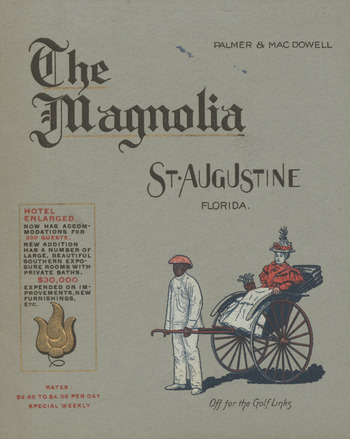
Pedalled wheelchairs became a fixture on these jungle paths, although handheld rickshaws briefly preceded the bicycle-powered vehicles of Palm Beach. In 1900 the Hotel Magnolia in St. Augustine advertised itself with a pamphlet showing a well-dressed white woman in one of the resort's handheld rickshaws heading “off for the golf links” (See Figure 3).Footnote 54 Clubs in hand, she sat behind and above the black driver, whose attire, headwear, and vehicle recalled images of Japanese, Indian, and Chinese jinrikisha drivers from colonialist travel literature on the Far East.Footnote 55 “The jinrikishas, drawn by a human being, are an institution of China,” commented a writer in Vogue in a 1906 feature on the popularity of the vehicle in eastern Asia.Footnote 56 Florida's connection here with a broad and loosely defined “Orient” was no accident. Flagler initially imported Japanese-style jinrikishas for his resorts, including Palm Beach in 1895.Footnote 57 A resort visitor in 1900 noted that the “only modes of conveyance” were “the bicycle and the bicycle chair and an occasional jinrikisha.”Footnote 58 Their impracticalities in terms of balance and comfort, however, meant that the pulled rickshaw of Asia was not destined to be the tourist vehicle of choice in Florida: indeed, as an American journalist in Japan wrote of the jinrikishas, “the vehicle does not meet with the Western conception of comfort,” although “it gives a thrill to the stranger when he rides behind a coolie for the first time.”Footnote 59 In Florida, by 1900, resorts promised both the “coolie” thrill and “Western” comfort, as the rickshaw was superseded by the more mobile bicycle-chair, at the same time that St. Augustine was being surpassed as the state's leading resort by Palm Beach, a destination that would become the undisputed home of the Afromobile.Footnote 60 Almost overnight the Afromobile dominated Palm Beach's transportation, prominent in the resort's advertisements targeting well-heeled northerners. In 1906, the New York Tribune featured a photograph that showed at least sixty-four black drivers posing with the bicycle wheelchairs. The “popular ‘Afro-mobile[s]’ waiting for arriving guests at a Florida Resort,” the caption explained. “Half bicycle and half wheel chair, it runs easily over the hard beaten sands.”Footnote 61
Japanese-style rickshaws were used in the 1890s in Flagler resorts, but they were soon replaced by pedaled wheelchairs, which offered greater mobility, speed, and comfort.

The vehicle might well have “run easily” over the sands and paths, but driving an Afromobile was undoubtedly a hard shift. The journeys in the south Florida sun often lasted an hour or more during which “the negro chair chauffeurs drive the chair along by vigorous pedalling.”Footnote 62 According to one white journalist in 1900, his black driver, when asked whether the job was “harder work than plowing,” stated that it was – “here's all muscle work” – and he only stayed there because of “the good will o’ the people and the fees and things.”Footnote 63
Afromobiling was typical of Florida's growing tourism industry in its reliance on black “muscle work” to fulfil white leisure dreams. As a black newspaper observed of Florida in 1906 – alongside a photograph of an Afromobile – “To prepare the way for an army of pleasure-seekers another subsidiary army is necessary,” and it estimated that nearly three thousand resort workers, many of them African American, were “employed solely to minister to the comfort of the invading hosts.”Footnote 64 One of this “army,” Georgian Thomas Peppers, first came to Palm Beach as a Flagler employee and went on to run one of the resort's wheelchair concessions.Footnote 65 Haley Mickens, born in Monticello, Florida, in the 1890s settled in Palm Beach, where he ran the wheelchair concession for white landowner Colonel E. R. Bradley's Beach Club casino. Mickens founded West Palm Beach's Payne Chapel A.M. E. Church and became a leading figure in the town's growing black community.Footnote 66 His daughter, Alice E. Moore, later a Palm Beach County schoolteacher, recalled how her “Dad … felt very grateful [to Bradley for giving him the wheelchair concession], thus he felt it his duty to transport the colonel and members of his family when needed.”Footnote 67 The economic vulnerability and limited opportunities for advancement that African Americans faced in south Florida may have contributed to Mickens's sense of duty to his white employer. Black settlers like Peppers and Mickens initially lived in an area called the Styx in north Palm Beach. In the early twentieth century, however, white landowners moved the African American community out of the Styx and across Lake Worth to West Palm Beach, creating a firmer geographical separation between the local black (and white) working population in West Palm Beach and the affluent tourists and select few home owners in Palm Beach.Footnote 68 The colour line was rigidly drawn in West Palm Beach also. Peppers's daughter Inez Peppers Lovett recalled, “West of the Dixie Highway in West Palm Beach was blacks. East of the highway was whites,” while in downtown blacks were forbidden from entering stores or sitting down to eat in restaurants.Footnote 69 In Palm Beach itself, blacks’ movement was constantly monitored. Forbidden from entering white-only spaces and required to use specific routes, they could be seen by hotel guests only in specific, subservient roles: waiting tables, cleaning rooms, carrying luggage, performing “cake-walks,” and pedalling Afromobiles.Footnote 70
For African Americans and Caribbean-born blacks in south Florida, Afromobiling offered an important source of income, including tips.Footnote 71 A perusal of the 1910 federal census indicates the limited economic opportunities African Americans had in south Florida: the majority of blacks in Palm Beach County listed “laborer” as their occupation – often on local truck farms – or simply “odd jobs.”Footnote 72 South Florida's rising tourism industry, with its well-heeled clientele, provided alternative, if largely seasonal, employment possibilities. The Afromobile – despite its racial condescension – represented a vehicle for economic gain to support one's family. Indeed, while he likely did better than most wheelchair operators, Peppers “made $2 to $3 a day running the ‘Afromobiles’ at the Palm Beach Hotel” – more than twice what black industrial workers in Georgia earned at the time.Footnote 73 Tips from wealthy tourists could enhance the economic potential. Dora Doster Utz, a white resident of early West Palm Beach, emphasized this custom: “Our [black] servants often took ‘French leave’ of us, to become waiters, wheelchair boys, or caddies for the wealthy people, who tipped them outrageously.”Footnote 74 Alice E. Moore presented a similarly positive picture: for blacks in West Palm Beach, she recalled, working the wheelchairs had simply been “a way of life. The people they pulled, they were very nice. Some of them would tip heavily.”Footnote 75 Blacks seemingly exercised some degree of agency in terms of tips.Footnote 76 According to one Florida magazine, drawing an orientalist comparison to the chariot-driving king of Israel, “The jehu [driver] charges what he thinks you can afford to pay. He is a past master at spotting the inflated bank accounts.”Footnote 77 Writers critical of Palm Beach's excesses chafed at this custom, which, up to a point, suggested African American empowerment. In Ring Lardner's 1916 short story “Mr. Gullible” reluctantly agreed to an Afromobile journey only after his wife complained “that the real people takes them funnylookin’ wheel chairs.” These were (for Gullible) an awkward amalgam of vehicle and man, machine and race: “part bicycle, part go-cart and part African.” Most troubling, however, was paying the black driver at the end of the ride. Gullible “was obliged to part with fifty cents legal and tender,” making him quip that “when it comes time to go back I'll be able to walk.”Footnote 78
This was, of course, missing the point. The resort's affluent tourists, most of whom were perfectly “able to walk,” preferred the Afromobile to get around the grounds for other reasons. In his acerbic 1922 travelogue on Florida, Sun Hunting (1922), Kenneth Roberts described the Afromobile journey as a defining part of the itinerary of the Palm Beach guest: a daily outing that both “massaged” the riders and enabled them a fleeting intimacy with local blacks (whose exercise they appropriated). “The wheel-chair is the favorite Palm Beach method of locomotion, and it is the only form of exercise ever taken by many Palm Beach visitors,” Roberts wrote, adding caustically that the older tourists devoted “at least two hours to it every afternoon” on the grounds that it was “excellent for [their] liver.” A soothing, if not sensual, quality characterized the ride. “The alternative leg stroke [of the driver gave] the chair a gentle side to side motion which acts as a mild massage on the occupant.” The wheelchairs also became sites for interracial dialogue – fundamentally unequal yet oddly intimate. During their stay the closeted tourists often spoke “to no one except the hotel clerks, the news-stand girls, the waiters and their wheel-chair chauffeurs.” Consequently, black drivers acted as cherished sources of local wisdom on “the flora and fauna” and other resort matters – a conversational duty that, along with their pedaling, would “arouse the interest and stimulate the generosity of their charges.”Footnote 79 So did performing tricks for white patrons. Recalling “one of the diversions there [of] riding in wheel chairs which are propelled, bicycle fashion, by lusty negroes,” an unnamed widow from New York wrote in 1905 about how she had tipped her young black driver one dollar after demanding he get for her a hanging coconut. She delighted in how he “went up the tree like a monkey.”Footnote 80
While white riders tipped black drivers for their “exercise” and – in some cases, at least – for performing the desired role of “primitive” in their tropical rides, blacks may in turn have played up to these racist fantasies for financial rewards and regular patronage. Hale has identified this “dangerous dialectic” that shaped racial interactions in the Jim Crow South in which African Americans, responding to “white-crafted representations” of their race, “constructed masks of simplemindedness and sycophancy, loyalty and laziness,” in return for “very material benefits.”Footnote 81 Such “masks” were surely not restricted to blacks in the South, however, as evident in the popularity and performance of Afromobiles in Atlantic City also. Of course, the mask sometimes slipped and white anxieties about the veneer of genial race relations surfaced. A 1910 collection of stories entitled Tales of Palm Beach, for example, featured one character who “tipped the waiter generously,” only then to be “enlightened by the insolent expression of the negro as he surveyed his palm.”Footnote 82
Real or imagined, black “insolence” challenged white supremacy and was put down as brutally in south Florida as elsewhere in the country. Local whites in Palm Beach County maintained racial hierarchy through a combination of state and legal authority, economic power, and violence.Footnote 83 Economic intimidation was commonplace. In 1920 efforts by black waiters in Palm Beach to strike for higher wages were quashed by the local sheriff's threat to arrest them.Footnote 84 Whites also used violence to terrify blacks and reinforce white supremacy under the guise of social “order.”Footnote 85 On 6 June 1923, a local white mob targeted West Palm Beach's black quarter after the shooting of a white policeman. As white law enforcement authorities focussed their energies on keeping African Americans out of sight, a white mob whipped several blacks and lynched one – a Bahamian named Henry Simmons – whose body they then hung from a tree on the Poinciana's baseball ground: a very public message of racial dominance in a place where whites and blacks regularly played ball games for the entertainment of tourists.Footnote 86 This murder, however, happened mid-summer, out of season: few tourists would have been in the resort. Their visions of Palm Beach, in any case, elided the racial violence and economic intimidation that reinforced white supremacy, focussing, instead, on the exotic scenery of south Florida: its verdant gardens and black-chauffeured rolling chairs. The smiling Afromobile driver made a far more alluring symbol of tropical Florida than did the lynched black man or rundown black houses across the lake.
TROPICAL FANTASIES AND THE AFROMOBILE
“The Afromobile is the accepted conveyance, and … it is a wheeled chair drawn by an African guide,” a magazine writer explained in a 1917 article on Palm Beach. In a typical refrain, the writer then employed both orientalist and tropical imagery to capture the experience: “Solomon and the Queen of Sheeba would cast envious eyes … could they but glimpse the cocoanut groves, the flowering vistas, the leafy jungles” of the resort, which called to mind “days of ye olden tyme [sic], when at some famous baths over the seas fair ladyes [sic] in beauteous array were wheeled about in sedan chairs.”Footnote 87 As such accounts attest, for numerous white visitors the Palm Beach Afromobile called to mind European-style colonial leisure, whether in the tropics or the Orient (or both). South Florida's climate and environment gave vital verisimilitude to these fantasies. A typical promotional pamphlet from the 1890s declared of Palm Beach's landscape, “Bank after bank of flowers, foliage plants almost without number, limes, lemons, and a world of other growth suggestive of the two Zones, make one feel as if the land of enchantment had been reached, a perfect description of which would sound more like an oriental romance.”Footnote 88 This, to be sure, was a broad and amorphous “Orient,” alternately drawing links to Arabia or China, Persia or North Africa. The connection, however, was the perceived exoticism and sensuality of those different places. For Anglo-Americans, the “Orient was the maker of a game to play, of ways in which one could acquire, for however short a time, another personality or another experience, both personality and experience being primarily sensuous and, at some extreme, desirable but forbidden.”Footnote 89
Orientalism represented a recurrent feature in south Florida development. Most notably in Opa-Locka, a new town built in the 1920s boom “to fulfil a developer's dream of Araby” with the designer taking inspiration from the Arabian Nights.Footnote 90 Ironically, as Catherine Lynn has written, a strong, if unacknowledged, parallel existed in terms of the racial anxieties of US white supremacists and Opa-Locka's inspiring text, a work of romantic fiction in which “fear of black power – especially the sexual potency of male African slaves and its allure for the cloistered princesses of Araby – dominates much of the text's opening pages.”Footnote 91 Opa-Locka's designer was far from the first Florida developer to take a lead from the Arabian Nights. Thirty years earlier, Palm Beach's promoters – glossing over the text's racial fears – depicted a modern Arabia springing to life full of black servants at the beck and call of affluent whites. The Hotel Royal Poinciana's 1894 brochure advertised the resort's “Arabian Nights” quality, which, as Susan Braden states, was less an architectural link (the hotel was designed in the colonial revival style) and “more to do with the atmosphere of luxury” on display.Footnote 92 The hotel and its gardens were “like a myth from the Arabian Nights, rising at the touch of a modern Aladdin.”Footnote 93 Tourists and travel writers similarly praised the rich vegetation of private mansions in Palm Beach. The garden of a Philadelphia magnate reminded one visitor “of Hichens’ Garden of Allah in its shaded depths and tropical verdure,” while a guidebook described the tall, imported royal palms as “the trees of kings’ courtyards” and “columns [that] should grace the stone palaces of the Pharaohs.”Footnote 94 In Palm Beach, a female tourist wrote, “we Americans have evolved a place of recreation that old Kubla Khan might well have envied.”Footnote 95
These orientalist “games” contained a strong – if, in the context of traditional US national identity, “forbidden” – undercurrent of colonialist fantasy that shaped how white Americans interpreted tropical Florida and its Afromobile rides. Indeed, in borrowing from European colonial imagery of the Orient and the tropics, Florida boosters mirrored a trope in contemporaneous US imperialism. As Paul Kramer has shown, in relation to US involvement in the Philippines after the acquisition of those islands in 1898, “U. S. imperialists often took inspiration, in complicated ways, from the world's other empires, especially the British Empire.”Footnote 96 While such overt imperialism sat uneasily with many Americans, reared on a national narrative of anticolonialism and the continental expansion of “liberty,” it infused US promotional writings about the nation's new tropical acquisitions, such as Hawaii and the Philippines, whose native peoples and products were displayed at events like the 1904 St. Louis World's Fair that emulated European exhibitions.Footnote 97 While President William Taft hoped the exhibition would “put Philippine resources before the eyes of American consumers and investors,” numerous visitors thrilled in their encounter with imported native huts, tropical trees, and, in the words of Atlanta editor Henry Grady, “the peculiar people to be seen, their un-American dress, their wild customs and habits, [which] give the exhibit a spectacular side that draws thousands of sight-seers every day.”Footnote 98 Much like US imperialists, but without the troubling moral and political baggage of overseas colonialism (nor the “wild” threat of Philippine military resistance), South Florida promoters repeatedly conjured the imagery of tropical environs and Afromobile drivers to attract white Americans to their resorts.Footnote 99
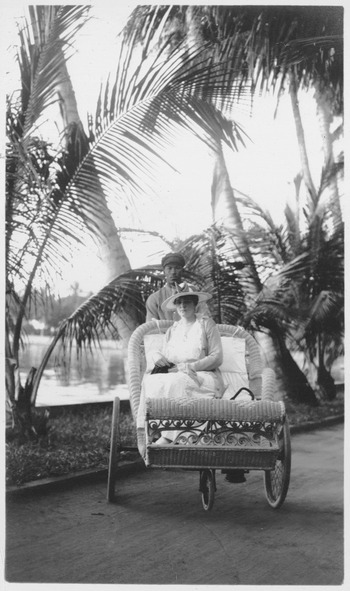
Locomotion became key to this tropical fantasy. For tourists, Palm Beach's “avenues of coconut palms and palmettoes” that ran “for miles, even into the jungle,” were best experienced through a modernized, American variant of the rickshaws of Asia: the “wheel chairs propelled by black boys pedaling behind, the jocosely termed ‘Afromobiles’.”Footnote 100 These rides included the promise of contented black service, with hospitality perceived as one of the core traits of tropical peoples.Footnote 101 The Afromobile driver was expected to smile as well as pedal. Florida guidebook author Nevin O. Winter thus explained of the Palm Beach rides that ran “through tunnels of strange vegetation and past weird trees”: “You will soon learn that the general means of conveyance [in Palm Beach] is a horseless carriage propelled by a motor with a smiling charcoal face.”Footnote 102 Constructed in such a way, the Afromobile journey played up to white expectations of “genial” and unthinking black servitude. On one level, this worked to neuter the threat of African American mobility since in the form of the wheelchair ride black mobility became a white-controlled activity. Vogue magazine in 1913, depicting two white guests – Robert M. Thompson, a local houseboat owner, and US naval admiral Richard Wainwright – on board a wheelchair, described the pair as “in command of an ‘afro-mobile’” (despite the fact the vehicle was in reality powered and directed by the black man sat behind them).Footnote 103 This colonialist narrative of white command helps to explain why, as numerous souvenir photographs indicate, Afromobiling appears to have been an unusual activity for the period in that it was perfectly acceptable for white women and black men to be left alone together – at least for the duration of the journey through the resort, where, as Braden writes, “women enjoyed more freedom than in urban environments because resorts … functioned rather like private estates and country clubs” (see Figure 4).Footnote 104 This “country club” ambience supported the Afromobile's interracial and inter-gendered coupling due to the racial dynamics of power that shaped it. Notably the reduction of the black male driver's power to a purely physical function. “Behind each of these chairs is a stalwart darkey [sic] on a wheel, who earns his dollar a day by the sweat of his brow,” one journalist explained of the journeys through the resort's “beautiful tropical tangle.”Footnote 105
Women often rode Afromobiles on their own, a reflection of the “country club” atmosphere cultivated at Palm Beach.

The black driver's exertions helped to affirm white fantasies of a tropical environment in which the “muscle” work of smiling and “technologically backward” blacks freed whites to relax.Footnote 106 Harrison Rhodes put this most bluntly in his popular travel guide, In Vacation America (sections of which were reprinted in newspapers). Praising Palm Beach as “a kind of dream of blazing flower gardens and alleys of palms,” Rhodes combined the fantastical elements of resort promotion with the controlling element that lay at the heart of Palm Beach's wheelchair phenomenon: “Its most characteristic sport is the wheel chair – the Afro-mobile, socalled [sic] from the black slave of the pedal who propels you.”Footnote 107 The “sport” suggested a return to an earlier (pre-mechanical) time. Riders frequently praised the “silence” or “noiselessness” of the Afromobile and driver – comments that further hint at the antimodern appeal of the activity at a time when motorcars were transforming US roads and communities. The Afromobile, Rhodes stated, “is silent and ordinarily swift,” while Winthrop Packard liked how the wheelchairs went around “silently bearing” their passengers.Footnote 108 Attempts to implement motorized Afromobiles received a notably cool response from guests. Reflecting the racist view of blacks as ill-suited to modern, motorized vehicles, one journalist claimed that the new “motor cycle wheel chair” created “havoc with the bicycle chair men, negroes, who shy at it, as do horses at automobiles.”Footnote 109 In the 1920s, several vehicles were equipped with small gasoline engines and electric motors which, a local reporter noted, meant “the occupants of the chairs could drive the vehicles themselves” – yet, tellingly, he added, “these innovations were not popular.”Footnote 110 While engine fumes and noise no doubt formed a factor in this, it is clear from the testimonies of tourists that, for them, a large part of the pleasure of Afromobiling lay in the human element: the fact that it was powered by a black man rather than an electric motor. “To roll gently along these fragrant and shaded trails and byways in a luxurious wheel chair propelled from the rear by a white-clad darky on a bicycle,” one female tourist wrote, “is infinitely more delicious than to speed in an automobile along these smooth highways.”Footnote 111
In contrast to the modern threat of black “automobility,” linked to technology, independence, and freedom, “Afromobility” in the tropical environs of south Florida cultivated associations with premodern manual labour and colonial hierarchy in Africa and Asia. Suniland magazine thus hailed the thrill of “the curious bicycle chairs that are propelled by the muscular calves of swarthy sons of Ethiopia.”Footnote 112 Winthrop Packard's 1910 guide to wintering in Florida was even more explicit in constructing a tropical–oriental fantasy around the experience. Describing the resort in Eden-like terms as “The Garden,” Packard likened the wheelchairs to the locomotion that had been used in the Arabia of the fifth Abbasid Caliph, Harun al-Rashid. The physical journey between the coconut trees, which “put the touch of picturesque adventure on the place,” was transposed into a racial and temporal excursion into the luxury of the Orient. “Benevolent Afreets frequent The Garden and the jungle path at all points,” Packard wrote of the drivers, promising in modern Florida the ancient silent service of African genies:
In the days of Haroun-al Raschid these used to gather princes up in mantles and bear them noiselessly from point to point. Here the mantle has become a wicker-basket wheel-chair, but the Afreets are in the business still and all along the paths you see them passing, silently bearing one or two passengers. A dollar wish will bring a bronze magician to your service for an hour and you glide majestically on air the while. You may be irreverent of tradition if you will and dub the Afreet and his conveyance an Afromobile, and say the air on which you glide majestically is but so much as is included in the inner tube of pneumatic tires, but the effect is the same.Footnote 113
This “effect” was to realize white Americans’ dreams of tropical leisure without leaving the United States: to “glide majestically on air,” while their black driver – the “Afreet” – pedalled them tirelessly through the palm-lined paths.
CONCLUSION
This “dollar wish” was still being fulfilled into the 1920s when “the shores of beautiful Lake Worth,” as one article explained, were “linked together by afromobile highways.”Footnote 114 In that decade, however, the resort and its “highways” changed rapidly as south Florida's real-estate boom sparked expanded hotel and house construction and the introduction of more and more motorized cars, thereby decreasing the historic reliance on Afromobiles in and around Palm Beach.Footnote 115 A representative 1926 pamphlet entitled Greater Palm Beach featured open-top automobiles on its cover (with not a single wheelchair within), the emphasis on investment and real-estate opportunities in a fast-growing town as much as on the leisure pursuits for which the resort was already famed.Footnote 116 Increased pollution further diminished the wheelchairs’ appeal. A 1930 Washington Post article, citing plans to preserve the Afromobiles that had “threatened to become extinct,” in part by setting aside specific paths solely for the wheelchairs, explained that “autos with gas fumes … [had] made riding in the wheel chairs unpleasant.”Footnote 117 Efforts to convert the Afromobiles into motorized vehicles themselves failed, with tourists preferring the human-powered contraptions for their “tropical rides.”Footnote 118 As automobiles became increasingly common at Palm Beach, the Afromobile, in a restricted scope, remained a tourist diversion through the 1930s and 1940s, notably on the Lake Trail, where motorized vehicles continued to be banned. Yet the wheelchair's former ubiquity in Palm Beach was ending.Footnote 119 The boom in automobile ownership in the late 1940s and the 1950s, coinciding with the postwar influx of residents to south Florida, made the Afromobile an increasingly anachronistic means of transportation. By 1955, with the resort dominated by automobile traffic, the Palm Beach Post referred to the “almost extinct afro-mobile wheelchairs.”Footnote 120
Yet, in the postwar period, the wheelchairs also became a historic, nostalgia-inspiring icon of Palm Beach. If no longer featured foremost in the resort's marketing literature, the wheelchairs instead were found (in 1947) as a centrepiece for a downtown hotel's new lobby mural, and (in 1962) in a piece in the Palm Beach Post that reproduced a decades-old photograph showing a wheelchair with a smiling, young white couple and its driver. Written in the midst of the civil rights movement and the federal dismantlement of Jim Crow and entitled “Looking Backward,” the piece struck a decidedly poignant tone, the Afromobile – and its black driver – remembered fondly, as if symbols of some earlier golden age of racial propriety (when blacks, presumably, showed greater outward deference to the tenets of racial hierarchy). “The Exact Date of this picture is not known,” the caption read,
but it harks back to the days when the Afro-mobile was Palm Beach visitors’ favored means of transportation, even though the mobile no longer took the place of the automobile. The honeymooning couple probably will be unrecognized by anyone here, but many will recall the driver, one of the community's best known figures. Do you remember him?Footnote 121
Fond memories are evident in more recent testimonies. A 2011 photo-book marking Palm Beach's centennial quoted two elderly white residents who recalled, “When we were kids our dad would take us to ride the Afromobiles … what fun!”Footnote 122 Nowadays visitors to the town can see an Afromobile on display at the Palm Beach County History Museum. The exhibit features “an actual ‘Palm Beach coach,’ a wicker wheelchair/bike powered by a pedaling tour guide,” the museum website states.Footnote 123 From hotel art to newspaper pieces, photo-books to museum exhibits, the “extinct” Afromobile lives on in both public and private memories of Palm Beach.
This only makes it more important to understand how the vehicle reflected the significance of race, mobility, and fantasy in the promotion of south Florida as a tropical US tourist destination. While it provided a source of income for black residents of West Palm Beach, Afromobiling offered white guests an idealized form of locomotion for their visions of a tropical playground akin to European colonial and oriental resorts. The name alone, of course, spoke volumes, explicitly linking the rides to Africa and Africans. Indeed, although the Palm Beach County Historical Society's website claims that the name – Afromobiling – only came into use “in later years,” the historical record indicates otherwise.Footnote 124 “Afromobiling” was coined in the very early years of Palm Beach, at a time when black automobile ownership was fostering anxiety among white Americans. In replacing “auto” with “afro,” and a motor engine with human exertion, Palm Beach promoters created a tourist experience that enabled whites to thrill in black locomotion. “Here,” as one journalist wrote, “is mounted your dusky chauffeur who pedals and perspires while you jog easily along your way.” The “popular Afro-mobile” was popular not least because it converted black mobility into a conduit for white tropical escapism.Footnote 125 Thus “the motor with a smiling charcoal face” became inseparable from the gardened paths of south Florida, at the very heart of the tropical tourist experience. As one writer noted in the 1920s, the Afromobile in Palm Beach was as “firmly entrenched in the native geography as are the stucco bungalows of Spanish design and the royal palm trees.”Footnote 126