Introduction
After lung and liver, the skeletal system is the most common location for metastasis.Reference Heymann 1 Skeletal metastases develop in 70–80% of patients with breast or prostate cancer and in up to 40% of patients with advanced stage lung cancer.Reference D’Antonio, Passaro and Gori 2
Bone metastases can cause significant morbidity. The management of bone metastases depends upon location as well as patient performance status and previous treatment.Reference Heymann 1 Therapeutic options include analgesics, systemic therapy, bisphosphonates and radiotherapy. The purpose of such treatments is to relieve pain and reduce risk of fractures. Treatments can also prevent problems linked with untreated progressive disease such as spinal cord compression.Reference Magné, Chargari and Mirimanoff 3
It has been found that 50% of cancer patients will have palliative radiotherapy during the course of their disease. Palliative radiotherapy has a 50–80% likelihood of overall pain relief.Reference Chow, Harris, Fan, Tsao and Sze 4
Randomised controlled trials have been carried out comparing single and multiple fractionated (SF and MF) regimes. Even though the findings have shown a comparative efficacy of both single- and multiple-fractionated schedules, it has been shown SF treatments remain underused.Reference Chung, Koom and Ahn 5 – 9
The aim of this study is to carry out an audit of a number of radiotherapy departments and their current external beam radiotherapy regimes to investigate factors associated with the choice of dose and fractionation in the treatment of bone metastases.
Ethical Issues
Participants and their trusts were assured of their and their trusts anonymity and permission were granted from the managers at each department. Nine departments were contacted which had a partnership with Sheffield Hallam University.
With regards to approval of this study, the Faculty of Health and Wellbeing Research Ethics Committee was consulted, and approval received. 10
Once permission was gained, an email was sent to the consultants and registrars inviting them to take part.
Materials and Method
An electronic audit was designed and performed amongst 46 physicians, within seven hospital trusts. The seven trusts used were partnered with Sheffield Hallam University as part of their nine current training sites. This was distributed using Survey Monkey (Survey Monkey Solutions, Dublin, Ireland). An advantage of an electronic audit is that they tend to acquire a greater response compared to postal surveys.Reference Braithwaite, Emery, De Lusignan and Sutton 11
The audit comprised of open and closed questions, four hypothetical cases of patients with bone metastases as well as general demographic questions. Population, Exposure and Outcome (PEO) and Population, Intervention, Comparison, Outcome (PICO) research models were used to help shape and define questions.
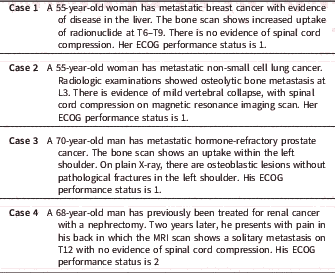
The hypothetical cases used within the survey were adapted from previous studies to allow comparisons to be made.Reference Chung, Koom and Ahn 5 – Reference Nakamura, Shikama and Wada 7 , 9 Table 1 describes the hypothetical cases that were used in the survey. See Appendix 1 which shows the full survey.
Hypothetical cases

Abbreviations: T, thoracic; L, lumbar; ECOG, Eastern Cooperative Oncology Group.
A pilot study was carried out in one of the clinical sites to test the survey and determine whether further development of the questionnaire was needed. Minor changes were introduced as a result of the pilot.Reference Silverman 12
Sampling
The sampling method that was used was voluntary convenience sampling. Consultants and registrars in oncology were invited to participate via email.
Data analysis
The data were analysed using the Statistical Package for Social Sciences (SPSS), version 24. There was a mixture of qualitative and quantitative questions used. The type of variable used established how the data were presented.Reference Maltby 13 Quantitative variables would include nominal or ordinal variables, which can be presented using graphs to identify any patterns. In this case, the nominal variables were the number of consultants that prescribed a certain fraction for a hypothetical case.
The data were represented using bar graphs (see Figures 1 and 2) so that comparisons could be made.Reference Maltby 13 In that, the radiation dose prescription that each consultant and registrar decided to prescribe was compared for each hypothetical case. The data were also presented in Tables 2 and 3, so that cross-tabulation could occur.
Distribution of responses.

Fractionation schedule for each case.

Significant factors influencing the decision of a single fraction

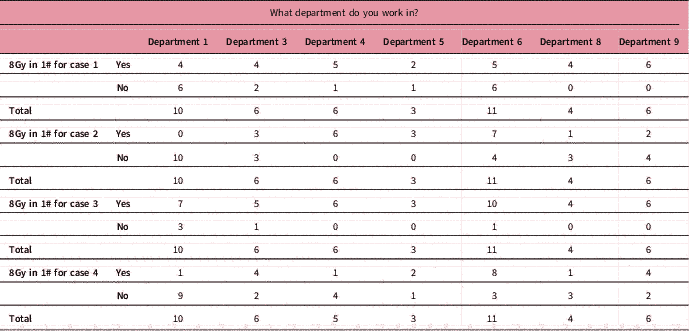
Comparison of departments for cases 1,2,3 and 4 recommending 8 Gy in 1#

As categorical data were produced a chi-square test (χ2) performed to test significance between two variables such as factors associated with the choice in fractionation. 14 A P value lower than 0·05 was considered to indicate statistical significance.
Discussion and Results
SF vs. MF Regime When Treating Bone Metastases
Studies have compared the efficacy of an SF to MF schedules when treating patients with bone metastases. In terms of MF regimes, they have varied from 20 Gy in 5 fractions, 24 Gy in 6 fractions, 30 Gy in 10 fractions and 40 Gy in 20 fractions. The SF usually consists of either 6 Gy or 8 Gy.Reference Heymann 1
A systematic review and meta-analysis of the literature, which compared SF radiotherapy to an MF schedule for patients with bone metastases were completed by Sze et al.Reference Sze, Shelley, Held, Wilt and Mason 8 in which 11 trials involving 3435 patients were identified. The findings had shown that the overall pain relief response rate was 60% for patients who had an SF and 59% for those that had an MF regime of radiotherapy. Confidence intervals were 0·89–1, which infers that were no differences in overall pain relief within the treatment schedules. The similarity between the treatment schedules regarding complete pain response implies that SF radiotherapy is as effective as multiple-fractionated radiotherapy, in terms of pain relief. Similar findings were shown by Arnalot et al.,Reference Arnalot, Fontanals and Galcerán 15 Chow et al.Reference Chow, Zeng, Salvo, Dennis, Tsao and Lutz 16 and Wu et al.Reference Wu, Wong, Johnston, Bezjak and Whelan 17
Strengths of SF radiotherapy
Another advantage of SF treatments was demonstrated by Hartsell et al.Reference Hartsell, Scott and Bruner 18 Their results show that the SF schedule had less acute toxicity compared to the MF arm. This study only included patients with primary breast or prostate cancer, which means outcomes may not be the same as other sites. However, Wu et al.Reference Wu, Wong, Johnston, Bezjak and Whelan 17 compared factors such as pain relief and acute toxicities across different tumour types and found that there was no significant difference in pain relief. Furthermore, the quality of life assessment did not show a difference between the single and multiple fractionation arms.
Hartsell et al.Reference Hartsell, Scott and Bruner 18 further highlighted that SF radiotherapy offers a major economic advantage of savings in radiotherapy capacity. However, reimbursement and health infrastructure are different in the United States than in the United Kingdom, making it difficult to apply these findings to the UK healthcare setting. Hartsell et al.Reference Hartsell, Scott and Bruner 18 stated that fewer visits to the hospital would result in lower cost for the patient.
Weaknesses of SF radiotherapy
One of the main drawbacks of delivering palliative radiotherapy in a SF is the retreatment rate being higher than a multiple fractionated regime. Chow et al.Reference Chow, Zeng, Salvo, Dennis, Tsao and Lutz 16 found that the retreatment rate was 2·6-fold greater in the SF arm, statistically significant (p=0·00001). The reason behind this could be due to the radiation oncologists being more willing to retreat patients when they have had an SF due to SF treatments being well within the limits of radiation tolerance.Reference Wu, Wong, Johnston, Bezjak and Whelan 17 , Reference Howell, James and Hartsell 19 , Reference van der Linden, Lok and Steenland 20
Another weakness of delivering the 8 Gy in a SF compared to MF schedule is the risk of a pathological fracture in the SF arm is greater.Reference Chow, Zeng, Salvo, Dennis, Tsao and Lutz 16 Though the systematic review had shown that there was not a significant difference between the two when they had reviewed 10 trials that had reported pathological fracture rates. Despite the results not being statistically significant, there was a trend for lower rates in the MF arm.
Stereotactic Body Radiotherapy
Stereotactic Body Radiotherapy (SABR) is a technique used to deliver a high dose of radiation to a target in a smaller number of fractions in comparison to conventional radiotherapy. This can provide better local control and longer symptom palliation in the setting of bone pain, compared to conventional radiation therapy. There are certain criteria that need to be met for SBRT treatment such as well-circumscribed, inoperable lesion.Reference Jhaveri, Teh, Bloch, Amato, Butler and Paulino 21 Current published results suggest that we can use SF at up to 20 Gy for relief of acute bone pain.Reference Jhaveri, Teh, Bloch, Amato, Butler and Paulino 21
Studies to show patterns of practice
In spite of the number of randomised controlled trials showing the efficacy of delivering radiotherapy in an SF,Reference Sze, Shelley, Held, Wilt and Mason 8 , Reference Arnalot, Fontanals and Galcerán 15 – Reference Wu, Wong, Johnston, Bezjak and Whelan 17 there is a variation in practice on an international basis as well as differences between centres in the United Kingdom. For instance, a study distributed an electronic survey to radiation oncologists to find out their patterns of practice.Reference Chung, Koom and Ahn 5 The findings showed that the most prescribed schedule was 30 Gy in 10# emphasising a gap between evidence and practice. It also looked at the decision factors affecting dose prescription, which allowed for comparisons to be made. In that, the oncologists were more likely to prescribe a shorter fractionation regime if the life expectancy of the patient was short.
As mentioned, patterns of practice may vary between radiotherapy centres. A review collated several trials to determine global patterns of practice.Reference Popovic, den Hartogh and Zhang 22 It was found that radiation oncologists from the United States and Asia were less likely to deliver radiotherapy in an SF (range: 1–15·6% of hypothetical cases), whereas patients in Canada, Australia and from the United Kingdom were more likely to receive an SF (range: 10·9–38·9%). The variation in practice may be due to oncologist preference, possibly influenced by reimbursement, patient age and the number of sites of bone metastases.Reference Bradley, Husted and Sey 23 It was concluded that a global reluctance still exists regarding the prescription of an SF of radiotherapy over the 20 years they had studied (1993–2013).Reference Popovic, den Hartogh and Zhang 22
It was found thatReference Gebhardt, Rajagopalan and Gill 24 the utilisation rate of SF was below 5% despite the American Society for Radiation Oncology (ASTRO) guidelines, as a result ASTRO published new guidance in 2017.Reference Lutz, Balboni and Jones 25 This was due to new literature that had arisen since 2011.Reference Chow, Zeng, Salvo, Dennis, Tsao and Lutz 16
For this research, an audit was undertaken and aimed to show what factors influenced the consultants in the United Kingdom with the choice of prescribed dose and differences between centres in the United Kingdom.
Aim/research question
“An audit of current external beam radiotherapy regimes in parts of the UK to investigate factors associated with the choice of dose and fractionation in the treatment of bone metastases.”
The literature review showed that there is a variation in patterns of practice when treating bone metastases despite there being abundant evidence and guidelines of the equivalence of SF to an MF regime. There are multiple factors that influence the choice of fractionation as discussed in the literature review. The recent publication by ASTROReference Lutz, Balboni and Jones 25 could influence patterns of practice and standardise the care of patients with bone metastases.
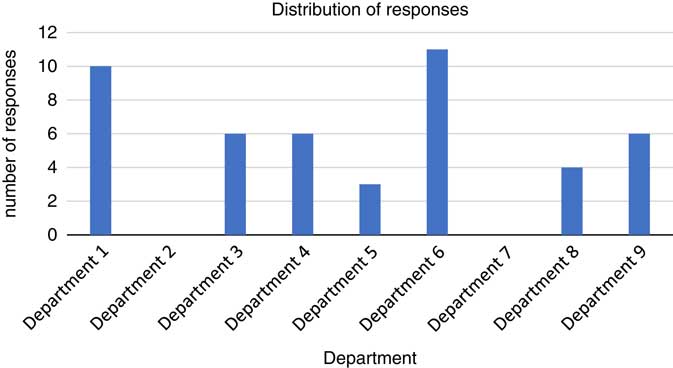
A total of 46 clinical radiation oncologists returned responses. Seven out of the nine departments that work in partnership with Sheffield Hallam University took part in the audit. The distribution of the departments in the population of responders is shown in Figure 1. Of those responders, 39 were consultants and 7 were registrars.
Fractionation for bone metastases
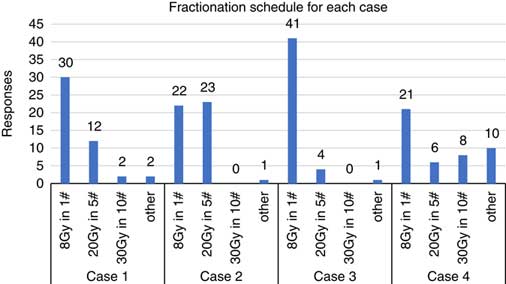
The recommended doses for cases 1 through to 4 are summarised in Figure 2. For case 1 and 3, the most commonly prescribed regimen was 8 Gy in 1#. Case 2 described a patient with mild vertebral collapse with evidence of spinal cord compression. The results show that 47·83% of respondents would deliver radiotherapy in an SF. For oligometastasis (case 4), 22% of respondents would prescribe a high-dose MF radiotherapy.
Factors associated with the fractionation schedule used
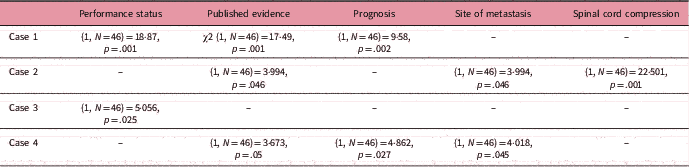
The results of the chi-squared test had shown certain factors to have an influence on the fractionation schedule. Table 2 shows the factors that had a significant relationship between the SF and the factors for each case.
Inter-Institution Differences
The results had shown that certain departments are more likely to choose an SF. Table 3 shows how many physicians at each department decided to prescribe 8 Gy in 1# for case 1. The physicians from department 9 all decided they would give an SF. Whereas, 66% of physicians at department 1 would choose the SF. Furthermore, the physicians at department 6 were more likely to choose an MF regime.
For case 2, Table 3, shows that all of the physicians at department 1 would prescribe 20 Gy in 5#. In comparison to this, all the physicians at department 4 and 5 would deliver radiotherapy in an SF. However, department 3, 8 and 9 indicated differences within their departments.
Findings
This survey was performed to demonstrate patterns of practice in patients with bone metastases and to determine the factors affecting radiotherapy prescriptions. The most commonly prescribed prescription was 8 Gy in 1#. However, MF schedules are still being used. The factors influencing such decisions included performance status, published evidence and site of metastasis. This varied depending on the hypothetical case. The factors least influencing such decisions were department policy, finance, patient choice and patient age.
Case 1
The results had shown that the majority of consultants and registrars would use an SF (65·2%). This case was modified from a study,Reference Fairchild, Barnes and Ghosh 6 to allow comparisons to be made. In fact, their results had shown that only 12·1% of all respondents recommended SF radiotherapy. This suggests that since 2009, an increased uptake in consultants preferred to use SF radiotherapy.
Furthermore, there was a significant relationship between the use of 8 Gy in 1# and the influence of published evidence, χ2 (1, N=46)=17·49, p=.001. Having said that, there was also a significant relationship between 20 Gy in 5# and the influence of published evidence, χ2 (1, N=46)=11·576, p = .001.
There was a significant relationship between SF radiotherapy and prognosis, χ2 (1, N=46)=9·58, p=.002. This is comparable to other studies such asReference Chung, Koom and Ahn 5 who found that 69·3% of respondents felt that the prognoses of patients are a factor that would influence their decision. It was found that 46% of respondents would choose SF radiotherapy if the patient has a poor prognosis.Reference Magné, Chargari and Mirimanoff 3 A studyReference Fairchild, Barnes and Ghosh 6 stated that due to the limited survival of palliative patients, the use of SF radiotherapy is recommended, to decrease the time spent in medical appointments.
Case 1 involved disease at T6–T9. It is not feasible to use SABR to treat extensive multilevel disease that involves the spine.Reference Jhaveri, Teh, Bloch, Amato, Butler and Paulino 21 However, a respondent recommended a ‘SBRT type dose if she has oligometastatic disease’.
Another respondent stated that travelling distance can be a factor, but ‘other factors selected usually have more of an impact on choice of dose/fractionation’. As part of the reasoning from Lutz et al.Reference Lutz, Balboni and Jones 25 recommending the use of an SF, it was mentioned that a single 8 Gy fraction provides a none inferior pain relief compared to an MF regime, which can be convenient for patients with a poor prognosis. Patient convenience was an important factor when recommending the fractionation, in 3·4% of patients.Reference Chung, Koom and Ahn 5 This indicates that this is not one of the main factors in determining dose.Reference Chung, Koom and Ahn 5
Case 2
For case 2, 22 respondents (47·83%) selected delivering an SF schedule, whereas 24 respondents (52·17%) chose a multi-fractionated regime. Indicating differences in the dose prescription when patients have spinal cord compression. A comparable case about spinal cord compression was in a survey distributed in Italy. 9 The results had shown that 30% of respondents would prescribe SF radiotherapy. The low use of SF radiotherapy was attributed to the perceived risk of cord compression and that neuropathic pain requires high doses to alleviate pressure on nerves. Nakamura et al.Reference Nakamura, Shikama and Wada 7 included a comparable case within their study and the findings had shown that 79% of respondents would deliver using a multi-fractionated regime. However, a small sample size reduces reliability in this study.
On the other hand, two respondents noted that ‘SCORAD trial results’ influenced their decision of choosing an SF. Hoskin et al.Reference Hoskin, Misra and Hopkins 26 compared 8 Gy in 1# to MFs for patients with spinal cord compression and found that using a single dose of 8 Gy is as effective in terms of overall survival. Therefore, it is recommended to use a single dose in this setting, with the main benefit of requiring a single visit.
In terms of the factors influencing the respondent to choose an SF, there was a significant relationship between spinal cord compression and delivering an SF, χ2 (1, N=46)=22·501, p = .001. Also, there was a significant relationship between published evidence and delivering an SF, χ2 (1, N=46)=3·994, p = .046.
Case 3
Case 3 described a hormone-refractory prostate cancer patient, who presented with progression of pain which was found to be osteoblastic lesions in the left shoulder. The findings had shown that 89·3% of responded would choose SF radiotherapy. The survey distributed by Fairchild et al.Reference Fairchild, Barnes and Ghosh 6 had a comparable case which was also found to have 8 Gy in 1# as the most common regimen. There was a significant relationship between prognosis and delivering an SF as p=0·01. This is because of the limited survival of patients and the importance of decreasing the time invested in hospital appointments.Reference Fairchild, Barnes and Ghosh 6
A respondent chose to deliver an SF schedule but stated the increased likelihood of retreatment due to this. As mentioned, Chow et al.Reference Chow, Zeng, Salvo, Dennis, Tsao and Lutz 16 found that the retreatment rate was 2·6-fold greater in the SF arm compared to MF. However, this could be due to the radiation oncologists being more willing to retreat patients as the sum of both treatments would be within the limits of radiation tolerance.Reference Wu, Wong, Johnston, Bezjak and Whelan 17
Case 4
Finally, case 4 describes a patient with a solitary metastasis on T12 who had previously been treated for renal cancer. Twenty-one (46·67%) respondents chose SF radiotherapy. There was a significant relationship between 8 Gy in 1# and poorer prognosis compared to MF regimes χ2 (1, N=46)=4·862, p=.027. Therefore, consultants are more likely to prescribe 8 Gy in 1# as a result of prognosis. Again, published evidence was a significant factor influencing respondents to choose SF radiotherapy, χ2 (1, N=46)=3·673, p = .05.
In terms of MF radiotherapy, 14 respondents (30%) recommended this. In that, eight respondents chose 30 Gy in 10# and six respondents chose 20 Gy in 5#.
However, 10 (22·22%) respondents suggested an SABR dose due to it being a solitary metastasis. Nakamura et al.Reference Nakamura, Shikama and Wada 7 had a comparable case about oligometastasis, in which 15/52 (29%) respondents recommended a high dose. Jhaveri et al.Reference Jhaveri, Teh, Bloch, Amato, Butler and Paulino 21 looked at SABR for bone metastases to investigate the impact of high doses at a target using single or multiple doses. It was found that SBRT can be safe and effective in relieving bone pain from metastatic disease. Current published results have shown that SF-SBRT of up to 20 Gy can be used to relieve bone pain.Reference Jhaveri, Teh, Bloch, Amato, Butler and Paulino 21 One of the respondents suggested a dose of 20 Gy in 5# and mentioned that it is a resistant disease. However, Jhaveri et al.Reference Jhaveri, Teh, Bloch, Amato, Butler and Paulino 21 stated that doses of up to 20 Gy can also be used for radioresistant tumour types such as renal cell carcinoma. The implications of this are that, in the future, the use of SABR may increase due to the positive findings studies have shown.
Inter-institution differences
As mentioned, certain departments are more likely to deliver SF radiotherapy such as departments 4, 5 and 6 (see Table 3).
In terms of the frequency of respondents of each departments suggesting SABR for case 4 in an SF, there were 4, 3, 2 and 1 number of respondents from department 1, 4, 8 and 3, respectively. This could be due to the increased use of SABR within these departments.
Limitations
Limitations include the primary researchers lack of experience in this type of research.
Another limitation was the small sample size. Due to the small absolute sample size (n=46), the results might not accurately represent the practice of physicians in the United Kingdom. Previous studies regarding patterns of practice with patients that have bone metastases have stated the response rate of the health professionals involved in their studies have been low which can affect the validity and reliability of their findings. Magné et al.Reference Magné, Chargari and Mirimanoff 3 had a response rate of 15·7% and Nakamura et al.’sReference Nakamura, Shikama and Wada 7 study had a response rate of 36%.
Conclusion
This survey has shown that the results tally with recent guideline recommendations.Reference Lutz, Balboni and Jones 25 In that, the majority of respondents recommended an SF to treat patients with bone metastases. The factors that had influenced the consultants and registrars to choose an SF schedule were: published evidence, prognosis, performance status and spinal cord compression. The factors considered the least often were patient choice, finance, late side effects and department protocol. But, about a third of respondents indicated use of MF regimes. The use of SABR may increase in the future due to studies supporting its use in a palliative setting for patients with solitary metastases.
Acknowledgements
The primary researcher would like to acknowledge the support of the hospital trusts and Sheffield Hallam University.
Financial Support
This research received no specific grant from any funding agency, commercial or not-for-profit sectors.
Conflicts of Interest
None.
Ethical Standards
This research did not include any human or animal experimentation.
Appendix 1
1) What department do you work in?
N.B The question allows data to be collated for analysis, but the name of the centre will be anonymised when the findings are being carried out.
Case 1:
A 55-year-old woman has metastatic breast cancer with evidence of disease in the liver. The bone scan shows increased uptake of radionuclide at T6–T9. There is no evidence of spinal cord compression. Her ECOG performance status is 1. Abbreviation: ECOG: Eastern Cooperative Oncology Group. Assume that you decide to give external beam radiotherapy, what dose and fractionation would you give?
Assume that you decide to give external beam radiotherapy, what dose and fractionation would you give?
 8 Gy in 1#
 20 Gy in 5#
 30 Gy in 10#
 Other dose. Please specify:
Please tick all boxes that would influence your choice of dose and fractionation, for this case and similar cases.
 Performance status
 Site of metastasis
 Patient age
 Patient choice
 Financial aspects
 Published evidence.
 Late side effects
 Spinal cord compression (present or impending)
 Prognosis
 Departmental protocol
 Other. Please specify:
Case 2:
A 55-year-old woman has metastatic non-small cell lung cancer. Radiologic examinations showed osteolytic bone metastasis at L3. There is evidence of mild vertebral collapse, with spinal cord compression on magnetic resonance imaging scan. Her ECOG performance status is 1. Assume that you decide to give external beam radiotherapy, what dose and fractionation would you give?
Same layout as case 1
Case 3:
A 70-year-old man has metastatic hormone-refractory prostate cancer. The bone scan shows an uptake within the left shoulder. On plain X-ray, there are ostetoblastic lesions without pathological fractures in the left shoulder. His ECOG performance status is 1. Assume that you decide to give external beam radiotherapy, what dose and fractionation would you give?
Same layout as case 1
Case 4:
A 68-year-old man has previously been treated for renal cancer with a nephrectomy. Two years later, he presents with pain in his back in which the MRI scan shows a solitary metastasis on T12 with no evidence of spinal cord compression. His ECOG performance status is 2. Assume that you decide to give external beam radiotherapy, what dose and fractionation would you give?
Same layout as case 1
Abbreviation: ECOG: Eastern Cooperative Oncology Group.
T: Thoracic
L: Lumbar