Volumes of literary criticism attest to the intimate relationship between politics and drama in Restoration England. Yet historians have paid little attention to either the Restoration theater or the scholarship devoted to it.Footnote 1 I argue here that the Restoration stage merits serious attention as a site of public politics. Critics have long been aware that many Restoration plays were political interventions, but they understandably remain more interested in the role of politics in drama than in the role of drama in politics. These interventions need to be studied with precise attention to their contexts and mechanics if drama is to become an integral part of political history. In particular, the playhouse ought to be considered a crucial venue for the emergence of an increasingly permanent political public sphere in the wake of the English Revolution.
This article takes a small step toward such a political history of the Restoration stage. It describes the public performances of perhaps the greatest blockbuster theater event of the period: Elkanah Settle’s 1673 tragicomedy The Empress of Morocco. This play exemplifies how the theaters produced, provoked, and perpetuated open discussion of matters of state during the succession crisis of the 1670s and early 1680s. In so doing, it forces us to question central aspects of the received political narrative of late Stuart England. By supporting writers like Settle, many supposed enemies of the public sphere—“loyalist” Catholics, the Stuart brothers, and their supporters—were themselves making sophisticated appeals to the public. And they were doing so long before the Exclusion Crisis, when their enemies, the Whigs, are thought to have pioneered these tactics. Once we realize that the era’s most powerful opponents of radical anti-popery were not reluctantly aping their adversaries when they first resorted to these appeals, we must ultimately question the basic analytical frameworks that currently underpin the study of both drama and politics in the late seventeenth century.
Here I use the terms “political public,” “political public sphere,” and “public politics” to refer in different registers to a phenomenon originally described by Peter Lake and Michael Questier.Footnote 2 I am concerned with political discourse whose “publicity” should be understood (both empirically and normatively) in opposition to the Renaissance notion of arcana imperii, or “secrets of state.” This discourse was not simply public but illicitly so. Those who engaged in it concerned themselves with matters whose discussion was ordinarily limited to “private” exchanges between monarchs and their counselors. The creators of political publics willingly exposed these matters to the scrutiny of a potentially unlimited audience. They legitimated these moves by referring to cherished (but threatened) public interests, and their appeals featured ideologically charged and often conspiratorial accounts of the political process. These narratives circulated by means of a variety of printed, scribal, oral, and performative media, including pamphlets, verse satires, scaffold speeches, and sermons; and they were digested and discussed in a number of venues, including churches, coffeehouses, and bookshops. They both presumed and helped to assemble a public that would be able to consider and respond to the issue at hand.
These political publics were initially brought into being not only by private citizens or “opposition” politicians but also (even primarily) by figures at the center of the political establishment. In this world, Jürgen Habermas’s distinction between state and society did not apply.Footnote 3 Whatever their political standing, those who resorted to public appeals did so in order to gather momentum behind their own ideological position and thereby influence the course of the political process at all levels. Their aim was to provoke deliberation, discussion, and action (including other public appeals) that furthered their political goals. Their public pitches, however, were usually met by opposing appeals. Despite the attempts of many political figures to restrain or manage them, political publics took on an uncontrollably dialogical (but not usually dichotomous) character. Their impact on the political process was anything but predictable.
Historians of late Stuart England have been reluctant to consider the stage as a venue for public politics. The few who have written about drama at all tend to do so in a manner that is in multiple senses one dimensional. They treat plays as ideologically transparent, monological texts that can be read in large batches (often with slight attention to the immediate context of their production) in order to shed light on the history of political thought.Footnote 4 At first glance, this restricted use of drama seems justified. Most critics and historians follow Habermas and the Whig historian G. M. Trevelyan in discounting the political importance of the stage and arguing that under the francophile, absolutist Stuart brothers, “the popular theatre did not survive.”Footnote 5 Instead, they claim, Charles II simply saw fit to erect two theaters that were extensions of the court, frequented only by an ultra-elite coterie.Footnote 6 Such spaces would, of course, be fundamentally unsuitable as sites for public politics.
Even Susan Owen, who has done more than any other critic to document the primacy of contentious politics in Restoration drama, argues that hardly any plays from the period even “resemble propaganda.” In her argument, assumptions about theater audiences are wedded to assumptions about the attitude of establishment figures toward public politics. The inability of Restoration drama to “inspire” or “mobilize people politically,” Owen argues, was epitomized by the flaccid “royalist-Tory” plays that predominated in the theaters. These plays were riddled with an aesthetic and political “contradiction” or “paradox”: “the vociferous assertion of a quietist message.” If Restoration drama was at all suited to public politics, it was suited to “opposition” or Whig politics. “The inability of the dramatists to produce satisfying Tory drama,” Owen adjudges, “is not so much their problem as a problem of Toryism.”Footnote 7
These Whiggish tendencies in literary criticism align surprisingly well with the historiography of Restoration public politics. Apparent exceptions again prove the rule. Even historians who acknowledge the willingness of establishment figures to make or sponsor appeals to the public depict this phenomenon as a contradiction, paradox, or irony. They assume that “government” agents, Tories, and Yorkists only began to make effective use of the political public sphere in the early 1680s. They did so grudgingly once they realized it was vital for them to ape the methods that had been pioneered by “opposition” or Whig figures in the late 1670s. “The government’s instinct, it needs to be stressed,” writes Tim Harris in his otherwise superb survey of the period, “was not to try to woo public opinion but rather to neutralize or silence critics of the regime. … It was only as a result of the failure of this approach that the court and its Tory allies came to appreciate that they would need to beat the Whigs at their own game.”Footnote 8 Steve Pincus goes even further and argues that in the 1680s Charles II and James II were still preoccupied with shutting down any means of dialogical, critical, and public engagement with matters of state. They were content to imitate Louis XIV and flood the world of print with monological, official propaganda.Footnote 9
The remnants of Whiggery in our current narrative of the period have also led historians to neglect the role of Catholics in the political public sphere prior to the reign of James II.Footnote 10 Yet in the wake of the Civil War and Interregnum, Catholics’ insistence on the Elizabethan slogan of “religion not treason” was more powerful than ever. As this article will show, there is considerable evidence that in 1673 Catholics reacted to the revocation of Charles II’s Declaration of Indulgence, the passage of the Test Act, and the first rigorous application of the penal laws since the Restoration with their own “loyalist” public campaign—a campaign that included Settle’s Empress of Morocco.
The commitment of establishment figures, whether Protestant or Catholic, to a fundamentally unstable, open-ended form of political engagement was not a paradox. A major barrier to appreciating this is the lingering assumption that late Stuart politicians’ approaches to the public were determined by ideologies of either freedom or authoritarianism.Footnote 11 Even studies that do not refer to these norms and ideals work from analytically equivalent categories: they continue to describe the dynamics of public politics within a dichotomous typology of repression and expression.Footnote 12 Nearly all political figures in the period, however, employed mixtures of “repressive” and “expressive” tactics and, indeed, relied upon many techniques that cannot be captured by either category.
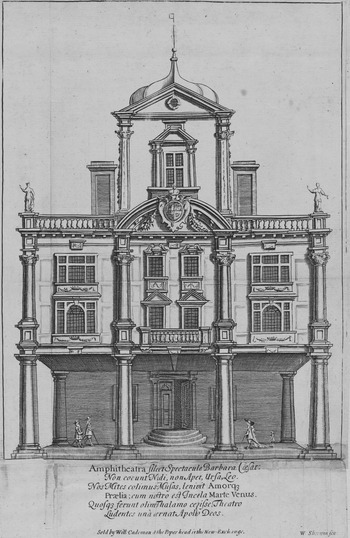
The notion that the Restoration theaters were unlikely sites for public politics is both factually inaccurate and analytically misconceived. While they were perhaps less “popular” than their Elizabethan and early Stuart predecessors, these playhouses were not aristocratic or courtly domains. Between 5 and 11 percent of London’s population attended the public theaters each year.Footnote 13 The most successful venue of the period (and the site of the early performances of The Empress of Morocco), the Duke’s Theatre at Dorset Garden, was a large citizens’ playhouse with a capacity of around one thousand people (fig. 1). The shilling price for entry to the upper galleries of both theaters was affordable for artisans and craftsmen and was similar to prices for seeing Shakespeare at Blackfriars. Most importantly, there was a significant middling element in these audiences, as well as a body of more substantial spectators, who along with the nobility would have made up the majority of habitual theater goers. These relatively well-educated spectators were drawn from a variety of overlapping groups and included rural gentry, parliament men, clergy, merchants, civic officials, military officers, doctors, and lawyers. The financial viability of the theater companies depended upon an audience that encompassed and even exceeded the bounds of the political nation.Footnote 14
These audiences made it possible for Restoration playhouses to serve as venues for the promiscuous discussion of matters of state. The mixed social composition of the largest section of the audience, the pit (which often attracted half of the spectators), may be aptly compared to the environment of the coffeehouse, as it was by contemporaries. Indeed the entire playhouse served as a space for socially mixed conversation. Hierarchy may have been embodied in the physical partitioning of the theater, but this was also a space where social status was continually constructed and negotiated. Audience members moved constantly from section to section. And they did not keep quiet: the level of chatter in the Restoration playhouses was notorious. Many audience members even arrived well before the plays began and remained long after they had ended to engage in conversation.Footnote 15
Poets like Elkanah Settle could therefore expect that their work would elicit a socially and topically unrestrained form of talk about politics.Footnote 16 As a few students of the early Stuart and Augustan periods have already shown, early modern playwrights and the prominent political figures who patronized them used plays to
Exterior of the Duke’s Theatre at Dorset Garden, from Elkanah Settle, The Empress of Morocco. A Tragedy. With Sculptures. As it is Acted at the Duke’s Theatre (London: Cademan, 1673). Wing S2678. Beinecke Rare Book and Manuscript Library, Yale University.

publicly confront rival accounts of the political process. Their public appeals were digested by both spectators in the theater and the readers (and hearers) of playbooks. These theatrical accounts of the political process were then subject to active and inherently uncontrollable interpretation and commentary in oral communications, verse satires, printed polemics, and of course other dramatic productions.Footnote 17
The duke of Buckingham’s popular satirical play, The Rehearsal, provides a vivid example of this process at work in the Restoration period. For Buckingham, a friend and counselor to Charles II who sympathized with the plight of nonconformist Protestants, theatrical politics was a family tradition. In 1671, he used The Rehearsal to confront his increasingly marginalized position at court and the rising tide of popery that allegedly accompanied it. Performed at the King’s Theatre, The Rehearsal publicly ridiculed Buckingham’s major political rival, the earl of Arlington, and exposed the court itself as a den of popish conspiracy and bumbling royal leadership.Footnote 18 Buckingham drew upon swirling news and rumor concerning the crypto-Catholicism of Arlington, the duke of York, and Charles II and intervened in a series of ongoing discussions in print about how this threat was most effectively neutralized. The Rehearsal’s literary structure and political content were then creatively appropriated in 1672 by one fan of the play, Andrew Marvell, in his famous Rehearsal Transpros’d. This popular defense of nonconformists, a direct response to the persecutory tirades of the Anglican divine Samuel Parker, was widely read and discussed in London coffeehouses. It perpetuated the public discussion of monarchical counsels found in The Rehearsal and a wider body of polemic from the late 1660s and early 1670s and elicited numerous responses in manuscript and print.Footnote 19 In episodes like this one, theatrical interjections in public politics informed both the literary structure and ideological content of the public appeals that they inspired in other media and venues.Footnote 20
Yet as Buckingham himself complained in The Rehearsal, despite the heterogeneity of theater audiences, the playhouses were not spaces in which all political perspectives were equally likely to be publicized. The theatrical companies’ institutional characteristics made them particularly well suited to exploitation by the Stuart brothers and their allies. They also ensured that plays had a general ideological hue. In the Elizabethan and early Stuart periods, drama was a broadly competitive business enterprise. But when Charles II restored public theater in England, he granted exclusive, hereditary patents to two former servants of the exiled royal court in France, William Davenant and Thomas Killigrew. Davenant’s Duke’s Company and Killigrew’s King’s Company duopolized theatrical production for the entire period.Footnote 21 These long-suffering royalists could justify their privileges by claiming that they provided a forum for the consumption and discussion of literary products that helped instill loyalty to the newly resurrected regime.Footnote 22
Loyalty, however, came in many forms during this period. As Richard Kroll has shown, dual-plot tragicomedies were part of a rhetorical culture of counsel. They were “forms of advice to the King and political nation, not instruments of Stuart absolutism.” Tragicomedy was well suited to the comparison of competing visions of epistemology, politics, and economics and fundamentally opposed to basic tenets of French dramatic theory, which insisted on a “monolithic conception of the ideological purpose of drama.”Footnote 23 Here I provide evidence that the rhymed heroic play subgenre of tragicomedy, of which The Empress of Morocco was an example, was also guided by this hortatory vision of dramatic politics.
The theaters, like coffeehouses and bookshops, were partly unrestrained sites for political discussion that did not always serve the interests of the monarch. Their structural situation made this possible. The private ownership of the companies, as well as the haphazard regulation and diverse sponsorship of the plays, left significant room for the license of writers, managers, and patrons. Very few plays faced official interference before 1680, and when they did, it was usually because their topical references were tactlessly direct or personal. The master of the revels, who after Henry Herbert’s death in April 1673 was Thomas Killigrew himself, had the lucrative right to censor and license plays, but his active censorship was limited. Charles II and the lord chamberlain also occasionally stopped individual plays from being staged or suppressed them after an initial performance. But as long as playwrights partly shrouded the topical and ideological relevance of their productions, they could be confident that their work would not be disrupted.Footnote 24
Indeed, these techniques of indirection were precisely what enabled drama to play such an important role in the political public sphere. To focus on the seemingly transparent aspects of these plays is to overlook what made them so unusually useful and important to those who sought to influence the political process. As critics have long recognized, plays like The Empress of Morocco exhibit a complex relationship between political conditions and literary form. Dramatists censored themselves to the extent that in even the most topically charged productions, references to contemporary events, individuals, and groups were usually made obliquely. This could be accomplished in a number of ways. In The Rehearsal, for instance, Buckingham shrouded his attack on Arlington and the court in a much more obvious attack on John Dryden and heroic drama.Footnote 25 More often, as in the case of The Empress of Morocco, playwrights made use of historical parallels.Footnote 26 Parallels, it must be emphasized, were not codes. The plays that employed them were not romans à clef, and the characters in these plays were not mere proxies for Restoration politicians. Poets like Settle left considerable room for audience application in constructing the meaning of individual productions, and the degree of topical specificity varied greatly from play to play. Historical parallels allowed playwrights to compellingly canvass arcana imperii in public and to do so with plausible deniability. Dramatists left their plays open to multiple topical readings and therefore left it to audience members to make the precise connections that would have otherwise incriminated the playwright. As a result, in moments of crisis, parallel plays were among the first literary works that were able to publicly broach subjects that had previously been confined to the more private realms of royal counsel.
The fact that playwrights purposely left their work open to multiple interpretations should never be taken to imply a lack of political purpose. On the contrary, the apparent contradiction or ambivalence in Restoration theater was usually an intentional form of ambiguity. It was essential to a play’s rhetorical purchase and political impact. To be sure, as Philip Harth has written, even a politically active poet like Elkanah Settle sought to ensure the commercial success and positive reception of his work “by appealing to all members of his audience and by avoiding overt political partisanship that would have alienated any considerable segment.” Yet pace Harth, broad appeal did not require “neutrality.”Footnote 27 In this sense, drama was in tune with fictional dialogues and many other propagandistic genres from the period.Footnote 28 “Dual” or “dialogic” literary structure was not a symptom of contradiction or ambivalence. Playwrights employed it as a vivid and rhetorically effective means of summoning a political public and admitting the presence of competing accounts of the political process only in order to refute them.Footnote 29 The ambiguity of these plays simulated the dialogical mechanics of the political public sphere in order to most effectively perpetuate and direct it.
Elkanah Settle personified the deep connection between the playhouse and the wider world of public politics in late Stuart England. Like most major Restoration dramatists, his plays were part of a wider body of political writing and activity. He is best known as a Whig propagandist but in fact spent his entire career repeatedly switching the allegiance of his pen. It is well known that in the mid-1670s Settle turned for support to the earl of Shaftesbury.Footnote 30 His Whig debut in 1679 was the most elaborate pope-burning pageant ever held in England. This episode in the politics of the street was thought to have attracted a crowd of 200,000.Footnote 31 Settle’s 1680 play The Female Prelate was the most outrageously anti-popish theater event of the era, and his 1681 pamphlet for parliament, The character of a popish successor, was one of the most widely read Whig tracts of the period. Yet, suddenly, in 1683, riding the wave of the Tory Reaction, Settle emerged as a champion of the duke of York and continued to support him until William III’s invasion.Footnote 32 After James fled to France, Settle prudently attached himself to the new king. This pattern of tergiversation persisted until Settle died in 1724.Footnote 33 The available evidence suggests that he was driven throughout his career not primarily by his personal views or ideological commitments but by an opportunistic effort to promote the politics of his patrons.
Settle’s career as a propagandist, however, did not begin with Whiggery, as scholars have assumed. His relationship with James II had deep roots. For nearly a decade, beginning in the mid-1660s, he wrote in defense of the duke of York and his allies and, to a lesser extent, Charles II.Footnote 34 Settle became well known to Londoners in early 1671, when his first play, Cambyses, was performed for three weeks to packed houses at Lincoln’s Inn Fields.Footnote 35 By 27 February 1672, he had become sewer in ordinary to Charles II, which allowed him to spend his days as one of the poets writing for the theater in Whitehall.Footnote 36 Settle was also well positioned to bring his plays from court to the public stage. He was paid fifty pounds per year by the Duke’s Company (whose patron, of course, was York himself) with the understanding that all his plays would be performed in their theater. Indeed, there is evidence that York personally commanded Settle to have The Empress of Morocco performed there in execution of this arrangement when he was considering whether to take it to the King’s Company instead.Footnote 37 Settle was personally linked to the Stuart brothers and eager to entertain and support them with his poetry.
More surprising was Settle’s relationship with the well-traveled Catholic courtier and ambassador to Morocco, Henry Howard, earl of Norwich. An active member of the Royal Society, Howard was keenly interested in and experienced with the Maghrib and the Ottoman Empire and would have delighted in a performance like The Empress of Morocco. Howard’s Catholicism, however, appears to have been equally instrumental in shaping the content of the play. Always keen to demonstrate his loyalty and service to the crown, Howard bemoaned the aggressive and tactless activism of many of his coreligionists. He took the oath of allegiance along with York in 1674 and frequently delivered potentially incriminating letters he received from Rome to the secretaries of state.Footnote 38 Yet we will see here that his approach to the plight of English Catholics was hardly one of “quietist” suffering.
The Empress of Morocco was therefore originally conceived under the auspices of both Charles II and some of the most powerful Catholics at court. In April 1673 it was performed on at least two occasions in Whitehall before courtly audiences that included Charles II. Howard appears to have been responsible for organizing the initial performance.Footnote 39 On 3 July, The Empress of Morocco reached a far wider audience, when it was performed by the Duke’s Company at the newest and best-equipped theater in London, Dorset Garden. As critics have long known, the play was wildly successful. It attracted significant notice throughout London and may have been performed for an entire month. It appears to have attracted over 20,000 spectators in all.Footnote 40
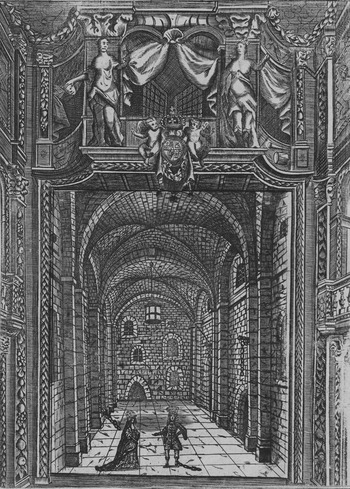
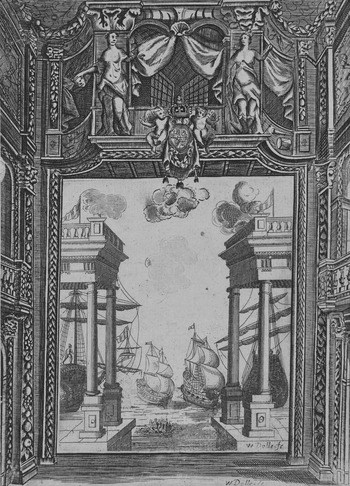
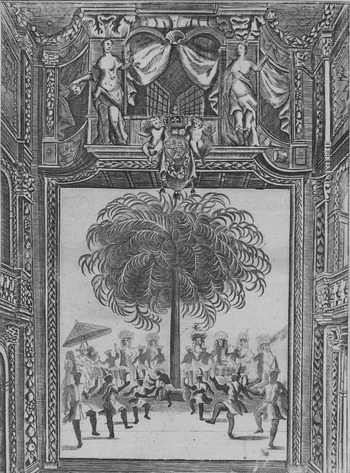
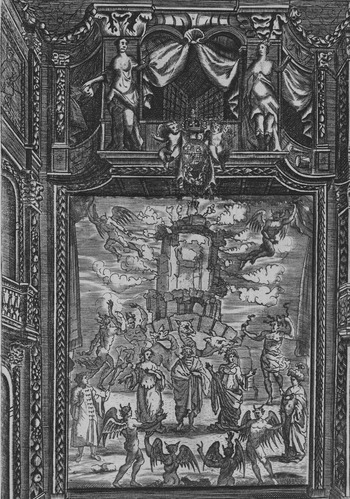
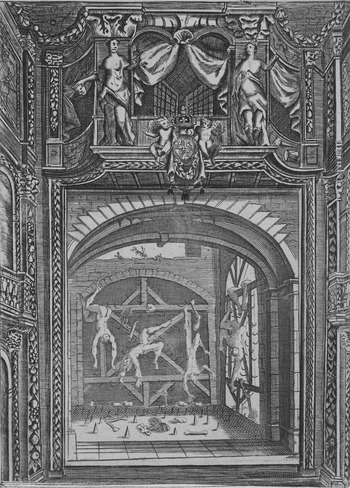
Settle lured thousands of viewers into considering the play’s politics by making use of astounding stage effects. As is well known, public spectacle was crucial to Charles II’s efforts to consolidate his authority and mold public opinion.Footnote 41 It should therefore come as no surprise that Settle’s well-known talents for spectacle were originally developed not for Shaftesbury but for the king, and not in the street but on the stage. Along with Davenant’s Macbeth, The Empress of Morocco was the first “operatic” or “spectacular” play performed at Dorset Garden, a venue created for such productions.Footnote 42 Its scenes and machines were probably without precedent in 1673.Footnote 43 The play included music, dancing, sound effects, stabbings, gunfire, a rainbow, and even a hailstorm. It featured a scene where naval ships are returning to port after battle; a masque set in hell, complete with flying demons; and a horrific, final dungeon spectacle in which at least four prisoners, including one of the play’s villains, have been impaled upon hooks and dangle above a floor strewn with metal spikes and rotting body parts (figs. 2345–6). A performance like this was not to be missed, and as we will see, its spectacular attributes seem to have been intended to accentuate and focus its political impact.
Act 1, Scene 1, from Elkanah Settle, The Empress of Morocco. A Tragedy. With Sculptures. As it is Acted at the Duke’s Theatre (London, 1673). Wing S2678. Beinecke Rare Book and Manuscript Library, Yale University.

Act 2, Scene 1, from Elkanah Settle, The Empress of Morocco. A Tragedy. With Sculptures. As it is Acted at the Duke’s Theatre (London, 1673). Wing S2678. Beinecke Rare Book and Manuscript Library, Yale University.

Act 2, Scene 2, from Elkanah Settle, The Empress of Morocco. A Tragedy. With Sculptures. As it is Acted at the Duke’s Theatre (London, 1673). Wing S2678. Beinecke Rare Book and Manuscript Library, Yale University.

Act 4, Scene 4, from Elkanah Settle, The Empress of Morocco. A Tragedy. With Sculptures. As it is Acted at the Duke’s Theatre (London, 1673). Wing S2678. Beinecke Rare Book and Manuscript Library, Yale University.

Act 5, Scene 3, from Elkanah Settle, The Empress of Morocco. A Tragedy. With Sculptures. As it is Acted at the Duke’s Theatre (London, 1673). Wing S2678. Beinecke Rare Book and Manuscript Library, Yale University.

Before we unpack the politics of the play, it will be helpful to summarize its dramatic action and further register its literary and intellectual background. Like other Restoration tragicomedies, The Empress of Morocco is, on the most superficial level, a tale of “regicide and restoration” that warns against rebellion.Footnote 44 It stages a series of intrigues at the court of Morocco that result in the rise and demise of a lascivious Moroccan empress, Laula, and her courtier lover, Crimalhaz. The lovers first conspire to poison Laula’s husband, the emperor, who is succeeded by Laula’s noble but oblivious son, Labas. The evil duo’s remaining formidable opponent is the “General Prince” Muly Hamet, a courtier and military hero who has recently returned from a successful campaign against an enemy prince called Gayland. Hamet discerns the conspiracy soon upon his arrival, but he is unsuccessful in confronting the villains. Instead, Laula and Crimalhaz manage to dupe Labas into believing that it is Hamet who aims to use his popularity to usurp the throne. Labas therefore does the traitors’ dirty work for them when he imprisons and then banishes his loyal servant. Crimalhaz succeeds Hamet as military commander, and Labas also makes Crimalhaz treasurer of the kingdom. Crimalhaz now moves against Labas by tricking the emperor’s wife, Morena, into stabbing her husband to death while performing a masque at court. Crimalhaz is then proclaimed emperor. At this point, the city braces for an imminent attack from a foreign prince, Taffaletta. But when Taffaletta’s army arrives, Hamet, returned from exile, is leading it. Beloved of the Moroccan people, Hamet enters the city without resistance. Order is finally reestablished when Hamet arrests Crimalhaz and accepts from Taffaletta “a Crown Restor’d.”Footnote 45
Settle’s source for most of the characters and dramatic action in The Empress of Morocco was a 1671 historical work called West Barbary, which had been written by the former Tangier chaplain and orientalist Lancelot Addison. Settle also appears to have drawn upon the same early Enlightenment style of historical analysis that Addison employed in his work. Settle accepted the basic premise behind West Barbary: the late humanist conviction that the histories of foreign lands like Morocco were indispensable materials for political counsel. This conviction, which was underpinned by the notion that political history unfolded in fundamentally similar ways across space and time, guided Settle’s use of historical parallel. The Empress of Morocco, like West Barbary, addressed English politics on two levels: it simultaneously described a North African political scene in which the English were directly involved and drew a number of parallels between the domestic histories of Morocco and England.Footnote 46
One particularly salient aspect of early Enlightenment historical culture—the changing meaning of “popery”—was also a central theme in the serious drama of the Restoration. After the English Revolution, this polemical and analytical category became universalized in its meaning and application. The charge of popery was successfully leveled in different formulations upon not only Catholic priests, their lay followers, and their Laudian look-alikes, but also upon puritans and Quakers. Anti-popery became not only a weapon for attacks on Catholics but also, ironically, a means of ridiculing rabid anti-Catholicism. The discourse of popery merged with the languages of anti-puritanism and Machiavellianism and became part of the early Enlightenment notion of “priestcraft,” which was in turn part of a universalist framework for describing the use of religion to promote tyranny and rebellion.Footnote 47 England’s increasingly sophisticated engagement with the great Islamic empires in the later seventeenth century was also essential to this process. Historians consistently described these polities and Islam itself in language previously reserved for critiques of Catholics’ superstitions and dreams of world dominion.Footnote 48 This conception of popery and the historical universalism underpinning it helped plays like Settle’s to present political parallels that were simultaneously deniable and compelling.
The Empress of Morocco addressed the Restoration succession crisis just weeks after it materialized.Footnote 49 England’s situation in European and Mediterranean politics in July 1673 was clearly paralleled in the play’s setting and dramatic action. In Settle’s text Morocco has just emerged triumphant from a battle against Gayland, a prince whom Muly Hamet has defeated on sea and land.Footnote 50 Hamet, however, has been forced to rush home from battle because Morocco faces an imminent invasion by another foreigner, Taffaletta. In the summer of 1673, England was embroiled in the third Anglo-Dutch War, fighting alongside the French. As The Empress of Morocco opened in London, Dutch ships were waiting off the coast to engage the English fleet, and the English were planning a land invasion of the Netherlands.Footnote 51 I suggest that the opening of the play presents a hypothetical English triumph in both arenas.
In 1673, however, many political observers in England viewed even victories against the Dutch with suspicion. Rumor had it that the French were using England to conquer the Netherlands while weakening English forces in the process. This would pave the way for France to invade England and secure the duke of York’s claim to the throne.Footnote 52 Playgoers privy to these rumors would have easily associated Settle’s aspiring conqueror, Taffaletta, with Louis XIV. The play staged the widely accepted conspiracy theory that was turning public opinion against the French alliance.
The historically rooted action in The Empress of Morocco offered an even more direct parallel with England’s position in North Africa and the Mediterranean. Many Londoners would have believed in the summer of 1673 that Taffaletta (known today as al-Rashīd) was indeed overrunning the northwest Maghrib. As far as they knew, the only independent political entity holding out against Rashīd was not Settle’s “Morocco” (Marrakesh) but the English colony of Tangier. Leaders of the regime in England, including not only Howard but also York, who convened the Tangier commission in his chambers, feared that their costly colonial project was coming to nothing. To make matters worse, the colony was widely viewed as a den of popish conspiracy since it was heavily populated by Portuguese, Irish, and Scottish Catholics. The imperial, European, and domestic politics of England were deeply intertwined at this juncture.Footnote 53
The play’s domestic parallels were more detailed, even personal. They require a lengthier historical introduction. Since the summer of 1672, York’s likely conversion to Catholicism had been common knowledge in London. He soon became the focus of an anti-Catholic (and anti-French) fury that enveloped the city as parliament reconvened in February 1673. On 8 March, in a major reversal for James and the religious policy of the Cabal ministry, Charles II reluctantly surrendered the Declaration of Indulgence, which had suspended penal laws against English Catholics. Members of Parliament also began to pressure the king to annul his marriage with his Catholic queen, Catherine of Braganza, who had not produced an heir and was a suspected ringleader of popish conspiracies at court. On 29 March, Charles grudgingly concluded the reversal of his policies by assenting to the Test Act, which made royal office-holding conditional on annual communion in the Church of England, oaths of supremacy and allegiance, and an oath against transubstantiation.
The English eagerly awaited the response of Catholic courtiers who held office. Two days after the act’s passage, circulating rumor held that Settle’s patron, Howard, the earl marshall, would resign, that Thomas Clifford, the lord treasurer, would retire into the country, and that York, the lord admiral, might refuse communion at Easter. By mid-May, York and Clifford had refused communion and Howard had resigned. Many assumed that Clifford would now surrender his post to the privy councilor Sir Thomas Osborne, who had helped to write the Test Act. Speculation also erupted about who would lead the June land expedition into Holland. The most-discussed candidates were York; a Frenchman, Frederick Herman de Schomberg; the duke of Monmouth; the duke of Buckingham; and the Scottish Catholic and Tangier veteran John Fitzgerald.Footnote 54 Nearly all of these prospects were troubling.
In June, rumor abounded concerning the impending transformation in the king’s counsels and the final dismantling of the Cabal ministry.Footnote 55 In the middle of the month York and Clifford relinquished their offices. Clifford was replaced by Osborne, and the day after his resignation, a commission was set up to manage York’s former office of lord high admiral. “Great is the talke of the Towne upon these suddain alterations,” the royal newsletter manager Henry Ball wrote his superior Joseph Williamson on 20 June, “especially of his Royall Highness’s laying downe, the generallity of people being so bold as to say he must not thinke to have the favour of England if he professes openly a Roman Catholicke.” At the end of the month, rumors were still circulating that York would command the forces. Indeed popular fears about the popish or atheistic command of the English army ranged far beyond the prospect of York’s involvement and extended to the other major candidates and other army officers. “These kind of reports makes the Town full of malicious libells,” Ball wrote to Williamson on 26 June. In this environment, those preparing for the fall parliament considered forcing the king to divorce the queen and banish his brother.Footnote 56
Just as the Test Act began to take its toll on York’s political and military career, he moved toward a new dynastic union that would further inflame the fears of his contemporaries. When Anne Hyde, the duchess of York, died in March 1671, rumors immediately circulated about York’s search for another Catholic bride. By the spring of 1673, it was still unclear whom James would choose. Early in the summer, well-informed Londoners believed that he was heading for an alliance with either the German house of Württemberg or a Catholic satellite family of the aspiring universal emperor, Louis XIV. By the end of July, York’s intention to wed Mary of Modena, a relative of Cardinal Mazarin, was the talk of the town. It was rumored that Louis was going pay the dowry himself.Footnote 57 In addition, talk of intrigue at court and the prospects of military command persisted throughout July, while The Empress of Morocco took London by storm. The political public created amid the crisis was operating in a variety of media and venues. “In the towne, every one turnes statesman, and takes the greatest liberty imaginable to discourse of the management of things,” wrote Robert Yard, editor of the London Gazette on 4 July, a day after the play’s first performance.Footnote 58 A panoply of fears about popery and imperial disaster gripped those who came to see The Empress of Morocco in the summer of 1673, and these fears prepared them to see domestic parallels in the play.
The swirl of rumor to which The Empress of Morocco responded was accompanied by public appeals in print. In the second week of March, Pierre du Moulin’s Dutch-sponsored attempt to influence events in parliament, England’s Appeal, was smuggled into England and widely distributed. Du Moulin’s Orangist tract provided a full-bodied version of the conspiracy theories that were passing by word of mouth among Londoners when it appeared. It claimed to document the diabolical designs of the French and the dark reality of English diplomacy under the leadership of the Cabal ministry. While the tract circulated too late to sway the Lords and Commons, by purporting to expose the reality of English statecraft at the highest levels, it opened a public space for discussion outside of parliament about the secret links between England’s French alliance and the threat of Catholicism at home.Footnote 59
Instead of simply attempting to curb this public discourse, Charles, York, York’s Catholic allies, and their servants actively perpetuated and publicized discussion of the arcana imperii at issue. The regime was well aware of the activities of Dutch-sponsored propagandists like du Moulin. While working to hunt down these writers and their works, they made detailed plans to offer their own competing public appeals through hired hands. Government involvement in the writings of Henry Stubbe in this period, for instance, is very likely.Footnote 60 Yet once Charles was forced to reverse his policies, the most strident responses to attacks on the French alliance came from the victims of the king’s volte-face, and in particular, it seems, from Catholic grandees and their servants. In the spring of 1673, for instance, they met manuscript libels against York with at least one of their own verse satires.Footnote 61 This was also the period in which the Catholic Roger Palmer, earl of Castlemaine, publicly battled the dean of Bangor, William Lloyd, with the weapons of Catholic loyalism. Writing from abroad, Castlemaine specifically associated Lloyd with tracts, like du Moulin’s, that the Dutch had smuggled into the country in order to influence political events.Footnote 62The Empress of Morocco was a crucial addition to this flurry of Catholic publicity.
Settle included numerous clues in the play to encourage audience members to link its dramatic action to contemporary English politics. The play features two heroic duos. These are the two royal couples: Labas and his wife Morena and Hamet and his fiancée Mariamne. Settle made it easy for the audience to associate both of them with the duke of York and his prospective bride. “Morena” and “Mariamne” are the only two European names in the play, and they jar with the Arab names of the other characters, which were drawn from Addison’s West Barbary. They would have called to mind the names of the duke of York’s primary marriage prospects in the summer of 1673: Mary of Modena and Mary Anne of Württemburg.Footnote 63 As if this was not suggestive enough, Morena and Mariamne continually identify themselves as Roman Catholics in an ostensibly Islamic play. In the first scene, for instance, as Morena and Labas are being escorted to prison, Morena tries to put a positive gloss on their sufferings: “Of our past Woes I have this relation given, / As Purgatory does make way for Heaven.” Later in the play, Mariamne visits Hamet in prison as well and tells him to flee the kingdom: “Absent you shall in my Remembrance reigne. / I’le to your Image dedicate this shrine.”Footnote 64 Here Settle employed simile and metaphor to shroud a commentary on Catholicism. Indeed, as these two scenes of imprisonment suggest, the royal couples are paired in the play. They appear in similar settings and predicaments and espouse similar values.Footnote 65
Unjustly suspected of treason and partial to “Catholic” women, both Labas and Hamet could have easily been considered York-like characters. Their predicaments also echo the experiences of Howard and many other Catholic officeholders in the wake of the Test Act. Labas would have most vividly brought to mind the image of York the courtier and future monarch. Morena, his lover, is the daughter of the aggressive, conquering emperor, Taffaletta. Mary of Modena, as we have seen, was closely connected to Louis XIV’s court and a relative of Cardinal Mazarin. Having declared war on Taffaletta as he approached Morocco, Labas’s father has imprisoned his son because he takes Labas’s escapades at the enemy’s court as an indication of treason. Labas’s attempt to studiously remain independent of an aggressive foreign monarch and loyal to his king has been mistaken for the precise opposite. Told by Morena that they will be executed once Taffaletta reaches Morocco, Labas encapsulates his position in a manner that would have resonated strongly with observers of York in England: “Condemn’d to Fetters, and to Scepters born! / ’Tis in this Garb unhappy Princes mourn.” Finally, later in the play Labas too uses the language of Catholicism. Here again, though, Settle employed indirection, by having Labas speak in a court masque.Footnote 66
In contrast to Labas, Hamet would have brought to mind York’s status as a military hero who, despite risking his life for his country, was widely suspected of conspiring against it. Settle made Hamet’s humble heroism clear to his audiences at Dorset Garden from the first moment he appeared on stage. He appears in front of his imposing navy, his presence announced by trumpets and gunfire, and immediately kneels before his king. Nevertheless, he is quickly suspected of using his military prowess to curry the favor of the populace. Hamet’s apparent unruly ambition and the concerns aroused by it have been fabricated by the villains in order to shroud their own conspiracy. Early in act 2, when Hamet arrives in Morocco at the head of his fleet and reports that he has defeated Gayland, a public celebration of the victory ensues. Laula and Crimalhaz use this opportunity to convince Labas (by means of fabricated rumor circulated by hired hands) that Hamet intends to manage popularity and military power to eventually wrest the crown from him. “They the Kings Ear will with such Whispers fill,” explains Hametalhaz, Crimalhaz’s henchman, “As shall the Poyson Jealousie instill: / And by such subtilty his Breast infect, / Till he his Generals Loyalty suspect.” Labas falls for the ploy, condemns Hamet to death, sends him “to the Tower,” and ultimately banishes him. At this crucial point Hamet, too, makes speeches that simultaneously affirm his loyalty and suggest his Catholicism (and martyrdom) through simile. “I must obey you, and embrace my Doom,” Hamet says, “With the same patience Saints do martyrdom.”Footnote 67
The “Catholicism” of Morena, Mariamne, Labas, and Hamet is a suffering religion of saints, shrines, relics, images, and altars. It is not a papal, episcopal, or even clerical religion. In the play, this form of popery is mostly one that poses no inherent political threat. While papal Catholicism could justify and motivate treason and tyranny, this purely religious Catholicism enables only patient, loyal subjecthood. Such Catholics would suffer martyrdom not in defiance of their sovereign, but only to further glorify him. This politically acquiescent piety is sung by “a Moorish priest” and two women in the lavish court entertainments arranged for Labas’s coronation, as other Moors dance around a large palm tree (fig. 4). Settle used this striking combination of scenery, costume, and song to draw attention to a basic message of the play. “No homage like what from Loyalty springs,” sing the women and the priest. “Wee’l kneel to our Gods, but wee’l die for our Kings … No raising of Altars like Long Live and Reign.”Footnote 68 Here civil religion trumps any other pious prerogatives that the heroes might have.
Labas’s decision to relieve Hamet of his command on the basis of fabricated rumors concerning his loyalty would have easily brought to mind the recent resignations of prominent English Catholics in the wake of the Test Act. After Hamet’s dismissal, Crimalhaz is not only made the new head of the armed forces but also becomes treasurer. Settle could hardly have risked being more obvious in his reference to the recent replacement of Lord Clifford by the new treasurer, Osborne, and the ongoing shakeup in the military leadership, which seemed likely to bring Buckingham and a Frenchman, Schomberg, into command. In 1673 Osborne was generally viewed as a zealously ambitious courtier. Schomberg was a Protestant, but among those who accepted a relatively secular interpretation of popery (precisely the one espoused in The Empress of Morocco), as a French subject he too was worthy of suspicion. Buckingham, on the other hand, was widely thought to be either a Catholic or an atheist. Accordingly, both Laula and Crimalhaz continually make atheistic and Hobbesian speeches as they explain their conspiracy, and Crimalhaz is described as a man of low birth and brutal ambition.Footnote 69
Settle’s use of parallel here suggests a Catholic loyalist reading of the play, which would have obviously ran counter to the political inclinations of most audience members. Long before the Exclusion crisis, Settle was staging what would become a classic Tory narrative, where an apparent popish plot is actually a fabrication meant to shroud a far more intricate conspiracy. This reading, however, partly sidelines one of the play’s two main villains and the subject of its title: Laula. In 1673, conspiracy was most commonly being considered, of course, in terms of Catholic conspiracy. Indeed, audience members who were resistant to engaging with the play’s Catholic loyalism might have understood The Empress of Morocco in a very different way. Settle surely allowed for this interpretation. On a more superficial reading, the play describes a state ridden with popish plotting and threatened by a popish invasion, and it recounts the heroes’ triumph over both. Even in this interpretation—where Laula and Crimalhaz are the Catholic plotters—parallelism would play a role. Laula, it is revealed in the final act, became infertile after giving birth to Labas. Given the widespread calls in 1673 for Charles II to divorce his infertile queen, Catherine, Laula’s leadership of the court conspiracy in Morocco would have appealed to the expectations of anti-Catholic audience members.Footnote 70
Nevertheless, Settle attempted to sway attentive spectators from this interpretation. Unlike other characters, Laula is never obliquely identified as a Catholic; she is instead depicted as an atheist and a witch. Indeed, at the only point in the play in which the conspiracy is depicted as even vaguely “Catholic,” this appearance is a ruse.Footnote 71 In the end, Settle presented his audiences with three apparent Catholic conspiracies: those of Labas and Morena, Hamet and Mariamne, and, of course, Laula and Crimalhaz. Yet the first two conspiracies turn out not to be conspiracies at all, and the third conspiracy turns out not to be particularly Catholic. Instead it is anti-Catholicism itself that is depicted as conspiratorial. The anti-popish plot of Laula and Crimalhaz is defeated by loyal subjects who happen to be Catholics themselves.
The end of the play drives home this message about the fundamental loyalty of English court Catholicism. When Hamet and Taffaletta defeat Crimalhaz’s army, the foreign army is able to enter Morocco unopposed. But this is only because Hamet is leading it. After taking the city, the general offers his sword to Taffaletta as a sign of subjection, but the feared foreign invader responds by surrendering the imperial crown to Hamet. The play thus stages a successful invasion by an imperious foreign prince but attributes to it the exact opposite significance that its audience would have. The invasion is welcomed by the populace, it is conducted by their own military leader at the head of a foreign army, and its result is not popish slavery but freedom, the deterrence of universal monarchy, and the return of political stability and justice. In a speech Hamet makes clear that it was his loyalty, and not his military power, that permitted his accession to the throne.Footnote 72 The duke of York, of course, would have preferred to be seen in much the same light. The play thus ultimately aimed to undeceive the English people about the role of the duke of York and his Catholic allies in English politics. It directly combated the hostile mass of rumor and publicly proffered conspiracy theories circulating in the summer of 1673, and offered an alternative conspiracy theory in which post-Reformation anti-popery was turned on its head.
From this vantage point it is possible to explore in more detail the distinctive ideological messages that The Empress of Morocco conveyed. The basic “Yorkist” theme within the play is underpinned by the two heroic couples’ patriarchal, divine right absolutism. They cheerfully obey the sovereign even when he unjustly accuses them of treason and condemns them to death. Their only mode of resistance is passive obedience. They interpret their fates, however unjust, in terms of the alignment of royal and divine disapproval, even discerning evidence for it in the weather. Early in the play, for instance, Labas accepts his incarceration as a testament to his father’s royal might and depicts the emperor as a sacerdotal monarch, again using the language of civil religion. Bound in chains, he muses: “But ’tis my Father has decreed my fate; / Yet still he shews his Greatness in his hate. / Thy rage, brave Prince, mean Subjects does despise; / None but thy Son shall be thy Sacrifice.” He continues shortly afterward: “I freely at his feet my Life will throw; / Life is a debt we to our Parents ow.” Morena, too, appears almost to welcome their execution at the hands of the prince: “He has pronounc’d such great and glorious things, / As are fit only for the Breath of Kings.” After the death of the emperor, Labas’s coronation celebrations are accordingly bathed in a language of loyalty, inheritance, and civil religion. Likewise, later in the play, Hamet accepts his banishment as a cruel fate that must be suffered with constant affection for his king. “I must obey you, and embrace my doom / with the same patience saints to martyrdom.”Footnote 73 Laula and Crimalhaz, by contrast, advocate (and act out) aberrant theories of monarchy, all of which amount to nontraditional and artificial ways of managing the succession.Footnote 74
The play’s meditations on monarchy were wedded to a careful commentary on empire. Labas is confident that he can honor his familial relationship with Taffaletta while still defending the empire from him. He and Hamet therefore seek to simultaneously maintain dynastic ties and the integrity of the state. In this sense, despite the Moroccans’ martial prowess, the heroes’ imperial vision is markedly restrained. They repeatedly harp upon the primacy of love, loyalty, and domestic stability over imperial expansion. And in the very last line of the play, Hamet muses that “An Age in Empire’s but an Hour in Love.” The heroes stress the Henrician notion of empire as independence from foreign potentates and accordingly deny that they seek universal dominion. Both Labas and Hamet insist that if they conquer Taffaletta’s territories they will not seek to assume dominion over them.
In keeping with the general political strategy behind the play, Settle was offering a vision of empire that was firmly opposed to a “popish” or French model yet still recognizable as Stuart imperialism. In the very first speech of the play, Labas, who prizes love and virtue above territorial dominion, announces from prison: “My Thoughts out-fly that Mighty Conqueror, / Who having one World vanquish’d, wept for more: / Fetter’d in Empires, he enlargement crav’d / To the short Walk of one poor Globe enslav’d.” Yet while they insist on the slavish nature of universal monarchy, the heroes do not endorse an empire that ends with commerce or even the rule of the seas. As early as 1666 Settle was willing to depict York in verse as a heroic defender of the doctrine of mare clausum against the Grotian Netherlands.Footnote 75 Accordingly, while Hamet makes clear to Mariamne that a happy marriage will be empire enough for him, he implicitly endorses maritime empire. “I am here more blest,” he says, “than if I an imperial sea possest.” Moreover, the heroes clearly endorse not only maritime dominion but also territorial expansion. For Hamet, ruling the waves is utterly insufficient. He explains this upon his return from battle with Gayland, standing in front of Settle’s striking battle fleet scene (fig. 3) and thus emphasizing the distinction: “Their Arms who have at Sea victorious been, / Do but the Out-works of an Empire win. / Then to compleat, what on Sea before / I’d but begun, I landed on their shore.”Footnote 76 Settle’s Morocco—like the Restoration empire, as it was viewed either from London or behind the walls of Tangier—is a reserved but undoubtedly expansionist polity. Here again Settle attempted to make the play’s Catholic loyalist, Yorkist, and pro-Stuart messages palatable to an audience that was largely Protestant, increasingly hostile to France, and primarily concerned in this moment with domestic stability.
In The Empress of Morocco, Settle’s audiences were invited to accept a version of popery that was divorced from Catholicism and thus compatible with early Enlightenment histories like Addison’s West Barbary. Settle realized that universalized conceptions of anti-popery could ironically serve to insulate Catholics from suspicions of sedition and treason because anti-popery itself could be described as popish. His heroes espouse an Erastian, absolutist Catholicism that is subservient to the demands of civil religion, a Catholicism that in its general contours matches James II’s religious style, as outlined by Steve Pincus.Footnote 77 They manage to show how such an outlook is not aligned with but rather inimical to popish conspiracy and foreign invasion. In this period the language of popery had merged with the languages of Machiavellianism and civil religion to the point that popery was not necessarily a result of Catholicism. The popery of Laula and Crimalhaz is ultimately characterized not by religion but by irreligion and tyranny. Just as Pincus has argued that James II pursued a vision of “Catholic modernity” in the late 1680s, Gabriel Glickman has recently drawn attention to an early eighteenth-century English Catholic Enlightenment. The Empress of Morocco allows us to see a form of Catholic Enlightenment being articulated much earlier than we might expect in order to defend the position of Catholics within the Restoration regime.Footnote 78
Yet The Empress of Morocco did not simply endorse a polite but full-bodied Stuart absolutism and imperialism whose most devoted adherents were Catholic statesmen. In fact, Settle offered his audience a stern critique of absolutist court culture. He endorsed public scrutiny of the monarchy, condemned sleepy, uncritical forms of loyalty, and summoned the most biting libels and satires about the notorious sexual maladies of Charles II’s court that were circulating in this period. Like Settle’s characterization of Laula, this aspect of the play resonated even with vociferous critics of the regime who had no time for Settle’s Yorkist appeals. In the end, Morocco has little to fear from dynastic links with foreign princes. Instead it is the internal corruption of its court—in particular, misplaced patronage and an obsession with love affairs—that makes conspiracy and regicide possible.
Labas enables Crimalhaz’s sudden rise to power by misplacing his bounty. As we have seen, there was a glaring parallel between Crimalhaz’s emergence as the head of both the army and treasury and Charles’s appointments after the Test Act. Hamet, before he is sent off to prison, warns Labas of the consequences of his deeds. “But though your frown declare my fetters just, / look to what dang’rous hand your pow’r you trust. / Monarchs do nothing ill, unless when they / by their own acts of grace their lives betray.” Similarly, when Crimalhaz flees the city at the head of Labas’s army (taking the state’s wealth with him to bribe the soldiers), the king is blamed for it by two unnamed lords: “Sir, he only does pursue / that treason which you lent him pow’r to do.” Labas himself soon accepts that his deluded suspicion of Hamet’s loyalty has ironically rendered him more susceptible to the advances of aspiring foreign princes: he is left without an army when Taffaletta is only a few days’ march from Morocco.Footnote 79 This aspect of the play clearly distanced it from Charles II’s policies in order to counsel the monarch and render its Yorkist message more attractive.
Nearly as important as Settle’s stress on patronage was his concern with the courtly matches that attracted so much attention in 1673. Labas is blinded by his love for Morena. “This dazling Object my weak sight invades,” he exclaims. “Such beauty would make Dungeons lose their shades.” While Labas and Morena’s love for one another enables their heroic loyalty, it also makes them the dupes of Laula and Crimalhaz. At the beginning of the play, as Labas leaves the stage for the first time, Laula snarls in his direction: “Besotted in thy Love and Empires Charms, / Sleep, and grow dull in your Morena’s Arms.” Similarly, later in the play, Hamet’s loyal assistant Abdelcador rues the effect that Hamet’s betrothal to Mariamne has had on the military hero: “Love o’re the hearts of yielding heroes sports; / Who’re conquerors in camps, are slaves in courts.”Footnote 80 A pervasive obsession with amorous escapades—by both participants and observers—has shrouded both loyalty and atheistic conspiracy and caused them to be mistaken for one another. In the end, though, it is not the licit marriages of princes and military heroes like York but the illicit liaisons rampant at court that are worthy of the nation’s fears. Again Settle used his talent for spectacle to make his main emphasis clear, in this case employing lurid, symbolic scenery. Hamet discerns Laula and Crimalhaz’s conspiracy at the moment he discovers them sleeping on a couch together in the queen’s bedchamber, with Crimalhaz’s drawn sword placed on a table nearby.Footnote 81
In the serious drama of the early 1670s, heroes were not mere emblems of aristocratic and political codes but were instead sites for questioning them.Footnote 82 Settle invited his audience to reflect upon the pitfalls of the royal couples’ loyalty by showing how Laula and Crimalhaz exploit traditional bulwarks of royal authority for their own ends. The villains repeatedly and explicitly defend the notion of arcana imperii, using it as a Machiavellian cover for their conspiracy. Once the usurpers realize that Hamet is on to them, Laula warns: “Who e’re has seen us, knows I am a Queen. / That powerful Word his Silence does demand; / ’Tis Blasphemy to name, nay understand / What Princes act.” Crimalhaz, once he has been crowned king, admits the role that the supposed sanctity of the arcana imperii played in his schemes: “Though on the Blood of Kings my Throne I’ve built, / The World my Glory sees, but not my Guilt. / Mysterious Majesty best fits a Throne. / They Vertuous seem whose Vices are unknown.”Footnote 83 Similarly, at other junctures Laula and Crimalhaz abuse another mainstay of royal legitimacy—the language of providence—to cover up their profoundly irreligious plot.Footnote 84
Because these aspects of monarchical authority can be aped and manipulated by traitors and tyrants, wide scrutiny of the secrets of state is in fact necessary to prevent rebellion. The evil duo’s conspiracy only begins to fail because Hamet trespasses in the queen’s chambers and Morena develops the courage to engage in politique maneuvers.Footnote 85 Settle staged the link between absolutism and conspiratorial tyranny that consumed the attention of his audience in the summer of 1673, and he insisted that open access to private realms of statecraft was necessary to sever this tie. On this general level, the play appealed directly to even the most vociferous critics of Charles II, the Cabal ministry, and the duke of York. Yet, as we have seen, Settle went out of his way to invite a more subtle reading that turned this superficial one on its head. He ultimately stressed the need for scrutiny of the arcana imperii to ward off the sedition and conspiracies that resulted from the abuse of anti-popery for factional ends.
It should be clear by now that The Empress of Morocco (and other plays like it) cannot be understood in terms of the dichotomies usually used to describe the politics of Restoration drama. We cannot mistake its fascinating construction of loyalism for “royalism” or see it as a “court” or “government” play that assailed the “opposition.” Settle set competing elements at court and in the political nation against one another; he highlighted the ills of Charles II’s policies; he cast skepticism upon some of the basic underpinnings of early modern monarchies; and he did all this in defense of the Stuart cause.Footnote 86 He targeted agents of radical anti-popery within and without the court, and while he cast doubt upon Charles II’s policies, the policies he criticized most severely had, he implied, been forced upon the king by evil counselors at court and demagogues in parliament. Yet perhaps the most interesting aspect of The Empress of Morocco’s critical stance toward absolutism is that it challenges our current understanding of the Restoration establishment’s attitude to the public. It clearly rejected the “quietism” that supposedly guided “royalist-Tory” politics. The play appears to have been an attempt by Settle—in the service of court Catholics and, to an extent, Charles II—to publicly respond to the anti-popish conspiracy theories generated in the wake of the Declaration of Indulgence.
After the summer performances of The Empress of Morocco, Settle’s public appeal assumed printed form and was quickly met with competing public appeals. The play’s second intervention in the public politics of 1673 coincided with the movement of political discussion out of parliament after it met in October and early November. The printing venture was managed by the New Exchange stationer William Cademan, who sought to capitalize upon what the Whig literary critic John Dennis later called “the prepossession of the town” with both the play and the ongoing controversy it addressed. Cademan arranged an unusually vivid production that included a dedication to Henry Howard, an engraving of the exterior of the Duke’s Theatre, and five engravings of scenes from the play on the Dorset Garden stage (figs. 12345–6). It is unclear whether the edition “with sculptures” was unusually expensive. But a presumably cheaper version, without engravings, was also available for sale.Footnote 87
The most direct and well-known replies to the play also appeared in the final months of 1673. Most famously, the poet laureate John Dryden teamed up with two other major playwrights to pen a line-by-line, ridiculing critique of play text. Settle responded in kind.Footnote 88 And in December, Thomas Duffet’s The Empress of Morocco: A Farce was performed at the King’s Theatre.Footnote 89 These responses to the play were in part episodes in what Habermas terms the literary public sphere. As usual, all the writers involved mostly avoided explicitly referring to the play’s political content. Dryden resented his rival’s popularity and believed that Settle had butchered the heroic genre of which Dryden was the master.Footnote 90 Literary scholars have identified these attacks on Settle’s play as important moments in the history of literary criticism, and some see this controversy as the death knell of rhymed heroic drama and Dryden’s engagement with the subgenre.Footnote 91
Habermas’s distinction between the literary and the political, however, does not apply in a categorical way, since literary exchange was hardly ever insulated from politics in this period. This episode was no exception: Dryden, Shadwell, and Crowne’s Notes and observations included accusations that Settle’s poetry was itself fanatical, enthusiastic, and popish in character. They thus attacked both possible political readings of the play. More importantly, perhaps, in the prologue to A Farce, the ghost of Labas is referred to as the ghost of “P__y.” While this was primarily a jab at the supposed unoriginality of Settle’s poetry, it may also have been intended as an acknowledgment of the play’s parallelism and its unmasking of fabricated anti-popery. Like Buckingham in The Rehearsal, these writers shrouded the political resonance of their criticisms by combining it with literary satire.Footnote 92 Other public appeals from this moment, emanating from both Dutch and English sources, responded more broadly to Yorkist accounts of politics like The Empress of Morocco without addressing the play directly. For instance, a manuscript verse satire written in the late summer of 1673, Advice to a Painter to Draw the Duke by, mercilessly attacked York, Clifford, three current or former Tangier governors, and their allies and servants, accusing them of hatching a violent popish conspiracy.Footnote 93
Yet the performance and printing of The Empress of Morocco did more than effectively perpetuate the increasingly regular presence of a political public sphere in the 1670s. It also symbolically and notionally legitimated it. Restoration tragicomedies had much in common with Caroline masques,Footnote 94 and the movement of the masque tradition to the public stage was a significant and transformative gesture. The Empress of Morocco itself made this point with unusual clarity: it contains a masque within it (fig. 5), and it was, of course, performed at court before it opened at Dorset Garden.Footnote 95 Generically and dramatically, then, the public incarnation of the play represented the introduction of political discourse originally reserved for the private world of the court to a world of popular consumption and scrutiny.Footnote 96
Even more striking is Settle’s clear insistence, in a piece of Catholic loyalist and pro-Stuart propaganda, that the arcana imperii cannot remain sacrosanct and must be publicly interrogated if the political nation is to distinguish between either loyalty and rebellion or kingship and tyranny. The play’s dialogue and dramatic action justified the practices that its performance exemplified. From the beginning of the succession crisis, playwrights continually offered explicit reflection upon the workings of popular politics.Footnote 97 In The Empress of Morocco, the “people” are never shown, but they are heard and described. They are described only by Crimalhaz, who on each occasion has recently been among them. As we have seen, the manipulation of public politics is essential to the villains’ effort to orchestrate the political process. Crimalhaz channels and manipulates the vox populi so effectively that political reality as his sovereign understands it is the opposite of the truth.Footnote 98
Yet the play hardly condemns efforts to sway the people. The world of The Empress of Morocco is one in which there is too often no visible distinction between kings and tyrants. “Death’s the thing / Distinguishes th’Usurper from the King,” Abdelcador announces in the final and most visually gripping scene of the play as he stands in front of Settle’s gruesome execution scene, where Crimalhaz has been ganched and hangs above the floor with three other dead bodies (fig. 6). “Kings are immortal, and from Life remove, / From their low’r Thrones to new Crowns above: / … When an Usurper dies he raigns no more.”Footnote 99 These distinctions, always visible to God, can only by discerned on earth by political actors who are willing to uncover and interrogate secrets of state and counter demagogues with their own popular tactics. The tactics of men like Crimalhaz make popularity vitally necessary for even the most loyal political actors. At the end of the play, after all, Hamet is only able to enter the city at the head of a foreign army because he has attracted the people’s love, and they have been able to see past Crimalhaz’s Machiavellian subterfuge.Footnote 100 A loyal querying of the magistrate’s commands by the populace is depicted as essential to the triumph of legitimate authority over treason. By attaching this message to the final lines and most gripping scene of the play, Settle indicated its centrality to the political message of The Empress of Morocco.
The Empress of Morocco is an unusually important, revealing, and suggestive subject of study because of its timing, popularity, documentation, and clear parallelism, as well as its connection to Catholic loyalism and its situation within Settle’s eclectic career as a propagandist. But there is little reason to think that its basic political characteristics were at all unusual in the Restoration era. The literary components that made it an effective medium for public politics—foreign settings, historical parallels, tales of regicide and rebellion, and engagement with the theme of “popery”—were utterly commonplace in the period, as were the institutional, rhetorical, and patronage structures within which the play was conceived and produced.
Only additional close readings and detailed contextual reconstruction of the sort attempted here can fully assess the extent to which other plays from the period played a prominent role in public politics. But as Kroll has already shown, many serious plays from the 1660s were not the monological appeals to absolutist loyalty they are usually taken to be. Even the productions of “the most blatant king-worshipper” among early Restoration playwrights, Roger Boyle, earl of Orrery, seem more amenable to multivalent audience application than scholars have assumed.Footnote 101 In addition, plays from the same political juncture as Settle’s blockbuster, such as Dryden’s Amboyna—whose print edition was dedicated to the Catholic Lord Clifford and explicitly remarked upon both his demise in the wake of the Test Act and its connection to English foreign policy—are at least as amenable to the sort of analysis pursued here as The Empress of Morocco. Finally, we also ought to study the deeply politicized drama of the Exclusion Crisis in this way and reconsider Owen’s argument that the plays of the late 1670s and early 1680s were simply appeals to already committed partisans.Footnote 102 It is indeed very likely that for the entire Restoration period, the theater served as a crucial, continuously operating venue for the political public sphere.
Plays like Settle’s suggest that from the very beginning of the succession crisis, York’s defenders and other members of the establishment were making sophisticated appeals to the public in order to bolster their position. These appeals even invited and endorsed broadly based engagement in matters of church and state. By noticing the early, “Yorkist” phase of Settle’s literary output, we see with unusual clarity the fact that loyalist appeals to the public hardly began with belated attempts to ape Whig methods at the end of the Exclusion Crisis. In fact, one of the Whigs’ great literary champions in the theater, the coffeehouse, and the street had honed his talent for spectacle and propaganda as a servant of Catholic courtiers.
From inside the public playhouses, then, it does not appear that Restoration political culture was characterized by a struggle for and against public dialogue on matters of state. Contemporary approaches to public politics were driven not by ideologies of freedom and repression but rather by the dictates of prudence. There was no irony or contradiction in the fact that in 1672 and 1674 Charles II issued proclamations against meddling in rumor, false news, and affairs of state, government, and counsel, while he simultaneously presided over a forum in which day after day the most outrageous rumors were provisionally granted, “false news” of popish conspiracies was staged, and the greatest concerns of state and the inner workings of the king’s counsels were opened to scrutiny before a socially diverse audience.Footnote 103 Charles restored the London theater scene at his own restoration so that it could serve as a forum for public politics that worked for the monarchy, not against it. Indeed, even the paradigmatic venues for the Habermasian public sphere, the coffeehouses, were often considered laboratories of loyalty. House owners and members of the regime who opposed the closing of these private, licensed spaces argued that coffeehouse reading and discussion ultimately instilled obedience. The coffeehouses, of course, were not duopolized, and many members of the Restoration regime came to believe that they fostered sedition more than loyalty. The crucial point, however, is that even in this case members of the regime asked not whether the political public sphere was desirable in principle but whether it was working in their interest.Footnote 104
There is no doubt that many agents of Charles II’s regime harbored “quietist” fantasies of an authoritarian society in which a public sphere ceased to exist, secrets of state remained secret, and a “peace of silence” was achieved. But these were fantasies, fantasies that were not even taken seriously by Stuart propagandists like Settle. These fantasies were usually only expressed because they had rhetorical purchase in specific circumstances. Indeed, there is little reason to doubt that most opponents and critics of the regime would have had the same fantasies were the balance of power tilted in their favor. Nearly all apparent defenses of free-flowing political and religious speech by such figures, before the Glorious Revolution and arguably long after it, were prudential products of their structural position, not the consequence of their ideals or values.Footnote 105 The same goes for the incessant denunciation of popular politics by the Tories and the Stuart brothers. Plays like The Empress of Morocco make this abundantly clear.