


In Japanese scholarship, the notion of public health is closely associated with modernisation and the adoption of Western medicine in the nineteenth century, which influenced the centralisation of medical affairs and establishment of hospitals. This article aims to challenge this assumption. A closer look at Japan's medical history shows that government institutions caring for the sick and destitute existed before the introduction of Western concepts of medicine. Furthermore, Japan had other ways of providing welfare, in addition to establishing hospitals. These included government-sponsored medical manuals designed to deliver healthcare via published texts, an aspect of welfare that has been neglected in the history of public health in Japan. This article fills this gap by illuminating and grasping lesser-known strands of healthcare delivery to enhance our understanding of the relationship between the state and medicine in early modern Japan. In particular, it examines welfare initiatives implemented by the tenth shogun, Tokugawa Yoshimune (r. 1716–1745), a prominent and well-researched figure in the history of Tokugawa Japan and a key player who laid the foundations of welfare in this era.Footnote 1 Before detailing his healthcare endeavours and publishing activities, I will give a brief definition of what is now generally understood by the term ‘public health’.
The World Health Organization defines public health as ‘the science and art of preventing disease, prolonging life and promoting human health through organised efforts and informed choices of society, organizations, public and private, communities and individuals’.Footnote 2 Its focus is ‘on the entire spectrum of health and wellbeing, not only the eradication of particular diseases’.Footnote 3 However, in Japanese and Western research on Japanese medical history, ideas about the meaning of public health and the areas it encompasses are generally associated with modernisation or the introduction of vaccinations and centralisation.Footnote 4 Some scholars absolve the government from any responsibility for providing social welfare by arguing that the extended family was entirely responsible for providing nursing care.Footnote 5 This public health debate is not confined to Japanese scholarship but reflects varying attitudes towards public health among historians and public health experts; it also reveals the ambiguity of the term ‘public health’ and its various concepts and definitions.Footnote 6 Historical and contemporary studies of public health in Europe and North America, for example, reveal positions that range from arguments in favour of restricting public health to the control of infectious diseases, to perceptions of public health in the wider context of social history, with scientists arguing that inequalities within a society are often the determinants of mortality differentials.Footnote 7
What is striking in Japanese scholarship is that the majority of approaches focus on the shift from medical care practised and understood in an early modern society to that of a modern state confining itself in general to the determinants of centralisation, modernisation, and vaccination. Researchers often overlook the fact that a centralised healthcare administration, such as that established in the Meiji period (1868–1912), is not mandatory for the successful implementation of public health measures. This has been shown by healthcare endeavours in early modern domains, such as the Yonezawa domain.Footnote 8 Such studies also exclude other initiatives that could be attributed to public health, such as environmental measures involving urban sanitation and dam construction.Footnote 9 Finally, it has rarely been noted that medical manuals can play a pivotal role in providing public healthcare by disseminating medical knowledge.
In focusing on Tokugawa Yoshimune's healthcare initiatives, I intend to show that providing public healthcare is a complex endeavour that cannot be attributed to one or two factors because it has several social and economic dimensions. In contrast to the West, where epidemics were the driving force behind public healthcare initiatives, Yoshimune appears to have been forced to take action by several serious fiscal and social problems, which he inherited as a consequence of the dynamic growth of the preceding Genroku era. The shogun was confronted by increasing numbers of poor and outcast people, part of a growing population that worked far from home as day labourers or servants. His strategies to improve this tenuous situation resulted in the so-called Kyōhō reforms, in which he promoted a new industry policy, lifted the ban on Dutch studies, and encouraged the reception of Western sciences. A substantial number of his reforms also involved public welfare. These healthcare projects can be divided into three major and overlapping areas: the enhancement of herb gardens containing medicinal herbs, the foundation of a hospital, and the publication of medical books for both experts and laymen.
Herb gardens and the cultivation of medicinal plants
One essential initiative was to make medicine available to everyone by promoting the cultivation of medicinal plants and establishing herb gardens. The concept of cultivating medicinal plants was an attempt to counter several serious fiscal and social problems, first by reducing expensive imports of materia medica from China and other countries, and second by making herbal medicine available to the general public. These considerations are mentioned in the Tokugawa Jikki 徳川実紀 (the official record of the Tokugawa house), which notes that medicinal drugs from China and Western countries were very effective, but also expensive and in short supply. It was not easy for ordinary people to acquire them. To address this difficult situation, an order was issued to cultivate medicinal plants that would grow in local conditions.Footnote 10 Yoshimune was not the first shogun to appreciate the need to study botany and to cultivate medicinal herbs; this approach had already been introduced by Tokugawa Ieyasu 徳川家康 (r. 1603–1605):
[He] directed his attention to medicine and botany. When Yakuin SōhakuFootnote 11 came over from Kyoto, they always dined together. Ieyasu also questioned Yoshida Sōjun about [Japanese] products, and on one occasion he asked for high-quality vermillion (kōmyōju), but all [of the samples] were of low quality. Since Sōjun's father had crossed the sea to China, he offered the vermillion his father brought with him, which was very much to Ieyasu's liking. What an honourable family, indeed. […] Sōjun furthermore made ‘purple snow’ (shisetsu),Footnote 12 which he compounded based on Hejiju fang, and presented it to him [Ieyasu]. This was much to his delight, and from there, through being told about its production, all doctors were able to make it. On another occasion, [Ieyasu] was given a thin solid, about one shaku (ca. 30cm) long, which resembled [the twig of] an oriental thuja (konotegashiwa) from a ship that came from China. Since its shape made it look like a rough horsetail or the needles of a thuja strung together, he thought it was strange and asked all of the physicians but nobody knew anything about it. Sōjun said that it must be an agatized coral (menō no hana) and when they checked it in the Bencao gangmu, it was, as expected, an agate. When [Ieyasu] was given the piece of coral from a ship en route, nobody was familiar with it, since at that time it still was something rare. He therefore made a drawing and asked all of the physicians for its name, which none of them could provide except for Sōjun, who said that it must be a piece of coral […]Footnote 13
This passage, which at first glance looks like a hymn of praise for Yoshida Sōjun 吉田宗恂 (1558–1610), provides some clues about the state of medical and botanical research and the role of foreign countries in contributing to an exchange of knowledge. The much-appreciated Sōjun was a physician who originally served Toyotomi Hidetsugu 豊臣秀次 (1568–1595) and later also Ieyasu, under whose aegis he became an adviser on botanical studies.Footnote 14 The Sunpu Records mention his engagement with Confucian studies under Fujiwara Seika 藤原惺窩 (1561–1619). His father, Yoshida Sōkei 吉田宗桂 (1512–1572), served as Ashikaga Yoshiharu's 足利義晴 (r. 1521–1546) personal physician and went twice to China. The first time was in 1539, when he stayed for two years to study medicine; the second time was in 1547, when he apparently impressed the Ming emperor Jiajing 嘉靖 (r. 1521–1567) with his medical skills and was therefore generously rewarded for his successful treatments.Footnote 15 There were also two Chinese medical works, Li Shizhen's 李時珍 Bencao gangmu 本草項目 (Compendium of Materia Medica, 1596), which was donated to Ieyasu in 1607, and Hejiju fang 和剤局方 (Prescriptions of the Imperial Pharmacy, 1107–1110), originally a compilation of about 300 prescriptions.Footnote 16 Both works would prove important to the development of medical and botanical studies in seventeenth- and eighteenth-century Japan; these will be discussed in more detail below.Footnote 17
The second shogun, Tokugawa Hidetada 徳川秀忠 (r. 1605–1623), was also very interested in botany, and particularly in flowers, an enthusiasm that led to the creation of flower gardens and the cultivation of camellia japonica. Under the rule of the third shogun, Tokugawa Iemitsu 徳川家光 (r. 1623–1651), medicinal gardens based on concepts laid out in the Taihō Code (703) were revitalised. Although the main purpose of this revival was to obtain medicines, it also enabled researchers to observe and test the medical efficacy of plants and to study different species, helping to distinguish between genuine medicinal plants and fakes. Fake medicines were a huge problem and botanical knowledge was indispensable in tackling this issue. The first two gardens were designed in Edo in 1638: the Northern Medicinal Garden (abandoned in 1681) and the Southern Medicinal Garden, which continued to exist as the Koishikawa Medicinal Garden and began to flourish under the aegis of Yoshimune. In 1640, the Northern and Southern medicinal gardens were created in Kyoto and other regions followed this example.Footnote 18 Until the era of Tokugawa Tsunayoshi 徳川綱吉 (r. 1680–1709), medicinal gardens were little more than ornamental exhibition gardens. However, they did promote the cultivation of rare plants, which appeared in books on herbalism, and were coveted as original objects to admire.Footnote 19
Where Yoshimune differed from his predecessors was in his systematic and practical approach to medical and botanical studies. He sent out ‘commissioners for collecting medicinal herbs (saiyakushi), including Niwa Shōhaku 丹羽正伯 (1691–1756), Noro Genjō 野呂元丈 (1694–1761), Uemura Masakatsu 植村政勝 (1695–1777), and others to search for indigenous medicinal plants in every corner of the provinces’.Footnote 20 Niwa Shōhaku and Noro Genjō, as well as Matsuoka Gentatsu 松岡玄達 (1669–1747, also known as Joan 恕庵), were all disciples of the Confucian scholar and herbalist Inō Jakusui (1655–1715). They, together with Uemura Masakatsu and Abe Tomonoshin 安陪友之進 (1650–1753), would become central figures in the establishment and development of botanical studies; their names will appear again in connection to other Yoshimune projects.
What role did these ‘commissioners’ play in the effort to acquire an understanding of nature as the basis for developing various kinds of medicine? Essentially, these collectors were early botanists who received an order from the Bakufu to assess the medicinal value of the country's flora and fauna and to cultivate selected plants in medicinal gardens. Niwa Shōhaku was the first commissioner to be given this assignment; in 1720, he, Noro Genjō, and several others went first to Hakone and later that year to Shinano (present-day Nagano), Kai (present-day Yamanashi), and Suruga (present-day Shizuoka). The following year, he went with Uemura Masakatsu to the provinces: Yamashiro (southern Kyoto Prefecture), Tanba (Kyoto and Hyogo), Tango (northern Kyoto Prefecture), Wakasa (western Fukui Prefecture), Ōmi (present-day Shiga), Mino (southern Gifu Prefecture), and all parts of Ōshū (comprising present-day Fukushima, Miyagi, Aomori, and Iwate prefectures, and part of Akita Prefecture).Footnote 21 The results of these investigations were reported in the nine-volume work Shoshū saiyaku ki 諸州採薬記 (Record of Drugs Collected from Various Provinces), also known as Shokoku saiyaku ki 諸国採薬記, which was compiled by Uemura Masakatsu and which he presented to Yoshimune in 1726. In total, it contains information about 27 provinces. For the most part, it describes temples, shrines, and famous places of natural beauty and historic interest. To a lesser extent, it discusses botanical findings and regional medicines.Footnote 22 The Tokugawa Jikki includes a short commentary on this endeavour:
Also Uemura Saheiji Masakatsu (guard of the medicinal herb garden in Komaba) has recently received the order to write down the topography and customs of the places he visits while traveling through all of the provinces to collect medicinal drugs. Moreover, Narushima Dōchiku Nobuyuki noted that Masakatsu was ordered to make a report to ensure that the shōgun was well informed. In the eighth month of Kyōhō 11 (1726) it was finished and given to the shōgun.Footnote 23
The report became excessively long and Masakatsu was asked to produce an abbreviated version; this was Shoshū saiyakuki shōroku 諸州採薬記抄録, which he gave to Yoshimune in 1740. In 1755, he gave a copy to the ninth shogun Tokugawa Ieshige 徳川家重 (r. 1745–1760).Footnote 24
A handwritten copy of Shoshū saiyakuki, 1790. Source: National Diet Library, Digital Collections.

It was not the only report of its kind. The activity of collecting medicinal plants throughout the country did not stop when Yoshimune retired; instead, it continued until the end of the Tokugawa period and resulted in many books. Among them, we find works commissioned by the government, as well as texts that emerged without any connection to the Bakufu. Their content was not restricted to medicinal drugs, but dealt with botany more generally.Footnote 25
A major source of concern in the acquisition of materia medica was the circulation of fake drugs. Yoshimune was aware that the traders and merchants who assessed and sold medicinal drugs played a key role in acquiring and disseminating medicines: he therefore had to include them in plans to regulate the circulation of medicines. In 1722, the year after Niwa Shōhaku left to collect herbs, the Bakufu summoned Matsuoka Joan to Edo, where he met with officials and representatives of the Ōsaka, Sakai, and Shizuoka pharmacy guilds. The purpose of this meeting was to draft a list of items to be investigated and to hear the opinions of participants, which, Sōda believes, also reflected the business and market interests of the traders attending from Osaka and Sakai.Footnote 26 The result of this meeting was the establishment of an agency called Wayakushu aratame kaisho 和薬種改会所 (Committee for the Evaluation of Domestic Medicinal Drugs) to identify and verify indigenous drugs and to assess and control their quality. A committee of the same type, set up the following year in Ōsaka, expanded its investigations to medicines imported from China, including Western drugs brought to Japan on a Dutch East India Company vessel.Footnote 27 These committees did not last very long; they were abolished in 1738 for various reasons. One problem was that the regulation and supervision of medicinal drugs was becoming more logistically challenging, as the drugs had to be transported to Edo, examined, approved, and given a seal of warranty, before being sent back. As the pharmacy emerged as a place to obtain crude drugs, it created a new profession—the pharmacist—who became a powerful figure through his acquired knowledge of materia medica and the economic strength he acquired from that. As a consequence, it became more and more difficult for the Bakufu to intervene and control the quantity or quality of drugs.Footnote 28
Yet not all business was left to the medical market. Another one of Yoshimune's projects was the cultivation of ginseng. Classified as one of the superior drugs in the Chinese herbal classic Shennong bencao jing 神農本草経 (Divine Farmer's Classic on Materia Medica, circa 200–250), ginseng was widely valued as a panacea and medicine offering regeneration and rejuvenation. It has many names in Japanese, reflecting its history; it is known as Koryŏ-ginseng (kōrai ninjin 高麗人参) or as Korean ginseng (chōsen ninjin 朝鮮人参) because it was first mentioned during the Tenpyō period (729–749), as a gift from the kingdom of Palhae (698–926). It was further described as otane-ginseng (otane ninjin 御種人参) after Yoshimune, or Jilin-ginseng (kitsurin ninjin 吉林人参) after its place of origin in China.Footnote 29 Since it was a very expensive medicine and in great demand in early modern Japan, many fake and inferior products circulated. A person caught selling fake ginseng generally faced death, as happened in 1730, when someone selling platycodon root dyed in green tea purporting to be the much sought-after ginseng root was caught and sentenced to death.Footnote 30
The government's cultivation of ginseng turned out to be an arduous venture, due to the complex environment that the plant requires to grow. Yoshimune faced various difficulties before his botanical specialists finally succeeded. The specialist who was most successful at cultivating ginseng was Tamura Ransui 田村藍水 (1718–1776) and the successfully cultivated ginseng he finally produced was called ‘noble seed’ (otane) in honour of Yoshimune and distributed to every region.Footnote 31
One of the oldest and most illustrious Tokugawa medicinal gardens, where the cultivation of plants was attempted and studied, was the shogunal garden at Koishikawa, mentioned above. In 1721, it was enlarged to ten times its former size, providing an area of 16.4 hectares for cultivating plants.Footnote 32 It is also at this location that another pillar of Yoshimune's healthcare projects was pursued: the Koishikawa Sanatorium.
Dispensary
In Holland, there is a location called ‘gasthuis’, which can be translated as an institution for sick people (minjin byōin). This location is immeasurable, huge, and the reason for this is that it hosts travellers who have come together here from abroad and also ill people of the country, regardless of their social status. It is similar to Hiden'in and Seyakuin which [both] were established by Shōmu Tennō, and the Koishikawa Sanatorium.Footnote 33
In the above remarks, Morishima Chūryō 森島中良 (1756–1810) used the term ‘hospital’ (byōin) for the first time in Kōmō zatsuwa 紅毛雑話 (Gossip Stories about the Red-haired, 1787). The Seyaku'in 施薬院 or Yaku'in Morishima mentioned in this passage was a dispensary established in 730 in Nara, affiliated with the residence of the empress Kōmyō 光明皇后 (701–760). Although it had stopped functioning as a dispensary by 760 and was moved to Heian-kyō (Kyoto) in 836, Shinmura quotes from the Ruiju sandaikyaku 類聚三代格 for the year 825 to show that the institution was still intact and organised into administrative ranks, which included the position of physician.Footnote 34 We know that, from the eleventh century onwards, the physician's position was hereditary, held initially by the Tanba family of physicians and later, during the Muromachi period, partly by the Wake family. However, the Seyaku'in lost its essential function as a place of free medical treatment towards the end of the Heian period. Buddhist temples took over this task in the following centuries, providing some free treatment.Footnote 35 Indeed, there is evidence of such activities in the thirteenth century at the Gokurakuji Temple 極楽寺 in Kamakura, where the monk Ninshō 認性 (1217–1303), assisted by the Hōjō-clan, established extensive medical facilities.Footnote 36
The second hospital mentioned is the Hiden'in 悲田院. Based on the Buddhist notion of ‘merit’ (J. fukuden; Skt. puṇya-kṣetra),Footnote 37 it served as a general establishment that cared for starving and destitute people and others who lacked family support. Japanese scholarship has not clearly identified the first such institution to be established. It is assumed that one of the four buildings inside the Shitennōji Temple complex built by Shōtoku Taishi 聖徳太子 (574–627) provided a treatment centre for destitute people; it is likely that the Kōfukuji Temple, founded in 669 by the Fujiwara clan as Yamashina-dera, incorporated such an institution. Empress Kōmyō is known to have established a hiden'in alongside the Seyaku'in in 730, but this served as a shelter for orphans and destitute people, in contrast to the Seyaku'in, which focused on treatment. Between the eighth and twelfth centuries, two such institutions existed in Heian-kyō and they were named the Western and Eastern Hiden'in, after the cardinal directions. These centres repeatedly burned down and were rebuilt; only the Eastern Hiden'in survived into the Middle Ages. In 1273, an institution known as Ango'in Hiden'in 安居院悲田院 appeared for the first time in the records of the Western Hiden'in. In the fifteenth century, the Ango'in became the crematorium of Emperor Go-Hanazono 後花園天皇 (1419–1471) and Hosokawa Katsumoto 細川勝元 (1430–1473), a famous deputy to the shogun. The activities of the Ango'in as a sub-temple of the Enryakuji Temple are well known; it is likely that a hiden'in was either attached to the living quarters of the Ango'in or established in its vicinity. Researchers believe that, between the end of the thirteenth and the beginning of the fourteenth centuries, only two hiden'in survived as government-level institutions caring for the needy:Footnote 38 the Eastern Hiden'in and the Ango'in Hiden'in.
Finally, the Koishikawa Sanatorium (Koishikawa yōjōsho 小石川養生所 or simply Yōjōsho) was established by Yoshimune in 1722. The impetus for creating this official dispensary was a petition from the city-physician Ogawa Shōsen 小川笙船 (1672–1760). In a letter that he posted in a complaints box in front of the Supreme Court of the shogunate (Hyōjōsho 評定所), Shōsen wrote, ‘I would be very grateful and happy if the shōgun gave the order to establish a dispensary. There are extremely poor ill people to be seen in the quarters of the town and for these countless miserable people, such an institution would be a blessing.’Footnote 39 This concern is also detailed in the Tokugawa Jikki:
When the poor in remote regions, for example, become ill, they cannot rely on a doctor and many are likely to meet an untimely death. Since this deplorable state of affairs has lasted for a long time, a dispensary has been founded in Kyōhō 7 (1722) and it has been proclaimed that medicine should be granted upon application made by the incoming needy. Disciples of the medical staff as well as ordinary doctors do widely treat the sick. Since the orders were given that those who intended to test their skills should come to that place and practice without restriction, doctors and also patients came day by day in groups from other places. It was reported that medical treatment was extensively carried out.Footnote 40
This institution, originally designed for 40 inpatients, was soon overcrowded. In 1724, for example, the number of inpatients increased to 57 and the number of outpatients to 314, forcing the sanatorium to stop admitting outpatients, due to a shortage of physicians.Footnote 41 Until 1843, the Yōjōsho was staffed by doctors in the service of the Bakufu; these were later replaced by ‘ordinary’ physicians (machi'i).Footnote 42 From 1830 onwards, the Yōjōsho also became a training ground for physicians of the Igakkan, the Bakufu's medical academy, which was founded in 1791 through the takeover of a private medical school.Footnote 43 However, towards the end of the Tokugawa period, the image of the sanatorium as a place for the poor and sick was damaged. The institution, originally a place of treatment and care, deteriorated as a result of corruption and carelessness on the part of the nursing staff, doctors, and officials. In 1865, it was finally abandoned by the Bakufu, who left it in the care of the (Bakufu) physician Taki Yōan 多紀養安.Footnote 44 Today, a well is all that remains of Yoshimune's Yōjōsho.
It is difficult to assess the extent to which the Yōjōsho contributed to the welfare of ordinary people. Although it is hard to imagine that it greatly improved the dire situation of the poor and sick, it was nevertheless an important initiative, part of the move towards a more systematic approach to public healthcare. Given that it lasted until the end of the Tokugawa period and was not abandoned after Yoshimune's time as shogun, it must have retained some relevance for succeeding governments as a place of learning and public health.Footnote 45 Yoshimune also engaged in another activity that helped to enhance medical knowledge and expand welfare: the publication of medical texts and the dissemination of one self-help book in particular.
Yoshimune and his publishing activities
He also always looks at medical books. Works like Shenghui fang, Hejiju fang, Tong‘ŭi pogam, and Waitai miyao are always piled up at the right side of his seat.Footnote 46
From the works mentioned in this passage we have already come across Hejiju fang, which was mentioned in connection with Ieyasu. Before discussing the works that Yoshimune commissioned or had revised for broad dissemination, it is useful to understand the works he was reading. Yoshimune seems to have appreciated the Shenghui fang and Waitai miyao discussed above. Shenghui fang 聖恵方 (Sacred and Beneficial Prescriptions) is the abbreviated title for Taiping shenghui fang 太平聖恵方 (Sacred and Beneficial Prescriptions of the Taiping Era, 992), a compilation of a huge 100-volume formulary that the Song emperor Taizong 太宗 (r. 976–997) commissioned in 978. It contains almost 1,700 formulas collected throughout the country, which Taizong wished to distribute as widely as possible.Footnote 47 The other work, Waitai miyao 外臺秘要 (Arcane Essentials from the Imperial Library), is a 40-volume book of prescriptions compiled in 752 by Wang Tao 王燾 (670–755) of the Tang Dynasty.Footnote 48 It contains prescriptions for use in internal medicine, surgery, obstetrics, and other fields, as well as information on collecting and preparing drugs, acupoints, and moxibustion. Wang opposed acupuncture, as he believed that it ‘can kill the living but cannot revive the dying’.Footnote 49
It is the Chinese work Hejiju fang and the Korean manual Tong‘ŭi pogam 東医宝鑑 (Mirror of the Treasures of Eastern Medicine, 1613) that Yoshimune considered important for the dissemination of medical knowledge. In 1724, he decided to make a Japanese version of the popular Korean work, and in 1732, he commissioned a translation of the Chinese work. Additionally, in 1729, he commissioned a self-help manual for ordinary people, Fukyū ruihō 普救類方 (Classified Methods for General Help). As it is no exaggeration to say that these works form the core of Yoshimune's medical publishing, they will be described in more detail below.
Tong’ŭi pogam
This Korean medical book was compiled by a famous Korean physician, Hǒ Chun 許浚(1546–1615), and published in 1613, during the Chosǒn Dynasty. Fukui regards it as the most authoritative medical book in Korea, a view supported by the fact that most later Korean medical books expounded on its foundational knowledge.Footnote 50 The Tong’ŭi pogam is divided into one section that deals with internal medicine consisting of four booklets, a second section on external medicine comprising another four booklets, 11 booklets on difficult diseases, three on remedies, one on acupuncture and moxibustion, and two that simply provide a table of contents.Footnote 51 The official reason for its publication was that Sǒnjo 宣祖 of Chosǒn (r. 1567–1608) felt that the theories on diseases and the range of treatments, methods, and remedies developed by former generations were no longer able to meet the needs of the time. He therefore decided to compile an up-to-date anthology of medical knowledge. At the beginning of the Chosǒn Dynasty (1392–1910), Hyangyak chipsŏng pang 郷薬集成方 (Compilation of Native Prescriptions, 1433) was considered the most influential text on Korean medicine. It is based on an earlier work, similarly called Hyangyak chesaeng chipsŏng pang 郷薬済生集成方 (Compilation of Benevolent Native Prescriptions, 1398), but it also draws on Chinese medical books. After the Korean kingdom came into contact with the amalgamated medicine of the Jin-Yuan period (1115–1368) and the newly established medicine of the Ming Dynasty (1368–1644), it viewed its own medical works as no longer up-to-date. Sǒnjo therefore decided to commission a new selection of medical works, assigning Hǒ Chun to the task in 1586. Together with other physicians, he set up an editorial office. This endeavour was interrupted by Toyotomi Hideyoshi's invasions of Korea between 1592 and 1598, which dispersed Hǒ Chun's collaborators in all directions. He therefore had no choice but to stop the project. After Hideyoshi's withdrawal and repeated demands from Sǒnjo Hǒ Chun, he resumed work on the book and finished the section on internal medicine during Sǒnjo's reign. He finally completed the work in 1610 under Kwanghaekun 光海君 of Chosǒn (r. 1608–1623) and published it three years later with the title Tong’ŭi pogam.Footnote 52 That the work took so long may reflect both a missed opportunity to discuss various methods and prescriptions with other physicians, and also the Japanese looting of books, which forced Hǒ Chun to draw more upon his personal experience as a physician.Footnote 53
Teisei tō’i hōgan 訂正東医宝鑑 (The Revised Mirror of the Treasures of Eastern Medicine), as the Kyōhō edition of Tong‘ŭi pogam was titled, was the edition created by Hosokawa Tōan 細川桃庵 (Motomichi 元通) (1648–1723), who corrected the original and added guiding marks for Japanese readers.Footnote 54 In the Afterword, Tōan tells the reader that he began revising the book in March 1722 and finished it in around December of the same year, receiving the rank of ‘Second Monk’ (hōgen) for his achievement.Footnote 55 Originally, Manase Yōan'in 曲直瀬養安院Footnote 56 was assigned to this task but he became ill and asked Tōan to make the revisions instead.Footnote 57 Tōan passed away the year before the first publication in 1724, when booksellers in Kyōto were encouraged to sell and disseminate it. It was reprinted in 1730 and sold at a reduced price so that commoners could afford it. There must have been considerable demand for the book after this, as Osaka requested the plates for a reprint, which came out in 1799. According to the Tsūkō Ichiran 通航一覧 (a compilation of sources documenting Japan's relations and negotiations with foreign countries), this 1799 reprint was once more exported to Qing China via Nagasaki in 1811 and 1837. In China, these volumes were in turn reprinted in 1890, and later, a Shanghai lithographic print edition was also produced.Footnote 58
Revised Japanese edition of Tong‘ŭi pogam, 1724. Source: National Diet Library, Digital Collections.

Numerous treatment methods and prescriptions in the Tong‘ŭi pogam were drawn from Chinese medical works of the Song, Yuan, and Ming dynasties.Footnote 59 Drawing on the sources that influenced the text, Asami argues that it is less a medical book than a huge work on natural history. According to her, the text was heavily influenced by two famous works of the Ming Dynasty, the aforementioned Bencao gangmu and Bencao pinhui jingyao 本草品彙精要 (Essentials of Herbal Collections), compiled by Liu Wentai 劉文泰 (dates unknown) in 1505.Footnote 60 However, it is hard to believe that the latter influenced Tong‘ŭi pogam since, according to another source, neither of Wang Daochun's supplements (王道純, ?–1644) were published before 1700.Footnote 61
Setting aside the Bencao gangmu, the Tong‘ŭi pogam relied on other sources that deserve closer attention. Asami does not seem to be aware of these texts, although they became very popular during the Tokugawa period and inspired Japanese doctors to write many commentaries. These are the Yixue rumen 医学入門 (Introduction to Medicine, 1575) written by Li Chan 季梃 (in the late sixteenth to early seventeenth centuries) and Wanbing huichun 万病回春 (Return of the Ten-thousand Diseases in Springtime, 1587) written by Gong Tingxian 龔延腎 (1522–1619).
To begin with Yixue rumen, this text was one of the most influential introductory medical textbooks of the Ming Dynasty. After its initial publication in 1575, it was reprinted at least five more times, and during the Qing period, there were as many as 13 editions. This book had also a great impact on Tokugawa Japan, where it went through at least 16 editions.Footnote 62 Wanbing huichun, influenced by Yixue rumen,Footnote 63 enjoyed even greater popularity. This eight-volume work was reprinted at least 20 times from the beginning of the Keichō era (1596–1615) to the mid-Tokugawa period. It was also accompanied by several supplementary readers, of which Manbyō kaishun shinan 万病回春指南 (Instruction on the Return of the Ten-thousand Diseases in Springtime, 1688) by Okamoto Ippō 岡本一抱 (1654–1716) can be regarded as the most prominent.Footnote 64
The impact of Bencao gangmu on Japan was overwhelming. In 1607, it was donated to Tokugawa Ieyasu by the Neo-Confucian thinker Hayashi Razan 林羅山 (1583–1657), who obtained it in Nagasaki. Soon afterwards, in 1637, the first Japanese reprint was published, triggering a boom in botanical studies that ushered in the beginning of Japanese botany research.Footnote 65 One major achievement resulting from the study of the Bencao was Kaibara Ekiken's 貝原益軒 (1630–1714) Yamato honzō 大和本草 (Materia Medica of Japan, 1704). In this work, Ekiken did not merely translate Bencao's content; he also showed evidence of his own fieldwork and experience, taking a first step towards what Endō has called independent Japanese studies on materia medica.Footnote 66 Ekiken was originally a Confucian philosopher in the service of the daimyō of the Fukuoka domain in Chikuzen Province (present-day Fukuoka Prefecture). Although he had no disciples and his teaching did not lead to the foundation of a school, a new tradition of botanical studies began to develop in Kyoto. It started with Inō Jakusui 稲生若水 (1655–1715), who is famous for his work Shobutsu ruisan 庶物類纂 (Classified Collection of All Things, 1747), which he compiled with his disciple, Niwa Shōhaku, whose name is already familiar from other Yoshimune projects and who completed the work after Jakusui's death.Footnote 67
We do not know much about the actual impact of the Tong‘ŭi pogam on forms of medicine practised in early modern Japan, apart from the fact that it was highly popular and many editions were published. What we do know, at least from the testimony of traditional medical practices in Korea, is that that Tong‘ŭi pogam has not lost any of its appeal—even in the present day—as it was selected for UNESCO's Memory of the World Programme and has recently been translated into English.Footnote 68
Fukyū ruihō
The next book Yoshimune commissioned was a medical manual explicitly designed to be used as a practical guide by members of the general public who lacked access to a doctor. In contrast to Tong‘ŭi pogam and Hejiju fang, which are Japanese editions of a non-Japanese text, this text was an independent work. Fukyū ruihō, as the Tokugawa Jikki explains, was a handbook that aimed ‘to help the indigent and others in distant provinces. Therefore, he [Yoshimune] ordered Bakufu physicians to gather many books, even those with strange formulae, for immediate use’.Footnote 69 For the compilation, he chose two physicians: Hayashi Ryōteki Motoakira, the physician in charge of the outer parts of the castle (ban'i), and Niwa Shōhaku Sadamoto, the physician in charge of the officials who maintained and repaired the shogunal palace (kobushin ishi). In 1729, Imaōji Chikaaki 今大路親顕 (1675–1735) was ordered to write a Foreword and the authors were paid ten silver pieces each for helping to compile this book.Footnote 70 From a proclamation issued by the shogunate in 1730, we know that it was published in 12 separately bound volumes and that Yoshimune wished to have the whole manual sold at a fixed price so that poor people might be relieved from the torment of sickness by means of a book that would teach them about remedies and provide immediate help.Footnote 71
The book itself is written in an easy-to-understand Japanese using mainly hiragana; the Chinese characters have furigana glosses to facilitate reading. In the Preface, the authors comment on the difficulties of adapting Chinese recipes to suit Japanese environmental realities—in other words, the challenge of finding appropriate plants and animals in Japan. At the beginning of the first book is a table of contents, in which diseases are arranged in accordance with the ‘a capite ad calcem’ classification system, which starts from the top of the body, listing eye, ear, and other diseases of the head. This classification follows a list of common diseases, as well as emergency cases, such as injuries and accidents. The illustrations in the final volume were made by the artist Kanō Tanenobu 狩野種信 (1666–1739), a painter from a prominent family.Footnote 72 The entries are structured so that the name of each disease is followed by a short description of the symptoms and then a range of treatments, with explanations of how to prepare remedies. The end of each entry mentions the source from which the recipe was taken. The following example, on ‘acute jaundice’ (kyūō 急黄) illustrates the way in which medical information drawn from various sources was adapted and incorporated into the text to provide the reader with an efficient method for carrying out necessary treatment:
Acute jaundice is a disease in which jaundice breaks out abruptly. The whole body becomes yellow, [the person is troubled with] an oppressed chest, breathing is arduous and harsh, and the symptoms are life-threatening.
It is good to grate fresh podophyllum versipelle root (kikyū 鬼臼), squeeze the juice, and drink it. If there is no fresh root, grind a dried one, and take it in water. Bencao gangmu Footnote 73 Another recipe is to break open a turnip (kabura no mi 蔓菁子),Footnote 74 cut it into small pieces and stir in water, then squeeze out the juice and drink it. When sneezing occurs, yellowish water comes out of the nostrils and defecation takes place; then healing takes place. Ibid. Footnote 75 Another beneficial recipe is to boil down Capillary wormwood (inchin 茵陳),Footnote 76 from which as much as possible should be taken Weisheng yijian fang.Footnote 77 Another beneficial recipe is to grind two pieces of sparrow excrement, put them into cold water, and drink the mixture. Ibid. Or steam a lily bulb, mix it with molasses (mitsu), and eat it. It would be best to grind it up, mix it with molasses, and then take it. One should use white spring lilies. Ibid.Footnote 78
Tsukamoto discovered that the authors did not always, or entirely, follow the prescriptions listed in the cited sources; they left some ingredients out and added others. He explains these changes or ‘adaption’ of recipes by referring to the authors’ own experience as physicians.Footnote 79 Applying his findings to the case of acute jaundice and comparing the first recipe (the ingestion of podophyllum versipelle root) with the recipe in Bencao gangmu, we do not find any change in the ingredients used. Instead, the authors of Fukyū ruihō failed, for some reason, to specify the amount of medicine to take, indicated as a small cup of fresh juice in the original text.Footnote 80 The fact that the ingredients are identical to those in the original recipe can be explained by the nature of the disease; however, it is not clear why the authors omitted the dosage, especially given the fact that podophyllum is a highly poisonous plant. Furthermore, the sources quoted in this passage illustrate, once again, the impact of the Bencao gangmu, apparently still going strong more than a hundred years after its introduction to Japan.
Original text of Fukyū ruihō (1729), vol. 4, part 1, pp. 12b–13a. Source: National Diet Library, Digital Collections.

It is still an open question whether and to what extent Fukyū ruihō circulated among the populace. We know from the Tokugawa Jikki that Yoshimune ordered commercial publishers to sell it at a fixed price. However, it was not only important to ensure the distribution of works such as the self-help manual, it was also necessary, so as to reach a broad audience, for it to be affordable; that is to say, the potential reader had to be able to borrow or purchase it and, most importantly, had to be capable of reading it. Current scholarship suggests that eighteenth-century commoners were increasingly able to read easy texts, as literacy was becoming essential for practical purposes. Nevertheless, the question of whether such people had the resources to purchase books and how expensive those books would have been, in comparison to articles of daily use, remains to be answered.Footnote 81 A crucial role in the acquisition of knowledge was played by the lending libraries, of which Daisō, which was located in Nagoya, was the largest. Fukyū ruihō was listed in its catalogue and therefore available to those interested in medical matters.Footnote 82
Hejiju fang
After the publication and dissemination of Fukyū ruihō, Yoshimune decided to print a revised version of the aforementioned Hejiju fang. Originally a collection of about 300 prescriptions compiled by Chen Cheng 陳承 (eleventh century) and others, and enlarged and revised in 1151 under the name Taiping huimin hejiju fang 太平恵民和剤局方 (Prescriptions of the Imperial Pharmacy of the Taiping era), the manual, among others, became crucial for standardising medicinal preparations and helping to make medical care more widely accessible to the masses in both China and Japan.Footnote 83
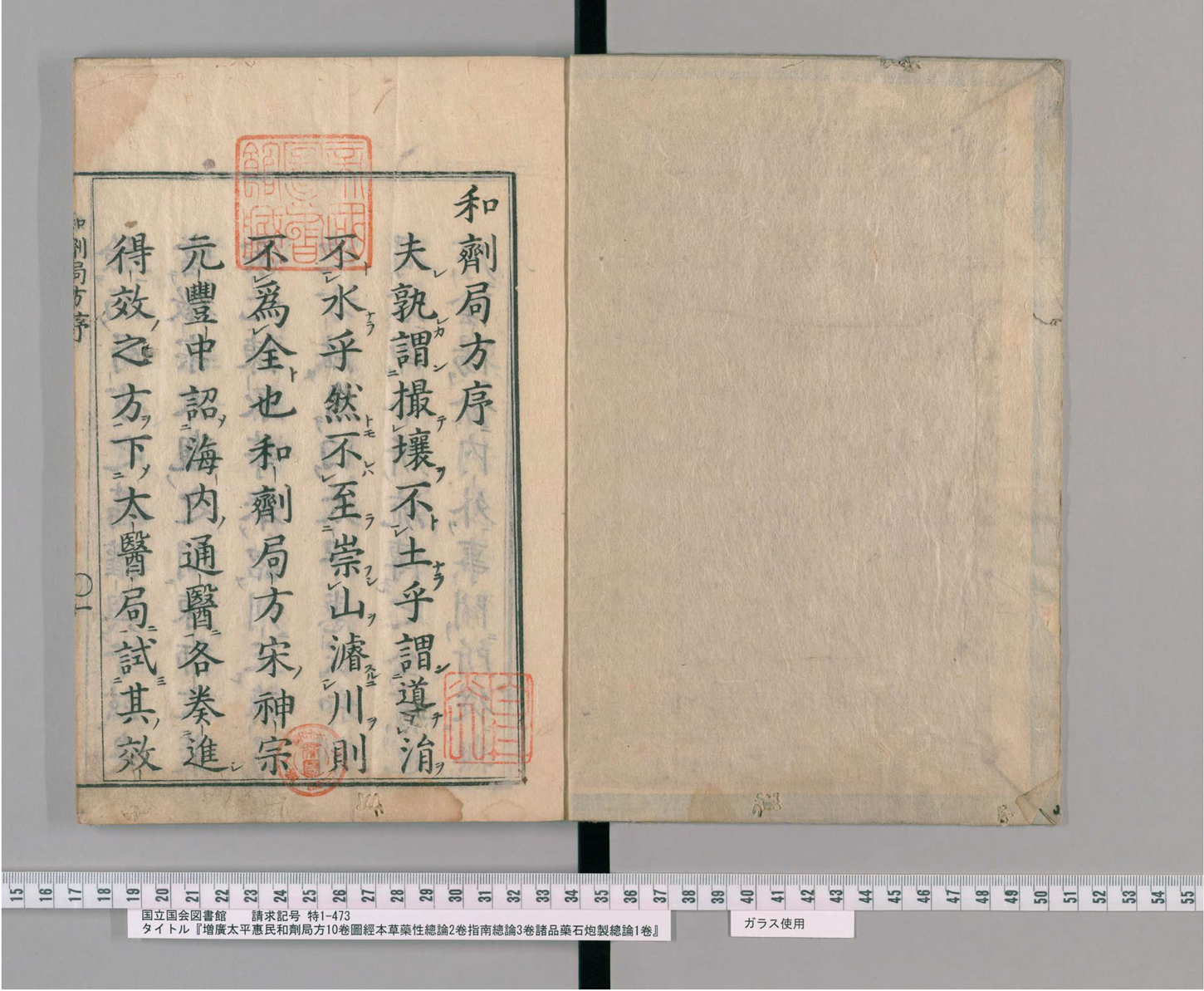
To write the Kyōhō edition, the authors gathered together revised editions and original prints from earlier dates, including the Korean and Ming editions stored in Tokugawa Ieyasu's libraries and the Momijiyama Bunko, the Bakufu library in Edo, as well as editions belonging to Bakufu physicians. Physicians such as Imaōji Chikaaki, who also wrote the Foreword to Fukyū ruihō; the second-generation doctor Hosokawa Tōan (also known as Motonobu 元信, 1699–1761), whose father was responsible for the Japanese version of Tong‘ŭi pogam; Mochitsuki San'ei 望月三英; Niwa Shōhaku; and others worked on the revised edition for about seven years. In 1732, it was finally printed as Zōkō taihei keimin wazai kyokuhō 増広太平恵民和剤局方 (Enlarged Edition of Prescriptions of the Imperial Pharmacy of the Taiping era).Footnote 84
Zōkō taihei keimin wazai kyokuhō (1789), vol. 1, Foreword, 1789. Source: National Diet Library, Digital Collections.
As mentioned before, this Chinese source was already known to and appreciated by Ieyasu. When we look further back into Japan's past, we find that this text can be traced back as far as the Middle Ages. Prescriptions from the Hejiju fang already appear in the thirteenth Japanese herbal dictionary Honzō irohashō 本草色葉鈔 (A Selection of Materia Medica in Iroha-order). Koremune Tomotoshi 惟宗具俊 (thirteenth century), who wrote this eight-volume work, used the works that had most recently arrived from China, including the Zhenglei bencao 証類本草 (Collected Classified Materia Medica) written by Tang Shenwei 唐慎微 (1056–1093) and Zhang Zongjing's 張 仲景 famous Shanghan lun 傷寒論 (Treatise on Cold Damage Disorders) (150–219).Footnote 85 The monk and physician Kajiwara Shōzen 梶原性全 (1266–1337) also had access to at least one edition of this work, which he occasionally referred to in his Man'anpō 万安方 (Ten Thousand Safe Prescriptions), commenting that the ingredients in a prescription might differ slightly, depending on the edition.Footnote 86
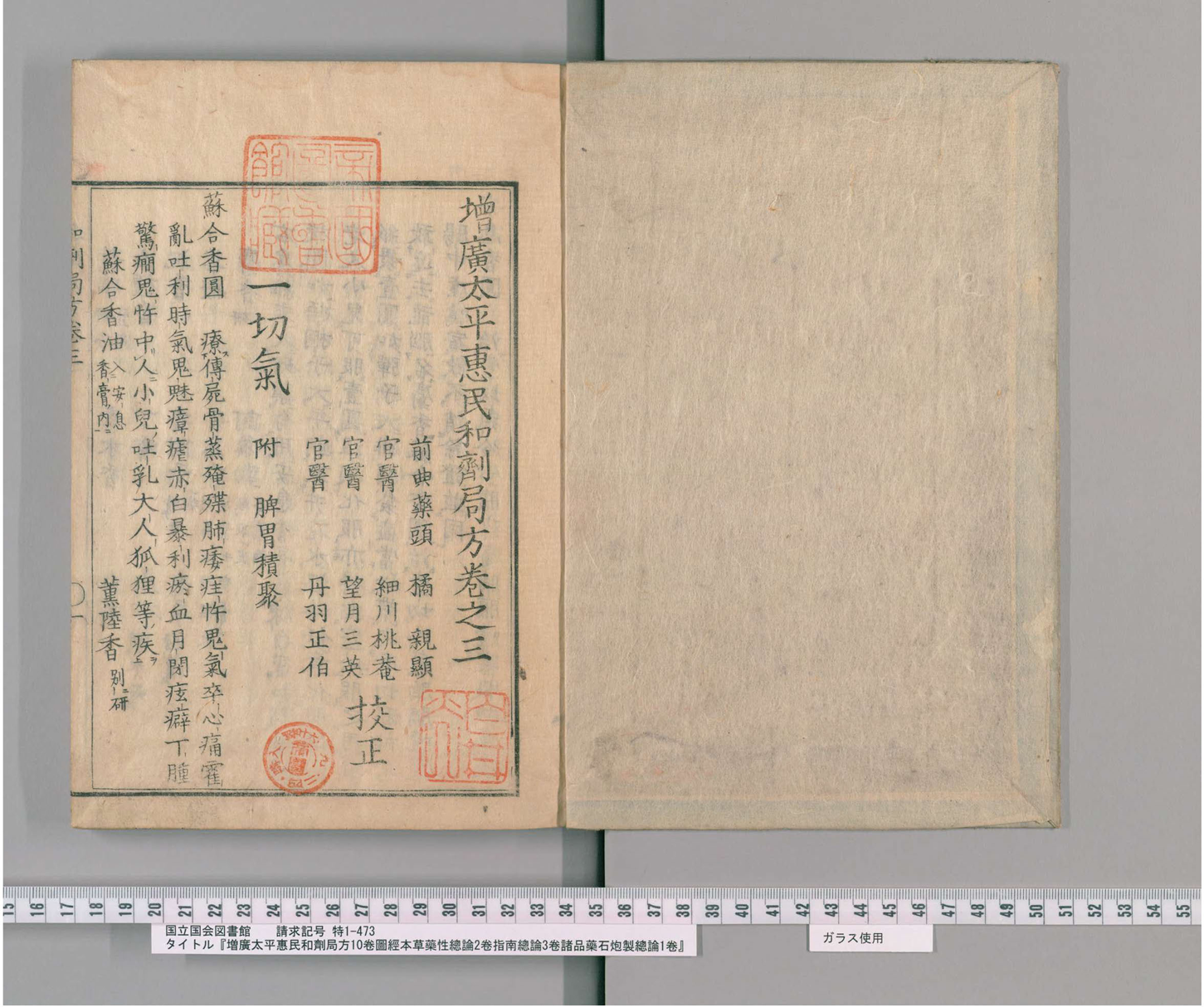
What makes the Heji jufang particularly interesting in this context is not so much the number of versions that physicians had access to but the fact that it contained—alongside approved medical knowledge from China—many prescriptions and ingredients drawn from the Arabic medical tradition. By analysing the formulas and their components, Nakamura and others have discovered that Arabic medicine had a significant influence on treatments covering ‘all forms of [disorders of] vital energy’ (issaiki), especially in the area of aromatic stomachics. These were known as Jawarish and were highly developed in Arabic medicine.Footnote 87
Zōkō taihei keimin wazai kyokuhō (1789), vol. 3, Issaiki. Source: National Diet Library, Digital Collections.
Having investigated these ‘Western’ prescriptions and ingredients—crude drugs originating from Middle East and India—in works by Shōzen and other medieval authors, Goble has concluded that Arabic medicine provided medieval Japan with a way of treating stomach and enteric ailments that was superior to anything previously available.Footnote 88 We can therefore conclude that Yoshimune also revived Arabic medicine with the publication of Hejiju fang; in this context, it would be interesting to find out to what extent this medicine was actually administered by professionals and how far it diffused into daily life as common medical knowledge.
Conclusion
Investigating Yoshimune's diverse activities brings us back to the initial question of whether they can be seen as an expression of public healthcare. If we look at the scale and systematic arrangement of his projects, which are undoubtedly impressive and were not pursued to the same extent by earlier governments, we can certainly regard him as a pioneer of public welfare. While agreeing with Felix Gutzwiller and Fred Paccaud that the successful implementation of public health policies depends on the natural and social environment encountered,Footnote 89 we can affirm that Yoshimune's investigations into horticultural and botanical studies did help to improve people's access to medicines, particularly through the cultivation of ginseng, his most prominent undertaking. As the plant collector Matsui Shigeyasu 松井重康 (dates unknown) noted in his Foreword to ‘The Records of Herb Collectors’ (Saiyakushi ki 採薬使記, 1758), the government
has extended its reach to the ordinary people to help them in their sufferings. Presently, no physicians trust Japanese products but only esteem Chinese medicines; for curing diseases, however, our people cannot do anything but rely on medicines growing in our country. Even if those of humble origin know about the efficacy of Chinese products, they cannot be helped and have to die, either because the medicines are too expensive or else because the ship from China is delayed.Footnote 90
Although it took Yoshimune about 30 years of trial and error to produce ginseng, seeds were finally distributed in many areas to people who wanted to cultivate them.Footnote 91 This policy not only provided income for the farmers who grew ginseng, but also satisfied medical demands for the plant, providing, as it did, an inexpensive and reliable product.Footnote 92
One of the characteristics generally associated with public health is the establishment of facilities to care for the sick; such efforts are also apparent in Yoshimune's policies. The tenuous situation in an overcrowded Edo prompted him to act and establish a dispensary. In contrast to previous dispensaries, which were clearly founded in accordance with the Buddhist notion of merit, the creation of the Koishikawa sanatorium appears to have been less an act of religious devotion than a political and pragmatic move. Far more central to his healthcare politics than building an institution was his involvement in the publication of texts to enable the access and dissemination of medical knowledge, a point that has been largely neglected in the literature. These texts offered enormous potential for useful information in two ways; first, by enabling both professionals and amateurs to expand their knowledge and second, by applying this knowledge in daily life. These medical manuals can be classified both as writings addressed to a learned audience with the aim of expanding and deepening their medical knowledge—and also as texts written for the general population to be directly applied in daily life. In this regard, the Shenghui fang, Hejiju fang, Tong‘ŭi pogam, and Waitai miyao belong to the first category of texts, while the Fukyū ruihō was clearly addressed to a wider audience to provide medical self-help.Footnote 93 The former were all more or less versions of recipes from Chinese sources that had been freshly evaluated and tested; the latter processed these sources and attempted to adapt the information they contained to the economic and social circumstances of the time. In this sense, the publication of Fukyū ruihō in particular can be seen as an early attempt by the government to provide the population with medical knowledge as a welfare tool.
To sum up, this investigation of Yoshimune's welfare activities has shown how his initial response to a volatile social and economic situation at the beginning of his time in office developed into a dynamic welfare initiative, of which his healthcare activities became an important part. He drew on the ideas, projects, and experiences of previous governments in Japan and abroad. As Gutzwiller and Paccaud have argued, public health is a dynamic process that must be balanced and realised in concrete life situations.Footnote 94 That is exactly what Yoshimune achieved through his diverse endeavours.
Conflicts of interest
The author reports none.



