A 2-month-old preterm boy was referred for surgery with complex cyanotic CHD. Prostaglandin E1 therapy had been initiated at birth; 2D Echo confirmed dextrocardia, double-outlet right ventricle, severe pulmonary stenosis, disconnection of the pulmonary arteries, left pulmonary artery supplied by a patent ductus arteriosus, and systemic venous abnormalities.
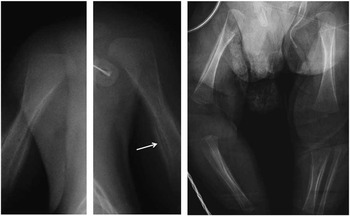
Reconnection of the left pulmonary artery, ductal closure, and Blalock–Taussig shunt were scheduled but had to be delayed due to severe respiratory viral infection. On day 75, he was noted to be irritable and to have painful bilateral swelling of the arms and legs. X-ray studies revealed cortical hyperostosis as an intense periosteal reaction with bilateral corticoperiosteal thickening of the diaphyses of the femur, tibia, humerus, radius, and ulna (Fig 1). Analgesics were prescribed, surgery was undertaken, and prostaglandin E1 therapy was withdrawn.
Periosteal detachment of the long bones in a patient treated with prostaglandin E1. Radiographs of the long bones revealed a thicker, dense, linear image in the central portions of the diaphysis. In some cases, several layers can be seen (arrow).

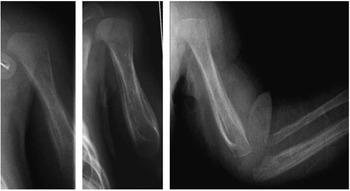
Swelling of the limbs progressively disappeared, and 3 months later the periosteal detachments were almost completely fused with the cortical diaphysis (Fig 2).
Subsequent humerus radiographs showed a more solid and thicker periosteal reaction, with better definition of the cortical bone limits. After 3 months, the periosteal detachments had been consolidated and were almost completely fused with the cortical diaphysis.

Periosteal changes may be seen after prolonged prostaglandin E1 infusions but have also been reported as early as within 2 weeks. Cortical hyperostosis usually has an asymptomatic course, and therefore its diagnosis is seldom made unless the symptomatology is clinically significant. Histology shows formation of primitive bone with thickening of the periosteal membrane, resorption of the outer cortical surface, and bone formation in the inner surface.Reference Jorgensen, Svanholm and Host 1
Painful swelling of the limbs may help detect cortical hyperostosis. Attention has to be paid to those babies in whom surgical therapy has to be delayed and long-term therapy with prostaglandin E1 is required.
Acknowledgement
We wish to thank all the people involved in patient management.
Financial Support
The remaining authors have no financial relationships relevant to this article to disclose.
Conflicts of Interest
The authors have no conflicts of interest to disclose.