Introduction
Temporal lobe epilepsy (TLE) often has onset in childhood and persists into adulthood. Interestingly, distinct neurological and neuropsychological features of this type of epilepsy are not apparent in infants and preschool children, but gradually emerge, as the brain matures and a range of physiological and behavioral manifestations develop. For example, in adults with TLE, memory deficits (learning and/or retention of information over 20- to 30-min delays) are often found to be material-specific. Impaired memory for verbal materials is evident in patients with a left temporal lobe seizure focus (Bell, Fine, Dow, Seidenberg, & Hermann, Reference Bell, Fine, Dow, Seidenberg and Hermann2005; Frisk and Milner, Reference Frisk and Milner1990; Hermann, Wyler, Richey, & Rea, Reference Hermann, Wyler, Richey and Rea1987; Jones-Gotman et al., Reference Jones-Gotman, Zatorre, Olivier, Andermann, Cendes, Staunton and Wieser1997; Seidenberg et al., Reference Seidenberg, Hermann, Dohan, Wyler, Perrine and Schoenfeld1996). Impaired memory for visual materials tends to be found (albeit less consistently) in patients with a right hemisphere seizure focus (Bell et al., Reference Bell, Fine, Dow, Seidenberg and Hermann2005; Chiaravalloti, Tulsky, & Glosser, Reference Chiaravalloti, Tulsky and Glosser2004; Jones-Gotman, Reference Jones-Gotman1986; Jones-Gotman et al., Reference Jones-Gotman, Zatorre, Olivier, Andermann, Cendes, Staunton and Wieser1997; Pillon et al., Reference Pillon, Bazin, Deweer, Ehrlé, Baulac and Dubois1999; Smith and Milner, Reference Smith and Milner1989). Memory deficits are also evident in children with TLE, but the findings relating to material-specificity tend to differ from the findings in the adult literature. In children, verbal memory deficits are often found to be unrelated to laterality of seizure focus (Gonzalez, Anderson, Wood, Mitchell, & Harvey, Reference Gonzalez, Anderson, Wood, Mitchell and Harvey2007; Lendt et al., Reference Lendt, Gleissner, Helmstaedter, Sassen, Clusmann and Elger2002; Mabbott & Smith, Reference Mabbott and Smith2003; but see: Cohen, Reference Cohen1992; Gleissner et al., Reference Gleissner, Sassen, Lendt, Clusmann, Elger and Helmstaedter2002), whereas visual memory deficits have been found in children with right hemisphere seizure focus in some (i.e., Beardsworth & Zaidel, Reference Beardsworth and Zaidel1994; Nolan et al., Reference Nolan, Redoblado, Lah, Sabaz, Lawson, Cunningham and Bye2004), but not in other studies (e.g., Gonzalez et al., Reference Gonzalez, Anderson, Wood, Mitchell and Harvey2007). Interestingly, a recent longitudinal study revealed a change in the pattern of memory deficits from childhood to adolescence/young adulthood (Gonzalez, Mahdavi, Anderson, & Harvey, Reference Gonzalez, Mahdavi, Anderson and Harvey2012). Initially, verbal memory deficits in children were unrelated to the laterality of seizure focus, but lateralized verbal memory deficits were evident at follow-up, during adolescence or young adulthood. Similarly, in a large cross-sectional study examining verbal memory across a wide age-span (6–68 years) impact of laterality was not evident in children, but was apparent in adolescence/early adulthood (Helmstaedter & Elger, Reference Helmstaedter and Elger2009). Inspection of verbal memory scores across childhood and adolescence/early adulthood was indicative of a developmental hindrance (rather than cognitive decline) in patients with epilepsy relative to healthy participants. This hindrance resulted in a gap that widened from childhood to adolescence/early adulthood. Interestingly, the emergence of lateralized verbal memory deficits coincides with the endpoint of functional cerebral plasticity and increased hippocampal activation as children move into adolescence (Ghetti, DeMaster, Yonelinas, & Bunge, Reference Ghetti, DeMaster, Yonelinas and Bunge2010). Importantly, for our study, the hippocampus is also proposed to be critical for recollection of past autobiographical memories irrespective of their distance from the present (Nadel & Moscovitch, Reference Nadel and Moscovitch1997). Moreover, adults with unilateral TLE have been found to experience difficulties in autobiographical recall (Addis, Moscovitch, & McAndrews, Reference Addis, Moscovitch and McAndrews2007; Viskontas, McAndrews, & Moscovitch, Reference Viskontas, McAndrews and Moscovitch2000). It is not known, however, whether children with TLE experience similar difficulties.
Autobiographical memory is a complex, uniquely human memory system that contains semantic and episodic components. While the semantic component involves recall of factual autobiographical information, the episodic component relates to the ability to recollect personally experienced events of a known temporality that are rich in contextual details (Tulving, Reference Tulving2002). Moreover, recalled episodes (but not semantic details) are often emotionally salient (Piefke, Weiss, Zilles, Markowitsch, & Fink, Reference Piefke, Weiss, Zilles, Markowitsch and Fink2003), vivid, and associated with the sense of re-experiencing (Hassabis & Maguire, Reference Hassabis and Maguire2007). These two components of autobiographical memory were proposed to be supported by different neural networks (but see Squire, Cohen & Nadel, Reference Squire, Cohen and Nadel1984) and to have different developmental trajectories. While the semantic memories can be supported by neocortical structures, the retrieval and re-experiencing of autobiographical episodes require hippocampal involvement. With respect to developmental trajectories, marked improvements have been documented in the recall of episodic details from childhood to adolescence in the general population (Picard, Reffuveille, Eustache, & Piolino, Reference Picard, Reffuveille, Eustache and Piolino2009; Picard, Cousin, Guillery-Girard, Eustache, & Piolino, Reference Picard, Cousin, Guillery-Girard, Eustache and Piolino2012; Piolino et al., Reference Piolino, Hisland, Ruffeveille, Matuszewski, Jambaqué and Eustache2007; Willoughby et al., Reference Willoughby, Desrocher, Levine and Rovet2012), while increases in the recall of semantic details over the same developmental period have either been small (Willoughby, Desrocher, Levine, & Rovet, Reference Willoughby, Desrocher, Levine and Rovet2012) or insignificant (Piolino et al., Reference Piolino, Hisland, Ruffeveille, Matuszewski, Jambaqué and Eustache2007).
Given the role of the hippocampus in autobiographical memory, studies of TLE patients are particularly relevant, as seizures often [but not always (Cascino, Reference Cascino1992)] emanate from the hippocampus within this patient group (Spencer, Williamson, Spencer, & Msattson, Reference Spencer, Williamson, Spencer and Mattson1987; Spencer, Spencer, Williamson, & Mattson, Reference Spencer, Spencer, Williamson and Mattson1990). Several recent studies of adults with TLE [but not all, (Upton, Corcoran, Fowler, & Thompson Reference Upton, Corcoran, Fowler and Thompson1992)], have found evidence of impaired autobiographical memory, but the patterns of impairments differed. Impairments have been found in the recall of (i) semantic, but not episodic, memories (Barr, Goldberg, Wasserstein, & Novelly, Reference Barr, Goldberg, Wasserstein and Novelly1990; Lah, Grayson, Lee, & Miller, Reference Lah, Grayson, Lee and Miller2004); (ii) episodic (O'Connor et al., Reference O'Connor, Morin, Verfaellie, Greenblatt, Doherty, Cahn and Schomer1999; Noulhiane et al., Reference Noulhiane, Piolino, Hasboun, Clemenceau, Baulac and Samson2007; Voltzenlogel, Despres, Vignal, Kehrli, & Manning, Reference Voltzenlogel, Despres, Vignal, Kehrli and Manning2007), but not semantic memories (Addis et al., Reference Addis, Moscovitch and McAndrews2007; St-Laurent, Moscovitch, Levine & McAndrews, Reference St-Laurent, Moscovitch, Levine and McAndrews2009; Viskontas et al., Reference Viskontas, McAndrews and Moscovitch2000; Voltzenlogel et al., Reference Voltzenlogel, Després, Vignal, Steinhoff, Kehrli and Manning2006), and (iii) both episodic and semantic memories (Herfurth, Kasper, Schwarz, Stefan, & Pauli, Reference Herfurth, Kasper, Schwarz, Stefan and Pauli2010; Lah, Lee, Grayson, & Miller, Reference Lah, Lee, Grayson and Miller2006). Although it is possible that these inconsistencies are partly due to variations in methods, test protocols, or sample characteristics, they may also be due to between-study differences in hippocampal status, as functional neuroimaging studies have found that the activity of the residual hippocampal tissue was significantly reduced in an autobiographical memory task relative to a control task in pre-surgical patients (Addis et al., Reference Addis, Moscovitch and McAndrews2007). Furthermore, it has been found that the volumes of residual mesial temporal structures were correlated with episodic autobiographical memory scores (Noulhiane et al., Reference Noulhiane, Piolino, Hasboun, Clemenceau, Baulac and Samson2007). Finally, regional cerebral blood flow in the medial temporal lobe, including the hippocampus, has also been associated with the recall of episodic events from all stages of life (Piolino et al., Reference Piolino, Desgranges, Hubert, Bernard, Matuszewski, Chételat and Eustache2008), providing further support for the notion that the hippocampus is necessary for re-experiencing episodic memories, irrespective of their age (Steinvorth, Levine, & Corkin, Reference Steinvorth, Levine and Corkin2005).
In addition to hippocampal integrity, other clinical variables (i.e., laterality of seizure focus and epilepsy treatment) have also impacted autobiographical memory recall in adults with TLE, although findings have been inconsistent. Deficits in episodic recall were found to be more severe in patients with a seizure focus in the left (Barr et al., Reference Barr, Goldberg, Wasserstein and Novelly1990; Leeman, Macklin, Schomer, & O'Connor, Reference Leeman, Macklin, Schomer and O'Connor2009; Voltzenlogel et al., Reference Voltzenlogel, Després, Vignal, Steinhoff, Kehrli and Manning2006) or in the right (Lah et al., Reference Lah, Lee, Grayson and Miller2006) temporal lobe. Moreover, in patients who underwent temporal lobectomy, the absence of seizures and being off anti-epileptic drugs was associated with better semantic recall (Lah et al., Reference Lah, Grayson, Lee and Miller2004). In pre-surgical patients with TLE, those on polytherapy have exhibited poorer episodic recall than those on monotherapy (Lah et al., Reference Lah, Lee, Grayson and Miller2006). Finally, as the hippocampus is purported to be critical for both new learning and recall of past personally experienced episodes, it was expected that the correlations between scores obtained on these two types of memory tests will be high. Instead, significant correlations have been found between new learning and semantic autobiographical details (Lah et al., Reference Lah, Lee, Grayson and Miller2006), but not between new learning and recall of personally experienced episodes (Herfurth et al., Reference Herfurth, Kasper, Schwarz, Stefan and Pauli2010; Lah et al., Reference Lah, Grayson, Lee and Miller2004, Reference Lah, Lee, Grayson and Miller2006). Finally, seizures themselves may interfere with consolidation (in adults: Blake, Wroe, Breen, & McCarthy, Reference Blake, Wroe, Breen and McCarthy2000; Mameniskiene, Jatruzis, Kaubrys, & Budrys, Reference Mameniskiene, Jatuzis, Kaubrys and Budrys2006; Muhlert et al., Reference Muhlert, Grünewald, Hunkin, Reuber, Howell, Reynders and Isaac2011; in children: Gascoigne et al., Reference Gascoigne, Barton, Webster, Gill, Antony and Lah2012), which in turn could compromise autobiographical memory.
To our knowledge, no study has systematically examined autobiographical memory in children with TLE, although Smith, Elliot & Lach (Reference Smith, Elliot and Lach2006) noted that children with epilepsy (among whom were a large proportion with TLE) reported difficulties recalling events from their lives. This lack of research represents a notable gap, as these children are likely to be at risk of autobiographical memory impairments, which is of clinical significance. In addition, studies involving children with TLE may offer further insight into the role of the hippocampus in autobiographical memory. Of relevance are studies involving patients with developmental amnesia (DA) arising from early bilateral hippocampal damage (e.g., from perinatal hypoxia or ischemia). The memory impairment in these patients is characterized by severely impaired new learning and recall of this newly learned information after short delays (Vargha-Khadem et al., Reference Vargha-Khadem, Gadian, Watkins, Connelly, Van Paesschen and Mishkin1997) and poor everyday memory (Gadian et al., Reference Gadian, Aicardi, Watkins, Porter, Mishkin and Vargha-Khadem2000; Vargha-Khadem et al., Reference Vargha-Khadem, Salmond, Watkins, Friston, Gadian and Mishkin2003), but relatively preserved semantic knowledge (Gardiner, Brandt, Vargh-Khadem, Baddeley, & Mishkin, Reference Gardiner, Brandt, Vargha-Khadem, Baddeley and Mishkin2006). As young adults, these patients tended to recall significantly fewer episodic details, but not semantic details relative to healthy controls on autobiographical memory tasks (Kwan, Carson, Addis, & Rosenbaum, Reference Kwan, Carson, Addis and Rosenbaum2010; Rosenbaum et al., Reference Rosenbaum, Carson, Abraham, Bowles, Kwan, Köhler and Richards2011). Moreover, in a recent study that examined 24-hr recall of staged events typically encountered during a neuropsychological assessment, Cooper, Vargha-Khadem, Gadian, and Maguire (Reference Cooper, Vargha-Khadem, Gadian and Maguire2011) found that, relative to controls, school-aged children with DA exhibited poorer recall of spatiotemporal and episodic information (while being able to recall the gist of the event). Additionally, within the DA group, smaller hippocampal volume (both right and left) was associated with poorer episodic recall (Cooper et al., Reference Cooper, Vargha-Khadem, Gadian and Maguire2011).
This study aimed to examine autobiographical memory in children with TLE. We hypothesized that, in a test of autobiographical recall, children with TLE would recall fewer episodic details relative to their healthy control peers. Further exploratory analyses were conducted to investigate potential relationships between performance on the autobiographical memory task, tests of new learning and short-term memory, chronological age, and relevant epilepsy variables (presence of hippocampal abnormality, laterality of seizure focus, surgical treatment, mono versus poly-therapy, epilepsy severity, age at diagnosis, and proportion of life with epilepsy).
Method
Participants
Twenty-four healthy children (the control group) and 21 children with TLE were recruited for the present study. Inclusion criteria were: aged 6 to 16 years at the time of assessment and fluency in English. Exclusion criteria were: (i) Full Scale Intelligence Quotient (FSIQ) < 80; (ii) presence of a major sensory deficit; (iii) significant neurodevelopmental disorder (e.g., autism, but not learning disability or ADHD), or (iv) the presence of another neurological disorder.
TLE participants were recruited from specialist epilepsy programs within three children's hospitals: The Children's Hospital at Westmead (Sydney, Australia) and The Hospital for Sick Children (Toronto, Canada) and McMaster Children's Hospital (Hamilton, Canada). The study was approved by ethics committees of participating hospitals and The University of Sydney. Potential participants with TLE (pre-surgical, post-surgical, and non-surgical) were identified by review of patient files. Electroencephalography (EEG) records, medical history, and imaging data (where available) were reviewed by the treating pediatric neurologists, and only children who met the International League Against Epilepsy criteria for TLE (Commission on Classification and Terminology of the International League Against Epilepsy, 1989) were invited to participate. Clinical data for all TLE participants are summarized in Supporting Table 1.
Demographic, cognitive, and clinical data

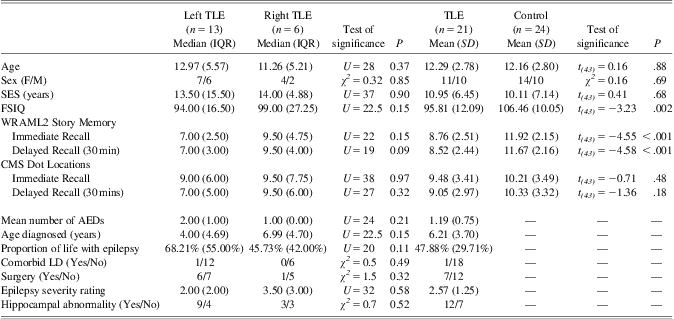
AED: anti-epileptic drug; CMS: Children's Memory Scale; FSIQ: Full Scale Intelligence Quotient; IQR: Inter-Quartile Range; LD: learning disability; SES: Socioeconomic status; TLE: temporal lobe epilepsy; WRAML2: Wide Range Assessment of Memory and Learning, Second Edition.
Of the 21 children with TLE, 13 had seizures emanating from the left temporal lobe (including six postoperative patients), six from the right temporal lobe (including one postoperative patient) while the laterality of seizure focus could not be satisfactorily determined in two participants. A total of six participants who had not undergone surgery had MRI evidence of a hippocampal abnormality, involving either hippocampal sclerosis (n = 2), tumor (n = 1), dysplasia (n = 2), and gliosis (n = 1). Of the seven postoperative TLE patients, six had undergone a resection that involved the hippocampus, as a result of mesial temporal gliosis (n = 3), sclerosis (n = 1), microcortical dysgenesis (n = 1), and dysplasia (n = 1). One patient with TLE underwent a left anterior lateral temporal lobectomy (due to ganglioglioma), which spared the hippocampus. One participant was left-handed. Complex partial seizures were the most common seizure type. Seventeen participants experienced only one seizure type, while four experienced a combination of seizure types. Two participants were not taking any anti-epileptic drugs (AEDs). Twelve were on monotherapy and seven on polytherapy. Six different AEDs were represented within the TLE patient group. One TLE participant was reported to have a diagnosed learning disability; however, no control participant was diagnosed with a comorbid developmental disorder.
Control participants were recruited via word-of-mouth through the peer networks of both TLE and control participants (snowball recruitment). Only children who met inclusion/exclusion criteria, and were free of a history of epilepsy, as per intake interviews with the parents/guardians, were invited to be control participants.
Measures
Socioeconomic status (SES) was measured by average years of parent/guardian education. Intelligence (FSIQ; M = 100; SD = 15) was assessed with the two-subtest version (Vocabulary and Matrices) of the Wechsler Abbreviated Scale of Intelligence (WASI; Wechsler Reference Wechsler1999). New learning and short-term memory were evaluated with the Dot Location subtest from the Children's Memory Scale (CMS; Cohen, Reference Cohen1997) and the Story Memory subtest from the Wide Range Assessment of Memory and Learning: Second Edition (WRAML2; Sheslow & Adams Reference Sheslow and Adams2003). Age scaled scores were used (M = 10; SD = 3).
Epilepsy Severity
Treating pediatric neurologists completed the Global Assessment of Severity of Epilepsy (Speechley et al., Reference Speechley, Sang, Levin, Zou, Eliasziw, Smith and Wiebe2008), an instrument which has high test–retest (weighted j = 0.90) and inter-rater reliability (weighted j = 0.85), in addition to good construct validity. When giving a severity rating, neurologists considered the frequency and intensity of seizures, severity of postictal period, injuries during seizures, number and side effects of antiepileptic drugs, and interference of epilepsy or drugs with daily activities. Epilepsy severity was rated from 1 (Not at all severe) to 7 (Extremely severe).
Children's Autobiographical Interview
The Children's Autobiographical Interview (CAI; Willoughby et al., Reference Willoughby, Desrocher, Levine and Rovet2012) is an adapted version of the Autobiographical Interview (AI; Levine, Svododa, Hay, Winocur, & Moscovitch, 2002), which was originally developed for adults. Children were asked to recall two separate events (specific to a time and place) which they were personally involved in from any period during their lives, except for the preceding month. To aid the selection of appropriate memories, all children were provided with a list containing examples of 18 different life events (such a birthday party or school excursion), but reminded that they were free to recall any event, irrespective of the suggestions contained in the list.
The CAI involved administration of three conditions: Free Recall, General Probe, and Specific Probe. In the Free Recall condition, which was administered first, participants were given up to five minutes to recall as much information as possible about a specific event without any interruptions or prompting from the interviewer. In the General Probe condition, administered immediately after the Free Recall of an event, participants were either given (i) a general prompt to recall any additional details or (ii) to choose and clarify the event if multiple or non-specific events had been recounted during Free Recall. The Specific Probe condition was the final stage of the CAI, administered only once the Free Recall and General Probe conditions had been completed for both events to prevent any contamination of the Free Recall of the second event. During the Specific Probe, children were asked a set of standardized questions relating to types of details (Event, Time, Place, Perceptual, and Emotion/Thought) that were not recalled in the previous two conditions.
The recall of both memories was recorded and transcribed (see example in Figure 1). Each memory was scored according to the AI scoring manual (Levine et al., Reference Levine, Svoboda, Hay, Winocur and Moscovitch2002). Two main types of details were identified within each memory: (i) episodic details, that pertain directly to the main episode and are placed in a particular spatio-temporal context, suggestive of the re-experiencing of the main event and (ii) semantic details, representing general autobiographical information that is not integral to the main event. The average score of the two recalled memories was obtained separately for episodic and semantic details for each of the three conditions: (i) Free Recall, (ii) General Probe (Free Recall+General Probe), and (iii) Specific Probe (Free Recall+General Probe+Specific Probe). See Figure 1 for a scored example of a transcribed memory.
Scored shortened example of a transcribed memory from the Children's Autobiographical Interview.
Each transcribed memory was initially scored by one experimenter (MG) who had previously completed training by scoring a practice set of memories provided with the AI scoring manual (Levine et al., Reference Levine, Svoboda, Hay, Winocur and Moscovitch2002), achieving correlations ranging from 0.89 to 0.99 with the practice set. Another trained staff member independently scored ten randomly selected memories. Intra-class inter-rater correlations for the composite scores obtained on the CAI were (i) Free Recall: 0.77 and 0.71 for episodic and semantic details, respectively; (ii) General Probe: 0.82 and 0.88 for episodic and semantic details, respectively; and (iii) Specific Probe: 0.98 and 0.75 for episodic and semantic details, respectively.
Procedure
Parents gave informed consent and children gave informed assent for participation in the study. Medical records were reviewed to obtain relevant medical information, which was verified by treating pediatric neurologists. Parents of control and TLE participants were interviewed regarding their child's developmental and medical history, relevant epilepsy and SES variables, and completed questionnaires about their child. All children underwent a 90-min assessment, conducted by a psychologist, which included a battery of intelligence and memory tests, administered in a set order. The CAI, administered at the end, took approximately 25 min to complete. One interviewer (M.G.) conducted 33 (73%) of the interviews, while the remaining 12 (27%) were conducted by another psychologist (M.L.S.) and other trained support staff. Treating neurologists assessed epilepsy severity in the children with TLE.
Statistical Analysis
Preliminary analyses investigated all variables for outliers (i.e., 3 SD > M) and normality of distributions using the Shapiro-Wilk test. Two control participants were identified as outliers on the General Probe stage of the CAI and had their answers adjusted to the next most extreme value (Tabachnick & Fidell, Reference Tabachnick and Fidell1996). For variables that were normally distributed, between-group differences were examined using independent t tests. Where normality assumptions were not met Mann-Whitney U tests were used to examine between-group differences, and Spearman's rho (rs) was used for correlational analyses. With a sample size of 21 TLE patients, only correlations above r = 0.52 would be detected as statistically significant (Machin, Campbell, Fayers, & Pinol, Reference Machin, Campbell, Fayers and Pinol1997).
Chi-square tests were conducted for categorical variables, such as sex, surgical history, presence of hippocampal abnormality, and comorbid disorders. Effect sizes (Cohen's d) were calculated for all stages of the CAI and post hoc power calculations carried out for the General and Specific Probe stages of the CAI. As our data were not normally distributed, effect sizes (r) were calculated and converted to Cohen's d as described in Fritz, Morris, and Richler (Reference Fritz, Morris and Richler2012).
Results
Background Demographic, Cognitive and Clinical Variables
The left- and right-TLE groups did not differ on any demographic variables, including: age, sex distribution, and SES (see Table 1). Similarly, scores obtained by left- and right-TLE groups on Story Memory (WRAML2) and Dot Location (CMS) were comparable. Furthermore, the left- and right-TLE groups did not differ on clinical variables, including age of epilepsy diagnosis, proportion of life spent with epilepsy, mean number of prescribed AEDs, surgical history, epilepsy severity rating, presence of hippocampal abnormality or presence of a comorbid neurodevelopmental disorder.
As the left- and right-TLE groups were comparable on all background variables, and to increase statistical power, the two TLE groups, and two TLE participants in whom the laterality of seizure focus could not be satisfactorily determined, were merged into a single patient group and compared to the control group in subsequent analyses. No differences were found between the TLE and control groups for age, sex, and SES. However, the TLE group had significantly lower FSIQ than the control group. Moreover, the TLE group obtained significantly lower scores than the control group on immediate and delayed recall on Story Memory (WRAML2), but not on Dot Location (CMS; see Table 1).
Although the FSIQ of the TLE group was significantly below that of the control group, FSIQ was unrelated to the recall of autobiographical memory details within the TLE group during either the Free Recall (Episodic: rs = 0.28; p = .22; Semantic: rs = −0.07; p = .76), General Probe (Episodic: rs = 0.31; p = .17; Semantic: rs = −0.10; p = .68), and Specific Probe (Episodic: rs = 0.27; p = .23; Semantic: rs = −0.38; p = .87) conditions. Additionally, Dennis et al. (Reference Dennis, Francis, Cirino, Schachar, Barnes and Fletcher2009) pointed out that when a clinical group is significantly different from the control group on a variable that is integral to the condition, it is not necessary to control for this variable. Low FSIQ had previously been found to be an integral part of TLE (Hermann, Seidenberg, Schoenfeld, & Davies, Reference Hermann, Seidenberg, Schoenfeld and Davies1997); FSIQ < 85 was found in approximately 30% of TLE patients (Helmstaedter & Kockelmann, Reference Helmstaedter and Kockelmann2006). Moreover, in our study, the between-group difference in FSIQ could not be attributed to differences in the demographic variables, such as SES, as our groups were well matched on these variables. For these reasons, FSIQ was not used as a covariate in the subsequent analyses.
Children's Autobiographical Interview (CAI)
Total episodic and semantic scores obtained by two groups on the CAI across the three recall conditions are presented in Figure 2. Mann-Whitney U tests revealed that the TLE group recalled significantly fewer episodic details (median = 16; interquartile range (IQR] = 11.00) than the control group (median = 21.8; IQR = 20.88) in the Free Recall condition (p = .02; d = 0.67). However, no between-group differences in the recall of episodic details were found during either the General Probe (p = .07; d = 0.61) or Specific Probe conditions (p = .46; d = 0.47). Furthermore, no between-group differences were found for the recall of semantic details during the Free Recall (p = .62; d = 0.03), General Probe (p = .44; d = 0.09), or Specific Probe stages (p = .43; d = 0.07).
Children's Autobiographical Interview: number of episodic and semantic details by group and recall condition. *p < 0.05; TLE: Temporal Lobe Epilepsy. Boxes represent the Inter-Quartile Range, which contains data between the 25th and 75th percentiles. The median is represented by a horizontal line within each box. Whiskers represent minimum and maximum values.
Post hoc calculations indicated that to detect a significant statistically difference between the TLE and Control groups at the General and Specific probe stages of the CAI, with power of 0.80 and α at 0.05, a total of 36 TLE participants and 59 TLE participants, respectively, would be required.
Similarly, no differences between the TLE and control groups were found in the proportion of episodic details, relative to semantic details, recalled during either the Free Recall (median = 81.3%; IQR = 27.0% vs. median =88.0%; IQR = 14.0%, respectively; p = .13), General Probe (median = 82.1%; IQR = 27.0% vs. median = 87.5%; IQR = 15.0%, respectively; p = .10), or Specific Probe (median = 85.5%; IQR = 11.0% vs. median = 90.6%; IQR = 10.0%, respectively; p = .32) conditions.
Due to the absence of between-group differences in the recall of semantic details in all conditions, and episodic details in the General and Specific Probe conditions, and to minimize the number of comparisons, we only undertook further analyses for episodic scores obtained in the Free Recall condition. Given the small sample sizes in these analyses, they should be considered as exploratory.
Exploratory Analyses
Relations with chronological age
Relations between chronological age and recall of episodic details were separately examined in the TLE and control groups (see Figure 3). A significant correlation was found in the control group (rs = 0.45; p < .05); that is, older children recalled more episodic details. There was no significant correlation for the TLE group (rs = 0.34; p = .11).
Children's Autobiographical Interview: Free Recall condition. Number of episodic details recall by age and group.
Relations with tests of new learning and short-term memory
Within the TLE group, relations were examined between the Free Recall of episodic details and scores on standardized tests that required new learning and short-term memory on which significant between-group differences were found. Correlations with Story Memory (WRAML2): immediate (rs = 0.08; p = .72) and delayed (rs = 0.15; p = .50) recall, and Dot Location (CMS): immediate recall (rs = 0.08; p = .72) were small and non-significant.
Relations between Epilepsy-Related Factors and CAI
Hippocampal abnormality
To explore the potential relationship between hippocampal integrity and the recall of episodic details in the Free Recall condition of the CAI, TLE patients with an intact hippocampus (n = 9; median = 16; IQR = 7.50) were compared with those whose hippocampus was abnormal (n = 12, median = 15.5; IQR = 19.63). A Mann-Whitney U test showed that the two groups did not differ significantly in the number of episodic details recalled (p = .97; d = 0.23).
Other epilepsy variables
Mann-Whitney U tests revealed no significant differences between right-TLE (n = 6; median = 24; IQR = 22) and left-TLE (n = 13; median = 13.5; IQR = 9.25, p = 0.11; d = 0.97) children in the Free Recall of recall of episodic details. Inspection of boxplots and scores for individual participants in Figure 3 suggests that laterality played little role in recall of autobiographical memory. Moreover, correlations between episodic recall and age at diagnosis (rs = 0.20; p = .39), proportion of life with epilepsy (rs = −0.07; p = .39), and epilepsy severity ratings (rs = 0.03; p = .90) were small and not significant.
Epilepsy treatment
Children who underwent surgical treatment (n = 7; median =17.5; IQR = 11.5) did not differ significantly (p = .91; d = 0.09) from children who did not undergo surgery (n = 14; median = 16; IQR = 13.38) in the number of episodic details recalled. Finally, no significant difference (p = .15; d = 0.33) was found between children who were on monotherapy (n = 12; median = 16; IQR = 15.38) compared to those on polytherapy (n = 7; median = 17.5; IQR = 13).
Discussion
In this, to our knowledge, first study of autobiographical memory in children with TLE, significant deficits were evident in the free recall of episodic (but not semantic) autobiographical details. Exploratory analysis suggested that hippocampal abnormalities may not appear to be associated with worse recall of episodic details in the TLE group. Moreover, epilepsy variables (seizure laterality, duration, and severity of epilepsy disorder), treatment variables (surgery, drug polytherapy), and scores on standardized memory tests were not associated with episodic recall. The richness of episodic recall did not improve with age in children with TLE, unlike the healthy control group.
Interestingly, the between-group difference in recall of autobiographical events was not present when children were prompted. This raises a possibility that, within the TLE group, impairments in episodic recall were largely due to retrieval difficulties, rather than memory storage. Moreover, episodic recall was not associated with standardized memory test scores, even though it has been proposed that episodic recall and recall of newly learned material are both related to hippocampal integrity. While puzzling, this is consistent with other adult studies that have not reported a significant association between autobiographical recall and standardized memory test scores (Herfurth et al., Reference Herfurth, Kasper, Schwarz, Stefan and Pauli2010; Lah et al., Reference Lah, Grayson, Lee and Miller2004, Reference Lah, Lee, Grayson and Miller2006). Moreover, and again contrary to our expectations, no between-group difference in episodic recall was found when children with a hippocampal abnormality were compared with children without a hippocampal abnormality. Together, our findings raise a possibility that other cognitive deficits, such as executive dysfunction, contribute to impaired episodic recall in patients with TLE and/or that contralateral or surrounding ipsilateral brain regions support the functions of the abnormal hippocampus in children with unilateral TLE.
Other epilepsy variables, such as epilepsy severity ratings, lifetime duration of active epilepsy, and age at diagnosis were also unrelated to episodic recall in children with TLE. It is possible that these factors may have a cumulative, but gradual impact on formation and retrieval of autobiographical memories. Thus the effect of these factors may not become apparent until adulthood.
The relationship between chronological age and number of episodic details recalled was somewhat different in children with TLE and control children. Like previous developmental studies (Picard et al., Reference Picard, Reffuveille, Eustache and Piolino2009, Reference Picard, Cousin, Guillery-Girard, Eustache and Piolino2012; Piolino et al., Reference Piolino, Hisland, Ruffeveille, Matuszewski, Jambaqué and Eustache2007; Willoughby et al., Reference Willoughby, Desrocher, Levine and Rovet2012), we found that, within the control group, the richness of episodic recall appeared to increase in older children. While in children with TLE the same trend was observed, the strength of the association between the richness of episodic recall and age was slightly weaker, and did not reach statistical significance. This correlation, however, was medium in size (r = 0.34), which suggests that the relation between chronological age and richness of episodic recall needs to be explored in larger samples of children with TLE. Although based on a small number of participants and related to recall of memories from the past, however, our findings are consistent with a large cross-sectional study that compared learning and word recall between patients with chronic TLE (n = 1156, aged 6 to 68 years) with control subjects (n = 1000, aged 6 to 80 years) (Helmstaedter & Elger, Reference Helmstaedter and Elger2009). Patients made much smaller gains in recall of newly learned material during childhood and adolescence in particular, as learning peaked at an earlier age in patients (16–17 years) compared to controls (23–24 years). In addition, lack of significant developmental gains in memory for arbitrarily related word pairs from childhood to adolescence was also evident in another longitudinal study (Gonzalez et al., Reference Gonzalez, Mahdavi, Anderson and Harvey2012). Together, these findings suggest that children with TLE “grow into their deficits.” This suggestion raises a possibility that in our study, the lack of between-group differences in episodic recall, despite retrieval support, was due to participants being rather young. This conclusion, however, seems at odds with findings of studies involving patients with DA, where memory deficits were evident in childhood rather than appearing in teenage years (Vargha-Khadem et al., Reference Vargha-Khadem, Gadian, Watkins, Connelly, Van Paesschen and Mishkin1997, Reference Vargha-Khadem, Salmond, Watkins, Friston, Gadian and Mishkin2003). Nevertheless, while patients with DA had severe episodic memory deficits arising from bilateral hippocampal pathology, children in our study had mild episodic memory deficits arising from unilateral temporal lobe abnormalities/seizure foci. These milder episodic deficits may not be evident early but are likely to come to light gradually, over the course of episodic memory development, which unlike semantic memory, continues to develop into adolescence.
Our study has several limitations. First, the heterogeneity of the TLE sample is acknowledged. A more homogenous sample of TLE participants would have been preferable, as those in the current study varied with respect to surgical history, laterality of seizure focus and presence of hippocampal lesions. Second, the analyses of the relationship between hippocampal integrity and episodic recall relied on visual inspection by experienced neuroradiologists of clinically obtained MRI rather than quantified structural or functional neuroimaging data, which would provide more precise information about this relationship. It is also possible that the comparatively lower episodic recall scores within the TLE group could be due subtle hippocampal structural or functional abnormalities that could not be detected by visual inspection of the clinical scans. Third, our clinical sample was too small to undertake statistical analyses (such as regression) that would allow us to concurrently examine contribution of different variables on episodic memory. Fourth, it is acknowledged that our findings are based on cross-sectional data, which address the relationship between age and memory development only indirectly. Accordingly, longitudinal studies are needed to yield more precise data about episodic memory development, and factors that may interfere with its development in children with TLE. Fifth, it is unclear whether difficulties in episodic recall were secondary to poor executive or reduced naming skills, which were not measured in our study, but were previously found to contribute to recall of event details in typically developing children (e.g., Piolino et al., Reference Piolino, Desgranges, Hubert, Bernard, Matuszewski, Chételat and Eustache2008). Sixth, while the CAI protocol does not require memories to be dated this information would be useful to further examine the relationship between seizure onset and episodic recall. Seventh, it is acknowledged that some of our null findings should be treated with caution, as the modest sample size limited statistical power to detecting large effect sizes. Replication of our findings in a large sample is warranted. Eighth, our patients were recruited from specialized, tertiary health care facilities, which limits generalizability of our findings. Nevertheless, it is important to note that in patients with TLE seizures are more likely to be difficult to control with medication than in patients with other types of epilepsy. Hence patients with TLE are often referred to specialized tertiary epilepsy facilities. Thus participants of our study may not be dissimilar to other children with TLE. Finally, future studies could examine the impact of other potentially important epilepsy-related factors such as seizure frequency, which has been associated with a decline in hippocampal volume (Fuerst, Shah, Shah, & Watson, Reference Fuerst, Shah, Shah and Watson2003) and could thereby lead to deficits in the recall of autobiographical events (Addis et al., Reference Addis, Moscovitch and McAndrews2007; Noulhiane et al., Reference Noulhiane, Piolino, Hasboun, Clemenceau, Baulac and Samson2007).
Although with limitations, our study has provided novel findings that are theoretically intriguing and clinically relevant. Theoretically, our findings raise a possibility that the nature of autobiographical memory deficits changes in children with unilateral TLE with age, in a similar manner to changes in memory for new verbal materials previously demonstrated in this patient population (Gonzalez et al., Reference Gonzalez, Mahdavi, Anderson and Harvey2012; Helmstaedter & Elger, Reference Helmstaedter and Elger2009). Our findings raise a possibility that the contralateral hippocampus or temporal structures that surround the abnormal hippocampus, support autobiographical memory in children, but not in adolescents with unilateral TLE. This issue warrants further examination, ideally using functional neuroimaging. The findings of our study are also of clinical significance. They suggest that older children/adolescents with TLE are at risk of episodic autobiographical memory deficits, which has not been recognized until now. This risk is important, as autobiographical memory has been found to play a significant role in everyday life and adaptive functioning. For example, in adults with TLE poor recall of past autobiographical event details was associated with reduced social problem solving (Sheldon, McAndrews, & Moscovitch, Reference Sheldon, McAndrews and Moscovitch2011). Thus early diagnosis and intervention that enhances retrieval of memories is likely to be important for children with TLE.
Acknowledgments
We thank Mr. Joe Soliman and Ms. Safia Khalil from the University of Toronto (Canada) for assistance with data collection, Ms. Chloe Gott from the University of Sydney for double-scoring of the CAIs, and Drs. Rajesh RamachandranNair at McMaster Children's Hospital, Cristina Go at The Hospital for Sick Children and Jayne Antony at the Children's Hospital at Westmead for assistance in the recruitment of participants with TLE. This research was partly supported by the Academy of the Social Sciences in Australia (ASSA) International Science Linkages Scheme (SL and MLS) and Australian Research Council Centre of Excellence in Cognition and its Disorders (ARC-CCD) Cross-program (SL) grants. M.G. was supported by a postgraduate scholarship from The University of Sydney and the ARC-CCD PhD completion scholarship. S.L. was in part supported by The University of Sydney Thompson Fellowship. Finally, we would like to express our gratitude to all participants and their parents for taking part in this study. None of the authors has any conflict of interest to disclose.