Why do some countries fail to govern parts of their territory? Incomplete sovereignty, defined as the absence of effective authority over a country's territory, has severe consequences for security and economic development. In the ungoverned and partially governed spaces from Ukraine to Pakistan and the Philippines and beyond, terrorist and rebel groups have established havens that allow them to stage attacks and perpetuate violence.Footnote 1 The margins of the state also provide areas where organized crime and illicit economic activity can thrive, depriving governments of resources and fueling insecurity and corruption.Footnote 2 Poor state administration and control stunt economic growth, deter investment, and harm human health and well-being.Footnote 3 These pernicious effects of incomplete sovereignty do not remain confined within the national borders of fragile states.Footnote 4 The 2014 Ebola outbreak and the European migration crisis have illustrated vividly that even fully consolidated states are not immune to the problems of weak statehood in other parts of the world.
These observations about the harmful consequences of incomplete sovereignty raise the question of why ungoverned and partially governed spaces remain without effective state authority. While the international relations literature suggests that state weakness persists because of an absence of war and the comparative politics literature treats political underdevelopment as the consequence of domestic factors, these views are incomplete. I argue that foreign interference by hostile neighbors can degrade state authority and prevent state consolidation through the use of subversion or coercion. I investigate the effects of hostile neighboring states through a cross-national, within-country statistical analysis utilizing a novel indicator of state authority and pair this analysis with a qualitative case study of Malaysian subversion of the Philippines in the 1970s. Together, this evidence demonstrates that hostile neighbors weaken state authority in border territories. International factors are thus an important but previously overlooked obstacle to state consolidation.
This study makes three contributions to the scholarship on political development and international relations. First, I broaden our understanding of state development by investigating a relatively understudied phenomenon: the consolidation of state authority over territory. The existing literature on state building and political development has largely understood the problem of state weakness as a problem of inadequate state centralization, or the lack of capacity in the state's central administrative apparatus. Yet for much of the developing world, the modern state-building challenge is a problem of incomplete state consolidation, or the failure to extend domestic sovereignty and authority over territory—an inherently spatial phenomenon. The conflation of state centralization with state consolidation is misleading at best. States can be centralized but not consolidated, a condition that characterizes a great number of states in the international system, including countries as diverse as Turkey, Indonesia, and Georgia. These are countries with reasonably functioning central institutions but nonetheless they do not exercise full authority over some parts of their territory. In contrast, developed states like France and the United States are both centralized and consolidated: they have highly effective central institutions and they fully govern and control all their territory. Failed states like Afghanistan and Somalia are neither centralized nor consolidated; such places are empirically rare in the international system.Footnote 5 The political processes of centralization and consolidation are theoretically distinct. While the existing scholarship suggests that external threat may be beneficial for state centralization, this study demonstrates that external threat is harmful for state consolidation.Footnote 6
Second, by distinguishing between centralization and consolidation, this study also challenges our understanding about the effects of international politics on internal state consolidation. Recent literature has suggested that war, particularly in the pursuit of territory, has dramatically declined as an instrument of foreign policy.Footnote 7 For some scholars, this absence of war helps explain the persistence of weak states.Footnote 8 I demonstrate that conflictual international politics short of war remain highly consequential for internal political development. It is not an absence of war but rather “war” in another form that contributes to the persistence of weak states. In the contemporary era, hostile states have sought to weaken their neighbors by meddling with their authority. Because these efforts to undermine domestic sovereignty typically avoid the overt use of force, scholars who examine only conventional militarized force risk missing the harmful effects of international conflict on political underdevelopment.
Third, this study confronts the conventional wisdom in comparative politics that political underdevelopment is a consequence of domestic factors that make the projection and consolidation of authority costly. While these domestic factors are important, I demonstrate that international factors also contribute to deficiencies in state authority above and beyond the effects of domestic factors. Foreign meddling by hostile states is an underappreciated yet important international factor that harms state authority. To understand why weak states persist, and why otherwise capable, centralized states fail to consolidate control, we need both domestic and international explanations together.
Literature Review
The existing scholarship has tended to seek the causes of incomplete sovereignty, or the absence of effective state authority over territory, in either purely systemic or purely domestic explanations. Systemic explanations focus on the structure and normative environment of the international system to account for changing patterns in political development before and after 1945. In the pre-1945 period, interstate war had beneficial effects on both state centralization and state consolidation in Europe.Footnote 9 In other words, external threat promoted both the accumulation of power and capacity in the state's administrative institutions, or state centralization, as well as the exercise of authority and control throughout the state's territory, or state consolidation, my focus here. The possibility of dismemberment through annexation or death through conquest had two important implications for state building and domestic sovereignty. First, to extract revenue to fund their militaries, European rulers centralized power and built administrative apparatuses for taxation.Footnote 10 These efforts promoted state centralization. Second, since external pressures were the primary threat to pre-modern rulers, the periphery became a crucial first line of defense against those external pressures. These pressures promoted state consolidation. Consequently, the international environment generated strong incentives for rulers not only to build their states, but to project authority throughout their territories. In other words, prior to 1945, state centralization and state consolidation were intimately connected.
The systemic shift after the end of World War II in 1945 established a new international order. Two features of the new order have reduced the incentive to control and administer a state's entire territory. First, the postwar period saw the emergence of new norms or principles about territorial integrity and international recognition. Violent territorial change has become unacceptable after 1945, and “state death” is now exceedingly rare.Footnote 11 Concomitantly, decolonization altered the rules of the game by affording international legal sovereignty and its benefits to new states lacking effective authority of their territory.Footnote 12
A second feature of the new order pertains to the material costs and benefits of war in the postwar period. Powerful members of the international system, some of whom possess nuclear weapons, have demonstrated their willingness to guarantee the territorial status quo with armed intervention and punitive sanctions. Superpowers and regional powers have also been loath to abet expansionism even by friendly states.Footnote 13 Whether external guarantors of the status quo are motivated by normative ideals or material interests is less important than the fact that they are willing to preserve existing boundary arrangements in ways that raise the cost of naked attempts to seize territory. Additionally, states have more to lose from the use of force in the post-1945 period, as economic interdependence between states reduces the benefits that can be gained from going to war.Footnote 14 For much of the world, the upshot is that the prospect of violent dismemberment through annexation or absorption through conquest by another state is a remote threat. To the extent that external pressures such as international rivalry continued to threaten states in a more limited way in the post-1945 period, the benefits to state building appear to have accrued only to the state's central administrative apparatuses.Footnote 15 While external threat seems to have motivated continued state centralization in the post-1945, the existing scholarship suggests little to no corresponding benefit with respect to state consolidation.
Perhaps because theories about the effects of external pressures on state consolidation over territory do not generalize easily to the post-1945 non-European world, scholars of political development have turned their attention to domestic factors. This second category of theories consists of explanations that focus on features of the state itself to account for the spatial variation in state authority. Theories on the role of geography and demography stress that terrain and population-settlement patterns increase the challenge of state consolidation. Difficult physical geography, defined in terms of distance or ruggedness, raises the costs of state penetration while also making it easier for individuals to flee the state and its coercive reach.Footnote 16 Political geography also affects the variation in domestic sovereignty. Writing on Africa, Herbst argues that states with unfavorable political geographies, such as distant but dense populations, confront large power-projection costs and may therefore opt out of exercising authority.Footnote 17
Existing scholarship on the domestic causes of incomplete state consolidation have also examined the relationship between grievances and challenges to state authority. Scholars have found that ethnic, religious, linguistic, or racial differences from the group that controls the state can be politicized in ways that can escalate into violence and resistance to state authority.Footnote 18 Others have argued that political exclusion or economic inequality are linked to the outbreak of conflict.Footnote 19 A limitation of this literature is that it is largely confined to understanding the onset of civil war or the extreme case of state failure, rather than the underlying and more common problem of incomplete sovereignty and authority over territory.Footnote 20
The attention to domestic explanations was in part motivated by the sense that the post-1945 world was different, and that the international explanations for the pre-1945 period could not adequately explain variation in state consolidation in the post-1945 period. Yet if the postwar era is characterized by a waning of war, it is by no means the case that policy disputes have withered away. How states resolve those disputes in the contemporary period may still have implications for political development even when states turn to instruments other than direct force. By overlooking international relations, researchers ignore an important factor in contemporary political development and state consolidation.
This article differs from the extant scholarship in two key ways. First, I return attention to the role of international factors by examining how aggressive neighbors damage domestic sovereignty through means other than interstate war. I show that conflictual international politics still affect state authority over territory even in a period in which annexation and conquest are rare. Second, by distinguishing between the concept of state consolidation and state centralization, I directly challenge the existing scholarship on state building that suggests that external conflict promotes internal state development.
Theory: Hostile Neighbors, Foreign Interference, and State Authority
Foreign interference from hostile neighboring states harms state authority over territory. States may become embroiled in adversarial relationships as a result of severe policy incompatibilities, and the primary sources of these incompatibilities for the majority of the world's countries are neighboring states. Proximity increases the opportunity and willingness for states to interact; it facilitates conflict and is itself a source of conflict.Footnote 21 Neighbors may find themselves with incompatible policy preferences for a variety of reasons. The neighbor may be an international rival or competitor for regional hegemony.Footnote 22 One may claim territory of the other. The two neighbors might clash over ideology, religion, the nature of their regimes, or even practices concerning their own populations, such as the mistreatment of ethnic or religious kin. Drawing on insights from the international rivalry and territorial dispute literatures, we know that these policy disputes often lead to aggressive behavior. States locked in enduring rivalries, for example, are much more conflictual in their behavior toward each other than states not in rivalries.Footnote 23 States engaged in territorial disputes, too, are also more likely to fight each other than those whose borders are settled.Footnote 24 Indeed, neighbors are more likely to fight than non-neighbors.Footnote 25 Thus, neighbors are especially likely to have divergent, incompatible policy preferences, and these incompatible preferences tend to give rise to aggressive foreign policies.
States have several policy options for pursuing their interests against neighbors with incompatible policy preferences. Besides outright use of force, among the available options is political interference in the domestic sovereignty of the target state. Like conventional force, political interference in domestic sovereignty imposes costs on the target state's exercise of authority. It renders territory ungovernable or exacerbates and perpetuates weak state authority over territory, without actually seizing the territory itself.
The indirect nature of political interference in a target state's sovereignty is the source of important features of this policy instrument compared to conventional force. First, interference is often less expensive compared to other punitive policy instruments. Resource-poor states may find sovereignty-targeting approaches appealing if they expect these strategies to be economically or politically cheaper than conventional armed conflict. For example, Apartheid-era South Africa sponsored the Mozambique National Resistance's war against the Mozambican government in part because South African leaders believed indirect destabilization of state authority over territory carried lower economic and political costs than direct military action.Footnote 26 Militarily weak states will also find political interference attractive since they provide an alternative means to degrade a target's sovereignty without the need for effective militaries.
Second, political interference is harder to observe, verify, and link to the meddling state compared to other policy instruments. States may thus prefer sovereignty-undermining strategies if they believe they are less likely to be sanctioned for this behavior by other members of the state system. The presence of Russian “peacekeepers” in Georgia after the civil wars of the 1990s illustrates the ambiguity surrounding some types of external interference. The peacekeepers, officially a Commonwealth of Independent States mission, are ostensibly an impartial force but were effectively an instrument of Russian state interests in Georgia. Similarly, Syria claimed that the Kurdistan Workers Party was using Syrian territory in the 1990s as a staging ground for incursions in Turkey against the will of Damascus, leading Turkey to delay escalation against Syria for several years.
Degrading a target state's authority over territory is a useful and potent policy tool for advancing the hostile neighbor's foreign or domestic policy objectives. The foreign objectives vary: defeating ideological enemies, effecting regime change, protecting kin groups, pursuing disputed territory, and winning regional status and influence, among others.Footnote 27 Indeed, territorial disputes are powerful motivations to engage in political interference, particularly in an international context where the naked annexation of territory is extremely costly. Domestic motivations can also influence the choice to engage in external interference. For example, claims to protect kin groups or to prevent foreign encroachment on disputed territory can yield political benefits to state leaders.
Regardless of the particular motivation, states must believe that undermining state authority will increase the probability of achieving their objectives. Political interference, which imposes costs on the exercise of state authority, can advance the hostile neighbor's policy goals in at least four ways. First, political interference creates bargaining leverage.Footnote 28 In this case, the hostile state can make the cessation of interference conditional on concessions on some issue under dispute—and can do so even if the hostile state denies culpability.Footnote 29 Second, political interference can prompt a target to reallocate resources to counteract efforts to undermine its sovereignty, thereby preventing those resources from being used to threaten or compete with the meddler.Footnote 30 Target states may reallocate resources even if the territory in question is not particularly valuable if the target is concerned about reputation building or about other adverse domestic political consequences.Footnote 31 Third, interference can weaken the target's ability to draw resources from the territory or deny it access to the territory altogether—again affecting the target's ability to compete with or threaten the rival state. Fourth, playing politics with a target can serve as a useful diversionary tactic in the domestic political space of the hostile state, as recent Russian interference in Ukraine illustrated.
Given the existence of policy incompatibilities with a neighbor, how can hostile states degrade domestic sovereignty and promote incomplete sovereignty in their targets? I identify two strategies of interference: (1) subverting existing state authority through support of domestic proxy groups in the target, and (2) coercing the target to halt or refrain from state consolidation efforts. Both strategies can raise the cost or reduce the effectiveness of state administration and control and thereby weaken state authority.
Subversion
In the subversion strategy, hostile states use a nonstate proxy group to disrupt the target state's domestic sovereignty. Consider the disruptions to state authority resulting from the outbreak of political violence. The empowerment and support of proxy groups by hostile states against target states often results in large-scale violence.Footnote 32 This violence can destroy state infrastructure, send bureaucrats fleeing from their posts, and help alternative claimants to authority gain control of territory, making the target state's exercise of authority more challenging compared to the absence of violence. However, subversion need not manifest as violence. Although highly visible, violence is merely one symptom of weak state authority. More insidiously, subversion can create or sustain parallel local security taxation, justice, and public service institutions that compete with or replace the state's administrative apparatus.Footnote 33 These institutions hollow out the state and deny it access to resources. The unsanctioned administrative activities of protostates in Kenyan-backed Jubaland (Somalia) and Russian-backed Abkhazia (Georgia) are examples of territories outside the authority of their central governments, neither of which are embroiled in civil wars or involved in conventional territorial disputes.Footnote 34 If being a state requires controlling the means of violence and subordinating other groups to the final authority of the state, then disruption and institutional replacement are fundamental challenges to the state itself.
Proxy groups do not perform this destabilization service for free. Hostile states provide proxy groups with diplomatic, psychological, and material resources that benefit the groups while also enhancing their ability to subvert state authority. Diplomatic support can raise the international profile of the proxy group and increase the target state's international costs for dealing harshly with that group. Psychological forms of support include propaganda or statements of solidarity that embolden the proxy group to challenge, resist, and disrupt state administration and control. More commonly, hostile neighbors provide material support that includes arms and funding for insurgencies or unrecognized protostates that equip the proxy groups with much-needed resources they may not be able to obtain on their own.Footnote 35 Hostile states can also allow their territory to be used as safe havens or training camps for rebels and terrorists, as exemplified by Sudan and Uganda in the 1990s.Footnote 36
Subversion as a strategy will be more likely when proxy groups are available in the target state. Where do these proxies come from? In the simplest case of subversion, the hostile neighbor takes advantage of existing contentious relations between a noncore group and the core group controlling the political center. Alternatively, an especially motivated hostile state can also develop its own proxy group by politicizing differences between a noncore group and the core group. External powers have long played important roles in mobilizing new and distinct political identities among marginal groups.Footnote 37 Groups that share ascriptive or ideological ties with the potential patron are perhaps most likely to accept an external sponsor's support, but a proxy group need not share anything in common with the sponsor other than mutual hostility toward the target. Pakistan's support for Indian Sikh terrorists in the 1980s is an example of an alliance of convenience that did not rely on ties other than animosity toward the Hindu-dominated Indian state. This is the logic of the old adage “the enemy of my enemy is my friend.” Kinship ties might be useful as political cover for the hostile state's true intentions, but are not necessary for subversion. Once mobilized, the hostile state can channel diplomatic, psychological, and material support to its proxy to weaken the target's domestic sovereignty.
Coercion
The hostile neighboring state can also degrade a target's domestic sovereignty by coercing the target state into leaving a territory without full authority. In this approach, the hostile state issues threats to dissuade the target from establishing or improving administration and control over some part of the target's territory. To be successful, the expected costs of the coercive punishment must outweigh the expected or actual returns to administration in a given region. If so, then the target state will leave a territory partially or fully ungoverned. As in the subversion strategy, coercion raises the costs of exercising authority.
What are these costs? An obvious form of coercion is to threaten military force against the target state. For the threat of force to be credible, the enemy state must possess sufficient conventional capability or significant tactical advantages relative to the target. This particular threat is therefore more likely to be available to states facing neighbors who are militarily weaker or at parity. Given the high costs of military force in the post-1945 era, the threat is also more likely to be credible if the enemy state can claim to be acting in the interests of marginalized groups. The Russian peacekeepers stationed in Abkhazia, Georgia's breakaway province, deter Georgian efforts to close its sovereignty gap in the northwest part of the country, but do so in the name of protecting the rights of the Abkhaz. According to Konstantin Zatulin, the head representative of the Russian Ministry of Foreign Affairs negotiation team on Abkhazia, the continued Russian troop presence in Abkhazia guarantees Georgia's respect for Abkhazia's status outside Georgian authority.Footnote 38 Elsewhere in the Caucasus, Armenia also relies on its conventional capabilities to deter Azerbaijan from trying to assert domestic sovereignty over Nagorno-Karabakh, an Armenian-majority region inside Azerbaijan's borders. Despite Azerbaijan's desire to control Nagorno-Karabakh, Armenian troops occupy the territory surrounding Karabakh, and key Azerbaijan energy, industrial, and infrastructural assets are vulnerable to Armenian artillery and missile strikes. These factors serve as Armenia's primary bargaining chip in discussions over Karabakh's future.Footnote 39
States have other means to back up coercive threats besides conventional military force. They may threaten to close the border with the target state, cutting off economically vital crossborder trade, or they may threaten to impose economic sanctions. They could also threaten to use their positions in international organizations to block policies or programs that would benefit the target state. China employed this tactic to block an Asian Development Bank loan to India to prevent infrastructure projects that would have increased effective Indian authority in a disputed territory.Footnote 40 These options do not require the state issuing the coercive threat to possess conventional military strength, nor do they require much in terms of central state capability.
Responding to Hostile Neighbors
Target states often have incentives to respond to political interference from hostile neighbors, but those responses are unlikely to fully recapture authority losses. Consider three types of responses. First, a state may attempt to change the hostile neighbor's behavior in an effort to shut off the source of the problem. For example, a target state might punish the enemy state by supporting disaffected groups on the neighbor's side of the border, as Sudan did after Ugandan meddling in Sudan's southern periphery. A target state might even acquiesce to the neighbor's demands on some issue under dispute if the sovereignty problem is sufficiently dire. Unless the target is immediately successful at altering the neighbor's behavior, the damage to state authority will already be done, and it will be difficult to roll back these authority losses.
A second type of response is to counteract the hostile state's efforts by attempting to increase domestic sovereignty in the targeted regions. Target states might, for example, deploy the military to restore public order or invest in transport and administrative infrastructure that facilitates the projection of state power and authority. Yet even in this case the target state is unlikely to fully recapture authority. Since external political interference can raise the cost or reduce the efficacy of state-building efforts, the state would have to invest more resources to obtain the same degree of authority that it would exercise in the absence of the enemy neighbor's efforts. Under some conditions, the required amount of resources necessary to return to the status quo ante may be prohibitively high for state leaders. For example, the expenditure of resources to improve state administration and control carries distributional consequences since those resources could be spent on other parts of the country, other political constituencies, or on other policy priorities.Footnote 41 Investing too many resources to reassert authority in an area targeted by a neighbor can therefore be politically risky for some state leaders.
A third possibility is that the target state may simply relinquish authority in response to political interference from the enemy. To again use the example of Georgia, in the face of a highly credible Russian deterrent threat, Georgian leaders have chosen to let the breakaway regions of Abkhazia and South Ossetia effectively remain outside of Georgian authority. The Georgian example notwithstanding, doing nothing in the face of political interference may be an unlikely outcome. For many state leaders, the domestic risks of conceding authority are quite high: doing nothing exposes leaders to domestic criticism and potentially removal through the ballot box or a military or palace coup. Consequently, it is more likely that target states will respond to the sovereignty-undermining efforts of hostile neighbors, even if those responses are not fully adequate for reasserting state authority.
The only states likely to break out of this trap of incomplete sovereignty are those with a relatively high degree of central state capacity. For example, China can direct significant economic and military resources to Tibet and Xinjiang, and despite Tibet's restiveness, the province is relatively well governed despite its proximity to India, a rival and hostile neighbor on China's southwestern periphery. Yet most states fall far short of China's level of state centralization. For those countries, the problem of reasserting authority will be especially difficult, resulting in lower levels of domestic sovereignty in the presence of hostile neighbors than in the absence of hostile neighbors.
Based on this theoretical discussion, I derive and test the following observable implication: states are less likely to exercise authority in territory next to enemy states than in territory not next to enemy states. I test this conjecture using large-N statistical methods and a within-country analysis. I complement the results of that analysis with a brief case study that leverages over-time variation to illustrate the subversion strategy and trace how a hostile neighbor undermined and exacerbated state authority.
Data
Interference from hostile neighboring states helps explain variation in state consolidation, a property of states that varies within countries. The posited explanation suggests not simply why some states do not exercise authority effectively, but where within countries state authority is deficient. Consequently, both the concept to be explained and the explanation itself require a research design that permits within-country analysis. I draw inferences about the effect of hostile neighbors on domestic sovereignty by utilizing a cross-national within-country design that compares levels of state authority b etween subnational provinces that border another state. The unit of analysis is thus the province-year. Besides being the theoretically appropriate unit of analysis, this cross-national within-country design provides greater analytic leverage than a conventional country-level design by allowing me to link outcomes more closely to particular neighboring states. To mitigate endogeneity concerns related to omitted variable bias, I deploy country-year fixed effects and control for the most likely observable subnational confounds. In addition to this analysis, I examine temporal variation and estimate a longitudinal within-country model using province fixed effects.
Dependent Variable
The dependent variable is state authority. Because this study tests the effect of hostile neighbors on spatial variation in state authority over territory, the dependent variable must be measured at the subnational level. Existing indicators of state authority like the Worldwide Governance Indicators or infant mortality are not available for a large number of countries over time or at the subnational level. Consequently, I rely on a novel measurement approach that proxies for state authority using the accuracy of age data collected in national population censuses. In doing so, I follow in the footsteps of scholars who have recognized that gathering administrative data about the population is an important and universal function of the state and have used the existence of the census as an indicator of state capacity.Footnote 42 This proxy improves on previous approaches by providing a more fine-grained measure that also varies subnationally.Footnote 43
The key insight underlying this approach is that the collection of accurate age data is a function of state authority. There are two sources of census inaccuracy intimately related to state administration and control that are captured by the census indicator: enumerator error and respondent error. Enumerator error is error introduced by census interviewers who shirk. Census enumeration in developing countries is almost exclusively carried out via face-to-face household interviews in which a trained interviewer asks household members a series of questions and records answers on a form. As intermediaries between the population and the state, census enumerators can introduce error into census results through shirking. Systematic shirking is heavily influenced by poor conditions related to state authority, such as physical insecurity or inadequate state infrastructure that make it dangerous or difficult for census interviewers to perform their duties. For example, in the 1961 Nepal census, poor infrastructure led some enumerators to skip entire villages. Instead, the enumerators sat on hills, looked down at the villages, and made up data.Footnote 44 However, interviewers who shirk cannot simply turn in empty census forms to their supervisors because too few completed forms are evidence of shirking. As the Nepal example demonstrated, interviewers instead make up data, and do so in ways that are nonrandom and detectable when aggregated.
A second source of error is respondent error. Respondent error occurs when individuals do not know their precise ages. Knowledge of one's precise age is only relevant in a context in which central state authorities penetrate, organize, and administer society by promulgating rules and collecting population data.Footnote 45 The state's exercise of authority in this way increases the likelihood of individuals knowing their own ages in two important ways. First, because rights, responsibilities, and privileges vis-à-vis the state are conditional on age, individuals have an incentive to learn their precise ages. Second, through interactions with the state's administrative apparatus, individuals obtain “artifacts” such as national identification cards or birth certificates necessary for proving one's age to gain access to state privileges and rights. In the context of a census, identity documents are important for the production of accurate age data because respondents and enumerators can refer to these papers to determine people's true age.Footnote 46 When the state is ubiquitous, as it is in the United States, knowledge of precise age is banal. In contrast, when individuals do not interact with the state administrative apparatus, which is the case in parts of many developing countries, quantitative age has no meaning or social import, and age tends to be reckoned in qualitative terms (young or old). Similarly, respondents’ inability to produce an identity document with their exact year of birth suggests that individuals have little incentive to keep documentation proving their ages. In other words, precise age is not a salient piece of information, implying weak or absent state administration and control. When individuals are forced to give a precise age, as in the case of the census, they estimate. Like census interviewers, they estimate nonrandomly, often favoring ages ending in 5 or 0.
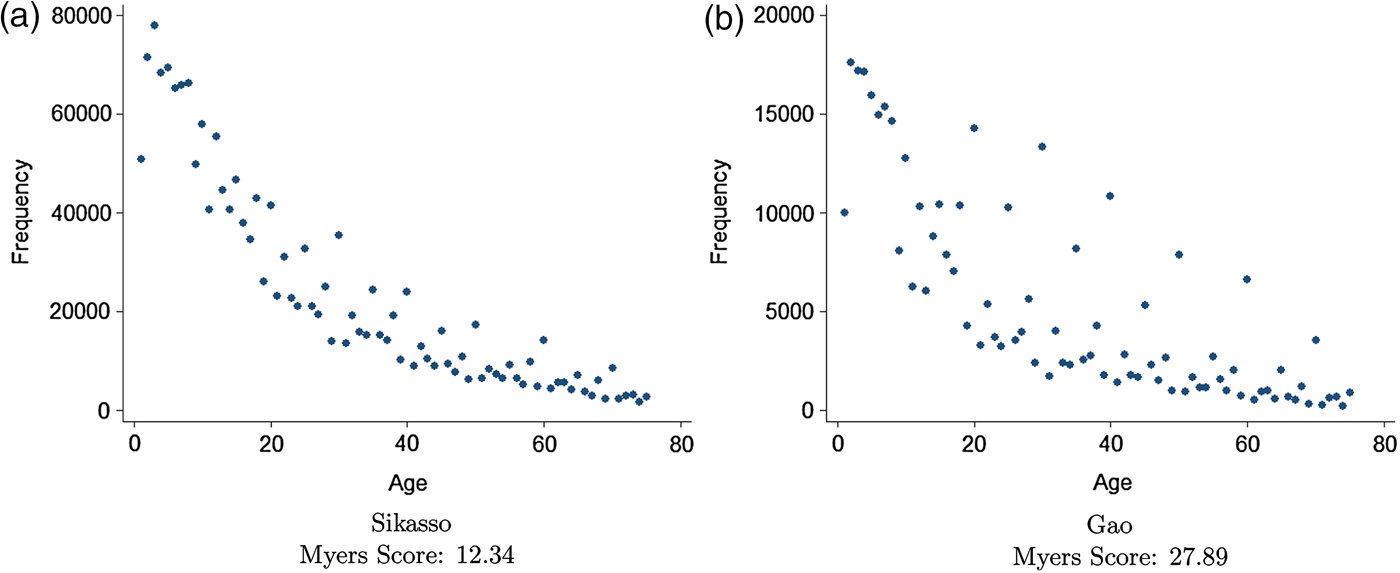
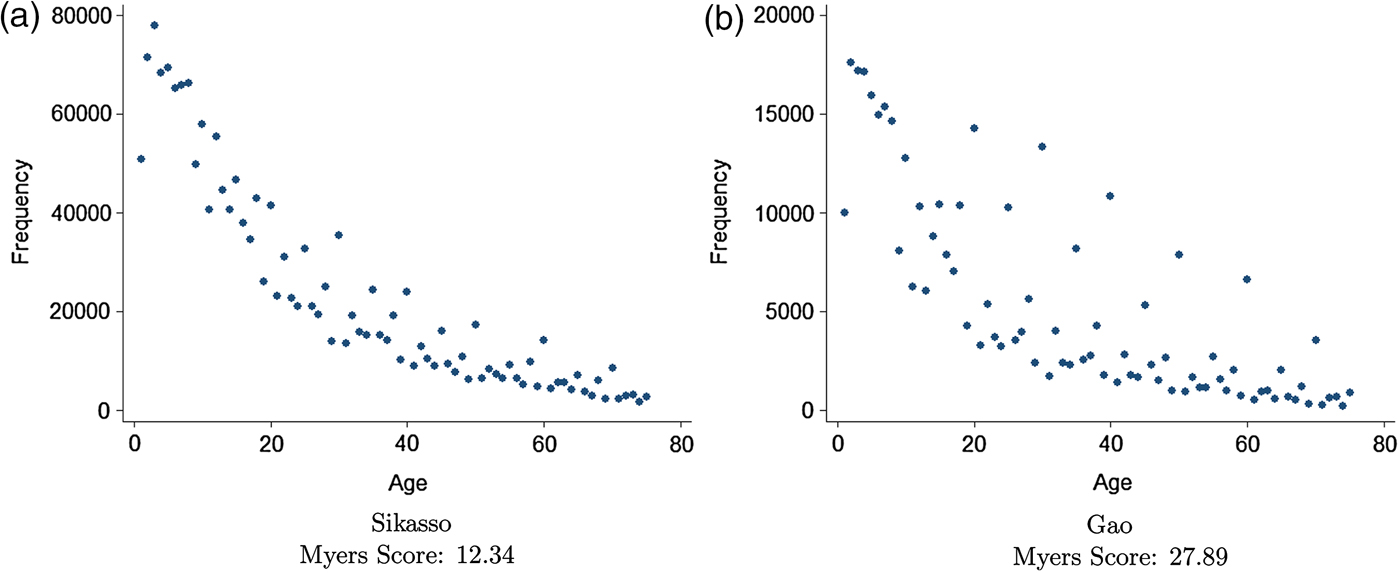
To quantify census accuracy, the indicator I use exploits a fact well-known among demographers that true age distributions within a population follow a naturally smooth curve. In expectation, the percentage change in the number of individuals in two consecutive single ages is extremely small in a natural population. Deviations from this smooth curve suggest inaccuracies in the age returns. Figure 1 illustrates this phenomenon using the 1998 census data from Mali. The left panel shows the distribution of population for each single age for Sikasso, a region located near the national capital. The right panel shows the distribution for Gao, a region where the Malian state has been historically weak and where the state's domestic sovereignty has been contested by militants seeking to supplant the state. Although the underlying age curves are evident in the distributions for both regions, the age curve for Gao exhibits considerable variance (“noise”) around the true distribution, which is a graphical indication of age inaccuracy. Building on the insights I mentioned about the sources of census error, I interpret these patterns as evidence of weak state authority.
Two regions in Mali, 1998
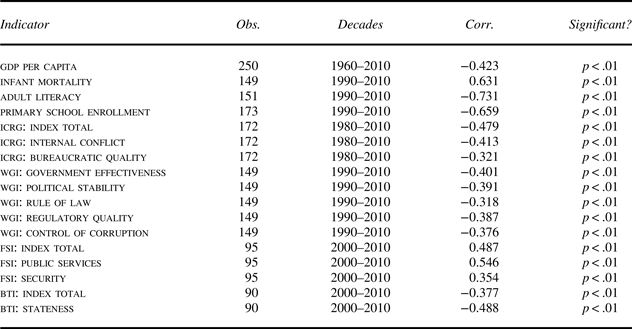
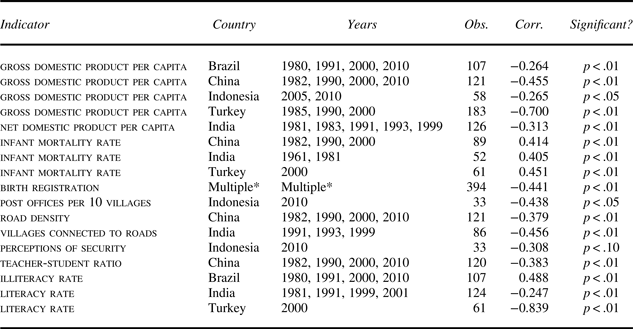
The census indicator quantifies age accuracy using a demographic technique called the Myers Index.Footnote 47 The Myers Index has a theoretical range of 0 to 90, and an observed range of up to about fifty-three in my sample. Lower values indicate greater age accuracy and thus stronger domestic sovereignty. In terms of the Myers Index's suitability as a proxy for the dependent variable of interest, two points are worth mentioning. First, the data are available at the subnational level for a large number of countries over time. This subnational component is a crucial feature of the data because it allows me to capture the territorial variation in state consolidation, rather than national-level state centralization. Second, the index is well correlated with national and subnational measures of state authority, which suggests that the index indeed picks up state authority and can therefore be treated as a proxy (see Tables 1 and 2).Footnote 48
National-level validity checks for Myers Index
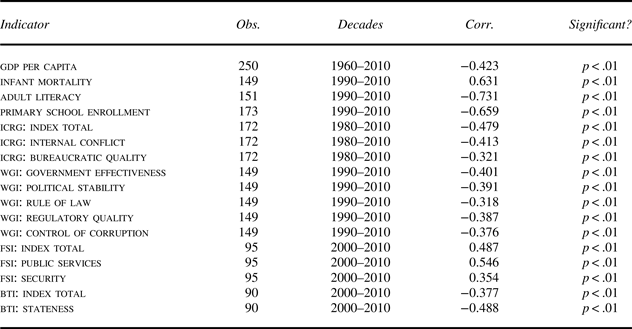
Notes: All correlations have the predicted sign. ICRG: International Country Risk Guide; WGI: Worldwide Governance Indicators; FSI: Fragile States Index; BTI: Bertelsmann Transformation Index.
Subnational-level validity checks for Myers Index
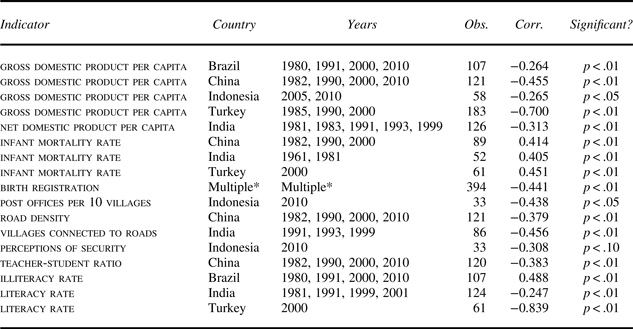
Notes: All correlations have the predicted sign. Recall that higher values on the Myers Index reflect worse levels of state authority. * See the online appendix.
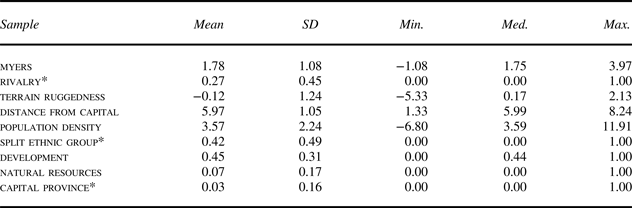
Because of heavy skew in the distribution of Myers scores in my sample, I log-transform this variable. Descriptive statistics appear in Table 3.
Descriptive statistics
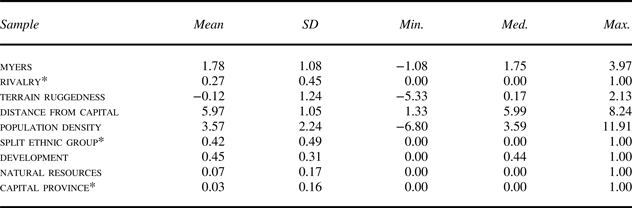
Notes: * Dummy variables. Myers, terrain, distance, and density are logged.
Independent Variable
The independent variable in the statistical analysis is the existence of a hostile neighbor. Hostile neighbors in these states are most likely to interfere in domestic sovereignty. For the purposes of analysis, state i’s neighbors include all states that share a land border with it. A hostile neighbor is a state that is an enemy of or in an antagonistic relationship with state i. Building on the theoretical discussion of hostile neighbors, I operationalize a hostile neighbor as a state engaged in an interstate rivalry with state i. This operationalization approach abstracts away from the particular issues under dispute, which can vary considerably in any given dyad. It also sets a high bar for hostility, but in doing so biases against finding an effect of hostile neighbors, since states in hostile relationships that do not rise to the level of rivalry may also engage in political interference against their adversaries.
I code rivalry using definitions and data from Thompson and Dreyer, who define a rivalry as a pair of states that regard each other as competitors, enemies, and sources of threats (actual or latent) with the potential to be militarized.Footnote 49 Put differently, a rivalry exists when a state regards another as hostile. This operationalization allows me to be agnostic about the particular policy incompatibilities between two states. For this reason, I also include all types of rivalries from the Thompson and Dreyer data.
The Thompson and Dreyer rivalry data set does not contain information that would allow me to identify any particular territory susceptible to the interference or threats from an enemy state. Nor does the theory generate clear predictions about which regions might be targets. In the subversion strategy, it is in principle possible to identify potential proxy groups and their distinct spatial settlement patterns, but the coercion strategy could operate for any region along the entire shared border. In the absence of such information, I code the rivalry variable as 1 if the province is next to a country that Thompson and Dreyer identify as a rival state in that year, and 0 otherwise. This approach treats all border provinces as equally likely to come under political interference from an unfriendly state. Since it is unlikely that an enemy will degrade domestic sovereignty in all of the target's territory along the border, this coding decision biases against finding an effect of hostile neighbors. Of the 2,115 observations in the data set, 581 province-years (269 unique provinces) in 109 country-years (45 unique countries) are coded as adjacent to a rival state.
Covariates
I control for several domestic factors that might affect state authority. Drawing from the literature on the domestic sources of incomplete sovereignty, these covariates include terrain ruggedness measured as the average percent rise in elevation, distance between the national capital and the centroid of each province in kilometers, population density, a dummy variable capturing whether the predominant ethnic group is split across a national border, economic development, the value of the territory proxied as the percentage of land with natural resources (known oil or gas deposits), and an indicator for the province containing the country's capital. These variables are coded at the province level, and the terrain, distance, and density measures are logged because of skewness.Footnote 50 Since factors at the country-year level might also affect the state's exercise of authority, I deploy country-year fixed effects models to capture the unobserved country-level covariates. Descriptive statistics appear in Table 3.
Sample
To enter the sample, a country must be an independent developing state in 1960 and share at least one international land border with another country. Developing states are defined as those that the Minorities at Risk project codes as not members of the “Western democracies and Japan” region.Footnote 51 Additionally, because the unit of analysis is the province-year, provinces must also have at least one international land border with another country. Island states, interior provinces, and coastal provinces without land borders do not enter the sample. These rules produce a sample of 2,115 province-years, 710 unique border provinces, and 78 countries over the period 1960 to 2012. The online appendix lists the countries and years included in the sample.
The two sample restrictions—developing states with land borders—reflect dependent and independent variable data limitations rather than scope conditions of the theory. A feature of the Myers Index is that the data-generating process makes the index especially informative about variation between subnational units in developing countries where it is difficult to obtain valid data on state authority. Moreover, developing countries are those where there is between-province variation to be explained. Although the sample excludes developed states, the comparative within-country design of the analysis guards against concerns about selection on the dependent variable.
The contiguity restriction is a consequence of coding concerns with the independent variable. It also reflects an assumption about how the ability to interfere declines with distance. Although it is possible that enemy states could subvert or deter state authority in the heartland of a target state or in their maritime neighbors, very few states have the ability to project power over long distances. Most states likely to be able to do so have been dropped from the sample for reasons already discussed. Because it is unclear how to code neighbors for provinces in archipelago and island states, I follow Cederman and colleagues who restrict their analysis only to contiguous neighbors.Footnote 52
Model and Results
I estimate the following equation:
 $$y_{ijt} = \alpha _{it} + \beta _1rivalry_{ijt} + \beta_2X_{ijt} + \varepsilon _{ijt}$$
where subscript i indexes countries, subscript j indexes provinces, subscript t indexes time in years, y is the logged Myers variable, α is the country-year-specific intercept, rivalry is the dichotomous rivalry indicator, X is a matrix of province-level covariates, and ε is the error term. Standard errors are clustered by country-year. To assist with the interpretation of the effect sizes, I standardize the Myers variable and the continuous covariates to have mean 0 and standard deviation 1. This transformation means that the results can be understood as shifts in standard deviations. In other words, the coefficients on the predictors represent the fraction of a standard deviation shift in the outcome variable that results from a one standard deviation shift in the predictor (or moving from 0 to 1 on a dichotomous predictor like rivalry).
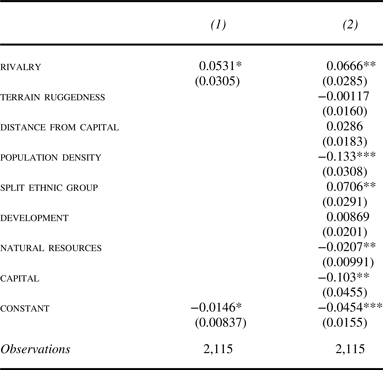
Because higher values on the Myers variable indicate worse levels of state administration and control, my theory implies that I should observe a positive coefficient on the rivalry variable. The OLS regression results in Table 4 bear out this expectation. In column 1 of Table 4, a simple regression without province-level covariates but with country-year fixed effects shows that the coefficient on rivalry is positively signed and statistically significant at the p < 0.10 level. The inclusion of province-level covariates in column 2 increases the precision of the estimate such that it reaches conventional statistical significance levels (p < 0.05). In the presence of those covariates, being next to a rival state is associated with about 7 percent of a standard deviation increase in the Myers Index, which corresponds to a lower level of domestic sovereignty when a province borders an enemy state. This finding supports my claim that hostile neighbors harm state authority.
Effect of hostility on state control
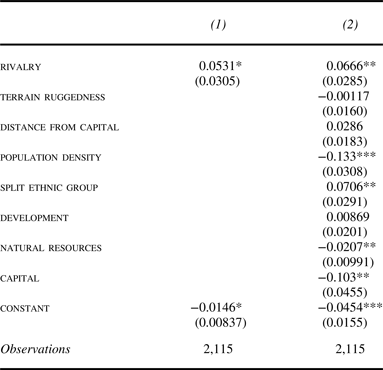
Standard errors in parentheses and clustered by country-year. Country-year intercepts suppressed. *p < .10; **p < .05; ***p < .01.
Since Myers scores are not directly interpretable, it is not immediately obvious how to draw conclusions about the substantive significance of a 7 percent standard deviation shift. One approach to interpreting the substantive effect is to compare that effect in terms of national-level Myers scores. This move abstracts away from the specifics of where states lack domestic sovereignty but permits tractable cross-national comparisons. A 7 percent standard deviation decline in state authority at the national level is the equivalent of shifting from a somewhat consolidated country like Ghana in 2000 to a country as unconsolidated as Pakistan in 1998. To concretize this comparison, consider these countries with respect to the state capacity indicators discussed in Table 1. Pakistan often falls into the bottom quintile of countries in terms of state authority while Ghana does not. The International Country Risk Guide, for example, ranks Pakistan twenty-fourth of 146 countries for investment risk in 1998, an indicator well-correlated with the exercise of effective state authority over territory. In contrast, Ghana ranks forty-eighth of 146. The WGI ranks Pakistan eleventh and twenty-fifth of 194 in terms of political stability and government effectiveness, respectively. Ghana outperforms Pakistan on both dimensions (thirty-eighth and fifty-fifth). Actual human development outcomes related to state authority also vary starkly between Pakistan and Ghana. Seventy-five out of every 1,000 babies born in Pakistan in 1998 did not survive to their first birthday, compared to fifty-seven out of 1,000 in Ghana in 2000. Adults were less likely to be literate in Pakistan (43%) compared to Ghana (58%). The hostile neighbor effect of 7 percent of a standard deviation shift is thus highly consequential for domestic sovereignty.
Another way to interpret the magnitude of the effect is to compare the coefficient on the rivalry variable to the other covariates, and in particular the coefficient on split ethnic groups (column 2 of Table 4). The literature on civil war suggests that ethnic groups split across national borders are an important domestic explanation for low state authority in border regions.Footnote 53 As expected, provinces that contain split ethnic groups have worse levels of state authority than provinces in which the predominant ethnic group is not split, a finding that is consistent with results reported by Michalopoulos and Papaioannou.Footnote 54 Two additional observations about the effect of ethnicity are warranted. First, the statistical significance of the estimate for the effect of rivalry does not disappear when controlling for split ethnic groups. One might worry that split ethnic groups can reduce domestic sovereignty and fuel antagonism between neighboring states, and that any observed relationship between state authority and rivalry was spurious. If that was the case, then I would expect to observe a positive statistically significant coefficient on ethnicity and no statistically significant results for the rivalry indicator. Table 4 shows that is not the case, alleviating concerns about this particular threat to inference. Second, the magnitude of the coefficient on ethnicity is just slightly higher than the coefficient on rivalry (both dichotomous variables). This suggests not only that hostile neighbors have an independent and negative effect on domestic sovereignty, but that this international factor plays as important a role in state authority as an important domestic factor.
Turning to the other covariates, three covariates are not statistically distinguishable from zero. Distance from the capital, one of the domestic explanations for within-state variation in authority, is signed as expected (positive) but does not reach statistical significance. Terrain ruggedness and economic development are also not significant predictors of state authority, and their signs are the opposite of what theory would predict. A likely explanation for these insignificant results could be the result of the time invariance of these measures (development is time invariant by construction because of data limitations), and their effect on state authority may attenuate over time or with the introduction of technology that reduces the challenge of projecting power.Footnote 55 If that is the case, then the average effect over that time period might be close to zero.Footnote 56 A second possible explanation is that the expected effects are not discernible when restricting attention only to border provinces. A third possible explanation is that the Myers Index is measured too imprecisely to detect an effect for terrain, distance, or development.
The remaining three covariates do reach statistical significance and their coefficients have signs consistent with theoretical expectations. Provinces with greater population densities are more likely to be characterized by lower Myers scores and thus higher levels of authority. The effect of population density is relatively large: a one standard deviation increase in (logged) population density results in about 0.13 of a standard deviation decrease in (logged) Myers scores. A standard deviation shift yields a harmful effect that is about twice the size of the effect of having an enemy state across the border. Valuable territory and the presence of the capital city also increase the likelihood that the state exercises effective authority. The greater the value of the province in terms of its natural resource wealth, the more likely that province will have higher levels of administration and control. The capital-containing province enjoys a sovereignty premium of about a tenth of a standard deviation in the logged Myers Index, which more than offsets the harmful effect of neighboring an enemy state.
The analysis in Table 4 examines the contemporaneous effects of neighboring enemy states on state authority within the same country-year. I also investigate longitudinal variation to assess how the onset or termination of hostile relations affects governance near state borders. Two caveats should be noted. First, there is less over-time variation in rivalry to exploit in my sample than I would prefer, an observation not surprising to scholars of international rivalry. Second, I have observations only when census data are available to construct the dependent variable, which makes it difficult to take advantage of the over-time variation that does exist in the sample. If the deleterious effects of hostile neighbors persist for some time even after the rivalry has ended, a failure to capture a terminated rivalry biases against finding an effect of hostility.
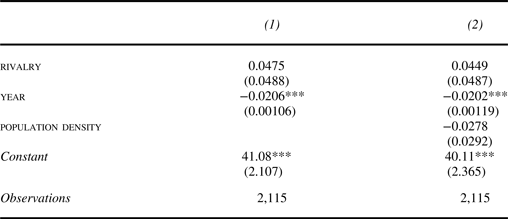
Still, it can be informative to examine variation within provinces over time in spite of these limitations. Table 5 reports the results. All time-invariant covariates drop out and I add a linear time variable to capture the downward secular trend in Myers scores. Not surprisingly, the standard errors are so large that the estimates for the effect of rivalry are not statistically distinguishable from zero. Yet this is a reassuring result: the magnitude of the coefficient on rivalry is only somewhat smaller than the estimates in Table 4, and its sign remains positive, which is consistent with the predictions of my theory. Thus, the longitudinal analysis reflects a lack of precision about the deleterious effect of hostile neighbors rather than a reversal of the expected effect.
Effect of hostility within provinces over time
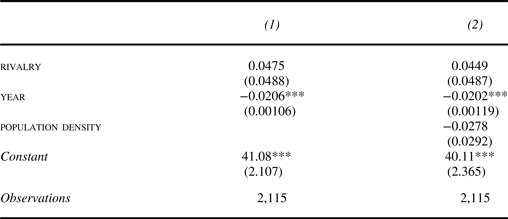
Notes: Standard errors in parentheses and clustered by province. Province intercepts suppressed. *p < .10; **p < .05; ***p < .01
I also conduct several robustness checks. These checks include robustness to additional covariates like province area; the selection of observable covariates; the sample's composition; and the specification of the effect of time. The effect of hostile neighbors is robust to these alternate specifications. A full discussion of these robustness checks, including tables and figures, is available in the online appendix.
The most likely threats to inference are omitted variable bias and reverse causality. Unobserved omitted variable bias would be problematic if there are unobserved controls not captured by the country-year fixed effects. However, if one assumes that the unobservables share the same covariance properties as the observables, then the sensitivity of the main independent variable to the set of observables is informative about the effect's sensitivity to the unobservables.Footnote 57 If this assumption holds, then the sensitivity checks in the online appendix demonstrating that the effect of rivalry is not sensitive to different combinations of observable controls should reassure readers wary about unobserved omitted variable bias.
The other likely threat to inference is reverse causality. I argued that antagonistic relationships between neighbors may arise for a variety of reasons, including territorial disputes and enduring rivalries. Could it be that neighbors make territorial claims on poorly governed regions? The territorial dispute literature has not empirically shown that to be the case, instead pointing to other causes unrelated to state authority in the claimed territory.Footnote 58 What about enduring rivalries? The rivalry literature suggests that the foundation of rivalry rests on the issues under contention.Footnote 59 Thompson and Dreyer offer one typology of issues: territory, “positional” competition, and ideology.Footnote 60 Yet the evidence suggests that most rivalries are about territory rather than other issues.Footnote 61 Moreover, from a theoretical standpoint, it is not obvious how positional competition or ideological differences might be caused by low state authority in peripheral regions. In terms of empirics, the longitudinal analysis in Table 5 combined with the case study in the following section provide additional reassurance to readers concerned about reverse causality.
On the whole, the evidence presented here strongly supports the conclusion that hostile neighbors have harmful consequences for the exercise of state authority in territory bordering them. To be clear, this does not mean that the extant domestic explanations are wrong. Rather, the evidence points to the underappreciated role of hostile states that degrade state authority above and beyond the effects of domestic factors alone. Although the effect size may initially appear small, its implications for human well-being are large. Additionally, the test I run is a “hard” test, in that inferences are drawn by comparing border provinces next to hostile neighbors with border provinces not next to hostile neighbors, by deploying country-year fixed effects, and by coding the independent variable to bias against finding an effect of hostile neighbors. The results do not account for the fact that when faced with subversion, some states may respond by investing in state authority (as the theory discussed). The heterogeneity of potential target state responses is theoretically and empirically interesting, and will be explored in future work. Here, the heterogeneity and other mentioned factors suggest that the results I observe in the statistical analysis underestimate the true effect of hostile neighbors. Combined with robustness and sensitivity analyses, my results indicate that hostile neighbors are an underappreciated yet important source of incomplete sovereignty and state weakness.
Evidence from Malaysia and the Philippines
I complement the quantitative analysis with a qualitative examination of Malaysia's role in undermining domestic sovereignty in the 1970s in Mindanao, a region of the southern Philippines. Although the quantitative analysis permits rigorous testing of the proposition that hostile neighbors weaken the state, the empirical approach did not allow me to investigate interference itself, or to rule out reverse causality. This case study addresses those concerns. The case evidence is primarily drawn from archival documents, as well as some secondary literature on the Mindanao conflict.Footnote 62 The evidence demonstrates that the Philippines' maritime neighbor Malaysia, with whom it had an acrimonious relationship since the 1960s, played a crucial role in empowering the Philippine rebel group that successfully undermined Philippine state authority in Mindanao.
Hostile Neighbors and the Decision to Subvert
The southwestern portion of the Mindanao island group of the Philippines is home to a large, multi-ethnic Muslim population called Moros. For much of its history, the Philippine state exercised relatively little authority in Mindanao. Although the Moros periodically rebelled against what they perceived to be internal colonization efforts from alien rulers, the period prior to the late 1960s was largely without violence. Yet state authority crumbled in 1969 and resulted in open warfare against the state in the early 1970s.
What caused the breakdown of domestic sovereignty in Mindanao? Conventional accounts emphasize domestic factors like the economic and cultural grievances of the Moro population. These long-standing grievances certainly fueled resentment of the state and played an important role. But they do not explain the timing of the collapse of state authority nor the state's inability to reassert domestic sovereignty in the region. International factors, in the form of the hostile relationship between the Philippines and Malaysia, help complete the picture.
The two maritime neighbors were embroiled over a serious policy incompatibility from the moment of Malaysia's creation in 1962. The central point of contention was the Philippines' claim to Sabah, one of the constituent parts of Malaysian federation. The Philippines objected to Sabah's inclusion in the federation as illegal on the basis of prior legal agreements, and the boundaries of its claim reflected the considerations of legal-historical precedent rather than levels of state authority or the material value of the territory.Footnote 63 The Philippines antagonized Malaysia by refusing to recognize the country as a sovereign state. When Manila did extend recognition, it made clear that recognition did not constitute acknowledgment of Malaysia's legal sovereignty over Sabah. The dispute continued to sour bilateral relations for the next few years.
For its part, Malaysia considered the claim to be a threat to its territorial integrity. Fearing future foreign adventurism and seeking the elimination of the claim, Malaysia issued a series of deterrent threats against Philippine state authority in Mindanao. In April 1968, Muhammed Ghazali bin Shafie, permanent secretary of the Malaysian Ministry of Foreign Affairs (MFA), identified anti-Manila sentiments among the Philippine Muslims and said that Malaysia could foment disturbances by arming and training those Muslims, using Sabah as a launch point.Footnote 64 Ghazali underscored Malaysian readiness to degrade Philippine authority in its southern periphery. He noted that Sabah's security forces had experienced confrontation with Indonesia and therefore were experienced and competent in mounting unconventional operations in an aggressor's own territory.Footnote 65 Around the same time, MFA Assistant Secretary for Southeast Asian Affairs Zainal Abidin bin Sulong told the Australian High Commission that Malaysia could easily exploit Muslim dissatisfaction in the south if the Philippines went too far in pressing its claim to Sabah.Footnote 66 Two months later, MFA Deputy Secretary Hussein bin Osman echoed these sentiments when he indicated to the US Embassy in Kuala Lumpur that it would be a simple matter for Malaysia to stir up problems among the Muslims of the southern Philippines if the Philippines tried to “play rough” after talks over Sabah.Footnote 67
When these deterrent threats failed to halt the escalation of Philippine rhetoric, Malaysia embarked on a program to subvert Philippine state authority in Mindanao. Subversion took the form of training, harboring, and arming dissident groups that organized in Mindanao in the late 1960s. Congressman Rashid Lucman, a prominent Muslim leader in Mindanao, was among the first to form links with Malaysia. Lucman's son recounted a secret meeting between the elder Lucman and Malaysian Prime Minister Tunku Abdul Rahman in early 1968. During the meeting, they discussed “the planned military training of 10,000 Moros in sabotage, counter-insurgency, and guerrilla tactics,” who would be “armed and provided for by the Malaysian Special Forces.”Footnote 68 The purpose of the training was to fight for the independence of Mindanao as a means to erase the Sabah claim.Footnote 69 Lucman recruited and organized the first batch of rebels, known as the First 90. Among them was Nur Misuari, the future leader of the Moro National Liberation Front (MNLF), the most consequential of the southern dissident organizations. He and other recruits traveled to Malaysia to train and prepare for a guerrilla war against the Philippine state under the tutelage of officers from the Malaysian military.Footnote 70
US diplomatic communications corroborate the Malaysian central government's active role in undermining Philippine sovereignty. In 1969, the United States government acquired intelligence that the Malaysian External Intelligence Organization, the Malaysian equivalent of the US Central Intelligence Agency, was involved in clandestine activities directed against the southern Philippines.Footnote 71 These activities continued throughout the early 1970s despite official denials.Footnote 72
A powerful local politician in Sabah, Tun Mustapha, also helped undermine Philippine domestic sovereignty. Mustapha supplied guns and money to militants in the south and purportedly encouraged the Filipino Muslims to join Malaysia.Footnote 73 His involvement proved to be politically useful to Malaysian authorities who tolerated his activities.Footnote 74 Mustapha provided convenient cover for the more centrally directed efforts to cripple Philippine domestic sovereignty. When the unrest in the south erupted into open conflict against Philippine authority in 1973, Malaysia linked the Sabah claim to Mustapha's activities as a means of obtaining bargaining leverage over Manila. For example, Malaysian MFA Secretary-General Zaiton said that the central government could not effectively control Mustapha as long as the Philippines maintained a claim on Sabah.Footnote 75 Malaysian officials also told their Philippine counterparts that if Philippine President Marcos really wanted to end problems in the southern Philippines, Marcos would abandon the claim.Footnote 76
Effects on Philippine Domestic Sovereignty
By empowering the MNLF in the organization's critical early years, Malaysian subversion played a central role in reducing state authority in Mindanao. The Moros had long-standing grievances against the Philippine state.Footnote 77 Malaysian assistance in the late 1960s and early 1970s allowed the MNLF to translate those grievances into an effective resistance against state authority. For this reason, Malaysian involvement helps explain both the timing and course of the struggle against state authority in Mindanao.
To appreciate the importance of the MNLF, one must first understand the political landscape of the southern Philippines. The Muslims who united together to fight against the state in the 1970s represented disparate regions and ethnic groups. Although Islam was the religion of the three major ethnic groups, ethnic identity was at least as important as religious identity, and coordinated political behavior predicated on shared religious identity was far from a given. The MNLF overcame the divisions of ethnicity and region and consolidated the disparate forces into a semicoherent organization, if only for a few critical years. Such organization would not have been possible without external assistance.Footnote 78 Indeed, this coordination was the principal contribution of the MNLF in the ongoing Moro struggle.Footnote 79 The First 90 who traveled to Malaysia included members of the three principal ethnic groups who were also represented in the MNLF's founding leadership. Under the tutelage of their Malaysian trainers and in the year they spent together training against a common enemy, they learned to stop thinking of themselves as members of their respective ethnic groups and instead as soldiers united against the Philippine state.Footnote 80
Malaysian training and assistance also helped create a viable fighting force capable of taking on the battle-hardened Armed Forces of the Philippines (AFP). Previous Moro struggles were characterized by values that gave primacy to individualized acts of heroism and the personal glory of martyrdom. Translated into battlefield tactics, these values did not lend themselves well to coordination, efficiency, or effectiveness. The post-1968 struggle represented a radical break with the past. Tan, a Filipino scholar of the Muslim south, credits the adoption of modern guerrilla tactics and the emphasis on mobility and coordination as important factors that made the Moro struggle in the postcolonial period difficult to control and eliminate.Footnote 81 Instruction on these tactics came from Malaysian operatives who ran the training camps.Footnote 82
Manila's response to this externally supported challenge to its authority came in two forms, but neither response resulted in a return to the status quo ante. First, the Philippines fought back against the MNLF with military force. However, the MNLF outnumbered and outgunned the AFP. In a March 1973 letter to Marcos, AFP Chief of Staff General Romeo Espino described the external assistance in the form of money, arms, and ammunition as “very adequate” and linked the “offers of the secessionists and their foreign supporters of a gun and P2,000 per rebel” to the “swelling of the ranks of the rebels in the last two years.”Footnote 83 Since the southern Philippines was impoverished, P2,000 (funds for which came from external sources) would have been a very attractive incentive to take up arms against state authority. Espino noted that although the rebels did not threaten the territorial integrity or stability of the Philippines as a whole, their activities made “possible the sequestration of Philippine territory and the exercise of extraneous sovereignty over Filipinos and others living therein.”Footnote 84
Second, Manila tried to shut off the Malaysian pipeline of assistance to the MNLF. Perhaps the best evidence that Malaysia significantly undermined domestic sovereignty in the southern Philippines can be found in Manila's attempts to bargain for the termination of Malaysian involvement. Thus, even though Malaysia never acknowledged its complicity, its efforts to subvert Philippine sovereignty provided a useful source of leverage in the conflict over Sabah. In June 1973, when the war with the MNLF was going particularly poorly for the government, Manila offered to drop the Sabah claim in return for Malaysia cutting off external assistance to the MNLF. This deal represented a reversal of the government's previous position on the Sabah issue. Only two months prior, Manila said that trading Sabah for Malaysian cooperation would be an unacceptable sign of weakness.Footnote 85 Any backpedaling on Sabah risked provoking serious domestic consequences for President Marcos, who exploited the issue for electoral gain and had supported the promulgation of a constitution that defined the national territory of the Philippines to include the Sabah claim. Nonetheless, Marcos considered Malaysian meddling to be so detrimental to state authority in Mindanao that he indicated his willingness to drop the claim in return for the cessation of Malaysian interference.Footnote 86
Conclusion
Incomplete domestic sovereignty has pernicious effects on security, development, growth, and human well-being. The conventional wisdom holds that, in the absence of the pressures of war, this failure of state consolidation is the product of domestic factors that make governing costly. But international factors also influence state authority over territory. Leveraging a cross-national within-country statistical analysis as well as a qualitative case study, I demonstrate that hostile neighboring states exacerbate and perpetuate weak domestic sovereignty. The stunting of state authority matters not only for security and economic development but also for human well-being. The evidence in this study help us understand not simply why states fail to exert effective authority over their territories but why ungoverned and partially governed spaces persist in the places that they do.
This article raises important implications for theories of political underdevelopment and international relations scholarship more generally. My conclusions imply that a systemic shift in the international system has fundamentally altered the relationship between external threat and internal political development by changing the calculations of states with respect to how they manage their threat environments. In the pre-1945 period, states faced external threat and went to war to resolve their disputes with their neighbors. For the states that survived, war had beneficial effects for state centralization and consolidation. As a result, these two processes were intimately connected.
The international system of the post-1945 era is one in which the use of force is both materially costly and legally proscribed. Though war has not disappeared, conventional force is no longer commonly employed. This system-level shift in the way that states restrict and limit the use of force makes the foreign policy strategy of weakening state authority through subversion or coercion more appealing. External political interference has always been a form of power; it is certainly not unique to the post-1945 period. Yet that power is all the more important when the other tools of statecraft must remain in the toolbox. Hostile neighbors undermine and cripple state authority because sovereignty-undermining strategies are attractive and help achieve state objectives. Consequently, the link between state centralization and state consolidation has been severed. Far from being helpful for state consolidation, external threat produces profound state weakness. This also implies that greater conflict between states will not be a panacea to the problem of weak statehood.
For scholars of political development, this article highlights the importance of the international environment on internal domestic development. States have never existed in political vacuums but the political science scholarship has only just begun to think systematically about how and why the international environment affects state authority. Failure to account for hostile neighbors, and how the pursuit of conflicting, incompatible policy interests might operate differently in the post-1945 world than in the pre-1945 world or the early modern period, risks misunderstanding the process of state consolidation and the obstacles to the successful extension of state authority over territory.
For policymakers, practitioners, and members of the development community, there is no silver bullet to the problem of political underdevelopment and its harmful consequences on human well-being. States will always have disputes with their neighbors. The disputes underlying political interference in domestic sovereignty are severe and often intractable. Mutual suspicion and hostility between enemy states only amplify the problem. Third parties might mitigate some mistrust between states but ungoverned and partially governed spaces exist in part because they are strategically useful for neighboring enemy states in an era where alternative policy options have been circumscribed. So long as the current international rules of the game remain in place, so too will the incentives that give rise to sovereignty-harming strategies.
Supplementary Material
Supplementary material for this article is available at <https://doi.org/10.1017/S0020818318000085>.