Introduction
Autism spectrum disorder (ASD) is a childhood-onset neurodevelopmental disorder, with strong heritability (Colvert et al. Reference Colvert, Tick, McEwen, Stewart, Curran, Woodhouse, Gillan, Hallett, Lietz, Garnett, Ronald, Plomin, Rijsdijk, Happe and Bolton2015; Kim & Leventhal, Reference Kim and Leventhal2015) and familial aggregation (Sucksmith et al. Reference Sucksmith, Roth and Hoekstra2011; Sandin et al. Reference Sandin, Lichtenstein, Kuja-Halkola, Larsson, Hultman and Reichenberg2014). Attempts to find genetic variants that link to ASD susceptibility yield inconsistent results, owing substantially to phenotypic heterogeneity (Geschwind & State, Reference Geschwind and State2015). To aid the identification of more homogeneous subgroups within the autistic spectrum and to increase statistical power to detect susceptible genes, researchers turn to endophenotypes, the intermediate components connecting genotype and behavioral phenotypes. Endophenotypes are quantifiable traits associated with a disorder. They are heritable and present in biological relatives (e.g. unaffected siblings) at a higher rate than in the general population (Gottesman & Gould, Reference Gottesman and Gould2003; Glahn et al. Reference Glahn, Knowles, McKay, Sprooten, Raventos, Blangero, Gottesman and Almasy2014). Features shared by individuals with ASD and their siblings at the brain level are potential endophenotypes for identifying mechanisms leading to ASD.
Neuroimaging data provide evidence for atypical brain growth trajectories in ASD involving the frontotemporal, frontoparietal and frontostriatal circuitries, anterior and posterior cingulate cortices, the amygdala–hippocampal complex and cerebellum (Amaral et al. Reference Amaral, Schumann and Nordahl2008; Ecker et al. Reference Ecker, Bookheimer and Murphy2015). These regions are heavily implicated in specific clinical symptoms (Courchesne et al. Reference Courchesne, Pierce, Schumann, Redcay, Buckwalter, Kennedy and Morgan2007; Amaral et al. Reference Amaral, Schumann and Nordahl2008; D'Mello et al. Reference D'Mello, Crocetti, Mostofsky and Stoodley2015). Structural magnetic resonance imaging (MRI) studies also suggest that the atypical neuroanatomy of ASD is sex- (Lai et al. Reference Lai, Lombardo, Suckling, Ruigrok, Chakrabarti, Ecker, Deoni, Craig, Murphy, Bullmore and Baron-Cohen2013; Schaer et al. Reference Schaer, Kochalka, Padmanabhan, Supekar and Menon2015; Supekar & Menon, Reference Supekar and Menon2015) and age-dependent (Nickl-Jockschat et al. Reference Nickl-Jockschat, Habel, Michel, Manning, Laird, Fox, Schneider and Eickhoff2012; Lin et al. Reference Lin, Ni, Lai, Tseng and Gau2015). Atypical neuroanatomy of ASD lies beyond widespread local changes but also involves inter-regional brain connectivity (Schipul et al. Reference Schipul, Keller and Just2011). At the functional level, these were once posited as short-range over-connectivity and long-range under-connectivity (Belmonte et al. Reference Belmonte, Allen, Beckel-Mitchener, Boulanger, Carper and Webb2004; Wass, Reference Wass2011). Emerging literature on intrinsic functional connectivity (iFC) suggests unique patterns of both under- and over-connectivity in ASD with regional specificity (Di Martino et al. Reference Di Martino, Yan, Li, Denio, Castellanos, Alaerts, Anderson, Assaf, Bookheimer, Dapretto, Deen, Delmonte, Dinstein, Ertl-Wagner, Fair, Gallagher, Kennedy, Keown, Keysers, Lainhart, Lord, Luna, Menon, Minshew, Monk, Mueller, Müller, Nebel, Nigg, O'Hearn, Pelphrey, Peltier, Rudie, Sunaert, Thioux, Tyszka, Uddin, Verhoeven, Wenderoth, Wiggins, Mostofsky and Milham2014; Fishman et al. Reference Fishman, Keown, Lincoln, Pineda and Müller2014). Recent attempts to resolve conflicting findings have delineated methodological (Müller et al. Reference Müller, Shih, Keehn, Deyoe, Leyden and Shukla2011), conceptual (Vissers et al. Reference Vissers, Cohen and Geurts2012) and developmental (Uddin et al. Reference Uddin, Supekar and Menon2013) issues. A multimodal structural and functional imaging approach might be able to detect informative super-regional neural characteristics jointly in ASD (Mueller et al. Reference Mueller, Keeser, Samson, Kirsch, Blautzik, Grothe, Erat, Hegenloh, Coates, Reiser, Hennig-Fast and Meindl2013).
First-degree relatives of individuals with ASD may display mild autistic traits, including communication and social difficulties, alongside rigid personality, interests and behavior (Sucksmith et al. Reference Sucksmith, Roth and Hoekstra2011). Biological full siblings of individuals with ASD are about 10 times more likely to develop ASD than the general population (Sucksmith et al. Reference Sucksmith, Roth and Hoekstra2011; Sandin et al. Reference Sandin, Lichtenstein, Kuja-Halkola, Larsson, Hultman and Reichenberg2014). These findings indicate that some unaffected siblings of individuals with ASD inherit the associated genetic predisposition for ASD, and they may have the broader autism phenotype. As genetic factors are responsible for a significant amount of variation in neuroanatomy (Giedd et al. Reference Giedd, Stockman, Weddle, Liverpool, Alexander-Bloch, Wallace, Lee, Lalonde and Lenroot2010; Blokland et al. Reference Blokland, de Zubicaray, McMahon and Wright2012; Hibar et al. Reference Hibar, Stein, Renteria, Arias-Vasquez, Desrivières, Jahanshad, Toro, Wittfeld, Abramovic, Andersson, Aribisala, Armstrong, Bernard, Bohlken, Boks, Bralten, Brown, Chakravarty, Chen, Ching, Cuellar-Partida, den Braber, Giddaluru, Goldman, Grimm, Guadalupe, Hass, Woldehawariat, Holmes, Hoogman, Janowitz, Jia, Kim, Klein, Kraemer, Lee, Olde Loohuis, Luciano, Macare, Mather, Mattheisen, Milaneschi, Nho, Papmeyer, Ramasamy, Risacher, Roiz-Santiañez, Rose, Salami, Sämann, Schmaal, Schork, Shin, Strike, Teumer, van Donkelaar, van Eijk, Walters, Westlye, Whelan, Winkler, Zwiers, Alhusaini, Athanasiu, Ehrlich, Hakobjan, Hartberg, Haukvik, Heister, Hoehn, Kasperaviciute, Liewald, Lopez, Makkinje, Matarin, Naber, McKay, Needham, Nugent, Pütz, Royle, Shen, Sprooten, Trabzuni, van der Marel, van Hulzen, Walton, Wolf, Almasy, Ames, Arepalli, Assareh, Bastin, Brodaty, Bulayeva, Carless, Cichon, Corvin, Curran, Czisch, de Zubicaray, Dillman, Duggirala, Dyer, Erk, Fedko, Ferrucci, Foroud, Fox, Fukunaga, Gibbs, Göring, Green, Guelfi, Hansell, Hartman, Hegenscheid, Heinz, Hernandez, Heslenfeld, Hoekstra, Holsboer, Homuth, Hottenga, Ikeda, Jack, Jenkinson, Johnson, Kanai, Keil, Kent, Kochunov, Kwok, Lawrie, Liu, Longo, McMahon, Meisenzahl, Melle, Mohnke, Montgomery, Mostert, Mühleisen, Nalls, Nichols, Nilsson, Nöthen, Ohi, Olvera, Perez-Iglesias, Pike, Potkin, Reinvang, Reppermund, Rietschel, Romanczuk-Seiferth, Rosen, Rujescu, Schnell, Schofield, Smith, Steen, Sussmann, Thalamuthu, Toga, Traynor, Troncoso, Turner, Valdés Hernández, van 't Ent, van der Brug, van der Wee, van Tol, Veltman, Wassink, Westman, Zielke, Zonderman, Ashbrook, Hager, Lu, McMahon, Morris, Williams, Brunner, Buckner, Buitelaar, Cahn, Calhoun, Cavalleri, Crespo-Facorro, Dale, Davies, Delanty, Depondt, Djurovic, Drevets, Espeseth, Gollub, Ho, Hoffmann, Hosten, Kahn, Le Hellard, Meyer-Lindenberg, Müller-Myhsok, Nauck, Nyberg, Pandolfo, Penninx, Roffman, Sisodiya, Smoller, van Bokhoven, van Haren, Völzke, Walter, Weiner, Wen, White, Agartz, Andreassen, Blangero, Boomsma, Brouwer, Cannon, Cookson, de Geus, Deary, Donohoe, Fernández, Fisher, Francks, Glahn, Grabe, Gruber, Hardy, Hashimoto, Hulshoff Pol, Jönsson, Kloszewska, Lovestone, Mattay, Mecocci, McDonald, McIntosh, Ophoff, Paus, Pausova, Ryten, Sachdev, Saykin, Simmons, Singleton, Soininen, Wardlaw, Weale, Weinberger, Adams, Launer, Seiler, Schmidt, Chauhan, Satizabal, Becker, Yanek, van der Lee, Ebling, Fischl, Longstreth, Greve, Schmidt, Nyquist, Vinke, van Duijn, Xue, Mazoyer, Bis, Gudnason, Seshadri, Ikram, Martin, Wright, Schumann, Franke, Thompson and Medland2015) and iFC (Glahn et al. Reference Glahn, Winkler, Kochunov, Almasy, Duggirala, Carless, Curran, Olvera, Laird, Smith, Beckmann, Fox and Blangero2010; Fornito et al. Reference Fornito, Zalesky, Bassett, Meunier, Ellison-Wright, Yucel, Wood, Shaw, O'Connor, Nertney, Mowry, Pantelis and Bullmore2011) in neurotypical individuals, shared alterations in brain morphology and associated iFC between individuals with ASD and their unaffected siblings is likely to be an informative endophenotype.
Some studies have investigated brain structural differences in relatives of people with ASD. Relative to controls, reduced amygdala volume reduction and larger left hippocampus volumes were reported in unaffected siblings (Dalton et al. Reference Dalton, Nacewicz, Alexander and Davidson2007) and unaffected parents (Rojas et al. Reference Rojas, Smith, Benkers, Camou, Reite and Rogers2004) of individuals with autism, respectively. However, Peterson et al. (Reference Peterson, Schmidt, Tregellas, Winterrowd, Kopelioff, Hepburn, Reite and Rojas2006), using voxel-based morphometry (VBM), failed to replicate these, while they reported increased gray matter (GM) volume of the inferior and middle frontal gyrus and cerebellum in parents of children with autism. Contrary to the findings mentioned above, Palmen et al. (Reference Palmen, Hulshoff Pol, Kemner, Schnack, Sitskoorn, Appels, Kahn and Van Engeland2005) did not detect any significant differences in any brain regions in parents of ASD probands. Earlier literature also reports no differences in total brain (Rojas et al. Reference Rojas, Smith, Benkers, Camou, Reite and Rogers2004; Peterson et al. Reference Peterson, Schmidt, Tregellas, Winterrowd, Kopelioff, Hepburn, Reite and Rojas2006) and corpus callosum volume (Branchini et al. Reference Branchini, Lindgren and Tager-Flusberg2009) between unaffected relatives and controls. Using the same participant cohort, Segovia et al. (Reference Segovia, Holt, Spencer, Gorriz, Ramirez, Puntonet, Phillips, Chura, Baron-Cohen and Suckling2014) applied a multivariate approach and reported that cerebellum volume could be a candidate neuroendophenotype; Moseley et al. (Reference Moseley, Ypma, Holt, Floris, Chura, Spencer, Baron-Cohen, Suckling, Bullmore and Rubinov2015) suggested that whole-brain functional hypoconnectivity in task and rest conditions may be an endophenotype of ASD in adolescents; Spencer et al. (Reference Spencer, Chura, Holt, Suckling, Calder, Bullmore and Baron-Cohen2012) reported local endophenotypic effects in visual processing and default mode networks. Despite respective evidence of brain structural and functional differences in autism relatives, to the best of our knowledge, analysis of shared alterations in brain structures and associated shared iFC between autistic probands and their unaffected siblings has not been implemented. As atypical neuroanatomical findings may result in atypical functions and functional connectivity patterns, this dearth of integrative evidence limits functional interpretations of brain morphological studies, and eludes direct explorations of neuroimaging endophenotypes of ASD.
This study thus aimed to examine the hypothesis that individuals with ASD and their unaffected siblings share alterations in GM and white matter (WM) volume, and the associated iFC is also shared by individuals with ASD and their unaffected siblings. Given that brain structural differences in autism are modulated by sex (Lai et al. Reference Lai, Lombardo, Suckling, Ruigrok, Chakrabarti, Ecker, Deoni, Craig, Murphy, Bullmore and Baron-Cohen2013; Schaer et al. Reference Schaer, Kochalka, Padmanabhan, Supekar and Menon2015; Supekar and Menon, Reference Supekar and Menon2015), we focused only on male participants to build upon limited literature about neuroimaging endophenotypes of ASD. We also tested whether these shared differences were associated with behavioral characteristics of ASD.
Method
Procedure
The Research Ethics Committee at the National Taiwan University Hospital (NTUH) approved this study before implementation (approval number: 201201006RIB; ClinicalTrials.gov number, NCT01582256). The procedures and purpose of the study were explained face to face to the participants and their parents, who then provided written informed consent. All participants underwent the same clinical and MRI assessments; the ASD group additionally received the Chinese version of the Autism Diagnostic Interview-Revised (ADI-R) assessment (Gau et al. Reference Gau, Chou, Lee, Wong, Chou, Chen, Soong and Wu2010).
Participants and measures
We recruited 94 Taiwanese male participants [aged 8–19 years, full-scale intelligence quotient (FSIQ) 75–148], including males with ASD and their unaffected full biological brothers in 20 simplex families, consecutively from the child psychiatry out-patient clinic of NTUH. We also recruited 54 typically developing (TD) males matched for age from similar geographical districts, without a family history of ASD. Participants with ASD were clinically diagnosed according to Diagnostic and Statistical Manual of Mental Disorders, 4th Edition, Text Revision (DSM-IV-TR) and International Statistical Classification of Diseases and Related Health Problems, 10th Revision (ICD-10) criteria and further confirmed by the ADI-R (Rutter et al. Reference Rutter, Le Couteur and Lord2003; Gau et al. Reference Gau, Chou, Lee, Wong, Chou, Chen, Soong and Wu2010). All unaffected brothers and TD males were also clinically assessed to confirm that they did not have a diagnosis of ASD. All participants and their parents received an interview using the Chinese version of the Kiddie epidemiologic version of the Schedule for Affective Disorders and Schizophrenia (Gau et al. Reference Gau, Chong, Chen and Cheng2005) to exclude any current or lifetime DSM-IV-TR psychiatric disorder. Exclusion criteria for all groups included past or current neurological or severe medical illness (e.g. tic, epilepsy), substance use disorders, schizophrenia, attention-deficit/hyperactivity disorder, lifetime diagnoses of mood disorders, current anxiety disorders, current use of psychotropic medication, FSIQ <70.
Intellectual function was assessed by the Wechsler Intelligence Scale for Children–3rd Edition (Wechsler, Reference Wechsler1991) in participants aged 16 years or younger, or by the Wechsler Adult Intelligence Scale–3rd Edition (Wechsler, Reference Wechsler1997). Handedness was assessed by the Edinburgh Inventory (Oldfield, Reference Oldfield1971). Autistic traits were assessed by the Chinese version of the Social Responsiveness Scale (SRS) (Gau et al. Reference Gau, Liu, Wu, Chiu and Tsai2013), the Autism Spectrum Quotient (AQ)-Chinese (Lau et al. Reference Lau, Gau, Chiu, Wu, Chou, Liu and Chou2013) and the Social Communication Questionnaire (SCQ) (Gau et al. Reference Gau, Lee, Lai, Chiu, Huang, Kao and Wu2011). The Chinese SRS (Gau et al. Reference Gau, Liu, Wu, Chiu and Tsai2013), AQ (Lau et al. Reference Lau, Gau, Chiu, Wu, Chou, Liu and Chou2013) and SCQ (Gau et al. Reference Gau, Lee, Lai, Chiu, Huang, Kao and Wu2011) have well-accepted psychometric properties for measuring autistic features in the Taiwanese population (Hsiao et al. Reference Hsiao, Tseng, Huang and Gau2013; Kuo et al. Reference Kuo, Liang, Tseng and Gau2014; Lau et al. Reference Lau, Gau, Chiu and Wu2014). Confirmatory factor analysis revealed a four-factor structure of the Chinese SRS, namely ‘social communication’, ‘autism mannerism’, ‘social awareness’ and ‘social emotion’ (Gau et al. Reference Gau, Liu, Wu, Chiu and Tsai2013). The AQ-Chinese, simplified from the original version of the AQ (Baron-Cohen et al. Reference Baron-Cohen, Wheelwright, Skinner, Martin and Clubley2001), comprises 35 items with five dimensional factors, including ‘socialness’, ‘mindreading’, ‘patterns’, ‘attention to detail’ and ‘attention switching’ (Lau et al. Reference Lau, Gau, Chiu, Wu, Chou, Liu and Chou2013).
MRI acquisition and preprocessing
High-resolution T1-weighted images and echo planar imaging (EPI) were acquired on a 3 T MRI scanner (Siemens Magnetom Tim Trio) using a 32-channel phased-arrayed head coil. Three-dimensional magnetization prepared rapid acquisition gradient echo sequence parameters were: repetition time (TR) = 2000 ms; echo time (TE) = 2.98 ms; inversion time (TI) = 900 ms; flip angle = 9°; field of view (FOV) = 256 × 256 mm2; matrix size = 256 × 256 × 192; voxel size = 1 mm3 isotropic. To complete a 6-min resting-state functional MRI (rs-fMRI) scan, all participants were verbally instructed to remain still with their eyes closed (Van Dijk et al. Reference Van Dijk, Hedden, Venkataraman, Evans, Lazar and Buckner2010). Wakefulness was monitored and ensured at the end of the scan by checking the participants’ prompt responses to technicians’ questions. All participants denied falling into sleep during scanning. The resting EPI parameters were: 180 volumes; TR = 2000 ms; TE = 24 ms; flip angle = 90°; FOV = 256 × 256 mm2; matrix size = 64 × 64; 34 axial slices acquired in an interleaved descending order; slice thickness = 3 mm; voxel size = 4 × 4 × 3 mm3; imaging plane being parallel to the anterior commissure–posterior commissure (AC–PC) image plane.
Structural imaging preprocessing and VBM
Before preprocessing, we visually inspected structural image data to confirm no anatomical lesions, nor imaging artefacts, and ensure data quality without excessive in-scanner head motion in all participants. Individual T1-weighted images were segmented by the New Segment toolbox in SPM8 (Wellcome Trust Centre for Neuroimaging, UK) to produce native space GM, WM and cerebral spinal fluid (CSF) images. During segmentation, for all individuals below the age of 18 years, age- and sex-matched study-specific tissue probability maps generated from the Template-O-Matic toolbox (using the ‘matched-pair’ approach) were used (Wilke et al. Reference Wilke, Holland, Altaye and Gaser2008); for individuals above 18 years old, the default tissue probability map in New Segment was used. The native-space GM and WM images of all participants were then registered to a study-specific template using a high-dimensional non-linear diffeomorphic registration algorithm (DARTEL) (Ashburner, Reference Ashburner2007), with modulation (preserve volume). The modulated GM and WM maps were smoothed with a 4 mm full width at half maximum (FWHM) Gaussian kernel. Individual total GM, WM and CSF volumes were estimated by summing up the partial volume estimates throughout each class of segmented image in the native space. Total brain volumes were estimated by summing up total GM and WM volumes.
rs-fMRI imaging preprocessing
Standard echo-planar imaging (EPI) preprocessing was performed using the DPARSF toolbox (Yan & Zang, Reference Yan and Zang2010) based on SPM8. The first five EPI volumes were discarded to allow for signal equilibration. Functional images were slice timing corrected, and each volume was realigned to the first image volume using a least-squares minimization and a six-parameter (rigid-body) spatial transformation. Participants were excluded if their translation and rotation realignment estimates were >1.5 mm and >1.5°. Realigned EPI image were then co-registered to structural scans, normalized to a Montreal Neurological Institute (MNI) template in isotropic 3 mm voxels via the GM segment, and smoothed with an 8 mm FWHM Gaussian kernel.
Prior to temporal filtering, we calculated the frame-wise displacement (FD) of in-scanner head motion based on the measures derived from Jenkinson and colleagues (Jenkinson et al. Reference Jenkinson, Bannister, Brady and Smith2002; Yan et al. Reference Yan, Cheung, Kelly, Colcombe, Craddock, Di Martino, Li, Zuo, Castellanos and Milham2013a ), to further ensure all EPI data did not exhibit maximum FD >1.5 mm. Participants with mean FD greater than 2 standard deviations above the mean motion of all participants (threshold: 0.257 mm) were further excluded for iFC analyses (Yan et al. Reference Yan, Craddock, Zuo, Zang and Milham2013b ), leaving 18 participants with ASD, 20 brothers and 48 TD males after two-stage exclusion based on the in-scanner motion criterion (online Supplementary Table S1). The smoothed fMRI data were denoised by implementing the Independent Component Analysis- based strategy for Automatic Removal of Motion Artifacts (ICA-AROMA) (Pruim et al. Reference Pruim, Mennes, Buitelaar and Beckmann2015a , Reference Pruim, Mennes, van Rooij, Llera, Buitelaar and Beckmann b ). After motion denoising, the EPI data were further denoised using the CONN toolbox v.15c (Whitfield-Gabrieli & Nieto-Castanon, Reference Whitfield-Gabrieli and Nieto-Castanon2012) to remove other resources of non-neural noises through a component-based (anatomical CompCor) approach (Behzadi et al. Reference Behzadi, Restom, Liau and Liu2007). The first three principal components of the signals from the WM and CSF regions of interest (ROI) (anatomical masks derived from the prior segmentation steps), and linear detrending were included as regressors in the first-level denoising regression model. All of the regressors were filtered before performing the denoising regression (Hallquist et al. Reference Hallquist, Hwang and Luna2013). Temporally band-pass filtering (0.01–0.08 Hz) was performed simultaneously with regression (‘Simult’).
Statistical analyses of VBM
For all imaging analyses, an unbiased whole-brain approach was used to explore group differences. Group-level VBM was performed with SPM8 using the general linear model, with FSIQ, age (Ecker et al. Reference Ecker, Bookheimer and Murphy2015; Lin et al. Reference Lin, Ni, Lai, Tseng and Gau2015) and tissue-specific volume (i.e. total GM volume for GM analysis) included as covariates. Age × group interactions were similarly examined, but were not significant and thus excluded from the model.
Conjunction analysis testing using SPM8 of the minimum t-statistic over two orthogonal contrasts for regional neuroanatomical differences at cluster level was used. Only clusters surviving at family-wise error (FWE) p < 0.05 using random field theory, corrected for non-stationarity (Hayasaka & Nichols, Reference Hayasaka and Nichols2003) at cluster level with a cluster-forming threshold of 0.005, were reported. Conjunction analysis testing for global differences (Friston et al. Reference Friston, Holmes, Price, Buchel and Worsley1999, Reference Friston, Penny and Glaser2005) allows testing the null hypothesis of no differences between ASD individuals v. TD males and unaffected brothers v. TD males. To identify increased brain volume in the ASD group and their unaffected brothers compared with the TD group, the conjoined contrasts were (ASD > TD males: 1 0 −1; Brother > TD males: 0 1 −1). Conjunction analyses to detect decreased brain volume in the ASD group and their unaffected brothers compared with TD males were carried out with the conjoined contrasts as (ASD < TD males: −1 0 1; Brother < TD males: 0 −1 1) [a similar approach has been implemented in Belton et al. (Reference Belton, Salmond, Watkins, Vargha-Khadem and Gadian2003) and Pironti et al. (Reference Pironti, Lai, Muller, Dodds, Suckling, Bullmore and Sahakian2014)].
iFC and statistical analyses
To investigate the functional implications of the shared brain structural differences among ASD and brothers, we employed a seed-based approach to investigate iFC based on the GM cluster surviving conjunction analyses of VBM, the mid-cingulate cortex (MCC). The peak coordinates of the identified GM cluster were extracted and defined as a priori seeds with a 5-mm radius. Whole-brain functional connectivity was calculated by correlating the seed time-series with the time course of all other voxels using the RESting-state fMRI data analysis Toolkit (REST) toolbox (Song et al. Reference Song, Dong, Long, Li, Zuo, Zhu, He, Yan and Zang2011). The resulting Pearson's correlation coefficients were Fisher-z transformed to conform to normality assumptions for second-level analyses.
Group-level analyses of iFC were identical with the VBM approach, using general linear models with FSIQ, age and mean FD (Yan et al. Reference Yan, Cheung, Kelly, Colcombe, Craddock, Di Martino, Li, Zuo, Castellanos and Milham2013a ) as nuisance covariates. Conjunction analyses based on a global null hypothesis (Friston et al. Reference Friston, Holmes, Price, Buchel and Worsley1999, Reference Friston, Penny and Glaser2005) were implemented to identify shared atypical iFC by individuals with ASD and their brothers. The threshold of cluster-level inferences for conjunction analyses was also the same with those in VBM, i.e. a cluster-forming threshold of 0.005, and a cluster-level FEW-corrected p < 0.05 for the minimum t-statistic over two orthogonal contrasts. Owing to the finite spatial coverage of the EPI scan, we excluded the cerebellum in the analysis by subtracting the cerebellum ROIs in the Automated Anatomical Labeling template (Tzourio-Mazoyer et al. Reference Tzourio-Mazoyer, Landeau, Papathanassiou, Crivello, Etard, Delcroix, Mazoyer and Joliot2002) from the GM mask.
To characterize differences between the three groups, clusters surviving the conjunction analyses were extracted and imported into SPSS to perform analysis of variance with ‘group’ (ASD, Brother, TD) as a fixed factor and cluster regional volume estimates or iFC as the dependent variable. All brain coordinates were given in the MNI convention. The xjView8 toolbox (http://www.alivelearn.net/xjview8/) was used to localize the significant GM clusters and the related Brodmann area (BA). WM structures were labeled by overlaying the significant clusters with standard space defined from JHU diffusion-tensor-imaging-based WM atlases (Wakana et al. Reference Wakana, Caprihan, Panzenboeck, Fallon, Perry, Gollub, Hua, Zhang, Jiang, Dubey, Blitz, van Zijl and Mori2007; Hua et al. Reference Hua, Zhang, Wakana, Jiang, Li, Reich, Calabresi, Pekar, van Zijl and Mori2008). The results were visualized using BrainNet Viewer (Xia et al. Reference Xia, Wang and He2013) and MRIcroN (Rorden et al. Reference Rorden, Karnath and Bonilha2007).
As the analysis of covariance may not adjust for a pre-existing between-group difference in IQ, which is a correlated covariate (Suckling, Reference Suckling2011) with the independent variable ‘group’, we employed subsidiary analyses using models without covarying FSIQ for both structural and iFC comparisons (online Supplementary Fig. S1). To further allow comparisons with the earlier literature in the field, the results of the non-conjoined analysis (i.e. ASD v. TD and Brother v. TD, respectively) are also presented in the online Supplementary Results.
Assessment of familiality
Based on a published method (Menzies et al.
Reference Menzies, Achard, Chamberlain, Fineberg, Chen, del Campo, Sahakian, Robbins and Bullmore2007; Ersche et al.
Reference Ersche, Jones, Williams, Turton, Robbins and Bullmore2012), we calculated the variance of the within-family-pair difference in brain measures: σ (ASD proband–Brother pair) =
 $\mathop \sum \nolimits (u_j \; - \; \bar u)^2 /N$
. u
j
is the within-pair difference of the measures for the j
th pair of participants;
 $\bar u$
is the mean of the within-pair differences; N is the total number of the pairs (n = 20 for structural measures; n = 18 for iFC). Then the new pairs were randomly reassigned to make each participant paired with an unaffected brother to whom they were not personally related. The variance of the within-pair difference in the randomized sibling pair was calculated after each random re-pairing. This process was repeated 1 000 000 times to sample the permutation distribution of σ (ASD proband–Brother pair) under the null hypothesis that the observed variance of within-pair differences was not determined by the familiality of the observed pairs. On the alternative hypothesis that the observed variance would be small, this was compared with the 50 000th value of the permutation distribution for a one-tailed test of the null hypothesis with p < 0.05.
Correlations of GM and WM volumetric differences and altered iFC with autistic symptoms
Besides regional volume estimates of shared GM and WM differences, the iFC strength (z-transformed correlation) in each cluster with a significant conjoined difference was extracted from each participant. To investigate the association of volume estimates and altered iFC with autistic symptoms, respectively, bivariate Pearson's correlation was employed separately for each group. Autistic symptoms were encapsulated as the regression factor derived from a principal component analysis of the total scores of the Chinese SRS, Chinese SCQ and AQ-Chinese. The first principal component was extracted, which explained 97.01% of the variance. This was decided based on eigenvalues, cumulative variance and inspection of the scree plot. Factors were orthogonally rotated using Varimax rotation. Pearson's correlations and principal component analysis were implemented using IBM SPSS Statistics for Macintosh, version 22.0 (IBM Corp., USA).
Ethical standards
All procedures contributing to this work comply with the ethical standards of the relevant national and institutional committees on human experimentation and with the Helsinki Declaration of 1975, as revised in 2008.
Results
Demographic and clinical characteristics
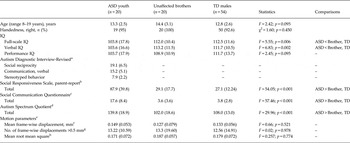
The three groups did not differ in age or handedness. The ASD group differed from the Brother and TD groups in FSIQ and verbal IQ, alongside parent-reported autistic symptoms regarding total scores of the Chinese SRS, Chinese SCQ and AQ-Chinese (Table 1). In participants qualified for resting-state fMRI analysis, these patterns remained the same (online Supplementary Table S1). There were no significant differences in in-scanner motion composites in terms of mean FD, time point exhibiting FD > 0.5 mm, alongside root mean squared head position change, among the three groups (Table 1).
Demographic characteristics of the participants

Data are given as mean (standard deviation) unless otherwise indicated.
ASD, Autism spectrum disorder; TD, typically developing; IQ, intelligence quotient; Brother, unaffected brother.
a Calculated based on the diagnostic algorithm.
b Only 19 male youths with ASD, 19 unaffected brothers and 54 TD males had been assessed by the Chinese Social Responsiveness Scale.
c Only 19 male youths with ASD, 19 unaffected brothers and 41 TD males had been assessed by the Chinese Social Communication Questionnaire.
d Only 17 male youths with ASD, 16 unaffected brothers and 41 TD males had been assessed by the Chinese Autism Spectrum Quotient.
e A total of 18 male youths with ASD, 20 unaffected brothers and 48 TD males were included in the final analysis of resting-state functional magnetic imaging data.
f Frame-wise displacement (volume to volume displacement) was derived from Jenkinson et al. (Reference Jenkinson, Bannister, Brady and Smith2002).
g There were 175 available time points (volumes) for every participant, and 10 displacements correspond to 5.7% of total time points; this parameter was estimated based on Power et al. (Reference Power, Barnes, Snyder, Schlaggar and Petersen2012).
h This parameter was estimated based on Power et al. (Reference Power, Barnes, Snyder, Schlaggar and Petersen2012).
Neuroimaging analyses
Multivariate analysis of covariance assessing for GM, WM and total brain volume with group as a fixed factor and age and FSIQ as covariates showed no differences between the three groups (GM: F 2,89 = 1.06, p = 0.351; WM: F 2,89 = 1.55, p = 0.218; total brain volume: F 2,89 = 1.28, p = 0.284) (online Supplementary Table S2).
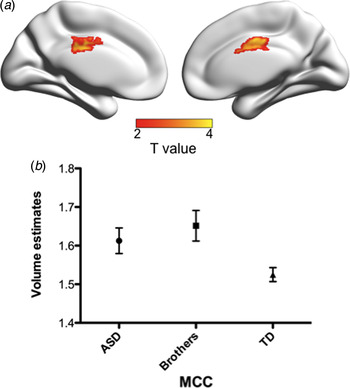
Whole-brain conjunction analysis showed a GM cluster at the MCC (cluster surviving at FWE p = 0.004; MNI x = 6, y = −7, z = 36; BA 24/23; cluster size 2841.75 mm3) (Fig. 1, online Supplementary Table S3). Group comparisons based on analysis of variance on the regional volume estimates extracted from this cluster revealed that both ASD probands and brothers had increased GM volume than TD (online Supplementary Table S4), suggesting that an atypical increase in GM volume in the MCC was shared by both ASD probands and their brothers.
Increased gray matter volume in the midcingulate cortex (MCC) is shared by male youths with autism spectrum disorder (ASD) and their unaffected brothers (Brothers). (a) The significant MCC cluster. (b) Mean volume estimates according to group. Bars represent the standard errors of the mean. TD, Typically developing males.

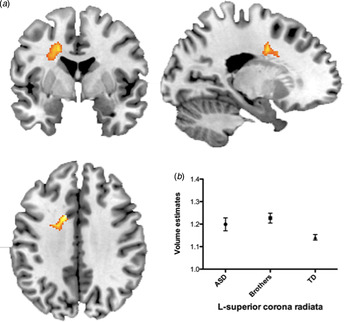
Whole-brain conjunction analysis revealed a WM cluster located at the left superior corona radiata (cluster-level FWE corrected p = 0.016; MNI x = −12, y = 9, z = 36; cluster size 1532.25 mm3) (Fig. 2, online Supplementary Table S3). Group comparisons from the analysis of variance on extracted volume estimates revealed that brothers and ASD probands had significantly increased WM volume than TD (online Supplementary Table S4). Subsidiary conjunction analyses from a general linear model without covarying FSIQ identified MCC (online Supplementary Fig. S1a) and left superior corona radiata (online Supplementary Fig. S1b) clusters of similar spatial extents as those identified by the main analyses.
Significant cluster (conjoined analyses) of increased white matter volume in the left (L) superior corona radiata in autism spectrum disorder (ASD) and unaffected brothers (Brothers) as compared with typically developing (TD) males. (a) The significant midcingulate cortex (MCC) cluster. (b) Mean volume estimates according to ‘group’. Bars represent the standard errors of the mean.

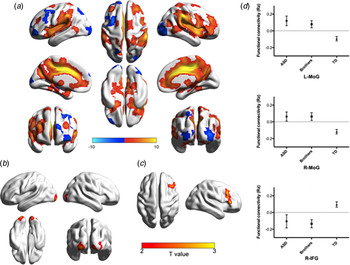
We identified three significant clusters of iFC surviving cluster-level FWE correction at p < 0.05 from the conjunction analysis (Fig. 3b and c , online Supplementary Table S5). Two clusters were in the occipital cortex, with peak voxels centered at the left middle occipital gyrus (L-MoG) and right MoG (R-MoG) (Fig. 3b ). Another cluster was at the right inferior frontal gyrus (R-IFG, Fig. 3c ). Group comparisons based on the analysis of variance of the iFC extracted from the L-MoG revealed that ASD probands and brothers had significantly increased iFC between the L-MoG and MCC than TD (online Supplementary Table S4). Similar results were found in the R-MoG showing that both ASD and brother groups had significantly increased R-MoG-MCC iFC than TD. Group comparisons revealed significantly reduced R-IFG–MCC iFC in ASD and brothers than TD. A subsidiary general linear model without covarying FSIQ also identified bilateral MoG (online Supplementary Fig. S1c) and R-IFG (online Supplementary Fig. S1d) clusters that survived conjunction analysis. These identified clusters mentioned above demonstrated similar spatial extents to those identified by the main analyses.
Intrinsic functional connectivity based on the midcingulate cortex cluster. (a) Within-group functional connectivity map of typically developing (TD) male youths. (b) Significant clusters of shared increases in connectivity between the midcingulate cortex and bilateral middle occipital gyrus (MoG) among male youth with autism spectrum disorder (ASD) and unaffected brothers (Brothers). (c) A significant cluster of shared decreases in connectivity between the midcingulate cortex and right inferior frontal gyrus (R-IFG) among ASD and Brothers. (d) Mean functional connectivity according to group. Bars represent the standard errors of the mean. Rz, z-Transformed correlation coefficient; L, left; R, right.

Tests on familiality showed the variance of the within-pair difference of the GM volume increase in the MCC (permutation test, p = 0.031) and of the WM volume increase in the left superior corona radiata (permutation test, p = 0.027) were both smaller in biological siblings than in randomly paired pseudo-siblings, indicating that this atypicality is shared between members within the same family. By contrast, the increased iFC between the MCC and L-MOG (permutation test, p = 0.797) alongside R-MOG (permutation test, p = 0.170), and the reduced MCC-R-IFG connectivity (permutation test, p = 0.124) in the sib-pairs did not survive the test of familiality.
Brain–behavior relationships
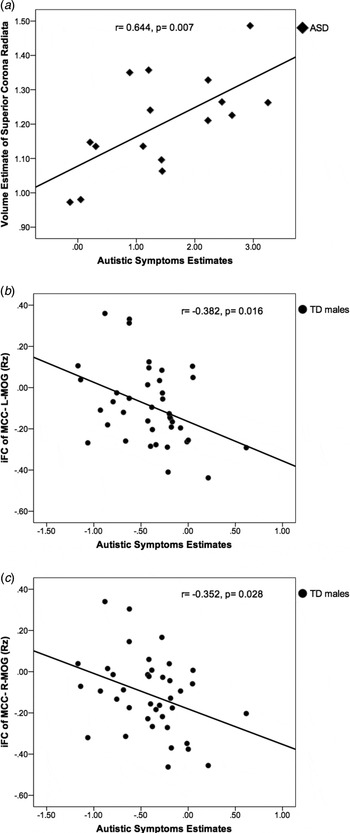
As shown in online Supplementary Table S6 and Fig. 4, in the ASD group, autistic symptoms positively correlated with WM volume in the left superior corona radiata (r = 0.644, uncorrected p = 0.007), but not with other brain measures. In TD males, autistic symptoms negatively correlated with iFC between the MCC and bilateral MoG (MCC–L-MoG: r = −0.382, uncorrected p = 0.016; MCC–R-MoG: r = −0.352, uncorrected p = 0.028).
Scatterplots of brain–behavior correlations. Significant correlations of (a) white matter volume of the left superior corona radiata with the level of autistic symptoms in male youths with autism spectrum disorder (ASD); significant correlations of intrinsic functional connectivity (iFC) between the midcingulate cortex (MCC) and (b) left middle occipital gyrus (L-MoG), alongside (c) right MoG (R-MoG), with the level of autistic symptoms in typically developing (TD) male youths. p Values are uncorrected. Rz, z-Transformed correlation coefficient.

Discussion
This study is the first to use a combined structural and functional imaging approach to examine shared atypicalities in brain structures and associated iFC in youth with ASD and their unaffected siblings. With conjunction analysis we identified that male youth with ASD and their unaffected brothers share atypically increased GM volume in the MCC, and this finding was confirmed by the test of familiality to be shared between members of the same family. MCC dysconnectivity (reduced MCC–R-IFG and increased bilateral MoG–MCC functional connectivity) were also identified by the conjunction analysis. Nonetheless, the shared iFC differences between ASD and brothers did not survive the permutation test of familiality, suggesting that other, unknown non-familial factors might also partly account for this abnormality. Our results demonstrate that unaffected brothers of ASD probands, while not behaviorally expressing ASD features, share similar neuroanatomical and neurofunctional atypicalities with their brothers with ASD.
The shared differences of GM volume among individuals with ASD and their brothers involved the MCC. This cluster lies approximately at the junction of the anterior and posterior MCC (Vogt, Reference Vogt and Vogt2009). In TD individuals, the anterior portion of the cluster is involved in perceiving others in pain and direct experience of pain (Lamm et al. Reference Lamm, Decety and Singer2011; Shackman et al. Reference Shackman, Salomons, Slagter, Fox, Winter and Davidson2011) and processing of negative affects (Shackman et al. Reference Shackman, Salomons, Slagter, Fox, Winter and Davidson2011); the posterior subdivision of this region is implicated in action control (Morecraft & Tanji, Reference Morecraft, Tanji and Vogt2009). Difficulty in recognition of negative emotions (Uljarevic & Hamilton, Reference Uljarevic and Hamilton2013), unusual embodied empathy (Hadjikhani et al. Reference Hadjikhani, Zurcher, Rogier, Hippolyte, Lemonnier, Ruest, Ward, Lassalle, Gillberg, Billstedt, Helles, Gillberg, Solomon, Prkachin and Gillberg2014) and a failure of empathetic behavior (Minio-Paluello et al. Reference Minio-Paluello, Baron-Cohen, Avenanti, Walsh and Aglioti2009) during pain observation, alongside prominent motor impairments (Dziuk et al. Reference Dziuk, Gidley Larson, Apostu, Mahone, Denckla and Mostofsky2007) have all been reported in individuals with ASD, despite no atypical hemodynamic responses in the MCC in ASD during the motor- and affect-processing tasks (Harms et al. Reference Harms, Martin and Wallace2010; Philip et al. Reference Philip, Dauvermann, Whalley, Baynham, Lawrie and Stanfield2012). Prior functional neuroimaging findings have also revealed unusual reductions in brain activity of the MCC when individuals with autism make investment in a trust game (Chiu et al. Reference Chiu, Kayali, Kishida, Tomlin, Klinger, Klinger and Montague2008), view physical (Fan et al. Reference Fan, Chen, Chen, Decety and Cheng2014) and social (Krach et al. Reference Krach, Kamp-Becker, Einhauser, Sommer, Frassle, Jansen, Rademacher, Muller-Pinzler, Gazzola and Paulus2015) pain, observe hand actions (Marsh & Hamilton, Reference Marsh and Hamilton2011), and practise a working memory task (Urbain et al. Reference Urbain, Pang and Taylor2015). The involvement of the MCC might be partly explained by the prior neuropathological findings of increased pyramidal neuron and von Economo neuron numbers in this region in children with autism (Uppal et al. Reference Uppal, Wicinski, Buxbaum, Heinsen, Schmitz and Hof2014). Importantly, we observed that increased MCC volume was shared among ASD probands and their brothers, suggesting that this atypicality is at least partly mediated by factors common to both groups.
Based on this atypical MCC cluster, the ASD group showed reduced iFC between the R-IFG and MCC, and increased MCC–bilateral MoG connections, and, importantly, these abnormalities were also identified in their unaffected brothers. A recent meta-analysis suggests that, in TD adults, the MCC pivotally co-activates with the R-IFG in the supervisory attentional system (Cieslik et al. Reference Cieslik, Mueller, Eickhoff, Langner and Eickhoff2015). Based on the peak coordinates of this identified cluster, the functional connectivity map derived from NeuroSynth (Yarkoni et al. Reference Yarkoni, Poldrack, Nichols, Van Essen and Wager2011) reveals that, in the TD population, the MCC is connected with the IFG, whereas no synchronous activity between the MCC and MoG is identified (thresholded at z-transformed r > 0.2). This converging evidence suggests a possible pattern of ‘dysconnected’ iFC in ASD, i.e. increased functional connectivity between areas that are not typically connected (Di Martino et al. Reference Di Martino, Kelly, Grzadzinski, Zuo, Mennes, Mairena, Lord, Castellanos and Milham2011; Chien et al. Reference Chien, Lin, Lai, Gau and Tseng2015). Importantly, this dysconnectivity based on the MCC identified by the combined structural and functional MRI approach, shared among male youth with ASD and unaffected brothers, may serve as a neural vulnerability marker for ASD. Our cross-modal MRI approach could extend bidirectional structural–functional implications, which have frequently been overlooked in prior MRI literature in ASD (Mueller et al. Reference Mueller, Keeser, Samson, Kirsch, Blautzik, Grothe, Erat, Hegenloh, Coates, Reiser, Hennig-Fast and Meindl2013). Convergent findings from different modals of MRI studies may serve the field for theory validations and hypothesis generation.
Our findings correspond to the concept that brain volume (Giedd et al. Reference Giedd, Stockman, Weddle, Liverpool, Alexander-Bloch, Wallace, Lee, Lalonde and Lenroot2010; Blokland et al. Reference Blokland, de Zubicaray, McMahon and Wright2012; Hibar et al. Reference Hibar, Stein, Renteria, Arias-Vasquez, Desrivières, Jahanshad, Toro, Wittfeld, Abramovic, Andersson, Aribisala, Armstrong, Bernard, Bohlken, Boks, Bralten, Brown, Chakravarty, Chen, Ching, Cuellar-Partida, den Braber, Giddaluru, Goldman, Grimm, Guadalupe, Hass, Woldehawariat, Holmes, Hoogman, Janowitz, Jia, Kim, Klein, Kraemer, Lee, Olde Loohuis, Luciano, Macare, Mather, Mattheisen, Milaneschi, Nho, Papmeyer, Ramasamy, Risacher, Roiz-Santiañez, Rose, Salami, Sämann, Schmaal, Schork, Shin, Strike, Teumer, van Donkelaar, van Eijk, Walters, Westlye, Whelan, Winkler, Zwiers, Alhusaini, Athanasiu, Ehrlich, Hakobjan, Hartberg, Haukvik, Heister, Hoehn, Kasperaviciute, Liewald, Lopez, Makkinje, Matarin, Naber, McKay, Needham, Nugent, Pütz, Royle, Shen, Sprooten, Trabzuni, van der Marel, van Hulzen, Walton, Wolf, Almasy, Ames, Arepalli, Assareh, Bastin, Brodaty, Bulayeva, Carless, Cichon, Corvin, Curran, Czisch, de Zubicaray, Dillman, Duggirala, Dyer, Erk, Fedko, Ferrucci, Foroud, Fox, Fukunaga, Gibbs, Göring, Green, Guelfi, Hansell, Hartman, Hegenscheid, Heinz, Hernandez, Heslenfeld, Hoekstra, Holsboer, Homuth, Hottenga, Ikeda, Jack, Jenkinson, Johnson, Kanai, Keil, Kent, Kochunov, Kwok, Lawrie, Liu, Longo, McMahon, Meisenzahl, Melle, Mohnke, Montgomery, Mostert, Mühleisen, Nalls, Nichols, Nilsson, Nöthen, Ohi, Olvera, Perez-Iglesias, Pike, Potkin, Reinvang, Reppermund, Rietschel, Romanczuk-Seiferth, Rosen, Rujescu, Schnell, Schofield, Smith, Steen, Sussmann, Thalamuthu, Toga, Traynor, Troncoso, Turner, Valdés Hernández, van 't Ent, van der Brug, van der Wee, van Tol, Veltman, Wassink, Westman, Zielke, Zonderman, Ashbrook, Hager, Lu, McMahon, Morris, Williams, Brunner, Buckner, Buitelaar, Cahn, Calhoun, Cavalleri, Crespo-Facorro, Dale, Davies, Delanty, Depondt, Djurovic, Drevets, Espeseth, Gollub, Ho, Hoffmann, Hosten, Kahn, Le Hellard, Meyer-Lindenberg, Müller-Myhsok, Nauck, Nyberg, Pandolfo, Penninx, Roffman, Sisodiya, Smoller, van Bokhoven, van Haren, Völzke, Walter, Weiner, Wen, White, Agartz, Andreassen, Blangero, Boomsma, Brouwer, Cannon, Cookson, de Geus, Deary, Donohoe, Fernández, Fisher, Francks, Glahn, Grabe, Gruber, Hardy, Hashimoto, Hulshoff Pol, Jönsson, Kloszewska, Lovestone, Mattay, Mecocci, McDonald, McIntosh, Ophoff, Paus, Pausova, Ryten, Sachdev, Saykin, Simmons, Singleton, Soininen, Wardlaw, Weale, Weinberger, Adams, Launer, Seiler, Schmidt, Chauhan, Satizabal, Becker, Yanek, van der Lee, Ebling, Fischl, Longstreth, Greve, Schmidt, Nyquist, Vinke, van Duijn, Xue, Mazoyer, Bis, Gudnason, Seshadri, Ikram, Martin, Wright, Schumann, Franke, Thompson and Medland2015) and iFC (Glahn et al. Reference Glahn, Winkler, Kochunov, Almasy, Duggirala, Carless, Curran, Olvera, Laird, Smith, Beckmann, Fox and Blangero2010; Fornito et al. Reference Fornito, Zalesky, Bassett, Meunier, Ellison-Wright, Yucel, Wood, Shaw, O'Connor, Nertney, Mowry, Pantelis and Bullmore2011) are largely genetically determined. Our novel finding of shared atypicality in the MCC has not been identified in prior literature on the first-degree relatives of ASD (Rojas et al. Reference Rojas, Smith, Benkers, Camou, Reite and Rogers2004; Palmen et al. Reference Palmen, Hulshoff Pol, Kemner, Schnack, Sitskoorn, Appels, Kahn and Van Engeland2005; Peterson et al. Reference Peterson, Schmidt, Tregellas, Winterrowd, Kopelioff, Hepburn, Reite and Rojas2006; Dalton et al. Reference Dalton, Nacewicz, Alexander and Davidson2007; Branchini et al. Reference Branchini, Lindgren and Tager-Flusberg2009; Segovia et al. Reference Segovia, Holt, Spencer, Gorriz, Ramirez, Puntonet, Phillips, Chura, Baron-Cohen and Suckling2014; Moseley et al. Reference Moseley, Ypma, Holt, Floris, Chura, Spencer, Baron-Cohen, Suckling, Bullmore and Rubinov2015). These discrepancies may arise from the following methodological considerations. First, variation in the ages of participants could modulate cortical morphometry in ASD (Nickl-Jockschat et al. Reference Nickl-Jockschat, Habel, Michel, Manning, Laird, Fox, Schneider and Eickhoff2012; Ecker et al. Reference Ecker, Bookheimer and Murphy2015; Lin et al. Reference Lin, Ni, Lai, Tseng and Gau2015). Some prior papers on broader autism neuroendophenotypes studied adult participants (unaffected parents) (Rojas et al. Reference Rojas, Smith, Benkers, Camou, Reite and Rogers2004; Palmen et al. Reference Palmen, Hulshoff Pol, Kemner, Schnack, Sitskoorn, Appels, Kahn and Van Engeland2005; Peterson et al. Reference Peterson, Schmidt, Tregellas, Winterrowd, Kopelioff, Hepburn, Reite and Rojas2006), whereas others investigated adolescent cohorts (Dalton et al. Reference Dalton, Nacewicz, Alexander and Davidson2007; Branchini et al. Reference Branchini, Lindgren and Tager-Flusberg2009; Segovia et al. Reference Segovia, Holt, Spencer, Gorriz, Ramirez, Puntonet, Phillips, Chura, Baron-Cohen and Suckling2014; Moseley et al. Reference Moseley, Ypma, Holt, Floris, Chura, Spencer, Baron-Cohen, Suckling, Bullmore and Rubinov2015). Here we studied youth aged 8–19 years. Although we did not identify significant age-related changes or age × group interactions, the effects of development on neuroendophenotypes for ASD awaits explorations. Furthermore, this study was limited by a lack of measure of puberty status, of which effects on brain structures and functions of ASD remain elusive. Second, only the present study and one previous work (Moseley et al. Reference Moseley, Ypma, Holt, Floris, Chura, Spencer, Baron-Cohen, Suckling, Bullmore and Rubinov2015) studied male-only participants, possibly explaining the discrepancy between our work and earlier literature using mixed-sex samples, as sex modulates brain structures in ASD (Lai et al. Reference Lai, Lombardo, Suckling, Ruigrok, Chakrabarti, Ecker, Deoni, Craig, Murphy, Bullmore and Baron-Cohen2013, Reference Lai, Lombardo, Auyeung, Chakrabarti and Baron-Cohen2015; Schaer et al. Reference Schaer, Kochalka, Padmanabhan, Supekar and Menon2015; Supekar & Menon, Reference Supekar and Menon2015). Another critical issue is the selection of participants based on the familial occurrence of ASD. In the present study, we recruited simplex families. However, previous studies on neuroendophenotypes or broader autism neurophenotypes allow for samples of unaffected first-degree relatives to be from either families with only one individual with ASD (simplex families), or families with two or more affected individuals (multiplex families). The current sample of simplex families might partly contribute to disparity between findings of prior studies on siblings of ASD and ours. Finally, the different genetic (Kuo et al. Reference Kuo, Chuang, Su, Chen, Chen, Wu, Yen, Wu, Liu, Chou, Chou, Chiu, Tsai and Gau2015; Liu et al. Reference Liu, Shimada, Otowa, Wu, Kawamura, Tochigi, Iwata, Umekage, Toyota, Maekawa, Iwayama, Suzuki, Kakiuchi, Kuwabara, Kano, Nishida, Sugiyama, Kato, Chen, Mori, Yamada, Yoshikawa, Kasai, Tokunaga, Sasaki and Gau2015) or cultural (Han & Ma, Reference Han and Ma2015) backgrounds of the samples may also contribute to the discrepant reports.
To facilitate endophenotype discovery, we adopted a three-group (i.e. ASD, unaffected relatives, TD controls) (Dalton et al. Reference Dalton, Nacewicz, Alexander and Davidson2007; Segovia et al. Reference Segovia, Holt, Spencer, Gorriz, Ramirez, Puntonet, Phillips, Chura, Baron-Cohen and Suckling2014; Moseley et al. Reference Moseley, Ypma, Holt, Floris, Chura, Spencer, Baron-Cohen, Suckling, Bullmore and Rubinov2015), rather than a two-group (i.e. unaffected relatives and healthy controls) (Rojas et al. Reference Rojas, Smith, Benkers, Camou, Reite and Rogers2004; Palmen et al. Reference Palmen, Hulshoff Pol, Kemner, Schnack, Sitskoorn, Appels, Kahn and Van Engeland2005; Peterson et al. Reference Peterson, Schmidt, Tregellas, Winterrowd, Kopelioff, Hepburn, Reite and Rojas2006; Branchini et al. Reference Branchini, Lindgren and Tager-Flusberg2009), design. Statistically, inclusion of three groups within a general linear model with conjunction analyses may partly explain our distinct but limited finding in the MCC differences. However, we assert that more precise neuroendophenotypic markers for ASD could be identified by adopting these approaches in the current study (Kaiser et al. Reference Kaiser, Hudac, Shultz, Lee, Cheung, Berken, Deen, Pitskel, Sugrue, Voos, Saulnier, Ventola, Wolf, Klin, Vander Wyk and Pelphrey2010). This design specifies ‘trait’ signature, i.e. shared atypicality in siblings and autistic probands, and partly explains the distinct findings between the current study (‘trait’ features) (Kaiser et al. Reference Kaiser, Hudac, Shultz, Lee, Cheung, Berken, Deen, Pitskel, Sugrue, Voos, Saulnier, Ventola, Wolf, Klin, Vander Wyk and Pelphrey2010), literature on ASD probands alone, and siblings alone. Notably, the significant conjunction that we identified does not indicate that all the contrasts were individually significant (i.e. a conjunction of significance). It simply means that the contrasts were consistently high and jointly significant (Friston et al. Reference Friston, Penny and Glaser2005). This account highlights the unique interpretations using the conjunction analyses (Friston et al. Reference Friston, Penny and Glaser2005; Heller et al. Reference Heller, Golland, Malach and Benjamini2007), which is not the common approach in the earlier neuroimaging literature on ASD relatives. Moreover, despite the advantage of the current design, it should be noted that we did not employ a linear mixed-effects model, a suggested approach for accounting for relatedness and heritability among subjects within the families (Chen et al. Reference Chen, Saad, Britton, Pine and Cox2013), as the current neuroimaging software has difficulty handling the conjunction analysis for this complex model. Alternatively, we tested the variance of the within-family-pair difference as an assessment of familiality (Menzies et al. Reference Menzies, Achard, Chamberlain, Fineberg, Chen, del Campo, Sahakian, Robbins and Bullmore2007; Ersche et al. Reference Ersche, Jones, Williams, Turton, Robbins and Bullmore2012) to aid interpretation of the findings from fixed-effect models. Finally, despite the sophisticated study designs, the current findings are still limited by the relatively modest sample size in the ASD and brother groups, and should be further replicated in a large-scale independent cohort.
With regard to imaging methodology, as in-scanner head motion would introduce artifacts in both structural (Reuter et al. Reference Reuter, Tisdall, Qureshi, Buckner, van der Kouwe and Fischl2015) and functional image (Power et al. Reference Power, Schlaggar and Petersen2015), we used stringent motion-exclusion criteria, a robust motion-denoising strategy (i.e. ICA-AROMA), matching motion composite across groups, and including mean FD as a covariate in the statistical models for rs-fMRI data (Yan et al. Reference Yan, Cheung, Kelly, Colcombe, Craddock, Di Martino, Li, Zuo, Castellanos and Milham2013a ). Nonetheless, we acknowledge that even a relatively small amount of head motion may still confound the present findings. Herein, we adopted the VBM approach to identify structural differences, which may be sensitive to the inaccuracy of tissue-classification and smoothing extents (Mechelli et al. Reference Mechelli, Price, Friston and Ashburner2005). To date, no study on unaffected relatives of ASD has applied surface-based morphometry. Future studies could adopt both voxel-based and surface-based methods to complement each other. Lastly, although we employed seed-based correlation analysis to directly link structural anomalies to iFC, interpreting these resulting spatial map and group difference as the sole finding is an under-representation of the data, as only one network is tested. Different seed-selection strategies may bias the reports (Cole et al. Reference Cole, Smith and Beckmann2010). Future work using a more refined approach to integrate structural and functional features, which balance the unbiased data-driven explorations and hypothesis-based selections of the candidate systems in the contexts of overall literature of ASD, is warranted.
In summary, using a combined structural MRI and rs-fMRI approach, we reported for the first time that increased GM volume in the MCC and its dysconnected iFC were shared among male youth with ASD and their unaffected brothers. This highlights that the MCC may be a candidate neuroendophenotype for ASD. Our findings characterized the underlying trait of vulnerability to develop ASD in light of the structures and functions of the MCC. This might have implications for discovering factors common to both affected individuals and unaffected relatives, which give rise to atypical neuroanatomy and brain connections.
Supplementary material
The supplementary material for this article can be found at https://doi.org/10.1017/S0033291716002695
Acknowledgements
This work was supported by grants from the National Science Council of Taiwan (NSC 97-3112-B-002-009, NSC98-3112-B-002-004, NSC 99-2627-B-002-015, NSC 100-2627-B-002-014, NSC 101-2627-B-002-002, NSC 101-2314-B-002-136-MY3), National Taiwan University (AIM for Top University Excellent Research Project: 10R81918-03, 101R892103, 102R892103), and the National Taiwan University Hospital (NTUH101-S1910, NTUH103-N2574, NTUH104-S2761). M.-C.L. is supported by the O'Brien Scholars Program within the Child and Youth Mental Health Collaborative at the Centre for Addiction and Mental Health and The Hospital for Sick Children, Toronto. We are grateful for all participants and their parents for taking part in the study.
S.S.-F.G. was the principal investigator of this study. H.-Y.L and S.S.-F.G. were responsible for the study concept and design. S.S.-F.G. recruited and assessed participants and acquired clinical data. S.S.-F.G. and W.-Y.I.T. supervised the study and acquired imaging data. H.-Y.L., S.S.-F.G. and Y.-T.C. analysed and interpreted the data. H.-Y.L. produced the figures. H.-Y.L., M.-C.L. and S.S.-F.G. wrote the manuscript. All authors read and approved the manuscript.
Declaration of Interest
None.