Influenza is a leading cause of morbidity and mortality, causing an estimated average of 12,200 hospital admissions and 3,500 deaths annually in Canada.Reference Schanzer, Sevenhuysen, Winchester and Mersereau 1 During waves of influenza activity, the virus is transmitted from person to person both in the community and in institutions.Reference Vanhems, Voirin and Roche 2 Acute-care hospitals pose particular challenges because patients ill with influenza require care and because the fatality rate for hospital-acquired influenza is high.Reference Macesic, Kotsimbos, Kelly and Cheng 3 – Reference Pagani, Thomas and Huttner 6
Vaccination is the most effective known strategy for preventing illness caused by influenza viruses, and vaccination of patients, staff, and visitors are all important in protecting hospitalized patients from illness and death due to influenza.Reference Ahmed, Lindley, Allred, Weinbaum and Grohskopf 7 Other strategies to reduce transmission of influenza in hospitals include the exclusion of ill staff and visitors, adherence to good hand hygiene routines, screening to detect influenza illness in patients, additional precautions used to care for patients with influenza, and antiviral agents.Reference Blanco, Eisenberg, Stillwell and Foxman 8 – 10 Despite implementation of such strategies, healthcare-acquired influenza and influenza outbreaks continue to occur.
We undertook this study to describe the continuing burden of influenza exposure from patients in a large community hospital with active surveillance (defined as mandatory screening at triage and surveillance for new onset of respiratory symptoms among inpatients) for influenza as well as to determine the rate of, and risk factors for, transmission from patients with laboratory-confirmed influenza illness to their hospital roommates.
METHODS
Background
North York General Hospital is a 426-bed community teaching hospital in Toronto, Ontario, Canada. All patients presenting to the emergency department are routinely screened at triage using mandatory computer fields to identify those that meet the Ontario Provincial Infectious Disease Advisory Committee (PIDAC) definition of febrile respiratory illness (ie, cough or shortness of breath with fever, feverishness, shakes, or chills; FRI). 9 Surveillance is also conducted for new-onset FRI symptoms among inpatients. Surveillance includes infection control staff performing daily unit rounds and liaising with healthcare providers regarding new-onset fever or respiratory symptoms among inpatients. Providers have also been trained to notify infection control staff about any pertinent new signs or symptoms. Additional precautions are implemented if patients have both respiratory symptoms and feverishness, if they have an admitting diagnosis of pneumonia, or if they have a positive laboratory test for influenza from a respiratory specimen. 11 Testing and additional precautions are also implemented at the discretion of treating clinicians for patients whose only symptom is feverishness, those with respiratory symptoms, and those with cardiac symptoms in whom an underlying infection is suspected. Additional precautions include accommodation in a private room and the use of gown, gloves, mask, and eye protection by any staff or visitor entering the room. Nasopharyngeal swabs are submitted for influenza testing for all patients flagged by triage screening, all patients placed on additional precautions, and other patients at the discretion of the treating physician.
Roommates of patients with influenza are placed on additional precautions for at least 72 hours after their last exposure. They are assessed daily for signs and symptoms of infection, and nasopharyngeal swabs are obtained if they develop respiratory symptoms or fever. Nasopharyngeal swabs are tested for influenza using real-time polymerase chain reaction (PCR) (Simplexa Flu A/B & RSV Kit, Focus Diagnostics, Cypress, CA, or Xpert Flu, Cepheid, Sunnyvale, CA).
Data Collection
All patients with laboratory-confirmed influenza admitted from October 1 to April 30 in 2012–2013, 2013–2014, and 2014–2015 were approached for consent for interview, chart review, and family practitioner contact to determine the time of symptom onset, presenting symptoms, time of admission and discharge, antiviral medication use, underlying chronic illness, vaccination history, and outcome. Infection control and bed management data were reviewed to identify roommates of cases. Roommates’ charts were reviewed to identify the timing and duration of exposure, development of symptoms, influenza testing and results, and antiviral prophylaxis and therapy.
Definitions
A case of influenza was defined as a patient who tested positive for influenza from a respiratory specimen. Nosocomial cases were defined as illness in patients who developed symptoms >72 hours after admission while community-onset cases had symptoms at admission. Community-associated, hospital onset cases were those without symptoms at admission but with onset within 72 hours of admission. Fever was defined as body temperature of ≥37.8°C. The Public Health Agency of Canada (PHAC) definition of an influenza-like illness (ILI) includes fever and cough and 1 or more of the following symptoms: sore throat, arthralgia, myalgia, or prostration. 12 The Centers for Disease Control and Prevention definition includes a fever of ≥37.8°C and a cough and/or sore throat. 13
Roommates were defined as exposed if they shared an inpatient room with a case patient for any period, with exposure calculated in hours. Transmission from case patient to roommate was defined as having occurred if there was shared room time, symptoms developed in the roommate >18 hours after first roommate exposure but <72 hours after last exposure, and the case and roommate tested positive for the same influenza subtype. Oseltamivir was used for treatment and prophylaxis following Association of Medical Microbiology and Infectious Disease Canada guidelinesReference Aoki, Allen, Stiver and Evans 14 and at the discretion of the treating clinician.
Data Management and Analysis
Data were double-entered in SAS version 9.1 (SAS Institute, Cary, NC) and cleaned before statistical analyses were conducted using StataSE version 11.2 (StataCorp, College Station, TX). Comparisons were performed using the χ2, Fisher’s exact, or Student t test, as appropriate. Logistic regression, including assessment for outliers and influential observations and model fit, was used to compare variables associated with diagnosis of community onset cases at admission. All tests were 2-tailed, and a P value <.05 was considered statistically significant.
RESULTS
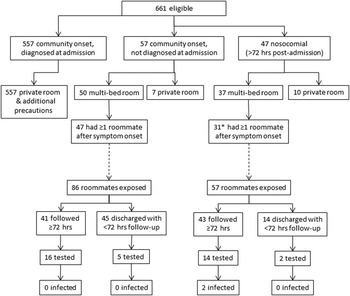
We assessed influenza in patients admitted during the 2012–2013, 2013–2014, and 2014–2015 influenza seasons. During these three seasons, 4,401 of 42,594 hospitalized patients (10.3%) were tested for influenza. Those tested for influenza included 1,099 (25%) whose admitting diagnosis was pneumonia and 436 (9.9%) patients with underlying cardiac disease whose cardiac symptoms were suggestive of an underlying infection. In total, 661 patients had laboratory-confirmed influenza: 402 patients (60.8%) had influenza A(H3N2), 96 patients (14.5%) had influenza A(H1N1), 36 patients (5.4%) had influenza A (untyped), and 127 patients (19.2%) had influenza B. As shown in Footnote Figure 1, 557 of these cases (84.3%) had community-onset disease with influenza diagnosed and additional precautions implemented at admission. The remaining 104 cases included 57 cases with community-onset influenza but whose illness was not recognized upon admission and 47 cases (7.1%) of nosocomial disease. We identified no community-associated, hospital-onset cases of influenza.
Flow of patients diagnosed with influenza, Toronto, Canada, 2012–2013, 2013–2014, and 2014–2015 seasons. The 104 patients not diagnosed at admission were put in additional precautions a median of 1 day after admission or onset of symptoms. *A total of 6 nosocomial cases were diagnosed as 3 pairs of roommates with onset of symptoms within 12 hours of each other, suggesting an unidentified common source.

The 57 community-onset cases not diagnosed at admission had symptom onset reported a median of 3 days (IQR, 1–5 days) prior to hospital admission. A nasopharyngeal swab was collected a median of 1 day (IQR, 0–1 days) after hospital admission. Of 10 patients, 7 were admitted to single rooms and thus did not expose roommates. The remaining 47 patients exposed 86 roommates prior to their diagnosis. The median duration of roommate exposure after the onset of symptoms was 20.5 hours (IQR, 6.6–32.8). None of the 41 roommates with complete follow-up (25 of whom received antiviral prophylaxis) developed respiratory symptoms or fever and tested positive for influenza (Figure 1).
The 47 nosocomial cases were identified a median of 9 days (IQR, 5–17) after admission. Symptom onset preceded swab collection by a median of 1 day (IQR, 0–2). Of the 47 cases, 10 were identified as part of an outbreak. A single outbreak caused by influenza A(H3N2) in December 2012 infected 3 patients on 1 ward; an outbreak caused by influenza A(H1N1) in January 2014 infected 5 patients on a second ward; and 1 case caused by influenza A(H3N2) in February 2015 infected 2 patients on a third ward. The remaining 37 cases were sporadic. The overall proportion of influenza cases that were nosocomial was similar across the 3 seasons at 17 of 203 (8.4%), 9 of 191 (4.7%), and 21 of 267 (7.9%), respectively (P=.30).
Of the 47 nosocomial cases, 31 had roommates following symptom onset. In 3 instances, pairs of roommates had onset of symptoms separated by <18 hours, suggesting that they were both exposed to an unrecognized case (eg, staff or visitor) rather 1 case being the source for the other. A total of 57 additional patients were exposed to nosocomial cases for a median of 21.5 hours (IQR, 11.9–38.0). Of the 43 roommates with complete follow-up, 2 developed respiratory symptoms or fever and tested positive for influenza. Both patients were among the 32 roommates who received antiviral prophylaxis; symptom onset in these cases occurred <24 hours and 3 days after the first oseltamivir dose, respectively.
Clinical Presentation and Outcomes
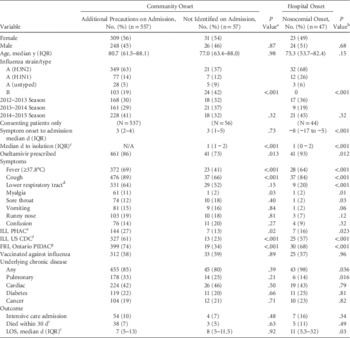
As shown in Table 1, detailed clinical data were available for 637 cases (96.4% of those eligible). ILI criteria used as a guide for testing would have identified 158 of 637 (24.8%) of all influenza-positive cases based on the PHAC definition; 57.3% would have been identified with the CDC definition; and 70.3% would have been identified using the PIDAC definition for FRI. Although demographically similar to cases identified at admission, only 7 (12.5%) community-onset cases identified after admission met the PHAC definition while 23.2% met the CDC definition and 33.9% met the PIDAC definition. These rates were significantly different than the rates identified at admission (P<.02). Community-onset patients who were not identified at admission were significantly more likely to be infected with influenza B than other community-onset cases, even while adjusting for age, sex, season, and number of symptoms present on admission (OR, 3.0; 95% CI, 1.7–5.6; P<.001).
Patient Demographics, Symptoms, and Exposures, by Symptom Onset and Timing of Diagnosis of Influenza, Toronto, Canada, 2012–2013 to 2014–2015 Winter Seasons

NOTE.CO, community-onset; N/A, not applicable; FRI, febrile respiratory illness; ILI, influenza-like illness, IQR, interquartile range; PHAC, Public Health Agency of Canada; CDC, Centers for Disease Control and Prevention; PIDAC, Provincial Infectious Diseases Advisory Committee.
a Comparing patients recognized and not recognized at admission.
b Comparing all three groups of patients.
c After admission for community-onset cases; after symptom onset for nosocomial cases.
d Lower respiratory symptoms include: shortness of breath or difficulty breathing, or wheezing.
e PHAC definition of ILI: fever (37.8°C) & cough & ≥1 of the following: sore throat, arthralgia, myalgia, or weakness. 12
f CDC definition of ILI: fever (37.8°C) & cough or sore throat. 13
g PIDAC definition of FRI: cough or SOB & fever or chills. 11
DISCUSSION
In our hospital, all patients are screened at triage for symptoms and >10% of admissions are tested for influenza during winter seasons. Despite these measures, we identified an additional 9% of community-onset cases by review of hospital admissions by infection control practitioners. Based on detailed chart reviews, these cases had less typical presentations (often not meeting standard definitions of ILI or FRI) than those cases diagnosed at admission, making it more difficult for clinicians to recognize disease. More work is needed to optimize admission screening to reduce patient and staff exposure to influenza. In the meantime, vaccination of healthcare workers may be the most effective way to assure healthcare worker protection from patients with atypical influenza.
This study confirms that the CDC and PHAC case definitions of ILI, which are intended for surveillance, are not appropriate for clinical decision making.Reference Priest and Kelly 15 Less than 60% of laboratory-confirmed cases of influenza in this study population presented with an ILI meeting the CDC definition. Several other studies have also found that only 20%–50% of adult patients requiring admission for influenza meet the CDC case definition for ILI.Reference Vanhems, Voirin and Roche 2 , Reference Babcock, Merz, Dubberke and Fraser 16 – Reference Jiang, Lee and Lim 18
Our hospital uses the PIDAC definition of FRI, which is intended for active case finding. However, only 70% of the cases of influenza we identified met the PIDAC definition. We believe that our encouragement of clinicians to use a liberal approach to the definition of feverishness, especially for older adults and patients who are immunocompromised, as well as to use clinical judgment about whether a viral respiratory infection may be present, was associated with a significant improvement in disease detection. However, even in our situation, we failed to detect all community-onset cases at admission: 34% of patients meeting FRI definitions according to symptoms collected in the ward/unit were not identified at triage.
In this study, we identified transmission to roommates from patients with nosocomial but not community onset disease. This may be due to the timing of the exposure: nosocomial cases expose their roommates prior to and during the first few days of their illness when viral shedding is higher,Reference Suess, Remschmidt and Schink 19 , Reference Cowling, Chan and Fang 20 while exposure to community-onset cases started on average 3 days after the onset of symptoms. At least 1 other study has suggested that transmission occurring >3 days after the onset of symptoms is uncommon and is less likely than would be expected given the concentration of virus shed.Reference Suess, Remschmidt and Schink 19 , Reference Lau 21 However, another explanation for influenza in roommates of nosocomial cases is that both the case patient and roommate were infected by a visitor or healthcare worker. We did, in fact, find 3 instances in which symptom onset occurred in 2 roommates occurred within the same 12-hour period, suggesting that both were exposed to an unidentified infected person. It is likely that the actual attack rate among roommates was higher than we report because roommates were only tested if they had respiratory symptoms or fever, which may have missed some cases. Finally, more than half of exposed roommates received antiviral prophylaxis, which likely prevented some illnesses.
Although we were unable to follow exposed healthcare workers in this study, those who provide hands-on care to patients are likely at higher risk of contracting influenza from infected patients than are the patients’ roommates, who have little or no direct contact with their roommate and have >1.5 meters of distance and curtains between the heads of beds in multibed rooms. While some healthcare facilities have adopted a requirement for healthcare workers to receive influenza vaccine annually, others have opted for a vaccinate-or-mask policy to provide healthcare workers with an option for annual vaccination. The use of surgical masks or N95 respirators has been shown to protect wearers against respiratory infections,Reference Bin-Reza, Lopez Chavarrias, Nicoll and Chamberland 22 – Reference Yang, Seale and MacIntyre 25 and community-based studies suggest a level of protection against influenza, especially when combined with good hand hygiene.Reference Blanco, Eisenberg, Stillwell and Foxman 8 , Reference Aiello, Perez, Coulborn, Davis, Uddin and Monto 26 Our study emphasizes that donning masks only for those patients who are identified by a FRI surveillance system will perform suboptimally in protecting unvaccinated staff. Similarly, dependence on the exclusion of unvaccinated staff during outbreaks will also be ineffective: fewer than 2% of overall cases and fewer than 25% of hospital-acquired influenza cases occurred as part of an outbreak.
These data have several limitations. Our screening for nosocomial cases during these seasons relied on fever and respiratory symptoms; thus, our data are incomplete and the number of sporadic nosocomial cases identified is likely a significant underestimate of the true number. Similarly, because only roommates with a fever or respiratory symptoms were tested for influenza, we missed some infections in roommates. We were not able to monitor healthcare workers or visitors, and we may have missed both sources and other secondary cases of influenza in these groups. We could not follow-up discharged patients; thus, >40% of exposed roommates were lost to follow-up.
In conclusion, our data demonstrate that exposure to patients with influenza persisted in our hospital despite an intensive program to reduce the exposure of healthcare workers and other patients. Because exposure to patients can occur prior to symptom onset and to those with atypical symptoms, emphasis on optimal hand hygiene and vaccination of healthcare workers is a necessary adjunct to routine and additional precautions if patients and workers are to be best protected against influenza. Healthcare workers should also be aware that workplace exposure to influenza is very difficult to completely preclude.
ACKOWLEDGMENTS
We thank the investigators and staff of the Toronto Invasive Bacterial Diseases Network (TIBDN) for sharing detailed clinical data for influenza cases. B.L.C. and W.N. contributed equally to the manuscript.
Financial support: Funding for data collection on influenza cases was provided by an unrestricted grant to the TIBDN from Hoffman LaRoche Limited and by the Public Health Agency of Canada and the Canadian Institutes of Health Research through the Serious Outcomes Surveillance network of the Canadian Immunization Research Network (CIRN).
Potential conflicts of interest: A.J.M. has received research funding from Hoffman LaRoche Limited. The Serious Outcomes Surveillance network of CIRN is funded, in part, by a collaborative research agreement with GlaxoSmithKline Biologicals, SA. All other authors declare no conflicts of interest relevant to this article.