


The past quarter century of scholarship on public opinion has shown that citizens' attitudes can be influenced significantly by how elites frame their communications in the mass media. In the parlance of this research, a speaker “frames” an issue by encouraging readers or listeners to emphasize certain considerations above others when evaluating that issue. A framing “effect” occurs when individuals arrive at different positions on the issue, depending on the priority given to various considerations (Druckman and Nelson 2003: 730). For example, a newspaper editorial defending a hate group rally in terms of the group's free speech rights may move readers to favor allowing the rally by causing them to weigh speech concerns more heavily when assessing the issue. Alternatively, an editorial challenging the rally as a threat to public safety may lead readers to give priority to maintaining social order and turn them against the rally (Nelson, Clawson, and Oxley 1997).
Such studies raise questions about the capacity of citizens to provide autonomous input into the democratic process. If public preferences can be arbitrarily manipulated by how issues are framed, there can be no legitimate representation of public interests or meaningful discussion of government responsiveness (e.g., Bartels 2003; Entman 1993; Zaller 1992). Public opinion fails in these instances as a reliable guide to policy.
Most of this research, however, has drawn its conclusions from observations of noncompetitive political contexts in which elite frames are conveyed without debate or opposition. There has been surprisingly little attention given to the electorate's susceptibility to framing under more robust political conditions. In declaring that voters are not fools, Key (1966) argued that the quality of their judgments is affected by the degree to which institutions and competitive contexts structure debate and decision making. Political parties, the mass media, and electoral campaigns all have the potential to educate citizens and enable them to make more carefully considered choices.
In this article, we study the effect of democratic competition on the power of elites to frame public opinion. A democracy minimally requires that citizens have an opportunity to choose among rival elites and platforms in regular elections (e.g., Dahl 1971, Riker 1982). Competition ensures that voters are not confined to a single perspective, but instead have access to arguments representing opposing positions. In the conclusion to his treatise on the democratic process, Schattschneider (1960: 138) wrote that “democracy is a competitive political system in which competing leaders and organizations define the alternatives of public policy in such a way that the public can participate in the decision-making process.”
We investigate whether such competition between leaders and organizations in a democratic system improves the public's capacity to evaluate and choose among alternative frames. We focus in particular on the attributes of citizens and the conditions of competition that are conducive to reducing framing effects and improving the consistency and quality of public opinion.
We address this issue first by defining the range of competitive contexts that might surround any debate over a policy issue. We then offer a theory that predicts how audiences, messages, and competitive environments interact to influence the magnitude of framing effects. These hypotheses are tested using experimental data gathered on the opinions of adults and college students toward two policy issues—the management of urban growth and the right of an extremist group to conduct a rally.
Experimentation offers the twin advantages of randomization and control. Through random assignment of participants to treatments, we overcome the self-selection problem common to nonexperimental communications research in which people's attitudes are correlated with the messages they receive. By controlling participants' exposure to media messages, we can separate the effects of the content and frequency of alternative messages. Foremost, we can determine how different forms of competition affect decision making. After analyzing the results of our experiments, we discuss their implications for the study of public opinion, political debate, and the design of democratic institutions.
FRAMING EFFECTS IN DIFFERENT COMPETITIVE ENVIRONMENTS
Schattschneider (1960: 68) believed that in any debate or conflict, “the definition of the alternatives is the supreme instrument of power.” His ideas about the influence of rhetoric in the management of conflict anticipated the vast literature on framing based on experimentation and survey research produced in the past 25 years.
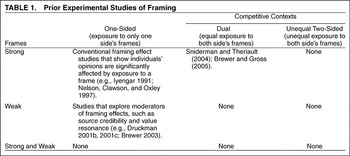
Analysts have documented framing effects for numerous substantive issues in various political contexts. But, remarkably, the voluminous literature on framing effects has virtually ignored perhaps the most typical communications environment in which competing sides promote alternative interpretations of an issue. We are not the first to recognize this problem. A decade ago, Zaller (1996: 59) lamented the “failure to develop sufficiently incisive models of the effects of competing communications.” More recently, Sniderman and Theriault (2004: 141-42) noted that existing studies have “restricted attention to situations in which citizens are artificially sequestered, restricted to hearing only one way of thinking about a political issue” (also see Entman 1993: 55; Riker 1995: 33). This bias in past research is vividly illustrated in Table 1, which shows where the majority of previous experimental research falls within a two-dimensional typology of competitive environments.

One dimension of Table 1 represents the relative frequencies of competing communications to which individuals are exposed. If we assume two competing parties (e.g., two sides of the issue; see Sniderman 2000), we can reduce all possible combinations of relative frequencies into three discrete categories: (1) one-sided studies in which individuals receive only one side's frames (e.g., the free speech frame one or more times); (2) dual studies in which individuals receive opposing frames in equal quantities1
“Dual” therefore refers solely to equal numbers of exposure to frames on either side. We reserve the term “balanced” to refer to competitive contexts in which both the strength and quantity of frames on either side are equal.
Frames vary on a second dimension defined by their relative perceived strengths. We will elaborate later on what we mean by strength, but for now we loosely define a frame's strength as increasing with its perceived persuasiveness. Weak frames are typically seen as unpersuasive, whereas strong frames are compelling. For example, most people would presumably regard “maintaining public safety” as a stronger or more persuasive frame for prohibiting a hate group rally than “preventing litter on the streets.” Although strength lies on a continuum, we simply distinguish “strong” from “weak” frames. As Table 1 shows, an experiment can employ strong frames exclusively, weak frames exclusively, or a mixture of strong and weak frames.
Taken together, variations in the relative frequencies and strengths of frames combine to yield nine possible research conditions or competitive contexts. Table 1 indicates that almost all prior work employs one-sided designs using either strong or weak frames. A main exception is Sniderman and Theriault's (2004) dual study using (apparently) strong frames (also see Brewer and Gross 2005, who focus on open-ended responses, and Hansen n.d.). They argued that framing effects are cancelled when opposing frames are presented concurrently. However, Sniderman and Theriault do not address whether their conclusion requires that the competing frames be equally strong, be delivered with equal frequency, or both.
The most noteworthy feature of the table is the five study designs of competitive situations that heretofore have not been implemented. These include dual studies in which opposing frames are of unequal strength, and two-sided studies that expose individuals to opposing combinations of frames in unequal quantities. There are many ways in which competition in politics is uneven, and imbalances in the ability of opposing campaigns to develop and disseminate their messages may permit one side to gain the upper hand in framing an issue (Pan and Kosicki 2001). Yet, we have virtually no insight into how individuals respond to competitive frames of varying quantities and strengths.
The literature on opinion formation suggests two possibilities. One hypothesis, focusing on the relative volume of competing messages, posits that whichever frame is loudest—that is, repeated most frequently— will have the greatest influence on an individual's opinions, all else constant. Zaller (1992: 311) summarizes this perspective: citizens “are blown about by whatever current of information manages to develop with the greatest intensity” (e.g., Cappella and Jamieson 1997: 81–82; Nabi 2003: 225). This prediction assumes that individuals do not consciously evaluate the strength of a frame, but simply embrace the frame they hear most often.
An alternative hypothesis is that the strongest frame will exert the greatest influence on individual opinion, regardless of repetition, all else constant. This prediction follows from work on the qualities of frames that contribute to their strength, such as the credibility of their source and their relationship to consensus values and prior beliefs (e.g., Brewer 2001, Druckman 2001b).
To date, we have no clear theoretical expectations of the relative influence of the strength and frequency of frames in different competitive contexts. No work has varied both the frequency and the strength of frames. Work on loudness has used only strong frames. Work on the strength of frames shows that one-sided exposure to a weak frame fails to move opinions; however, it is not known whether exposure to a weak frame might cancel the impact of a strong opposition frame in competitive situations by providing a plausible alternative to that frame.
THE PSYCHOLOGY OF FRAMING EFFECTS
The theory we develop here to explain whether framing effects will occur in various competitive situations extends prior work on framing and social cognition (also see Chong and Druckman 2007a). This work suggests three main psychological processes to determine the extent to which a given consideration affects an individual's overall opinion (e.g., Bless, Fiedler, and Strack 2004; Higgins 1996). First, a consideration must be stored in memory to be available for retrieval and use (e.g., Eagly and Chaikin 1993: 131, 329; Higgins, King, and Mavin 1982). If, for example, an individual fails to understand the concept of free speech, then free speech is not an available consideration, and the individual will neither comprehend nor be affected by a free speech frame. Availability thus varies across individuals, depending on whether one understands a consideration and connects it to his or her opinion on the issue.
An available consideration affects information processing and judgment only when it is made accessible (i.e., retrieved from long-term memory; e.g., Fazio 1995; Higgins and King 1981). The accessibility of a consideration increases with its chronic use; therefore, politically knowledgeable people who often think about political issues have more accessible considerations. Similarly, regular or recent exposure to a communication emphasizing a consideration also can increase the accessibility of that consideration (e.g., Higgins 1996; Sherman, Mackie, and Driscoll 1990; also see Iyengar 1991; Zaller 1992 on accessibility and framing). The amount of repetition of a frame needed to enhance accessibility relates inversely to the extent to which an individual chronically uses that consideration (e.g., a person who rarely thinks about free speech needs more frequent exposure to a free speech frame before it becomes accessible; Bargh, Lombardi, and Higgins 1988; Bless, Fiedler, and Strack 2004: 48). Thus, repetition will tend to have a larger effect on less knowledgeable individuals who have fewer chronically accessible considerations (and thus require more exposures to recognize and comprehend a given frame).2
However, more knowledgeable individuals also are likely to have a wider array of chronically accessible beliefs that can serve to counteract framing. For example, when presented with a free speech frame, more knowledgeable individuals might think independently of public safety concerns that counter the free speech frame (see Bless, Fiedler, and Strack 2004: 68). Therefore, more knowledgeable individuals are sometimes more susceptible to framing and sometimes less susceptible (Druckman and Nelson 2003).
Individuals sometimes base their opinions on available and accessible considerations without conscious deliberation (Fazio and Olson 2003; Higgins 1996). Other times an individual will consciously evaluate the applicability of accessible considerations (i.e., accessibility will not be a sufficient condition for influence; Althaus and Kim 2006; Chong 1996; Nelson, Oxley, and Clawson 1997; Price and Tewksbury 1997). Conscious evaluation occurs if one of the following two conditions is met. First, if individuals are sufficiently motivated, they will weigh competing considerations that either come to mind spontaneously or are suggested by a frame (e.g., Fazio 1995; Stapel, Koomen, and Zeelenberg 1998). Second, prior research shows that all individuals will become more motivated to engage in conscious evaluation when they are exposed to opposing considerations (e.g., Druckman 2004; Kuklinski et al. 2001; Martin and Achee 1992). Thus, the competitive context will stimulate individuals to deliberate over alternatives to reconcile conflicting considerations. In the absence of individual motivation or contextual effects, individuals will forego assessing applicability.3
There is often conceptual confusion between the terms “framing” and “priming.” We prefer to use “priming” to refer strictly to any procedure that affects accessibility rather than the amount of emphasis given to an issue in a communication (as the term has been used by many communication scholars). Our theory suggests that framing can work via accessibility (i.e., priming a consideration) or applicability (which is similar to Nelson, Clawson, and Oxley's 1997 belief importance theory). An implication, which we elaborate upon in Chong and Druckman (2007b), is that the concept of media priming (as it is commonly employed by communication scholars) is theoretically indistinguishable from framing.
The likelihood that a consideration suggested by a frame will be judged effective (by individuals engaged in such evaluations) and shape an individual's opinion increases with perceptions of the applicability of the frame (Eagly and Chaiken 1993: 330). Factors that shape these perceptions include the quality or logic of the argument, source credibility, and other features of the source and message (see, e.g., O'Keefe 2002). The specific elements used to assess applicability depend in large part on the individual's ability and motivation. In practice, perceived persuasiveness (and hence applicability) is measured by asking individuals to rate a message (in isolation from other messages) and its source on a scale ranging from “definitely not effective” to “definitely effective” (Eagly and Chaiken 1993: 310–31; Petty and Wegener 1998).4
In essence, we assume that dual process models of persuasion can be applied not only to the evaluative components of an attitude but also to the salience components (Eagly and Chaiken 1993: 257–58). Also, our use of an empirical assessment of applicability means the precise factors that make a message (or “frame” in our case) applicable remain unspecified (c.f., Chong 2000, Gamson and Modigliani 1987). These factors will depend on individual perceptions of what is compelling.
In what follows, we use the term (perceived) strength to refer to the extent to which a frame emphasizes available and applicable considerations. Strong frames that emphasize available and applicable considerations often alter opinions. In contrast, weak frames that either focus on unavailable considerations or are judged to be inapplicable will typically have no effect. In some cases, weak frames will backfire in the face of strong competition by pushing the recipient further in the direction of the stronger frame than if he or she had been exposed only to the strong frame (e.g., Herr 1986; Martin and Achee 1992). The sharp contrast in the quality of opposing frames can cause the recipient to infer that the weaker side has an indefensible position. For example, if an individual fails to see the relevance of “street cleanup costs” as an argument for prohibiting a Ku Klux Klan rally, he or she may react negatively to this frame when it is raised in opposition to a persuasive free speech argument.
Contrast effects depend on one's reaction to the juxtaposition of substantive arguments represented in a particular mix of frames. Therefore, such effects are not inevitable whenever a weak frame is paired with a strong frame; rather, they will tend to occur only when the rationales embodied in competing frames are viewed differently in light of each other. Prior work also suggests that contrast effects are more likely to occur among motivated individuals who are likely to engage in deliberate comparisons of alternative frames (see, e.g., Eagly and Chaiken 1993: 369–70; Stapel, Koomen, and Zeelenberg 1998: 880).
HYPOTHESES
It follows from these theoretical assumptions that the magnitude of framing effects depends not only on the strength of the frame, but also on the context in which it is presented and the characteristics of the recipient of the frame. The context in which information is delivered affects how people process that information; individuals in turn vary in their knowledge and motivation to think about an issue, so they are not equally receptive or responsive to the same messages. General predictions regarding the relative influence of the strength and frequency of frames are difficult to formulate, because the effect of frequency is contingent on the strength of the frame, the schedule of exposure, and the sophistication of respondents. Nonetheless, we can offer some bounded hypotheses about the relative impact of strength and frequency that are tied to the characteristics of respondents and the particulars of the competitive environment.
The first two hypotheses pertain one-sided contexts in which individuals are exposed solely to the reasoning behind one side of an issue.
HYPOTHESIS 1. Frames will be influential in one-sided contexts in direct relation to their strength. Strong frames will move opinions by bringing available and applicable beliefs to mind.
HYPOTHESIS 2. (a) Weak frames that invoke unavailable beliefs will not affect opinions; (b) Weak frames that elicit available beliefs can be effective in one-sided contexts, especially among less motivated individuals who rely on easily accessible beliefs without regard for their applicability.
The next three hypotheses apply to competitive contexts. By introducing conflicting claims, competition increases attention to information and motivates individuals to evaluate competing frames more systematically. The outcomes of those comparisons depend on the relative quality of the frames.
HYPOTHESIS 3. In general, strong frames will dominate weak frames in competitive contexts because strong frames will be considered more applicable to the issue.
HYPOTHESIS 4. A substantively weak frame that is paired with a substantively strong opposing frame can backfire by causing an individual's opinion to move away from the position suggested by the weak frame. These types of “contrast” effects will be more likely to occur among motivated individuals who purposely deliberate over the alternatives.5
In general, backfiring need not be limited to weak frames. It might also occur in response to strong frames on highly accessible controversial issues that provoke counterarguing by motivated partisan or ideological individuals. Therefore, the contrast effects we explore should be considered a particular instance of backfiring.
HYPOTHESIS 5. Exposure to strong opposing frames will elicit conflicting considerations on the issue and pull respondents in contrary directions. This will generally lead to intermediate opinions between the positions taken in response to exposure to one-sided frames on either side of the issue.6
Hypothesis 5 differs from our reading of Sniderman and Theriault's (2004) cancellation argument, which we interpret as predicting that when one is exposed to a dual frame, one's opinion will be the same as when one is exposed to a one-sided, value-congruent frame. Therefore, cancellation entails rejection of the value-contrary frame and acceptance of the value consistent frame. Hypothesis 5 states that individuals evaluate the relative strengths of the competing frames and generally will respond differently to dual frames than to one-sided, value-congruent frames. In dual-frame conditions involving strong opposing frames, the value-contrary frame will tend to pull people away from their value-congruent position by invoking available and applicable considerations.
The final hypothesis traces the influence of repetition to the quality of the frame and the capacity of recipients.
HYPOTHESIS 6. Repetition of available frames should have a greater effect on less knowledgeable individuals. Such individuals require more exposures to be influenced because they are less likely to chronically use the considerations highlighted by the frame.
EXPERIMENTAL TESTS: PARTICIPANTS, DESIGN, AND PROCEDURE
To investigate our hypotheses, we conducted two experiments on separate political issues: urban growth and conservation (experiment I), and a hate group rally (experiment II). These issues each received periodic coverage in the community where the research was conducted (indicating their relative salience), involve tradeoffs between basic values (as we will discuss), and have received some attention in prior work (thus allowing us to compare our results to other studies).
We recruited participants from a large public university and the general public by inviting them to take part in a study on public opinion at the university's political psychology laboratory in exchange for a cash payment and a snack. A total of 869 individuals participated in the urban growth experiment, and 1,277 took part in the rally experiment.7
Overall, aside from the disproportionate number of students, the samples were fairly diverse, with liberals, whites, and politically knowledgeable individuals being slightly over-represented (relative to the area's population). We checked and confirmed that adults and nonadults did not significantly differ from one another in terms of the experimental causal dynamics presented later. This is consistent with other work that shows no differences between students and nonstudents (e.g., Druckman 2004; Kühberger 1998).
Experiment I: Growth and Conservation
The urban growth and conservation issue has received increasing attention in state and local politics as communities have become concerned about preserving the environment during periods of rapid development. We focused on a hypothetical urban growth management proposal (in the city in which the experiment took place) that would channel development toward the city's center by prohibiting development in certain parts of the city and requiring developers to pay for infrastructure in new developments. We also explained that the proposal called for direct citizen input in implementing the plan. These details echo ongoing contemporary discussions about urban growth in the city where the study occurred and also correspond to the particulars of growth management proposals in other cities (e.g., Portland, OR, or Phoenix, AZ).
Drawing on observations, content analyses, and interviews (Chong and Wolinsky-Nahmias 2005), we pinpointed eight specific frames representing different sides of the controversy.8
The frames included arguments focusing on air pollution, the city's resources, open space, strong communities, higher property values, voter competence, economic costs, and neighborhood density (Chong and Wolinsky-Nahmias 2005).
Strength is measured by the mean perception of strength in the group. Although there is intra-group variation in perceptions of strength, our focus is on how individuals respond to each side's best campaign frames.
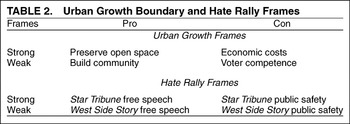
Based on this stage of the pretest, we chose the four frames described in Table 2 (under the heading Urban Growth Frames) for use in the main experiment. One “Pro” proposal frame was the “open space” frame, which emphasized that development was rapidly consuming open space and wilderness, and that it was necessary to conserve the natural landscape that remained. A second Pro frame emphasized building “stronger communities” by concentrating development in more compact neighborhoods that foster social interaction and active community participation. The pretest results show that these two frames do not significantly differ in terms of perceived direction of support (t45 = .66; p < .55); however, the open space frame is perceived as significantly stronger than the expanding community frame (t44 = 1.75; p < .09). Thus, if we find that these frames have varying effects, we can be confident the difference comes not from the direction of support, but rather from the strength of the arguments.

We also identified two frames on the opposing or “Con” side of the proposal: an “economic costs” frame that used the law of supply and demand and economic studies to argue that growth boundaries would inflate the cost of housing and place first homes beyond the reach of young families; and a “voter competence” frame that criticized the policy on the grounds that it required participation of citizens in arcane issues of regulation beyond their interest and competence. Participants rated the voter competence frame as being significantly weaker than the economic costs frame (t44 = 3.60; p < .01). As with the Pro frames, we find no significant difference in the perceived direction of the two Con frames (t44 = 1.08; p < .30), thereby again allowing us to conclude that any differences stem from strength and not direction. Of course, in terms of direction, both of the Con frames differed significantly from the two Pro frames. Detailed examples of the frames are available from the authors.10
The directions of the pro and con frames are perceived to be significantly different. For example, the community building frame is perceived to be significantly more supportive of the policy than the voter competence frame: t44 = 5.27 (p < .01). The opposing strong frames (open space vs. economic costs) are not significantly different in terms of strength: t44 = 1.21 (p < .25), nor are the opposing weak frames significantly different in terms of strength: t44 = .56 (p < .60).
The first pretest shows that respondents judge the voter competence and community building frames to be weak frames. Our second pretest probed whether this perceived weakness reflected unavailable considerations—which would be the case, for example, if individuals did not see a connection between community building and the proposal—or, alternatively, if respondents found the considerations to be available but inapplicable. Following typical approaches for assessing availability (e.g., Higgins, King, and Mavin 1982; Lau 1989), we asked a representative sample of 143 participants (who did not participate in the first pretest or the main experiment) to list the ideas that come to mind when they think about the urban growth proposal (of which they received a description). Seventy-three percent of respondents listed economic costs, 65% listed open space, but only 18% and 22% identified citizen participation and community building, respectively. This suggests that the voter competence and community building frames are generally unavailable and thus unlikely to have an effect on individuals' opinions under any conditions (see hypotheses 2a and 3).11
On the availability pretest, participants could list as many ideas as they desired and were instructed to include any idea even if they did not think it was especially important. Their responses were evaluated by two coders who showed near 90% agreement (correcting for chance agreement).
Note that our first pretest was insufficient to distinguish between availability and applicability. We expected and found that the unavailable frames always registered low applicability scores (e.g., “definitely not effective”). Such scores, however, could be explained either by a frame's unavailability or by its inapplicability (despite being available). This second pretest enables us to identify which frames were unavailable and to confirm that the frames identified as applicable (on the first pretest) were in fact available.
Experiment II: The Hate Group Rally
Our rally experiment focused on a proposed rally on a nearby university's campus by a white supremacist organization known as the Aryan Nations. We informed participants that: the group had been dormant in recent years, but was in the process of rebuilding its organization and initiating periodic demonstrations; past rallies had sometimes resulted in violent confrontations with bystanders and opponents of the group; and the leader of the group maintained the proposed rally would be a peaceful demonstration of the group's views.
In the rally experiment, we created two frames—a Pro frame focusing on the group's first amendment right to hold the rally and a Con frame describing the public safety risks of the rally (e.g., Nelson, Clawson, and Oxley 1997, Sullivan and Transue 1999). Pretest participants saw the two frames as equally strong but significantly different in terms of their direction. Another pretest showed that both frames invoke widely available considerations. Seventy percent mentioned public safety, and 71% mentioned free speech as considerations that came to mind after reading the description of the issue.
In contrast to the urban growth experiment, in which we manipulated the strength (or, in essence, the applicability) of frames by varying their substantive content, in the rally experiment, we created strong and weak frames by manipulating the attributed source of the frame. We asked 24-pretest participants to assess the perceived trustworthiness and expertise of eight news sources; from these eight, we chose the Star Tribune (the major metropolitan area newspaper) as the credible, or strong, source and a local high school newspaper, called the West Side Story, as the noncredible, or weak, source. These two sources significantly differed from one another on both trustworthiness and expertise.12
The other pretested sources included the New York Times, the Associated Press, CNN, the Workers World News Service (a socialist newspaper), the university newspaper, and the National Enquirer. None of these sources was seen as significantly more expert or trustworthy than the Star Tribune, and none was viewed as significantly less expert or trustworthy than the West Side Story. We used these two sources because they were judged to be the most realistic in the pretest and because the use of general circulation and student newspapers follows prior work on source credibility and communication (e.g., Petty and Cacioppo 1986).
We display the mix of frames in Table 2 under the heading Hate Rally Frames. The strong-Pro frame was a Star Tribune editorial using the free speech argument, whereas the weak-Pro frame was the same editorial attributed to the less credible West Side Story. Analogously, the strong-Con frame was a Star Tribune editorial invoking public safety concerns, and the weak-Con frame was the same editorial attributed to the West Side Story. We confirmed in a pretest that when we combine sources and arguments to create the overall frame, participants' perceptions of strength and direction were consistent with our classifications.
Given that all of the rally frames, regardless of source, focus on available considerations, we expect that, in contrast to the weak frames in the urban growth experiment, the weak rally frames will have an impact among less motivated participants in one-sided conditions (see hypothesis 2b). In both experiments, we expect strong frames to have an impact in one-sided conditions and all competitive conditions (hypotheses 1 and 3),13
In competitive conditions involving two conflicting strong frames, the frames will push in opposite directions, making their individual effects difficult to discern when their aggregate effect is compared with the control group standard.
Some readers may question whether manipulating a heuristic such as source credibility is sufficient to vary strength for more motivated and able individuals who typically focus on message quality rather than cues. However, because message content does not vary, even these individuals should attend to source cues. Eagly and Chaiken (1993: 328–29) explain that “heuristic and systematic processing can co-occur…systematic processing will often attenuate the judgmental impact of heuristic processing…systematic processing need not invariably quash the judgmental impact of heuristic processing [and thus] even in settings that foster systematic processing, heuristic processing can exert a significant—and independent—influence.” Thus, in the absence of other sources of variation, we expect motivated individuals to attend to source cues in both one-sided and competitive situations.
Experimental Conditions
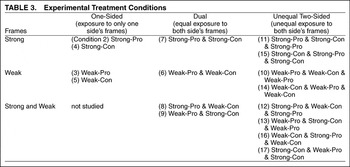
We tested our hypotheses by creating virtually the full set of conditions identified in Table 1, including those that have never been studied. Specifically, we created 17 conditions in each experiment that varied the combined number (0, 1, 2, or 3 frames), strength (weak or strong), and direction (pro or con) of the frames received. In the control condition (1), participants received none of the frames; they simply were given a neutral description of the issue and asked to complete the questionnaire, described later. The other 16 conditions are described in Table 3, which follows the format of Table 1.

These conditions can be grouped into three general categories. First, in the one-sided conditions (2–5), participants received exactly one of the four frames.15
We ignore one-sided exposure to a combination of strong and weak frames.
With this design, we not only replicate prior work on strong frames (conditions 2 and 4; e.g., Nelson, Clawson, and Oxley 1997), weak frames (conditions 3 and 5; e.g., Druckman 2001b) and dual strong frames (condition 7; e.g., Sniderman and Theriault 2004), but we also, for the first time, examine unequal two-sided scenarios (conditions 10–17) and dual scenarios involving exclusively weak frames and frames of unequal strength (conditions 6, 8–9). In addition, we can test the strength hypothesis against the frequency hypothesis because there is variation on both dimensions across conditions.
In each experiment, we provided participants with a brief description of the issue, informed them it would be debated over the next few months, and mentioned that local newspapers already have published various editorials on their Web sites about the issue. We randomly assigned participants to one of the 17 conditions. Those in the treatment conditions read one or more opinion editorials from a given newspaper's Web site (i.e., the Star Tribune or West Side Story in the rally experiment and an unnamed “major local paper” in the urban sprawl experiment).
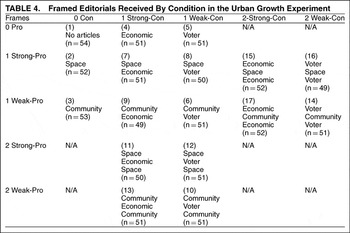
Each editorial framed its position around one of the strong or weak arguments on either side of the issue. We created multiple versions of the framed editorials so that, in conditions where participants received more than one exposure to a particular frame (e.g., a strong-Pro frame twice, as in conditions 11 and 12), they read two distinct editorials. (We pretested the nonframed parts of the different editorials to ensure they did not differ significantly from one another in information or perspective.) In Table 4, we report the specific articles used in the urban growth experiment, in the order received, for each condition (i.e., this table merges the information from the top half of Tables 2 and from Table 3), as well as the Ns for each condition. An analogous table for the rally experiment is available from the authors (note that the average N per condition in the rally experiment was 75 participants).

Measures
All participants completed a short background questionnaire prior to reading the editorials in their assigned condition. After reading the editorials, they completed another questionnaire measuring their opinions. The first questionnaire included standard demographic questions and a battery of factual political knowledge items. The questionnaire also included a value question that measured the priority each participant assigned to competing values on the issue under consideration. In the urban growth experiment, respondents were asked: “In general, what do you think is more important: protecting the environment, even at the risk of curbing economic growth, or maintaining a prosperous economy, even if the environment suffers to some extent?” Respondents rated themselves on a 7-point scale, with higher scores indicating an orientation toward maintaining a prosperous economy. An analogous question asked respondents in the rally experiment to weigh the relative importance of free speech versus social order. We will include these value items in our analyses because general values are a prominent competing influence on opinions and also presumably correlate (to some extent) with prior issue-specific opinions. We also use the value measures in an analysis of the impact of dual framing on the likelihood of value-consistent choices.
The second questionnaire contained various items, including our key dependent variables measuring overall opinions on the issues. We asked participants in the urban growth experiment to indicate their answers to the question “Do you oppose or support the overall proposal to manage urban growth in the city?” on a 7-point scale, with higher scores indicating increased support. In the rally experiment, we asked: “Do you think that the University should allow or not allow the Aryan Nations to hold a rally on campus?” This also was measured on a 7-point scale, with higher scores reflecting greater tolerance for allowing the rally. We also followed Nelson and colleagues (e.g., Nelson, Clawson, and Oxley 1997, Nelson and Oxley 1999) by including measures of the perceived importance of various beliefs. For example, for urban growth, participants rated the importance (on 7-point scales) of “protecting open space and the ecosystem” and “controlling the cost of housing and ensuring affordable housing for all,” among other goals. Analogous items were used in the rally experiment.
FINDINGS
We focus our analysis on how framing affects overall attitudes toward the growth and rally issues at the center of our two experiments. We also note some results that address whether frames influence respondents' assessments of the relative importance of various beliefs underlying their attitudes. Our analysis uses ordered probit models to estimate the marginal influence of receiving either one or two frames that are differentiated by direction (pro or con) and strength (strong or weak). To do this, we treated the “neutral” control group as a baseline or point of comparison.16
Our use of the control group as the standard of comparison differs from other studies that measure the size of a framing effect by comparing the impact of a Pro-frame with the impact of a Con-frame (e.g., Nelson, Clawson, and Oxley 1997). When applied to a study of competing frames, this standard is problematic because the comparison benchmark for a mix of frames is unclear. The control group standard generally requires larger framing effects to achieve statistical significance than the conventional between-frame comparisons in which opinions are usually being influenced in opposite directions (see Druckman 2001a for discussion).
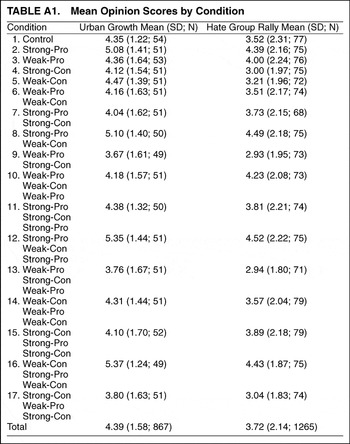
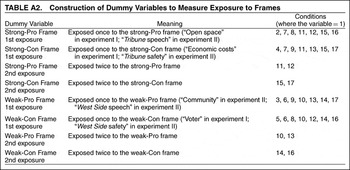
This model allows us to measure the independent impact (relative to the control group) of receiving one or two exposures to each type of frame, holding constant exposure to all other combinations of frames. The approach enables us to examine the impact of strength (i.e., the “strong” coefficients) versus repetition (i.e., the second exposure coefficients). As mentioned, we also include, in the regressions, the priority placed on economic growth and free speech respectively in the two experiments. (Although the model represents each experimental condition with a unique set of dummy variables, for ease of interpretation, we also report, in the Appendix, the mean opinion scores by condition for each issue in Table A1 and the details on the construction of the dummy variables in Table A2)


Results from the Urban Growth Experiment
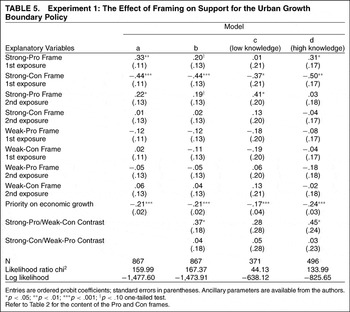
Strength of Frames. The first model (5a) reported in Table 5 shows that preferences on the urban growth policy are a function of prior values and current messages. Individuals who value environmental protection over economic growth favor placing limits on development, but those who give priority to the economy are more likely to oppose the policy. However, despite the stabilizing influence of value priorities across all of the models tested, exposure to the news editorials produced framing effects under certain experimental conditions.

Framing effects depended more on the strength of the frame than on its frequency. First exposure to an editorial built around either of the two strong frames, as well as second exposure to the strong-Pro (open space) frame, significantly influences opinion in the direction advocated by the given frame. Consistent with hypotheses 1 and 3, this occurs regardless of exposure to other frames (i.e., it generally holds in one-sided and competitive contexts). In contrast, single or double exposure to either side's weak frame (i.e., the community and voter competence frames) does not significantly move opinion (the coefficients on these frames are insignificant). As hypothesis 2a predicts, frames that draw on unavailable beliefs (as these frames do according to our pretest) do not affect opinions.
To quantify the impact of the frames, consider an “average” respondent who places at the mean on the economic values variable. If this individual receives no frame, the probability he or she supports the proposal is .57.17
We compute these (and subsequent) probabilities using Clarify (Tomz, Wittenberg, and King 1999). We do not report standard deviations because Clarify provides probabilities for each dependent variable value (1 through 7), and we sum the probabilities for 5, 6, and 7. The results are consistent using different breakdowns.
Strong frames also have a significant impact on the subjective importance of the values emphasized by those frames (data not reported). The open space frame elevates the perceived importance of open space in forming an opinion on the growth issue (p < .05 for a one-tailed test), whereas the economic costs frame increases the salience of housing costs (p < .05). These two frames, respectively, increased the probabilities of viewing the given belief as important by 8% and 7%. However, weak frames emphasizing community building and voter competence do not increase the salience of the values they promote. These results are consistent with previous research (Nelson, Clawson, and Oxley 1997, Nelson and Oxley 1999) showing that strong frames influence the salience of the considerations they highlight.
Frequency of Exposure.
A second exposure to the strong-Pro frame significantly increases support beyond the initial exposure (p < .05$). Aside from this one case, however, repetition of frames does not affect attitudes toward the growth boundary policy (no other second exposure coefficients are significant). In particular, repetition does not transform the weak, unavailable frames into available, strong frames. We also find (in data not reported) that a second exposure to the economic costs frame further boosts the perceived importance of affordable housing in the overall decision (p < .05). This is, however, the only case in which repetition affects the perceived importance of economic costs or open space. Thus, repetition plays a minor role in determining a frame's effect and seems to matter only when the frame is strong.
Contrast Effects.
Weak frames have no apparent effect on opinions, regardless of number of exposures. However, hypothesis 4 predicts that when a weak frame built on a flimsy argument is matched against a substantively strong frame, it can backfire by causing individuals to move away from the position advocated by the weak frame. We test for contrast effects using two appropriate dummy variables: Strong-Pro/Weak-Con Contrast identifies participants who received a strong-Pro frame (open space) combined with a weak-Con frame (voter competence), whereas Strong-Con/Weak-Pro Contrast identifies those who received a strong-Con frame (economic costs) and a weak-Pro frame (building communities). A significant coefficient for either of these variables would indicate the disparity in the strength of the two frames backfires against the weak frame.
The results of this test, reported in model 5b, show that respondents who received the open space and voter competence combination of frames were significantly more likely to support the growth control policy, beyond the separate influence of each frame.18
The means reported in the Appendix suggest that the contrast effect is magnified by repetition of the strong frame (conditions 12 and 16).
No contrast effect is evident when a weak-Pro frame (building communities) is combined with a strong-Con frame (economic costs).19
However, the means reported in the Appendix suggest some movement toward a contrast effect, as can be seen by comparing condition 4 with conditions 9, 13, and 17.
Specification by Knowledge.
To test our hypotheses regarding knowledge (hypothesis 6) and motivation (hypotheses 2b and 4), we reexamined the effects of strength and repetition conditional on the respondents' general political knowledge. The knowledge items, therefore, are used to gauge both the respondents' general knowledge and their motivation. Prior work suggests that general political knowledge is a reliable measure of general motivation (e.g., Delli-Carpini and Keeter 1996: 271; 184–85, 216–17). Based on an eight-item battery of political fact questions (α = .68), we divided the sample at the median into low and high groups and reestimated model 5b for each group.
The results, reported in models 5c and 5d, show, as hypothesis 6 predicts, less knowledgeable individuals require greater exposure to the open space (strong-Pro) frame before their opinion shifts—a single exposure had no significant impact, but a second exposure increased support (p < .05). In contrast, repetition has no effect on the more knowledgeable group. This shows that multiple exposures can compensate for knowledge in determining susceptibility to a frame. Knowledgeable individuals may be quicker to recognize the significance of a frame, but less knowledgeable individuals may be equally responsive on second exposure (a possibility overlooked in past research that offered only one exposure to a frame; e.g., Druckman and Nelson 2003, Nelson, Oxley, and Clawson 1997).
Repetition of the other frames, including the strong economic costs frame, had no effect. This implies that the degree of specification by knowledge will depend on the strength of a given argument. Whereas the open space frame took longer to penetrate those who were less knowledgeable, the strong-Con frame emphasizing economic costs registered immediately on both high- and low-knowledge groups, although it had a larger impact among the more knowledgeable (the interaction between knowledge and the economic costs frame is significant at the .01 level). Just as more knowledgeable respondents did not require repetition of any frames—presumably because open space and economic costs were chronically accessible to them—less knowledgeable participants may not have needed repetition of the economic costs frame perhaps because economic considerations (and negative arguments generally) are more readily accessible to everyone. The most proximate determinant of the effect of repetition is, therefore, the chronic accessibility of considerations emphasized by the frame. General knowledge is positively correlated with accessibility of considerations, albeit imperfectly.
The results also show that, as predicted by hypothesis 4, a contrast effect was evident only among knowledgeable (i.e., motivated) individuals who received the open space and voter competence combination of frames (an interaction between knowledge and the contrast variable is significant at the .05 level). Less knowledgeable individuals show no sign of synthesizing arguments across frames but instead appear to treat each frame discretely. More knowledgeable individuals, however, also do not exhibit a contrast effect when responding to the economic costs and building communities combination of frames.
Contrast effects, therefore, are not inevitable but depend on possibly fortuitous combinations of elements in a mix of frames. The effect arises when evaluations of one frame are influenced by the presence of an opposing frame. This may occur, for example, only when the specific contents of the competing frames lend themselves to being played off each other as opposed to being evaluated separately. Hypothesis 4 therefore postulates only necessary but not sufficient conditions for a contrast effect. Because frames can have unintended consequences when combined with other frames, future research should explore potential interactions within sets of frames (rather than study frames in isolation).
Results from the Rally Experiment
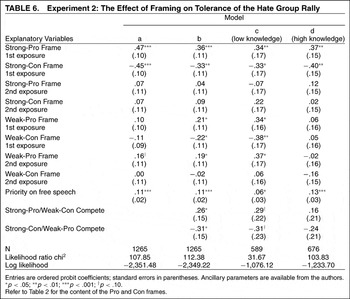
We report the results from the rally experiment in Table 6, which contains four models that parallel those used in the urban growth analysis. In all four models, as in the urban growth experiment, prior values are a strong predictor of attitudes toward the issue. Individuals who placed a higher priority on freedom were significantly more likely to support granting a permit to the Aryan Nations than individuals who placed greater importance on maintaining social order. Values retain their stabilizing influence across the four models, but certain frames are successful in moving opinions on this issue.

Strength Versus Frequency.
Turning first to model 6a, we find that strength once again dominates repetition. An average individual, scoring at the mean of the freedom measure, who receives no frames, has a .41 probability of supporting the right to rally (i.e., to score 5, 6, or 7 on a 7-point scale). First exposure to the strong-Pro frame (Star Tribune free speech) causes the probability to jump to .60, whereas first exposure to the strong-Con frame (Star Tribune public safety) causes it to drop to .26. With one exception, weak frames and repetition of either weak or strong frames do not matter in this initial model. The sole exception is that a second exposure to a weak-Pro frame (West Side Story free speech) has a marginally significant (p < .10) effect. We will not dwell on these results because several refinements of note emerge in a more completely specified model.
Noncompetitive Versus Competitive Environments.
The fuller model tests a slightly different set of predictions in the rally experiment than in the urban growth experiment, owing to variation in how the frames were constructed in the two experiments. Whereas the strengths of the urban growth frames are determined by their substantive content, the strengths of the rally frames are based on their sources. Therefore, contrast effects (hypothesis 4) are not expected when weak and strong frames are combined in the rally experiment. As we discussed earlier, a contrast effect requires competing rationales that vary sharply in their persuasiveness. This condition does not hold in the rally experiment, as both strong and weak frames invoke the same available considerations and are substantively identical.
These characteristics of the rally frames, however, permit us to test hypothesis 2b, which is unique to the rally experiment. Hypothesis 2b states that weak frames that draw on available considerations can have an impact in noncompetitive environments, particularly on less motivated individuals. The rally frames therefore should move opinions even when they are attributed to a high school newspaper, so long as they are uncontested. Such influence, however, should vanish, according to hypothesis 3, when the same frames encounter strong competition, because competition will motivate individuals to judge these frames to be inapplicable based on their weak sources.
Model 6b allows us to test both hypotheses with the addition of two combination variables that measure exposure to a weak frame in conjunction with one or more strong opposing frames. The variable Strong-Pro/Weak-Con Compete captures exposure to the weak-Con frame (West Side Story public safety) and the strong-Pro frame (Star Tribune free speech), and the variable Strong Con/Weak Pro Compete identifies those who received the weak-Pro frame (West Side Story free speech) and the strong-Con frame (Star Tribune public safety).
The estimates obtained for model 6b show that initial exposure to each strong frame continues to have a significant impact, but so do first exposure to both weak frames and second exposure to the weak-Pro frame. However, both Compete coefficients also are significant, in the expected directions, indicating that the impact of weak frames is negated—in fact, overwhelmed—when they are paired with a strong opposition frame. For example, if the average individual receives the weak-Pro frame in isolation, the probability of supporting the rally increases from .41 to .50. But in competition with a strong opposition frame, the strong-Con frame swamps the weak-Pro frame and lowers the probability to .26. Similarly, one-sided exposure to the weak-Con frame drops support to .33, but dual exposure to both the weak-Con and strong-Pro frames produces an outcome akin to one-sided exposure to the strong-Pro frame. Therefore, weak frames that tap available considerations matter only when they are unopposed; in competitive contexts, they have no effect and are dominated by strong frames. Mere competition is thus insufficient to temper framing effects (as Sniderman and Theriault 2004 suggest); we also have to account for the relative strengths of competing frames.20
These results do not suggest a contrast effect because the Compete coefficients negate the significant first exposure effects of the weak-Pro and weak-Con frames. This departs from the urban sprawl results, where the significant Strong-Pro/Weak-Con Contrast coefficient augments the effect of first exposure to the strong-Pro frame (the weak coefficients are not significant). The difference between the two experiments shows that a contrast effect occurs when the content of opposing frames varies sharply in quality.
In the rally experiment, we also expect that the impact of a weak frame will disappear in the presence of competition from an opposing weak frame (conditions 6, 10, and 14). The mean score of 3.76 (2.10; 227) for these conditions does not differ significantly from the control group score of 3.52 (t302 = .87; p < .40 for a two-tailed test). We do not include an additional competition variable for these conditions in the regression because we expect (and find) it to be nonsignificant, relative to the excluded control group. Conversely, the competition conditions we did include in the model are significantly different from the control group because these conditions contained an opposing strong frame. (As mentioned, the results also suggest a continued impact of multiple exposures to the weak-Pro frame—this can also be seen by comparing the control group with condition 10 as opposed to conditions 6 and 14.)
In sum, model 6b confirms our theoretical expectation that competition among alternatives stimulates conscious deliberation over one's choice. One-sided exposure to weak frames can shift opinions by increasing the temporary accessibility of available beliefs, but competition will increase attention to the applicability or relevance of alternative arguments. As a result, individuals are more apt to see through weak frames in competitive contexts.
Specification by Knowledge.
Our theory leads us to expect a further specification by motivation level. Highly motivated individuals are more likely to evaluate the applicability of a frame in all contexts. On the other hand, less motivated individuals generally will respond to accessible frames and will consider their applicability only in competitive contexts. We therefore tested the effects of motivation and competition on information processing by once again using general knowledge as a proxy for motivation and separating low- and high-knowledge respondents in models 6c and 6d.
Two significant results emerge that support our expectations. First, weak but accessible frames have an impact in one-sided conditions only among those who are less knowledgeable; they do not persuade more knowledgeable respondents. Second, weak frames influence less knowledgeable respondents only in noncompetitive contexts; in competition with strong frames, weak frames lose their effect, even on those who are less knowledgeable. Therefore, weak frames can be influential in noncompetitive environments among less knowledgeable audiences, but competition tends to reward strong frames and winnow weak frames by drawing attention to the applicability of frames.
Models 6c and 6d also show that repetition of the weak-Pro frame matters among less knowledgeable respondents. This result is somewhat surprising (although see hypothesis 6), as we assumed that both free speech and public safety considerations would be chronically accessible to all individuals, thus making repetition unnecessary.
Dual Framing and Value Consistency
In their paper testing the effect of dual messages on preferences, Sniderman and Theriault (2004) argue that when citizens are exposed to dual or opposing frames, they choose the alternative that is consistent with their values or principles. People are “capable of picking the side of the issue that matches their political principles when they are exposed to a full debate” (Sniderman and Theriault 2004: 149).
The results from both of our experiments show that dual frames by themselves do not necessarily equalize competition between opposing sides. When opposing frames vary markedly in strength, the stronger frame dominates the weaker frame, even after controlling for the prior values of our subjects. Therefore, weak frames are unable to hold partisans to their “home” positions.
In this section, we examine whether competition between opposing strong frames is more successful in anchoring respondents to their value positions. We compared how people with different value priorities on the urban growth issue responded to one-sided and two-sided messages. (We did not conduct a parallel analysis with the rally issue because of insufficient sample sizes in the relevant conditions; see note 20 for elaboration on how we combine conditions.) Specifically, we compared the preferences of “Economists,” who favor economic goals over the environment, with “Environmentalists,” who give priority to the environment over the economy. We also include for analysis a third “Neutral” group of individuals who were indifferent between the two value priorities on the issue.
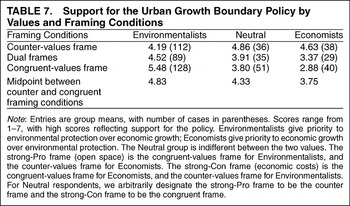
Table 7 reports the mean opinion scores on the urban growth issue for individuals in these three groups when they receive: (1) a one-sided strong frame (either a “congruent-values” or “counter-values” frame); or (2) a two-sided message in which each side's strong frame is represented.21
To have a sufficient number of cases to make the analysis, (1) we combined and treated as equivalent the conditions 2, 8, 12, and 16, in which individuals received strong-Pro only, strong-Pro/weak-Con (because weak-Con does not have a significant effect), one strong-Pro/two weak-Con, and two strong-Pro/one weak-Con; (2) similarly, we combined conditions 4, 9, 13, and 17, in which individuals received strong-Con only, strong-Con/weak-Pro, one strong-Con/two weak-Pro, and two strong-Con/one weak-Pro frames. (We could not do this with the rally issue because the weak frames have a significant impact on that issue.) The conditions contained in (1) and (2) constitute the one-sided congruent and counter frame conditions (defined from the value perspective of the respondent).
The dual frame conditions 7, 11, and 15 consist of the strong-Pro/strong-Con condition, as well as the asymmetrical conditions in which there were two strong-Pro frames (or two strong-Con) and one strong-Con frame (or one strong-Pro). These conditions are similar to the balanced dual-frame condition because loudness does not make a large difference.
The key question is whether individuals exposed to the two-sided frames take a middle position between the positions they take in the congruent and counter conditions, or if they express the same value-consistent preference in the dual condition as in the one-sided, value-congruent condition. A middle position would reflect a compromise between opposing fremes, whereas a value-consistent position across conditions would indicate that exposure to dual frames negates or cancels the effect of the counter-values frame.

The evidence indicates that individuals do not reject strong contrary frames in favor of strong congruent frames in the dual condition; instead, they are pulled away from their value-congruent position in varying degrees toward a middle position. Thus, dual frames tend to moderate opinion, as individuals respond to the comparative strengths of the competing frames and do not simply choose the frame that is consistent with their values. If values dominated preferences on the urban growth boundaries issue, Environmentalists would embrace the policy once they were exposed to the open space frame (in either the one-sided congruent or two-sided conditions); and Economists likewise would oppose the policy once they were made aware of its implications for housing costs. But our experiment shows that both Environmentalists and Economists are drawn to varying degrees by the strength of the other side's frames. Therefore, the persuasiveness of the frame, as determined by its substantive content and source, influences the extent to which the frame will shift opinions.22
We do not expect individuals always to moderate their opinions in response to strong competing frames (or, for that matter, to be influenced always by strong frames in one-sided conditions). Some issues have such settled interpretations or well-defined opposing rationales that informed and motivated individuals will know the relevant arguments for their position and resist contrary frames (see Chong 1996).
In the urban growth experiment, each group's mean score for the dual frame condition lies on the pro-growth side of the midpoint between their mean scores for the counter frame and congruent frame conditions (low scores indicate opposition to the policy). Economists who receive the dual frame remain relatively close to their congruent frame position. Environmentalists who receive the dual frame actually end up on the wrong side of the midpoint, closer to the counter frame mean than the congruent frame mean. Similarly, the Neutral group ends up decidedly on the side opposed to growth boundaries when exposed to both side's frames. On the assumption that the stronger frame will pull mean opinion closer toward it in the dual condition, these results suggest, consistent with our earlier statistical tests, that the strong-Con frame is more effective than the strong-Pro frame.23
These results are not particular to the urban growth issue. A close examination of Sniderman and Theriault's (2004) results shows that, even on the more partisan hate group and welfare spending issues they study, the general public responds differently to dual frames than they do to value-congruent frames. Their data show that dual frames pulled respondents toward a moderate position between congruent and counter frames, consistent with our hypothesis 5. Knowledgeable respondents showed greater resistance than less knowledgeable respondents, but were nonetheless influenced by counter frames.
We suspect the strong-Con argument is more effective because its reference to affordable housing adds a liberal appeal to the economic discussion of housing costs (also see Cobb and Kuklinski 1997). The mean position in the dual conditions for Neutral individuals and Environmentalists is close to their mean scores when they receive only the strong-Con frame. This interpretation once again points to the critical dimension of the relative strengths of frames in determining whether dual-message conditions are indeed “balanced.”
SUMMARY OF RESULTS
The following inventory takes stock of the hypotheses tested in our two experiments on framing urban growth and a hate group rally:
- Overall, the relative strength of the frame was the most important dimension of influence.
- Strong frames moved opinions significantly in one-sided conditions in both experiments (hypothesis 1).
- Strong frames dominated weak frames in competitive conditions in both experiments (hypothesis 3).
- Weak frames were found to have one of the following impacts.
- If the frame emphasized unavailable considerations, as in the urban growth experiment, it had no impact in the intended direction (hypothesis 2a).
- Weak available frames in the rally experiment affected the opinions of less knowledgeable respondents in noncompetitive contexts (hypotheses 2b).
- Weak available frames in the rally experiment did not move the opinions of knowledgeable respondents in the directions advocated by the frames (hypothesis 2b).
- Competition between frames prompted more deliberate evaluation of frames by all respondents, in the following ways.
- Weak frames in the rally experiment lost their effect on less knowledgeable individuals when opposed by a strong frame (hypothesis 3).
- A weak frame (voter competence) opposed by a significantly stronger frame (open space) produced a contrast effect among more knowledgeable respondents in the urban growth experiment (hypothesis 4). Knowledgeable respondents moved away from the position advocated by the voter competence frame.
- Competition between strong opposing frames in the urban growth experiment caused individuals on either side of the issue to be pulled away from their value priorities toward an intermediate position proportional to the relative strengths of the frames (hypothesis 5).
- Repetition of frames had a limited effect on the opinions of less knowledgeable individuals (hypothesis 6). In the urban growth experiment, less knowledgeable respondents required double exposure to the strong-Pro frame before registering a framing effect. Similarly, in the rally experiment, only less knowledgeable respondents were affected (occasionally) by repetition of weak, available frames. But in no case did repetition of a weak frame allow it to prevail over a strong opposition frame.
This set of results is in accord with the predictions derived from our theoretical model. The effectiveness of a frame depends on its availability and applicability (i.e., strength), the competitive context, and the psychological characteristics of the recipient. Strong frames have a significant effect in both competitive and noncompetitive contexts. Using a weak frame may be effective on less knowledgeable individuals if it focuses on available beliefs and is uncontested by opposing frames. But it will have no impact if it draws on unavailable beliefs or if the audience is motivated and able, and a potentially negative impact if it is perceived to be an extremely weak argument. Competition between frames motivates conscious processing of information and integration of opposing viewpoints.
The participants in our experiments were open to argumentation on both sides of the issue and did not merely revert to standing positions. They assessed the relative merits of competing frames, counter-argued against weak frames, and searched for additional information to distinguish between opposing frames. Effectiveness does not seem to depend much on repetition per se, except when repetition allows a frame to penetrate less informed audiences.
CONCLUDING OBSERVATIONS
Our two experiments identified several psychological and contextual constraints on the influence of framing. Two important psychological factors that affect the magnitude of framing effects are people's value priorities and their motivation to think about politics. Individuals who are highly motivated expend more cognitive effort to determine whether a frame is applicable to an issue. They are therefore more likely to discriminate between available frames and dismiss weak arguments.
People's value priorities were a significant predictor of their policy preferences across framing conditions. Our experiments showed that framing can cause people's opinions to deviate from their values, but contrary to previous theoretical claims, not any frame will move opinions simply by repeating its message. Both experiments showed consistently that framing effects depended more on individual evaluations of the quality of frames than on the frequency with which they were received. Given a properly developed frame, it was possible to move public opinion on the issues we examined in both competitive and noncompetitive contexts. Therefore, any study that attempts to determine whether some issues are more susceptible to framing than others must consider that a difference found across issues may be explained by the relative strengths of the frames tested as opposed to the features of the issues.
The competitive context affects how much information people receive as well as how they process that information. In noncompetitive political environments, individuals, especially those who are unmotivated, are prone to use whatever considerations are made accessible by the messages they receive. In contrast, competing frames tend to stimulate individuals to deliberate on the merits of alternative interpretations. Motivation and competition therefore offer complementary protections against arbitrary framing effects. Both factors increase the chance that people will evaluate the applicability of frames and respond favorably only to strong frames. Individuals who are swayed by weak frames in noncompetitive environments are more likely to reject them in competitive contexts. Weak frames might also backfire when individuals deliberate over frames that differ markedly in strength. Competition therefore increases the probability that the arguments contained in weak frames will fail to move opinions.
By the same token, competition is also likely to stimulate expressions of opinions that are closer to an individual's true preferences. By true preferences, we mean simply the aggregate or summary evaluation of the set of considerations that an individual deems applicable to an issue. True preferences often reflect multiple values and conflicting considerations about the issue. Indeed, such ambivalence makes an individual especially susceptible to one-sided frames that emphasize a particular consideration. Competition, on the other hand, increases the accessibility of a broader sample of underlying considerations. Although this does not preclude framing effects, exposure to a debate involving multiple frames reduces the likelihood that individuals will base their opinions about an issue on a skewed subset of beliefs. In our experimental test of dual frames, individuals gave weight to applicable considerations on both sides of the issue in forming their policy preferences; consequently, they adopted a more moderate position than they took in response to one-sided communications.
These results show that the quality of the electorate's judgments depend on the nature of political competition and, more generally, on political institutions, such as the party system and the media that shape political debate (e.g., Sniderman and Bullock 2004; Sniderman and Levendusky 2007). Studies of information processing should take account of this institutional environment and examine the influence of different combinations of frames rather than focus solely on the effects of isolated single frames.
If personal motivation and competition place a premium on strong frames, a critical but underdeveloped topic is the determinants of the strength of arguments. The source of a strong frame is a problem that has puzzled political scientists and psychologists alike who study mass communication (O'Keefe 2002). Ideally, democratic competition and civic engagement would reward frames that were grounded in logic and empirical evidence. If the validity of a frame determined its credibility, we could be confident that debate would winnow specious claims and concentrate the public's attention on the crucial elements of an issue. It would be less reassuring, however, if enterprising politicians could fashion strong frames around any position they wished to promote, or if by some trick of marketing they could transform every consideration into a strong frame.
Our own position is that open debate surely improves the odds that germane considerations will be publicized and discussed. Nonetheless, we are equally certain that the strong frames that emerge from debate will reflect a political process in which the persuasiveness of a claim depends on more than its validity or relation to evidence. The elements of an argument that make it plausible or compelling seem to reside as much in its source and the cultural values and symbols it invokes as in its causal logic.
In the rally experiment, the same substantive argument could be made more or less compelling depending on the trustworthiness of the newspaper to which it was attributed. In the urban growth experiment, we developed frames for four empirical claims about the consequences of growth boundaries. Linking boundaries to the preservation of the environment (on the pro side) and to higher housing costs (on the con side) both seemed persuasive to our subjects. But neither the proponent's idea that compact communities would lead to stronger social bonds, nor the opponent's claim that voters were too incompetent to make land use decisions proved to be effective frames. Perhaps the stronger frames made more intuitive sense to our subjects or they appealed to goals such as homeownership and open space that held special meaning to them.
People's attitudes and values toward conservation and development, or toward freedom and social order, also may have played a role in determining the strength of various frames. In gathering and assessing evidence, citizens employ shortcuts and heuristics to reduce their costs of decision making. This means they seek out biased sources of information and are more likely to be convinced by information that reinforces existing attitudes. Selective exposure and motivated reasoning reduce opportunities for citizens to hear opposing views and affect their evaluations of the applicability of frames (Lodge and Taber 2000). These psychological biases dilute the benefits of democratic debate by reducing attention to information that is potentially valuable.
From a political perspective, it may be beside the point whether the claims that prove effective in the urban growth debate can be substantiated either by economic studies or by models of urban planning, so long as they move people in the intended direction. Public opinion may simply favor the side with greater resources at its disposal both to develop persuasive frames and to disseminate those messages to the widest audience. If this is the case (as it surely is to some degree) the sanguine observation that democratic competition increases deliberation over frames needs to be tempered with the implication that the strongest frames to emerge from this process will not necessarily be the most sound or meritorious arguments according to empirical, analytical, or normative standards. Although this may be less than we could hope for, the promise of democracy is to provide citizens with the freedom to choose, not to guarantee particular outcomes. Democratic competition broadens discussion and stimulates more careful evaluation of competing claims, but the framing of choices will continue to influence what people decide.
We thank Casey Buboltz, Jennifer Denk, Marie Hentges, Samantha Holland, Jason Kustka, Kjersten Nelson, Bas van Doorn, and especially Chris Chapp for research assistance. We also thank the many individuals (who are too numerous to list here) who provided helpful comments on previous drafts presented at colloquia and conferences in the United States and abroad. Support for this research was provided by the University of Minnesota, Northwestern University, the AT&T Research Scholar Fund, and the Searle Fund.



Comments
No Comments have been published for this article.