The meat industry in Slovenia
In economic terms, the meat industry represents an important agro-food processing business in Slovenia. Meat production contributes more than 30% of gross agricultural output, half of which comes from the beef sub-sector. The other two important sub-sectors are pig meat (8% of gross agricultural output or 28% of total meat output) and poultry meat production (6% of gross agricultural output or 20% of total meat output). The meat processing industry provides one quarter of revenues and employment, and contributes 20% of total added value of the whole food processing industry.
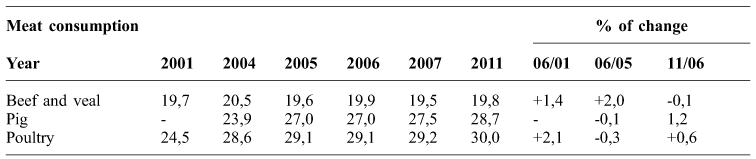
Total per capita meat consumption in recent years is around 99 kg per capita (in the year 2007), which is over the EU-27 average (85 kg per capita in year 2007), and well above the average of the New Member States – EU-2 (63 kg per capita in year 2007). Poultry meat has traditionally been the main type of meat, increasing its share since 2001. Pig meat – with consumption between 27 kg and 28 kg per capita – used to be in second place. An overview of meat consumption in Slovenia (kg/capita) can be seen in Table 1.
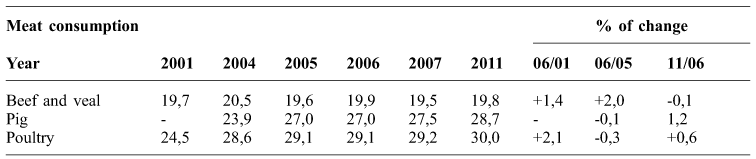
The causes for the change in meat consumption have been a much-debated issue in the agricultural economics literature. Economic models were used to econometrically test structural change (Chalfant and Alston, 1988). A structural change is defined as a change in preferences, regarding consumption changes caused by price and income effects. Whether a structural change is supported by the empirical data or not is still an open question (Heien et al., Reference HEIEN, CHEN, CHIEN and GARRIDO1996).
The poultry meat market in Slovenia
The poultry farming and processing sector is the most modern and dynamic sector in Slovenia. Slovenia is basically self sufficient regarding poultry meat, enjoying a period of stable production since it joined EU. The poultry sector is characterised by a high level of concentration, specialisation, vertical integration and efficiency. The three leading poultry processors are intensively upstream integrated businesses, either through cooperatives or by direct contracting with large producers. Producers provide labour and appropriate rearing facilities, whereas the contractor supplies chicks, feed and veterinary services. Accordingly, poultry meat is mainly sourced from highly specialised industrial operations.
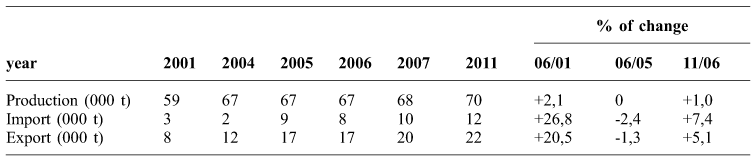
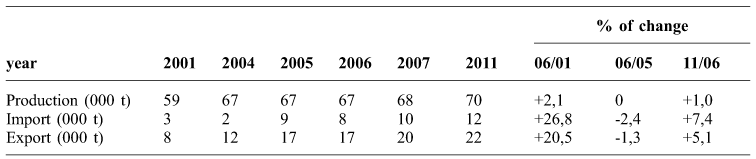
Production has been stable since the European Union accession, with an annual production of 67.000 t (Table 2). Poultry is one of few agricultural products where Slovenia is a net exporter, although the volume of net exports is small, ranging between 8.000-10.000 t in the past few years. The main export markets are Croatia and Bosnia, as well as to Italy. When Slovenia joined EU the small volume of imports increased in parallel with exports, with imports originating mainly from Italy. Production and sales growth (export, import) has been facilitated by changes in the consumers’ values regarding meat quality. An average consumer will rank their own health issues first, which resulted in growing sales of health-friendly products. Furthermore, they are also concerned with improvements in fresh meat products and more transparent ingredients and product features labelling.
The volume share of Slovenian poultry meat production in relation to the poultry meat production in the EU-27 is presented in Table 3.
Poultry meat production in EU-27.

In the last year (2007) production of poultry meat in EU-27 was 11,202,000 tonnes (Table 3). In comparison with the poultry meat production in EU-27, Slovenia has a relatively small share (0.6%) of EU-27 poultry meat production. Economic projections for poultry meat production are predicting a growing trend in the next few years for both EU-27 as well as for Slovenia as a new EU member. It can be expected that the growing trend of Slovenian poultry meat production will also increase its share in the EU-27 poultry meat production.
Options, challenges and potentials of poultry meat consumption
Since the beginning of the 1980s, certain trends in food consumption have became evident in Slovenia, including increased vegetables, fruit, cheese, meat and fish consumption on the one hand, and decreased sugar consumption on the other. Reasons for these trends are increased health concerns and preferences for personal diet as well as a lower demand for calorie intake. Furthermore, changes in the sociodemographics of the Slovene population have led to an increased demand for convenience food, ready-to-use products and smaller packaging units.
Compared to previous years, which were characterised by outbreaks of avian influenza, in 2007 the Slovenian poultry meat and poultry products market recovered. Forecasts show a positive and growing trend of consumption in Slovenia, which is expected to continue into the future. In Slovenia there is already a high level of per capita consumption, which has been stabilized at around 29 kg/capita. This is 30% above the EU-27 average (about 23 kg per capita). Following some consumption growth in 2005, in 2006 poultry consumption stagnated due to the Avian Influenza cases at the beginning of the same year. Comparison between structure of poultry meat consumption in Slovenia and the EU average can be seen in Table 4.
Comparison between poultry meat consumption in Slovenia and in EU-27.

(f)= forecast
Poultry meat is an important segment of consumption of all meat types. Changes in nutritional habits require growth of availability of certain types of meat. Poultry meat products are part of the most widely spread and favourite products, mainly because of the useful characteristics and versatility they can offer to consumers. Poultry meat is popular the world over since it is a regular feature in dishes in all countries.
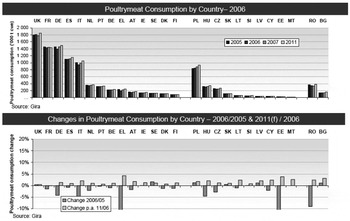
The forecasts, published by Magdalaine et al. (2008) can be used to analyse the current situation, recent trends as well as forecasts of EU-27 Member States for the coming years. Analysis of poultry meat consumption in EU-27 Member States shows that, in most of the states, in the period from 2005-2007 the consumption was ranging, which was the result of avian influenza and lack of confidence in such meat type consumption of. However, in the last year, the trend of poultry meat consumption in the EU-27 Member States has taken a turn for the better. Up until the year 2011, the forecasts show a positive trend of growth of poultry meat consumption in the analyzed states (see Figure 1, Gira Reference GIRA2007).
Poultry meat consumption (‘000 tons) and changes in poultry meat consumption by Country EU-27 – 2005/2006 & 2006/2011(f).
Source: Gira, Reference GIRA2007

Based on the results of the analyses and trends for the poultry meat industry in the European Union, with Slovenia as a new member state, the same positive market situation for the future could also be discerned. The poultry meat industry is changing due to the changes in lifestyle, reshaped nutritional habits and costumer needs. Costumers are more aware of the meaning of a healthy and balanced diet. Health has become an important value, which means more targeted products. Therefore, poultry processors are developing products to meet this need. Consumers have begun to read labels on products more carefully, giving special importance to the origin of products, which leads to a greater importance of packaging, where the content and properties of products are combined. The popularity of bioproducts and functional foods has also increased. Trends for foods associated with marketing phrases such as ‘lite’, ‘safe’, ‘low fat, ‘no preservatives or additives’, ‘added vitamins and minerals’, ‘dietary fibre’ and ‘probiotics’, are increasingly valued.
Research design and data collection – the case study from Slovenia
the Slovenian poultry industry in context
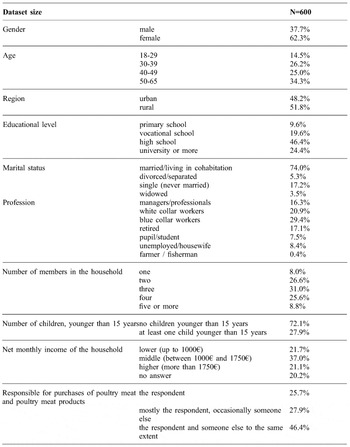
In order to investigate the purchasing habits of consumers, the perception of poultry meat and the importance of meat origin in the purchase making process needs to be evaluated. The 600 person research sample used was representative regarding age, which ranged between 18 and 65 years, gender, region, and the population settlement type in Slovenia. Interviewing individuals was used to determine attitudes, and this was backed up by a structured questionnaire. Table 5 shows socio-demographic properties of the respondents, who participated in the research, carried out in Slovenia.
Structure of the sample.

Questionnaire
The introduction letter, reminder, and draft questionnaire were developed for purpose of the research. Guidelines provided by Dillman (Reference DILLMAN1978) were used in order to structure the questionnaire, and to ensure that respondents could progress quickly through it. All questionnaires carried a stamped number in order to be able to add factual consumers’ data.
The questionnaire was divided into the following research themes:
• Lifestyle,
• Purchase and consumer habits regarding poultry meat,
• Perception and attitude toward poultry meat,
• The importance of poultry meat origin in a purchase-decision-making process,
• Demographic data at the end of the questionnaire.
Attitudes to meat consumption
The data from the questionnaire confirmed that Slovenian poultry consumption is comparatively high, with 96% of the respondents eating poultry meat at least once a week (Table 6).
Percentage of respondents consuming different meat types.

Consumers' attitudes toward poultry meat, determined in the sample
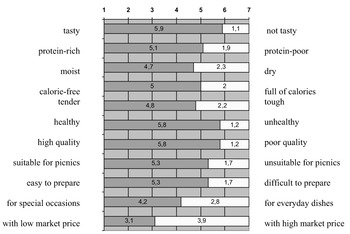
Consumers perceive poultry meat as a tasty, high quality, healthy and protein-rich food source. Since it is easy to prepare and suitable for picnics and social gatherings, it also represents a very popular type of meat (see Figure 2). It was determined that the results of the Slovenian research coincide with the trends that are characteristic of consumers on a global scale, being associated with fast moving consumer goods (FMCG), part of which is processed poultry meat.
Consumer perception of poultry meat.

Country of origin
A very important segment of our research was where the importance of meat origin in the purchase-decision-making process was assessed. In the existing literature, there is a proliferation of studies to document country of origin perspectives. From these studies, market and consumer behaviour researchers generally accept that a product's or brand's country of origin is an important factor, influencing the consumer decision-making process (Khachaturian and Morganosky, Reference KHACHATURIAN and MORGANOSKY1990). Most of the studies suggest that country of origin information, which is indicated by ‘Made in…’ label serves several purposes in the purchasing process. It acts as a salient attribute in product evaluation (Johansson, Reference JOHANSSON1989), stimulates consumer's interest in the product (Hong and Wyer, Reference HONG and WYER1990), affects behavioural intentions through social norms and influences buyer behaviour through affective processes, i.e. patriotic feelings about their own country (Han and Terpstra, Reference HAN and TERPSTRA1988). The overall evaluation of products is influenced by country stereotyping, that is, the image that consumers have about a certain country will influence their perceptions of products from that country (Bilkey and Nes, Reference BILKEY and NES1982).
Poultry meat is a typically distinctive generic product, where branding may have no special importance in the purchasing decision. Brands are built on factors reflecting a consumer's way of thinking: the image of the brand and its trade mark, familiarity of the name, perception of quality, loyalty, positive associations and other benefits (Keller Reference KELLER1993, Aaker Reference AAKER1991). Consumers expect the top brands to be perfect and to fulfil their promises. Superior quality must be adhered to since one little mistake can ruin a brands reputation.
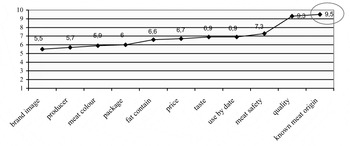
Factors that Slovenian consumers find to be most important were marked on a scale from 1 to 10, where 1 was the least important, and 10 was the most important purchasing factor. The already defined factors of the decision-making purchasing process of poultry meat were marked with the evaluation from 1 to 10. Based on the dataset, the average evaluation of the individual factors were calculated and then sorted out the evaluations from the most to the least important factor for purchasing decisions relating to poultry meat.
Average marks for factors and their importance for Slovenian consumers, they purchase poultry meat.

The survey of the Slovenian market shows that the most important include the origin of meat (the evaluation of significance in the decision-making purchasing process was 9.5), its quality, safety, use by date, taste and price (see Figure 3). A study (Magdelaine et al., Reference MAGDELAINE, SPIESS and VALCESHINI2008) of French consumers revealed that the sell by date was by far the most important information for consumers (70%). The name of the product was also considered a priority and ranked second (43%), along with the presence of an official quality label (Label Rouge). The packaging date and origin both lay in third position (27%). The branding was of no special importance for the purchase, and was in 6th place with only 19%.
The results of the study (Becker et al., Reference BECKER, BENNER and GLITSCH2000) with German consumers showed that country of origin and place of purchase seem to have minor importance, though extrinsic cues in general were still regarded as more useful than intrinsic cues. More than 40% of respondents indicates that a known source of poultry meat was an important element in the purchase decision-making process.
When comparing the study made in Slovenia to its French and German counterpart, it has been determined that the importance of factors, which are considered by consumers on all analyzed markets when purchasing poultry meat, is slightly different; however, the known origin of meat still played an important role when purchasing. The origin of meat was closely connected to the product's name and branding. The role of the origin of meat when making a purchase appears to be becoming increasingly important, which may be related to the outbreak of the avian influenza (H5N1) in the global poultry meat market in the years 2005 and 2006. The latter has caused consumers to mistrust the quality of meat from foreign (or unknown) origins, and has promoted consumers trust in the quality and safety of poultry meat provided by domestic producers.
Conclusions
In times of a highly competitive market, poultry companies are increasingly aware of the importance of familiarity of consumers with their product, their motives for the purchase of certain product and their standpoints on traded goods. Companies pay attention to market and consumer research, which have become important factors in determining the success of a product in the market. In the recent years, developments in the global poultry meat market due to outbreaks of avian influenza (H5N1) do not indicate a change in the average view of market development and poultry meat production. This remains positive due to two facts:
• The competitive price of poultry meat in comparison with other types of meat,
• Strong liking of consumers for poultry meat, mainly because of its numerous advantages over other types of meat, which contributes to its higher usage and thus the consumption of poultry meat.
This review focused on recent trends in Slovenia, in order to show how this country's poultry production and consumption fits into the general trends observed in the European Union. The projections for production, consumption and trade (import, export) of poultry meat, regardless the fluctuations in the previous year which were the result of avian influenza, predict a growing trend for the EU-27 as well for Slovenia as a new EU member. The survey indicates significant opportunities, challenges and potentials in the development of the Slovenian poultry meat market.