The mortality rate of infants born with congenital heart disease has been considerably reduced during the past decades. Nowadays, in developed countries, most children born with congenital heart disease reach adulthood, and the number of women of childbearing age continues to rise. Most of these women question their ability to lead a normal family life because they are told that pregnancies in women with cardiac disease can lead to both maternal and foetal complications. This has been shown in few studies specifically addressing pregnancy complications in women with congenital heart disease or other cardiac diseases.Reference Khairy, Ouyang and Fernandes 1 – Reference Siu, Colman and Sorensen 8 For these reasons, the cardiac condition of the mother is often considered to interfere with obstetrical life and even with marital life. Some authors have studied the psychological impact of congenital heart disease,Reference Brandhagen, Feldt and Williams 9 but nothing is said about the interference of the mother's cardiac condition with her desire and ability to start a family. The aim of our single-centre study is to assess the real-life situation for these women with regard to their success in family life, whether being at risk for pregnancy jeopardises their family life, and to identify the maternal and foetal complications observed during their pregnancies.
Materials and methods
The study population consisted of all the women included in the Brugmann University Hospital database of adult congenital heart disease at the time of inclusion (April, 2010). Most of these patients underwent surgery in the cardiac unit of the Reine Fabiola Children Hospital and were followed up in the same unit during their infancy. A total of 178 women included in this database were contacted, and 160 women completed the questionnaire, had their files reviewed, and were included in the analysis.
The women were classified into one out of three groups according to the estimated amount of risk of undergoing a pregnancy. The estimated risk was based on the woman's cardiac condition at the time of pregnancy, referring to classic risk factorsReference Siu, Sermer and Colman 10 and some additional risk factors identified in studies specifically addressing congenital heart disease.Reference Khairy, Ouyang and Fernandes 1 – Reference Yap, Drenthen and Meijboom 4 , Reference Aggarwal, Suri, Kaur, Chopra, Rohila and Vijayvergiya 7 These risk factors are New York Heart Association functional class superior to grade II; impaired systemic ventricular function – ejection fraction less than 50% on echocardiography; prior documented cardiac events or arrhythmias; presence of a shunt; pulmonary hypertension; left heart obstruction; aortic root pathology – including arterial switch operation; oral anticoagulation; impaired right ventricular function; and significant valvular incompetence – superior to grade II. We also took into account the presence of extracardiac sequelae and associated abnormalities such as pulmonary or neurological sequelae and mental retardation.
The “good condition” group included women with simple lesions or more complex lesions that have been cured with no or mild sequelae, and who had no restriction on pregnancy. The more complex lesions included in this group were eight tetralogy of Fallot and five atrioventricular septal defects, which were perfectly operated with no significant sequelae.
The “at-risk” group included women with at least one risk factor, whose pregnancy should be monitored in a tertiary centre with a cardiologist specialising in congenital heart disease and an obstetrician specialised in high-risk pregnancies. Most of the women of this group had complex cardiopathies. Some simple cardiopathies such as atrial septal defect or pulmonary stenosis are classified in this group because of sequelae due to late repair or imperfect surgery. We also classified in this group some women with a good cardiac condition, but under oral anticoagulation for mechanical valve prosthesis.
Pregnancy was inadvisable in the “contraindicated” group. These women were classified more subjectively, but all had at least three risk factors, and the cardiologist felt that pregnancy could be very deleterious for these women. Most of these women have very complex cardiopathies – univentricular heart, tetralogy of Fallot with very complex anatomy and late repair leading to cardiac and extracardiac sequelae, multi-operated congenitally corrected transposition with ventricular dysfunction. Some patients with less severe sequelae, but with mental retardation that would make the follow-up harder, were also classified in this group.
The cardiac follow-up scheme in the “at-risk” group included at least three visits during the pregnancy: at the beginning, during the 5th month of pregnancy with a foetal echocardiography at the same time, and 1 month before delivering. Some women were seen more often because of their clinical status, which was decided by the cardiologist. The delivery was scheduled in a specialised clinic for high-risk pregnancies, and when necessary the delivery was induced – in case of cardiovascular compromise. In the “good condition” group, the women were allowed to continue their antenatal care and deliver at a peripheral centre. Endocarditis prophylaxis is almost always advised.
Results
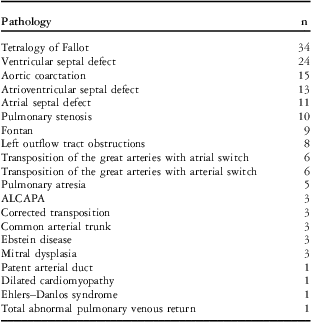
The 160 women studied were in the age group of 16–56 years, with a mean age of 27 years, and 80% were aged between 20 and 30 years. Their cardiac diseases are listed in Table 1. The majority of these cardiopathies were surgically corrected with the exception of four non-surgical ventricular septal defects, one uncorrected atrioventricular septal defect in a Down's syndrome patient, and one minor Ebstein's anomaly. There were 12 women under chronic oral anticoagulation for either a prosthetic valve or a Fontan palliation. Only three women had cyanosis; they were all classified in the “contraindicated” group because of association with other risk factors, and none of them had a pregnancy. There were 17 women with serious mental retardation, six with Down's syndrome, two with Noonan, and nine with no identified chromosomal abnormality.
Cardiopathies.

ALCAPA = anomalous left coronary artery from pulmonary artery
n, number of women
In all, 74 women were married or in a relationship (46%); 50 women had at least one child (31%); 54 women had a total of 121 pregnancies and 84 live births. None of the mentally compromised women were in a relationship, nor had a pregnancy.
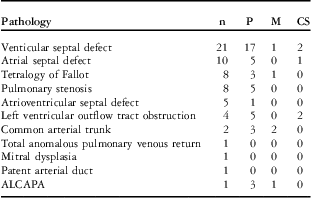
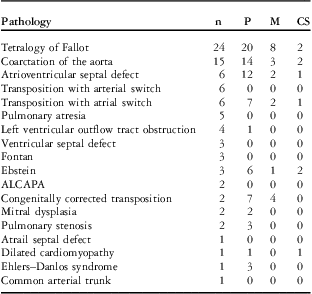
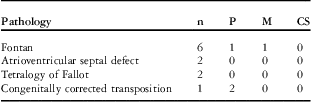
A total of 62 patients were classified in the “good condition” group (Table 2), 87 patients in the “at-risk” group (Table 3), and 11 patients in the “contraindicated” group (Table 4). The mean age was identical in all three groups. The proportion of married – or in relationship – women was 41%, 49%, and 45% in the three groups, respectively. The proportion of women with a child was 55% in the “good condition” group, 56% in the “at-risk” group, and 9% in the “contraindicated” group.
Pathologies in the “good condition” group – no restriction for pregnancy.
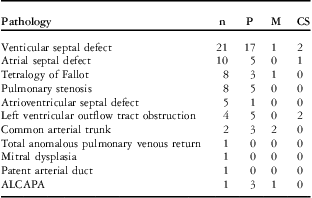
ALCAPA = anomalous left coronary artery from pulmonary artery; CS = caesarean sections; M = miscarriages; P = pregnancies
n, number of women
Pathologies in the “at-risk” group – women with pregnancies needing to be followed in tertiary centres.
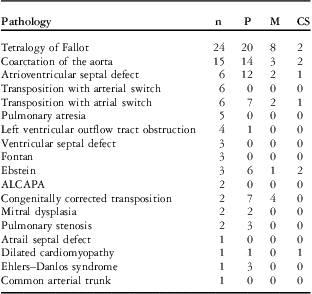
ALCAPA = anomalous left coronary artery from pulmonary artery; CS = caesarean sections; M = miscarriages; P = pregnancies
n, number of women
Pathologies in the “contraindicated” group – pregnancy inadvisable.

CS = caesarean sections; M = miscarriages; P = pregnancies
n, number of women
The mean age at first childbirth was 25 years in the first two groups, and one patient had a child in the “contraindicated” group when she was 18 years old.
The total incidence of spontaneous abortion was 21%; 12% in the “good condition” group, 26% in the “at-risk” group (p equals 0.195, not significant), and 33% in the “contraindicated” group. Medical abortion was performed in five cases for the following reasons: two pregnancies were conceived under oral anticoagulation – decision of the mother; one because of foetal non-cardiac malformation; and two because of the poor cardiac condition of the mother – one with poor systemic ventricular function in a congenitally corrected transposition, and one with a huge mitral regurgitation post atrioventricular septal defect surgery.
The rate of caesarean section was 15% – 13 caesarean sections in 10 women, including 7 in the “at-risk” group – and most of these were for obstetrical reasons (70%). The four caesarean sections performed for cardiac reasons were for patients in the “at-risk” group, and included the following pathologies: cardiac failure in a patient with congenital dilated cardiomyopathy, endocarditis in an Ebstein patient, poor tolerance in a patient with tetralogy of Fallot with exclusion of one lung, and in a tetralogy of Fallot patient with severe obstruction.
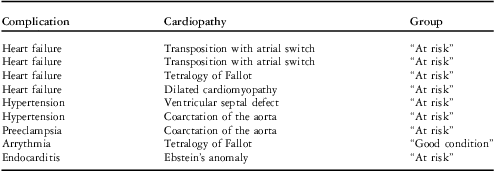
The maternal complications are listed in Table 5. All but one of these complications occurred in patients in the “at-risk” group. The cardiac diseases in which we saw complications were systemic right ventricle in transposition of the great arteries with atrial switch, tetralogy of Fallot with severe obstruction, dilated cardiomyopathy, aortic coarctation, a woman in the “good condition” group with tetralogy of Fallot, and an Ebstein. The patient who had a pregnancy in the “contraindicated” group had no complications during her pregnancy, but her cardiac function deteriorated after her pregnancy and she required transplantation. This rapid deterioration was partly attributed to the pregnancy.
Maternal complications.

The incidence of cardiac failure – defined as dyspnoea with pulmonary slight oedema requiring diuretics – was 4.7%, but all were easily controlled with low-dose diuretics. Cardiac failures occurred in one woman with tetralogy of Fallot with severe obstruction, two women with transposition with atrial switch, and one woman with congenital dilated cardiomyopathy.
Other cardiac complications included arrhythmia – one atrial tachycardia in tetralogy of Fallot, 1.2% – and endocarditis – one case in a patient with Ebstein's anomaly, 1.2%. Obstetrical complications included hypertension – two cases in patients with coarctation of the aorta and ventricular septal defect, 2.4% – and preeclampsia – one case in a patient with coarctation of the aorta, 1.2%.
The foetal complications included prematurity – defined as birth before 37 weeks of gestation – and/or low birth weight – defined as weight at birth less than 2.5 kilograms – with an incidence of 9.5%, and one foetal malformation (0.82%), which led to a medical abortion. There were no differences between the “good condition” and “at-risk” groups with regard to the incidence of prematurity. The only live birth in the “contraindicated” group was a premature infant.
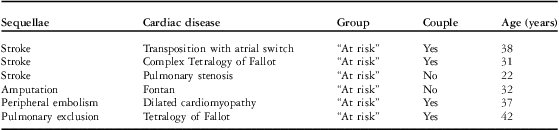
The extracardiac sequelae are listed in Table 6. These seem to have had no impact on marital life, because most of these women were married or in a relationship.
Extracardiac sequelae.

Discussion
This study shows that congenital heart disease does not seem to severely affect the desire and the ability of women to start a family, with the exception of a small proportion of women with a very poor heart condition or mental retardation. The women with more complicated cardiopathies or with sequelae – classified in the “at-risk” group – get married and have children as often as women in the “good condition” group. This means that although we ask that these women to be followed in a tertiary centre, they are not discouraged from getting pregnant. Moreover, the proportion of women in a relationship in our study was similar to that of the general population – around 50% of those aged over 25 years in Europe. Considering only the two groups where pregnancy is advisable – the majority of our patients, the proportion of women with at least one child was equivalent to that of the general population. Therefore, these women seem not to be handicapped in their family life.
The incidence of maternal and foetal complications is, of course, higher than in the general population, but there were no severely compromising complications provided that they are well monitored in tertiary centres. The most frequent maternal complication was cardiac failure (4.7%). This is consistent with other studies,Reference Khairy, Ouyang and Fernandes 1 , Reference Drenthen, Pieper and Roos-Hesselink 2 , Reference Jastrow, Meyer and Khairy 5 but higher than in a recent study from the Netherlands.Reference Drenthen, Boersma and Balci 6 This difference is probably due to the definition of cardiac failure. We had a very low incidence of arrhythmia (1.2%) compared with other studies,Reference Khairy, Ouyang and Fernandes 1 , Reference Drenthen, Pieper and Roos-Hesselink 2 , Reference Drenthen, Boersma and Balci 6 , Reference Siu, Colman and Sorensen 8 particularly, in the Netherland's Concor study,Reference Drenthen, Boersma and Balci 6 where arrhythmias were far more prevalent. This difference could be because almost all the women in our population had corrected heart disease, unlike in their study. Patients with uncorrected disease are at higher risk, especially for the occurrence of arrhythmias. In addition, the low proportion of atrial septal defects, which is the predominant pathology in the Concor study, could have lowered the incidence of atrial arrhythmias in our study. The rate of caesarean section is equivalent to the general population, meaning that the indications for caesarean section are not exaggerated. The majority of these are realised for obstetrical indications.
The incidence of prematurity and/or infants who are small for their gestational age (9%) is slightly more important than in the general population, but lower than in other reports.Reference Khairy, Ouyang and Fernandes 1 , Reference Drenthen, Boersma and Balci 6 – Reference Siu, Colman and Sorensen 8 , Reference Fesslova, Villa and Chessa 11 Again, this could be explained by the low proportion of unrepaired disease and cyanotic disease, which is known to be a risk factor for the foetus.Reference Fesslova, Villa and Chessa 11 , Reference Presbitero, Somerville, Stone, Aruta, Spiegelhalter and Rabajoli 12
The 21% incidence of miscarriage is consistent with the incidence reported in the Concor study,Reference Drenthen, Boersma and Balci 6 but higher than in the general population (15%). This incidence is slightly more important in women in poorer cardiac condition, but not statistically significant. Some of the spontaneous abortions could be related to cardiac disease in the foetus – this was not demonstrated, as there were no pathological analyses of the aborted foetuses.
In contrast with other studies, where the incidence of recurrent cardiopathy is 5–7%,Reference Khairy, Ouyang and Fernandes 1 , Reference Kaemmerer, Bauer and Stein 3 , Reference Drenthen, Boersma and Balci 6 there were no cardiac diseases in the live births in our population. This is probably because there were too few deliveries. Systematic antenatal screening is advised, and the majority of the women participated in these.
Limitations
The study is retrospective, which could underestimate the number of complications. Some events considered by the patient as benign may not have been mentioned to the cardiologist, mild arrhythmias, for example. The retrospective design does not allow an evaluation of maternal death. In addition, owing to the retrospective design, the classification of the women into three groups was not as rigorous as it should have been, but this probably reflects “real life”, because most of the time there are subjective considerations that cannot be quantified but which we took into account in our estimates of the risk of a pregnancy. The statistical analysis lacked power owing to the small number of patients; therefore, it was not our aim to compare cardiac diseases or to identify risk factors. Our population does not include Marfan patients, because these patients are followed up at another centre. This can distort the results, as these patients are particularly at risk. Our centre is a tertiary centre; consequently, there are a small number of “benign” pathologies such as atrial septal defect or bicuspidy, which are often followed up at periphery centres.
Conclusions
This study shows that women with severe congenital heart disease get married and start families, even if they are considered to be at risk and advised to have their pregnancy followed in a specialised centre for high-risk pregnancies. This is an important finding, as it is an important part of the well-being of these women.
Although the complication rate during pregnancy in congenital heart disease remains high, we are pleased to see that, with good monitoring, these pregnancies proceed with no severely compromising complications, and a low rate of medical abortion or caesarean section. These encouraging results are possible thanks to good multidisciplinary collaboration, including the selection of women at risk, cardiac follow-up during pregnancy, good scheduling of delivery, and antenatal screening of foetal malformations.