





Introduction
Language is not only a system of grammar and syntax but also a social practice through which people are represented, recognized, and valued. In many gendered languages, plural masculine forms are traditionally used to refer to mixed-gender groups. While referred to as “generic masculine,” these forms rarely function as such in everyday communication, because they tend to evoke male-dominated mental images rather than mixed groups (e.g., Gygax et al., Reference Gygax, Sato, Öttl and Gabriel2021a). These linguistic bias matters because language both reflects and shapes social reality influencing who is made visible, who is remembered, and who is imagined as belonging to a category. However, language operates within a bidirectional interaction with pre-existing social representations: stereotype-congruent social knowledge facilitates processing of expected information and makes stereotype-incongruent exemplars less accessible in memory and linguistic processing (e.g., Mari & Müller, Reference Mari and Müller2023). This suggests that linguistic interpretation is shaped not only by grammatical form but also by the distribution of socially available exemplars. Consequently, linguistic input interacts with cognitive representations that have been shaped by prior social experience. From a cognitive and applied psycholinguistics perspective, understanding how these biases manifest in real-time processing is critical, as it allows us to link linguistic input with measurable outcomes in perception, memory, and decision-making.
Adolescents today are immersed in online media environments, where YouTubers and social media influencers play a central role in shaping social knowledge by providing salient exemplars to which adolescents attend, identify with, and integrate into their mental representations of people and roles. Adolescents’ online media consumption differs by gender (Fernández-de-Arroyabe-Olaortua et al., Reference Fernández-de-Arroyabe-Olaortua, Lazkano-Arrillaga and Eguskiza-Sesumaga2018), with girls tending to consume more content produced by female creators, and this gendered exposure to YouTubers and influencers shapes their representations, including gender stereotypes (Tolbert & Drogos, Reference Tolbert and Drogos2019). During adolescence, a period marked by rapid development in reading fluency, working memory, and sensitivity to social identity, masculine-default interpretations of language may have particularly strong consequences for the formation of mental representations and social reasoning (e.g., Master et al., Reference Master, Cheryan and Meltzoff2021). Yet, little is known about how these biases interact with cognitive processes at this developmental stage.
Inclusive writing (IW) strategies, such as full doublets (FD), explicitly mention both masculine and feminine forms (e.g., les étudiants[masc.] et les étudiantes[fem.] | male students and female students) and have been shown to increase female representation in adults and children (Brauer & Landry, Reference Brauer and Landry2008; Brohmer et al., Reference Brohmer, Hofer, Bauch, Beitner, Berkessel, Corcoran, Garcia, Gruber, Giuliani, Jauk, Krammer, Malkoc, Metzler, Mües, Otto, Rahal, Salwender, Sczesny, Stahlberg, Wehrt and Athenstaedt2024; Tibblin et al., Reference Tibblin, van de Weijer, Granfeldt and Gygax2022). Examining FD in adolescents is particularly relevant because cognitive resources and social identity awareness are still developing at this age. Moreover, individual differences in reading fluency, a key cognitive skill, may influence how adolescents process inclusive forms, highlighting the relevance of this study for applied psycholinguistics and educational practice. The present study therefore examines whether FD promote female representation in adolescents’ mental imagery, while assessing how gender and reading fluency modulate this effect.
Masculine forms in French: Linguistic rules and cognitive implications
In French, the plural masculine form used to refer to groups of people can be interpreted in two ways: specifically or generically. In the specific interpretation, a plural masculine noun refers only to males. According to the grammatical rule of the “generic” masculine, however, when a group includes both males and females, the noun phrase is still written in the plural masculine form. This rule is often taught in school as “Masculine prevails over feminine.” For example, in a sentence such as “Students are looking forward to vacation,” the masculine form of “students” is “étudiants,” whereas the feminine form is “étudiantes.” Even though the group of students is composed of 99 females and one male, the grammatically correct sentence is “Les étudiants[masc.] ont hâte d’être en vacances.” The prevalence of this grammatical rule highlights the importance of understanding how linguistic norms interact with cognitive processes and social perception, particularly during adolescence, a developmental period that could be characterized by heightened attention to identity and social comparison (Blakemore & Mills, Reference Blakemore and Mills2014). From a psycholinguistic perspective, these rules offer a natural context for investigating how grammatical gender influences mental representations and bias during language comprehension in adolescents.
Cognitive representations of masculine forms
A key question in psycholinguistics is whether the plural masculine in French and other gendered languages is interpreted generically or specifically. Research shows that it is typically processed as male-specific rather than gender-neutral (e.g., Gygax et al., Reference Gygax, Zufferey and Gabriel2021b). French speakers encountering plural masculine forms for mixed-gender groups tend to form mental images dominated by men (Gygax et al., Reference Gygax, Gabriel, Sarrasin, Oakhill and Garnham2008, Reference Gygax, Gabriel, Lévy, Pool, Grivel and Pedrazzini2012, Reference Gygax, Sato, Öttl and Gabriel2021a). This male bias has been observed across multiple tasks, including sentence-picture matching, comprehension, and memory recall (e.g., Brauer & Landry, Reference Brauer and Landry2008; Gygax et al., Reference Gygax, Gabriel, Sarrasin, Oakhill and Garnham2008, Reference Gygax, Gabriel, Lévy, Pool, Grivel and Pedrazzini2012, Reference Gygax, Schoenhals, Lévy, Luethold and Gabriel2019, Reference Gygax, Sato, Öttl and Gabriel2021a). Cross-linguistic studies indicate that this male-dominated bias is not limited to French. Indeed, similar cognitive patterns have been observed in German (Backer & Cuypere, Reference Backer and Cuypere2012; Misersky et al., Reference Misersky, Majid and Snijders2019), Dutch (Backer & Cuypere, Reference Backer and Cuypere2012), and Spanish (Giró, Reference Giró2020), suggesting a widespread cognitive tendency to default to masculine imagery when linguistic forms are ambiguous.
While recent work has highlighted ongoing theoretical and methodological discussions regarding the interpretation of experimental findings on the generic masculine (de Saussure, Reference de Saussure2024; Gygax & Zufferey, Reference Gygax and Zufferey2024), these contributions point to the diversity of approaches and interpretations within this field of research. The present study follows the experimental psycholinguistic tradition that examines how grammatical gender influences mental representations during language processing. In line with this perspective, we adopt Slobin’s “thinking-for-speaking” hypothesis (Reference Slobin, Gumperz and Levinson1996, Reference Slobin, Gentner and Goldin-Meadow2003), which proposes that linguistic structures guide speakers’ attention to particular features of their conceptual environment. Within this framework, the current study aims to provide additional empirical evidence on how gender-marked forms may shape cognitive representations.
Both children and adults visualize or recall male-dominated images rather than balanced representations when exposed to masculine forms (e.g., Brauer & Landry, Reference Brauer and Landry2008). Studying these cognitive representations during adolescence is particularly relevant because this period is marked by heightened sensitivity to social categories and identity-relevant cues (Blakemore & Mills, Reference Blakemore and Mills2014), potentially amplifying the effects of masculine generics.
Social consequences of male-biased language
Exposure to masculine-biased language has been associated with gendered cognitive and social effects in various empirical studies, such as influencing who is more likely to be visualized, remembered, or considered for certain roles. For example, masculine-coded language in job advertisements can reduce women’s likelihood of applying, contributing to underrepresentation in certain fields, especially leadership roles (Gaucher et al., Reference Gaucher, Friesen and Kay2011; Hetjens & Hartmann, Reference Hetjens and Hartmann2024). In educational contexts, exposure to masculine forms can shape students’ perceptions of abilities and career aspirations: adolescents report lower confidence in male-typed careers when instructions use masculine forms (Chatard et al., Reference Chatard, Guimont and Martinot2005), and girls in primary school show reduced interest in such professions (Vervecken et al., Reference Vervecken, Hannover and Wolter2013). Even among adults, grammatical gender can influence judgments of competence and career suitability (Gygax et al., Reference Gygax, Gabriel, Sarrasin, Oakhill and Garnham2008). Taken together, these findings suggest that masculine-default linguistic forms can contribute to the subtle reinforcement of gender stereotypes, which may in turn promote the tendency to interpret men as the default human referent and reduce the visibility of women and non-binary individuals. From an applied psycholinguistics perspective, examining how linguistic interventions modify mental representations is essential to linking cognitive processes with real-world social outcomes, including gender equity in educational and vocational settings.
Inclusive writing as a strategy to reduce bias
IW encompasses a set of linguistic strategies designed to reduce gender stereotypes by making women and gender minorities (e.g., non-binary, agender, gender-fluid, trans) more visible in the language (Gygax et al., Reference Gygax, Zufferey and Gabriel2021b). The two main approaches are neutralization and refeminization. Neutralization reduces the salience of gender when it is not relevant, using tools like sentence reformulation, group terms, or epicene words (e.g., les artistes[neutr.] | the artists). However, neutralization may be less effective at increasing female representation and may be limited to specific contexts (Spinelli et al., Reference Spinelli, Chevrot and Varnet2023; Storme & Storme, Reference Storme and Storme2026). Refeminization emphasizes both feminine and masculine forms, often through Full Doublets (FD; e.g., les étudiants[masc.] et étudiantes[fem.] | male students and female students) or abbreviated forms (e.g., les étudiant·es). Research shows that FD reliably increase female representation in mental models (Liénardy et al., Reference Liénardy, Tibblin, Gygax and Simon2023; Pozniak et al., Reference Pozniak, Corbeau and Burnett2024; Tibblin et al., Reference Tibblin, van de Weijer, Granfeldt and Gygax2022, Reference Tibblin, Granfeldt, van de Weijer and Gygax2023; Xiao et al., Reference Xiao, Strickland and Peperkamp2022). However, these effects are generally modest in magnitude and should be understood as contributing to incremental shifts in mental representations rather than fundamentally transforming them. They are also highly sensitive to task demands, experimental paradigms, and contextual factors (Pozniak et al., Reference Pozniak, Corbeau and Burnett2024; Tibblin et al., Reference Tibblin, Granfeldt, van de Weijer and Gygax2023). From a psycholinguistic standpoint, FD can be seen as explicit disambiguation cues that guide referential resolution by activating both gender features simultaneously. This dual activation likely modifies the mental model under construction, resulting in a more balanced representation of gendered referents. In this sense, IW offers a powerful experimental lens to study how linguistic form interacts with conceptual accessibility and discourse processing.
For instance, Stahlberg et al. (Reference Stahlberg, Sczesny and Braun2001) showed that German-speaking adult participants asked to name individuals in occupational categories cited significantly fewer women when prompted with masculine-generic forms. In contrast, gender-inclusive forms, including FD, led to more women being named, demonstrating that explicit inclusion increases women’s salience. Brohmer et al. (Reference Brohmer, Hofer, Bauch, Beitner, Berkessel, Corcoran, Garcia, Gruber, Giuliani, Jauk, Krammer, Malkoc, Metzler, Mües, Otto, Rahal, Salwender, Sczesny, Stahlberg, Wehrt and Athenstaedt2024) replicated and extended this in a large-scale, multi-lab study (N = 2,697), again confirming the effectiveness of FD in German-speaking adults. Similarly, Brauer and Landry (Reference Brauer and Landry2008) asked 100 French-speaking adults to name candidates for the position of Prime Minister using either masculine forms (i.e., candidats[masc.] | candidates) or FD (i.e., candidats[masc.] ou candidates[fem.] | male or female candidates). FD increased the proportion of women cited from 15% to 40%. Comparable effects were observed in children, with FD increasing female representation in drawings from 39% to 54%.
These studies shed light on the cognitive mechanisms through which IW shapes mental representations—mechanisms involving lexical access, referential processing, and the construction of situation models. This makes IW a particularly relevant object of study for applied psycholinguistics, especially when investigating how linguistic input influences perception, memory, and social categorization during adolescence, a developmental period characterized by heightened sensitivity to identity-relevant cues (Blakemore & Mills, Reference Blakemore and Mills2014). However, empirical work focusing specifically on adolescents remains scarce, and no studies have examined whether individual differences in reading skills modulate the effectiveness of inclusive forms.
Individual differences in the effectiveness of inclusive writing
Processing inclusive forms such as FD may impose greater linguistic and cognitive demands than conventional masculine forms. FD increase lexical length and syntactic complexity, which can place heavier demands on decoding, working memory, and sentence integration processes (Just & Carpenter, Reference Just and Carpenter1992; Perfetti, Reference Perfetti2007). Reading fluency, the ability to decode and integrate written words quickly and accurately, is a critical predictor of comprehension efficiency (Fuchs et al., Reference Fuchs, Fuchs, Hosp and Jenkins2001; Kim & Wagner, Reference Kim and Wagner2015). Consequently, adolescents with lower reading proficiency, including those enrolled in specialized education programs, may struggle to fully comprehend gender-inclusive structures. This reduced comprehension could limit the cognitive impact of IW for struggling readers, making it less effective at shifting gendered mental representations. Beyond reading ability, participant gender may also influence FD effectiveness: women often name more female exemplars than men in gendered tasks, yet previous studies have shown small or inconsistent interactions between FD and gender (e.g., Brohmer et al., Reference Brohmer, Hofer, Bauch, Beitner, Berkessel, Corcoran, Garcia, Gruber, Giuliani, Jauk, Krammer, Malkoc, Metzler, Mües, Otto, Rahal, Salwender, Sczesny, Stahlberg, Wehrt and Athenstaedt2024). These factors underscore the importance of examining how both cognitive capacity (i.e., reading fluency) and social identity (i.e., gender) interact with the processing of inclusive language, particularly in adolescence when social salience and identity formation are heightened.
In sum, examining individual differences in both reading fluency and participant gender is essential to determine whether FD benefit adolescents equitably across diverse cognitive profiles and to identify potential constraints on the effectiveness of inclusive linguistic interventions.
Current study and hypotheses
A novel contribution of the present study lies in addressing this gap: although prior research has focused primarily on adults or typically developing readers, this work examines whether IW effects generalize to adolescents with varying literacy profiles. This study examines FD in an ecologically valid context, by asking adolescents to list YouTubers and influencers, reflecting their daily media environment. By combining measures of gender representation with continuous reading fluency data, we assess whether the cognitive accessibility and social impact of IW are equitably distributed across readers.
First, psycholinguistic research indicates that grammatical gender marking influences the mental representations constructed during language comprehension. Masculine-only forms tend to evoke male-biased representations, whereas forms that explicitly mention both genders increase the accessibility of female referents and lead to more balanced representations (Brauer & Landry, Reference Brauer and Landry2008; Gygax et al., Reference Gygax, Sato, Öttl and Gabriel2021a; Tibblin et al., Reference Tibblin, van de Weijer, Granfeldt and Gygax2022). Therefore, we hypothesize that (1) FD will be associated with an increase in female representation overall, although this effect is expected to be modest, consistent with previous findings.
Second, prior research shows that participant gender influences the gender distribution of names generated, with female participants typically naming more women than male participants (Brauer & Landry, Reference Brauer and Landry2008; Stahlberg et al., Reference Stahlberg, Sczesny and Braun2001). In addition, because the “generic” masculine is often interpreted as male-specific, and boys tend to generate fewer female names than girls, FD may have a stronger effect on boys’ representations. We therefore hypothesize that (2) girls will name more women than boys, and that the increase in female representation induced by FD may be larger for boys than for girls.
Third, according to capacity-constrained models of language processing, comprehension depends on the allocation of limited cognitive resources across decoding and integration processes (Just & Carpenter, Reference Just and Carpenter1992; Perfetti, Reference Perfetti2007). Because FD increases lexical length and syntactic complexity, they may impose additional decoding and integration demands. For adolescents with lower reading fluency, more resources may be devoted to read individual words, which may make it harder to incorporate gender-fair forms into their mental representation. Accordingly, we hypothesize that (3) reading fluency will moderate the effect of FD, with weaker effects expected among lower-fluency readers.
To summarize, we hypothesize that (1) FD will be associated with an increase in female representation overall, (2) girls will name more women than boys, and the effect of FD may be stronger for boys than for girls, and (3) reading fluency may moderate the effect, with lower-fluency readers potentially benefiting less.
Method
Participants
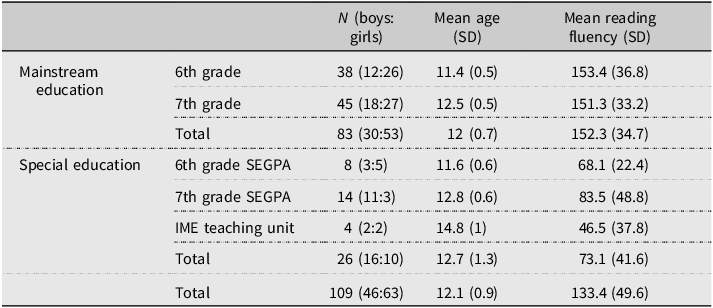
This research is integrated within the “EI Co Co” project, which includes three complementary studies conducted on a common participant cohort. The final sample consisted of 109 adolescents. Of the 146 participants initially recruited, 37 were excluded due to missing data: 27 because they were absent during at least one of the three testing sessions, and 10 because they did not complete the task. All students were enrolled in the same rural middle school in France, with a mean age of 12.1 years (SD = 0.9). They came from seven different classes of 6th and 7th grade, including two mainstream education classes (N = 83). Two classes were special-education classes for 6th (N = 8) and 7th grade (N = 14), specifically French SEGPA classes (i.e., Sections d’Enseignement Général et Professionnel Adapté) designed for students with significant learning difficulties. The last class (N = 4) was a teaching unit of a French educational and medical institution (i.e., Institut Médico-Educatif, IME) aimed at adolescents with intellectual developmental disabilities. Descriptive data regarding each class is presented in Table 1.
Description of the sample of participants depending on their class

Table 1. Long description
The table presents descriptive data regarding each class, focusing on the number of boys and girls, mean age, and mean reading fluency. It has 10 rows and 4 columns. The columns are labeled N (boys:girls), Mean age (SD), and Mean reading fluency (SD). The rows are divided into two main categories: Mainstream education and Special education. Mainstream education includes 6th grade, 7th grade, and Total. Special education includes 6th grade SEGPA, 7th grade SEGPA, IME teaching unit, and Total. Row 1: Mainstream education, 6th grade, 38 (12:26), 11.4 (0.5), 153.4 (36.8). Row 2: Mainstream education, 7th grade, 45 (18:27), 12.5 (0.5), 151.3 (33.2). Row 3: Mainstream education, Total, 83 (30:53), 12 (0.7), 152.3 (34.7). Row 4: Special education, 6th grade SEGPA, 8 (3:5), 11.6 (0.6), 68.1 (22.4). Row 5: Special education, 7th grade SEGPA, 14 (11:3), 12.8 (0.6), 83.5 (48.8). Row 6: Special education, IME teaching unit, 4 (2:2), 14.8 (1), 46.5 (37.8). Row 7: Special education, Total, 26 (16:10), 12.7 (1.3), 73.1 (41.6). Row 8: Total, 109 (46:63), 12.1 (0.9), 133.4 (49.6).
Note: SD = Standard deviation; SEGPA = French adapted general and professional education section; IME = French educational and medical institution.
Description: Bar chart showing mean scores for Group A and Group B with standard deviation.
The study complied with the ethical principles of the Declaration of Helsinki and was approved by the school administration. Although all students took part in the school-based activities, parental consent for the use of data was obtained through an opt-out procedure. Every child was given a book at the conclusion of the final testing session, irrespective of whether their data are included in the study.
Materials
Reading fluency task “Monsieur Petit.” At the start of the school year, each student read aloud the text “Monsieur Petit” for one minute (Cogni-Sciences, 2008). This task has been standardized on 783 children from 2nd to 7th grade, with the expected level at the end of 5th grade being 120 correct words per minute (DEPP, 2022). It provides a standardized measure of Reading Fluency, assessing both oral reading speed and accuracy. Scores correspond to the number of words correctly read per minute. The task is commonly used in French educational and research contexts to identify children with reading difficulties and evaluate automaticity in word decoding. In the present study, it was used to capture individual differences in reading ability within the sample.
Listing of YouTubers and influencers. Each student completed the task with different instructions, which were presented in a counterbalanced order across sessions and participants. In one session, the instruction was given using the masculine form (i.e., Cite des youtubeurs[masc.] et des influenceurs[masc.] que tu connais | Name YouTubers and influencers you know). In the other session, the instruction used FD, making it explicit that students could list women as valid answers (i.e., Cite des youtubeurs[masc.] ou youtubeuses[fem.] et des influenceurs[masc.] ou influenceuses[fem.] que tu connais | Name male or female YouTubers and male or female influencers you know). Although the literature indicates that the order of gendered terms can influence salience and processing (Glim et al., Reference Glim, Körner, Härtl and Rummer2023; Kesebir, Reference Kesebir2017), the masculine form was consistently presented first (masculine–feminine) throughout the study, as counterbalancing the order of gendered terms would have increased the complexity of the experimental design.
Students wrote their answers on paper. The score was the percentage of women cited by each student in each writing condition, ranging from 0% to 100%.
Coding of responses
Students produced a total of 1,705 responses, of which 1,641 (96.2%) were usable. Among these, 25.0% referred to women. On average, each student named 7.3 celebrities per session (SD = 4.0). Across all responses, 432 distinct celebrities were mentioned, 33.1% of whom were women (see Supplementary Materials).
Written data were first entered into a spreadsheet exactly as produced by the students. Because handwriting was sometimes difficult to interpret, transcription was carefully performed by a research assistant, a former middle-school teacher, whose experience proved valuable in resolving ambiguous cases. The first author and another research assistant then collaborated to identify which celebrity each creatively spelled YouTubers’ or influencers’ name referred to, and to standardize the orthography accordingly (e.g., scisi/skizi/squesi/scouisie/skwenzi, all referring to the famous French YouTuber “Squeezie”; see Supplementary Materials). This step was challenging given the limited familiarity of the authors with the influencer landscape. The two coders systematically conducted online searches using phonological variants of the written names to determine the most likely referent and to assign the celebrity’s gender (with no cases of ambiguous, non-public, or non-binary genders encountered in the dataset). When these strategies proved ineffective to identify the celebrity, the first author consulted adolescents familiar with the relevant social media figures to draw upon their expertise. Entries that could not be confidently identified were excluded from further analysis.
Among the 1,641 usable answers, 494 (30%) were not spelled correctly and were recoded manually. All of them are provided in Supplementary Materials (i.e., student’s original answer, corresponding celebrity’s name, error type, and pronunciation of student’s original answer). In 60% of cases, the celebrity’s name was phonologically correct even though the spelling was incorrect. For example, instead of “Kendji Girac,” a student wrote ‘quaingi jiraque,” both pronounced [kεndʒi ʒiʁak]. Another 50% of cases entailed exactly one phonemic error, with a missing phoneme (e.g., “Eunchene” [ʌnʃεn] instead of “Unchained” [ʌnʃεnd]), a phoneme replaced by another one (e.g., “Le Bledort” [lə bledɔʁ] instead of “Le Blé d’Art” [lə ble daʁ]), or a phoneme added (e.g., “Valouzy” [valuzi] instead of “Valouzz” [valuz]). 7% of incorrectly spelled answers entailed exactly 2 phonemic errors (e.g., “Appolin” [apolε̃] instead of “Apolline” [apolin], “Bingament” [bε̃gamɑ̃] instead of “Benjamin” [bε̃ʒamε̃], “Leana Salomon” [leana salomɔ̃] instead of “Lévannah Solomon” [levana solomɔ̃], etc.). 2% of wrongly spelled answers entailed more than 2 phonemic errors but were still identifiable without doubt. More precisely, 6 and 3 answers entailed respectively 3 or 4 phonemic errors. For example, “mistebite” [mistbit] instead of “MrBeast” [mistœʁbist] or “Furouse Jépeur” [fyʁuz ʒepœʁ] instead of “Furious Jumper” [fyʁjus ʤœmpœʁ]. The remaining 1% of errors were not phonemic but rather orthographic (e.g., “br never” instead of “dr never,” or “CRB mp3” instead of “CRB mp5”) or semantic (e.g., “Zoé et les chevaux” | “Zoe and the horses” instead of “Les poneys de Zoé” | “Zoe’s ponies”).
In total, 64 responses (3.8%) were excluded from the final dataset: 39 (2.3%) that could not be linked to a celebrity, and 25 (1.5%) deemed irrelevant. These irrelevant responses fall into several categories: Generic words (e.g., “tractor”) or non-creator entities (e.g., “Youki” the dog of the influencer Michou), content descriptions rather than creator names (e.g., “gives anime summaries”), channels with few subscribers which are unlikely to correspond to established influencers (e.g., “Xewen” with less than 200 subscribers), and non-influencer group names (e.g., “les kids united”).
In 96% of answers, students referred to individual creators, sometimes mentioning the name of their channel. However, when teenagers named YouTube collectives comprising multiple members, the gender of each member was counted proportionally (see Supplementary Materials). More specifically, “La Team Croûton” appeared 10 times and was coded as six men and two women, “La Famille Ventura” (i.e., two men and two women), and “Code famylia 10” (i.e., two men and one woman) appeared each once. Collectives of two people (e.g., “Les Parodie Bros,” “Un mec, une meuf”) appeared four times, and 44 responses referred to pairs of individuals named together (e.g., “McFly et Carlito”).
Results
Hypotheses and plan of analyses
We hypothesize that (H1) full doublets (FD), compared to masculine instructions, would increase the percentage of women named, (H2) girls would name more female YouTubers than boys and the effect of writing type would be stronger for boys than for girls, and (H3) the effect of writing type would decrease as reading ability decreased.
Two sequential linear mixed-effects models (LMEMs) were fitted, with participant included as a random intercept to account for repeated measures. The baseline model tested writing type and gender, while the moderation model added reading fluency. This sequential modeling approach preserves interpretability of main effects and minimizes overcontrol of covariates (Barr et al., Reference Barr, Levy, Scheepers and Tily2013; Wurm & Fisicaro, Reference Wurm and Fisicaro2014). Students were recruited across both special-education and mainstream programs to ensure a broad range of reading abilities. However, in the main analysis, education type was only used for sampling and not included as a predictor, to avoid high collinearity with Reading Fluency (Gelman & Hill, Reference Gelman and Hill2007).
The dependent variable (proportion of women named) was first adjusted using the formula p = (y × (n−1) + 0.5)/n, then logit-transformed to meet LMEM assumptions of normality and homoscedasticity (Warton & Hui, Reference Warton and Hui2011). This transformation was applied because proportions are bounded between 0 and 1, violating linear model assumptions. The logit transformation converts them to an unbounded scale and helps stabilize variance and normalize residuals. All statistical analyses were conducted using JASP version 0.13.1.0 (JASP Team, Reference JASP2020). Data are publicly available at https://osf.io/c5j4r/
Sample verification
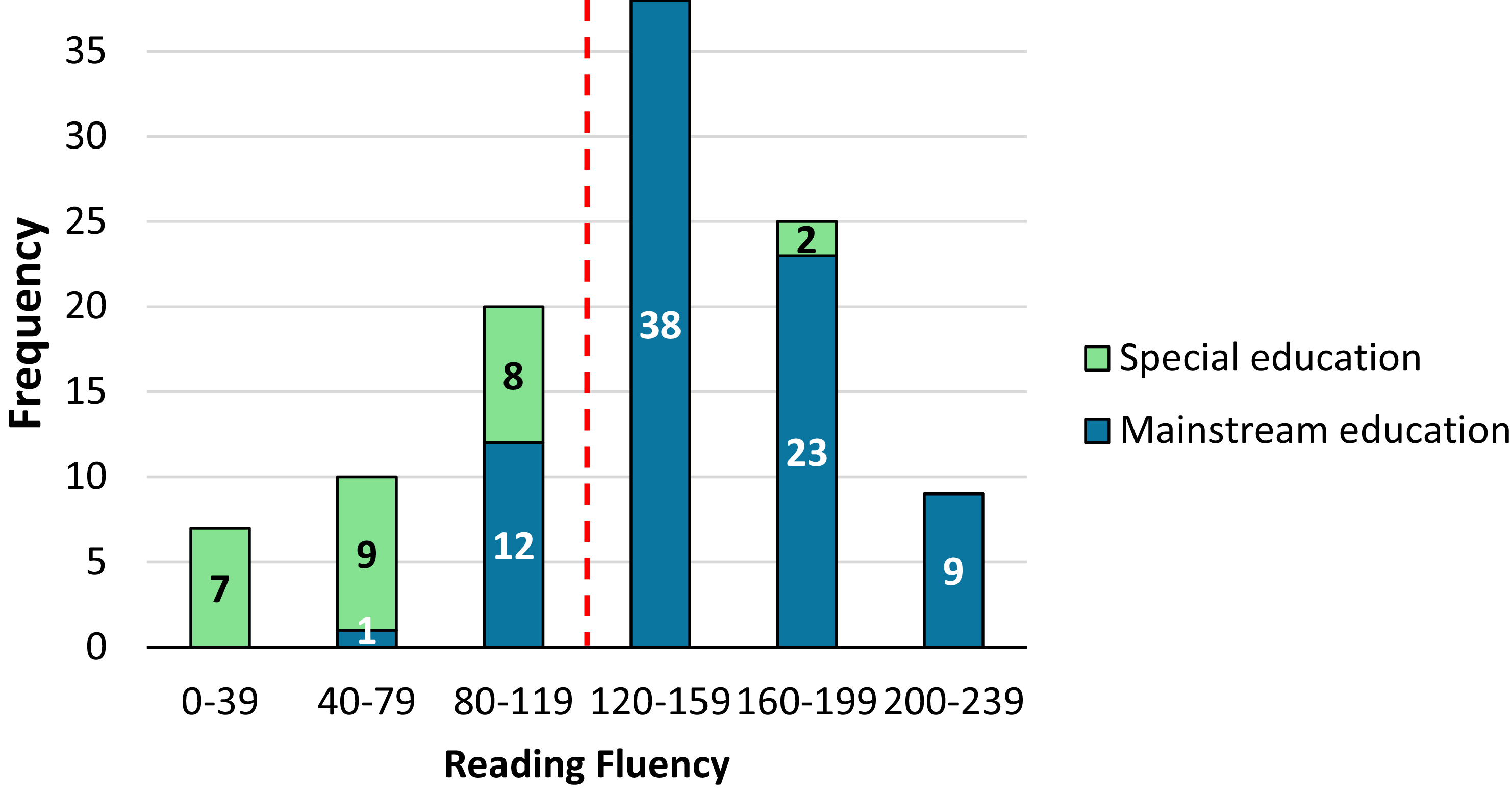
As illustrated in Figure 1, our sample covered a wide range of reading abilities. Specifically, 37 out of 109 adolescents (34%) performed below the expected level of reading fluency at the end of 5th grade (i.e., 120 correctly read words per minute; DEPP, 2022) and can therefore be considered to have reading difficulties. Among these students, 7 exhibited extreme reading difficulties (i.e., fewer than 40 correctly read words per minute; 6% of participants), 10 had severe difficulties (i.e., 40–79 words per minute; 9% of participants), and 20 showed moderate difficulties (i.e., 80–119 words per minute; 18% of participants). As anticipated, the majority of students with reading difficulties in our sample (24 of 37, 65%) were enrolled in special education. Notably, however, 13 students from mainstream education also exhibited significant reading difficulties.
Distribution of reading fluency scores depending on education type (special education vs. mainstream education). Red dotted line represents the expected level at the end of 5th grade (i.e., 120 correctly read words per minute; DEPP, 2022).

Although using the end of 5th grade benchmark may slightly underestimate difficulties in some 7th grade students, our sample still included a substantial number of adolescents with low reading skills. These results confirm that our recruitment strategy successfully captured a broad range of reading abilities, including adolescents with significant reading difficulties. They further justify using Reading Fluency as a continuous predictor rather than educational placement, due to overlap and variability within groups.
Baseline linear mixed-effects model
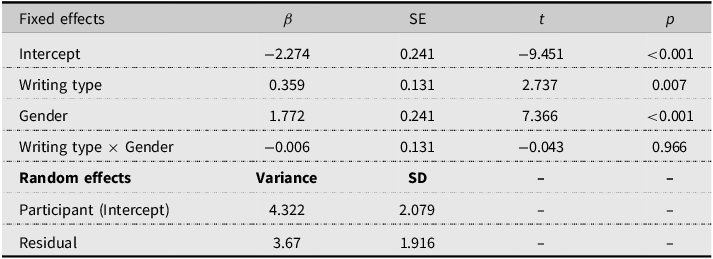
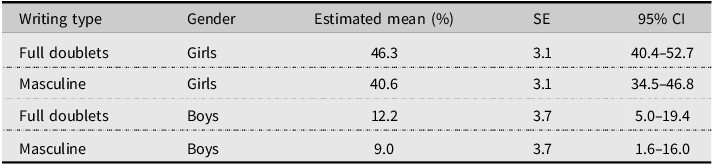
To examine the effects of writing type and gender on the logit-transformed proportion of women named, we fitted a baseline LMEM with Writing Type (i.e., Masculine vs. FD) and participant’s Gender (i.e., Girls vs. Boys) as fixed effects and Participant as a random intercept. This model assessed the main effects of Writing Type and Gender, while accounting for individual variability in the proportion of female YouTubers and influencers named. Results of the Baseline LMEM predicting the percentage of women named are presented in Table 2, and the corresponding marginal means are shown in Table 3.
Baseline linear mixed-effects model predicting logit-transformed proportion of women named

Table 2. Long description
The table presents the results of a baseline linear mixed-effects model predicting the logit-transformed proportion of women named. It includes fixed effects such as Intercept, Writing type, Gender, and the interaction between Writing type and Gender. The table has 5 rows and 4 columns. Column headers are Fixed effects, β, SE, t, and p. Row labels are Intercept, Writing type, Gender, and Writing type x Gender. The random effects section includes Participant (Intercept) and Residual with their respective Variance and SD values. Each row provides specific values for β, SE, t, and p. The table captures the statistical analysis of the effects of writing type and gender on the proportion of women named, accounting for individual variability.
Note: SE = Standard error.
Marginal means of the percentage of women named baseline linear mixed-effects model

Table 3. Long description
The table presents the estimated mean percentage of women named, segmented by writing type and gender. It includes four rows and five columns. The columns are labeled Writing type, Gender, Estimated mean (percent), SE, and 95 percent CI. The rows are labeled with combinations of writing types (Full doublets and Masculine) and genders (Girls and Boys). Row 1: Writing type, Full doublets; Gender, Girls; Estimated mean (percent), 46.3; SE, 3.1; 95 percent CI, 40.4-52.7. Row 2: Writing type, Masculine; Gender, Girls; Estimated mean (percent), 40.6; SE, 3.1; 95 percent CI, 34.5-46.8. Row 3: Writing type, Full doublets; Gender, Boys; Estimated mean (percent), 12.2; SE, 3.7; 95 percent CI, 5.0-19.4. Row 4: Writing type, Masculine; Gender, Boys; Estimated mean (percent), 9.0; SE, 3.7; 95 percent CI, 1.6-16.0.
Note: SE = Standard error; CI = confidence interval.
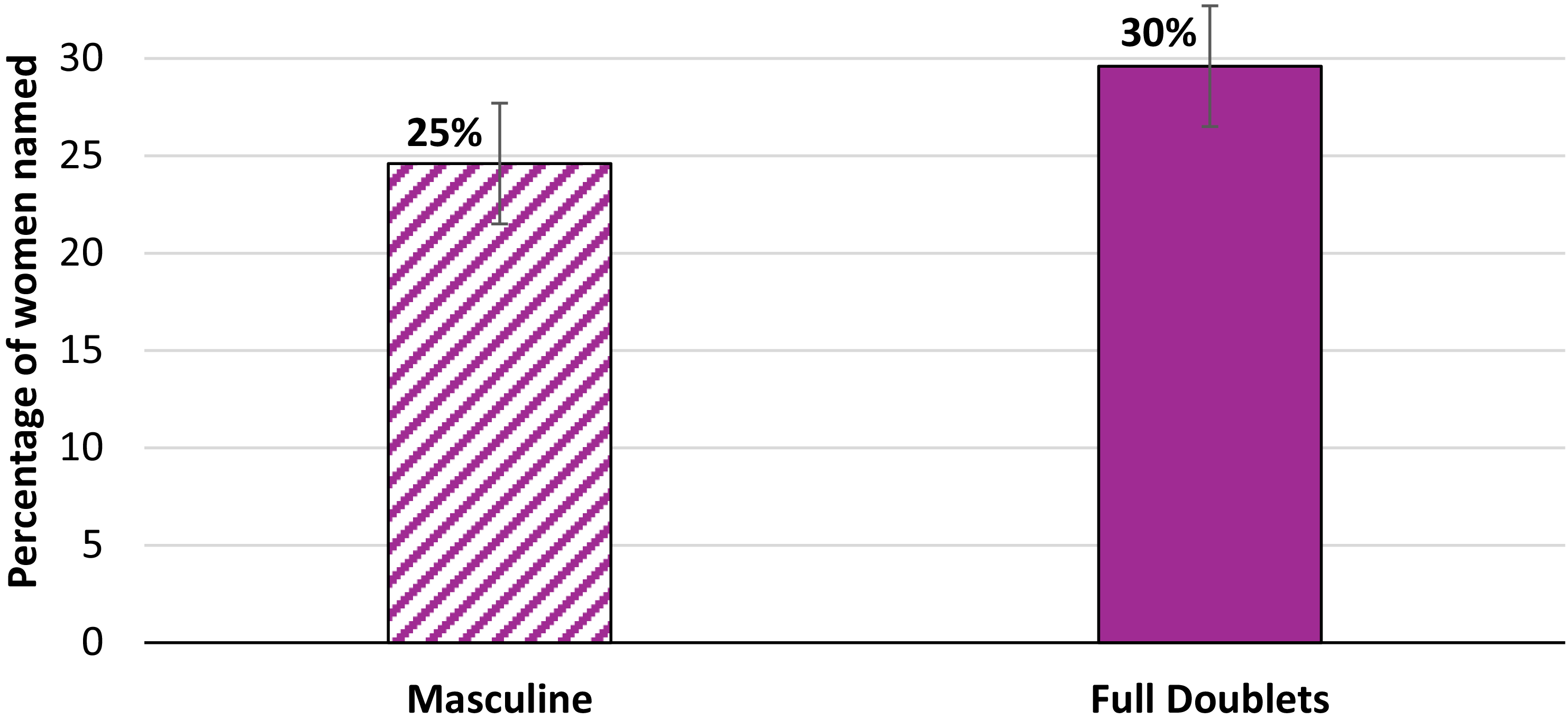
There was a statistically significant main effect of Writing Type (β = 0.359, SE = 0.131, t = 2.74, p = 0.007), with students naming a higher proportion of women in the FD condition (M = 29.4%, SE = 2.4%, 95% CI = 24.6, 34.1) than in the Masculine condition (M = 24.7%, SE = 2.4%, 95% CI = 20.0, 29.4; see Figure 2). There was also a statistically significant main effect of adolescents’ Gender (β = 1.772, SE = 0.241, t = 7.37, p < 0.001) with Girls naming more women (M = 43.6%, SE = 2.9%, 95% CI: 38.0–49.2) than Boys (M = 10.5%, SE = 3.3%, 95% CI: 3.9–17.0). The Writing Type × Gender interaction was not statistically significant (β = −0.006, SE = 0.131, t = −0.043, p = 0.966) indicating that Writing Type had a similar effect for Girls (Masculine: M = 40.6%, SE = 3.1%, 95% CI: 34.5–46.8; FD: M = 46.3%, SE = 3.1%, 95% CI: 40.4–42.7) and Boys (Masculine: M = 9.0%, SE = 3.7%, 95% CI: 1.6–16.0; FD: M = 12.2%, SE = 3.7%, 95% CI: 5.0–19.4). Random-intercept variance for Participant was substantial (σ 2 = 4.32, SD = 2.08), indicating meaningful variability across individuals in the percentage of female YouTubers and influencers named. Residual variance was σ 2 = 3.67 (SD = 1.92).
Percentage of women named by adolescents as a function of writing type (masculine vs. full doublets) in the baseline linear mixed-effects model.

Moderation linear mixed-effects model
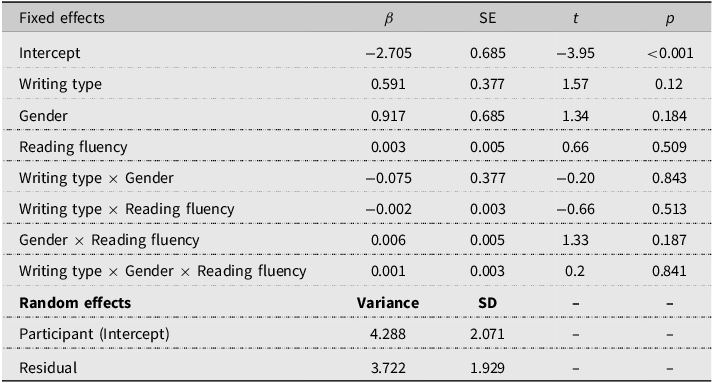
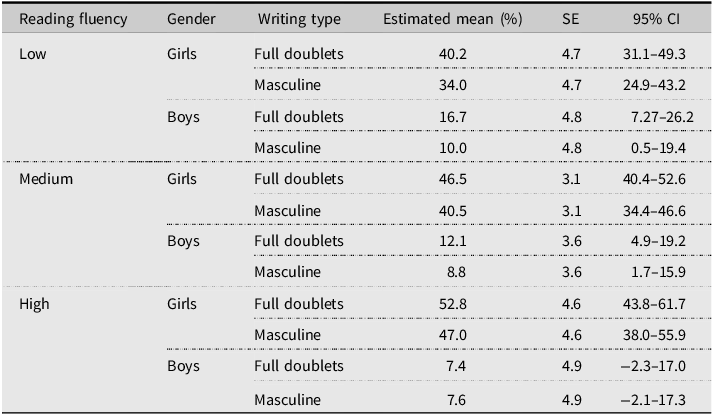
To examine whether individual differences in reading ability moderated the effect of writing type, we fitted a second LMEM with Writing Type (Masculine vs. FD), adolescent’s Gender (Girls vs. Boys), and Reading Fluency as fixed effects, and Participant as a random intercept. The dependent variable was again the logit-transformed proportion of female named. The results of this moderation LMEM are presented in Table 4, and the corresponding marginal means are shown in Table 5.
Moderation linear mixed-effects model predicting logit-transformed proportion of women named

Table 4. Long description
A table with fixed and random effects of a moderation linear mixed-effects model predicting logit-transformed proportion of women named. The table has 11 rows and 5 columns. The columns are labeled as Fixed effects, Beta, SE, t, and p. The rows under Fixed effects are Intercept, Writing type, Gender, Reading fluency, Writing type x Gender, Writing type x Reading fluency, Gender x Reading fluency, and Writing type x Gender x Reading fluency. The rows under Random effects are Participant (Intercept) and Residual. The table presents the variance and standard deviation for the random effects. The fixed effects include the beta coefficients, standard errors, t-values, and p-values for each predictor. The random effects include the variance and standard deviation for the participant intercept and residual.
Note: SE = Standard error.
Marginal means of the percentage of women named (moderation linear mixed-effects model)

Table 5. Long description
A table with three rows and four columns comparing the percentage of women named based on reading fluency, gender, and writing type. The columns are Reading fluency, Gender, Writing type, Estimated mean (percent), SE, and 95 percent CI. The rows are grouped by reading fluency levels: Low, Medium, and High. Each group further divides into gender and writing type with corresponding estimated mean percentages, standard errors, and 95 percent confidence intervals. Row 1: Reading fluency Low, Gender Girls, Writing type Full doublets, Estimated mean 40.2, SE 4.7, 95 percent CI 31.1-49.3. Row 2: Reading fluency Low, Gender Girls, Writing type Masculine, Estimated mean 34.0, SE 4.7, 95 percent CI 24.9-43.2. Row 3: Reading fluency Low, Gender Boys, Writing type Full doublets, Estimated mean 16.7, SE 4.8, 95 percent CI 7.27-26.2. Row 4: Reading fluency Low, Gender Boys, Writing type Masculine, Estimated mean 10.0, SE 4.8, 95 percent CI 0.5-19.4. Row 5: Reading fluency Medium, Gender Girls, Writing type Full doublets, Estimated mean 46.5, SE 3.1, 95 percent CI 40.4-52.6. Row 6: Reading fluency Medium, Gender Girls, Writing type Masculine, Estimated mean 40.5, SE 3.1, 95 percent CI 34.4-46.6. Row 7: Reading fluency Medium, Gender Boys, Writing type Full doublets, Estimated mean 12.1, SE 3.6, 95 percent CI 4.9-19.2. Row 8: Reading fluency Medium, Gender Boys, Writing type Masculine, Estimated mean 8.8, SE 3.6, 95 percent CI 1.7-15.9. Row 9: Reading fluency High, Gender Girls, Writing type Full doublets, Estimated mean 52.8, SE 4.6, 95 percent CI 43.8-61.7. Row 10: Reading fluency High, Gender Girls, Writing type Masculine, Estimated mean 47.0, SE 4.6, 95 percent CI 38.0-55.9. Row 11: Reading fluency High, Gender Boys, Writing type Full doublets, Estimated mean 7.4, SE 4.9, 95 percent CI -2.3-17.0. Row 12: Reading fluency High, Gender Boys, Writing type Masculine, Estimated mean 7.6, SE 4.9, 95 percent CI -2.1-17.3.
Note: SE = Standard error; CI = confidence interval.
There were no statistically significant main effects of Writing Type (β = 0.591, SE = 0.377, t = 1.57, p = 0.12; Masculine: M = 24.6%, SE = 2.4%, 95% CI: 20.0–29.3; FD: M = 29.3%, SE = 2.4%, 95% CI: 24.6–33.9), adolescent’s Gender (β = 0.917, SE = 0.685, t = 1.34, p = 0.184; Girls: M = 43.5%, SE = 2.8%, 95% CI: 38.0–49.0; Boys: M = 10.4%, SE = 3.3%, 95% CI: 4.0–16.9), or Reading Fluency (β = 0.003, SE = 0.005, t = 0.66, p = 0.509; Low: M = 35.2%, SE = 3.0%, 95% CI: 19.3–31.2; Medium: M = 27.0%, SE = 2.2%, 95% CI: 22.7–31.2; High: M = 28.7%, SE = 3.1%, 95% CI: 22.7–34.7) on the logit-transformed proportion of women named.
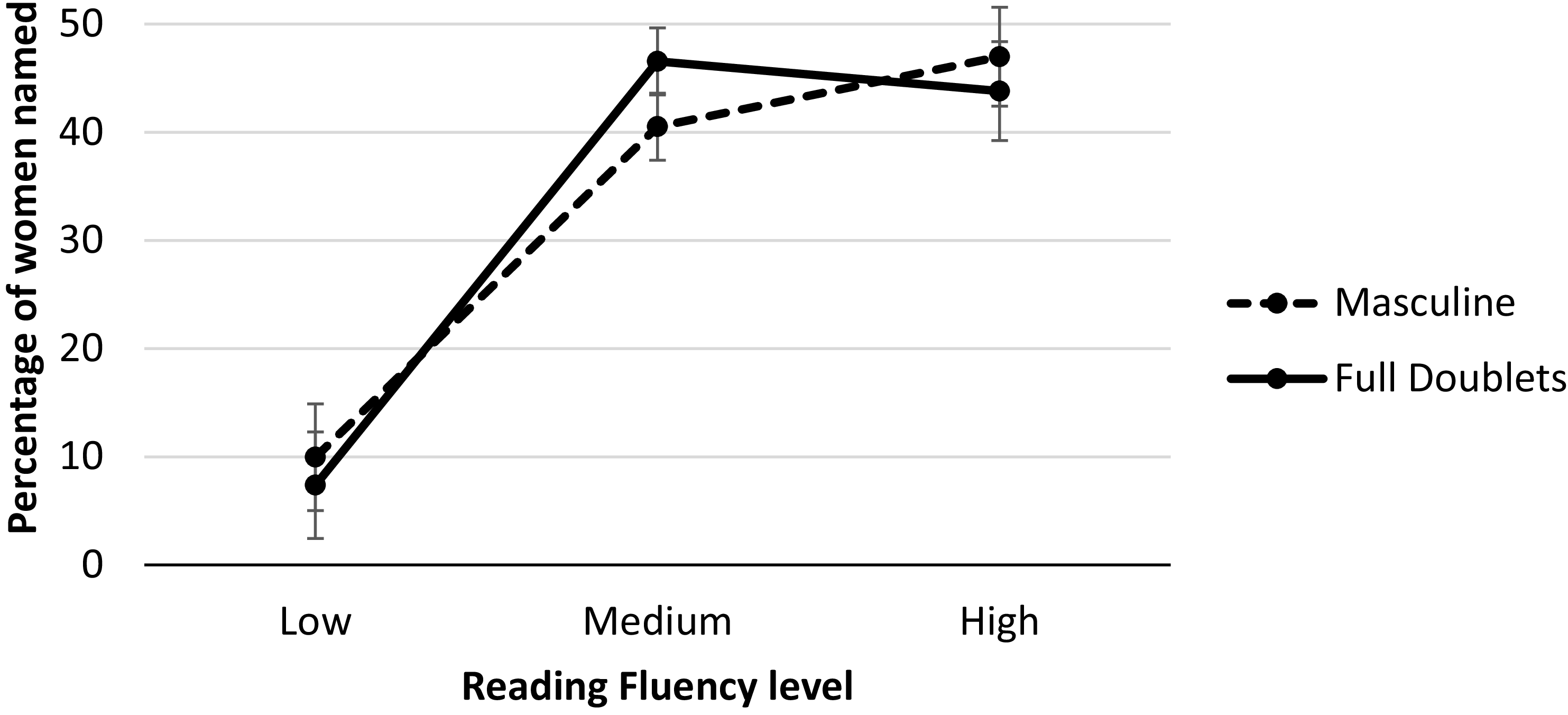
The Writing Type x Gender interaction was statistically non-significant (β = −0.075, SE = 0.377, t = −0.20, p = 0.843; Girls-Masculine: M = 40.5%, SE = 3.1%, 95% CI: 34.4–46.6; Girls-FD: M = 40.5%, SE = 3.1%, 95% CI: 40.4–52.6; Boys-Masculine: M = 8.8%, SE = 3.6%, 95% CI: 1.7–15.9; Boys-FD: M = 12.1%, SE = 3.6%, 95% CI: 4.9–19.2), as was the case for the Writing Type × Reading Fluency interaction (β = −0.002, SE = 0.003, t = −0.66, p = 0.513; Low-Masculine: M = 22.0%, SE = 3.4%, 95% CI: 15.4–28.6; Low-FD: M = 28.5%, SE = 3.4%, 95% CI: 21.9–35.0; Medium-Masculine: M = 24.6%, SE = 2.4%, 95% CI: 20.0–29.3; Medium-FD: M = 29.3%, SE = 2.4%, 95% CI: 24.6–33.9; High-Masculine: M = 27.3%, SE = 3.4%, 95% CI: 20.7–33.9; High-FD: M = 30.1%, SE = 3.4%, 95% CI: 23.5–36.7; see Figure 3). Thus, although including Reading Fluency reduced the main effects of Writing Type and Gender, this likely reflects shared variance with Reading Fluency rather than a true moderation effect.
Percentage of women named by adolescents across reading fluency levels as a function of writing type (masculine vs. full doublets). Error bars represent ± 1 standard error. The interaction effect is statistically non-significant.

The Gender x Reading Fluency interaction was statistically non-significant (β = 0.006, SE = 0.005, t = 1.33, p = 0.187; Low-Boys: M = 13.4%, SE = 4.4%, 95% CI: 4.8–22.0; Low-Girls : M = 37.1%, SE = 4.2%, 95% CI: 28.8–45.4; Medium-Boys: M = 10.4%, SE = 3.3%, 95% CI: 4.0–16.9; Medium-Girls: M = 43.5%, SE = 2.8%, 95% CI: 38.0–49.0; High-Boys: M = 7.5%, SE = 4.5%, 95% CI: 0–16.3; High-Girls: M = 49.9%, SE = 4.1%, 95% CI: 41.7–58.0), so as the Writing Type x Gender x Reading Fluency interaction (β = 0.001, SE = 0.003, t = 0.20, p = 0.841; see Table 5). Random-intercept variance for Participant remained substantial (σ2 = 4.29, SD = 2.07). Residual variance was σ2 = 3.72 (SD = 1.93).
Robustness checks with alternative codings of reading ability
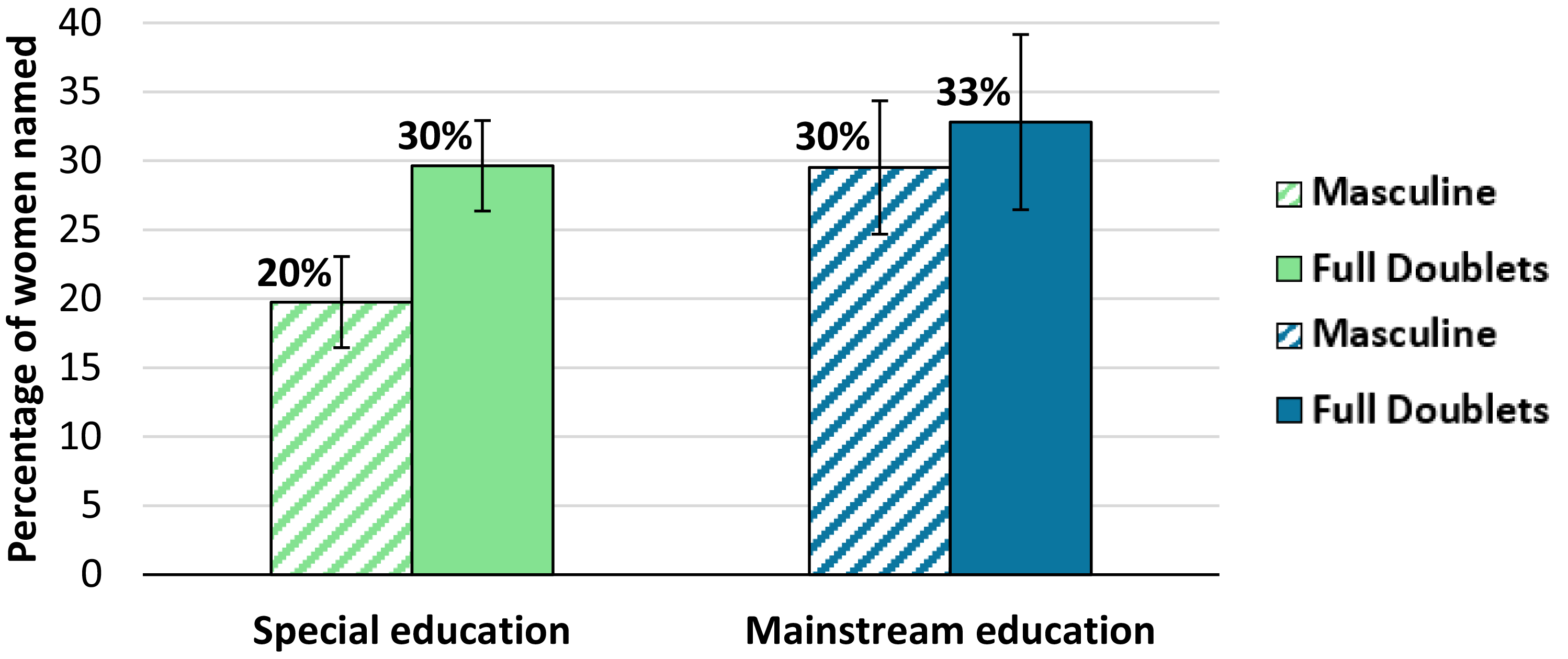
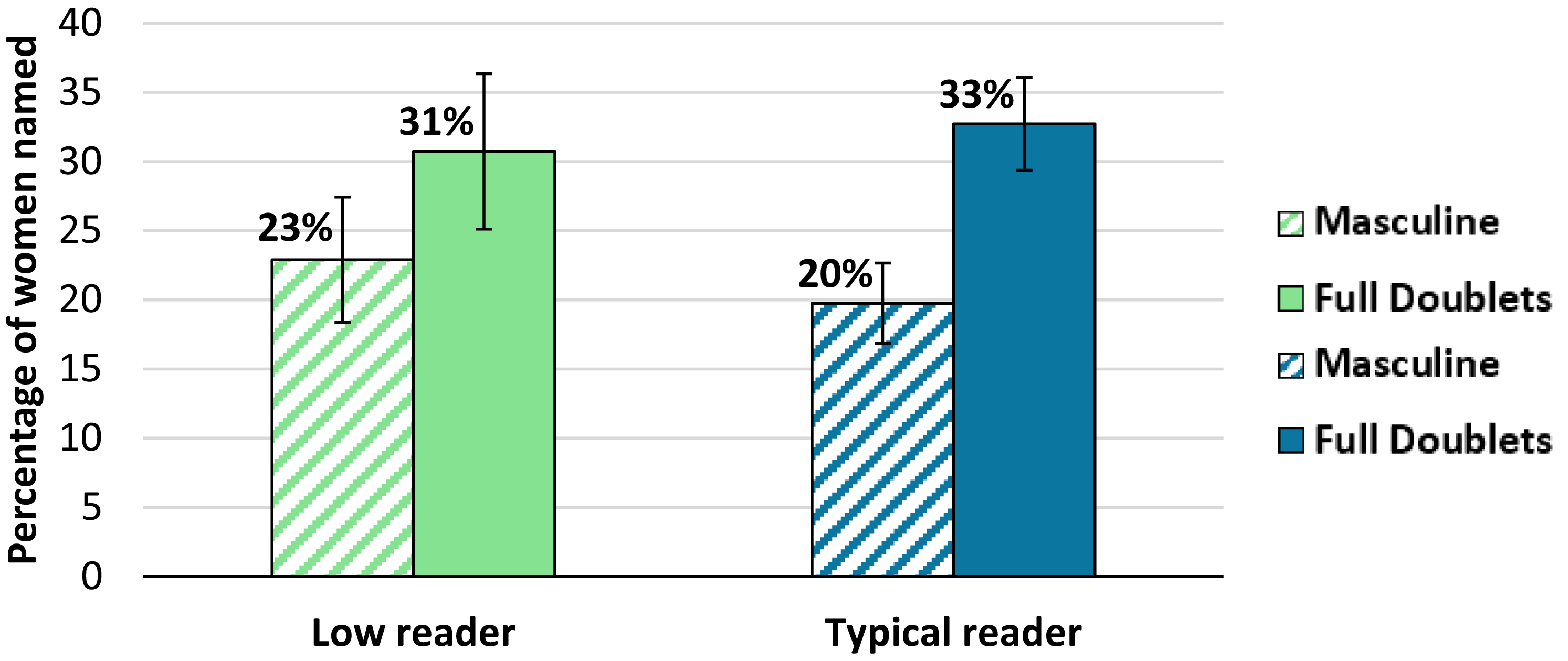
To ensure that the non-significant interaction between Writing Type and Reading Fluency was not an artifact of treating reading abilities as a continuous variable, we re-ran the moderation LMEM replacing Reading Fluency with (a) Education Type (Mainstream Education vs. Special Education) and (b) a dichotomized Reading Group (Low vs. Typical readers, using 120 words per minute as a threshold, corresponding to the expected level at the end of 5th grade; DEPP, 2022). These additional analyses were conducted only as robustness checks, not as theoretically preferred models, to address potential reader expectations for group-level comparisons. Across all models, the Writing Type × moderator interaction remained non-significant, demonstrating that the lack of statistically significant moderation does not depend on how reading ability is coded. The (non-significant) interactions are illustrated in Figures 4 and 5, with detailed results reported in the Supplementary Materials.
Percentage of women named by adolescents as a function of writing type (masculine vs. full doublets) and education type (special education vs. mainstream education) in the moderation linear mixed-effects model. Error bars represent ± 1 standard error. The interaction effect is statistically non-significant.

Percentage of women named by adolescents as a function of writing type (masculine vs. full doublets) and reading group (low readers vs. typical readers) in the moderation linear mixed-effects model. Error bars represent ± 1 standard error. The interaction effect is statistically non-significant.

We retained Reading Fluency as a continuous predictor in the main analyses because it more accurately captures individual differences, avoids arbitrary cutoffs, and preserves statistical power (MacCallum et al., Reference MacCallum, Zhang, Preacher and Rucker2002; Royston et al., Reference Royston, Altman and Sauerbrei2006). Including group analyses serves solely as a robustness check, ensuring that findings are not an artifact of model specification (Brauer & Curtin, Reference Brauer and Curtin2018). Although dichotomization can reduce statistical precision, the persistence of the same pattern under these less optimal codings further supports the robustness of the main findings. The consistency of the Writing Type effect across continuous and dichotomized models increases confidence that the absence of moderation is genuine, rather than a coding artifact. Overall, these analyses support the conclusion that the effect of writing type is stable across the full range of reading fluency, regardless of how the variable is operationalized.
Discussion
According to the “generic” masculine rule in French, plural masculine forms are grammatically prescribed to refer to mixed-gender groups. These interpretations have important implications for applied cognition: they demonstrate how grammatical structures can bias the activation of social categories in working memory and influence mental model construction even in adolescents. Prior psycholinguistic research suggests that such gendered interpretations arise naturally during comprehension, as readers integrate grammatical gender cues into their mental representations of referents (e.g., Garnham et al., Reference Garnham, Gabriel, Sarrasin, Gygax and Oakhill2012; Reali et al., Reference Reali, Esaulova and Von Stockhausen2015). Together, this body of work underscores that linguistic conventions can subtly shape how speakers represent social categories. By situating this research in a context relevant to adolescents’ daily experiences (i.e., YouTubers and influencers), the present study provides ecologically valid evidence that inclusive linguistic cues actively modulate referential gender processing at a stage when social and identity representations are rapidly developing.
Full doublets are effective in limiting male-biased representations
The effect of Writing Type was statistically significant, with adolescents naming a higher proportion of women when instructions used FD (29.6%) compared to the masculine form (24.6%). Although the effect size in the present study was modest, previous research has reported larger effects, for instance Brohmer et al. (Reference Brohmer, Hofer, Bauch, Beitner, Berkessel, Corcoran, Garcia, Gruber, Giuliani, Jauk, Krammer, Malkoc, Metzler, Mües, Otto, Rahal, Salwender, Sczesny, Stahlberg, Wehrt and Athenstaedt2024) observed a medium-sized effect in a large-scale adult sample. These findings confirm that French-speaking adolescents, like adults, interpret the masculine plural as male-specific rather than generic. FD appear to shift early processing of gender cues, increasing the likelihood that female referents are activated during comprehension.
Several cognitive mechanisms may underlie the effects of FD. At the lexical level, explicitly presenting the feminine morpheme may automatically activate semantic representations of female referents, increasing their accessibility relative to masculine-default interpretations, as supported by ERP evidence showing early N400 effects for gender-marked words (Misersky et al., Reference Misersky, Majid and Snijders2019). At the attentional level, FD may act as cues that highlight gender as a relevant category, leading readers to pay more attention to female exemplars, consistent with eye-tracking findings (Reali et al., Reference Reali, Esaulova and Von Stockhausen2015). Finally, at the discourse level, FD can reduce the male bias during pronoun resolution, resulting in more balanced mental representations, as shown in behavioral reading tasks (Tibblin et al., Reference Tibblin, Granfeldt, van de Weijer and Gygax2023).
From a socio-psychological perspective, even minimal interventions such as FD can make female figures more cognitively available, illustrating the causal role of language in shaping mental representations and social cognition. In practical terms, FD may help counteract implicit gender biases and influence adolescents’ perceptions of gender-appropriate roles. Previous research has shown that IW can enhance self-efficacy in children (Chatard et al., Reference Chatard, Guimont and Martinot2005), broaden perceptions of occupational success in adolescents (Vervecken et al., Reference Vervecken, Hannover and Wolter2013), and increase women’s interest in job offers in adults (Hetjens & Hartmann, Reference Hetjens and Hartmann2024). Our findings extend these benefits to early adolescence, a critical period for identity formation, vocational aspirations, and social learning (Blakemore & Mills, Reference Blakemore and Mills2014).
The effect of full doublets is independent of teenagers’ gender
Results indicate that compared to male students, female students named a larger proportion of female YouTubers and influencers, replicating robust gender differences in social exemplars and interests previously observed among adults (Brauer & Landry, Reference Brauer and Landry2008; Brohmer et al., Reference Brohmer, Hofer, Bauch, Beitner, Berkessel, Corcoran, Garcia, Gruber, Giuliani, Jauk, Krammer, Malkoc, Metzler, Mües, Otto, Rahal, Salwender, Sczesny, Stahlberg, Wehrt and Athenstaedt2024; Stahlberg et al., Reference Stahlberg, Sczesny and Braun2001). Crucially, the absence of a Writing Type × Gender interaction suggests that FD operate equally across genders, highlighting their potential as a broadly applicable intervention to reduce male-default bias. This highlights their potential as a broadly applicable intervention: both male and female adolescents respond to inclusive linguistic cues, suggesting that the referential disambiguation triggered by FD is not contingent on the participant’s own gender. This finding adds to a mixed body of evidence regarding potential gender moderation effects in IW research. Some studies have reported slightly weaker IW effects in men (e.g., Brohmer et al., Reference Brohmer, Hofer, Bauch, Beitner, Berkessel, Corcoran, Garcia, Gruber, Giuliani, Jauk, Krammer, Malkoc, Metzler, Mües, Otto, Rahal, Salwender, Sczesny, Stahlberg, Wehrt and Athenstaedt2024), whereas others found no reliable interaction (e.g., Brauer & Landry, Reference Brauer and Landry2008; Brohmer et al., Reference Brohmer, Hofer, Bauch, Beitner, Berkessel, Corcoran, Garcia, Gruber, Giuliani, Jauk, Krammer, Malkoc, Metzler, Mües, Otto, Rahal, Salwender, Sczesny, Stahlberg, Wehrt and Athenstaedt2024). Our results align with the latter pattern, suggesting that FD’s cognitive benefits are robust across adolescent genders. From an applied cognitive perspective, this suggests that inclusive linguistic interventions can universally shape mental representations in adolescent populations, independent of prior gender-based expectations or experiences.
Inclusive writing remains effective across reading abilities
A common concern about IW is that it may be less accessible to readers with lower reading skills, potentially reducing its effectiveness. Contrary to concerns that linguistic complexity might limit effectiveness, Reading Fluency did not moderate FD’s impact. Even if FD introduce additional morphosyntactic elements, the cognitive system of adolescents appears capable of integrating these forms without observable decrement in referential processing. From an applied standpoint, this indicates that educational or media interventions employing FD can be effective across literacy levels, supporting equitable access to inclusive representations.
Limitations and future directions
It will be important to test IW in adolescents with diagnosed reading disorders and in other low-literacy populations to identify possible cognitive limits on intervention effectiveness. Comparing FD with other IW forms, such as abbreviated doublets (e.g., les étudiant·es) or neutral forms, would clarify the trade-offs between cognitive load and social salience. Such comparisons should evaluate both immediate representational effects and downstream consequences for comprehension. In addition, the present study used a consistent ordering of gendered terms within FD (masculine–feminine), reflecting common usage conventions in French. However, prior research indicates that word order within gendered pairs is not cognitively neutral: entities mentioned first tend to be perceived as more salient, relevant, and socially important than those mentioned second (Glim et al. Reference Glim, Körner, Härtl and Rummer2023; Kesebir, Reference Kesebir2017). Future research should also manipulate doublet order to determine whether placing the feminine form first further enhances the activation of female. Moreover, eye-tracking studies or paradigms in which participants read sentences at their own pace could help determine whether FD impose measurable processing demands during online comprehension. Combining self-paced reading and eye-movement measures with electrophysiological recordings (e.g., ERPs) would allow researchers to link processing cost hypotheses to specific time-courses of lexical access and referential resolution. Finally, testing IW across different communicative contexts (e.g., school materials, job ads, and social media) and in other languages/cultures would establish boundary conditions for generalization.
Practical implications follow these research directions. Overall, these results reinforce that grammatical gender cues actively shape social cognition, even in adolescents. Demonstrating that brief linguistic changes such as FD can increase the salience of women among adolescents underscores how language functions as a mechanism for stereotype mitigation. Practically, integrating FD into classroom materials, youth media, or online platforms may foster more balanced perceptions of gender roles. For example, FD could be incorporated into textbook narratives and problem statements, reading comprehension exercises, career guidance materials, and examination prompts. In digital learning environments, FD could be implemented in instructional interfaces, automated feedback messages, educational apps, and online course platforms to ensure gender-balanced linguistic input. Pilot implementation studies could assess feasibility, teacher/student acceptance, and short-term effects on attitudes and choices. Longitudinal studies could explore whether FD influence real-world choices, such as course selection, extracurricular engagement, or occupational aspirations. In sum, combining field interventions with laboratory measures (behavioral, eye-tracking, electrophysiology) and longitudinal follow-ups will clarify both how IW works cognitively and how it can be deployed effectively to promote more equitable mental representations in adolescence.
Conclusion
This study demonstrates that FD, a form of IW, reliably increase the salience of female exemplars in adolescents’ mental representation, extending prior evidence from children and adults. Importantly, these effects were observed regardless of reading fluency, indicating that IW can effectively shape mental representations even among less proficient readers. These findings position FD as a practical, theoretically grounded tool to reduce male-default bias in adolescence. By integrating developmental, social, and psycholinguistic perspectives, the present work clarifies how grammatical cues guide referential processing and conceptual accessibility in younger readers. Language interventions like FD offer scalable, low-cost strategies to foster gender equity, with potential long-term impacts on academic, social, and occupational outcomes. Comparing FD with shorter inclusive forms (e.g., the midpoint) will further clarify whether social benefits can be preserved while reducing cognitive demands. Overall, these results demonstrate that IW is a socially impactful and developmentally robust approach for fostering gender equity and inclusive social cognition during adolescence.
Supplementary material
The supplementary material for this article can be found at https://doi.org/10.1017/S0142716426100794
Replication package
All study materials, analysis code, and data are publicly and freely available on OSF at the following link: https://osf.io/c5j4r/.
Acknowledgements
We gratefully acknowledge the teachers and students for their active participation in this study. We would like to express our sincere gratitude to Emilie Gerbier for her substantial contribution to this study. The work reported here benefited greatly from her involvement during her master’s thesis. Since then, she has qualified as a speech and language therapist and preferred not to be listed as a co-author. We also thank Léa Walilko for her invaluable assistance with data entry and coding. Finally, we warmly thank the first author’s nephews, Loann, Maël, and Noah, for their insightful guidance on mysterious YouTubers and influencers.
Authors contributions
Conceptualization and project administration (MB) – Methodology (MB, LVD) – Statistical analysis (MB) – Data curation (LVD, MB) – Writing – original draft (MB, MG) – Writing – review and editing (MB, MG, LVD).
Competing interests
The authors declare that they have no competing interests that could have influenced the research, authorship, or publication of this manuscript.
AI tools declaration
The authors confirm that AI-assisted technologies were used in the writing process to improve the clarity and quality of the English language in this manuscript.


 Open access

