Introduction
Binge eating disorder (BED) is the most common typical eating disorder and is characterized by recurrent episodes of binge eating without purging, leading to marked distress.Reference Hay 1 – 4 It is also associated with significant comorbidity; most individuals with lifetime BED meet criteria for other mental disorders and it is linked to physical comorbidities such as obesity and diabetes.Reference Kessler, Berglund and Chiu 5 –Reference Udo and Grilo 7 The mean age of onset for BED is later than for anorexia nervosa and bulimia nervosa, occurring in young adulthood,Reference Kessler, Berglund and Chiu 5 , Reference Hudson, Hiripi, Pope and Kessler 6 and longitudinal data suggest that earlier detection and treatment might improve outcomes and reduce healthcare costs.Reference Watson, Jangmo and Smith 8
Young adulthood is associated with the onset of a range of mental disorders, including BED, and university students may be particularly vulnerable, due to stressors such as academic pressure and major life changes.Reference Pedrelli, Nyer, Yeung, Zulauf and Wilens 9 Improving understanding of BED rates and correlates in university students is therefore important in identifying risk factors and levels of need in this higher-risk group. Studies of student populations have reported rates of BED between 0% and 12.9%, depending on diagnostic criteria and the specific population studied,Reference Kugu, Akyuz, Dogan, Ersan and Izgic 10 –Reference Cotrufo, Barretta, Monteleone and Maj 18 while prevalence of binge eating behaviors has been reported to be as high as 50% in female undergraduates.Reference Badrasawi and Zidan 19 In student populations, binge eating has been associated with functional impairment,Reference Kim, Hwang and Lee 20 mental health problems and lower academic performance,Reference Serra, Kiekens and Vanderlinden 21 and so may have long-term consequences.
Impulsivity and compulsivity are latent constructs implicated in a number of mental disorders, as well as being highly relevant in normative populations.Reference Chamberlain, Stochl, Redden and Grant 22 Impulsivity refers to a tendency to undertake behaviors/actions that are inappropriate, premature, or risky,Reference Evenden 23 whereas compulsivity refers to repetitive acts that are performed according to rigid rules or in a habitual fashion.Reference Luigjes, Lorenzetti and de Haan 24 Both impulsivity and compulsivity are thought to be core features relevant to understanding of BED, as evidenced by findings from cognitive tasks, neuroimaging, and trait impulsivity scales.Reference Kaisari, Dourish, Rotshtein and Higgs 25 –Reference Voon 28 Higher impulsivity and compulsivity may also be related to BED severity, as nonplanning impulsivity has been found to correlate with binge eating frequency,Reference Griffiths, Aparício and Braund 29 while higher levels of obsessiveness and compulsiveness of binge eating-related thoughts and behaviors, as well as more frequent binge eating, correlate with higher scores on the global clinical disease severity scale.Reference Citrome, Kando and Bliss 30 It has not previously been possible to carry out trans-diagnostic measurement of trait compulsivity in normative and clinical populations due to the lack of appropriate measures; however, reliable scales have recently been developed, allowing dimensional measurement of compulsivity in large sample sizes.Reference Hook, Grant and Ioannidis 31
Although a number of studies have assessed BED in university students either alone or with a small number of comorbidities, there are less data regarding associations of BED with a wider range of comorbidities in this population.Reference Serra, Kiekens and Vanderlinden 21 In addition, although compulsivity is thought to be a core feature implicated in BED, it has not often been measured in such student studies. Therefore, this study aimed to examine the prevalence of BED in a large sample of university students, its demographic and clinical associations, and relationships to measures of trait impulsivity and compulsivity.
Methods
The Internet-based survey was conducted at Boynton Health Services at the University of Minnesota. Study procedures were conducted in accordance with the Declaration of Helsinki. The study was approved by the University of Minnesota’s Institutional Review Board.
Participants
Email invitations were sent to 10 000 randomly selected students, from a total of approximately 60 000 students, at a large Midwestern university over 3 weeks in fall 2016. Among them, 9449 were successfully received. On responding to the email, students were informed via an online interface that participation was confidential, those completing the survey would be entered into a prize draw and 10 participants would be randomly selected to receive prizes (3 would receive tablet computers, 4 would receive $250 gift certificates, 2 would receive $500 gift certificates, and 1 would receive a $1000 gift certificate). They were assured that contact details for the prize draw would be stored separately from their survey responses to ensure confidentiality. The survey was presented following provision of consent. Students were required to review, but not to answer, all questions to be eligible for the prize draw. A total of 3659 students completed the survey. After 1 week, a reminder email was sent to selected students.
Survey overview
The survey took approximately 30 minutes to complete. BED was assessed using the self-report Minnesota Impulse Control Disorders interview (MIDI) in which subjects first responded to a general question about the disorder. If they responded yes, further questions were asked based on diagnostic criteria and positive responses to all questions indicated presence of BED. Although, the MIDI criteria for BED have not been examined against other measures, the questions mirror the Diagnostic and Statistical Manual of Mental Disorders (DSM)-% criteria and thus it has good face validity. Furthermore, the MIDI shows high test–retest reliability, good concurrent validity against a gambling disorder interview and trait impulsivity scales and good divergent validity.Reference Chamberlain and Grant 32 Participants were classified into two groups: students meeting criteria for current BED and students without BED, based on the MIDI. As outlined in further detail below, the survey collected contextual information about demographics, substance use and impulsive behaviors/psychiatric history, and assessed measures of impulsivity and compulsivity.
Demographics
Demographic information collected included gender, year in college (undergraduate or graduate), race/ethnicity and Grade Point Average (GPA) (<3 or ≥ 3).
Substance use
Participants were asked about frequency of e-cigarette use and alcohol consumption, and age at first use of cigarettes/nicotine. They were asked if they had used any of the following and the frequency: non-prescription amphetamines, cocaine, opiates, inhalants, sedatives, marijuana, or prescription pain medication. Participants completed the Alcohol Use Disorders Identification Test (AUDIT) (with a score ≥ 8 indicating potentially hazardous or harmful alcohol use)Reference Saunders, Aasland, Babor, de la Fuente and Grant 33 and the Drug Abuse Screening Test (DAST-10) (with a score of three indicating a positive screen for a drug use disorder).Reference Skinner 34 , Reference Yudko, Lozhkina and Fouts 35 They were also asked whether they had been treated for drug/alcohol use problems.
Impulsive behaviors and psychiatric history
Participants were asked how many caffeinated soft drinks they had consumed over the past week; whether they had been treated for psychological/emotional problems; and whether they were currently taking prescribed mental health medication(s). Gambling disorder was assessed using the MIDI. Participants also completed the following previously validated questionnaires: Patient Health Questionnaire (PHQ-9) (with a score ≥ 10 indicating depressive symptoms of moderate severity or greater)Reference Kroenke, Spitzer and Williams 36; Primary Care Post-Traumatic Stress Disorder (PC-PTSD) screen (with a score ≥ 3 indicating probable post-traumatic stress disorder, PTSD)Reference Prins, Ouimette and Kimerling 37; Generalized Anxiety Disorder 7 (GAD-7) (with scores indicating: 0-4, no anxiety; 5-9 mild anxiety; 10-14, moderate anxiety, and 15-21, severe anxiety)Reference Spitzer, Kroenke, Williams and Löwe 38; Adult ADHD Self-Report Scale (ASRS-v1.1) Part A (six questions screening for attention-deficit/hyperactivity disorder, ADHD), where positive screen was based on previous definitionsReference Kessler, Adler, Gruber, Sarawate, Spencer and Van Brunt 39 , Reference Kessler, Adler and Ames 40; and the Rosenberg Self-Esteem Scale (RSES) (with a score < 15 indicating low self-esteem).Reference Rosenberg 41
Impulsivity and compulsivity
The Barratt Impulsiveness Scale, Version 11 (BIS-11) was used to assess impulsivity and provided three-dimensional scores for impulsivity: attentional, motor and nonplanning.Reference Stanford, Mathias, Dougherty, Lake, Anderson and Patton 42 , Reference Patton, Stanford and Barratt 43 The Cambridge-Chicago Compulsivity Trait Scale (CHI-T) assessed compulsivity and provided a total compulsivity score.Reference Chamberlain and Grant 44
Statistical analysis
Respondents who answered the BED MIDI module (3415 out of 3659) were included in analyses. Likelihood ratio tests and analysis of variance (ANOVA) were used to explore associations of current BED with survey items. Effect sizes (measures of magnitude of the association between two variables) were reported using Cramer’s V (V) or Cohen’s D (D). V varies between 0 and 1, where values between 0.1 and 0.2 suggest a weak association, between 0.2 and 0.4 suggest a moderate association and above 0.4 suggest a relatively strong association.Reference Lee 45 D of 0.2 is commonly interpreted as a small effect, 0.5 as a medium effect and 0.8 as a large effect.Reference Lakens 46 SPSS (version 24, IBM Corp) was used for all analyses. Statistical significance was defined as P < .05, with Bonferroni correction for the number of measures in each table. Missing data were missing completely at random, and the sample was large. Therefore, the analysis was conducted using list-wise deletion where missing data occurred.
Results
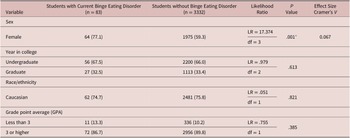
A total 3415 college students were included. Of these, 83 (2.4%) had a positive screening outcome for BED, based on the relevant MIDI module. Current BED was associated with female gender. Other demographic factors (year in college, racial/ethnic group, and GPA) did not differ significantly between those with vs without BED (Table 1).
Demographics of University Students based on Binge Eating Disorder

All numbers are n (%) unless otherwise stated.
* P value significant with Bonferroni correction; critical P = .05/4 = .125.
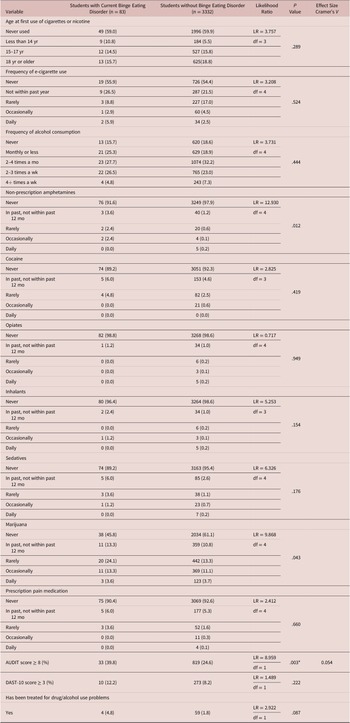
BED was associated with higher AUDIT scores but not with frequency of alcohol consumption, treatment for drug/alcohol use problems or use of any other substances included in the survey (Table 2).
Alcohol, Tobacco and Drug use Based on Binge Eating Disorder

All numbers are n (%) unless otherwise stated.
Abbreviations: AUDIT = Alcohol Use Disorders Identification Test (AUDIT); DAST-10 = Drug Abuse Screening Test.
* P value significant with Bonferroni correction; critical P = .05/13 = .004.
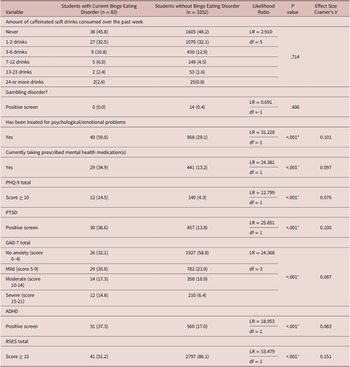
Students with current BED were more likely to have been treated for psychological/emotional problems and to be taking prescribed mental health medications. Questionnaires demonstrated that BED was associated with higher scores in the PHQ-9 and GAD-7, lower RSES scores, and higher likelihoods of PTSD and ADHD. BED was not associated with consumption of caffeinated soft drinks or with presence of gambling disorder (Table 3).
Impulsive Behaviors and Psychiatric History Based on Binge Eating Disorder

All numbers are n (%) unless otherwise stated.
Abbreviations: ADHD, Attention-Deficit/Hyperactivity Disorder; GAD-7, Generalized Anxiety Disorder 7; PHQ-9, Patient Health Questionnaire; PTSD, Post-Traumatic Stress Disorder; RSES, Rosenberg Self-Esteem Scale.
* P value significant with Bonferroni correction; critical P = .05/9 = .006.
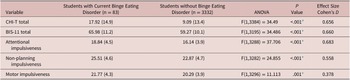
Students with current BED had higher BIS-11 total scores, including higher scores for each subscale. BED was also associated with higher CHI-T scores (Table 4).
Impulsivity and Compulsivity Based on Binge Eating Disorder

Data refer to mean and (standard deviation).
Abbreviations: BIS-11, Barratt Impulsiveness Scale, Version 11; CHI-T, Cambridge-Chicago Compulsivity Trait Scale.
* P value significant with Bonferroni correction; critical P = .05/5 = .01.
Discussion
This large study of university students assessed associations between BED and demographic and mental health measures. We found that 2.4% of students had a positive screen for current BED, which is in line with the lower end of estimates by previous studies in university student populations.Reference Kugu, Akyuz, Dogan, Ersan and Izgic 10 –Reference Cotrufo, Barretta, Monteleone and Maj 18 BED was more likely in females, consistent with previous findings.Reference Galmiche, Déchelotte, Lambert and Tavolacci 2
The largest effect sizes in this study were seen when examining the associations of BED with trait impulsivity and compulsivity. Students with BED had significantly higher BIS-11 and CHI-T scores with medium-large effect sizes (D = 0.660 and 0.656, respectively), including higher scores in all three BIS-11 subscales. Deficits in tasks assessing inhibitory control and cognitive flexibility have previously been reported in BED, supporting involvement of impulsive/compulsive tendencies in its pathophysiology.Reference Kessler, Hutson, Herman and Potenza 27 In addition, neuroimaging findings have implicated brain regions such as the prefrontal cortex and striatum in BED, suggesting parallels with other impulsive/compulsive-related disorders such as substance use or behavioral addictions.Reference Kessler, Hutson, Herman and Potenza 27 , Reference Boswell, Potenza and Grilo 47 –Reference Chamberlain, Lochner and Stein 49 Higher BIS-11 scores have previously been associated with BED.Reference Ural, Belli, Akbudak, Solmaz, Bektas and Celebi 50 However, to our knowledge, this is the first study to investigate trait compulsivity in BED, as self-report measures designed to assess compulsivity across disorders have only recently been developed.Reference Hook, Grant and Ioannidis 31 Prior work has typically used scales unsuitable for measuring compulsivity, such as relying on measures of obsessive–compulsive symptoms. In future, these associations should be tested in a range of populations, using both self-report measures and cognitive tasks. It would also be valuable to conduct longitudinal research to examine whether these traits exist prior to BED and confer vulnerability to developing it.
Regarding substance use, BED was associated with higher AUDIT scores, consistent with previously reported links between BED and alcohol use disorder.Reference Bogusz, Kopera and Jakubczyk 51 However, the effect size was very small (V = 0.054) and there was no association between BED and frequency of alcohol consumption or treatment for drug/alcohol problems. As the AUDIT captures information regarding drinking behaviors as well as frequency,Reference Saunders, Aasland, Babor, de la Fuente and Grant 33 the higher AUDIT scores identified here may indicate a possible relationship between BED and binge drinking. Indeed, there is evidence of a direct relationship between binge eating and binge drinking in undergraduate studentsReference Escrivá-Martínez, Galiana, Herrero, Rodríguez-Arias and Baños 52 and this association could be mediated either via shared neurobiology or through use of these behaviors to avoid or delay unpleasant affective states.Reference Bogusz, Kopera and Jakubczyk 51 –Reference Ferriter and Ray 53 Given this possible relationship between binge eating and binge drinking, and the identification of higher AUDIT scores in students with BED in this study, it may be important to screen for other binge behaviors in individuals with BED.
BED was associated with a range of other mental disorders in this study. Students with BED reported higher levels of anxiety and depressive symptoms, lower self-esteem and higher likelihoods of PTSD and ADHD. They were also more likely to have been treated for psychological/emotional problems and to be taking prescribed mental health medications. However, and in contrast to the links with compulsivity and impulsivity at the trans-diagnostic level, all these associations had small effect sizes, with V between 0.076 and 0.151. These findings are in line with previous literature, which has reported that a majority of individuals with BED meet lifetime criteria for other mental disorders.Reference Kessler, Berglund and Chiu 5 Depressive symptoms and low self-esteem have been linked to self-criticism and the over-evaluation of shape and weight in BED,Reference Dunkley and Grilo 54 as well as to a greater likelihood of later reporting binge eating in a longitudinal study,Reference Goldschmidt, Wall, Zhang, Loth and Neumark-Sztainer 55 suggesting that they might be related to the development of BED. Lifetime prevalence of BED is higher in individuals with PTSD compared to people with no trauma exposure and so binge eating may act as a mechanism to cope with PTSD symptoms or trauma.Reference Braun, El-Gabalawy, Sommer, Pietrzak, Mitchell and Mota 56 Prior literature also supports a relationship between binge eating and ADHD, although the nature of the association is unclearReference Cortese, Bernardina and Mouren 57 –Reference Nazar, Bernardes, Peachey, Sergeant, Mattos and Treasure 59 and may be accounted for by comorbid psychopathology.Reference Ziobrowski, Brewerton and Duncan 60 Taken together, the findings presented here support previous reports of comorbidity between BED and multiple other mental disorders. Students with BED in this study were more likely to have been treated for psychological/emotional problems than students without BED, in line with prior research in BED; however, evidence suggests that only a minority of individuals with BED receive treatment specifically for their eating disorder.Reference Kessler, Berglund and Chiu 5 , Reference Ágh, Kovács, Pawaskar, Supina, Inotai and Vokó 61 This may be related to low levels of recognition, as one internet-based survey found that only a small minority (3.2%) of respondents from the general population meeting criteria for BED had received a formal diagnosis.Reference Cossrow, Pawaskar and Witt 62 Therefore, our findings highlight the need to screen for disordered eating in individuals presenting with a range of mental disorders, to facilitate access to specific support.
Major strengths of this study are its large sample size, the wide variety of comorbidities included, the use of a self-report BED tool adapted from a validated clinical interview (the MIDI), and the collection of a trans-diagnostic compulsivity measure (as well as other salient parameters). An important limitation is the anonymous, self-report design, which may be less accurate than face-to-face clinical assessment, including in terms of diagnosing BED accurately. However, this design may have facilitated participants disclosing information regarding their mental health and substance misuse more openly than they might have done in a face-to-face research study. In addition, as the survey was cross-sectional, causality cannot be shown. The response rate to the survey was 36.1% and it is not possible to confirm whether these findings generalize to the whole sample. As the survey was anonymous, it is not possible to compare the demographic information of those who completed the survey and those who did not. Those students who completed the survey, however, were similar on demographic variables to the larger university population.
To conclude, in a large sample of university students, we found a BED prevalence of 2.4% and BED was more likely in females. BED was associated with trait impulsivity and compulsivity with medium-large effect sizes, implicating these latent phenotypes in its pathophysiology. BED was also associated, with smaller effect sizes, with higher AUDIT scores, depressive and anxiety symptoms, PTSD, ADHD, low self-esteem and treatment for psychological/emotional problems (including prescribed medication). The identified associations with impulsivity and compulsivity strengthen current understanding of the neurobiological underpinnings of BED, while the associations with a wide range of mental disorders, albeit with small effect sizes, highlight the need to screen for disordered eating in a range of psychiatric presentations.
Authorship Contributions
Conceptualization: K.L., S.R.C., and J.E.G.; Data curation: K.L., J.E.G.; Investigation: J.S., S.R.C., and J.E.G.; Formal analysis: K.L. and J.E.G.; Methodology: K.L., S.R.C., and J.E.G.; Project administration: K.L. and J.E.G.; Funding acquisition: S.R.C.; Writing – original draft: J.S., K.L., S.R.C., and J.E.G.; Writing – review & editing: J.S., S.R.C., J.E.G.
Funding
This research was funded in whole, or in part, by Wellcome (110049/Z/15/Z & 110049/Z/15/A). For the purpose of open access, the author has applied a CC BY public copyright licence to any Author Accepted Manuscript version arising from this submission. Dr Solly’s role in this study was funded by the East Anglian Foundation Program.
Disclosure
Prof. Grant has received research grants from the TLC Foundation for Body-Focused Repetitive Behaviors, and Otsuka, Biohaven, and Avanir Pharmaceuticals. He receives yearly compensation for acting as editor-in-chief of the Journal of Gambling Studies and has received royalties from Oxford University Press, American Psychiatric Publishing, Inc., Norton Press, and McGraw Hill. Prof. Chamberlain receives an honorarium from Elsevier for editorial work. He previously consulted for Promentis on work unrelated to the content of this paper. Prof. Chamberlain’s role in this project was supported and funded by Wellcome. Jeremy Solly and Katherine Lust report no relevant disclosures.