Introduction
The apple clearwing moth, Synanthedon myopaeformis (Borkhausen) (Lepidoptera: Sesiidae), is a destructive pest of commercial apple trees, Malus domestica Borkhausen, in Europe (Dickler 1976; Blaser and Charmillot 1984; Castellari Reference Castellari1987; Sahinoglou et al. 1999; Kutinkova et al. Reference Kutinkova, Andreev, Subchev, Szöcs and Tóth2006) and some eastern Mediterranean countries (Abd Elkader and Zaklama Reference Abd Elkader and Zaklama1971; Ateyyat and Al-Antary Reference Ateyyat and Al-Antary2006). Its recent introduction to Canada (Beaton and Carter Reference Beaton and Carter2006; Philip Reference Philip2006) and proliferation in organic apple-growing areas of British Columbia, Canada in particular (Cossentine et al. Reference Cossentine, Aurelian and Judd2013), has stimulated our research to improve behaviourally based alternatives for managing this European pest. Mass trapping adult S. myopaeformis has provided promising levels of control in Europe (Trematerra Reference Trematerra1993; Önuçar and Ulu Reference Önuçar and Ulu1999; Bosch et al. Reference Bosch, Sarasua and Avilla2001) and is under evaluation as an organic tactic for this invasive species in British Columbia (El-Sayed et al. Reference El-Sayed, Suckling, Wearing and Byers2006; Aurelian Reference Aurelian2011).
Development of an effective mass-trapping system depends on accurate characterisation of the trap parameters that affect catches and an understanding of how these factors might interact and be combined in order to maximise mass-trapping efforts (Broumas et al. Reference Broumas, Haniotakis, Liaropoulos, Tomazou and Ragoussis2002). Sex pheromone, juice baits, and floral odours have been identified as potential attractants for mass-trapping S. myopaeformis (Judd et al. Reference Judd, Gries, Aurelian and Gries2011; Aurelian et al. Reference Aurelian, Evenden and Judd2012; Eby et al. Reference Eby, Gardiner, Gries, Judd, Khaskin and Gries2013a) but the importance of other trap attributes that might affect catches with these baits has not been examined in any detail. Vision is an important sensory modality used by many diurnal insects to find a variety of resources including host plants, mating encounter sites and food sources (Prokopy and Owens Reference Prokopy and Owens1983; Balkenius et al. Reference Balkenius, Rosén and Kelber2006). The “colour” of these resources, or more accurately their spectral reflectance, is often a key stimulus and some species exhibit considerable visual specialisation (Prokopy and Owens Reference Prokopy and Owens1978). For day-flying species like S. myopaeformis, often observed swarming over and mating on sunlit foliage at the top of apple trees (Stüber and Dickler Reference Stüber and Dickler1988; Trematerra Reference Trematerra1993; G.J. personal observations), or visiting and feeding on various flowers (Popescu-Gorj et al. Reference Popescu-Gorj, Niculescu and Alexinschi1958; Aurelian Reference Aurelian2011; Eby Reference Eby2012), vision might be an especially important sensory system. By extension, catches in traps emitting sex pheromone or floral odours that elicit mate-finding or food-finding orientation behaviours, respectively, might be influenced by associated visual cues.
The role of vision in pheromone-mediated behaviour of moths and its influence on their catches in pheromone traps has received limited research effort, probably because their highly efficient olfactory mate-finding systems seemingly render other sensory systems unnecessary. Nevertheless, studies have shown that spectral reflectance from pheromone traps can affect catches even among nocturnal and crepuscular Lepidoptera (McLaughlin et al. Reference McLaughlin, Brogdon, Agee and Mitchell1975; Mitchell et al. Reference Mitchell, Agee and Heath1989; Meagher Reference Meagher2001; Knight and Miliczky Reference Knight and Miliczky2003; Athanassiou et al. Reference Athanassiou, Kavallieratos and Mazomenos2004). Similar studies in day-flying Sesiidae are somewhat limited (McLaughlin et al. Reference McLaughlin, Doolittle, Gentry, Mitchell and Tumlinson1976; Childers et al. Reference Childers, Hollowa and Pollet1979; Timmons and Potter Reference Timmons and Potter1981; Stüber and Dickler Reference Stüber and Dickler1988; Knodel and Agnello Reference Knodel and Agnello1990; Būda and Karalius Reference Būda and Karalius1993; Trematerra Reference Trematerra1993; Suckling et al. Reference Suckling, Gibb, Burnip, Snelling, De Ruiter and Langford2005; Roubos and Liburd Reference Roubos and Liburd2008; Teasdale et al. Reference Teasdale, Judd, Gries and Gries2013) even though some species have well-developed vision (Karalius and Būda Reference Karalius and Būda2007).
Many of the early visual studies on sesiid species appear to have been motivated by the view that cues associated with their typically colourful females might influence mate finding (Barry Reference Barry1978). Unfortunately, in most studies the size and scale of trap mimics did not match those of moths, the traps often varied in parameters other than colour, spectral properties of traps were mostly unknown and in choice tests the spacing between traps varied from 0.3–20.0 m. Not surprisingly the results are quite variable, sometimes even within species, and no clear statement about colour optimisation of pheromone traps for the Sesiidae can be made. For example, lilac borer, Podosesia syringae (Harris), and peachtree borer, Synanthedon exitiosa (Say), were most often caught in black traps, whereas lesser peachtree borer, Synanthedon pictipes (Grote and Robinson), responded most often to red and all three responded least often to white (Childers et al. Reference Childers, Hollowa and Pollet1979; Timmons and Potter Reference Timmons and Potter1981). These studies contradict earlier findings that trap colour had no effect on catches of either peachtree borer species (McLaughlin et al. Reference McLaughlin, Doolittle, Gentry, Mitchell and Tumlinson1976).
With reference to S. myopaeformis, Stüber and Dickler (Reference Stüber and Dickler1986) used motion photography to show that visual cues associated with the orange-red band on the otherwise black abdomen of the females, are involved in the close-range orientation behaviour and mating attempts of the male. Subsequent tests showing males approached black and red-striped pheromone traps more often than others, were interpreted as evidence of this mate-finding behaviour (Stüber and Dickler Reference Stüber and Dickler1988). In apparent contradiction, however, Trematerra (Reference Trematerra1993) reported that yellow or green pheromone-baited traps caught the most moths. In both of these papers, the authors failed to mention what kinds of traps were used and neither provided measurements of the spectral reflectance properties of their traps (Stüber and Dickler Reference Stüber and Dickler1988; Trematerra Reference Trematerra1993). These are important omissions because the level of spectral discrimination displayed by some sesiid species when orienting to pheromone traps is apparently affected by trap type (Suckling et al. Reference Suckling, Gibb, Burnip, Snelling, De Ruiter and Langford2005; Teasdale et al. Reference Teasdale, Judd, Gries and Gries2013); pheromone catches of several sesiid species, including S. myopaeformis, are strongly influenced by trap design (Trematerra Reference Trematerra1987; Knodel and Agnello Reference Knodel and Agnello1990; Rocchini et al. Reference Rocchini, Lindgren and Bennett2003; Jackson et al. Reference Jackson, Canhilal and Carner2005; Brown et al. Reference Brown, Kittelson, Hannon and Walsh2006; Weihman and Liburd Reference Weihman and Liburd2007); and pigments subjectively described as being green, yellow, or even white, can have quite different spectral reflectance properties (Prokopy et al. Reference Prokopy, Economopoulos and McFadden1975; Judd et al. Reference Judd, Borden and Wynne1988).
Our understanding of the role visual stimuli play in food finding by clearwing moths is even more rudimentary than that of mate-finding behaviour. Nectar-feeding insects generally use vision and olfaction to find rewarding flowers and different species may give different weight to the two sensory inputs (Balkenius et al. Reference Balkenius, Rosén and Kelber2006). Eby (Reference Eby2012) showed that olfactory stimuli took precedence over visual stimuli when S. myopaeformis was foraging for and feeding on inflorescences of showy milkweed, but phenylacetaldehyde, the key olfactory stimulus (Eby et al. Reference Eby, Gardiner, Gries, Judd, Khaskin and Gries2013a), was never recombined with visual stimuli from the plant to determine whether the cues acted in concert. For example, in laboratory choice and no-choice tests, the African vine borer, Melittia oedipus Oberthür (Lepidoptera: Sesiidae), spontaneously landed more often on yellow-coloured papers than those of any other colour, and the addition of a honey-water food source significantly increased landings on yellow (Reddy et al. Reference Reddy, Cruz, Braganza and Muniappan2009). Although there is insufficient evidence to conclude yellow elicits a food-finding response in M. oedipus, it serves as an example that combining sensory stimuli can maximise responses by sesiid moths. Aurelian et al. (Reference Aurelian, Evenden and Judd2012) recently conducted mass-trapping studies on S. myopaeformis using yellow bottle traps baited with grape juice. In that study, both sexes of moths were caught in large numbers and both often fed on the bait before being caught, but the relative roles of visual and olfactory stimuli associated with these traps was not determined.
Our objective in the study described here is to provide information that might improve food- and pheromone-based mass-trapping systems for S. myopaeformis by characterising the spectral reflectance from various traps and by developing a deeper understanding of the importance of these visual stimuli in maximising catches of S. myopaeformis orienting to these olfactory baits. Throughout this paper, our use of the word “colour” to describe traps is for language convenience only and in no way implies insects use colour vision or have a psychophysical response to colour, but only to the measurable spectral reflectance.
Materials and methods
Fifteen experiments were conducted over several summers (2007–2012) in various commercial organic apple orchards near Cawston (49.15°N and −119.74°W) in the Similkameen Valley, British Columbia, Canada. Orchard blocks were composed of mixed varieties (Ambrosia, Gala, Granny Smith, and Spartan) of dwarfing, high-density superspindle plantings with an average of height of 2–3 m and 1200–5444 apple trees per ha.
Several experiments made use of clear plastic delta traps and sticky bases (Pherobank International, Wageningen, The Netherlands). Plastic delta traps, 21 cm long with 10 × 10 × 10 cm cross-sectional dimensions, were painted internally and externally with a gloss white base coat (Krylon® Fusion for Plastic™, Krylon Products Group, Cleveland, Ohio, United States of America), and then with one of an assortment of pigments having dominant wavelengths (hues) that spanned the human visible spectrum (purple, blue, green, yellow, red, white, and black) using high-gloss acrylic water-borne Ecologic™ paints (Cloverdale Paints, Penticton, British Columbia, Canada). These same paints were applied to 2-L clear plastic beverage bottles (Bottle Depot, Summerland, British Columbia, Canada) that had two 13 × 13 cm windows cut out on opposing sides as described by Aurelian et al. (Reference Aurelian, Evenden and Judd2012).
In all experiments with sex pheromone, each trap was baited with a grey halobutyl rubber septum (West Co., Lyonville, Pennsylvania, United States of America) impregnated with 1 mg of 3Z,13Z-octadecadienyl acetate (Pherobank, Wageningen, The Netherlands; >95% isomeric purity) diluted in 200 μL of HPLC grade hexane (Aldrich Chemical Co., Milwaukee, Wisconsin, United States of America). In all experiments with delta traps, the pheromone lure was always pinned inside the trap at its upper centre and traps were hung about 1.5 m above ground within the tree canopy.
Odour-modulated spectral discrimination
Three experiments were conducted to compare the responses of S. myopaeformis to the same range of chromatic and achromatic visual stimuli when orienting to traps baited with different olfactory lures eliciting either mate finding (sex pheromone) or food finding (grape juice or phenylacetaldehyde).
In experiment 1, we used a randomised block design with 10 replicates to compare catches of male S. myopaeformis in pheromone-baited delta traps. The eight treatment traps (purple, blue, green, yellow, red, white, black, and clear) were deployed in linear blocks with 5 m between traps. Each block of eight traps was separated from the next by 20–21 m. Traps were deployed on 21 June 2007, moths were counted and sticky bases replaced on 28 June, and all traps were retrieved and moths counted on 5 July.
In experiment 2, we used a randomised block design with five replicates to compare catches of S. myopaeformis in phenylacetaldehyde-baited delta traps of different colours. The eight treatment traps (purple, blue, green, yellow, red, white, black, and clear) were deployed in linear blocks with 15 m between traps. Each block of eight traps was separated from the next by 15 m. A phenylacetaldehyde lure was pinned inside each trap at its upper centre. Phenylacetaldehyde lures consisted of an 8-mL Nalgene bottle (#2006-9025, Thermo Scientific, Rochester, New York, United States of America) containing two cotton balls to which 2 mL of phenylacetaldehyde (≥90%, Sigma-Aldrich, St. Louis, Missouri, United States of America) was applied and from which it volatilised through a 6.35-mm hole in the lid (Eby et al. Reference Eby, Gardiner, Gries, Judd, Khaskin and Gries2013a). Traps were hung about 1.5 m above ground within the tree canopy. This study was conducted from 12–26 August 2011. Moth catches were counted and sticky bases were replaced weekly.
In experiment 3, we used a randomised block design with five replicates to compare catches of S. myopaeformis in grape juice-baited bottle traps painted different colours. The bottom of each bottle was filled with 200 mL of fresh Concord grape juice (SunRype™, Kelowna, British Columbia, Canada). In this trap, grape juice acts as an attractant and serves as the trapping medium (Aurelian et al. Reference Aurelian, Evenden and Judd2012). Eight bottle traps (purple, blue, green, yellow, red, white, black, and clear) were deployed in linear blocks with 5 m between traps. Each block of eight traps was separated by 15 m. Traps were hung from trellis wires between adjacent trees about 1.5 m above ground. Traps were checked daily and moths were counted on three consecutive days, after which juice baits were replaced and checked daily for another three days. This experiment was conducted from 24–30 July 2008. Moths caught in experiments 2 and 3 were not separated by sex because males and females respond equally to grape juice or phenylacetaldehyde in relation to the population sex ratio (Aurelian et al. Reference Aurelian, Evenden and Judd2012; Eby et al. Reference Eby, Gardiner, Gries, Judd, Khaskin and Gries2013a).
Pheromone-baited fluorescent delta traps
Experiment 4 was conducted to examine the impact of increasing the intensity of reflectance from pheromone-baited green and yellow delta traps on catches of male S. myopaeformis. Daylight fluorescent pigments (DayGlo® Color Corporation, Cleveland, Ohio, United States of America) absorb shorter wavelengths of incident light in the violet-blue end of the spectrum and radiate them in the green-yellow (500–600 nm) region of the spectrum (Voedisch Reference Voedisch1961). The net result is that the intensity of light reflected from daylight fluorescent green and yellow pigments in the 500–600 nm wavelength region often exceeds 100% of the incident visible energy, making these pigments appear brighter than equivalent nonfluorescing pigments.
In experiment 4, we used a randomised block design with 10 replicates to compare catches of male S. myopaeformis in pheromone-baited delta traps painted with Turf Green (A127-TG 1740-227) and Saturn Yellow (A127-SY 1740-236) fluorescent pigments (Beauti-Tone, Home Hardware Stores Ltd., Burford, Ontario, Canada), relative to catches in clear plastic delta traps and those painted nonfluorescent yellow or green. The five treatment traps were deployed in linear blocks with 5 m between traps. Each block of five traps was separated from the next by 20 m. Traps were deployed on 7 July 2007 and moths were counted and sticky bases replaced on 14 July and traps were retrieved and moths counted again on 17 July.
Studies with single colour unitraps
Universal moth traps, developed in the 1980s (International Pheromone Systems Ltd., United Kingdom) and often referred to as bucket traps, funnel traps, or unitraps, are a large-volume nonsaturating trap suitable for mass-trapping S. myopaeformis (Trematerra Reference Trematerra1987; Aurelian et al. Reference Aurelian, Evenden and Judd2012). Unitraps are a plastic composite trap consisting of a lid, funnel, bucket, and lure basket with a snap cap that fits into the lid. Unitraps are available in assorted colours from various commercial sources but parts are interchangeable. Two studies on sesiid moths (Suckling et al. Reference Suckling, Gibb, Burnip, Snelling, De Ruiter and Langford2005; Roubos and Liburd Reference Roubos and Liburd2008) have concluded that an industry standard multicolour unitrap with a green lid, yellow funnel, and white bucket is more attractive than all-yellow equivalents similar to that used by Aurelian et al. (Reference Aurelian, Evenden and Judd2012).
We conducted experiments 5–7 to test the hypothesis that male S. myopaeformis discriminate among pheromone-baited unitraps constructed in different single colours. All-green and all-white multicomponent unitraps (lid, funnel, bucket, and pheromone lure basket) were purchased from Contech Enterprises, Delta, British Columbia, Canada. It should be noted that these traps bore a label embossed in the plastic lids indicating they were the original Unitrap™ and were manufactured in the United Kingdom. All-yellow and all-red unitraps that bore no such label were purchased from AgBio Inc., Westminster, Colorado, United States of America, but were manufactured by ChemTica International, Costa Rica. Translucent white lure baskets (AgBio Inc.) containing a rubber septum pheromone lure were used in all experiments with unitraps unless stated otherwise. We placed a 2.5 × 5.0 cm insecticidal strip containing 10% dichlorvos (Vaportape™ II, Hercon Environmental, Emigsville, Pennsylvania, United States of America) inside the bucket of all unitraps to improve capture and kill moths quickly after entry. Unitraps without insecticidal strips catch significantly fewer S. myopaeformis than those with these strips (G.J., personal observation).
In experiments 5 and 6, we compared catches in all-yellow, all-green, and all-white unitraps using 20-m and 1-m trap spacing in each, respectively. In experiment 5, we used a randomised block design with nine replicates. The three treatment traps were deployed in linear blocks with 20 m between traps and 50 m between blocks. Traps were checked every three to four days from 2–16 July 2008. In experiment 6, we used a randomised block design with six replicates. The three treatment traps were deployed in linear blocks with 1 m between traps but each group of three traps was deployed 50 m apart. Traps were checked every 3–4 days from 17–31 July 2008. In experiment 7, we deployed four unitrap treatments (all-white, all-green, all-yellow, and all-red) in four square blocks with 20 m between traps and 50 m between blocks. Traps were hung from trellis wires between adjacent trees about 1.5 m above ground. This experiment was conducted from 12 July until 9 August 2012. Traps were checked every seven days, at which time moths were counted and removed, and then traps within blocks were rotated clockwise one position.
Studies with multicolour unitraps
We conducted experiments 8–12 to test the hypothesis that catches of male S. myopaeformis in pheromone-baited unitraps are influenced by the spectral reflectance properties of their individual components. In each of these five experiments, three treatment traps were deployed in 5–9 linear blocks and traps within each block were spaced 1 m apart. Each block of traps was separated by at least 50 m. Traps were checked every four days at which time moths were counted and removed, and then traps within blocks were rotated clockwise one position. This rotation was repeated twice so each trap occupied each position within each block at least once. To maintain consistency each group of three traps was always deployed in an east-west direction in the same row of trees to ensure uniform southern lighting. Using this procedure, we examined the influence of spectral reflectance from the lid (experiment 8), funnel (experiment 9), and bucket (experiment 10) of all-yellow traps, and from the funnel (experiment 11) and lid/bucket (experiment 12) of all-green traps. Experiments 8–10 were conducted from 30 June until 12 July 2011 and experiments 11 and 12 were conducted from 12–24 July 2007.
Experiment 13 was conducted to test the hypothesis that the colour of the pheromone basket influenced catches in all-yellow unitraps. Industry standard green and translucent white pheromone baskets (Contech Enterprises) were compared with a custom black basket (AgBio Inc.). The three treatments were deployed in nine linear blocks with 20 m between traps and 50 m between blocks. This experiment was conducted from 3–31 July 2010.
Experiment 14 tested the hypothesis that adding an orange-red elastic band around the centre of a black pheromone basket might influence catches in all-yellow unitraps. The two treatments were deployed as pairs 5 m apart in five blocks with blocks separated by 50 m. This experiment was conducted from 5–12 August 2010.
Daily activity patterns
In experiment 15, catches of S. myopaeformis in three all-yellow pheromone-baited unitraps and three juice-baited yellow bottle traps that were randomly deployed 20 m apart within the canopy of an apple orchard were recorded every hour from 08:00–20:00 PDT on 18 July 2008. During each hourly test period, light intensity was measured in lux using a VWR light meter (catalogue number 21800-014; VWR International, Ltd., Mississauga, Ontario, Canada), oriented horizontally and positioned at approximately the same height as the top of the trap. Temperature within the canopy was recorded using a mercury thermometer hanging on the north side of a tree in the north-east corner of the orchard. Measurements were taken every 15 minutes and averaged over each hour of observation.
Spectral reflectance measurements
The spectral reflectance from all traps was measured with a JAZ-PX spectrophotometer (Ocean Optics, Dunedin, Florida, United States of America) using a pulsed full spectrum Xenon Arc light source with a 400-μm diameter silica core fibre optic reflection probe (QR400-7-UV-VIS, Ocean Optics) fitted with a custom-built 45° black anodised aluminium attachment. The spectrophotometer was calibrated against a Spectralon white standard (WS-1-SL, Ocean Optics) and dark reference before measuring each sample. The intensity of reflectance from measured surfaces is presented as a percentage relative to the white standard, which is considered 100%. It was impossible to directly measure reflectance from clear traps. Therefore, we measured reflectance from the Spectralon white standard covered with clear acetate plastic, which allowed us to visualise the clear transmittance of the plastic and infer its neutral reflectance. To obtain smooth reflectance curves, measurements were taken with the lamp flashing every 10 ms and the JAZ completing 50 scans to average with 0-boxcar smoothing (averaging of adjacent pixels).
Statistical analyses
Trap-catch data generated by experiments 1–13 were tested for normality (Kolmogorov–Smirnov Test) and equality of variances (Levine's Median Test) before being subjected to two-way randomised block analyses of variance (ANOVA). Data from experiments 2, 7, and 8 were transformed (√[x + 0.5]) to meet these conditions before the ANOVA (Zar Reference Zar1984). Mean catches for each treatment were separated post hoc using Tukey's multiple comparison procedure with the experiment-wise error rate set at α = 0.05 (Zar Reference Zar1984). Experiment 14 was analysed using a two-sample t-test. A χ2 test was used to compare distributions of hourly catches in juice and pheromone traps (experiment 15). All analyses were performed using SigmaPlot® 12 (Systat Software Inc., San Jose, California, United States of America).
Results
Odour-modulated spectral discrimination
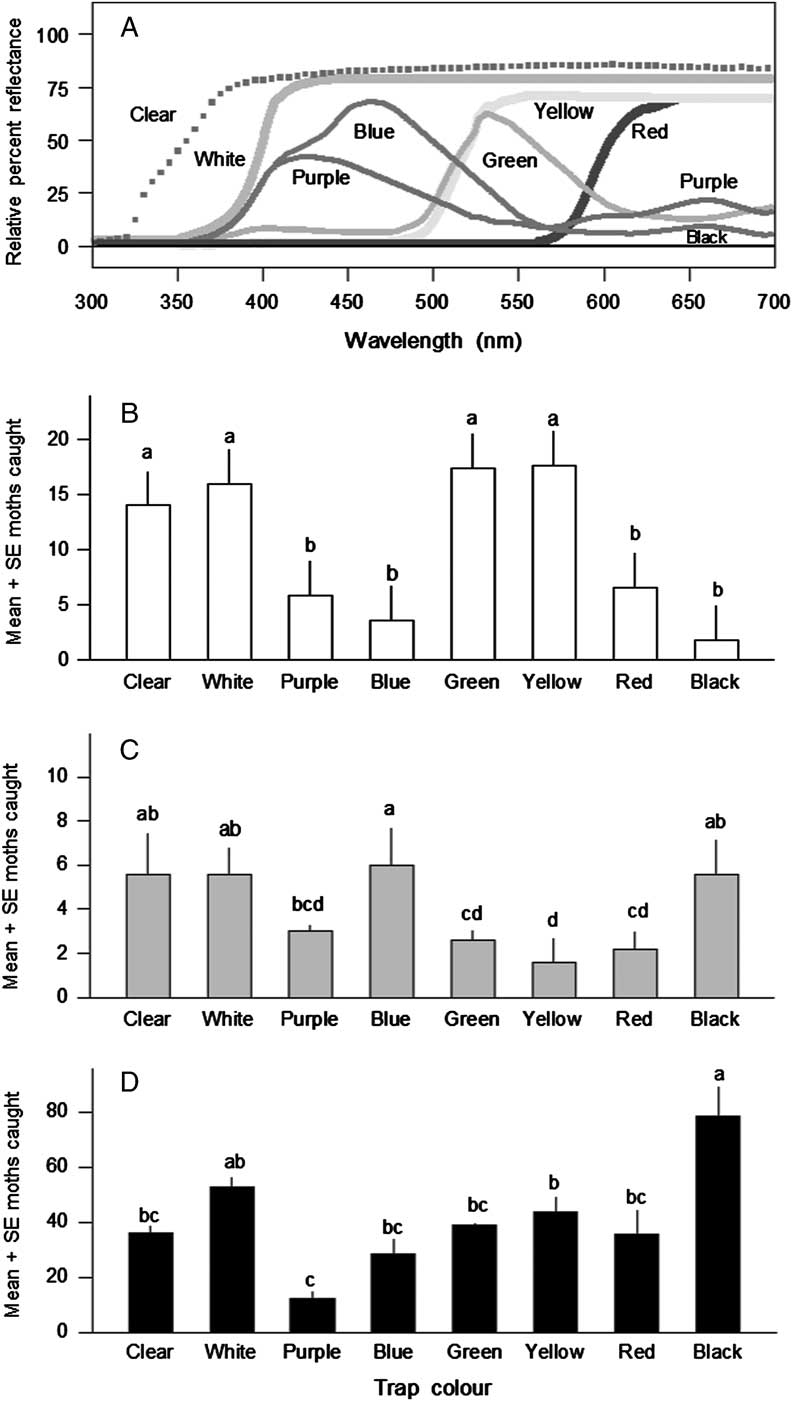
Catches of S. myopaeformis in pheromone-baited delta traps were significantly (F 7, 63 =4.47, P < 0.001) influenced by their spectral reflectance (Fig. 1A) and treatment colours sorted statistically into two distinct groups (Fig. 1B). The most attractive traps all had similarly high levels of reflectance between 500 and 550 nm (yellow, green, and white), or likely transmitted these wavelengths (clear) as reflection from background apple foliage (Prokopy and Owens Reference Prokopy and Owens1978). Traps with peak reflectance outside the green region of the spectrum (purple, blue, and red) had similarly low attraction. Black delta traps reflected little light and were the least attractive pheromone-baited traps (Figs. 1A–1B).
(A) Relative spectral reflectance curves for various acrylic paints when applied to clear plastic delta traps or beverage bottles and (B) catches of male Synanthedon myopaeformis in delta traps baited with 1 mg of 3Z,13Z-octadecadienyl acetate (sex pheromone), and (C) catches of male and female S. myopaeformis in delta traps baited with 5 mL of phenylacetaldehyde (floral odour), and (D) in bottle traps (Aurelian et al. Reference Aurelian, Evenden and Judd2012) baited with 200 mL of Concord grape juice. Bars topped with a common letter are not significantly different (Tukey's test, α = 0.05) following significant ANOVA: pheromone (F 7, 63 = 4.47, P < 0.001); phenylacetaldehyde (F 7, 28 = 9.142, P = 0.001); grape juice (F 7, 28 = 9.221, P < 0.001).

Catches in phenylacetaldehyde-baited delta traps were low because the experiment was conducted late in the season, but trap catches varied significantly (F 7, 28 = 9.142, P = 0.001) with differences in spectral reflectance (Fig. 1A). Yellow delta traps were among the least attractive when baited with phenylacetaldehyde (Fig. 1C), whereas black and blue were among the most attractive, and both of these results are in complete contrast to spectral responses with pheromone-baited delta traps (Fig. 1B).
Catches in juice-baited traps varied significantly (F 7, 28 = 9.221, P < 0.001) with their spectral reflectance (Fig. 1A), but in contrast with pheromone-baited traps, black juice-baited bottle traps were among the most attractive (Fig. 1D), catching significantly more moths than yellow traps.
Pheromone-baited fluorescent delta traps
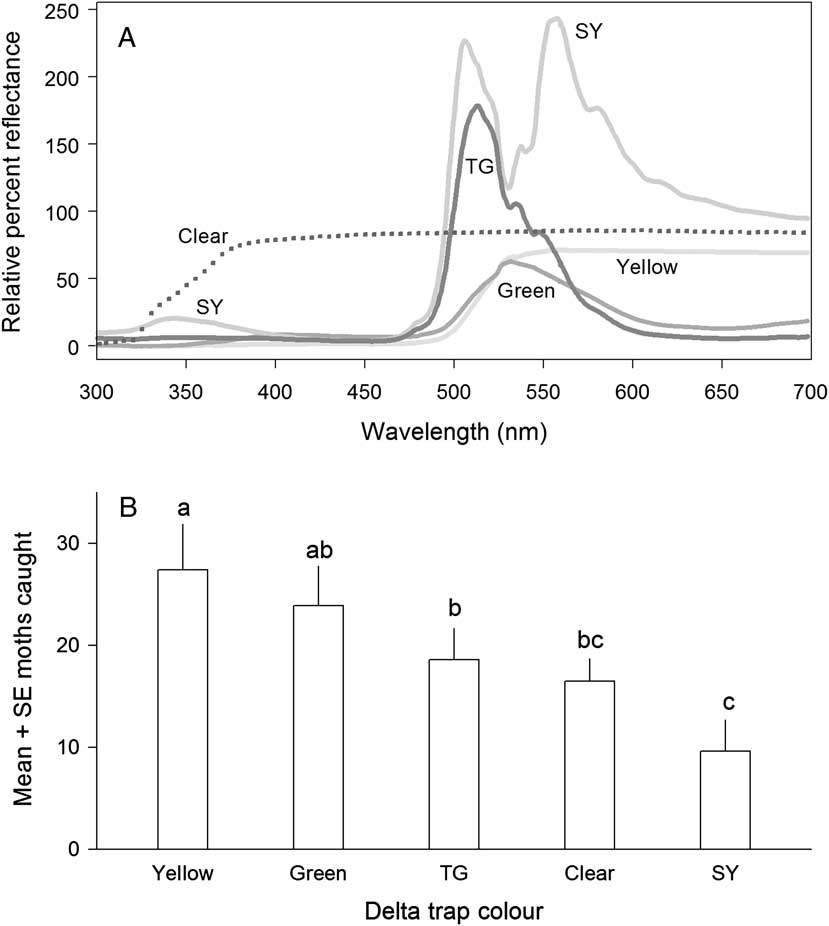
Fluorescent yellow (SY) and green (TG) delta traps reflected substantially more green wavelengths (500–550 nm) than either of their nonfluorescent equivalents (Fig. 2A) and catches of male S. myopaeformis in fluorescent and nonfluorescent pheromone-baited delta traps were significantly different (F 4, 36 = 6.986, P < 0.001). Standard yellow traps were most attractive and fluorescent yellow traps were least attractive (Fig. 2B). Fluorescent green traps were of intermediate attractiveness (Fig. 2B) and their spectral reflectance (Fig. 2A) differed from that of fluorescent yellow traps by reflecting less (5.8% versus 14.5%) ultraviolet light (300–400 nm) and less light above 550 nm (16.6% versus 133.5%).
(A) Relative spectral reflectance curves for green and yellow acrylic paints and two fluorescent pigments Turf Green (TG) and Saturn Yellow (SY) when applied to clear plastic delta traps, and (B) catches of male Synanthedon myopaeformis in these traps when baited with 1 mg of 3Z,13Z-octadecadienyl acetate (sex pheromone). Bars topped with a common letter are not significantly different (Tukey's test, α = 0.05) following significant ANOVA: F 4, 36 = 6.986, P < 0.001.

Single colour unitraps
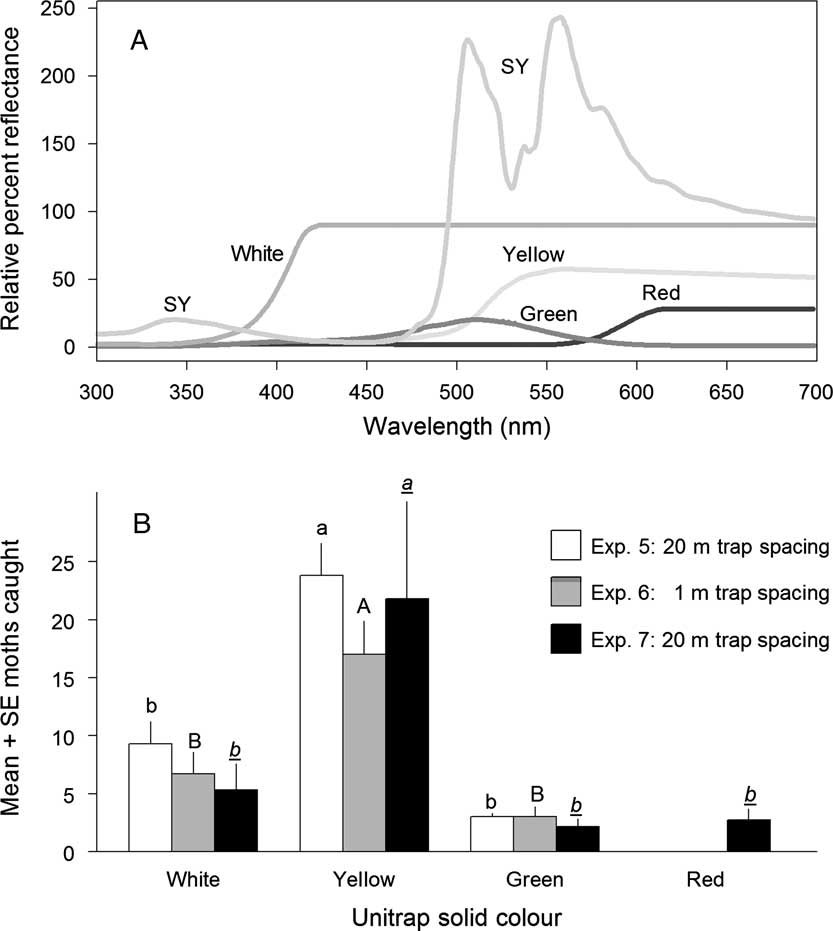
White unitraps reflected more light overall (300–700 nm) and within the 500–550 nm region of the spectrum than did yellow or green unitraps (Fig. 3A). White unitraps also reflected more light than white delta traps (Fig. 1A), but yellow and green unitraps reflected less light (Fig. 3A) than the nonfluorescent yellow and green delta traps, respectively (Fig. 2A). Green unitraps had the lowest intensity of reflected light among all colours used in these studies with the exception of black delta traps (Figs. 1A–3A,).
(A) Relative spectral reflectance curves for several commercial unitraps constructed of differently coloured plastics and Saturn Yellow (SY) fluorescent pigment applied to a white unitrap, and (B) catches of male Synanthedon myopaeformis in some unitraps when baited with 1 mg of 3Z,13Z-octadecadienyl acetate (sex pheromone) and tested using different trap spacing. Bars topped with a common letter and type are not significantly different (Tukey's test, α = 0.05) following significant ANOVA: (experiment 5: F 2, 16 = 5.089, P < 0.019; experiment 6: F 2, 10 = 12.246, P = 0.002; experiment 7: F 3, 9 = 9.812, P = 0.003).

Catches of S. myopaeformis in commercial unitraps constructed of single colours were significantly different in three separate experiments (experiment 5: F 2, 16 = 5.089, P < 0.019; experiment 6: F 2, 10 = 12.246, P = 0.002; experiment 7: F 3, 9 = 9.812, P = 0.003). In each of these experiments, pheromone-baited all-yellow unitraps caught significantly more moths than any other single colour unitrap (Fig. 3B). As a pairing, yellow and green unitraps were less similar with respect to their intensities of reflectance between 500 and 550 nm (Fig. 3A) than the pairing of yellow and green delta traps that caught similar numbers of moths (Fig. 1A). The ranking of catches by unitrap colour was similar using either 1-m or 20-m trap spacing (Fig. 3B), but the 1-m trap spacing provided less variability in mean catches, a larger F statistic and smaller P-value (Fig. 3B). For these reasons, and the observations that moths tended to be caught more often in the most upwind trap, or in the outside positions when grouped closely (G.J., personal observation), all subsequent (chronologically) spectral discrimination tests with unitraps used the 1-m trap spacing and made use of trap rotation within groups.
Multicolour unitraps
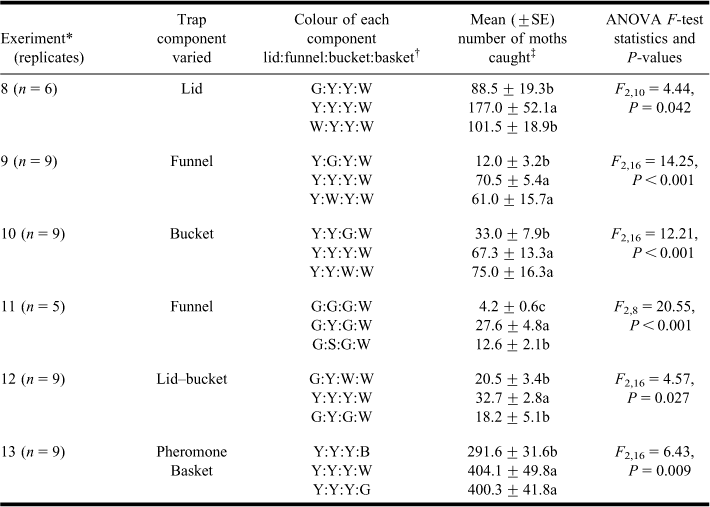
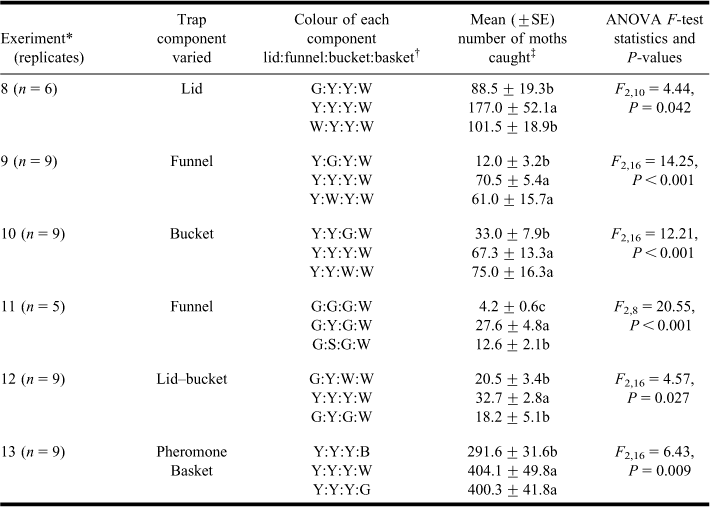
Varying the spectral reflectance patterns of commercial unitraps by interchanging the individual components significantly affected catches of male S. myopaeformis (Table 1). Introducing a green lid, funnel, or bucket component as part of an otherwise yellow unitrap (experiments 8–10, respectively), significantly reduced catches of male S. myopaeformis relative to the all-yellow trap (Table 1). Adding green funnels resulted in an 82% reduction in catches (experiment 9), whereas adding green lids or buckets only caused 50% reductions (Table 1). With the exception of the lid (experiment 8), introducing a white component to yellow unitraps did not significantly influence catch (Table 1).
Catches of male Synanthedon myopaeformis in various solid and multicolour unitraps baited with 1 mg of 3Z,13Z-octadecadienyl acetate (sex pheromone) loaded on grey rubber septa in pheromone baskets.
*Trap spacing in all experiments was 1 m except experiment 13 where 20 m spacing was used.
†Component colours: Green (G), Yellow (Y), White (W), Fluorescent Saturn Yellow (S), Black (B).
‡Means followed by a common letter within an experiment are not significantly different (Tukey's test, α = 0.05) following significant ANOVA (P < 0.05).
Increasing the intensity of green reflectance (500–550 nm) from the funnel component of a green unitrap (experiment 11) yielded mixed results (Table 1). Introducing standard yellow funnels provided a doubling of average reflectance between 500 and 550 nm above that of green funnels (37% versus 18%), but produced a sixfold increase in catches, whereas the fluorescent-painted yellow funnel provided a larger increase in green reflectance (175% versus 18%) but only a threefold increase in catches (Table 1). Saturn yellow funnels reflected more ultraviolet light than standard yellow funnels (Fig. 3A).
The industry standard multicolour unitrap with green lid, yellow funnel, and white bucket was less attractive than an all-yellow unitrap and no more attractive than a multicolour trap with green lid, yellow funnel, and green bucket (Table 1, experiment 12).
Introducing custom black pheromone baskets to all-yellow unitraps significantly reduced catches of male S. myopaeformis relative to catches with identical traps having standard green or translucent white pheromone baskets (Table 1).
Catches in all-yellow unitraps with black pheromone baskets having an orange-red elastic band (24.0 ± 15.9) were not significantly different (t = 0.328, df = 8, P = 0.751) than those with plain black pheromone baskets (22.6 ± 6.4).
Daily activity patterns
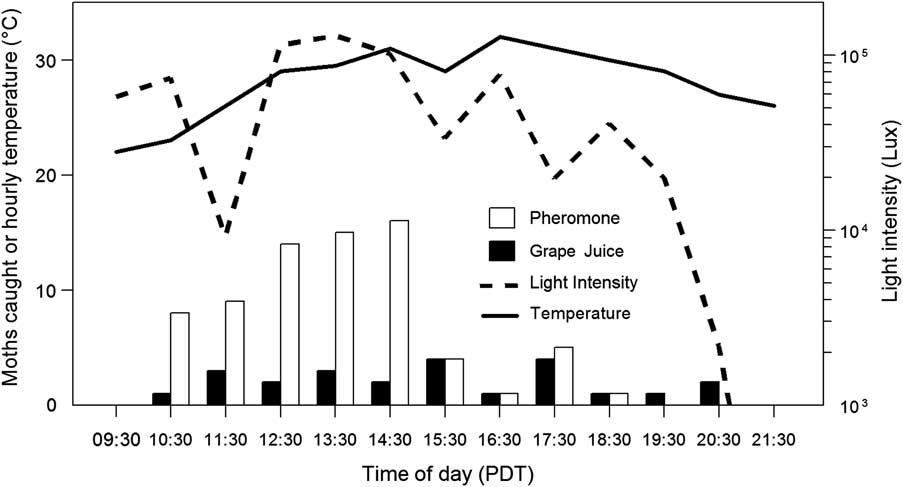
In a single preliminary experiment catches of male S. myopaeformis in pheromone traps varied throughout the day (Fig. 4). No moth catches were recorded in pheromone traps over night or before 10:00 PDT, but catches increased slowly and peaked between 13:30 and 14:30 PDT. Pheromone trap catches declined abruptly in early afternoon as light intensity declined but air temperatures remained high (Fig. 4). Juice traps caught moths uniformly throughout the day and their pattern of hourly catches was significantly different than that of pheromone traps (χ2 = 19.725, df = 10, P = 0.032).
Hourly total catches of male and female Synanthedon myopaeformis in three yellow delta traps and three yellow bottle traps (Aurelian et al. Reference Aurelian, Evenden and Judd2012) baited with 1 mg of 3Z,13Z-octadecadienyl acetate (sex pheromone) or 200 mL of Concord grape juice, respectively, in relation to air temperature and light within the canopy of an apple orchard at Cawston, British Columbia, Canada, on 18 July 2008. Distributions of hourly catches for pheromone and grape juice are significantly different (χ2 = 19.725, df = 10, P = 0.032).

Discussion
Within the context of pheromone communication, S. myopaeformis is clearly influenced by green wavelength reflectance surrounding the source, but the intensity of this reflectance, its mixture with, or level of desaturation by other wavelengths, and perhaps its spatial pattern and contrast, are critical to understanding discrimination among different traps. Synanthedon myopaeformis did not discriminate among pheromone-baited yellow, green, white, or clear delta traps, and all except clear traps, reflected similar intensities of green wavelengths (500–550 nm), whereas the least attractive colours all had peak reflectance outside this region (Fig. 1A). Our interpretation of catches in clear traps is that insects respond to the green wavelengths they transmit as part of their experimental setting and the direction from which they are viewed, i.e., those reflected from surrounding apple foliage. According to Prokopy and Owens (Reference Prokopy and Owens1978), apple foliage has a dark-green reflectance similar to green unitraps (Fig. 3A), and as such, smaller catches with clear traps when compared with yellow or green traps, is expected (Fig. 2B).
Discrimination by S. myopaeformis among the coloured delta traps tested is consistent with electroretinograms from their compound eyes (Eby et al. Reference Eby, Weis, Gardiner, Judd and Gries2013b). Like Synanthedon tipuliformis Clerck (Karalius and Būda Reference Karalius and Būda2007), compound eyes in S. myopaeformis have two distinct peaks of sensitivity, one in the green region (500–550 nm) and another in the ultraviolet region (300–400 nm) of the electromagnetic spectrum. This indicates both species likely have at least two photoreceptors and the potential for ultraviolet – green dichromatic vision (Kelber Reference Kelber2006). Dichromatic vision of this type provides species with the capacity to discriminate among most delta traps tested in experiment 1 using input from green photoreceptors (Kelber Reference Kelber2006) and differences in the intensity of green wavelength reflectance only (Fig. 1A). These same species may have difficulty discriminating among white, yellow, and green delta traps that reflect similar intensities of green light (Fig. 1A), but some, like S. tipuliformis, can apparently discriminate between white and yellow delta traps having similar green wavelength reflectance (Būda and Karalius Reference Būda and Karalius1993). This added level of discrimination would be possible for species having a third receptor type with peak sensitivity in the blue-violet region of the spectrum (Kelber Reference Kelber2006), because white pigments reflect more blue light than yellow or green pigments (Fig. 1A). Even though their electrophysiological data showed no peak sensitivity to blue wavelengths, Karalius and Būda (Reference Karalius and Būda2007) argued with some justification, that S. tipuliformis likely has ultraviolet-blue-green trichromatic vision.
Synanthedon myopaeformis clearly discriminated among fluorescent and nonfluorescent yellow and green delta traps (Fig. 2B). Fluorescent yellow-green pigments used in this study differ from their nonfluorescent equivalents in two key spectral elements: (1) the intensity of green wavelength reflectance is greatest from fluorescent pigments, and (2) the fluorescent pigments reflect ultraviolet light (Fig. 2A). With ultraviolet-green dichromatic vision (Eby et al. Reference Eby, Weis, Gardiner, Judd and Gries2013b), a species like S. myopaeformis should be able to use either or both of these spectral regions to discriminate among fluorescent and nonfluorescent yellow and green pigments in experiment 2 (Fig. 2A). Nonfluorescent yellow was most attractive and fluorescent Saturn yellow was least attractive to S. myopaeformis (Fig. 2B). This was an unexpected result because among several herbivorous species studied, all were more strongly attracted to Saturn yellow traps than they were standard yellow traps (Prokopy and Boller Reference Prokopy and Boller1971; Prokopy Reference Prokopy1972; Prokopy et al. Reference Prokopy, Economopoulos and McFadden1975; Cross et al. Reference Cross, Mitchell and Hardee1976; Prokopy and Owens Reference Prokopy and Owens1978; Coli et al. Reference Coli, Hollingsworth and Maier1992). Saturn yellow reflects significantly more green light than any other pigment. Prokopy (Reference Prokopy1972) argued that enhanced attraction of Saturn yellow is caused by its elevated emission of green wavelengths because this makes Saturn yellow a “supernormal” foliage-type stimulus that elicits heightened food-seeking or host-plant-seeking behaviours. While this is a reasonable hypothesis, it fails to acknowledge the presence and potential role of ultraviolet reflectance in explaining attraction of Saturn yellow to different species. Interestingly, the ultraviolet reflectance properties of fluorescent pigments were not reported in any of the insect studies we reviewed (Prokopy and Boller Reference Prokopy and Boller1971; Prokopy Reference Prokopy1972; Prokopy et al. Reference Prokopy, Economopoulos and McFadden1975; Cross et al. Reference Cross, Mitchell and Hardee1976; Prokopy and Owens Reference Prokopy and Owens1978; Coli et al. Reference Coli, Hollingsworth and Maier1992) and none of these studies were on Lepidoptera. Feeding behaviour in some nectar-feeding Lepidoptera is stimulated by blue-green wavelengths, but these same moths avoid feeding on natural or artificial flowers that simultaneously reflect ultraviolet-blue-green wavelengths (White et al. Reference White, Stevenson, Bennett and Cutler1994). Perhaps pheromone-mediated orientation in S. myopaeformis is analogous in being stimulated by green wavelengths (Figs. 1A–1B) but inhibited by stimulation of an ultraviolet-sensitive mechanism that antagonises mate-finding behaviour (Fig. 2). Alternatively, S. myopaeformis may have a threshold for green light reflectance above which attraction is inhibited and which Saturn yellow crosses. It would be interesting and possible to test these competing hypotheses by covering fluorescent pigments with ultraviolet-absorbing filters that leave green light reflectance unchanged.
Spectral discrimination by S. myopaeformis when orienting to pheromone-baited unitraps appeared more consistent and fine-tuned than discrimination during orientation to pheromone-baited delta traps (Figs. 1–3, Table 1). Pheromone-baited all-yellow unitraps consistently caught more S. myopaeformis than any other single colour unitrap (Fig. 3B). As a pairing, yellow and green unitraps were less similar with respect to their intensities of reflectance between 500 and 550 nm (Fig. 3A) than the pairing of yellow and green delta traps that caught similar numbers of moths (Fig. 1A). Preference for all-yellow unitraps over all-red, and even all-green traps, is easily explained by the elevated intensity of green wavelength reflectance from yellow unitraps. However, this does not explain low catches with all-white unitraps nor would ultraviolet reflectance as it was similar in yellow and white unitraps (Fig. 3A). The fact that all-white unitraps had the highest intensity of overall reflectance, but only marginally more than attractive white delta traps (Fig. 1A), argues against general brightness as a limiting factor in pheromone trap catches. The most likely explanation for these results is that S. myopaeformis, like S. tipuliformis (Karalius and Būda Reference Karalius and Būda2007), probably has blue sensitive photoreceptors that enable discrimination of all-white and all-yellow unitraps using differences in their blue-green spectral compositions (Fig. 3A). Discrimination between yellow and white when presented as unitraps, but not apparent with delta traps, may also have something to do with trap design. The pheromone plume and spectral reflectance from a unitrap are omnidirectional, and regardless of wind direction, are always consistently aligned within the front-ventral visual field of an insect when approaching the pheromone source along the longitudinal axis of the plume. In contrast, pheromone plumes exit delta traps from their open ends, and therefore, in their final approach to the source, insects enter delta traps with little visual input about the external spectral properties.
Using unitraps separated by 1 m, we were able to demonstrate that within certain limits, S. myopaeformis displays spectral discrimination beyond the gross spectral properties of a unitrap by responding to changes in the individual components (Table 1). We deliberately chose this trap spacing to ensure moths had an opportunity to discriminate among nearby visual targets. When pheromone traps are placed several metres apart, olfactory stimuli may take precedence and override the visual cues of a trap in the absence of any “apparent” visual choice. When this is coupled with large within-orchard population variation (Aurelian et al. Reference Aurelian, Evenden and Judd2012) spectral discrimination may appear quite variable, less fine-tuned or even lacking in some experiments. Studies on visual discrimination in the Sesiidae have employed trap separations of 0.3–20.0 m and this may account for some of the variable conclusions (McLaughlin et al. Reference McLaughlin, Doolittle, Gentry, Mitchell and Tumlinson1976; Childers et al. Reference Childers, Hollowa and Pollet1979).
Catches of S. myopaeformis were negatively affected by reductions in the overall intensity of green wavelengths from all-yellow unitraps when green components were added (experiments 8–10), and positively affected when a yellow funnel was added to green traps (experiment 11). Synanthedon myopaeformis appeared less able to discriminate more subtle changes in the intensity of green wavelengths, or changes in spectral composition, that occur when white components are added to an otherwise yellow unitrap (experiments 9–10). Apparently some sesiid species can discriminate on this fine scale because currant clearwing moth, S. tipuliformis, and grape root borer, Vitacea polistiformis (Harris) were caught more often in unitraps with green lids, yellow funnels, and white buckets than in all-yellow unitraps (Suckling et al. Reference Suckling, Gibb, Burnip, Snelling, De Ruiter and Langford2005; Roubos and Liburd Reference Roubos and Liburd2008). Note, however, all three species respond maximally to unitraps with yellow funnels.
Most sesiid moths examined have not been attracted by yellow traps (McLaughlin et al. Reference McLaughlin, Doolittle, Gentry, Mitchell and Tumlinson1976; Childers et al. Reference Childers, Hollowa and Pollet1979; Timmons and Potter Reference Timmons and Potter1981; Knodel and Agnello Reference Knodel and Agnello1990; Teasdale et al. Reference Teasdale, Judd, Gries and Gries2013) so the question arising from our studies is why species like S. myopaeformis, S. tipuliformis, and V. polistiformis, are responsive to bright patches of green light when baited with pheromone and others are not? It seems likely these responses have something to do with the location and timing of mating encounters in different species. For example, male peachtree borer often fly beneath the tree canopy and land on reddish-brown tree trunks in search of females when orienting to pheromone (Barry Reference Barry1978) and are often caught with black or red pheromone traps (Childers et al. Reference Childers, Hollowa and Pollet1979). In contrast, male currant clearwing moths often fly along and over rows of commercial currant plantings and are most often caught in yellow pheromone traps placed near the top of the plant canopy (Būda and Karalius Reference Būda and Karalius1993). Synanthedon myopaeformis are commonly seen swarming and patrolling over sunlit foliage near the tops of apple trees (G.J., personal observation) and catches of S. myopaeformis in pheromone traps are greatest when traps are located in sunny locations near the tops of trees (Trematerra Reference Trematerra1993). Although our data are preliminary and experiments need repeating, males did appear most responsive to pheromone traps during the sunniest part of our one-day study, a time when yellow traps would appear brightest. In contrast, responses to food odours occurred throughout the day (Fig. 4). Collectively, these observations give rise to the idea that male S. myopaeformis search visually for sources of pheromone (females) when and where foliage is well illuminated. To the human observer, patches of sunlit apple tree foliage appear brighter and more yellow than shaded foliage; we hypothesise therefore, that all-yellow unitraps mimic patches of sunlit foliage and males preferentially orient to these in search of females when baited with pheromone. Any reduction in the size or intensity of these bright patches, which occurs when green lids, funnels, or buckets are added to yellow unitraps (Fig. 3A) should make them less detectable and consequently less attractive (Table 1). Changing spectral composition of yellow patches by adding ultraviolet wavelengths in the form of a fluorescent yellow funnel (Fig. 3A) also reduces their attraction (Table 1), probably because neither sunlit nor shaded apple foliage reflects ultraviolet light (Prokopy and Owens Reference Prokopy and Owens1978).
When approaching females on sunlit foliage, male S. myopaeformis appear to orient their body position and mating attempts in relation to the orange-red band on the black body of the females, which is often positioned on horizontal leaves (Stüber and Dickler Reference Stüber and Dickler1986). Given these observations, we predicted that visual discrimination by male S. myopaeformis may not end once they arrive at the pheromone-baited trap and hypothesised that black pheromone baskets might increase catches of S. myopaeformis in yellow unitraps. However, black pheromone baskets reduced catches compared with standard green or white baskets in all-yellow unitraps, and black baskets with red bands were no more attractive than black baskets alone. These unexpected results may indicate our black pheromone baskets were poor female mimics, either because they are several times larger than female moths, or were incorrectly oriented in a vertical plane. Changing the colour of the pheromone basket may affect catches of S. myopaeformis in unitraps because it influences the time a male spends examining the basket. Increasing examination time would increase the probability of succumbing to dichlorvos vapours, falling into the trap, and eventually being caught. This aspect of unitrap design warrants further study because ours may be the first to have examined the effects of a pheromone basket on catches of any moth in a unitrap.
Spectral discrimination by S. myopaeformis within the context of orienting to food odours was more variable than during mate finding (Fig. 1). When baited with phenylacetaldehyde, black delta traps were among the most attractive, and significantly more attractive than yellow traps, but there was little statistical separation of the other colours (Fig. 1B). Black bottle traps were also among the most attractive when baited with grape juice and purple ones were among the least attractive, but there was little discrimination among the other colours. The fact that S. myopaeformis does not associate any particular colour with grape juice is not surprising because the grape volatiles that elicit their feeding responses (G.J., personal observation) are generic to many fermenting fruits. Clearly yellow is not an innate food-finding cue in S. myopaeformis as it appears to be in the sesiid M. oedipus (Reddy et al. Reference Reddy, Cruz, Braganza and Muniappan2009). Low preference for yellow traps in combination with either food bait, in direct contrast to pheromones, suggests S. myopaeformis may even avoid this colour in the context of feeding behaviour. It seems plausible that male mating and feeding behaviours are antagonistic, which would help to explain why male catches were not increased when pheromones and grape-juice baits were combined in yellow bottle traps (Aurelian et al. Reference Aurelian, Evenden and Judd2012). Most nectar-feeding species studied show innate preferences for blue flowers (Kelber Reference Kelber2006), presumably because they have large nectar rewards. This may explain slightly elevated responses to blue phenylacetaldehyde-baited traps and their significant difference from yellow traps (Fig. 1B). Phenylacetaldehyde is a common floral odorant associated with flowers of all colours (El-Sayed et al. Reference El-Sayed, Byers, Manning, Jürgens, Mitchell and Suckling2008). Lack of a strong association between any particular colour and generic food odours may be evidence of a behavioural pattern that has a flexible reaction to colour, i.e., one that changes with experience (Kelber Reference Kelber2006). It can be advantageous for an insect to learn chromatic properties in one context and use chromatic signals in an inflexible way in another (Kelber Reference Kelber2006). Hence, within the context of mate detection a spectral signal like green or yellow may have a “hard-wired” connection to a behavioural reaction that is likely not altered by experience because it already maximises mate finding. Innate colour preferences when responding to general food odours (Fig. 1) may limit food-finding opportunities.
Collectively, our studies have demonstrated that S. myopaeformis displays a high degree of spectral discrimination and specificity when orienting to traps baited with sex pheromone and a lesser level of selectivity when traps are baited with food odours. Not surprisingly, spectral preferences appear to be modulated by associated odours known to elicit different behaviours. This implies the presence of different wavelength-specific behaviour patterns that may or may not be antagonistic (Menzel Reference Menzel1979) and may even provide evidence for colour vision (Kelber et al. Reference Kelber, Vorobyev and Osorio2003). This information can be useful to our efforts to mass trap S. myopaeformis with various olfactory baits. Using yellow traps baited with pheromone or grape juice, Aurelian et al. (Reference Aurelian, Evenden and Judd2012) showed that juice-based mass trapping was superior to pheromone trapping because it caught both sexes throughout the season, and often as many males as pheromone traps. Juice traps caught many nontarget, often beneficial insects (Aurelian Reference Aurelian2011), presumably in part because yellow is a general insect attractant (Prokopy and Owens Reference Prokopy and Owens1983). Elevated responses to black traps, regardless of the food bait, and their concomitant lack of nontarget insects (G.J. personal observation), suggests their use with food baits may improve efforts to mass trap both sexes, but especially female S. myopaeformis, while potentially lessening impact on nontarget species.
If the goal of a mass-trapping program is to maximise catches of male S. myopaeformis only, then we conclude that pheromone-based mass trapping is best conducted with an all-yellow unitrap having a green or white pheromone basket (Aurelian et al. Reference Aurelian, Evenden and Judd2012). However, pheromone-baited yellow unitraps also capture significant numbers of beneficial insects including various bees (Roubos and Liburd Reference Roubos and Liburd2008; Aurelian Reference Aurelian2011) and this should be considered when evaluating optimal trap designs (Meagher Reference Meagher2001). Yellow unitraps probably capture many nontarget insects because yellow reflectance is a general insect attractant (Prokopy and Owens Reference Prokopy and Owens1983). Given that pheromone-baited clear delta traps caught a significant number of S. myopaeformis, and few nontarget insects (G.J., personal observation), it may be worthwhile examining the performance of clear unitraps as a male mass-trapping tool that minimises impact on beneficial insects.
Acknowledgements
The authors thank Marius and Larisa Aurelian, Erik Bakkeren, Tiffany Fransbergen, and Mark Gardiner for assistance with field experiments and data collection; Regine Gries for technical instruction on making spectral reflectance measurements; and Trevor Evans, Robert Dawson, Tony Dawson, Joe Lucich, Partap Sandhu, Ron Schneider, and Andrea Turner for allowing access to their farms. This research was funded in part by a British Columbia Plant Health Fund Grant from the British Columbia Ministry of Agriculture and Lands to G.J. and by a Natural Sciences and Engineering Research Council of Canada Scholarship to C.E.