1 Introduction
English light verbs have been an object of linguistic study for nearly a century, and have often been defined in primarily semantic terms. Poutsma (Reference Poutsma1926: 394–400) employed the term group verbs for transitive verbs in which the entire construction is semantically equivalent to a verb that is related to the Direct Object (DO). His examples include give an answer and make an answer, both semantically equivalent to answer (v.). Jespersen (Reference Jespersen1954: 117) coined the term light verb for verbs in such constructions, referring to similar criteria. As with Poutsma and Jespersen, one defining feature of light verbs continues to be the existence of a verb that is semantically equivalent to the DO (Huddleston & Pullum Reference Huddleston and Pullum2002: 290–4; Ronan & Schneider Reference Ronan and Schneider2015; see also OED3 make, v., subsense 45 and take, v., sense VIII).
In addition to Jespersen's (Reference Jespersen1954) term light verb, light verb construction (LVC) has become a common term for particular pairings of light verbs and DOs (Karimi Reference Karimi2013). LVC is a useful term insofar as it accommodates perspectives of construction grammar: the semantic characteristics of an LVC can be seen to arise at the level of the construction, including both the light verb and its DO, rather than solely at the level of the light verb's lexical semantics. Some researchers restrict the definition of LVCs beyond strictly semantic characteristics, such that the DO must have perfect identity of form with the related verb (see Wierzbicka Reference Wierzbicka1982; Dixon Reference Dixon1991; Hoffmann et al. Reference Hoffmann, Hundt and Mukherjee2011). For example, have a swim is equivalent to swim (v.), and the DO swim (n.) is isomorphic with the verb swim. Other researchers allow LVCs whose related verbs are related derivationally (Algeo Reference Algeo, Aarts and Meyer1995), such that take action is equivalent to act (v.), and act (v.) is related derivationally to action. Dixon (Reference Dixon and Dixon2005) notes that make tends to be used in LVCs with derived DOs (e.g. make a decision), while take and give tend to be used with DOs identical in form to their related verbs (e.g. take a look, give a kiss), while Allerton (Reference Allerton2002: 114–15) groups derived related verbs by suffix, identifying unique semantics for each suffix. Some debate has addressed whether DOs in LVCs should be analysed as verbs themselves (see Wierzbicka Reference Wierzbicka1982; Dixon Reference Dixon1991) or as nouns (see Newman Reference Newman1996). Hoffmann et al. (Reference Hoffmann, Hundt and Mukherjee2011), following Dixon (Reference Dixon and Dixon2005), restrict LVCs in terms of internal modification of the DO: if a DO in an LVC is modified by an adjective, there must be an adverb derived from the adjective that can modify the related verb: for example, take quick action is equivalent to act quickly. Finally, there is literature on acceptable grammatical transformations for various English LVCs (see Algeo Reference Algeo, Aarts and Meyer1995), and broader pragmatic equivalencies such as complex intransitive alternatives with related adjectives or nouns as Predicative Complements (e.g. criticise, make criticisms, be critical, be a critic; Allerton Reference Allerton2002: 18).
In addition to LVCs in English, there is a considerable body of work on LVCs across languages (see Karimi Reference Karimi2013; Butt & Lahiri Reference Butt and Lahiri2013; Family Reference Family2011; Butt Reference Butt, Amberber, Baker and Harvey2010; Wichmann & Wohlgemuth Reference Wichmann, Wohlgemuth, Stolz, Bakker and Palomo2008). For example, Butt (Reference Butt, Amberber, Baker and Harvey2010) focuses on Urdu, but underlines the issues that arise in defining LVCs in a way that applies to all languages. Family (Reference Family2011; see also section 2) examines LVCs with xordæn (‘eat’) in Persian, asserting that the extremely high productivity of light verbs in Persian renders Persian a useful system for studying LVCs in general, alongside fundamental linguistic properties such as productivity, compositionality and polysemy.
It has been posited that LVCs might be expected to vary across regional varieties, with studies comparing LVCs in British and American English (see Algeo Reference Algeo, Aarts and Meyer1995; Leech et al. Reference Leech, Hundt, Mair and Smith2009) or in other varieties worldwide (see Smith Reference Smith, Peters, Collins and Smith2009; Hoffmann et al. Reference Hoffmann, Hundt and Mukherjee2011; Werner & Mukherjee Reference Werner, Mukherjee and Hoffmann2012; Ronan & Schneider Reference Ronan and Schneider2015). Such work tends to involve quantitative comparisons of light verbs against each other, noting for example that LVCs with have are more common than LVCs with take in New Zealand, Australian and British English (Smith Reference Smith, Peters, Collins and Smith2009). Hoffmann et al. (Reference Hoffmann, Hundt and Mukherjee2011) examine LVCs in large web-based collections of English newspapers from India, Pakistan, Bangladesh and Sri Lanka, to identify the possible spread of regional norms, and the influence of Indian English on the region. They observe a few LVCs that occur more frequently in South Asian data than in British data, including give boost and have a glimpse (Reference Hoffmann, Hundt and Mukherjee2011: 273–4). Ronan & Schneider (Reference Ronan and Schneider2015) employ computational methods to identify LVCs in ICE-GB and ICE-Ireland. They find that British English displays a narrower range of high-frequency light verbs, while Irish English displays a more diverse array of low-frequency light verbs. These quantitative corpus studies examine some usage trends in LVCs, but do not generally involve close semantic analysis. Werner & Mukherjee (Reference Werner, Mukherjee and Hoffmann2012) conduct a semasiological study by identifying all senses of give and take, including light uses, and manually categorising individual instances in ICE-India, ICE-Sri Lanka and ICE-GB. They find that semasiological proportions are not consistent between the corpora: for example, the three data sets exhibit different proportions of light verbs to concrete senses of the same verbs.
The approach adopted here differs from foundational semantic work on light verbs (see Wierzbicka Reference Wierzbicka1982; Newman Reference Newman1996; Brugman Reference Brugman2001) insofar as I investigate natural use via corpus data. The present work also differs from recent corpus studies of LVCs (see Smith Reference Smith, Peters, Collins and Smith2009; Hoffmann et al. Reference Hoffmann, Hundt and Mukherjee2011; Werner & Mukherjee Reference Werner, Mukherjee and Hoffmann2012; Ronan & Schneider Reference Ronan and Schneider2015) insofar as I adopt an onomasiological approach for detailed manual semantic analysis of specific alternation patterns for individual LVCs, rather than broad descriptions of large quantities of light verbs and their collocation patterns. This close manual semantic analysis of individual LVCs, and indeed of individual examples of each LVC, facilitates observation of delicate gradations of meaning. An onomasiological approach is well established, but has not previously been applied systematically to light verbs. In addition to the onomasiological analysis, I also employ an important new corpus semantic method, identity evidence, for identifying polysemy in use. In this case, I test how discrete light uses of verbs like give are from their non-light uses: for example, is the meaning of give in give someone a kiss distinct from the meaning of give in give someone a book? In addressing such questions, there is a useful intersection between classic polysemy tests and naturally occurring linguistic data in corpora: it is possible for natural language evidence to resemble the ‘identity test’, used in semantic studies for decades (Mehl Reference Mehl2013; see also Zwicky & Saddock Reference Zwicky, Saddock and Kimball1975; Kempson Reference Kempson1977: 130; Palmer Reference Palmer1981: 106; Cruse Reference Cruse1986: 62, Reference Cruse2004: 104). For example, if natural language evidence includes instances of constructions such as give a kiss and a book, then it may be that give is not polysemous, with a light sense and a concrete sense. Such evidence can support arguments for or against polysemy in specific words, based on usage patterns rather than on speaker intuition, and can indicate characteristics of LVCs at the level of the construction. Identity evidence is discussed in detail in section 3.2. Combined with onomasiological analysis, the two methods constitute a valuable approach to corpus semantics, illustrating how speakers and writers use LVCs to communicate.
In this study, I employ corpus semantic techniques to examine LVCs with make, take, give Footnote 1 and their related verb alternatives in the International Corpus of English (ICE), representing Singapore, Hong Kong and Great Britain.Footnote 2 Specifically, I ask the following research questions:
i. What unique LVCs can be observed in ICE-Singapore (ICE-SIN), ICE-Hong Kong (ICE-HK) and ICE-Great Britain (ICE-GB)?
ii. Do the three data sets differ in their onomasiological selection preferences for LVCs with make, take, give and their related verb alternatives?
iii. Do the three light verbs make, take and give differ semantically in terms of their polysemy in use, as shown by identity evidence?
Based on onomasiological analysis and identity evidence, I propose that not all light verbs and LVCs are light in the same way, and that this seems to be the case in similar ways across all three regions. Indeed, the semantics of light verbs and LVCs are remarkably consistent across the three regions.
2 Light verb semantics
There is a limited body of systematic semantic research on English LVCs. It is generally accepted that the semantic contribution of the light verb is different from the semantic contribution the same verb would make in other constructions (Karimi Reference Karimi2013: 2). ‘Bleaching’ has been forwarded as the diachronic semantic mechanism by which these verbs take on light uses (Traugott & Dasher Reference Traugott and Dasher2001). Indeed, bleaching seems to accord with Jespersen's (Reference Jespersen1954) original assertion that these verbs are semantically ‘light’. Butt & Lahiri (Reference Butt and Lahiri2013) argue explicitly against bleaching, stating that there is a ‘tight bond’ between a verb in LVC usage and its non-LVC senses. Butt & Lahiri (Reference Butt and Lahiri2013) examine LVCs in Indo-Aryan languages to argue that light verbs are not the result of semantic bleaching. Forwarding a similar but not identical argument, Wierzbicka (Reference Wierzbicka1982) asserts that have in LVCs conveys important meaning related to have in non-light senses, and that clear semantic restrictions can be established on permissible DOs for light have, based on the other senses of have. Newman (Reference Newman1996) likewise argues that LVCs with give retain important semantic characteristics of give in non-LVC senses. Adopting a different perspective, Brugman (Reference Brugman2001) asks whether the verb in LVCs actually exhibits semantic ‘underdetermination’ or ‘vagueness’ with its non-LVC form, and concludes that light verbs are not underdetermined, but instead exhibit distinct meanings that can be clearly identified and defined, separate from the verb's other senses.
Given that Algeo (Reference Algeo, Aarts and Meyer1995: 213) describes LVCs as being ‘at the boundary between grammar and lexis, partaking of some of the characteristics of each’, it is not surprising that Construction Grammar approaches have been applied effectively to LVCs. Construction Grammar posits that there is no non-arbitrary division between lexis and grammar (Goldberg Reference Goldberg1995: 7), and that ‘particular semantic structures together with their associated formal expression must be recognised as constructions independent of the lexical items which instantiate them’ (Goldberg Reference Goldberg1995: 1). Family (Reference Family2011: 9), discussing Persian, asserts that meanings ‘embedded’ in a light verb are ‘triggered’ by properties inherent in their complements, and these meanings arise at the level of the construction, rather than at the level of the lexical semantics of the verb. Family argues that specific light verbs combine with specific types of complements to give rise to categories of constructions with shared semantic and pragmatic characteristics (Reference Goldberg2011: 10). I discuss such a Construction Grammar perspective in relation to the present findings in section 6.
Poutsma (Reference Poutsma1926: 394) seems not to have assumed universal semantic features of light verbs, positing that:
It is but natural that the vagueness of the verb entering in these group-verbs is not equally pronounced in all of them. Nor is it possible to tell to what degree a verb should have weakened semantic significance to justify its being called a mere connective.
Poutsma's claim here is ambiguous: it is not clear whether he is arguing that various instances of a single light verb may be more or less vague or bleached depending on the construction (including the DO) or the broader context; or whether he is arguing that a given light verb or LVC may be more or less vague or bleached than other light verbs or LVCs; or, perhaps, both. In later semantic work on LVCs, there has sometimes been an implicit leap from observations about a small number of light verbs (or even a single light verb) to conclusions about light verbs in general: for example, Wierzbicka (Reference Wierzbicka1982) examines evidence for light have, and argues that have conveys discernible meanings even in LVCs; she then proposes that this is true of light verbs more generally. Brugman (Reference Brugman2001) argues that a given light verb may be more or less vague depending on the DO it takes, but that all light verbs carry some meaning distinct from their other senses. One new observation in the present study (see sections 5.3 and 6 below) is that make, take, give and their LVCs do not appear to be light in the same way: they are not equally light, but instead demonstrate varying degrees of lightness.Footnote 3
3 Methods
3.1 Corpus onomasiology
A corpus onomasiological approach begins with a question like the following: what is the observed probability that a language user employs make a decision instead of its onomasiological alternative decide? Parallel questions can be posed for each LVC with make, take and give, and each related verb alternative: for example, take action and act (v.); give support and support (v.). The basic alternation pattern between the LVC and the related verb is built upon the longstanding definition of light verbs and LVCs as semantically equivalent to a related verb (see Poutsma Reference Poutsma1926; Jespersen Reference Jespersen1954; Huddleston & Pullum Reference Huddleston and Pullum2002).
An onomasiological approach can be traced totwentieth-century research on regional lexical semantic variation (see Hempl Reference Hempl1902; Kurath et al. Reference Kurath, Hansen, Bloch and Bloch1939) through contemporary corpus studies of WEs (see Haase Reference Haase2004; Schneider Reference Schneider1994; Balasubramanian Reference Balasubramanian2009). There are two strong theoretical reasons for an onomasiological approach in semantics. First, the approach reflects psycholinguistic reality: language is a tool for communication, and language users can employ each of an array of available options for communicating a given general concept; make a decision and decide communicate a common general concept, and the occurrences of each can be identified and quantified across populations (see Geeraerts et al. Reference Geeraerts, Grondelaers and Bakema1994; Geeraerts Reference Geeraerts1997). Second, onomasiology represents a statistically sound starting point, given its focus on real, measurable probabilities, with a baseline of actual alternatives (see Wallis Reference Wallis2012). According to Wallis (Reference Wallis2012: 11), onomasiology ‘minimises invariant Type C terms’, i.e. non-alternatives that should not be part of a baseline of a statistical model. Wallis can be seen as reinterpreting Geeraerts et al.’s (Reference Geeraerts, Grondelaers and Bakema1994) psycholinguistic argument for an onomasiological approach in terms of statistical soundness.
An onomasiological approach maps neatly onto Glynn's (Reference Glynn, Glynn and Robinson2014: 14) definition of corpus semantics as the study of the ‘relative frequency of association of form and meaning’. Once we have identified hypothetical alternations, such as the alternation that defines LVCs, we can use corpora to ask how often, and in which contexts, each alternative is observed. These observations constitute relative frequencies of association, in use, between multiple forms and a given meaning.
3.2 Identity evidence for polysemy
The classic identity test for polysemy is meant to distinguish polysemy from vagueness (see Geeraerts Reference Geeraerts and Geeraerts2006 [1993]; Cruse Reference Cruse2004: 104, Reference Cruse1986: 62; Palmer Reference Palmer1981: 106; Kempson Reference Kempson1977: 128; Zwicky & Arnold 1975). Traditionally, a word is polysemous if it has multiple, discrete meanings that can be invoked independently and distinguished from each other; a word is vague in relation to any element of meaning that is not specified by the word. So, crane is polysemous insofar as it presents two distinct meanings: ‘bird’ and ‘construction tool’. The first sense of crane does not specify between ‘male bird’ and ‘female bird’, but accommodates both meanings, so crane is not polysemous with the two meanings ‘male bird’ and ‘female bird’, but is instead vague in relation to those two meanings. Polysemy tests determine whether multiple meanings are discrete polysemous senses or vague, non-specified elements of meaning accommodated within a single sense.
In cognitive linguistics, it is generally argued that there is no non-arbitrary division between polysemy and vagueness (see Langacker Reference Langacker1987; Geeraerts Reference Geeraerts and Geeraerts2006 [1993]). Instead of identifying polysemy or vagueness in any absolute way, it is possible to observe the relative frequencies, via identity evidence, of polysemous or vague instances of given words. We can then identify degrees of polysemy or vagueness in natural use.
The identity test can employ anaphora or coordination, and it is coordination, in the form of coordinated DOs, that occurs in the data examined here. Example (1) is invented to neatly demonstrate the identity test for a transitive verb, pass.
(1) He passed the exam and the pencils.
The identity test demonstrates whether separate meanings can be invoked in relation to each element of the coordinated DO. In example (1), the coordinated Noun Phrase the exam and the pencils might be seen in relation to two possible meanings of the verb pass: ‘hand over’ or ‘not fail’. It is possible that he ‘handed over the papers of the exam and also handed over the pencils’, but many English users may find it difficult to accept an interpretation in which he ‘did not fail the exam’ and also ‘handed over the pencils’. The intuited semantic dissonance, awkwardness or humour that arises when invoking both senses simultaneously is sometimes called zeugma. If it is indeed difficult to accept such an interpretation, this can be seen as evidence that the two senses of pass cannot be (or are not generally) invoked simultaneously, and are discretely polysemous. On the other hand, many English users might accept an interpretation in which he ‘handed over the papers of the exam and also handed over the pencils’, but did so in two different ways, such as sliding the papers across the table towards a recipient and dropping the pencils into the recipient's pencil bag. In this case, the manner of ‘handing over’ is an unspecified, vague element of the meaning.
In this traditional polysemy test, the semantic characteristics of the verb are indicated by elements of the construction (LVC). In traditional use, these tests would be seen to indicate the lexical semantics of the verb, but in construction grammar frameworks, this meaning can be seen to arise at the level of the construction instead. This construction grammar perspective proves useful in interpreting the present findings (see section 6).Footnote 4
Constructions such as example (1) can occur in natural language data in corpora. I refer to such occurrences as identity evidence, because they relate to the classic identity test for polysemy and they indicate polysemy via natural use. As far as I am aware, this phenomenon as a natural occurrence in corpus data has not been discussed in the literature, nor has it been observed or quantified via corpora. In this study, I have found that it is possible for some light verbs to take DOs that are coordinated Noun Phrases, in which one of the coordinated items represents an LVC, and the other a non-LVC. For example, phrases resembling the construction give him a kiss and a tissue do appear in the corpora, while examples such as make decisions and furniture do not (see examples (17)–(22) and the discussion of them in section 5.3). These phenomena can be interpreted as evidence that light give is not entirely discrete from other senses of give, while light make is discrete from other senses of make. Alternatively, from a construction grammar perspective, the evidence indicates that give LVCs are a different category of construction from make LVCs. Identity evidence supports my proposal of degrees of lightness: for make and take, the light use and the LVC seem to be discrete from the non-light use and LVC, whereas for give, this does not seem to be the case.
4 Data
4.1 Data collection
All instances of all forms of all three verbs were identified using one of two corpus interface software packages: AntConc (Anthony Reference Anthony2014) for ICE-SIN and ICE-HK, and the bespoke ICECUP (Nelson et al. Reference Nelson, Aarts and Wallis2002) software that is packaged with ICE-GB. The ICE components investigated here are sampled to represent spoken and written English native to Singapore, Hong Kong and Great Britain (Greenbaum Reference Greenbaum and Greenbaum1996). Each corpus includes 500 texts of around 2,000 words each, totalling approximately one million words per region, at a balance of 60 per cent spoken, 40 per cent written. The corpora are further controlled and balanced via an array of precise text types and subtypes. Language users in the corpora are at least 18 years of age and have completed school, primary through secondary, entirely in English, in the region; public personae who did not attend English language schools are also permitted (Greenbaum Reference Greenbaum and Greenbaum1996).Footnote 5
Each LVC with make, take or give in all three corpora was manually analysed. LVCs were identified first as those constructions in which the DO has a related verb, whether isomorphic or derived (see section 1 above and section 6 below). Examples of potential LVCs identified in this way were then sorted further via close manual semantic analysis of each example; particular issues are discussed in the next section. The following data were recorded for all examples:
a. corpus, text number, and line number for each occurrence
b. light verb employed (make, take or give)
c. complete utterance context (words to left and right of make, take or give, within the utterance)
d. DO (as a lemma)
e. coordination of DO (if present)
f. IO (if present)
g. modifiers of the DO (if present)
h. passivisation (if present)
i. other complementation including Preposition Phrases (if present)
In particular, identifying the occurrence of coordinated DOs facilitates the observation of identity evidence in the corpora.
LVCs that occur at least three times were identified, and the alternative related verbs of those constructions were manually identified. Data for each alternative related verb were recorded as above. Finally, as will be apparent in what follows, close reading and rigorous semantic deliberation, particularly in relation to identity evidence, is absolutely necessary for the present study. Indeed, it is close manual semantic analysis that distinguishes the present work from previous corpus studies of LVCs, and that reveals degrees of lightness.
4.2 Identifying LVCs
Examples of common LVCs with each verb are shown below:
(2) The exercise enables your body to make better use of the calcium you eat . . . (ICE-GB W2B-022 #45)Footnote 6
(3) They pass me some guidebooks to take a look (ICE-SIN S1A-026 #281)
(4) . . . it will help us to give you more accurate information. ICE-HK W1B-024 #31
In example (2), make use is equivalent to the isomorphic related verb use (v.); in example (3), take a look is equivalent to the isomorphic related verb look (v.); and in example (4), give information is equivalent to the non-isomorphic related verb inform.
In the following example, the LVC includes internal grammatical modification.
(5) Make the most of these years to take plenty of regular vigorous exercise. (ICE-GB W2B-022 #63)
In example (5), take exercise is equivalent to exercise (v.), but the equivalency may be less intuitive due to the other elements within the complete Verb Phrase take plenty of vigorous exerise. Hoffmann et al. (Reference Hoffmann, Hundt and Mukherjee2011) allow for adjectival but not nominal modification of the DO within LVCs; they require that LVCs only include adjectival modification in which a related adverb is allowed to modify the related verb. They would probably accept a parallel between take regular exercise and exercise (v.) regularly. However, due to the additional elements plenty of, it is likely that this construction would not qualify as an LVC in Hoffmann et al.’s study. Hoffmann et al.’s approach may be seen as erring on the side of false negatives. I take a different approach. First, unlike Hoffmann et al., I do not assume regional allowability of related adverbs as modifiers; it may be, for example, that plenty is used as an adverb in some English varieties. I accept that internal modification does not disqualify examples from being LVCs, and example (5), in the present study, represents an LVC. In a sense, my approach, in comparison with Hoffmann et al.’s, might be seen as erring on the side of false positives. My approach can also be seen as a minimal theoretical commitment given the lack of knowledge regarding full allowability of all adverb–adjective alternation in all varieties.
The following example represents a passivised LVC.
(6) Friedman (1984), for example, appears to suggest that the evolution of different contract strategies are fundamentally modifications made in the marketing direction to suit the clients’ requirements. (ICE-SIN W2A-003 #21)
In example (6), made occurs in a bare passive clause (see Huddleston & Pullum Reference Huddleston and Pullum2002). Modifications [were] made is parallel to make modifications, which is parallel to a related verb modify. This parallel may be less intuitive than more canonical cases because the LVC is passive. Passivised constructions are nonetheless catalogued as LVCs in the present study. As with modification in example (5), this decision can be seen as erring on the side of false positives rather than false negatives, and making minimal theoretical commitment given the lack of evidence regarding full allowability of the breadth of pragmatic alternatives for a given example, in each region.
Example (7) includes both modification and passivisation.
(7) It stressed that firm action will be taken against those who behave in a disorderly manner . . . (ICE-SIN S2B-001 #37)
Here, firm action will be taken is parallel to take (firm) action, which is equivalent to act (v.). All such examples are considered LVCs in the present study.
Additional questions arise due to the grammatical equivalency of complementation patterns.
(8) When Harunobu Inukai is a guest chef, he insists on making everything, unlike Vittorio Lucariello who takes a more laid-back approach. (ICE-HK W2D-011 #75)
In example (8), take an approach is equivalent to approach (v.). However, this related verb, approach (v.), in Standard British English is generally said to require a DO that is not expressed in the LVC, though it easily could have been. For example, the attested example could have been take a more laid-back approach to his work, which would be neatly parallel to the related verb phrase approach his work. There are numerous pragmatically equivalent information packaging techniques that might be used in this case, such as he . . . approaches his work in a more laid-back way. Hoffmann et al. (Reference Hoffmann, Hundt and Mukherjee2011: 266) consider as LVCs only those constructions whose equivalent forms include ‘minimal changes (like a different preposition or no preposition at all)’. Dixon (Reference Dixon and Dixon2005), on the other hand, required that any peripheral constituents be preserved from the LVC to its equivalent. These restrictions raise multiple issues. First, the range of possible pragmatic equivalencies is extremely broad, and seems to include a spectrum from, on one end, the preservation of all peripheral constituents, to, on the other end, no preservation of peripheral constituents whatsoever. The full range of pragmatic equivalence is far beyond the scope of the present study, and has not been discussed in LVC research (with the possible exception of Allerton Reference Allerton2002). Second, as with internal modification, discussed above, complementation patterns are not consistent across varieties of English, such that Singapore English, for example, is known to allow elision of DOs in Verb Phrases where elision would be non-standard in British English (e.g. oh yah then you can make, in reference to making ribbon, ICE-SIN S1A-047 #197, among other examples). As a result, it would be unjustifiable to assume that Standard British English complementation patterns for related verbs such as approach are valid in Singapore or Hong Kong English. For these reasons, examples with uncertain grammatical equivalency in their complementation patterns, such as example (8), are identified as LVCs here, based on the fundamental definitional principle of semantic equivalency between the DO in the LVC (approach in example (8)) and the related verb (approach (v.)). Future grammatical research could investigate these particular grammatical phenomena, and the full range of pragmatic equivalencies, further.
One additional issue is that of possibly obsolete related verbs.
(9) The superficial trabeculectomy scleral Qap was dissected and the partial thickness cataract incision was made. (ICE-SIN W2A-026#101)
(10) The second missile attack on Israel came after a night of false alarms during which the population had donned gas masks and taken refuge in sealed rooms three times (ICE-GB S2B-015 #101)
(11) Uh <,> before I make any comment I want to make a disclaimer as a professional uh <,> attitude . . . (ICE-HK S2A-021 #34)
In example (9), make an incision is equivalent to incise; in example (10), take refuge is equivalent to refuge (v.); and in example (11), make a disclaimer is equivalent to disclaim. These are the only three instances in the corpora of possible LVCs built on potentially obsolete verbs: all three verbs are described as obsolete in the OED. While the third edition of the OED does describe variation in WE lexis, the OED is not a reliable descriptor of all varieties of English. Moreover, because the ICE corpora are relatively small, the absence of incise, refuge (v.) or disclaim would not be surprising even if those lexemes were still in use in the variety represented by the corpus. The BYU interface for the Global Corpus of Web-Based English (Davies Reference Davies2013) indicates that incise and disclaim are in fact used in online writing in Singapore, Hong Kong and UK web domains, while refuge (v.) appears only once, in passive voice, and only in a UK web domain. Take refuge is therefore counted as an LVC in ICE-GB (the only corpus in which it occurs), and the other two LVCs are counted in all varieties.
It is noteworthy that some V–DO pairs might appear, superficially, to be LVCs, but can be discounted upon close reading: make complaints appears below.
(12) It has been noticed that the standard of the water supply of the above building is found to be unacceptable for a long period and it made a lot of complaints from our occupants. (ICE-HK W1B-019 #181)
In example (12), make complaints is in no way equivalent to complain, though in some other examples of make complaints, such equivalence certainly holds. Instead, this instance can only be interpreted as ‘produce / result in a complaint’. The necessity of close reading is apparent here, as is the creative flexibility in the language.
In addition, many related verb forms are themselves highly polysemous. For example, act often conveys the adoption of a position or role (e.g. act as an receptionist (sic), ICE-HK S1A-003 #336). This sense of act clearly does not alternate with take action. Again, close manual semantic analysis of every individual example of every instance of a potential related verb has been absolutely crucial for the present research. In practice, most instances are straightforward through manual analysis; for example, act is never ambiguous between the senses ‘perform actions’ and ‘adopt a position or role’, due in part to the different syntactic complementation patterns for the two senses.
5 Data analysis
5.1 Unique LVCs
There is no evidence of innovative LVCs which are unique to a single variety. The absence of innovative forms of LVCs seems to accord with Hoffmann et al.’s (Reference Hoffmann, Hundt and Mukherjee2011: 262–3) findings of only two innovative forms in a very large data set of web-based Indian English: give a chase (which is unique only insofar as it includes a determiner before the DO) and take an inbreathe. Despite the possibility of intense creative innovation with LVCs, such innovation seems not to occur widely in practice.
5.2 Onomasiological alternation
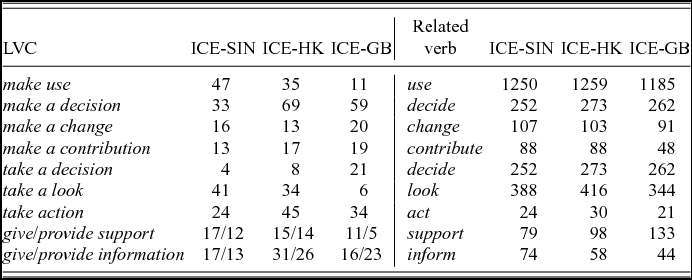
LVCs that occur at least three times in each corpus have been identified and catalogued. Related verbs that also occur at least three times in each corpus are then analysed as well. Pairs that occur at least three times in each corpus appear in table 1.
LVCs occurring at least three times in each corpus (ICE-SIN, ICE-HK and ICE-GB), with their semantically equivalent related verbs. Numbers represent frequency of occurrence of each LVC and its alternative(s) in each corpus.

After each instance of each alternative was manually identified and carefully read, two observations emerged. First, make a decision, take a decision and decide constitute a three-way alternation. With native-speaker informants, it might be possible to distinguish subtle semantic or pragmatic distinction between make a decision and take a decision, but with the corpus data available, the constructions appear to be onomasiological alternatives. These alternatives are therefore analysed as a trio. Second, it was observed that LVCs with give actually alternate not only with their related verbs, but also with another LVC with light verb provide.
(13) First of all, it provides you with the basic information, okay. . . (ICE-HK S1B-010 #20)
(14) But I like the book to give me all the information. (ICE-GB S1A-016 #116)
(15) . . . the Chinese administration uh apparently said that uhm she did not provide enough support . . . (ICE-HK S1B-037#33)
(16) Support is given to all investors. (ICE-SIN S1B-042 #43)
In examples (13) and (14), both provide information and give information alternate with inform, and in examples (15) and (16), provide support and give support both alternate with support (v.). These constructions are analysed as alternating trios. The implications of these observations are discussed further in section 6.
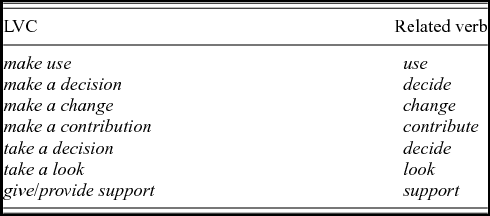
Preferences for each light verb or its related verb alternative have been statistically analysed using a Newcombe-Wilson test with continuity correction (p<0.05; see Wallis Reference Wallis2009).Footnote 7, Footnote 8 The null hypothesis for this test is that the underlying populations represented by the samples are not different. As with other forms of hypothesis testing, a significant result, refuting the null hypothesis, relates to both the quantity of data and the size of the difference between the measurements. For the LVCs in table 2, the null hypothesis cannot be rejected; the three corpora represent varieties that are not different in their preferences for LVCs or their alternatives.
LVCs exhibiting similar selection preferences across the three corpora (ICE-SIN, ICE-HK, ICE-GB)

The three corpora show strongly similar preferences regarding each of the alternatives in table 2, in both speech and writing. This finding relates to both the quantity of data and the size of the difference. In all cases, the related verb constitutes around 70 to 90 per cent of instances, a relatively large difference. Thus, in the majority of LVC alternation pairs and trios, all varieties consistently show a strong preference for the related verb over its alternative.
For the remaining two LVCs, the null hypothesis must be rejected: the three corpora represent varieties that are essentially different in their preferences for these LVCs and their alternatives. These LVCs are listed in tables 3 and 4, with their frequencies in speech and writing in each corpus.
LVCs exhibiting significantly different selection preferences across the three corpora in writing (ICE-SIN, ICE-HK, ICE-GB). Numbers represent frequency of occurrence of each LVC and its alternative(s) in the written portion of each corpus.

LVCs exhibiting significantly different selection preferences across the three corpora in speech (ICE-SIN, ICE-HK, ICE-GB). Numbers represent frequency of occurrence of each LVC and its alternative(s) in the spoken portion of each corpus.

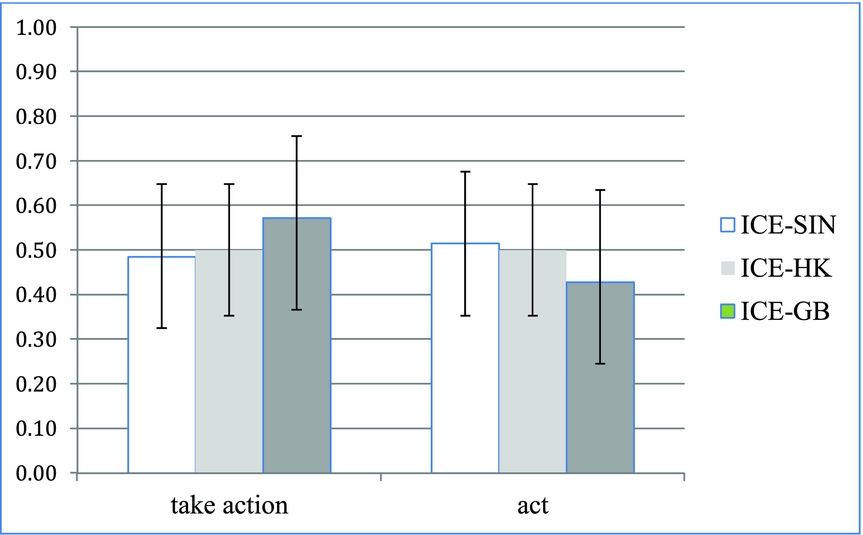
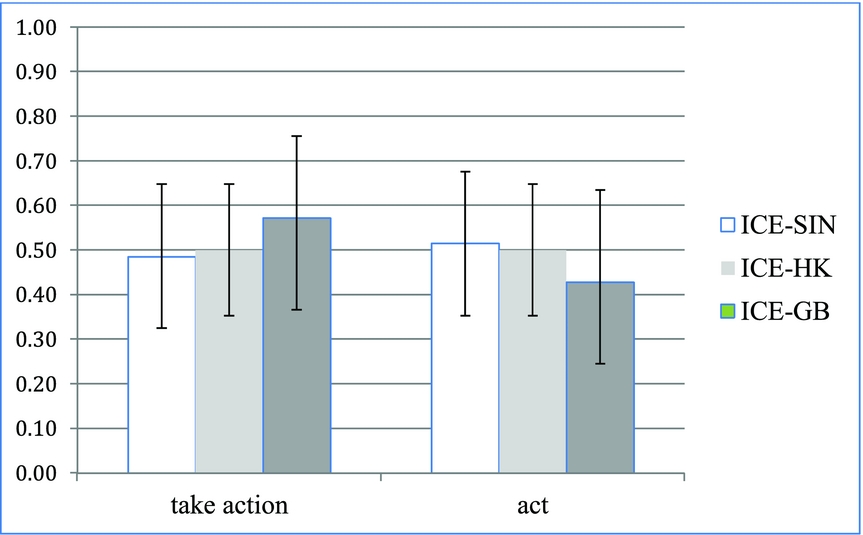
The rejection of the null hypothesis here relates to both the quantity of data and the size of the difference between the observed measurements. It is noteworthy, then, that the null hypothesis here is rejected and a significant difference is observable even given the relatively low quantity of data for take action and act (v.), which are the least frequently occurring pair in the corpora. Give/provide information and inform, too, are among the less common pairs in the corpora, but a significant difference is nonetheless observable. For these two LVCs, preferences vary across the corpora in different and complex ways. The following figures convey these preferences. In writing, all three corpora exhibit an equal preference for the LVC take action and its related verb act (v.).Footnote 9 The LVC and its alternative occur at an approximately equal rate. This observation is indicated in figure 1: overlapping error bars for each variety show that differences all fall within the margin of error.
Instances of take action and act (v.) in the written portions of ICE-SIN, ICE-HK and ICE-GB. The y-axis represents probabilities for each term in each corpus, and error bars represent Wilson intervals.
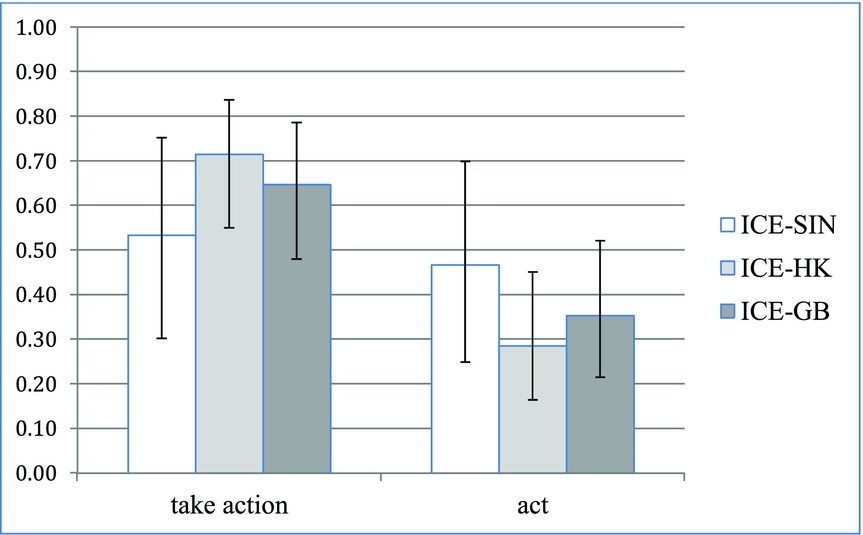
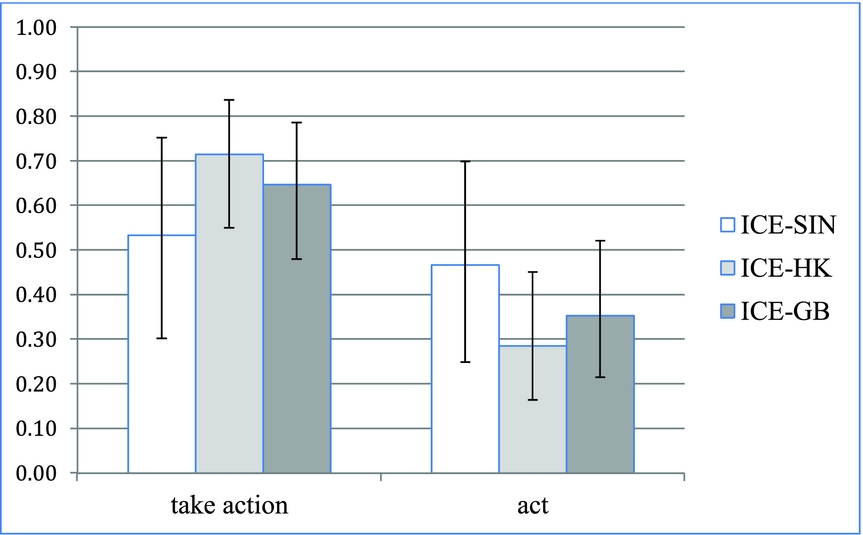
However, as shown in figure 2, preferences for take action in speech differ across the corpora. In this case, ICE-SIN and ICE-GB exhibit no significant preference for either alternative, as exhibited by the overlapping error bars in the graph. That is, in ICE-SIN and ICE-GB, the difference in observed probability between take action and act (v.) is within the margin of error. Uniquely, ICE-HK exhibits a strong preference for the LVC over its related verb; close reading of all examples in all texts indicates that this finding is not the result of any outlier files.Footnote 10
Instances of take action and act (v.) in the spoken portions of ICE-SIN, ICE-HK and ICE-GB. The y-axis represents probabilities for each term in each corpus, and error bars represent Wilson intervals.
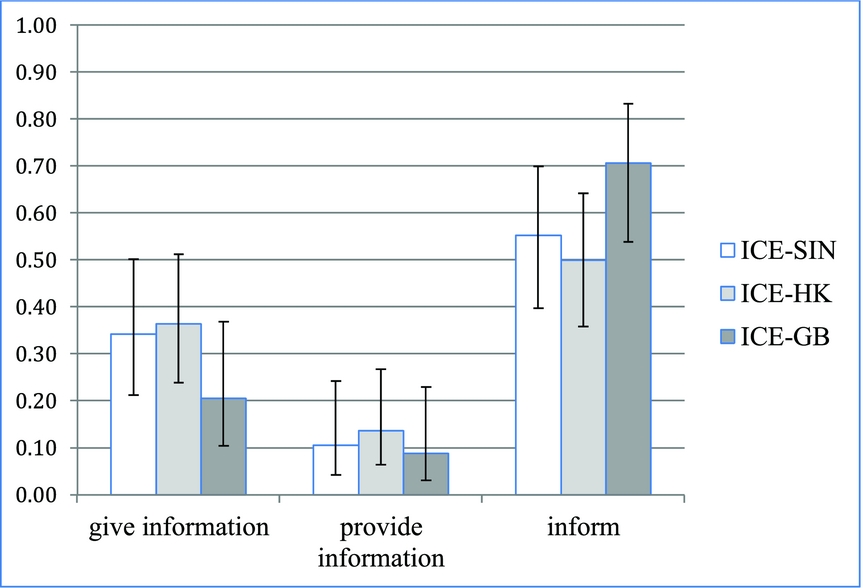
For the trio of the LVC give information, the LVC provide information and the related verb inform, the data are far more complex.
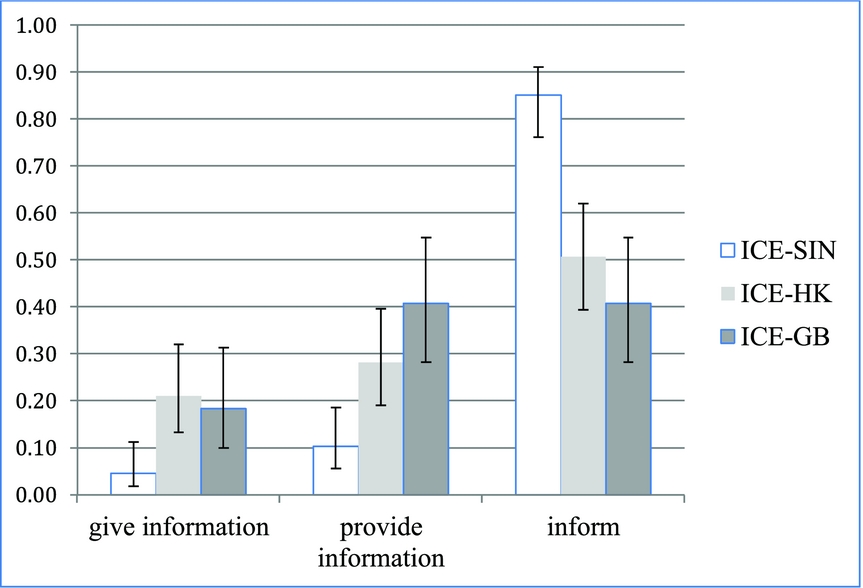
Figure 3 shows that, in writing, ICE-SIN and ICE-HK significantly prefer inform over both LVCs, and the two LVCs are equally preferred. ICE-GB, however, prefers provide information and inform equally, with a significantly lower preference for give information.
Instances of give information, provide information and inform in the written portions of ICE-SIN, ICE-HK and ICE-GB. The y-axis represents probabilities for each term in each corpus, and error bars represent Wilson intervals.
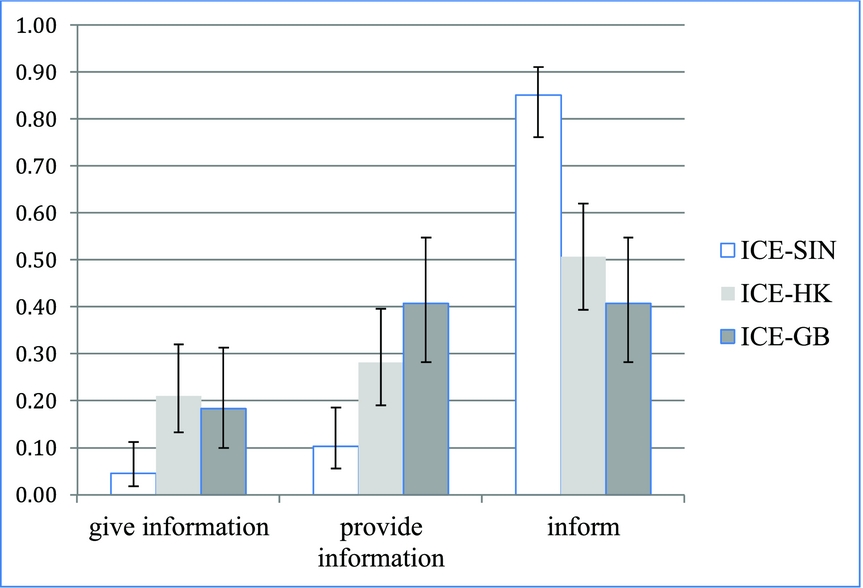
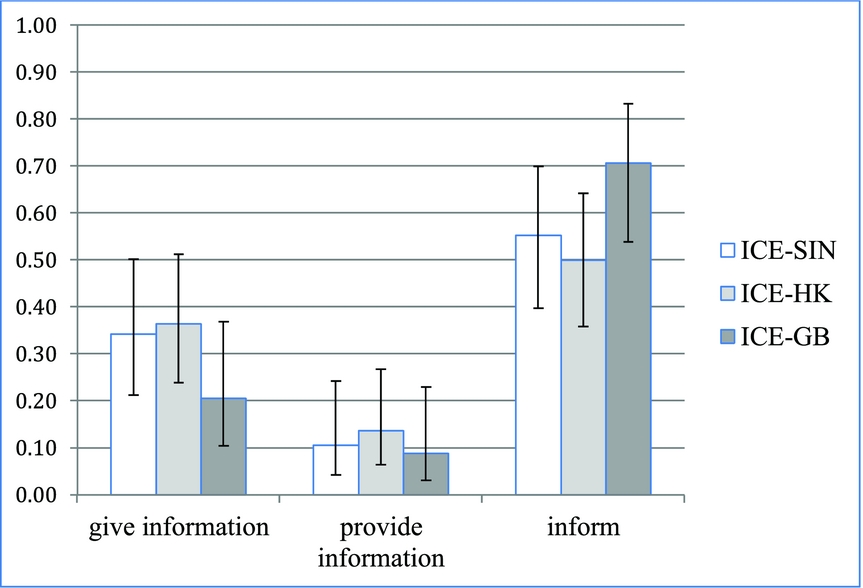
Figure 4 indicates that, in speech, ICE-SIN and ICE-HK prefer inform and give information statistically equally, and give information and provide information statistically equally, with a significant difference between provide information on the low end and inform on the high end. ICE-GB, however, prefers inform significantly more than both give information and provide information, which are preferred equally. For give information, provide information and inform, the picture is extremely complex and subtly varied, but it seems that ICE-SIN and ICE-HK are generally more similar to each other than to ICE-GB.
Instances of give information, provide information and inform in the spoken portions of ICE-SIN, ICE-HK and ICE-GB. The y-axis represents probabilities for each term in each corpus, and error bars represent Wilson intervals.
5.3 Identity evidence for light make, take and give
As discussed in section 3.2, identity evidence here involves coordinated DOs, and provides some insight into the semantics of these three light verbs and their LVCs. In the three corpora, there are 20 instances of natural language evidence that resemble the classic polysemy test known as the identity test, which relate light give to non-light give. These instances all include coordinated Noun Phrases as DOs of give. Six selected examples are presented below.
(17) He gave the young couple his blessing and a rather elegant house to live in. (ICE-GB W2F-011 #052)
(18) . . . you mainly give us our technical support and informations, uh, information brochure or some kinds of service support <,> (ICE-HK S2A-059 #16)
(19) Uh what they really need is to be given the uh uh technical uh assistance and guideline to get a good <,> certified gauges to do good maintenance programme (ICE-HK S1B-047 #90)
(20) Are there any preparatory courses or some supports um given to foreign students who may not know the French language very well (ICE-SIN S1B-049 #80)
(21) . . . I would appreciate it if you can give us your comments and any ideas to ensure the joint promotion is effective and beneficial for both hotels in terms of revenue. (ICE-SIN W1B-016 #105)
In example (17), give a blessing is equivalent to bless, and is an LVC, while give a house is a concrete use of give. The fact that give blessings and a house appears to be acceptable, and certainly occurs in written use, is evidence that the LVC use of give is not entirely discrete from the concrete sense of give. Put differently, it appears that light give may not be so ‘light’ after all, but may overlap with non-light uses of give such as the concrete sense here. Alternatively, from a construction grammar perspective, give LVCs may constitute a category that is separate from other LVCs. Each subsequent example provides similar evidence for this non-lightness of light give, and for some kind of overlap between light and non-light uses. Example (18) is spoken and may include some kind of correction. However, it is clear that give support is equivalent to support (v.) in both instances of support, while give brochures is a concrete use of give. In example (19), give assistance is equivalent to assist, while give guidelines is not equivalent to *guideline (v.), as there is no such verb. Instead, give guidelines appears to be an abstract use of give that is not an LVC. In example (20), the passivised support given is parallel to the active counterpart give support, which is equivalent to support (v.), and is an LVC, while give a course is a non-LVC use. Finally, in example (21), give comments is equivalent to comment (v.), while give ideas is a non-LVC use of give.
The examples above provide novel evidence for light give and its LVCs in relation to non-light give. Such evidence for make is far more rare – only one possible instance occurs in each corpus, but each is extremely dubious.
(22) We have made a pact. A new start. (ICE-GB W2F-008 #17)
(23) The aim of creating twelve-tone series is making a coherent or unity in the form of composition with the twelve pitches in scale. (ICE-HK W1A-015 #19)
(24) Sometimes, these Red Guards would also make minor ambushes and small-scale battles on the Nationalists. (ICE-SIN W1A-020 #114)
In example (22), make a start is equivalent to start (v.) and is an LVC, while make a pact is not an LVC. The full stop after pact is a written stylistic choice that separates a new start in a way that may render it more acceptable than the alternative ?We have made a pact and a new start. In example (23), it might be that make (a) unity is equivalent to unite. Make a coherent is most likely not equivalent to cohere, and may seem instead to indicate ‘create coherence’, but this example, too, is dubious. Finally, make ambushes or battles may be equivalent to ambush (v.) and battle (v.), such that this example is actually a coordinated LVC, but the non-standard and unusual nature of the LVCs renders the sentence debatable.
Take is unique among the three verbs. There are no examples, even debatable ones, of coordinated DOs in which one element represents an LVC and the other a non-LVC. This is true across all three corpora.
Coordinated DOs in which both elements of the coordination can be interpreted as LVCs are quite common in the corpora for give, not terribly common for make, and non-existent for take. Examples (25)–(29) all show LVCs with coordinated Noun Phrase DOs.
(25) And we would help to facilitate to make an assessment and evaluation of the building . . . (ICE-SIN S1B-041#10)
(26) We should bear in mind that all decisions and actions should be made with the animal welfare as the first priority . . . (ICE-HK W2B-027#131)
(27) I think in the future when government makes big statements announcements you should do what ministers do in the UK (ICE-HK S2A-033#115)
(28) . . . giving out blessings and absolutions to all sinners (ICE-GB S2B-027#67)
(29) . . . I would like to thank to say thank you to all who give help and support to this function . . . (ICE-HK S2A-034#4)
Tables 5–7 indicate how often coordinated Noun Phrases occur as DOs in LVCs for each verb, including how often they represent two LVCs, and how often they represent one LVC and one non-LVC. Examples (22)–(24) above are indicated with question marks in table 6.
Number of instances of coordinated Noun Phrases as DOs of light give

Number of instances of coordinated Noun Phrases as DOs of light make

Number of instances of coordinated Noun Phrases as DOs of light take

The theoretical implications of these observations are discussed further in the next section.
6 Discussion
The three varieties are quite consistent in both the absence of innovative or unique LVCs and the trends in onomasiological alternation preferences. There are no strong cases for unique regional norms that allow unique LVCs. For the three verbs examined here, make, take and give, all varieties exhibit a strong onomasiological preference against the LVC and in favour of the alternative verb in most cases. In two cases, take action and give/provide information, the three varieties differ from each other: with these two cases, the picture is relatively complex, and it is difficult to reach tidy generalised conclusions. Nonetheless, the onomasiological consistency across the varieties is impressive; future research could affirm or refute whether this might relate to a common core of semantic preferences for related verbs over high-frequency LVCs in English worldwide. Whereas we might have observed an array of novel or unique LVCs in a single variety, or unique onomasiological selection preferences in a single variety, we instead see worldwide consistency in both features.
The most striking finding here relates to identity evidence and LVCs. In section 3.2 above, I introduced the notion of identity evidence. Here, identity evidence has proven extremely useful. This evidence differs from applications of the identity test to introspectively derived examples, insofar as it relates to Glynn's (Reference Glynn, Glynn and Robinson2014) definition of corpus semantics: the mapping of the relative frequencies, in natural use, of form–meaning relations. Here, identity evidence indicates that light give is not terribly discrete from non-light give. As shown in the examples in section 6.3, light and non-light give can be evoked simultaneously via coordinated DOs in which one DO element would constitute an LVC, and the other would not. On the other hand, light make and take appear to be more discrete from non-light make and take. For take, light and non-light uses are never evoked simultaneously in a coordinated DO, and for make, light and concrete senses are evoked simultaneously only very rarely, if ever. This distinction is in line with Poutsma's (Reference Poutsma1926: 394) admittedly ambiguous suggestion of variation in light verb usage. I call this phenomenon degrees of lightness, and it applies across and between light verbs and LVCs: take and make seem to be used by speakers and writers with a discrete light use; give seems to have a less-discrete light use. Thus, we might say that light take and make (and their LVCs) are more light than light give. This element of meaning might be seen as constructional, rather than purely compositional or lexical semantic: these degrees of lightness can be seen to arise not at the level of the individual words, but at the level of the constructions, which can allow or disallow the evocation of lightness and non-lightness simultaneously.
Onomasiological evidence reinforces the argument that give is less light than make or take: light give alternates with light provide in LVCs, an alternation pattern that has no parallel for make or take. Give also alternates with provide in concrete and abstract uses in the corpora. It is therefore plausible that give and provide both share some meaning in their light and non-light uses, and constitute a shared category of ‘less-light’ constructions. This renders Newman's (Reference Newman1996) findings on give all the more interesting: Newman concluded that give was not terribly light in its LVC uses. The present findings corroborate Newman's assertions, but show that this is not a universal trend in light verbs.Footnote 11
If take and make are the more discretely light of the verbs studied here, it is worth noting one additional example, in which take and make are coordinated with a single DO.Footnote 12
(30) The staff member shall not: 1) Take or permit to be made any alterations in the internal construction or arrangements or in the external appearance or in the present scheme of decoration of the premises. (ICE-SIN W2D-003#130-1)
In addition, it is noteworthy that take a decision and make a decision seem to alternate as well. This seems to be further evidence that make and take constitute one category of construction, while give differs.
Further anecdotal evidence also might be interpreted to suggest that take resists coordinated DOs that would invoke light take alongside some other sense.
(31) Not only do most women in Britain from the age of about 50 onwards take far too little calcium, they also tend to take far too little exercise. (ICE-GB W2B-022#22)
(32) But this does not justify the United States and Britain taking the law into their own hands and taking military action to topple him because the leaders of these two countries do not like him. (ICE-HK W2E-002#53)
While this evidence is far from conclusive, it might be interpreted that take in example (31) is repeated so as to avoid the coordinated construction take calcium and exercise, in which take calcium is a non-LVC and take exercise is an LVC with the related verb exercise (v.). Similarly, take in example (32) may be repeated so as to avoid the coordinated construction taking the law into their own hands and military action, in which take action is an LVC and take the law into their own hands is a non-LVC. While purely anecdotal, this may complement the strong evidence that take never occurs with a coordinated Noun Phrase DO in which one element would constitute an LVC and the other would not.
There is one caveat to the identity evidence presented here. While take seems to strongly resist coordinated DOs in which one element would constitute an LVC and the other would not, take seems also to strongly resist any coordination whatsoever in its DO in LVC usage. It is conceivable that light take, or take more generally, simply resists coordinated DOs, and that this tendency is independent from its resistance to coordinating LVC and non-LVC elements. I would argue, nonetheless, that the lack of identity evidence for take is a powerful finding. It is possible that future work such as collostruction analyses (see Stefanowitsch & Gries Reference Stefanowitsch and Gries2003) could pinpoint the influence here of take’s broader preferences for or against coordinated DOs, if such preferences exist.
Moreover, a construction grammar approach allows the hypothesis that make and take might be members of a category of ‘very light’ verbs that combine with a category of verb-related nouns to form LVCs that cannot combine with non-LVC uses. In that case, give and provide might be members of a different category of ‘less light’ verbs, which can combine with verb-related nouns and other nouns simultaneously, to form a separate class of constructions, ‘less light’ LVCs. This second category may relate to semantics of transferral to a recipient, for example, expressed grammatically as an Indirect Object (or dative alternation), a constructional characteristic that occurs in 49–62 per cent of instances of light give (depending on the corpus) but which tends to be missing from light make and take.Footnote 13 Future construction grammar research might aim to corroborate the existence of such categories of constructions, and to establish additional specific characteristics of each category.
These features of light make, take and give, and their LVCs do not vary across the regions represented by the corpora. The consistency of these degrees of lightness across the corpora is noteworthy, particularly given the fine-grained features of meaning reflected in such usage, and the fact that these features have not been explicitly discussed before. In all three corpora, light take and make appear more light than light give, or appear to constitute a different category of construction. This might not have been the case: for example, we might have imagined the possibility, in a given variety, that give would never occur with coordinated DOs in which one element constituted an LVC while the other element was concrete – or, put differently, that give would represent the same kind of construction as make and take. Crucially, we might also have observed examples of make or take with coordinated DOs along the lines of *make decisions and furniture, or *take action and the book. However, we simply do not see such examples in the data, even though such examples are parallel to commonly observed examples of give with coordinated DOs such as give a blessing and a house. Again, this raises the possibility of a common core to light verb semantics or construction categories in World Englishes.
In fact, there is one interesting piece of identity evidence, via coordinated complementation pattern, for a possible different sort of nuance in Hong Kong English, involving make, but not in an LVC. This serves as an illustration for the type of coordinated DOs that might have been possible with LVCs.
(33) Medicine in this aspect may be really helpful because the effect of the medication has made the hyperkinetic child dull and feel drowsy. (ICE-HK W1A-012#72)
In this example, two senses of make are at stake. First, make the child dull is a use in which make can be glossed as ‘render’, requiring a DO and a Predicative Complement of the DO (see Huddleston & Pullum Reference Huddleston and Pullum2002). Second, in make the child feel drowsy, the gloss for make might be something like ‘cause to’, and make requires a DO and a Clausal Complement. The coordination of make with a single DO, child, and two different types of complements, would seem to suggest that these two senses of make may not be discretely polysemous for this particular writer in Hong Kong. This example is drawn from a student essay, as opposed to an edited newspaper, and it may be that this is an error rather than indication of useful regional evidence. It is nonetheless an interesting illustration of the type of phenomenon that could certainly have emerged with coordinated DOs in LVCs. Example (33) is an interesting counterpoint to the clear consistency in identity evidence for LVCs above.
Hoffmann et al. (Reference Hoffmann, Hundt and Mukherjee2011: 263) propose that LVCs are restricted largely by collocational norms, and that those norms might readily vary from region to region. The identity evidence here requires the examination of rare, even unique creative forms such as coordinated DOs, and moves beyond the question of collocational norms. Findings here suggest that the three varieties are remarkably similar even in their creativity, via rare constructions.
7 Conclusion
The present study has broken important new ground. Methodologically, the study has shown the importance of identity evidence, in which naturally occurring language data resemble the classic identity test for polysemy. This is a valuable new method which can be employed effectively not only to measure polysemy in natural use, but also to indicate separate categories of constructions from a construction grammar perspective. It is primarily via identity evidence that I have argued for degrees of lightness, or different categories of constructions for apparent light verbs, and shown that three varieties of World Englishes are similar in this regard.
In relation to the research questions posed in section 1, I have concluded that there is no evidence for unique or innovative LVCs in the three corpora, in line with Hoffmann et al.’s (Reference Hoffmann, Hundt and Mukherjee2011: 262–3) findings. In onomasiological selection preferences, there is remarkable similarity across the three corpora as well: all varieties, in most cases, prefer the related verb over the LVC in both speech and writing.
Finally, identity evidence suggests that light make, take and give exhibit degrees of lightness, such that light give and its LVCs are less light than light take and make and their LVCs. As with onomasiological selection preferences, there is remarkable similarity across the three corpora in the degree of lightness of these three light verbs. These preferences relate to very fine gradations of meaning that have not been previously reported, so their consistency across regional varieties is remarkable evidence for a common semantic core for these light verbs and LVCs worldwide. There is important future research to be conducted using identity evidence to test degrees of lightness for other light verbs and LVCs as well. Such research can establish the nature of the spectrum of degrees of lightness, or the nature of the categories of these constructions, in use.
There is also valuable future research to be done in onomasiological variation in World Englishes. By isolating the variable of onomasiological alternation first, semantic research can lay a solid foundation for future scientific inquiry into additional intersections and relationships with additional variables such as grammatical modification. It will also be important for future studies to attempt to corroborate or refute the degrees of lightness observed here, for make, take and give, and to expand such investigation to other light verbs. Identity evidence as presented here is likely to be a valuable tool for such research.