Introduction
Digital health is an umbrella term encompassing eHealth, telemedicine and telemonitoring. The World Health Organization highlights its role in the future of healthcare ‘in strengthening health systems and public health, increasing equity in access to health services, and working towards universal health coverage’. The adoption of digital communication within healthcare has accelerated since the start of the coronavirus disease 2019 pandemic,Reference Davis, Bankhead-Kendall and Dumas1 helping to facilitate remote consultations and maintain clinical services throughout lockdowns. There is growing recognition of the role digital health can play in monitoring of chronic conditions and providing equitable access to patients in remote and rural communities.Reference Morris, Rossi and Fuemmeler2 Digital health solutions can allow the expansion of clinical care in a resource efficient manner. This is reflected in a key ambition of the UK government's NHS Long Term Plan to make better use of data and digital technologies.3
The use of mobile devices has become ubiquitous in everyday life. Recent statistics show that approximately 83 per cent of the global population own a smart phone,4 with younger age, higher levels of education and higher income associated with greater digital connectivity.Reference Taylor and Silver5 Ownership is higher in developed economies such as the UK where 92 per cent of people own a smart phone, including 83 per cent of those over 55,6 and 97 per cent of households have internet access.7
Head and neck cancer accounts for approximately 5.3 per cent of malignancies worldwide, with incidence of human papilloma virus (HPV) related oropharyngeal cancer increasing, especially in developed countries.Reference Aupérin8 Head and neck cancer and its treatment have significant negative physical and psychological effects that persist beyond treatment and often continue lifelong. Head and neck cancer patients undergoing curative management have surgical resection, including total laryngectomy and neck dissection, radiotherapy, chemotherapy or combined modality treatment, all of which are physically and psychologically demanding. Once patients complete treatment, they suffer from wide-ranging morbidity, which may include dysphagia, dependence on tube feeding, loss of voice, trismus, neck pain and stiffness, and severe xerostomia. They can also experience significant levels of anxiety about cancer recurrence,Reference Deuning-Smit, Custers, Miroševič, Takes, Jansen and Langendijk9 body image disturbance,Reference Graboyes, Hill, Marsh, Maurer, Day and Hornig10 isolation and depression.Reference Henry, Arnovitz, Frenkiel, Hier, Zeitouni and Kost11 Digital health tools could be used to address symptoms alongside standard treatment and may lead to quality-of-life benefits.
This systematic review aimed to address how digital health is currently being used in patients with a diagnosis of head and neck cancer as an adjunct to usual care in order to improve outcomes relating to the disease or its treatment.
Materials and methods
The remit and search strategy of the review were established and registered with Prospero a priori (CRD42021264791).Reference Hulse, Douglas and Li12 Findings were reported in concordance with the Preferred Reporting Items for Systematic Reviews and Meta-Analyses (‘PRISMA’) reporting guideline.Reference Page, Moher, Bossuyt, Boutron, Hoffmann and Mulrow13 We also conducted an exploratory search of the Apple App Store for ‘head and neck’ and ‘laryngectomy’ to identify mobile applications available to the general public.
Eligibility criteria
Studies were deemed eligible for inclusion if they described development, evaluation or trial of an eHealth, telemedicine or telemonitoring tool as defined by Aapro et al.Reference Aapro, Bossi, Dasari, Fallowfield, Gascón and Geller14 These all involve provision of healthcare ‘supported by telecommunications or digital technology’ to support or optimise services. Studies using both quantitative and qualitative methods were included if they presented original data. Full inclusion and exclusion criteria are listed below.
Inclusion criteria were: any publication type that included original research regarding the development, evaluation or a clinical trial of an eHealth, telemedicine or telemonitoring tool; any publication assessing a tool intended for use by patients with a diagnosis of head and neck cancer or their carers and not used for diagnosis or screening; adult patients with head and neck cancer (including sinonasal, oral, oropharyngeal, laryngeal, salivary gland and thyroid) who were either the intended user or a defined group within the usership of the digital health tool; and publication where the full-text was available in the English language.
Exclusion criteria were: telemedicine or telephone consultation used to provide routine care as an alternative to face-to-face appointments (the use of telemedicine platforms for clinical consultation throughout the pandemic has been extensively reported in the literature and is not the intended subject of this review); patient questionnaires performed on digital or web-based platforms without an intervention; and malignancy of the head and neck other than those listed, such as upper oesophageal or cutaneous cancer.
Search and information sources
Searches were conducted on Embase (1974 to 15 April 2022), Ovid Medline (1996 to 15 April 2022) and Cinahl (1999 to 15 April 2022) for relevant studies performed in the last 10 years. Given the rapidly evolving nature of digital platforms and mHealth, this time limit was applied to ensure an accurate description of the current digital environment. The full search terms are listed in Appendix 1. Where a tool was the subject of multiple published papers, such as during piloting, sub-group analysis or cost-analysis, only the main publication describing the tool was included in the review. Bibliographies of the included records were screened to identify further relevant records. EndNote20 reference management tool (Clarivate, London, UK) was used to collate records and remove duplicates.
Selection process
Title and abstract screening were performed by the first author (KH), and two authors (KH and LL) independently screened the full text of the records. A third reviewer (CD) resolved any disagreements regarding inclusion.
Data items and charting
For each record, the country of origin, year of publication, study type, sample size, population of interest, intervention, outcome/s being assessed and key results were obtained. Where head and neck cancer patients made up a subset of the study population but were not presented separately in the results, an attempt was made to contact the corresponding author to obtain this data. If the author could not be contacted or the subset data was not available, the record was included as a narrative description of the tool without assessment of head and neck cancer specific outcomes.
Critical appraisal of evidence
Randomised, controlled trials (RCTs) were analysed for risk of bias based on the Cochrane Risk of Bias 2 tool by one author (KH) and allocated a score of low risk, some concerns or high risk.Reference Sterne, Savović, Page, Elbers, Blencowe and Boutron15 All records were included in the review regardless of bias status. Non-RCTs were not subject to a formal risk of bias assessment.
Synthesis of results
The data items described above were obtained from each record and summarised in tabular form. A narrative synthesis of the key functions and outputs of the digital health tools was performed. Given the heterogeneous nature of the RCTs, it was not possible to perform statistical comparison of outcomes or a meta-analysis.
Results
Selection and synthesis of evidence
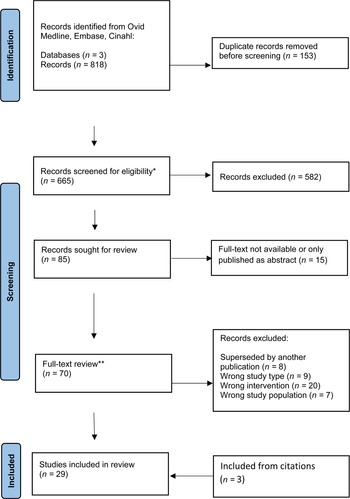
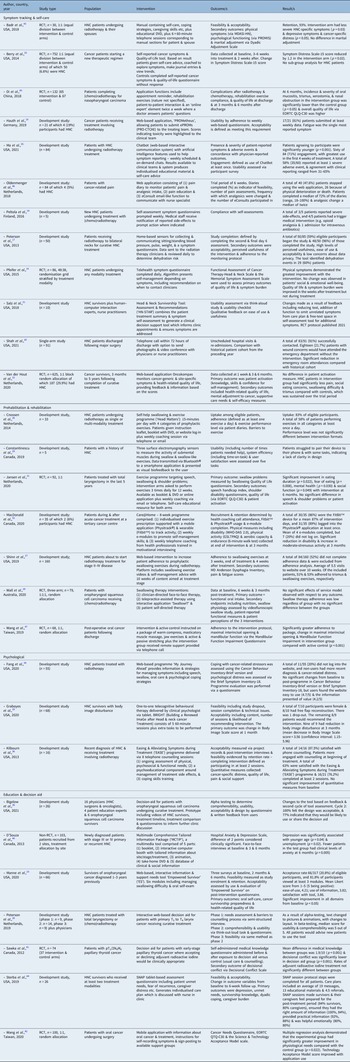
The results of the search and selection process is illustrated in a Preferred Reporting Items for Systematic Reviews and Meta-Analyses (‘PRISMA’) flow diagram (Figure 1). After duplicates were removed, 85 studies met the inclusion criteria and were sought for full-text review. After independent review by 2 authors, a total of 26 records were included in the analysis, which are summarised in Table 1. A further three studies were identified from cited papers of the included studies.
Study flow diagram. *Manual screening of title & abstract against inclusion and exclusion criteria. **Independent two-author review of full-text records with final decision by a third author if there was disagreement. Adapted from Page MJ, McKenzie JE, Bossuyt PM, Boutron I, Hoffmann TC, Mulrow CD et al. The PRISMA 2020 statement: an updated guideline for reporting systematic reviews. BMJ 2021;372:n71.

Summary of included papers

RCT = randomised, controlled trial; HNC = head and neck cancer; DVD = digital versatile disc; MDASI-HN = MD Anderson Symptom Inventory – Head and Neck; PROMIS = Patient-Reported Outcomes Measurement Information System; EORTC QTQ-C30 = European Organisation for Research & Treatment of Cancer quality of life questionnaire for cancer patients; ePROM = electronic patient-reported outcome measure; PRO-CTCAE = Patient Reported Outcomes-Common Terminology Criteria for Adverse Event; WHO-DAS 2.0 = World Health Organization's Disability Assessment Schedule 2.0; GSLTPAQ = Godin-Shephard Leisure-Time Physical Activity Questionnaire; SNAP = Survivorship Needs Assessment Planning
Characteristics of sources of evidence
Eighteen (62 per cent) studies of digital health interventions in head and neck cancer were by research groups based in the USA and Canada. Nineteen (66 per cent) studies were published in the second half of our review period. Seventeen (59 per cent) records were ‘development studies’ which aimed to assess the usability, feasibility and/or acceptability of the digital health intervention as the primary outcome. There were 10 RCTs. A statistical synthesis of the RCTs was not possible because of the heterogeneity in population, interventions and outcome measures. The remaining two studies were quasi-experimental: one single-arm and one non-RCT. Five studies, including 2 RCTs, described an intervention aimed at a mixed cancer population of which a proportion had head and neck cancer (5–30 per cent).
Results of synthesis
This systematic review aimed to address how digital health is currently being used in patients with a diagnosis of head and neck cancer as an adjunct to usual care to improve outcomes relating to the disease or its treatment. We found 29 studies of digital health tools in head and neck cancer. The purpose of these tools can be considered within four categories: symptom tracking and self-care, prehabilitation or rehabilitation, psychological support, and education, including decision aids.
Symptom tracking and self-care
Eleven of the digital health tools identified in the review facilitate symptom-tracking, mostly in patients actively undergoing (chemo)radiotherapy. The eHealth tools from Hauth et al.Reference Hauth, Bizu, App, Hauth, Bizu and App16 and Peterson et al.Reference Peterson, Shinn, Basen-Engquist, Demark-Wahnefried, Prokhorov and Baru17 collect data during radiotherapy, and this is made available to clinical teams in real-time, facilitating early detection of treatment toxicity. The studies by Peltola et al.Reference Peltola, Lehikoinen, Sippola, Saarilahti and Mäkitie18 and Pfeifer et al.Reference Pfeifer, Keeney, Bumpous, Schapmire, Studts and Myers19 both used telehealth to provide patient symptom questionnaires during active treatment and provide tailored self-management advice. Shah et al.Reference Shah, Douglas, Carey, Daftari, Smink and Paisley20 demonstrated the use of eHealth as an adjunct to follow up in the immediate post-operative period after major surgery and the potential to reduce use of unscheduled care.Reference Shah, Douglas, Carey, Daftari, Smink and Paisley20
There has been increasing emphasis on the concept of long-term survivorship in head and neck cancer, especially with growing numbers of patients with HPV-related oropharyngeal cancer surviving curative treatment. The head and neck cancer survivorship tool created by Salz et al. helps clinicians address cancer-related symptoms at clinic appointments.Reference Salz, Schnall, McCabe, Oeffinger, Corcoran and Vickers21 The RCT by Van der Hout et al. compares a web-based self-management programme for cancer survivors to usual care with specific head and neck cancer elements. They demonstrated an improvement in mouth pain, social eating, swallowing and trismus with the intervention compared with standard care.Reference Van der Hout, van Uden-Kraan, Holtmaat, Jansen, Lissenberg-Witte and Nieuwenhuijzen22 As well as modules to improve empowerment and self-management in oral cancer survivors, the online intervention by Manne et al. taught patients how to conduct surveillance for lesions through self-examination.Reference Manne, Hudson, Frederick, Mitarotondo, Baredes and Kalyoussef23 This is the only tool that describes the use of eHealth to help patients monitor for recurrence.
Prehabilitation and rehabilitation
The efficacy of prophylactic swallowing exercises on swallowing outcome in head and neck cancer patients is the subject of ongoing international RCTs.Reference Martino, Fitch, Fuller, Hope, Krisciunas and Langmore24,Reference Baudelet, Van den Steen, Duprez, De Bodt, Deschuymer and Goeleven25 If they demonstrate a benefit to swallowing outcome, there will be an expectation for speech and language services to provide exercises to patients. The digital tools created by Cnossen et al. provided a swallowing exercise programme that can be performed independently at home and may be adapted for this purpose.Reference Cnossen, Van Uden-Kraan, Rinkel, Aalders, de Goede and de Bree26–Reference Wall, Ward, Cartmill, Hill, Isenring and Byrnes28 The smartphone-enabled swallowing trainer developed by Constantinescu et al.Reference Constantinescu, Kuffel, King, Hodgetts and Rieger29 gives feedback on the physiological mechanism of swallow to aid rehabilitation. Adherence to swallowing exercises in head and neck cancer is a problem, with identified barriers being time investment and patients not understanding the benefit.Reference Wells and King30 In the RCT by Jansen et al., 17 of 41 (41 per cent) participants for whom adherence data was available reported low adherence to the rehabilitation programme despite several measures to optimise this.Reference Jansen, Eerenstein, Cnossen, Lissenberg-Witte, de Bree and Doornaert31
Psychological support
Berry et al.Reference Berry, Hong, Halpenny, Partridge, Fann and Wolpin32 presented a generic cancer tool that encourages self-management of psychological symptoms with an alert to contact clinicians in circumstances such as suicidal ideation. Graboyes et al. created an intervention to specifically address psychological distress around body image,Reference Graboyes, Maurer, Park, Marsh, McElligott and Day33 whereas Fang et al. addressed more general cancer-related psychosocial challenges.Reference Fang, Galloway, Egleston, Bauman, Ebersole and Chwistek34 Importantly, they found that head and neck cancer patients who were more recently diagnosed and had higher baseline levels of cancer-specific distress were less likely to engage with the tool. Furthermore, both Ma et al.Reference Ma, Orner, Ghaly, Parashar, Ames, Chen, Potters and Teckie35 and Kilbourn et al.Reference Kilbourn, Anderson, Costenaro, Lusczakoski, Borrayo and Raben36 found that engagement declined during the second half of treatment, which the authors attributed to increasing treatment toxicity and fatigue.
Education and decision aids
Decisional conflict is experienced by patients where there is uncertainty about the best course of action when there is potential for significant risk or poor outcome. Decision aids help patients to process evidence-based information alongside personal values and have been shown to reduce decisional conflict in cancer patients.Reference Mcalpine, Lewis, Trevena and Stacey37 Bigelow et al. and Peterson et al. both described the challenge of developing a decision aid that contains all the relevant clinical information without being too complex or overwhelming.Reference Bigelow, Windon, Fakhry, Kiess, Seiwert and D'Souza38,Reference Petersen, Berlanga, Stuiver, Hamming-Vrieze, Hoebers and Lambin39 A multi-modal approach to providing tailored information to patients was used in the non-randomised trial by D'Souza et al. and demonstrated a significant reduction in anxiety in users.Reference D'Souza, Blouin, Zeitouni, Muller and Allison40 Furthermore, Sawka et al. showed a significant reduction in decisional conflict related to adjuvant radioactive iodine treatment in patients with early papillary thyroid carcinoma when using a decision aid.Reference Sawka, Straus, Rotstein, Brierley, Tsang and Asa41 A key function of the mobile application described by Wang et al. was to signpost patients to external resources with relevant information.Reference Wang, Huang, Yang, Chou and Chen42 Two interventions were designed for use by patients and a caregiver. For example, Badr et al. provided intensive telephone-based support to patients and their spouses in separate but complementary sessions.Reference Badr, Herbert, Chhabria, Sandulache, Chiao and Wagner43 Similarly, the Survivorship Needs Assessment Planning (‘SNAP’) tablet-based tool by Sterba et al. includes assessment of caregiver distress to inform a personalised care plan.Reference Sterba, Armeson, Zapka, Scallion, Garris and Graboyes44 In summary, a range of digital tools related to information giving, education and decision-making is demonstrated with signs of possible utility in reducing anxiety and decisional conflict.
Methods of delivery
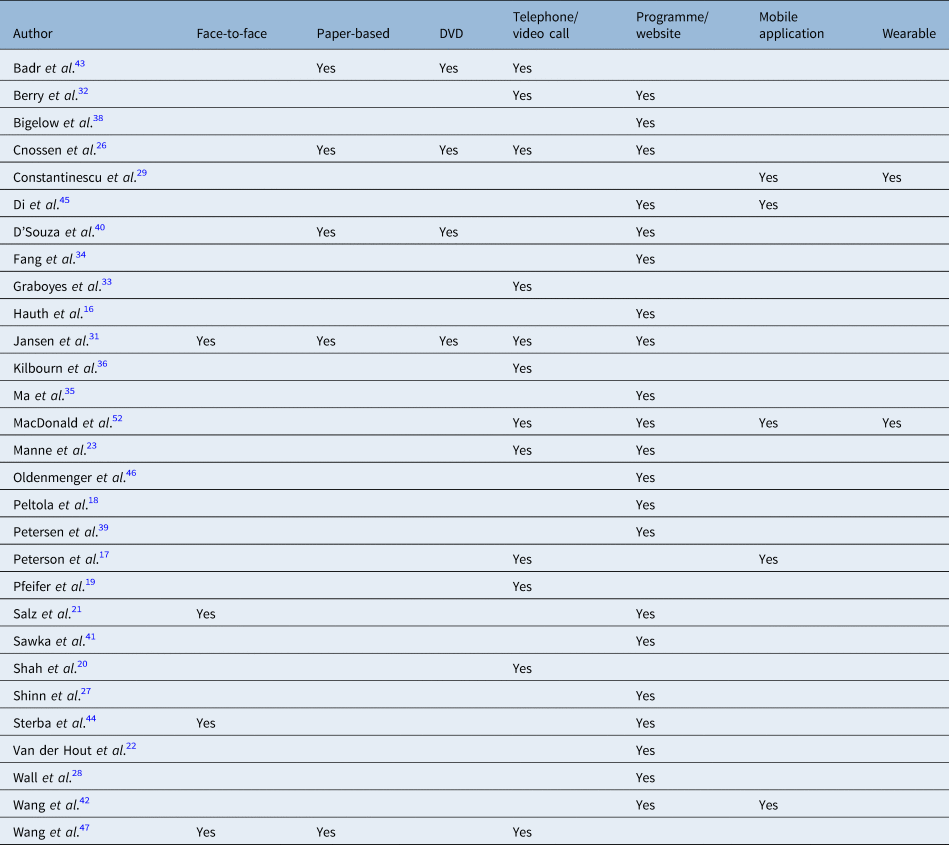
Table 2 shows the methods used to deliver the interventions. Sixteen (62 per cent) of the interventions used more than one method with off or online software being the most common, whereas only 5 (19 per cent) studies utilised a smartphone application. Only Constantinescu et al. addressed the potential for commercial wearable devices (FitBitTM activity tracker) in head and neck cancer patient monitoring.
Method of intervention delivery

Twelve studies reported interventions that involved additional interaction with the clinical team, either via telephone, video conference or face-to-face. For example, the intervention described by Badr et al. involved six hours of telephone sessions for the patient and their spouse provided by a mental health counsellor.Reference Petersen, Berlanga, Stuiver, Hamming-Vrieze, Hoebers and Lambin39 The telemedicine programme from Graboyes et al. is delivered on a one-to-one basis with a clinical psychologist, and therefore it must be considered whether the intervention is scalable in most health services.Reference Wells and King30 The studies by Di and LiReference Di and Li45 and Oldenmenger et al.Reference Oldenmenger, Baan and Van Der Rijt46 included a human-to-human interaction element in a more limited capacity with clinical contact being available via email or web chat if required. In the study by Wang et al., selective use of remote telephone support was shown to be useful for improving adherence to interventions.Reference Wang, Su, Leung, Liang, Wu and Wang47
An exploratory search of the Apple App Store for ‘head and neck’ and ‘laryngectomy’ found only two results. One application for head and neck cancer patients, called ‘head and neck cancer manager’ can help patients track symptoms, set appointment reminders and connect to care providers. The tool is compliant with US laws for protection of health information. There was one application for laryngectomy patients created by Atos medical, a developer and manufacturer of laryngectomy devices, which provided product information and education related to usage. There is no evaluation of the application content in the medical literature.
Bias of evidence
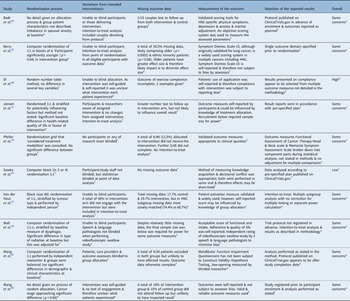
A summary of the risk-of-bias assessment for the 10 RCTs is demonstrated in Table 3. Overall, one study demonstrated a low risk-of-bias, eight studies had methodological flaws which raised some concerns about bias and one study had a high risk-of-bias. A common feature is the inability to blind the participants to treatment allocation as this is not possible when the intervention involves engagement with an eHealth tool.
Summary of the risk-of-bias assessment for the 10 randomised, controlled trials

*Some concerns of bias; †low risk of bias; ‡high risk of bias. As per Risk of Bias 2 guidelines, the overall risk of bias judgement is taken as the highest risk level in any domain or may represent the presence of several domains with concern of bias. HNC = head and neck cancer
Summary of the evidence
The aim of this systematic review was to address how digital health is currently being used as an adjunct to usual care to improve outcomes relating to head and neck cancer or its treatment. Three key themes emerged from this review: the apparent value of symptom-tracking and self-management, issues with engagement, and how digital tools can provide psychological support.
Firstly, the most common function of digital tools is symptom-tracking and self-care advice designed for patients undergoing active treatment. This reflects the recognised morbidity associated with head and neck cancer treatment and the need for greater support at this time. Four of the RCTs focusing on active treatment support were able to demonstrate improvement of physical symptoms in the intervention group. Remote symptom monitoring has also been shown to be effective in reducing symptom burden in several other cancer types. For example, the multi-centre ‘eSMART’ trial of Advanced Symptom Management System (‘ASyMS’) during chemotherapy treatment for breast cancer, colorectal cancer, Hodgkin's disease and non-Hodgkin's lymphoma demonstrated significant improvements in anxiety, health-related quality of life, self-efficacy and supportive care needs.Reference Maguire, McCann, Kotronoulas, Kearney, Ream and Armes48 Recent evidence shows that new symptoms after cancer treatment, such as pain, are a strong indicator that the cancer has returned;49 therefore, digital tools that track symptoms in the longer term may also lead to earlier detection of recurrence.
Self-assessment tools depend on patient engagement, and studies employed various ways to promote this among trial participants. For example, Peltola et al.Reference Peterson, Shinn, Basen-Engquist, Demark-Wahnefried, Prokhorov and Baru17 used a weekly reminder email whereas Pfeifer et al.Reference Peltola, Lehikoinen, Sippola, Saarilahti and Mäkitie18 had a device connected to the landline that flashed when assessments were due. Despite these efforts, engagement with the digital health tools was often poor. Ma et al. and Kilbourn et al. suggested that engagement could decline as symptom burden increased,Reference Ma, Orner, Ghaly, Parashar, Ames, Chen, Potters and Teckie35,Reference Kilbourn, Anderson, Costenaro, Lusczakoski, Borrayo and Raben36 and this issue therefore requires consideration in the development of future interventions.
Patients with head and neck cancer have one of the highest incidence rates of suicide even compared with other cancer patients,Reference Kam, Salib, Gorgy, Patel, Carniol and Eloy50 and body image disturbance is a significantly under-recognised issue, with prevalence as high as 89 per cent in the immediate post-treatment period.Reference Henry, Albert, Frenkiel, Hier, Zeitouni and Kost51 Psychological interventions are therefore an important component of post-operative care. The three studies identified in this review were development studies and were not powered or designed to prove clinical effectiveness. Nevertheless, the cognitive behavioural therapy intervention by Graboyes et al. resulted in improvement in body image disturbance at 1 month post-treatment compared with historical controls who showed no change in the first 12 months,Reference Deuning-Smit, Custers, Miroševič, Takes, Jansen and Langendijk9,Reference Berry, Hong, Halpenny, Partridge, Fann and Wolpin32 thus indicating potential for this approach.
Strengths and limitations
Because of the heterogeneity of the tools, we could not perform a statistical synthesis of outcomes, and the interventions described in the included studies were sometimes complex and involved multiple elements. This review is therefore unable to extricate what benefits were a result of the digital tool as opposed to the other elements, such as enhanced clinical interaction.
A strength of this review is the broad definition of digital health used and the inclusive search criteria. It is possible that studies have been missed if they did not use any of the expected terminology, but the authors consider this to be unlikely. Two authors screened the records to ensure papers were eligible to be included in the review.
Conclusion
In conclusion, there are a small number of digital health interventions for head and neck cancer. Most of the digital tools aim to promote self-management of symptoms and focus on supporting head and neck cancer patients during active treatment. There is a noticeable gap in tools designed for long-term follow up and for delivery via smart-phone applications. Several studies have found improved outcomes associated with the use of digital health interventions, but currently there is a lack of well-designed RCTs to demonstrate their effectiveness. Cancer-related morbidity as a barrier to eHealth engagement should be carefully considered in the design and implementation of such tools.
Competing interests
None declared
Appendix 1. Search terms
Ovid MEDLINE(R) <1996 to April 15, 2022>

Embase <1974 to 2022 April 15>

Cinahl <1999 to Apr 15 2022>