Introduction
Wheat storage proteins, mainly composed of polymeric glutenins and monomeric gliadins, primarily determine the processing quality of wheat flour with its unique viscoelastic properties for the production of bread and other food products (Shewry et al., Reference Shewry, Halford and Tatham1992). High-molecular-weight glutenin subunits (HMW-GS), which are the important components of glutenins, play a key role in governing bread-making ability to form large polymeric structures through disulphide bonds (Wrigley, Reference Wrigley1996).
HMW-GS are encoded by tightly linked x-type and y-type genes at the Glu-A1, Glu-B1 and Glu-D1 loci on the long arms of chromosomes 1A, 1B and 1D, respectively (Payne, Reference Payne1987). Three encoding loci, especially for Glu-B1, showed extensive allelic variations, and at least 20 HMW-GS alleles were identified and catalogued in bread wheat (Payne and Lawrence, Reference Payne and Lawrence1983). Considerable work has shown that allelic variations at the Glu-1 loci are strongly related to the processing quality of wheat flour, even though HMW-GS account for only 8–10% of the total protein in wheat grains (Branlard and Dardevet, Reference Branlard and Dardevet1985; Payne et al., Reference Payne, Holt, Krattiger and Carrillo1988; Lukow et al., Reference Lukow, Forsyth and Payne1992; He et al., Reference He, Liu, Xia, Liu and Pena2005). In addition, the high expression of some HMW-GS also has important effects on grain quality (Lukow et al., Reference Lukow, Forsyth and Payne1992; Wang et al., Reference Wang, Yu, Cao, Shen, Li, Li, Ma, Weißgerber, Zeller, Hsam and Yan2013). Particularly, the overexpression of the HMW Bx7 subunit (Bx7OE) in wheat cultivars and landraces, designated as Glu-B1al, has shown a strong correlation with improved dough strength (Lukow et al., Reference Lukow, Forsyth and Payne1992; Marchylo et al., Reference Marchylo, Lukow and Kruger1992; D'Ovidio et al., Reference D'Ovidio, Masci, Porceddu and Kasarda1997; Lerner et al., Reference Lerner, Ponzio and Rogers2003).
In terms of the overexpression mechanisms of the HMW Bx7 subunit, Lukow et al. (Reference Lukow, Forsyth and Payne1992) found two functional copies presented in the gene encoding the Bx7 subunit by Southern blot analysis. The simultaneous expression of the two copies leads to the overproduction of the Bx7 subunit, which was also supported by D'Ovidio et al. (Reference D'Ovidio, Masci, Porceddu and Kasarda1997). Afterwards, a Bacterial Artificial Chromosome (BAC) clone encompassing the Glu-B1 locus from the wheat cultivar Glenlea was sequenced, and a 10.3 kb duplication including the gene encoding the Bx7 subunit was identified (Cloutier et al., Reference Cloutier, Banks and Nilmalgoda2005). Two STS markers, designed based on the structural organization of the locus, could specifically amplify the right and left junction sequences of a long-terminal-repeat (LTR) retroelement that lies between the duplicated areas (Ragupathy et al., Reference Ragupathy, Naeem, Reimer, Lukow, Sapirstein and Cloutier2008; Ren et al., Reference Ren, Liang, Zhang, He, Chen, Fu and Xia2009).
In this study, the overexpression feature of the Bx7 subunit from a large number of wheat collections was characterized by sodium dodecyl sulphate–polyacrylamide gel electrophoresis (SDS–PAGE), reversed-phase high-performance liquid chromatography (RP-HPLC) and STS markers, and its effects on flour quality were further investigated. Based on these analyses, the distribution and the evolutionary origin of Glu-B1al in Triticum and related species were investigated. Our results provide useful information for further exploitation and utilization of Bx7OE genetic resource for wheat quality improvement.
Materials and methods
Plant materials
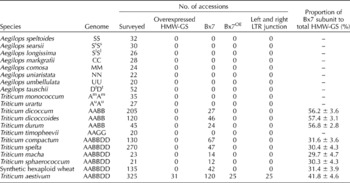
The materials used in this study included the diploid, tetraploid and hexaploid Triticum and Aegilops species that were mainly collected from the Chinese Academy of Agricultural Sciences (CAAS), the national gene pools of the USA and Germany and the International Wheat and Maize Improvement Centre (CIMMYT). The diploid accessions contained 32 Aegilops speltoides (SS), 30 Aegilops searsii (SsSs), 26 Aegilops longissima (SlSl), 28 Aegilops markgrafii (CC), 24 Aegilops comosa (MM), 22 Aegilops uniaristata (NN), 20 Aegilops umbellulata (UU), 52 Aegilops tauschii (DtDt), 35 Triticum monococcum (AmAm) and 27 Triticum urartu (AuAu). Four tetraploid Triticum species included 205 Triticum dicoccum (AABB), 120 Triticum dicoccoides (AABB), 45 Triticum durum (AABB) and Triticum timopheevii (AAGG) accessions. The hexaploid common wheat varieties and landraces (AABBDD) included 130 club wheat (Triticum compactum), 270 spelt wheat (Triticum spelta), 23 Triticum macha, 21 Triticum sphaerococcum, 135 synthetic wheat and 325 bread wheat mainly from China, Europe, North and South America and Australia (Table 1).
Identification of HMW-GS from bread wheat and related species by SDS–PAGE, RP-HPLC and STS markers

SDS–PAGE
HMW-GS were extracted from wheat grains using a modified method proposed by Gao et al. (Reference Gao, Ma, Chen, Wang, Li, Wang, Bekes, Appels and Yan2010). Identification of Bx7OE by SDS–PAGE was carried out as described previously by Yan et al. (Reference Yan, Hsam, Yu, Jiang and Zeller2003a).
RP-HPLC
RP-HPLC analysis of HMW-GS was as described by Dong et al. (Reference Dong, Hao, Wang, Cai and Yan2009) and performed on an Agilent 1100 using a Zorbax 300SB-C18 column (300 Å pore size and 5 μm particle size). The solvents (A) water and (B) acetonitrile both contained 0.06% (v/v) trifluoroacetic acid and filtered (0.45 μm) and degassed before use. For the analyses, 5 μl for each sample were injected. Proteins were eluted at 1 ml/min using a gradient from 21 to 48% B over 65 min, running for 20 column volumes. The column was maintained at 50°C and the proteins were monitored at 210 nm.
STS marker analysis
Genomic DNA extraction from dry seeds and PCR amplifications were as described previously by An et al. (Reference An, Zhang, Yan, Li, Zhang, Wang, Pei, Tian, Wang, Hsam and Zeller2006). Two pairs of allele-specific PCR primers were used to specifically detect Bx7OE (Ragupathy et al., Reference Ragupathy, Naeem, Reimer, Lukow, Sapirstein and Cloutier2008). Two STS markers flanking the LTR retrotransposon borders and the duplicated region were designed at the left and right junctions of the retroelement. The left-junction primers were 5′-ACGTGTCCAAGCTTTGGTTC-3′ and 5′-GATTGGTGGGTGGATACAGG-3′, and the right-junction primers were 5′-CCACTTCCAAGGTGGGACTA-3′ and 5′-TGCCAACACAAAAGAAGCTG-3′. The PCR conditions for the right and left junction markers of the retroelement were according to Ragupathy et al. (Reference Ragupathy, Naeem, Reimer, Lukow, Sapirstein and Cloutier2008). The PCR products were analysed by 1% agarose gel electrophoresis in Tris–acetic acid–EDTA buffer, and stained with ethidium bromide and visualized under ultraviolet light.
Gluten quality test
Gluten quality parameters were tested at Wheat Quality Laboratory, CAAS. Cleaned grain samples were pulverized using a Buhler experimental mill. A 10 g Mixograph (National Manufacturing) was performed to evaluate the quality properties of dough based on the procedure described by Yan et al. (Reference Yan, Jiang, An, Pei, Li, Zhang, Wang, He, Xia, Bekes and Ma2009). The Mixograph assays were performed by the 54-40A American Association of the Cereal Chemists method (AACC, 2000), and the results were automatically processed, mapped and displayed by Mixsmart software.
Results
Characterization of the overexpressed Bx7 subunit in bread wheat cultivars
A large number of bread wheat and related species collections listed in Table 1 were initially analysed by SDS–PAGE. The materials that were confirmed to carry the Bx7 subunit were further identified by RP-HPLC and STS markers. According to the relative proportion of the Bx7 subunit to total HMW-GS and the presence of the left and right LTR junctions, only 31 varieties among the 325 bread wheat varieties (120 with the Bx7 subunit) were found to have the Bx7OE subunit, and most of them originated from the American countries. Of the 31 varieties with the Bx7OE subunit, ten were from Canada (AC Vista, Bigger, Blue Sky, Burnside, Glenavon, Glenlea, Laura, Roblin, Oslo and Wild Cat), eight from Argentina (Buck Pucara, Calidad, El Gaucho, Klein Atlas, Klein Sendero, Pampa INTA, Retacon INTA and Victoria INTA), three from the USA (Red River 68, Nordic and Prospur), three from Australia (CD87, Kukri and Chara), two from Mexico (Bajio and Kanchan), two from Uruguay (Klein Credito and Olaeta Calandria), one from Brazil (Toropi), one from Portugal (Branco) and one from China (Demai 3), respectively.
The mean proportion of the Bx7 subunit to the total amount of HMW-GS among the 31 overexpressed Bx7 varieties was 41.8% (Table 1), which was much higher than that of the normal Bx7 subunit (generally about 30%). In addition to the Bx7OE subunit present in the 31 bread wheat varieties, no other overexpressed HMW-GS among the three encoding loci were found. This suggests that Glu-B1al is likely to be originated from a rare duplication event that occurred only in bread wheat varieties.
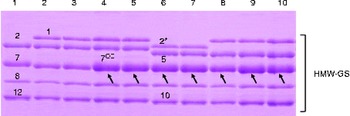
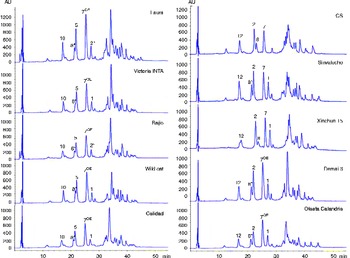
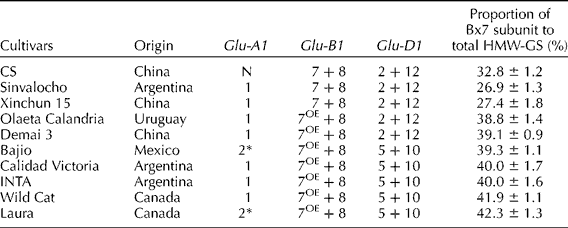
The HMW-GS of seven representative bread wheat varieties (Olaeta Calandria, Demai 3, Bajio, Laura, Victoria INTA, Wild Cat and Calidad) with Bx7OE as well as three varieties with the normal Bx7 subunit identified by SDS–PAGE are shown in Fig. 1. Although the sensitivity of SDS–PAGE was relatively low, the differences in expression between the normal and overexpressed Bx7 subunits could be easily differentiated on the gel. The HMW-GS compositions and the relative quantification proportion of the Bx7 subunit to the total amount of HMW-GS in ten bread wheat varieties were determined by RP-HPLC, as shown in Fig. 2 and Table 2. According to the results summarized by Ragupathy et al. (Reference Ragupathy, Naeem, Reimer, Lukow, Sapirstein and Cloutier2008), a variety could be defined as Bx7OE if the proportion of this subunit to the total amount of HMW-GS was more than 36%. The proportion of Bx7OE from the seven cultivars ranged from 38.8 to 42.3%, while that from the three normal cultivars (Chinese Spring (CS), Sinvalocho and Xinchun 15) were 26.9–32.8%, which was well corresponding to the results identified by SDS–PAGE (Fig. 1).
SDS–PAGE of HMW-GS from the ten common wheat varieties. The arrows indicate the Bx7OE subunit. 1. CS, 2. Sinvalocho, 3. Xinchun 15, 4. Olaeta Calandria, 5. Demai 3, 6. Bajio, 7. Laura, 8. Victoria INTA, 9. Wild Cat and 10. Calidad.

RP-HPLC profiles of HMW-GS from the ten common wheat varieties. The composition of HMW-GS in each variety is indicated.

HMW-GS compositions and relative proportion of Bx7 subunit to total HMW-GS in the ten common wheat cultivars determined by RP-HPLC

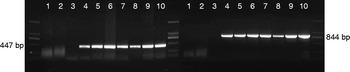
The Glu-B1 locus of the wheat cultivar Glenlea was sequenced (Cloutier et al., Reference Cloutier, Banks and Nilmalgoda2005). The tandem duplication of 10.3 kb comprised two copies of the Bx7 gene and flanked a complete and a partial LTR retroelement. According to this structural organization, Ragupathy et al. (Reference Ragupathy, Naeem, Reimer, Lukow, Sapirstein and Cloutier2008) designed two pairs of STS primers that can specifically detect the Bx7 OE gene. In this study, both STS markers were used to further detect the presence of the Bx7OE subunit identified by SDS–PAGE and RP-HPLC. As shown in Fig. 3, two fragments of 447 and 844 bp specific for the Bx7 OE gene were amplified in all the seven typical varieties containing Bx7OE, confirming that these varieties contain two duplication events of the Bx7 gene.
PCR amplification of the ten common wheat varieties with two STS markers. A 447 bp amplicon yielded by the amplified primers of the left junction of the retroelement and an 844 bp amplicon by the amplified primers of the right junction are shown. 1. CS, 2. Sinvalocho, 3. Xinchun 15, 4. Olaeta Calandria (Bx7OE), 5. Demai 3 (Bx7OE), 6. Bajio (Bx7OE), 7. Laura (Bx7OE), 8. Victoria INTA (Bx7OE), 9. Wild Cat (Bx7OE), 10. Calidad (Bx7OE).

Effect of the Bx7OE subunit on flour quality parameters
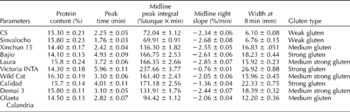
As shown in Table 2, the seven representative varieties with Bx7OE mainly originated from the American countries and three with normal Bx7 had similar HMW-GS compositions. The Mixograph quality parameters of these ten varieties were tested, and the results are shown in Table 3. The peak time (min) was used to test the time when dough reached maximum resistance, and the midline peak integral (%torque × min), also called area at 8 min, referred to the energy input in 8 min and indicated a synthetic indicator according to dough strength and rubbing resistance. The width at 8 min (mm) could determine the rubbing resistance of the dough. The cultivars with a larger value of peak time, peak integral and width at 8 min could have strong gluten and better flour quality. According to the results as well as gluten types estimated by the values of these Mixograph parameters, all varieties with Bx7OE except for Olaeta Calandria displayed strong or medium strong gluten quality (Table 3), generally better than those with the normal Bx7 subunit. This further supports previous reports that wheat cultivars with an overexpressed Bx7 subunit generally have superior gluten quality (Radovanovic et al., Reference Radovanovic, Cloutier, Brown, Humphreys and Lukow2002; Butow et al., Reference Butow, Ma, Gale, Cornish, Rampling, Larroque, Morell and Bekes2003).
Quality parameters of the ten common wheat varieties

Distribution of the Bx7OE subunit in Triticum and related Aegilops species as revealed by STS markers
Both Bx7OE STS markers were used to detect whether the LTR retroelement-mediated duplication at the Glu-B1 locus was present in Triticum and related species, as listed in Table 1 and Fig. S1 (available online). The results demonstrated that there were no accessions containing the left and right junction markers except for the 31 bread wheat varieties, which was well consistent with the identification results by SDS–PAGE and RP-HPLC. The S, Ss and Sl genomes of Aegilops, as potential ancestors of the B genome and the B genome of related tetraploid Triticum species (T. durum, T. dicoccoides and T. dicoccum) and synthetic hexaploid wheat varieties from durum wheat × Aegilops tauschii, did not possess the structure of the LTR retroelement-mediated duplication. These results suggest that the Bx7OE variant occurred only in bread wheat varieties with a lower frequency, which is mainly present in a few bread wheat varieties from the American countries.
Discussion
Association of allelic variations and expression at the Glu-1 loci with gluten quality
SDS–PAGE is a traditional method for the separation and identification of HMW-GS in wheat varieties. An overexpressed Bx7 subunit can be visualized by a relatively higher-intensity staining (Lukow et al., Reference Lukow, Payne and Tkachuk1989). However, this method is not precise and sensitive in the quantitative aspect. Allelic variation at the locus encoding the Bx7 subunit among different varieties can be quantitatively detected by RP-HPLC (Marchylo et al., Reference Marchylo, Lukow and Kruger1992; Butow et al., Reference Butow, Gale, Ikea, Juhasz, Bedo, Tamas and Gianibelli2004). Molecular markers can also detect the corresponding alleles with a lower cost, providing a much more convenient tool for rapid genetic analyses (Pagnotta et al., Reference Pagnotta, Nevo, Beiles and Porceddu1995).
Some investigations of the effects of Bx7 and Bx7OE at the Glu-B1 locus on dough strength have been reported. Marchylo et al. (Reference Marchylo, Lukow and Kruger1992) suggested that the Bx7 subunit might be associated with greater dough strength and decreased extractability of gluten proteins. Some genetic variability for gluten strength was accounted for the overexpression of the Bx7 subunit originating from the cultivar Glenlea-derived line 87E03-S2B1 (Radovanovic et al., Reference Radovanovic, Cloutier, Brown, Humphreys and Lukow2002). A strong association between the overexpression of Bx7 and high dough strength was present (Butow et al., Reference Butow, Ma, Gale, Cornish, Rampling, Larroque, Morell and Bekes2003). In addition, there was an additional impact of Glu-D1 alleles on dough properties, with lines containing both the overexpressed Bx7 subunit and Glu-D1 5+10 having the highest levels of dough strength. Cornish et al. (Reference Cornish, Vawser, Tonkin, Cauvain, Salmon and Young2005) also found that wheat varieties with both the overexpressed Bx7 subunit and the 5+10 subunits produced extra-strong dough properties. However, there was no statistically significant epistatic interaction between the Glu-B1 and Glu-D1 loci. The cultivars with Bx7OE possessed a significantly higher (P< 0.001) proportion of HMW-GS (56.80 ± 3.25%) encoded by the B genome, suggesting that the proportion of Glu-B1 subunits relative to the total amount of the expressed HMW-GS had a major effect on dough strength (Vawser and Cornish, Reference Vawser and Cornish2004). A recent report has also found that two novel HMW-GS from the Sl genome of Aegilops longissima had a higher expression level in the CS substitution line and led to significantly improved gluten strength (Wang et al., Reference Wang, Yu, Cao, Shen, Li, Li, Ma, Weißgerber, Zeller, Hsam and Yan2013). In this study, six varieties with Bx7OE displayed a strong or medium strong gluten property (Table 3), demonstrating the positive effect of HMW-GS overexpression on flour quality in addition to allelic variations of the Glu-1 loci.
Evolutionary origin of the Glu-B1al allele
Among the three Glu-1 loci, the Glu-B1 locus displayed the most extensive allelic variations in bread and spelt wheat varieties (Gianibelli et al., Reference Gianibelli, Larroque, MacRitchie and Wrigley2001; Yan et al., Reference Yan, Hsam, Yu, Jiang, Ohtsuka and Zeller2003b). The extensive allelic variations at the Glu-1 loci mainly resulted from single nucleotide polymorphisms and insertions/deletions (InDels), probably through unequal crossing over, slip mismatching, point mutations and illegitimate recombination (Zhang et al., Reference Zhang, Li, Wang, An, Zhang, Pei, Gao, Ma, Appels and Yan2008). These allelic variations in HMW-GS provide rich genetic resources for wheat quality improvement. The modern hexaploid wheat is an allohexaploid species with genomes A, B and D and an extremely large and complex genome up to 17,000 Mb. Genetic and phylogenetic studies have revealed that T. urartu and Ae. tauschii are A and D genome donors of hexaploid wheat, respectively, while the B genome is probably originated from the S genome of Ae. speltoides (Dvořák et al., Reference Dvořák, McGuire and Cassidy1988, Reference Dvořák, Resta and Kota1990; Petersen et al., Reference Petersen, Seberg, Yde and Berthelsen2006). Hexaploid wheat is the product of the hybridization between tetraploid wheat (AABB) and diploid goat grass (DD), which took place about 10,000 years ago (Zhang et al., Reference Zhang, Li, Wang, An, Zhang, Pei, Gao, Ma, Appels and Yan2008).
According to our results, the Glu-B1al allele (Bx7OE) was not found in wheat-related species through the analysis from a large number of collections, including spelt, club (Triticun compactum), dot (Triticum sphaerococcum) and durum wheat varieties, synthetic hexaploid wheat varieties from crossing between durum and Ae. tauschii as well as T. dicoccum, T. dicoccoides and several diploid Aegilops species carrying the S genome (Fig. S1, available online). The Glu-B1al allele appears to be present only in a few bread wheat varieties with a much low frequency (Table 1). This suggests that the Glu-B1al allele is originated from a rare mutation event. The retroelement-mediated recombination event at the Glu-B1 locus could have occurred more recently, later than the formation of hexaploid wheat. This result also provides the evidence for the role of retroelements on the evolution of agriculturally important loci.
The recent report on the analysis of the bread wheat genome has revealed that the gene family size is generally decreased in concurrent with domestication, whereas the gene family size for certain genes associated with crop productivity (defence response, energy metabolism, growth) and grain quality such as nutritional content and storage proteins is increased (Brenchley et al., Reference Brenchley, Spannagl, Pfeifer, Barker, D'Amore, Allen, McKenzie, Kramer, Kerhornou, Bolser, Kay, Waite, Trick, Bancroft, Gu, Huo, Luo, Sehgal, Gill, Kianian, Anderson, Kersey, Dvořák, McCombie, Hall, Mayer, Edwards, Bevan and Hall2012). Presumably these increases have been unconsciously selected during cultivation over the thousands of years since the species was formed to constitute a part of the co-evolutionary history of cereals and humans (Gill et al., Reference Gill, Appels, Botha-Oberholster, Buell, Bennetzen, Chalhoub, Chumley, Dvořák, Iwanaga, Keller, Li, McCombie, Ogihara, Quetier and Sasaki2004). The Glu-B1al allele that has originated very recently with a lower frequency may provide an example to support this evolutionary trend. This suggests that the retroelement-mediated recombination may play important roles in the increase of gene family size in bread wheat during the evolutionary process.
Supplementary material
To view supplementary material for this article, please visit http://dx.doi.org/10.1017/S1479262113000476
Acknowledgements
We are grateful to Dr Xianchun Xia and Dr Yan Zhang from the Institute of Crop Science, CAAS for constructive suggestions in reviewing the manuscript and flour quality analysis, respectively. This research was financially supported by grants from the National Natural Science Foundation of China (31271703 and 31101145), the China–Australia Cooperation Project from the Chinese Ministry of Science and Technology (2013DFG30530) and the National Key Projects for Transgenic Crops of China (2011ZX08009-003-004).