1. Introduction
Although doubts had always persisted concerning the authenticity of the Gospel of Jesus' Wife fragment (GJW) since its announcement on 18 September 2012, scholars had assumed that the associated fragments mentioned in Karen King's initial publication were authentic. Proponents of the GJW considered these accompanying papyri as corroboration of the recounted modern journey of the papyri from Potsdam, Germany in 1963 through the Freie Universität Berlin in 1983 and into the hands of the current owner. Dr King received copies of three modern documents from the present owner: a contract of sale for six Coptic papyrus fragments (dated 12 Nov 1999), a typed and signed letter from Egyptologist Peter Munro (dated 15 July 1982), and an unsigned, handwritten note mentioning Egyptologist (Gerhard) Fecht.Footnote 1 In December 2011, the owner delivered the GJW to Dr King. A second Coptic papyrus from the collection, of John's Gospel in Lycopolitan Coptic (hereafter, HLJ ‘Harvard Lycopolitan John fragment’), arrived on 13 November 2012.Footnote 2
In April 2014, a Harvard Theological Review issue published several articles discussing the authenticity of the GJW, including four articles presenting scientific results from radiometric dating, ink analysis and multispectral imaging. Some articles directly referenced the HLJ, but none of the articles presented images of the GJW or of the HLJ.Footnote 3 A dedicated website, hosted by the Harvard Divinity School, offered numerous images of the GJW, as well as more extensive versions of the scientific reports by Azzarelli et al. (‘Study of Two Papyrus Fragments’) and Yardley and Hagadorn (‘Characterization of the Chemical Nature’)Footnote 4 which contained images of the HLJ.
Shortly after publication of the Harvard Theological Review issue, the present author encountered images of the Coptic John fragment, and realised the significance of the fragment for demonstrating that both it and the GJW fragment were modern creations.Footnote 5 The two Coptic fragments clearly shared the same ink, writing implement and scribal hand.Footnote 6 The same artisan had created both essentially at the same time. The John fragment was in fact a crude but almost exact copy from Herbert Thomson's 1924 publication of the Qau codex. The present article will first survey the known witnesses to John's Gospel in Coptic and then relate those arguments which have compelled scholars to identify the HLJ as a modern simulation of an ancient manuscript.
2. The Qau Codex in its Coptic Context
Coptic, the final stage of the Egyptian language, was written with the Greek alphabet plus six or seven Demotic characters and was widely used from the fourth to thirteenth centuries in Egypt. The rise of written Coptic was undeniably tied to the rise of Christianity and monasticism in Egypt during the late third and fourth centuries. Until the sixth century, most Coptic literature had been translated from Greek or another language, and although a wide variety of literature survives in various more or less fragmentary forms from the pre-Islamic period, biblical texts are the most common type preserved.Footnote 7 Coptic was written in a number of distinct dialectal systems, several of which disappeared before the Arab invasion,Footnote 8 often meaning that a given New Testament text would only now be extant in the main dialects (Sahidic and Bohairic) with perhaps some fragments of one or two other dialectal translations. John's Gospel, however, survives not only in the greatest total number of Coptic manuscripts, but also in the largest variety of dialects — seven in total.Footnote 9
For over a century, scholars have focused on the Sahidic biblical tradition, because of the extensive number of early surviving witnesses to the tradition. Fortune favoured a cache of several hundred highly fragmentary manuscripts from the White Monastery of Sohag dating from the tenth–twelfth centuriesFootnote 10 as well as forty-seven well-preserved codices from the Archangel Michael Monastery of Hamuli dating from the ninth–tenth centuries.Footnote 11 Numerous further examples of Sahidic manuscripts can be dated as early as the fourth century.Footnote 12 Although the origins of Sahidic are unknown, the dialect flourished across southern and middle Egypt until the twelfth century, aided by its dialectally neutral phonology.Footnote 13
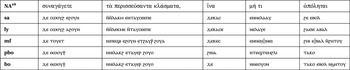
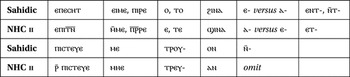
Approximately 155 witnesses to Sahidic John are currently known,Footnote 14 most of which are shattered remains of once glorious codices, consisting of a few leaves or even a single fragment. Five of these Sahidic John witnesses preserve a basically complete text of the gospel.Footnote 15 The Sahidic translation of John's Gospel systematically parallels the Lycopolitan Coptic translation. Although the various Coptic dialectal translations of John share similarities which naturally derive from essentially stable Greek tradition and the common vocabulary and grammar of the Coptic language, the similarity to the Lycopolitan is uncanny when compared with the other Johannine Coptic translations. Although one can only guess whether the Sahidic or Lycopolitan had precedence, the two versions must have derived from the same translation event. In this sense, it can be said that the Lycopolitan translation is the earliest extensive witness to the Sahidic version of John's gospel. Note the exact parallel between the Sahidic and Lycopolitan in the selection in Table 1, disregarding the dialectally related vowel changes.
The extant Coptic translations in John 6.12

Until the nineteenth century, Western scholars generally knew Coptic through one dialect — Bohairic, which flourished in the Nile Delta and was the principle dialect in the monasteries of Scetis. Probably because of the prominence of these monasteries, Bohairic emerged as the official liturgical language of the Coptic Orthodox Church from the thirteenth century onwards.Footnote 16 Essentially all extant classical Bohairic manuscripts date from the thirteenth through nineteenth centuries, whereas the earlier Bohairic manuscripts did not survive the humid conditions of the Nile Delta, where the dialect was spoken.Footnote 17 Only perhaps six Bohairic witnesses date to the first millennium, four of which preserve a sub-dialect of Bohairic labelled Proto-Bohairic or Old Bohairic.Footnote 18 Following several nineteenth- and early twentieth-century acquisitions of large collections of Sahidic manuscripts from Sohag, Hamuli, Edfu, Nag HammadiFootnote 19 and elsewhere, extensive study of Bohairic literature in general and the Bohairic biblical tradition in particular essentially ended. George Horner's edition of the Bohairic New Testament (1898–1905) was the last major publication.Footnote 20
Horner cited forty-two manuscripts in his edition of Bohairic John.Footnote 21 Unlike the other Coptic dialects, Bohairic manuscripts are often preserved intact, and likewise often contain dated colophons or watermarked paper allowing for precise dating. While scholars have often exaggerated the ‘Greekness’ of Bohairic versus Sahidic in terms of the use of Greek loanwords,Footnote 22 the Bohairic translator of John's Gospel was generally less formally literal in his translation, frequently employing Greek words and structures where the expected word or structure was not to be found.Footnote 23 Bohairic uses the character khei ϧ /x/ to distinguish the voiceless pharyngeal fricative from the character horeh ϩ /h/ found in all the dialects. The Bohairic dialect has a number of other distinctions such as some unique vocabulary, different verbal conjugation and the aspiration of certain consonants, which differentiate it from Sahidic and the dialects of southern Egypt. One papyrus codex discovered among the Dishna papers (P.Bodmer 3) contains an early Bohairic translation of John's Gospel which differs in the translation that it preserves and also offers a distinct sub-dialect of Bohairic.Footnote 24 Whereas Bohairic manuscripts typically date from the twelfth–nineteenth centuries, this Early Bohairic Gospel of John probably dates with the remainder of the Dishna papers to approximately the fourth century.
Scholars have classified manuscripts into several other ‘minor dialects’, so named because only a limited number of representative literary manuscripts survive, and because these dialects mostly did not survive beyond the fifth century. John's Gospel is extant in the best-known dialects, plus some unique sub-dialects. Fragmentary remains of ten Fayumic manuscripts of John represent the most widely attested of the minor dialects. Fayumic appears to have survived as a written form into the eighth century,Footnote 25 during which time the canal systems which supported agriculture in the Fayum Oasis failed, allowing for the preservation of a large amount of manuscripts in this quickly deserted region.Footnote 26 Fayumic shares verbal conjugations with Bohairic, but is best known for lambdacism; Fayumic texts often have lambda ⲗ in lieu of rho ⲣ. A Middle Egyptian or Oxyrhynchite translation of John survives in one papyrus fragment from the Oxyrhynchus excavations.Footnote 27 Middle Egyptian, like Fayumic and Bohairic, shares a northern Egyptian verbal conjugation system, but has a distinct orthography for the perfect conjugation (ϩⲁ- versus ⲁ-). The University of Michigan possesses a series of papyrus leaves with a ‘Middle Egyptian Fayumic’ translation (P.Mich. inv. 3521).Footnote 28 The text is not rigorously consistent with regard to dialect, and likewise the scribe vacillated between a distinctly Middle Egyptian shai ϣ /ʂ/ character and the shai typical of other biblical majuscule texts. Although the Middle Egyptian Fayumic offers a distinct and stable translation, the dialect may have been a short-lived or idiosyncratic phenomenon.
Two minor dialects can be localised to southern Egypt. A fragmentary series of papyrus leaves in Strasburg contain an edition of 1 Clement and the epistle to James in Achmimic Coptic, a dialect indigenous to ancient Thebes. This manuscript, known as  ${\frak (P)}$6, also contained a pericope from John's Gospel, which alternates between sections of John 10–11 in Achmimic and Greek.Footnote 29 Similar to Bohairic, Achmimic has a distinctive character khei ϩ /x/. The last dialect to be discussed here, and the most relevant to the present discussion, is Lycopolitan (formerly Subachmimic),Footnote 30 which must have been related to Achmimic. The first witness to John's Gospel in Lycopolitan is a seven-leaf writing exercise containing chapters 10–13 of John's Gospel,Footnote 31 which has essentially the same text as the primary witness to Lycopolitan John, the Qau codex.Footnote 32 This Lycopolitan manuscript is famous not only for its antiquity (discussed below), but also for the extensive amount of text which is preserved and its unique relationship to the wider Sahidic tradition.
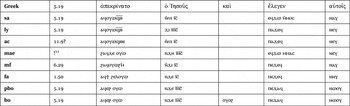
Table 2 illustrates the dialectal diversity of the Coptic John tradition. The readings below are based on the recurring stock phrase, ‘Jesus answered and he said.’ Except for the Middle Egyptian version, each instance has been based upon a specific occurrence of the phrase. These occurrences have been grammatically standardised to allow the reader to compare the differences. For instance, the following list has standardised the placement of the name ‘Jesus’. The dialects are listed geographically starting in Upper Egypt (Sahidic, Lycopolitan, Achmimic), moving to Middle Egypt (Middle Egyptian, Middle Egyptian Fayumic, Fayumic) and ending in Lower Egypt (Early [Proto-]Bohairic, Bohairic), with respective sigla as used in the Nestle–Aland editions.
A comparison of the Coptic dialects of John

The diversity of extant dialects suggest that John's Gospel was the most widely read not only of the Gospels, but indeed of any biblical text. Although the discovery of a new fragment of John in Coptic would be far from extraordinary, the emergence of a new fragment in one of the minor dialects would certainly attract attention.
3. The Harvard Lycopolitan John Fragment
From the beginning, the bizarre character of the GJW handwriting perplexed scholars.Footnote 33 Malcom Choat, a prominent Coptologist with wide-ranging experience with both documentary and literary texts, stated:
The handwriting is not similar to formal literary productions of any period and should be compared rather to documentary or paraliterary texts (though it does not closely resemble typical fourth-century Coptic documentary hands). While I cannot adduce an exact parallel, I am inclined to compare paraliterary productions such as magical or educational texts. The way the same letter is formed sometimes varies. Thin trails of ink at the bottom of many letters, multiple thin lines instead of one stroke, and the forked ends of some letters could suggest the use of a brush, rather than a pen: one may compare Ptolemaic-period Greek documents written with a brush. The brush had largely ceased to be used by the Roman period and should not be encountered in this context.Footnote 35
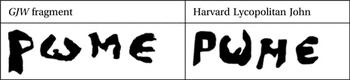
Because the GJW had no known parallels among extant Greek-Coptic hands, it was surprising to encounter the same handwriting, ink and writing instrument in the Lycopolitan John fragment. The two fragments were almost certainly the product of the same hand — even of the same writing instrument.Footnote 36 Compare the samples from the two papyri (Table 3).
Gospel of Jesus Wife and Lycopolitan John scripts

Although King originally referenced this fragment simply as a ‘Gospel of John in Coptic’,Footnote 37 it is immediately recognizable as a Lycopolitan Coptic text. As already mentioned, one would by default expect to encounter Sahidic on a papyrus fragment, as other dialects are comparatively rare and therefore noteworthy. The Harvard John contains John 5.26–31 on the recto and 6.11–14 on the verso, texts which are extant in only one other Lycopolitan manuscript — the Qau codex.
During a 1923 British School of Archaeology excavation led by Guy Brunton at Qau el-Kebir, excavators discovered a broken pot made of red pottery and decoratively painted (Figure 1, sketch), which contained a papyrus codex wrapped in linen.Footnote 39 In little more than a year, Herbert Thompson published this Qau codex, which is now in the holdings of the Cambridge University Library along with other manuscripts owned by the British and Foreign Bible Society, including photographs of every page alongside typeset transcriptions.Footnote 40 As will be discussed below, the HLJ is a direct copy from this publication, which has been widely available on the internet since as far back as February 2005.Footnote 41 The arguments for dependence and simulation are as follows:
i. Seventeen shared line breaks
ii. Radiocarbon dating and the demise of Lycopolitan
iii. Dialectal implausibility of ⲉⲃⲟⲗ/ⲁⲃⲁⲗ (Suciu)
iv. Writing both through and around a hole in the papyrus (Krueger)
v. Codicological reconstruction (Emmel)
vi. Shared peculiarities (Emmel)
vii. Forger's errors (nonsense readings)
i. Seventeen shared line breaks
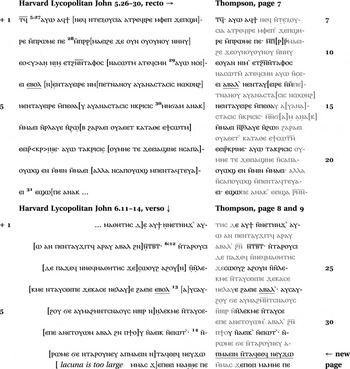
The HLJ has seventeen line breaks, all of which agree with line breaks in the Qau codex. Such agreement is unparalleled, for instance, among the known Sahidic witnesses of John and, perhaps more significantly, between the Chester Beatty writing exercise which contains John 10.7–13.38 in Lycopolitan (Ac. 1390), and the Qau codex.Footnote 42 The following parallel rough transcriptions illustrate how the copyist meticulously skipped every other line in Thompson's edition (Table 4). For the purpose of illustration, the Codex Qau text which is not preserved in the Harvard fragment appears in grey.
Shared line breaks in the Harvard John and Thompson's transcription of codex Qau

To understand why the copyist skipped every other line, one should consult Thompson's edition. Herbert Thompson transcribed two leaves of the codex on each page of his edition, and likewise presented two leaves side-by-side in each photo. Each leaf contained only one column of text. Greek and Coptic manuscripts from pre-Islamic Egypt rarely survive in a two-column format, but the modern copyist who produced the Harvard fragment must have mistaken the Qau codex as a two-column codex based upon Thompson's presentation. By skipping lines, the modern copyist probably was naively attempting to reconstruct two columns of content into a one-column format.Footnote 43
While every line break in the Harvard fragment matches a line break in the Thompson edition, the line-skipping pattern deviates with the last line of the verso. The copyist does not skip a line in John 6.14, but the reason is almost immediately obvious when Thompson's edition is at hand. Whether the copyist used the online PDF or a printed edition of Thompson's 1924 edition, he or she would have turned the page at this line break, because the penultimate line of the Harvard fragment is the ultimate line of the codex Qau page 8. This deviation only proves further the copyist's dependency on Thompson's publication, since the reconstruction of the lacuna in ⲛⲉⲩϫⲱ [ⲙ̄ⲙⲁⲥ ϫ]ⲉⲡⲉⲉⲓ ⲙⲁⲙⲏⲉ ⲡⲉ is too small compared to the other lines and cannot be expanded by appeal to textual variation, because the grammatical formula used here is stable. The Coptic verb ϫⲱ ‘to say’ is always followed by the phrase ⲙⲙⲁⲥ (ⲛⲁⲩ) ϫⲉ, leaving little doubt that a significantly longer variant text could expand the lacuna (Cf. transcription in Table 4.) Furthermore, the suggestion that the scribe could have been writing around a hole in the papyrus is complicated by the regularity of the line breaks on the recto, which do not support the presence of a hole.
ii. Radio-carbon dating and the demise of Lycopolitan
Scientists in Arizona and Massachusetts radiometrically dated the Harvard Lycopolitan John fragment to 681–877 and 648–800 ce respectively.Footnote 44 Insofar as some Lycopolitan manuscripts are datable, the fourth century is the prevailing period of origin. Perhaps eight tractates from the Nag Hammadi Codices could be classified as Lycopolitan; three documentary papyri from the binding of Codex vii preserve dates (20 Nov 341, 21 Nov 346 and 7 Oct 348 ce),Footnote 45 suggesting that the codices originated probably not more than a century afterward.Footnote 46 An archive related to Meletian monks containing three Lycopolitan documentary letters dates to approximately 330–40 ce based upon accompanying documents.Footnote 47 Likewise, archaeological excavations in the Dakhleh Oasis uncovered Lycopolitan documentary and literary papyri from a Manichean community which thrived from about 355 to 390, and a second group of Manichean Psalms codices reportedly found at Medinet Madi have been carbon-dated to the third–fourth centuries.Footnote 48 The dating of the Qau codex is a difficult affair. In an adjacent site, British archaeologists unearthed a horde of fifty gold coins which were minted in the period 343–61 ce.Footnote 49 Two coins from the excavation date from the ninth century,Footnote 50 so the evidence of the horde is tenuous. Although palaeographic dating is perilously speculative, Frederick Kenyon dated the scribal hand of the Qau codex to the third quarter of the fourth century.Footnote 51
Because Lycopolitan manuscripts with a known date repeatedly have fourth-century origins, and because the Coptic documentary tradition which flourishes in the sixth through eighth centuries uses only Sahidic and Fayumic dialects, Coptologists assume that the minor dialects (e.g. Achmimic, Lycopolitan and Middle Egyptian) were extinct by the sixth century. The radiometric dating of the Harvard Lycopolitan John to the seventh–ninth centuries indicates that the papyrus plant was harvested one or more centuries after its text should have been written.
iii. Dialectal implausibility of ⲉⲃⲟⲗ/ⲁⲃⲁⲗ
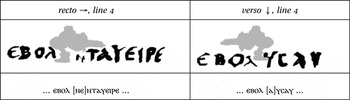
Alin Suciu first noted that the HLJ deviates from the Qau text only in the spelling of the adverb ⲉⲃⲟⲗ (Sahidic)/ⲁⲃⲁⲗ (Lycopolitan).Footnote 52 The Harvard John text therefore deviates from Lycopolitan (= Subachmimic) dialectal vocalisation only in two instances of ⲉⲃⲟⲗ (lines 4 recto and 4 verso). Although Lycopolitan forms frequently appear in Nag Hammadi texts like the Gospel of Thomas (and indeed the original publication of the GJW misinterpreted such a Lycopolitan negative aorist ⲙⲁⲣⲉ- as the Sahidic homophone), the present Sahidic word reveals the naiveté of a modern copyist. To understand why a copyist might offer such alterations, one should consider Bentley Layton's description of the dialect of the Nag Hammadi Codex ii, which contains the Gospel of Thomas:
Superficially the Coptic of Codex ii appears to consist of a random mixture of forms from the Sahidic (S) and Subachmimic (A²) dialects, with a preponderance of Sahidic … It is reasonable to assume that the Coptic of Codex ii is a literary language, which can be classed as ‘Crypto-Subachmimic’ (Crypto-A²), showing ‘the characteristics of a text written or translated by a native speaker of Subachmimic in which he attempts (without total success) to correct his own speech habits in conformity with another dialect — Sahidic in the case of Codex ii — with the result that (a) vocalization of lexical forms according to the other dialect is common or prevalent (sometimes even with hyper-correction), but (b) important A² traits, especially in syntax and the spelling of grammatical forms remain’.Footnote 53
The modern copyist may have attempted to imitate ‘Crypto-Subachmimic’ by adding a Sahidic element to the Lycopolitan text, but the kind of change does not parallel known dialectal variation. Consider the survey of Funk and Layton's ‘Crypto-Subachmimic’ tendencies in Table 5.Footnote 54
Examples of ‘Crypto-Subachmimic’ from the Nag Hammadi Codex ii

It is not impossible that Sahidic ⲉⲃⲟⲗ could occur for Lycopolitan ⲁⲃⲁⲗ; such a replacement does occur in Nag Hammadi Codex i,5, the Tripartite Tractate, whose dialect is predominately Lycopolitan with influence from Sahidic.Footnote 55 The appearance of ⲉⲃⲟⲗ in the Harvard John is extremely peculiar given other parallel texts, since the two deviations from Lycopolitan reflect a double vocalisation shift (ⲉ → ⲁ, ⲟ → ⲗ) in an otherwise stable dialectal text. Generally, most dialectal deviations such as those found in Nag Hammadi Codex ii or in the Tripartite Tractate reflect the vocalisation of a single vowel, and more significant deviations are in the minority. In the case of the Tripartite Tractate, ⲁⲃⲟⲗ is slightly more common than ⲉⲃⲟⲗ as a variant, and the form ⲁⲃⲁⲗ clearly predominates (ⲉⲃⲟⲗ × 17, ⲁⲃⲟⲗ × 20, ⲁⲃⲁⲗ × 375). Therefore, while the occurrence of this Sahidic form in a Lycopolitan text could be compared to parallels in the Nag Hammadi Corpus, the dialectal stability of the remainder of the HLJ (John 5.26–30 and 6.11–14) contrasts with these two major departures. One would expect two larger slips among numerous smaller dialectal deviations. Once again the text is more easily explained as a modern creation than an ancient one.
iv. Writing both through and around a hole in the papyrus (Krueger)
Joost Hagen published a PDF online, in which he shared Frederic Krueger's remarks about a papyrus hole and its relevance to the authenticity of the fragment.Footnote 56 Such lacunae are not uncommon in papyri. Sometimes, a scribe will write around a pre-existing hole in a papyrus or parchment leaf, and in other instances damage to the writing material deletes portions of the text. Krueger noted that the scribe of the HLJ wrote both around a hole, as if the hole were pre-existent, and through the hole, as if the hole were the result of post-scribal damage. In the images below, two characters have been lost on the recto, and the character nu is too diminutive to accommodate the papyrus hole, while an alpha has been lost on the recto presumably due to this hole (Table 6). The scribe appears to have been simulating a damaged papyrus, when he inconsistently wrote the character nu around the hole.
Writing both around and through a hole in the HLJ

v. Codicological reconstruction (Emmel)
Stephen Emmel, known for his expertise in reconstructing highly fragmentary manuscripts from the White Monastery of Shenoute, published a PDF online contending that the HLJ would have been ridiculously large, if the fragment had ever constituted part of an authentic codex:
Thus the reconstructed John manuscript is either an extraordinarily tall and narrow single-column codex, or it is a short and even more extraordinarily wide two-column codex. If its existence be accepted as a fact, it would appear to deserve to be acknowledged as the tallest (or widest) papyrus codex yet known. Among extant papyrus codices written in Coptic in particular, this hypothetical John codex would stand out as even more extraordinary.Footnote 57
Emmel notes that the largest surviving papyrus leaf (P.Berl. inv. 11739A) measures 40.4 × 21.5 cm (868.6 cm²), and is dwarfed by the reconstructed Harvard John leaf, which according to Emmel's average would have been approximately 59 × 29 cm (1225 cm²).Footnote 58
vi. Shared peculiarities (Emmel)
Emmel additionally noted two peculiarities in the HLJ, which suggest a dependency on Herbert Thompson's Qau publication. First, in line 5 of the recto, John 5.29, the Harvard fragment reads ⲛⲉⲛⲧⲁⲩⲉⲓⲣⲉ ⲙ̄ⲡⲉⲑⲁ[ⲩ], ‘the ones which did (the) evil’, in accordance with the Qau codex. A reader might expect to encounter ⲙ̄ⲡⲡⲉⲑⲁⲩ here, but a ⲡ has disappeared due to a dialectal tendency. The Lycopolitan dialect often omits the definite articles ⲡ- and ⲧ- before initial consonants ⲡ and ⲧ, respectively.Footnote 59 So, the scribe of the Harvard John has correctly copied the Lycopolitan form ⲙ̄ⲡⲉⲑⲁⲩ, but ironically this scribe copied Thompson's peculiar reconstruction from two lines earlier, ⲛⲙⲡⲉⲧⲛⲁⲛⲟⲩ ‘the ones which are good’, where one would expect ⲙⲡⲉⲧⲛⲁⲛⲟⲩ from the Lycopolitan context.Footnote 60 Instead of basing his reconstruction upon the extant parallels in Lycopolitan (here and John 3.20), Thompson followed Horner's Sahidic text in this instance and assumed that Qau would have the direct object marker (ⲛ-), the plural article (-ⲙ-) and finally the noun (ⲡⲉⲧⲛⲁⲛⲟⲩ). Thompson reconstructed an article where he should not have, and the HLJ has the same article.
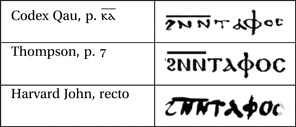
Second, the HLJ superlineates at least one word in a manner inconsistent with ancient standards but similar to the typesetting of the 1924 edition of Codex Qau. Referencing the Harvard John reading ϩ̅ⲛ̅ⲛ̅ⲧⲁⲫⲟⲥ, Emmel notes that ‘in the printed edition on the facing page, it appears at first sight that Thompson transcribed ϩ̅ⲛ as ϩ̅ⲛ̅ⲛ̅’.Footnote 61 Thus, the copyist of the HLJ produced a bizarre superlineation which reflected his dependency on Herbert Thompson's published transcription (see Table 7).
Peculiar superlineation in the HLJ

vii. Forger's errors (nonsense readings)
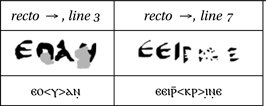
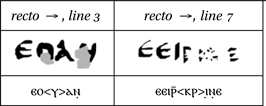
To err is human. Authentic ancient manuscripts are littered with errors which would in no way suggest that they are modern forgeries. The HLJ, however, contains uncorrected scribal errors which suggest that the fragment's creator was not in fact producing a text which would ever have been read in an ancient context. These uncorrected errors on the recto (lines 3 and 7) suggest that the manuscript was a hastily constructed prop, and not a literary document or even a writing exercise. In both instances, the scribe has omitted characters, and then relied on the damaged nature of the papyrus to cover the mistake, probably even inflicting the damage him- or herself to cover these errors. In both instances, the reader encounters uncorrected nonsense (see Table 8).
Uncorrected and effaced errors (recto)
4. Conclusions
The Harvard fragment of John's Gospel discussed here basically reproduces the text of the Qau codex published by Herbert Thompson in 1924. Not only is the text essentially identical in its content and line breaks (excepting the dialectal deviation of ⲉⲃⲟⲗ), but in those instances where the text offers some minor deviation, the difference unfailingly reflects an attempt to reproduce Herbert Thompson's transcription onto a recycled papyrus fragment.Footnote 62 Before sceptics rush in with untenable notions of coincidence or a storyline in which the Lycopolitan Qau codex, which was probably buried during or shortly after the fourth century, was somehow copied onto a papyrus leaf harvested in the seventh–ninth centuries (when the dialect was no longer in use), the astute reader should consider the weighty parallels between the GJW fragment and the HLJ. These two fragments, which apparently reflect the same hand, the same ink, the same writing instrument, also irrefutably resemble PDFs freely available on the internet.Footnote 63 The most obvious origin for these two fragments would lie in the years immediately preceding their popular advent. Presumably, the German professors Fecht and Munro had already passed away when the accompanying documents which mentioned the GJW and this John fragment were created (2006 and 2009, respectively).Footnote 64
The Harvard Lycopolitan John fragment served as a historical anchor for the GJW fragment, linking the more sensational manuscript with a less controversial group of papyri as well as a modern provenance (since 1963) which would allow a papyrologist to publish the fragment with a clear conscience.Footnote 65 Although the creator concocted the GJW patchwork in light of modern debates about the historical Jesus, the choice of text pericopes in the HLJ is not so easily discerned. The recto (John 5.26–30) discusses the authority of the Son of Man, and persons being resurrected from their tombs, while the verso (John 6.11–14) relates the feeding of the multitude. Perhaps the intent was to choose unremarkable passages, which would subsist in the shadow of the more interesting GJW text. Perhaps, however, the perpetrator chose not the scriptural passage but rather the papyrus image, noting in the spirit of Hermann Rorschach that the deterioration of the page left a hole that was distinctive from all others in the manuscript. The relevant bifolium of the Qau codex is mocking us (see Figure 2).Footnote 66
Burial potFootnote 38

Qau codex, pp. 21–2