Always bear in mind that the people are not fighting for ideas, for the things in anyone's head. They are fighting to win material benefits, to live better and in peace, to see their lives go forward, to guarantee the future of their children.Footnote 1
— Amílcar CabralIn the 1965 party directive quoted above, Amílcar Cabral laid out the challenge of mobilization for Guinea-Bissau's liberation movement, led by the Partido Africano da Independência da Guiné e Cabo Verde (PAIGC). The war affected the lives of virtually every Bissau-Guinean, especially those who served militarily and/or experienced the conflict as PAIGC combatants, as Portuguese soldiers, and as refugees from the violence. By 1970, an estimated 106,000 Bissau-Guineans, almost 20 per cent of the country's population, had relocated to the neighboring states of Guinea and Senegal.Footnote 2 Some of these migrants played a role in the war effort as well, aiding the independence forces by providing refuge and by helping move military material across the border.
This article represents a conscious decentering of Cabral and other important PAIGC figures in narratives of the war for independence, and in turn, focuses on the various perspectives brought forward in individual and community memory.Footnote 3 Most accounts of Guinea-Bissau's war for independence have focused on the PAIGC, particularly its leaders, military operations, and the work of building up the liberated areas to achieve Cabral's goal of ‘win[ning] material benefits’.Footnote 4 However, these narratives coexist somewhat uncomfortably with another story in need of a careful answer: how to explain why many Bissau-Guineans continued to fight in the Portuguese colonial military against the independence forces. As former Portuguese commando Amadú Bailo Djaló wrote in his memoir, ‘It was a war that divided…children of the same land’.Footnote 5 Though historians have looked more broadly at African soldiers in wars for independence, these histories need to be examined alongside those of liberation armies and struggles.Footnote 6 In Lusophone Africa and elsewhere on the continent, the legacy of Africans who served in colonial militaries is a problematic one that intimates the contested and fractured nature of liberation struggles.Footnote 7 To explore these fissures, I use narratives of individual and communal behavior to examine war as a ‘social condition’, demonstrating how a variety of social and cultural factors, rooted in local more than national dynamics, shaped individual experiences and decisions regarding participation during wartime.Footnote 8
Centering individual experiences highlights the social conditions that shaped individual decision-making, helping to fracture narratives that impose a teleological vision of wars for independence. These histories portray those fighting against colonial rule as valiant heroes, and ‘loyalists’ working with colonial governments as traitors to a state yet-to-exist. In the case of Guinea-Bissau, many decisions were consciously made to produce the greatest safety for oneself and one's family, regardless of the greater moral arc of the war. To give one example, Armando Abdulai Baldé of Canhamina became a Portuguese soldier after finishing his schooling. He claimed that he had to do so, as did other students completing their studies, because the Portuguese ‘had all your information’, and thus not participating in the war would have put his family at risk.Footnote 9 As in central Kenya during the Mau Mau rebellion, many ‘were risk averse actors…Wrong decisions were liable to be penalised with the harshest of sanctions — death’.Footnote 10 Opposition to liberation may, in this framing, be a conscious decision for personal safety and survival. Many Fulbe in Guinea-Bissau described their lack of open support for the PAIGC, and the assistance they gave to the Portuguese, in these individualized terms. Discussions of African wars of liberation have highlighted the role of liberation armies in exile or those who lived in refugee camps, but these were not the only people who left their homes during wars of liberation.Footnote 11 Because these wars shaped the lives of all individuals, it is important to understand that many people, like the one-fifth of Guinea-Bissau's population mentioned above, fled and integrated into communities on the other side of national borders.
Moreover, the militarization of liberation wars, and of war in general, have gendered effects that impact daily life beyond just active participation in soldiering.Footnote 12 The militarization of Guinea-Bissau in wartime shaped the lives of all Bissau-Guineans, not just those who fought in formal military roles. I argue that individual narratives of people's experiences during Guinea-Bissau's war for independence, whether through soldiering or other activities, offer a window onto the social conditions of war that informed the multilayered decision-making of Fulbe (and others). Myriad considerations structured and constrained decision-making, among which ethnicity was only one.
Fulbe narratives
This article's contributions rely on two new bodies of evidence: oral histories drawn from interviews and conversations with individuals in Guinea-Bissau and Senegal, as well as recently declassified accounts from a variety of Portuguese archives. I focus primarily on histories of Fulbe men and women in eastern Guinea-Bissau, because this history has too often been flattened by PAIGC members and historians alike who dismiss Fulbe as Portuguese collaborators. This ignores a much larger history of Fulbe participation in support of or disengagement from the war, and fails to account for how individuals made decisions in the face of imperfect options even when those decisions were to support the Portuguese military or cause.
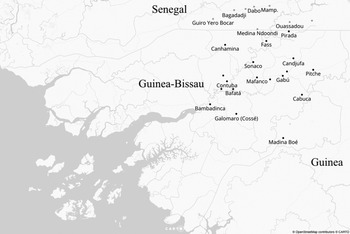
Oral histories of those who lived through the war are key to this rethinking of the war and how the war has lived on through individual and collective memory. The 33 interviews with 61 individuals cited in this article were conducted by myself alongside two research assistants, Falaye Danfakha and Mady Camara, in 2016 and 2017, as part of a larger research project on cross-border migration in nineteenth and twentieth century Senegal, Gambia, Guinea-Bissau, and Guinea. Those interviews included veterans, ranging in age from their 60s into their 80s, reflecting on military service from roughly 40 to 50 years earlier. To learn about noncombatant experiences of war and their impact on social life, or the social condition of war, we also interviewed those who lived through the war in Guinea-Bissau and Senegal, some of whom migrated due to violence and economic hardship. These interviews were crucial to understanding the way personal experiences and local conditions shaped individual and communal involvement in the war. Twenty of the interviews were with individuals, while the other thirteen were conducted in small groups ranging from two to five people. Of the 33 interviews, 29 were conducted in Pulaar (the Fulbe language) by the author, with assistance from Camara or Danfakha (who alternated working alongside the author). Three other interviews took place in Mandinka, with Camara or Danfakha translating. One interview took place in both Pulaar and Mandinka. The interviews themselves were recorded and held primarily in outdoor spaces within people's homes, and typically ranged from half an hour to an hour, generally preceded and followed by less formal conversations. In Senegal, and to a lesser extent Guinea-Bissau, I relied on personal connections to identify interview participants, and in both countries was aided by village chiefs and community leaders.Footnote 13
Map of interview locations.
Source: Created by author using CARTO and OpenStreetMap. © OpenStreetMap contributors, © CARTO.

Reframing anticolonial struggles
Questions about colonial loyalists and their post-independence legacies are not confined to the societies liberated from Portuguese rule in 1974–5, but rather extend across postcolonial nations in Africa and beyond.Footnote 14 As such, it is worth investigating the nature of collaboration as Africans participated in colonial militaries from the period of conquest through wars of decolonization, for a variety of reasons.Footnote 15 African service in colonial soldiering was not exclusive to the early period of conquest and colonial rule but was equally present during the runup to independence. In the case of Kenya, loyalists have been derided ‘as a few, wealthy Christian individuals, who acted in the service of colonial masters’. Footnote 16 But in central Kenya, loyalism during Mau Mau was not determined by attachment to the colonial regime, but ‘initially drew on specific, local histories’. The heroic narratives of military and political victories over colonial regimes in Africa make it difficult to parse the decisions many made to participate in colonial military institutions. This is particularly true among those who fought in militaries against independence, including the British ‘loyalists’ of 1950s Kenya, the harkis of the 1954–62 Algerian war of independence, and those who fought on the side of the Portuguese in the wars for independence in colonies like Guinea-Bissau, Angola, and Mozambique in the 1960s and early 1970s. Pedro Aires Oliveira claims Africans participated in the Portuguese military in Angola, Mozambique, and Guinea-Bissau, for better living conditions and salaries, with a desire to support the most likely victor of the conflict, and to fulfill familial traditions of military service.Footnote 17 All of these factors were at play in the decision-making of Bissau-Guineans who allied themselves with the Portuguese. Societal and individual factors like gender, social status, local political divisions, and individual and communal vulnerability informed Fulbe, and others, as they made decisions about their own participation.
Most Bissau-Guineans did not fight in either the PAIGC or Portuguese armies.Footnote 18 But many more participated in the war effort or were among the over 100,000 who fled the country. Viewing war as a social condition, rather than centering the military struggle itself, focuses on how individuals considered and made decisions about participation in the war in the face of difficult circumstances and limited options. This is what John Lonsdale has referred to as ‘agency in tight corners’, or Begoña Aretxagaa has called ‘choiceless decisions’.Footnote 19 Jacob Dlamini has argued that researchers examining the long struggle against apartheid in South Africa should ‘not buy into apartheid assumptions about how race determined the moral choices and political loyalties of individuals’.Footnote 20 As he points out, much like in Guinea-Bissau, ‘political wars in South Africa have always been intimate affairs’.Footnote 21 One's actions, as we will see, varied greatly depending not just on the individual, but changed throughout the course of the war in Guinea-Bissau. Oral histories demonstrate that people assisted either side — or sometimes both — in a number of ways, ranging from providing cattle to passing information in secret at night. These histories also made clear that participation in the war was a choice, but a choice restricted and shaped by a variety of factors.
Narratives of decolonization
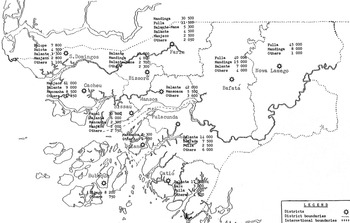
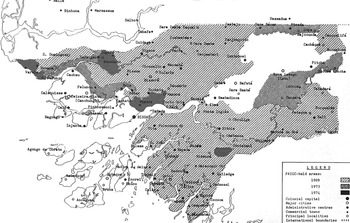
In Guinea-Bissau and elsewhere, conflicts in the run-up to decolonization have often been presented as ethnic-based, with certain communities allied and associated with independence forces or colonial governments.Footnote 22 While certain ethnicities were more likely to participate in particular ways, previous histories of Guinea-Bissau's war for independence have overemphasized ethnicity, treating it as indicative of one's allegiance. These works have identified Fulbe in eastern Guinea-Bissau as the primary collaborators of the Portuguese.Footnote 23 Fulbe people made up about 22 per cent of the country's population during the war, primarily in the eastern regions of Bafatá and Gabú (see Figure 2), much of which were controlled by the Portuguese until late in the war (see Figure 3).Footnote 24
Guinea-Bissau's ethnic demography by administrative district, c. 1960.
Source: Reproduced from M. Dhada, ‘The liberation war in Guinea-Bissau reconsidered’, Journal of Military History, 62:3 (1998), 573, with the author's permission. Nova Lamego was the colonial name for Gabú.

Areas under PAIGC control, 1969–74.
Source: Reproduced from M. Dhada, ‘Warriors’, 154, with the author's permission.

Although Fulbe people were overrepresented in the Portuguese military, the reasons for this are complicated, and do not represent the broader Fulbe experience during the war. Moreover, official narratives and existing scholarship elide the coercion and the pragmatism, rooted in everyday concerns about safety and economic gain, that emerged as a recurring theme in interviews. Portuguese military officials worked through village chiefs and other community leaders to recruit soldiers, something village chiefs often did not dispute because of fear or previous association with colonial rule.Footnote 25 Political, social, economic, and military dynamics were highly localized, thus making it hard to generalize about the war. However, there were important regional differences, especially as the war continued. A strong majority of Bissau-Guineans supported the PAIGC by the early 1970s, and most of the country consisted of ‘liberated zones’ by the beginning of 1972, though the boundaries of control were blurry and rarely fixed.Footnote 26 Because many Fulbe lived in areas still under Portuguese control until late in the war (see Figure 3 above), their experiences—and personal decision-making—were often subject to different factors than those in other regions, even if they tended more than other communities to support the Portuguese.
Neighboring Senegal and Guinea offered two different models of independence for Bissau-Guineans. While Guinea severed ties with the French and immediately began a drastic modernization campaign to remake communities across the country, Senegal maintained a relationship with the French and underwent a less radical economic shift.Footnote 27 When we spoke in April 2017, Tcherno Embaló and El Hadji Buaro recalled that they and their friends wanted ‘partial independence’, not the total independence advocated by Cabral, which necessitated a military struggle. They referred to Senegal's continued involvement with France as a model, and emphasized, ‘What we wanted the most was Portuguese and Blacks [Bissau-Guineans] working together, with the Portuguese supporting the Blacks’.Footnote 28 They wanted to continue a relationship with the Portuguese so they could aid Guinea-Bissau's development, and ultimately believed, incorrectly, that the PAIGC's war would fail and only lead to death and destruction.Footnote 29 For many Bissau-Guineans, independence was an unclear concept, and its value — when juxtaposed to the violence and destruction of the war — was assessed differently by individuals across the country. Though most Bissau-Guineans hoped for the end of colonial rule, having already seen their neighbors become independent, the path to independence — and what that independence looked like — was unclear. Yussuf Embaló, who fought in the Portuguese military, said that he joined the Portuguese military because he ‘didn't know’ the future, whereas other ethnic groups like the Balanta ‘knew better’ the value of independence, and the ability to win it.Footnote 30 In similar circumstances, during the Mau Mau rebellion, Branch has demonstrated that soldiers who fought for the colonial state did so because they shared a desire for ‘land and freedom’. They shared this desire with Mau Mau supporters but took a different route to fulfilling it, a path that did not depend on a quick decolonization.Footnote 31
Collaboration?
There is little doubt that Fulbe were overrepresented in the Portuguese military during the war, but oral histories and archival documentation indicate that the idea of Fulbe as simple Portuguese collaborators needs reassessment. Carlos Lopes and others have argued that, during the war, Fulbe chiefs attempted to leverage their existing relationships with the Portuguese to maintain their hierarchical societal structures.Footnote 32 Cabral worried that these social relations would impede the PAIGC's recruitment efforts in Fulbe communities.Footnote 33 However, these perspectives ignore the agency of Fulbe individuals to oppose or ignore their leaders, since, as Joshua Forrest contends, ethnicity was generally ‘not determinative of a given peasant community's choice of political allegiance’.Footnote 34 Many joined one side or the other during the war for a variety of reasons. These factors include gender, class/lineage, labor, power differentials, particular family circumstances, and individual and communal relationships with either PAIGC militants and/or Portuguese colonialism.
Though more Fulbe were allied with the Portuguese than any other ethnic group, there were many reasons for this association. The initial mobilization of the PAIGC focused on training militants from important towns, most notably the capital of Bissau, rather than areas dominated by Fulbe.Footnote 35 Moreover, those within Portuguese-controlled areas tended to be safer and better fed and provided for than those elsewhere, and they also ingested a steady diet of colonial propaganda. Those Fulbe who did support decolonization early in the liberation struggle tended not to back the PAIGC, but other groups including the União Popular para Libertação da Guiné (UPLG), not all of which advocated violent methods. In 1962, the UPLG joined the coalition known as the Frente de Luta pela Independência Nacional da Guiné (FLING), which at the time received support from the Senegalese government.Footnote 36 FLING actively recruited within the Fulbe exile population in the region of Kolda.Footnote 37
Cabral believed the lack of Fulbe participation in the PAIGC was to be expected, given his analysis of Fulbe social structures, in which peasants — especially women — were exploited by elites loyal to the Portuguese.Footnote 38 Not only did this framing ignore the individual decision-making of Fulbe men and women discussed below, but Lopes has argued that by overemphasizing differences and class in Fulbe society, Cabral offended many Fulbe and set back the independence movement.Footnote 39 Previous studies of the war have emphasized the alliance between Fulbe chiefs and the Portuguese but have often presented the choices of Fulbe people more broadly as ‘following their chiefs’. Analyzing the voluntary and coerced Fulbe participation in the Portuguese military allows for a more nuanced and holistic interpretation of the war itself. Ñaala Baldé, who spent seven years with the Portuguese military in Guinea-Bissau, attributed his decision to become a Portuguese soldier to PAIGC attacks on his village.Footnote 40 Sekou Baldé said he ‘didn't know’ the PAIGC, who spent most of their time recruiting among the Balanta and other populations.Footnote 41 On the other hand, chiefs played a role in coercing or even forcing some to join the Portuguese cause. Amadu Sadjo Sané said that the Portuguese asked chiefs for a specific number of individuals from each village to serve in their military, and that chiefs were too scared to refuse because of Portuguese military power. They were also unwilling to give up their power and leave their communities to join the PAIGC. Sané said that chiefs often took those who had not paid their taxes and sent them to join the Portuguese forces.Footnote 42
Coercion was a key theme expressed by interviewees in eastern Guinea-Bissau. El Hadji Mamadu Seku Candé claimed he would have been arrested by the Portuguese if he did not help them and was conscripted alongside two of his friends. He also said that, in general, many joined the Portuguese military because they believed it would keep their family from harm.Footnote 43 Money was also a frequently cited reason for joining the Portuguese.Footnote 44 Sindian Baldé became a colonial soldier because it was one of the few ways to earn money for his family. However, after he got married during the war, his wife fled across the border to escape the violence. As he recalled, ‘If you are not paid well, you are risking your life every day, and your wife runs away, what are you doing here? That is how I came to Casamance [southern Senegal] to join my wife’.Footnote 45 The PAIGC dropped leaflets urging soldiers to abandon colonial armies, writing: ‘they will remember you. Portuguese soldier. You, who continue in the colonial army: / to take part in crimes against our people: to contribute to ruining your country…ONLY FOR THE PLEASURE OF THE MONEY-GRABBERS OF YOUR COUNTRY’.Footnote 46 Despite this depiction of military participation as ideological, many individuals focused primarily on staying alive and supporting their families, no matter which side would best allow them to do so.
Although Fulbe support for the Portuguese was not uniform, because of Fulbe chiefs’ generally amicable relationship with the Portuguese, PAIGC operatives often feared that Fulbe would reveal their plans to the enemy.Footnote 47 Moreira Dauda Embaló, whose family were colonial régulos (chiefs), claimed Fulbe were with the Portuguese because the independence movement did not want them. However, his father, a régulo himself, pretended Embaló was younger, reducing his age by two years on government documents to prevent his son from being eligible to serve as a Portuguese soldier.Footnote 48 Despite hesitancy for the Portuguese cause, many Fulbe also remember the PAIGC as making little effort to mobilize them for the liberation movement, hindering the movement's development in Fulbe areas.Footnote 49 In Mafanco, a small town in eastern Guinea-Bissau outside of the regional capital, Gabú, some cited PAIGC harassment as their reason for joining the Portuguese forces.Footnote 50 El Hadji Gibril Djaló said he and the rest of his community were originally excited about the PAIGC, believing they would help the people of his village, but that after the PAIGC failed to do so, the community sided with the Portuguese.Footnote 51 The Portuguese propaganda campaign against the PAIGC included telling Muslim Fulbe that the PAIGC would force them to drink alcohol.Footnote 52 Despite this propaganda, some Fulbe Muslims took a firm stance against the Portuguese. Al-Hajj Abubacar Djaló described Portuguese governance as ‘opposed to the principles of Islam’, and that this in and of itself ‘was already revolting, leading Fulbe to systematically adhere to the PAIGC’.Footnote 53 While Djaló's perspective was not shared by all, there is sufficient evidence to suggest that despite the standard narrative of the war of Fulbe as Portuguese collaborators, their participation in the war was much more complex.
While oral histories confirm that more Fulbe were generally allied with the Portuguese than the PAIGC, at least within the boundaries of Guinea-Bissau, there were certainly plenty who aided the independence forces as well. Some did so as soldiers, while others assisted in a variety of ways within the circumstances in which they found themselves. Ebraima Sambambe Mballo fought for the PAIGC for seven years. The Portuguese attempted to conscript him, but his father negotiated with the district chief to keep him out of it. His brother, on the other hand, chose to become a Portuguese soldier.Footnote 54 Sulai Baldé worked clandestinely for the PAIGC in the colonial town of Bafatá for eleven years, buying cows from villagers and bringing them to the PAIGC to slaughter and eat. Eventually he was arrested by the Polícia Internactional e de Defesa do Estado (PIDE), the Portuguese security agency, whose agents tortured him for four months. Baldé claimed there were many clandestine Fulbe PAIGC operatives, who had to be careful not to jeopardize their own safety and that of their families and communities.Footnote 55 Many communities were concerned that they would be portrayed as ‘terrorists’, as the Portuguese generally termed the PAIGC.Footnote 56 Because of the harm that would come to any PAIGC cadres caught by the Portuguese, such people needed to be as secretive as possible when living in Portuguese-held towns.Footnote 57 In major towns in particular, the PAIGC often had a very secretive and decentralized organization, but given the Portuguese strength in the country's major urban centers, they were unable to engage in open military action.Footnote 58
According to colonial archives, including contemporaneous reports and news stories, Fulbe support of the PAIGC within Guinea-Bissau tended to be less public than that from Fulbe in neighboring countries like Senegal and Guinea, perhaps due to the strong presence of Portuguese troops in Fulbe areas.Footnote 59 However, many of the Fulbe financially or militarily supporting the PAIGC from these neighboring territories were originally from Guinea-Bissau, having fled because of the conflict. Some Fulbe border villages hosted bases from which the PAIGC launched raids into Portuguese-held territory.Footnote 60 Fulbe also continued to smuggle goods across the border throughout the war, their allegiance to one side or the other remaining ambiguous.Footnote 61 At first, these movements operated primarily in the open, but from 1963 they began to operate more clandestinely to avoid information being passed to the Portuguese.Footnote 62 With the help of local populations along the border, PAIGC soldiers regularly moved weapons from Senegal and Guinea into Portuguese Guinea.Footnote 63
In 1966, the Senegalese government formally agreed to allow the PAIGC to establish bases in Senegal, and to allow the free movement of soldiers in and out of Portuguese Guinea.Footnote 64 Toward the close of the war, Fulbe and other communities in Kolda aided the PAIGC substantially by bringing goods and weapons into liberated areas. The Portuguese claimed the PAIGC were bribing Senegalese border guards to allow them to move freely into and around Kolda and the rest of the southern Senegal, and that local populations and village chiefs opposed the movement of PAIGC soldiers, which was true in some cases.Footnote 65 For the most part, however, the PAIGC operated with at least the tacit acceptance of the local population. The independence forces maintained a house and warehouse in Velingara where they stored goods to be transported across the border into Guinea-Bissau. On a monthly basis, trucks from Koundara in Guinea laden with materiel including bazookas, other types of rockets, and light artillery pieces would head for the towns of Velingara, Kounkane, and Mampatim.Footnote 66 Local youth then helped walk these weapons across the border.Footnote 67 While the transnational nature of the war has been discussed at length, it has primarily focused on the setting up of military bases, schools, and hospitals in non-Fulbe parts of Senegal and Guinea. Better understanding the transnational nature of Fulbe support for the war effort, which has been given less attention, suggests that Fulbe were found in significant numbers on all sides of the conflict.
Some Fulbe joined the PAIGC out of desperation, and we must be especially attuned to the role of gender in individual decisions made during wartime. As historians of both colonial and postcolonial Africa have noted, gender is crucial to our understanding of military conflict.Footnote 68 In the case of Guinea-Bissau's war for independence, a variety of gender-related societal dynamics—including the prospect of forced marriage — shaped decisions about one's participation in the war. For instance, Fatima Buaro fled an arranged marriage to join the PAIGC, which had pledged to eliminate forced marriages and polygamy, and in hope of being reunited with her brother, who was fighting against the Portuguese. However, she was caught and married off to a Fulbe régulo. Her brother promised to come and free her from this marriage, but the régulo kept moving her between villages within his jurisdiction to prevent this. After five such moves, she ran away with her one-year-old son and eventually encountered PAIGC troops. From that point, Buaro first trained as a nurse's aide and worked at a PAIGC hospital, taking care of patients there and visiting villages to provide medical treatment. Eventually she was captured by Portuguese forces and brought to Bissau, but within a year was rescued by the PAIGC and sent to work as a nurse in their hospital in the village of Vendo Leidi.Footnote 69
The example of Fatima Buaro demonstrates that we should keep in mind that women combatants in war often have roles that are marginalized in official narratives. As Aliou Ly points out, many women worked for the PAIGC in places not typically considered spaces of war, ‘such as those allocated for cooking, fetching water, washing clothes, caring for babies, etc.’.Footnote 70 In a 2009 interview with Ly, Fatoumata Diallo recounted deciding to become involved with the PAIGC because of the Portuguese harassment of her son, a PAIGC supporter. Eventually she decided to live with PAIGC soldiers and cook for them, becoming an involved party militant herself.Footnote 71 In the town of Galomaro (Cossé), Fulbe women transported munitions and cooked for the PAIGC, but did not engage in military operations.Footnote 72 However, that does not make their contribution to the war effort any less important. We also see that women who rejected polygamy and the more rigid gender hierarchies of Fulbe society had greater reason to join the PAIGC cause, yet often fell into more traditional gender roles within the independence movement itself.
Intra-Fulbe tensions between those of ‘free’ and ‘enslaved’ descent further complicated wartime decision-making. Slavery had been common in Fulbe communities prior to and in the early years of colonial rule, and there were hostilities between those who claimed ‘free’ origins and those demeaned as descending from enslaved people. The Fulbe rimbe (so-called ‘free’ Fulbe) chiefs tended to ally themselves with the Portuguese, while Fulbe jiyaabe (‘enslaved’ Fulbe) often fought for the PAIGC.Footnote 73 Tensions between various Fulbe chiefs and communities also led some to ally themselves with whomever their rivals opposed. In the district of Sancorlá, for instance, the rule of a particularly harsh Fulbe chief provoked a large number of Fulbe to join the PAIGC.Footnote 74 This opposition was especially virulent when the Portuguese installed new, anti-PAIGC chiefs to carry out their agenda, as they did in Fulbe areas of central Gabú and northern Madina do Boé during PAIGC campaigns in those areas.Footnote 75 Portuguese political operations in Pachana along the Senegal border likewise alienated most Fulbe there from their leadership and drove them into the PAIGC fold.Footnote 76 Within Fulbe communities, the actions of the ruling class and the rest of the population often differed.Footnote 77 So on the whole, while Fulbe generally worked more closely with the Portuguese than with the PAIGC, decisions about which side to ally with were highly localized and individualized. The same was true across the border in Senegal, albeit with much less risk to those who chose to assist the PAIGC.Footnote 78 In the rest of Guinea-Bissau, most were largely supportive of the independence movement, believing it was in their personal, familial, and communal interest.
Attitudes also changed over time. The relatively close relationship between Fulbe chiefs and the Portuguese government during the war also impeded the PAIGC's project of national integration, even if people did not always follow their leaders. Cabral explained that when he asked Balanta soldiers to fight in Fulbe areas, they responded, ‘We've liberated our own country…now let those others [in the east] liberate theirs’.Footnote 79 He added that the PAIGC ‘didn't force the issue.’ In Portuguese Guinea, many Fulbe were skeptical of the PAIGC at first, but eventually came around. As Kumba Kolubali, a Fulbe woman interviewed by Stephanie Urdang just after the war, explained,
When the first comrade came here to mobilize us, we were very afraid. We did not know him so we did not trust him. We thought he was dangerous and that he would take our things and not pay for them. But he talked about all the bad things that the Portuguese were doing, which we understood very well. He said that the party believes everybody is equal and that we are all one people.Footnote 80
Therefore, we cannot assume that all Fulbe who favored the Portuguese at the beginning of the war rigidly maintained this view when faced with shifting circumstances. A gradual shift might be expected, as the PAIGC had to overcome regional, ethnic, religious, and class divisions that the Portuguese had intentionally exacerbated over the course of the colonial period. One Fulbe PAIGC official, Abdulai Barri, stated that beginning in 1966, more Fulbe peasants became involved on the PAIGC side.Footnote 81 The factors listed above made Fulbe communities more difficult for PAIGC operatives to access, let alone win over to their side. However, the individual narratives discussed above provide an understanding of the multilayered decision-making process of many Bissau-Guineans. Social, economic, political, and military factors varied for each person and community over time, showing the importance of social conditions in shaping wartime participation outside the perspective of ethnicity.
Survival
Focusing on either the ethnic dynamics or a binary of collaborator versus freedom fighter ignores that, for many, the primary issue in the war was survival. Because of the challenges faced during the war, a significant number of people felt caught between two less than ideal options. In particular, women, responsible for the safety and care of their children at a time of great physical violence, experienced these challenges.Footnote 82 As Ly argues, women saw their participation and actions during the war primarily through themes of ‘displacement, family hardship, sexual violence, hunger, and pain’.Footnote 83 The fear of displacement, and the desire for a safe home for one's family, motivated many women's actions during the war itself.Footnote 84 However, individual desires for vengeance or local rivalries also drove the participation of some people. Individuals who faced attack from one side or the other sometimes ended up fighting for whichever side had not caused them — or their community — direct harm. While there were certainly trends as to which ethnicities supported either the PAIGC or Portuguese, an emphasis on viewing the war through the social conditions that produced differing strategies of survival provides a more nuanced understanding of the war, and African liberation movements, more broadly.
Due to the changing dynamics of war, shifting engagement with the Portuguese and PAIGC militaries was a crucial tool for survival, as was fleeing across the border to avoid violence. Villagers did not want to shelter Portuguese troops for fear that the PAIGC would destroy their village.Footnote 85 Similarly, individuals and communities selectively engaged with the PAIGC and the Portuguese, worrying that if they aided either side too little or too much, they would be vulnerable to attack. Amadú Bailo Djaló, a Portuguese commando, tells the story of meeting a young boy who had been stopped by the PAIGC, who informed Djaló of his conversations with the liberation fighters. The boy connected Djaló to his brother-in-law, Jarga Bora, a clandestine collaborator of the PAIGC. Jarga Bora went with Djaló's unit on several missions, for which he was well paid. During this period, Djaló and his fellow soldiers were anticipating a PAIGC attack, which never came. Upon later reflection, Djaló wrote, ‘For me, this did not happen because Jarga Bora had many families to protect and if they [the PAIGC] attacked us, the NT [Nossas Tropas, ‘Our troops,’ referring to the Portuguese military] would surely destroy the tabanca [village] and the supplies for all the families. I think it was he, Jarga, who asked them not to attack us’.Footnote 86 Therefore, even those who supported the liberation struggle often did so carefully, calibrating their actions to protect their communities.
Many passed information or aided the Portuguese due to a great deal of coercion. As Aristides Pereira remembered:
As we had no weapons, the colonialists invaded the villages at will. They pressured the people to say where the ‘bandits’ were and to provide other information. There was a lot of repression… For this reason, there were people in some villages that, when the colonial troops arrived, immediately denounced the place where the ‘bandits’ were, so as not to be mistreated.Footnote 87
Portuguese soldiers even displayed the heads of deceased PAIGC soldiers in villages, attempting to scare communities into disowning and turning on the independence forces.Footnote 88 The Portuguese engaged in campaigns to destroy communities harboring the PAIGC, similar to what Rhodesian forces engaged in to stamp out nationalist forces in the latter country.Footnote 89 The PAIGC also used violence to discourage communities from allying with the Portuguese. Amadu Sadjo Sané reported that his family fled the village of Boé because of PAIGC violence, and continued to move between villages until 1966, when they arrived in the town of Cabuca and felt safe due to the presence of a Portuguese military camp.Footnote 90 Sometimes suspicion was enough to mark a village for attack or destruction. PAIGC forces suspected that the clerics of the important Muslim town of Fass supported the Portuguese and attacked the community even though its residents had intentionally avoided assisting either side.Footnote 91
While the PAIGC received support from some foreign nations, they had limited resources with which to carry out their war. As the war went on, the PAIGC's soldiers demanded food and cattle from villages for their war effort, which placed already stretched farmers in an even more precarious position.Footnote 92 The PAIGC tried to get rid of peanut cultivation in the liberated areas in 1972, since peanuts were primarily an export crop at a time of domestic food shortages. Cabral ordered members of the FARP, the armed wing of the PAIGC, to help villagers plant and harvest. However, as Mustafah Dhada chronicles, ‘The FARP soldiers ignored his specific instructions… The FARP's attitude was brutally forthright. It was they who were fighting the Portuguese. Why should they help crop growers do their work’?Footnote 93 Food shortages led many to reconsider their options, and to prioritize the acquisition of staple food crops over political considerations. Moreover, public support for one side or the other could lead families to lose their land. When the PAIGC liberated areas of northeastern Guinea-Bissau, anyone known to have supported the Portuguese had their land confiscated. The PAIGC used these lands either as farms, organized as collective or prison labor camps, or as weapons depots.Footnote 94 But, life was also exceedingly difficult in Portuguese-controlled areas due to the PAIGC's effectiveness at interrupting Portuguese trading routes. The PAIGC controlled the major rice-growing regions of the country, and limited access to this staple crop to communities and regions more focused on the production of cash crops like peanuts. At the same time, the PAIGC drastically undercut peanut production in Portuguese-held areas, as well as obstructing the transportation of peanuts to the coast.Footnote 95 All of the above dynamics created unpredictable, constantly changing situations, particularly in areas facing conflict, violence, or other hardships.
Flight
Although many individuals chose to participate on one side of the war or the other, even larger numbers (nearly 20 per cent of the population) fled Guinea-Bissau entirely and settled in neighboring Senegal and Guinea. Implicit in the PAIGC's fight for independence was an attachment to and a willingness to fight for the national territory of Guinea-Bissau itself. However, given the above discussions of individuals’ strategies of survival, many crossed the border and settled into communities in already independent countries. This was true not just among Fulbe communities, but of Bissau-Guineans more broadly. Emphasizing the agency of migrants who may be considered ‘forced’ or ‘involuntary’ opens possibilities to better understand mobility in times of war.Footnote 96 Migration was an important strategy for many Bissau-Guineans during the war, both within and outside of the country. Moreover, decisions about migration were shaped by a much larger set of factors, not simply personal safety.
Even before the war began in earnest, the Senegalese government granted Bissau-Guineans asylum in southern Senegal. Others settled in Guinea without official welcome.Footnote 97 The number of those fleeing across the border increased greatly in 1964, as the PAIGC took a tougher stance toward those suspected of supporting the Portuguese. On the night of 1 March 1964, PAIGC forces destroyed three villages near the border with Senegal, leading nearly 6,000 to cross the border to settle in more than 30 different villages in the districts of Dabo and Dioulacolon.Footnote 98 By May of that year, about one-tenth of the Senegalese region of Kolda was made up of immigrants from Guinea-Bissau.Footnote 99 Bissau-Guineans fleeing the war were present across southern Senegal, and belonged to a variety of ethnic groups.Footnote 100 Most of those who fled had not taken a strong stance in the war, but instead were individuals and families struggling through a violent conflict, where they could face military action or the requisitioning of food or other goods at any given moment.Footnote 101 Refugee populations also spiked during intense Portuguese bombing campaigns.Footnote 102 Reports estimated that there were 60,000 refugees in Senegal alone as of June 1967, amounting to more than 10 per cent of Guinea-Bissau's population.Footnote 103 The bombing campaigns that took place in 1965 and 1967 pushed producers of peanuts and rice north toward Senegal. Balante and Mankanya rice growers south of Farim fled in large numbers to Senegal due to heavy Portuguese bombing attacks. Others fled because of skepticism of the planned PAIGC agricultural cooperatives. Facing threats of violent bombardment and the destruction of agricultural products, many farmers doubted that PAIGC plans for communal agriculture would allow them to meet their needs, so they crossed the border north to Senegal.Footnote 104 PAIGC operatives emphasized to communities the importance of staying put to support the war effort, but for many, this was not a sacrifice they were willing to make.Footnote 105
Those who fled to Senegal did so for a variety of reasons. Some cited the requisitioning of cattle as well as harassment by the PAIGC forces fighting for independence, while others fled precipitously during attacks by one side or the other. Moukhtarou Coulibaly's village of Sare Mamadi housed Portuguese soldiers, and the PAIGC as a result came and attacked the village. He described the fighting,
They came into our village and they shot at us and killed one person, the village chief's son. When the PAIGC came, we ran away, and my elder brother went to untie the cows. One PAIGC soldier shot at him and thought he had hit him, but he did not. We took the cows and we came to Senegal near the border.Footnote 106
After crossing into Senegal, Coulibaly first settled in a village near the border, before moving further north to the town of Mampatim, where he had family connections and put down lasting roots.Footnote 107 While Bissau-Guineans working with the Portuguese would often guard the border, some people remembered these guards allowing people to cross unhindered if they spoke the same language while demanding money or items of value from speakers of other languages in exchange for safe passage.Footnote 108 For the most part, though, border crossers were met with little resistance, given the difficulty of monitoring the entirety of the boundary. To stop the flood of refugees, the Portuguese organized Fulbe and others into ‘strategic hamlets’ under Portuguese protection. However, these efforts generally failed. As Cabral explained, strategic hamlets were unsuccessful because people were ‘more realistic than the chiefs’, and sought safer conditions in neighboring countries.Footnote 109 Following the close of the war, both written and oral sources estimate that about half of those who had left for Senegal remained there.Footnote 110
Conclusion
The focus on either ex-colonial soldiers or liberation militaries relies on a nation-state and nationalist framing that prevents us from seeing wars of independence across Africa as lived struggles, not just to win independence, but to stay alive and support one's family. The violence and unpredictability of war, complicated local political and spatial dynamics, and the shifting nature of the conflict impacted the choices people made. In Guinea-Bissau's war for independence, the variety of factors that made up the social condition of war informed decisions about which side to support, assist, or ignore. Previous studies have overemphasized the role of ethnicity in this decision-making. While certain ethnic groups were represented in greater numbers in Portuguese colonial militaries or in the PAIGC, ethnicity was not a totalizing factor for most individuals, who made highly personal decisions based on loftier moral goals or to protect and support their loved ones. Most people in Guinea-Bissau, as elsewhere, did not actively pick up arms during wars of independence. Far larger numbers passed along information, food, or supplies to one side or the other, or fled these spaces of violence for neighboring countries to secure their safety. Those who fled to neighboring countries were not necessarily living in exile but safely in states that had already achieved independence.
Fulbe participation was not monolithic. Fulbe individuals made decisions in a context distinct from those living in other regions, or from other communities within the same region. Some fought voluntarily for either side based on personal or communal experiences, positively or negatively, with the PAIGC or the Portuguese. Others sought a middle ground, participating in clandestine ways, or in supporting whichever side happened to offer the greatest aid — or threat — at a given moment. And there were some who made choices out of ideology and a belief in the value of independence, even if that choice came with great risk. Lastly, nearly 20 per cent of Bissau-Guineans chose to emigrate to neighboring Senegal or Guinea, due to economic challenges, fears of violence, or to aid the war effort from outside the country.
Exploring this range of perspectives within Fulbe communities offers a more complete picture of Guinea-Bissau's war for independence and opens new areas of study for African wars of independence and understandings of collaboration – by focusing on human experiences as part of the ‘social condition’ of war, even if the dynamics discussed above were quite different in other conflicts across the continent. This article has argued that a holistic portrayal of African wars for independence must consider the numerous types of actions undertaken by people in a rapidly militarizing environment: as soldiers, by aiding one or both sides in other ways, or by taking flight. These decisions took place in a context where survival was uncertain, and many people prioritized individual, family, and community safety over political and ideological goals. Looking at the distinct conditions of those participating — or fleeing — violent conflict allows us to better understand wars for independence and the legacy of these wars in shaping national narratives and postcolonial politics.Footnote 111 This article is a first step in calling for a more expansive view of African wars of independence, by merging histories of those who actively fought on different sides of these conflicts alongside smaller acts of collaboration or resistance in the context of war.
Acknowledgments
I wish to thank first and foremost the individuals in Guinea-Bissau and Senegal who shared their time and experiences with me. I would also like to thank Falaye Danfakha and Mady Camara, who accompanied me and assisted with the interview process, and Adulai Djau, who aided me in locating veterans in Guinea-Bissau. Boubacar Diallo took great interest when I first mentioned to him my interest in Fulbe participation in the war, and I have benefitted from many conversations with him over the years about this topic. This article had its genesis in conversations with the late Leopoldo Amado, whose intellectual contributions helped me conceptualize the war in new ways. I would also like to thank Sarah Balakrishnan, Sarah Zimmerman, and Louisa Lombard, and the anonymous reviewers of The Journal of African History for their comments and suggestions. This paper also benefited from the feedback of Abel Djassi Amado, Mustafah Dhada, Aliou Ly, and Michael Panzer as part of a panel at the 2021 African Studies Association Annual Meeting. Mustafah Dhada graciously allowed me to reproduce two of his maps as well.
Competing interests
The author declares none.