Introduction
The oil palm in many communities of south-eastern Nigeria is a key tree crop. It is an important part of the family menu as well as an economic resource. From this all-important tree crop, the people derive palm oil, palm kernel, palm wine, brooms, materials for weaving baskets, and timber, among other items. The major raw materials demanded by the colonial economy in Nigeria from the oil palm included palm oil and palm kernel. However, colonial investment in the production was far from satisfactory. The British colonial government did not go much into agricultural production, nor did they allow a large measure of foreign participation. Even the bid by the Lever Brothers Company to acquire an extensive acreage of land for the establishment of large-scale oil palm plantations in this area of Nigeria was halted by the colonial authority. This was remarkable for colonial agriculture in Nigeria, as production was left in the hands of the indigenous people. Only a minimal fraction of the annual budget went into agriculture and the government hardly went beyond the provision of extension services and the distribution of high yielding seedlings and fertilisers at subsidised prices. The postcolonial government of Nigeria gave more incentives to oil palm farmers, realising the huge economic benefits of the oil palm. For example, the World Bank provided a credit assistance scheme for the rehabilitation of the oil palm industry in Nigeria at the end of the civil war in 1970. This scheme focused more on new plantings while the financing was a joint venture between the Federal and the concerned State governments of Nigeria. Under the credit scheme, farmers were provided with inputs such as seedlings, protective wire collars and fertiliser.Footnote 1 This was not without reason: the farmers had shown adaptiveness and resilience to the changing economic conditions. They were able to satisfy colonial demands for exports, as the need to acquire European goods and cash to pay their taxes drove the farmers to produce for export. Secondly, oil palm production was not new, as it had been part of the people’s menu and economic activity. What was more, production for export did not disturb subsistence farming, as the oil palm trees tolerated the farming of under-crops like cassava, cocoyam, water yam, and maize, among other crops.
Palm oil and palm kernel were of considerable significance in the export economy of Nigeria. N. P. Iloeje reports that ‘in 1906, Nigeria earned £22.43m and £10.962m from palm oil and palm kernel, respectively’.Footnote 2 At independence, the Eastern Nigerian Government took an interest in agricultural production, especially in the oil palm industry. It embarked on the Oil Palm Rehabilitation Scheme and established oil palm plantations in various locations in the Region.Footnote 3 Men and women were gainfully employed in the plantations in the Region. The Eastern Region of Nigeria was noted for palm oil production. The other three regions in Nigeria – Northern, Western and mid-Western – were noted for groundnut/cotton, cocoa and timber respectively.
The commercialisation of palm produce in Eastern Nigeria strengthened gender relations because until the trade with Europe in palm oil, production was carried out entirely by women and for household consumption among the Igbo.Footnote 4 Previously, women dominated the production of palm oil and palm kernel in the Enugu Ezike rural economy,Footnote 5 but with an increase in price due to colonial demands, men began to assert their right over the palms and there were moves to mechanise the production. The Pioneer Oil Mill and palm kernel cracking machines, which were introduced in southern Igbo areas in the 1930s,Footnote 6 did not come into use in Enugu Ezike until the 1990s.Footnote 7 Men owned the land and the palms and women who engaged in oil production obtained the kernel as compensation, as in many other Igbo subsistence economies.Footnote 8 According to E. J. Usoro,
an estimated minimum of 70% of the 5,244,000 agricultural workers out of an adult working population of 6,596,000 in Eastern Region in 1963, were involved in the processing of palm products.Footnote 9
The oil palm is unique in a number of ways and at present significant in the export and domestic economy, offering employment to 70 per cent of the working population. There is a need for micro studies in Igboland on the economic importance of the oil palm. This is because although belonging to the same economic belt, the importance attached to the different products vary. A. Martin, in her study of the Oil Palm Economy of Ibibioland,Footnote 10 agrees that it might be rash to generalise from her conclusions on the palm belt as a whole and, in particular, in the Igbo area to the North. Our area of study belonged to this area and the value attached to these products of the oil palm differed as one moved to other local societies.
T. C. Mbagwu in his thesis, ‘The Oil Palm Economy of Ngwaland, Eastern Nigeria’,Footnote 11 observed that the Ngwa (like their Enugu Ezike counterpart), were occupational pluralists; this was characteristic of peasant economies. However, unlike the Enugu Ezike oil palm farmers, who identified palm wine as the chief revenue earner of the oil palm industry, the Ngwa farmers concentrated their efforts on the exploitation of the oil palm for oil and kernel.
G. T. Basden, in a micro-study of oil palm in some Igbo societies, focused on Nachi in Udi Division, Agukwu (Nri) in Onitsha Division, and Agulu and Nibo in Awka Division, and portrayed the socio-economic significance of the oil palm. He observed that,
in many villages, palm wine is much easier to obtain than water. In the cities … palm wine is superseded by foreign drink while in the countryside, the consumption of palm wine is on the increase.Footnote 12
His observations aptly describe the situation in Enugu Ezike society at the time of his writing, where there was a perennial scarcity of water and abundance of palm wine. What is more, the palm wine industry continued to thrive despite the apathy to it in the cities. However, it appears that from the 1990s, this apathy diminished as those in the cities came to realise the real value of palm wine, hence its sharp rise in price, which gave the farmers impetus to increase production. E. E. Osim, S. E. Efem and K. M. Etta observed of fresh palm wine that ‘it is not ulcerogenic as might be thought despite its content of 5% ethyl alcohol’.Footnote 13 Before our period, palm wine drinking was a local village pastime, but recently, perhaps because of scientific research results, the urban population has been attracted to it. This situation has brought a boom in palm wine marketing and production as women and men, young and old, are engaged in one form of the business or other. How the palm wine overthrew other aspects of the oil palm business and the assessment of the attendant income it brought to rural farmers, is the kernel of this study. People join businesses to make gains and the palm wine provided the best returns from oil palm; it was better than palm kernel, palm oil, brooms and timber. It is thus certain that palm oil and kernel held sway because of the production for export and its attendant encouragement by the British and later Nigerian governments. With the boom orchestrated by the development of road transport, palm wine tapping has become an important economic activity for the rural poor as Enugu Ezike palm wine is daily distributed to major cities in Nigeria.
Literature review
Studies have been done on the oil palm industry in various Nigerian societies. Most of these focus on the importance and mechanics of production of the tree crop. A. Martin’s study considered the economic conditions under which the oil palm enterprise was carried on among the Ibibio society of Nigeria. She was of the view that increases in production of palm oil and kernel were dependent on the overseas commodities available for exchange and export.Footnote 14 This view disagrees with that espoused by G. K. Helleiner, who stressed that:
It would be misleading when discussing traditional agriculture in Nigeria to employ concepts as ‘export sector and subsistence sector’. This is because traditional agriculture embraces production for both the export and domestic sectors … most Nigerian peasants are engaged at one and the same time in production for export, production for internal trade and production for subsistence.Footnote 15
In the colonial and early postcolonial years, palm oil and palm kernel exports placed Nigeria top of the world chart. This may have derived from the colonial economic circumstances that ‘coerced’ local production of export commodities. However, these products of oil palm were part of the local menu even before they became export commodities. Therefore, production for subsistence and export were carried out simultaneously.
M. Lynn in ‘The profitability of the early nineteenth-century palm oil trade’ states the benefits of the palm oil trade to the colonial authorities in West Africa.Footnote 16 He cites Charles Livingstone,Footnote 17 Consul for the Bight of Biafra, who reiterated the benefits of the palm trade to the British thus: ‘their large capital in ships, goods, and experience gave them a monopoly of the trade and enormous profits’. He did not pay attention to the benefits of the oil palm trade and production to the rural farmers. Our article compares the economic benefits of the products of the oil palm to the Enugu Ezike farmer and contends that income from oil palm wine outweighs income from all other by-products.
G. T. Basden’s Among the Ibos of Nigeria devoted a full chapter to the economics of the oil palm.Footnote 18 It dwelt on the patterns of ownership, cultivation, methods of harvesting and mechanics of oil and wine extraction. Like Martin, he was not interested in what was the income of the farmers as export producers. In his Niger Ibos, he dwelt on the importance of the oil palm, the purpose of which, he stated, was
to show the benefits which the palms confer upon the native. They almost seem to have been created to meet his needs, for there is no tree which, in itself, has so many uses since every part is of value, timber, leaves, sap, and fruit.Footnote 19
In a similar study, but with a focus on palm oil, M. M. Green observed how a rise in the price of palm oil led to a change in the economics of the village of Umueke, near Obowo. She observed:
Before 1937, life was drab in Umueke, but, in 1937, with the price of palm oil higher, clothes were more numerous and the younger men were increasingly taking to shorts and shirts or singlet. Some of the elders wore shirts and hats on gala occasions. The school children wore hideous khaki jumpers and shorts during school hours.Footnote 20
From the 1970s, vehicular transport in Nigeria has risen and the number of motor vehicles has perhaps quadrupled. This development improved the connection of the rural communities to urban centres for the exchange of agricultural products and manufactured goods. Rural dwellers found a booming business in producing for the towns and the transport sector has been energised by the new petroleum industry. With regard to the export sector, local industries using palm oil and palm kernel were established and they mopped up what could be offered for export. Thus, the export performance for Nigeria nosedived. The fall in exports does not represent a fall in production of palm oil and kernel. However, this study is concerned with the rise in production of palm wine, another product of the oil palm, which hitherto was not regarded as an economic resource in the heydays of colonial administration in Nigeria or the early years after independence.
This is where the Ngwa farmer differed from the Enugu Ezike farmer, who had studied the oil palm properly to understand that both activities – wine-tapping and oil production – could go hand in hand. There are two categories of oil palm recognised in Enugu Ezike – Nnenkwu (mother palm) and Okennkwu (male palm). If a tree is exceptionally prolific in nuts, yielding good oil, it receives a courtesy title such as nnenkwu (mother of palms) in acknowledgment.Footnote 21 The nnenkwu is further grouped into three – the tenera (Osukwu), the dura (Okpurukpu) and the poissoni (Ojukwu).
On the Okenkwu, Basden suggested:
No fruit is ever found upon it; it merely produces a cluster of flowers which dry up and remain on the tree for a considerable time. From this tree is extracted the most powerful palm wine, known as ‘up-wine’.Footnote 22
Palm wine is the traditional alcoholic beverage of the Igbo and many other societies in the West Africa subregion. There are three methods of tapping the oil palm for wine. The first is the inflorescence tapping, which yields the ‘up-wine’ (nkwu enu). The second is the ekpo, where the tree is felled and tapped at the bud. The third method is the iti. Here, the tree is tapped at the bud. However, the nkwu enu is cherished by consumers more than the ekpo or iti. The inflorescence method is favoured as the tree continues to live and be tapped again whenever flowers appear. This will be explained shortly.
Perhaps, it was the use of the iti method among some southern Igbo communities that made Ngwa farmers apathetic to oil palm wine tapping. This method decimated the oil palm as palms so tapped seldom survive. More palm wine is extracted between the months of August to January than in the period between February and July. During the earlier period, more inflorescence grows on the palms. While the palm wine is tapped and cherished all over most of Igboland, ‘the Ngwa farmer does not allow any of his palms to be tapped for wine unlike the practice in the adjoining areas of Owerri and Bende and in most parts of Igboland’.Footnote 23
Unlike the Enugu Ezike environment where both palm wine and palm oil are obtained from the same tree (Elaeis guineensis), P. E. Leis observes that,
the Ijaw take their palm wine from trees (Raphia vinijera and Raphia hookeri) growing wild in the swamps and their palm berries from trees (Elaeis guineensis) growing in the dry portion of the forest.Footnote 24
No doubt, ‘oil palm is the chief cash cropFootnote 25 of the Igbo, providing not only oil and kernels but also palm wine, for which Enugu Ezike is justly famous’.Footnote 26 The Enugu Ezike farmer has grown conscious of the huge revenue made from palm wine. It makes economic sense for people to engage in the business that gives them greater returns on investment. The Enugu Ezike farmers have experimented with other products of the oil palm and found that more revenue came from the palm wine.
Virtually, all parts of the oil palm tree are of economic importance and play a major role in the lives of the people. A. Mbam examined the oil palm as a domestic food supplier, an employer of labour, a foreign exchange earner, as industrial raw material, and as contributor to the Gross Domestic Product (GDP).Footnote 27 Given the above, the oil palm is crucial to the Igbo economy, and considering the products examined and the period of the examination, it appears that new developments have taken place. The chief revenue earner to the rural farmer was no longer the palm oil and kernel, but the palm wine. There is evidence that revenue from palm wine is greater than that of palm oil and palm kernel combined.
Palm wine is the traditional alcoholic beverage of Igbo people of all ages and sexes. It is imperative in traditional festivals and all social gatherings. M. M. Green observed that palm wine was:
an important element in the diets of these people by reason of the vitamins it contains. A certain amount of it is given even to babies, but the men are the chief consumers, getting considerably more than women.Footnote 28
Apart from being an essential diet, the palm wine industry provided employment. This included all those working in tree climbing and tapping and those engaged in the marketing of the wine. The latter group included the middlemen and ‘middlewomen’ and owners of palm wine bars across the country. Employment in these various aspects of the oil palm industry enabled many to marry, raise children, build houses and buy motor vehicles, among many other things.
In the colonial and early postcolonial years, it was common knowledge that the oil palm was by far the leading foreign exchange earner for the Eastern Region of Nigeria, of which Enugu Ezike was a part. W. Miller suggested that in 1961, approximately 19 per cent of the total revenue of the Eastern Region came from (palm) produce purchase taxes and palm produce export duties, which were the direct taxes on palm products.Footnote 29 Until 1966, Nigeria was the world largest exporter and producer of palm oil and palm kernel. Palm produce accounted for over 50 per cent of the world palm kernel and over 30 per cent of its palm oil in the 1960s.Footnote 30 The export value of palm produce in Nigeria was £2.2m and £40.1m in 1960 and 1965, respectively.Footnote 31 When compared with the other two major export crops, namely cocoa and groundnut, palm produce had total export earnings of £594.5 million and £514 million respectively within the period.Footnote 32
Palm produce not only contributed to the foreign exchange earnings and the balance of trade of Nigeria, it also featured significantly in the GDP. Its advantage was that it was produced as part of the menu and increase in demand from the Europeans stimulated production by local farmers. The farmers were forced into this by demands of the colonial administration. They needed to pay their taxes and the best way to obtain foreign currency for this was by producing those staples in demand by Europeans. The products of palm produce in demand were palm oil and palm kernel. However, with independence in 1960 and growth of local trade, the demand for palm wine was stimulated by the realisation of its health benefits by the indigenous elite. Hence, palm wine became a nationwide drink, and demand for it rose more than supply. The price of a gallon of palm wine has been soaring since the 1980s. Apart from being consumables, fermented palm wine served as industrial raw material for the production of local gin. The rise in the price of palm wine led to improvements in the farmers’ standard of living. Palm wine tappers began to buy motor vehicles, build better houses, send their children to universities, and so on. In a study conducted by J. Robins in Ghana,Footnote 33 the increase in local demand for palm wine produced from felled oil palm treesFootnote 34 caused much concern among the elite owners of palms who became worried about the loss of oil-bearing trees and the sacrifice of their economic prosperity for palm wine. In the Enugu Ezike environment, the issue of the felling of oil palm trees for wine does not occur as farmers are interested in tapping the oil palm for wine without felling them to produce the up-wine (Nkwu enu),Footnote 35 for which they are justly famous. The Enugu Ezike farmer engages in the cultivation and exploitation of the oil palm for different purposes, which are economically rewarding.
The study area
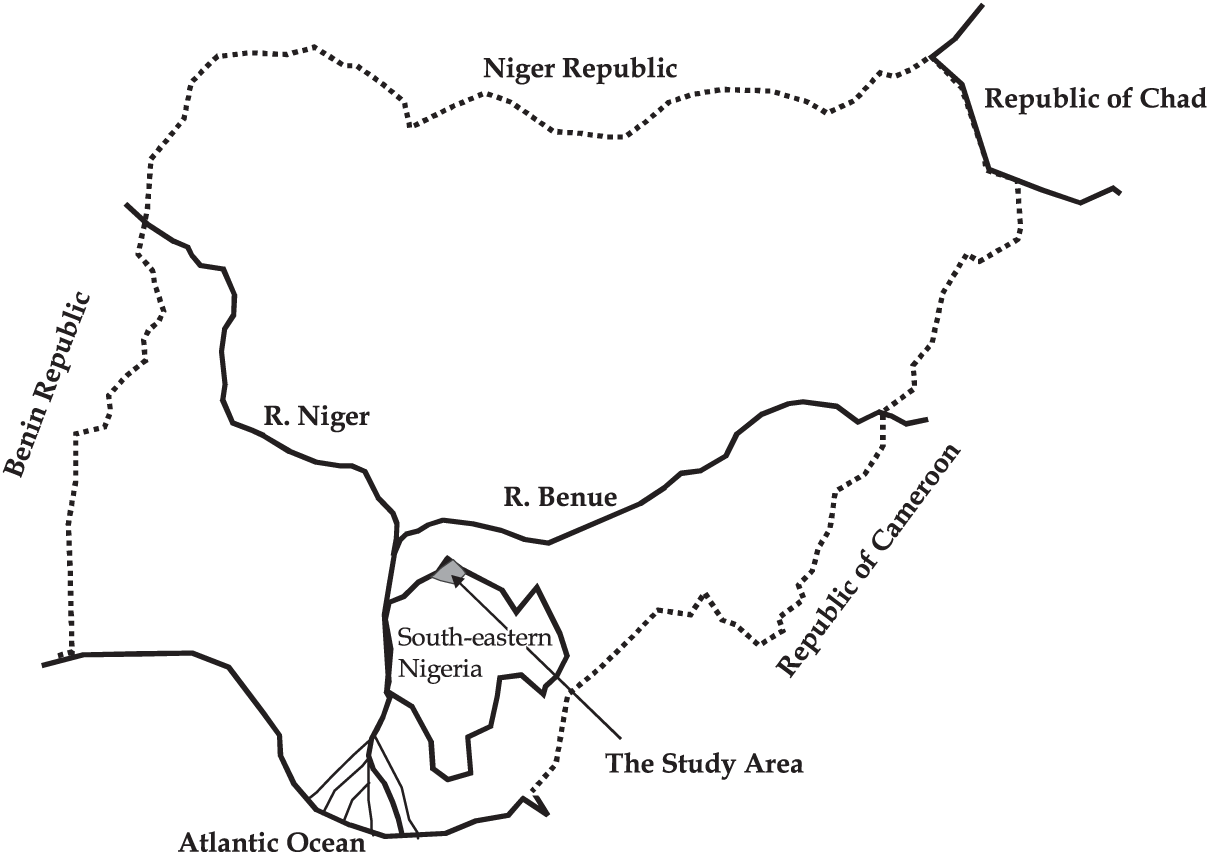
Enugu Ezike, south-eastern Nigeria occupies the northernmost fringes of Igboland and is located between latitude 70 02’N and 70 26’E and between 60 58’N and 70 31’E, covering an area of approximately 260 square kilometres with a population density of more than 800 persons per square kilometre. Its population was projected to 285,000 in 1991 and to 350,000 in 2006.Footnote 36 It is made up of four clans that comprise thirty-three villages, ‘the least among which compares favourably with any average rural town in South-Eastern Nigeria both in size and population’.Footnote 37 A. E. Afigbo had earlier claimed that Enugu Ezike is considered ‘the most densely populated rural village-group in West Africa’.Footnote 38 The Enugu Ezike area was on a well drained sandy loam plain devoid of gleying and appears to be best suited for oil palm growth.Footnote 39 The area belongs to what has been described as acidic soils of south-eastern Nigeria suited for the oil palm (Figure 1).Footnote 40
Map of Nigeria showing south-eastern Nigeria and the study area (indicated by arrow).

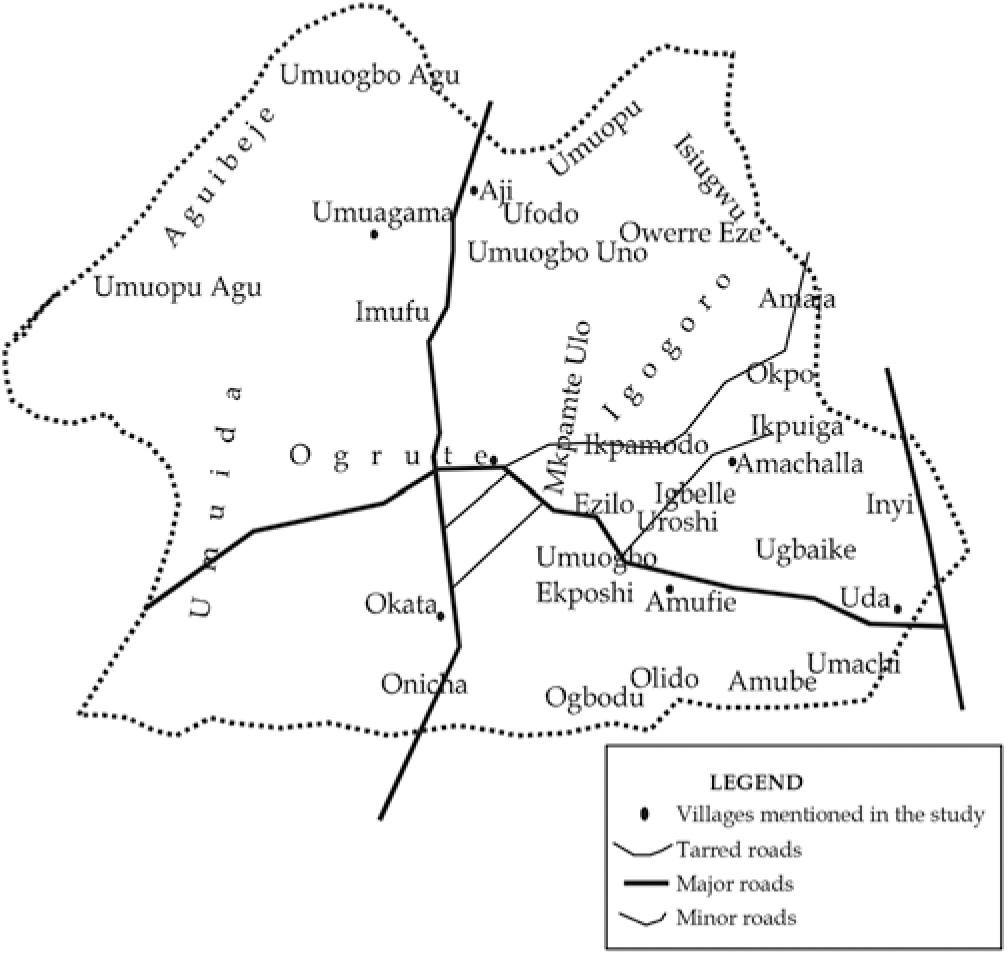
Since the 1970s, the oil palm industry has stagnated and exports have considerably declined. An intriguing question is whether the decline in exports can be related to decline in production? Much concern has been expressed with respect to the decline of the oil palm exports since the discovery of oil in Nigeria. Official and scholarly attention has been concentrated on the fall in overseas exports and loss in the expected foreign exchange to Nigeria. Studies of the oil palm tend to focus, in reminiscence, on the economic gains of its production and its importance in the GDP of Nigeria during the colonial and early postcolonial years. Little work has been done on the producers who played crucial roles in making Nigeria attain world leadership in the export. It is not yet clear what dampened the morale of producers and led to Nigeria losing its premier position in world oil palm export to Malaysia.Footnote 41 The importance of the producers in the national economy and their role in sustaining the oil palm industry over the years strongly justify this study. Such research on the oil palm industry in a rural Igbo economy and society is necessary to ascertain how the oil palm has helped in transforming society. It extends knowledge of Igbo economic history and explains why and how rural farmers were able to sustain production. Farmers in Enugu Ezike shifted attention to oil palm wine as they found that demand for domestic consumption could not even be met and the returns from it were excellent (Figure 2).
Map of Enugu Ezike showing the thirty-three villages.

The importance of this neglected product of the oil palm (palm wine) prompted this study. Because of the huge revenue from palm wine, famers have been apathetic towards the production of palm oil and palm kernel – two products of the oil palm that determined the international export position of Nigeria. The study compared the revenue earned by the local councils and the farmers from palm oil and palm kernel with that earned by the farmers from palm wine and concluded that the fall in production of oil and kernel was due to the poor remuneration farmers derive from them. The tendency is for a farmer to embrace the area of greatest return – palm wine production. This was the case for the Enugu Ezike farmer.
Method
The research employs both quantitative and qualitative methods of historical research. It used stumps of receipt booklets from local council produce collectors to estimate the quantity of palm oil and palm kernel as well as brooms offered for sale in Enugu Ezike between 2000 and 2015 from the three major markets – Eke Ozzi, Eke Amufie and Nkwo Aji. This provided data on palm oil, broom and kernel from 2010 to 2015. Data being dependent on receipt stumps restrain the calculations only to those products that actually went to the market, excluding those consumed at home or sent out to relations in the cities or taken away at night. More so, the study recognises the fraudulent character of some revenue officers who refuse to record the quantities and amount of monies collected. This also affects the calculations involved in this study. In periods of scarcity, tappers were besieged at the foot of the palm trees by those wishing to buy their products. This was also the case with palm wine as it was only marketed produce that was calculated for this research. Quantities bought at home, taken away before reaching the market or reserved for ceremonies were not part of the calculations. The local council does not collect revenue from palm wine. To estimate the quantity of palm wine offered for sale in Enugu Ezike during the period, four local markets representing the four subclans in Enugu Ezike were chosen as samples. Two of these markets were visited by the researcher for four consecutive days each in March and the other two in October, representing periods of palm wine scarcity and boom respectively. The average number of gallons of palm wine and their costs were used to estimate the production capacity of the Enugu Ezike farmer and the probable income to the rest of the thirty-three villages. This was compared with the revenue derived from palm oil, palm kernel, and brooms.
Cultivation and exploitation
At the close of market sessions at Eke Ozzi, Eke Amufie and Nkwo Aji, drums of palm oil, bags of palm kernel and bales of broom were loaded into vehicles by rural-urban traders for sale in different parts of Nigeria. Plantation agriculture did not operate in our study area. Palm produce is harvested from wild oil palms with regard to owned land. In Enugu Ezike, palm wine production comes from smallholding farmers who harvest wild oil palms using traditional techniques. We will come to this later. Large-scale oil palm plantations were not established in Igboland, perhaps due to land tenure. This was reiterated by Dere Okiy, the Director of the Nigerian Institute for Oil Palm Research (NIFOR) when he observed that:
the land tenure system in the country is a limiting factor against the private mass production of palm oil by individuals. State and local governments should provide land areas to oil palm farmers to encourage mass production of palm oil.Footnote 42
Attempts by the Nigerian government – colonial and postcolonial – to establish large-scale oil plantations failed. The resilience of the rural farmers was all that was needed for Nigeria to excel in oil palm production. Land appropriation for agricultural purposes was found to be counter-productive as such lands were often not actually put into use. The Nigerian government needed only to complement this resilience through the provision of modern harvesting and processing equipment, insecticides and fertiliser to the rural farmers through the Agricultural Extension Service staff. The danger and risk in climbing the palms tended to militate against production as the mortality rate of tappers due to occupational hazards is high. However, the huge revenue derived from the industry continues to be the driving force in production. As it is in the production of oil, so it is in the production of palm wine.
In appreciation of the price of palm wine, it became an elitist drink as rural dwellers resorted to drinking local gin produced from ethanol. The production of local gin with oil palm wine is expensive. In areas where the raphia palms grow, raphia palm wine is usually used for the purpose, as it is of low quality. In the Enugu Ezike environment, those who ventured into local gin production depended on fermented oil palm wine leftovers at ceremonies as raw material. There were no situations, such as obtained in Ghana, where it led to indiscriminate felling of oil palm trees.Footnote 43 The rise in rural-urban trade widened the markets for rural products such as palm oil, palm kernel, brooms and palm wine. L. C. Uzozie observed of the study area:
It is favourably located with respect to the oil palm industry almost at the northern frontiers of the oil palm belt; her palm oil has easy access to the domestic markets in the northern states.Footnote 44
Okereke recognised this when he opined that:
Trade in palm wine provided a source of income, not only to the tappers themselves but also to a wide range of market intermediaries – middlemen such as wholesalers and retailers.Footnote 45
T. C. Mbagwu noted that:
Along the Enugu Ezike – Nsukka road, the major commodity moving into town is palm wine. The traders bring them in on bicycles because of the volume of the quantity that could be carried on the head at a time would be too meagre to justify the business trip. Also, carrying palm wine by taxi cabs and along the rough road would make for heavy damages in transit because of the liquid nature of the good and the fragility of the containers.Footnote 46
Since the late 1970s, when the Enugu Ezike – Nsukka road was constructed, there began a boom in the palm wine industry and the wider horizon of the market became a sequel to this development. The road bisects Enugu Ezike society almost into two halves terminating at Ogugu, in Kogi State. Previously, calabash gourds were used to sell and transport palm wine during the period when Mbagwu was writing, and that posed many problems to the traders and tappers. Very often, accidents left nothing to be recovered of the goods as the gourds would break. However, improvements came to the business with the plastic industries producing containers in different shapes and sizes. Several plastic containers could be loaded into motor vehicles and taken to urban centres.Footnote 47 Tappers and traders cashed into this opportunity and the boom in the palm wine industry was sustained.
However, while many traders joined the palm wine trade, some traders were not very happy about the development. Ogbodo Aleke, who had traded in palm wine since the 1960s, lamented that the new road had turned everybody into a palm wine trader in Enugu Ezike.Footnote 48 This has to do with the prevailing competition among palm wine traders in the urban centres in Nigeria, who engaged some agents to buy palm wine and way-bill to them. As the price of palm wine rose, many youths as well as teachers, civil servants, and schoolchildren became involved in palm wine tapping as a secondary business. Tappers depended not only on their holding for tapping as oil palm trees were leased as in kola tenancy. Some men and women went into palm wine trading as middlemen, as demand for the product in the cities rose drastically. Then, the price was cheap, affecting the taste of urban dwellers whose demand for oil palm wine appears to have become inelastic. The price factor between palm wine and European beer was also instrumental, as a litre of palm wine in some months of the year costs more than a litre of beer.Footnote 49 This was not the situation in colonial Rhodesia when Wolcot remarks:
Perhaps most exciting to the student of culture change is the process of cultural diffusion as exemplified in the gradual shift toward the acceptance of and preference for European beer going on right before his very eyes in the urban setting. Who is making the ‘switch’ (from African beer) and who is resisting it? Is the decision an economic one, as some insist? That is the argument put forth in Salisbury, by a manager who feels that if the price of the two beers was comparable, ‘we wouldn’t sell a drop of African beer’.Footnote 50
The reverse has become the case. The high or low price of palm wine has failed to deter consumers. With the many different brands of beer in Nigeria the oil palm wine has continued to thrive. At ceremonies, when good palm wine is served, it is usually preferred to beer. The deciding factor appears to be getting value for money – palm wine evidently provides this.
Mechanics of production
Whereas other areas of Igboland, especially those that reside at river banks, obtain their palm wine from the raphia palms (Raphia vinijera and Raphia hookeri), and the palm oil from the oil palm (Elaeis guineensis), the Enugu Ezike farmers obtain their palm oil and palm wine from the oil palm tree. It is thus evident why the Ngwa does not allow his oil palms to be tapped for wine. First, the method of palm wine tapping understood by the Ngwa farmer is inimical to the palms. They employ the same method of tapping the raphia with the oil palms. Secondly, they have alternative palms – raphia – for tapping, which are not available to the Enugu Ezike farmer, and oil palms for oil production. Enugu Ezike palm wine stands apart because of its quality and freshness, which also attracts non-local consumers. From the 1990s, revenue from palm wine rose gradually to become the chief revenue earner of the Enugu Ezike farmer and occupy an enviable position among oil palm products in what was termed ‘the palm wine revolution’.Footnote 51 In the twenty-first century, palm wine became the major source of income for rural farmers in Enugu Ezike. As mentioned earlier, there are three methods of harvesting oil palm wine. These are the inflorescence, bud and felling methods. The quality of wine produced depended on the method used, as the best remained the inflorescence, followed by the bud and felling methods of tapping, in that order. Each of these methods requires considerable training and dexterity.
The inflorescence tapping is the most common method in Enugu Ezike. This involves cutting an equilateral triangular hole of about 2.5 cm deep at the base of the male inflorescence flower bud. The hole is attended to three times daily (morning, afternoon and evening) and kept fresh by cutting out a thin membrane of it each time. By the third day when wine begins to ooze, a funnel made of either bamboo or cassava stem is designed and fixed to the hole to cover it from sunlight and direct the wine into a calabash or any container as determined by the tapper. This container is held in position by a rope, and wine oozes out through the funnel into the container. Fresh wine is collected every morning but the tapper has to attend to the hole also in the afternoon and evening to clear it of mucus substance, which tends to block the xylem vessels from which the palm sap oozes out.Footnote 52 An inflorescence could give wine for about two weeks and a tree could be tapped for about six times annually as long as it produces an inflorescence. Tapping has to be done on a male flower bud because it does not yield palm fruits and dies off in about two weeks. The female flower bud can also be tapped, but that could lead to a dearth of palm oil as it can endanger palm fruit bearing. Some highly dexterous tappers also tap the female inflorescence without endangering it.
Bud tapping of palm wine is not practised in Enugu Ezike as it endangers the oil palm. If an oil palm was tapped at the bud, it could take up to six years to start bearing fruits again if it even survived.Footnote 53 Perhaps, because of the value the Enugu Ezike farmers attached to their palms, this style of tapping is abhorred.
The third style is the felling method. In this case, the oil palm tree is cut down or uprooted and tapped at the bud. When the tree is down, the leaves are cut off to expose the inner part of the bud, which is left for between two to four weeks. Then, a chamber of about 15 cm x 15 cm wide and deep is made on the bud and covered with leaves to protect it from direct sunlight, which could dry the surface. It is left again for about three days, after which a hole is bored through the chamber to below the bud. Here a funnel is fixed. Wine percolates in the chamber and moves through the hole to the funnel and finally into the gourd or pot kept under the bud. Wine from felled trees is called ‘down-wine’ (ekpo) to distinguish it from wine from inflorescence tapping, namely ‘up-wine’ (nkwu enu). Ekpo is a low-quality wine and a product of circumstances in Enugu Ezike. To produce ekpo, an oil palm must die. This can happen, for example, when it is necessary to give way for development activities such as building, road construction and electric powerline extensions or to prune the palms because of proximity to houses. Tapping from a felled tree can go on for about 28 to 48 days depending on the dexterity of the tapper.
Economics of the oil palm
The cash profits available to the palm oil, palm kernel, palm wine and broom producers would be an obvious consideration in choosing one over the other. As was the case with local gin distillers in the Niger Delta area of Nigeria, men (distillers or palmwine tappers) believe their new endeavour to be more profitable than processing palm oil. Distillers are unwilling to give income estimates because of their fear that such information will eventually result in an increase in taxes.Footnote 54 Palm wine tappers do not pay any revenue to the local government and as such their income can only be calculated by estimates, considering the average price and the quantities of gallons made available in the market, as well as changes in their living standards.
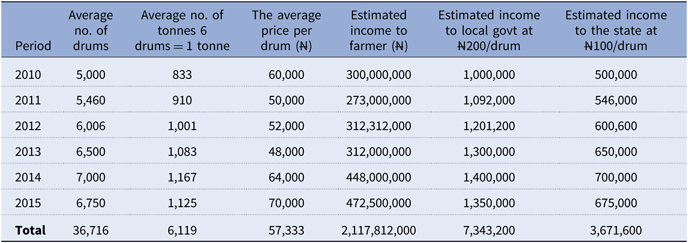
Palm oil production in Nigeria is on the increase due to the availability of markets – with urbanization and local industrialization - and improved means of transportation. The adduced fall in exports has been because of increased local consumption, not a decline in production. For example (see Table 5), in 2010 an average of 5,000 tonnes of palm oil was offered for sale in Enugu Ezike, and between 1950 and 1954 an average of 1,677 tonnes of palm oil was produced and offered for sale in the Gold Coast.Footnote 55 One might have expected a fall in production due to the paucity of the oil palms that continue to give way for development purposes, but those that remain have been put into use due to the large economic returns. However, despite the emergence of new and colonially unimportant palm wine as the money spinner among palm products, palm oil production has remained important due to domestic Nigerian demands. Trade among West African countries is minimal as most of them share the same vegetation and produce similar crops, such as oil palm.
Palm wine production is thus a major source of employment and revenue to the rural farmers. Production is controlled by peasant farmers with an average daily output of about one two gallonsFootnote 56 of wine during the peak period (August to January). The output is largely dependent on inflorescence tapping, which is also reliant on rainfall during the year. Production is high towards the end of the rainy season (August to December), and low during the dry season and early period of the rainy season (January to July). Between August and December is Egorigo, a period of plentiful palm wine. During this period, most marriages and funeral ceremonies are conducted because of the abundance of palm wine. Drunkenness is common in public as a result of excessive palm wine intake. General body weakness accompanying drunkenness, inability to work optimally the following day, and the tendency of the drunk to bad behaviour, have been the effects of excessive palm wine consumption.
Mr Celestine Aba, a tapper, reveals that
at the beginning of the rainy season, the oil palm sets to produce new roots and during that time does not produce inflorescence for tapping. Even the ones that do, wine tapped from them are not always very good. It is the period we call egbarigba – that is, when the palm gives out new roots. It is marked by scarcity of palm wine. Those who were able to tap make a huge profit from it.Footnote 57
From fieldwork conducted in March and October 2014 in four different villages in Enugu Ezike, it was evident that palm wine production was dependent on the season. However, the price was also affected by the abundance of product. As an agricultural commodity, supply determined the price as demand appears to have become inelastic, and this has been sustained for some time. Due to cultural links and the role that palm wine plays in the tradition of many Igbo communities, the demand for the product has gone up. Palm wine tapping is a way of life for the Enugu Ezike peasant farmer, combined effectively with other occupations, and it has become an integral part of their culture and economy. Palm wine takes a vantage position in various ceremonies, especially those concerning marriage in Igboland, in contractual negotiations, agreements, birth and death ceremonies, and the like.
Another tapper, Mr. Vincent Atta Eeke, replied sharply when asked about the product’s benefits to farmers:
It is the palm wine that sustains us and not the oil. Palm oil is part of our menu but the pillar that holds the various households is palm wine. Without palm wine tapping what else could attract people to this rural place? It is tapping that cushions the shock in every other business … when the going becomes tough, one resorts to tapping or marketing of palm wine to survive.Footnote 58
When salaries are not paid, civil servants and teachers resort to palm wine tapping to augment the family earnings. ‘Okada’ riders and drivers also carry on their trade alongside palm wine tapping. Members of the community who were dislodged from their places of sojourn in northern Nigeria because of the security challenges, on coming home took to tapping to take care of their families. Enugu Ezike as a community of oil palm producers, who are engaged in tree climbing, perform the ‘igba ukwu n’nkwu’ ritual when a man of substance is buried. This ritual is done while the corpse is taken to the grave. The pallbearers, while conveying the casket move to an oil palm tree, and touch it with the casket three times. The significance of this is to remove fear from the minds of the descendants when they climb the oil palm trees, especially those the dead man harvested in his lifetime.
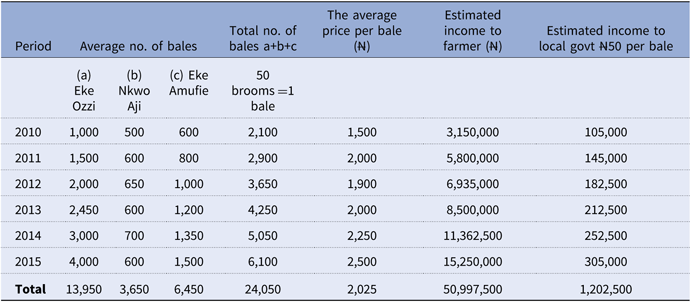
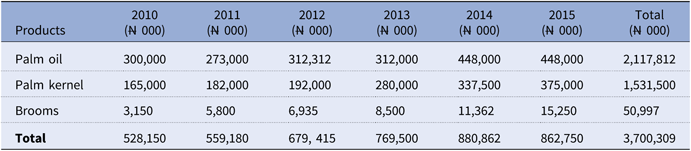
Tables 1 to 8 are estimates of value from fieldwork conducted in Enugu Ezike (2010–15), compared with various other products of the oil palm, to the farmer, to the local council and to the state government. The oil palm products compared here are palm oil, palm kernel, brooms and palm wine. Fieldwork on palm wine production and sale was conducted in four villages out of the thirty-three villages that make up Enugu Ezike. In each of the four villages, the study estimated the quantities of palm wine offered for sale in four days during the two major periods of palm wine scarcity (February to July) and plenty (August to January).
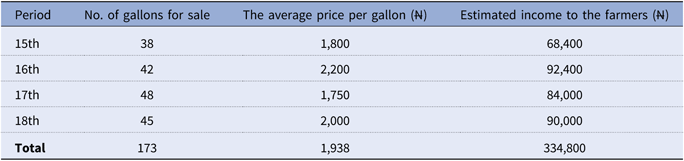
Estimated values of palm wine offered for sale at Orie Amachalla from 15–18 March 2014

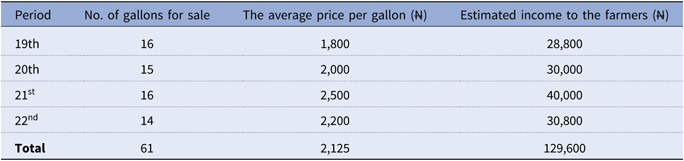
Estimated values of palm wine offered for sale at Orie Okata from 19–22 March 2014

Estimated values of palm wine offered for sale at Afor Umuagama from 11–14 October 2014

Estimated values of palm wine offered for sale at Nkwo Uda from 15–18 October 2014

Estimated values of palm oil produced and sold in Enugu Ezike from January 2010 to December 2015

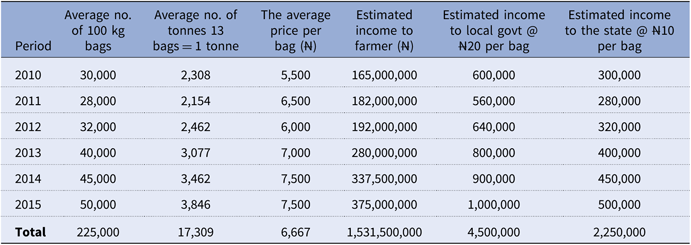
Estimated values of palm kernel produced and sold in Enugu Ezike from January 2010 to December 2015

Estimated values of brooms produced and sold in Enugu Ezike from January 2010 to December 2015


Note: The foreign exchange rate in Nigeria is in constant change. For example between 2010 and February 2015 the Naira stood at between  $\[{\rm{\rlap{--} N}}\]$160 and $\[{\rm{\rlap{--} N}}\]$200 per USD, but it rose up to $\[{\rm{\rlap{--} N}}\]$450 afterwards to the end of 2015.
From 15–22 March 2014 the researcher visited Orie Amachalla and Orie Okata markets to ascertain the quantities of palm wine brought for sale and their estimated average price per gallon. At Amachalla, the estimated price per gallon of palm wine between 15–18 March 2014 was $\[{\rm{\rlap{--} N}}\]$1,938 and average total income to farmers within the period was $\[{\rm{\rlap{--} N}}\]$334,800 (Table 1). The average price at Orie Okata between 19–22 March 2014 was $\[{\rm{\rlap{--} N}}\]$2,125 with $\[{\rm{\rlap{--} N}}\]$129,600 as the average income to farmers (Table 2).
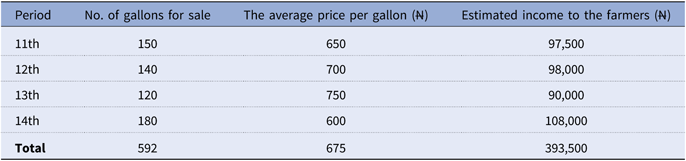
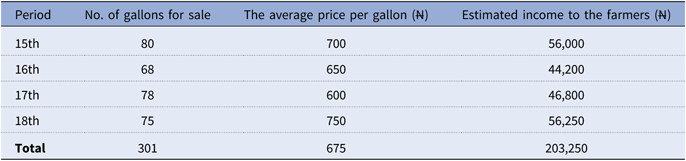
Between 11–18 October 2014, the researcher also visited Afor Umuagama and Nkwo Uda markets and recorded the quantities of palm wine offered for sale and at what price per gallon. At the Afor market square Umuagama, the average price of 592 gallons of palm wine offered for sale between 11–14 October 2014 was $\[{\rm{\rlap{--} N}}\]$675 and the estimated income to farmers was $\[{\rm{\rlap{--} N}}\]$393,500 (Table 3). From 15–18 October 2014, the average price of 301 gallons of palm wine offered for sale at Nkwo Uda was also $\[{\rm{\rlap{--} N}}\]$675 (Table 4). The income to farmers was $\[{\rm{\rlap{--} N}}\]$203,250 during the period.
Therefore, the average daily income to farmers in the thirty-three villages in Enugu Ezike could be derived by adding the total income in the four villages in four days = $\[{\rm{\rlap{--} N}}\]$1,061,150.
Finding the average daily income to farmers in the four villages = $\[{\rm{\rlap{--} N}}\]$265,287.50.
If $\[{\rm{\rlap{--} N}}\]$265,287.50 is the daily average income to palm wine tappers in each of the four villages, then the daily income to tappers in the thirty-three villages = $\[{\rm{\rlap{--} N}}\]$8,754,487.50k.
The annual income to tappers = $\[{\rm{\rlap{--} N}}\]$3,195,387,755
Within the six-year period (2010–15) = $\[{\rm{\rlap{--} N}}\]$19,172,326,530.
From palm wine sales, tappers earned $\[{\rm{\rlap{--} N}}\]$3,195,387,755 annually and in the six-year period, they earned $\[{\rm{\rlap{--} N}}\]$19,172,326,530.
The income from other products of the oil palm – palm oil, palm kernel and brooms are expressed in Tables 5–8. Table 5 indicates that farmers went home between 2010 and 2015 with about $\[{\rm{\rlap{--} N}}\]$2,117,812,000 as proceeds from about 36,716 drums of palm oil offered for sale. The Igbo Eze North Local Council and the Enugu State Government realised $\[{\rm{\rlap{--} N}}\]$7,343,200 and $\[{\rm{\rlap{--} N}}\]$3,671,600 respectively as tax from the same quantity of palm oil.
Within the same period, 2010 to 2015, farmers earned $\[{\rm{\rlap{--} N}}\]$1,531,500,000 from sale of 225,000 bags of palm kernel as indicated in Table 6. The Igbo Eze North Local Council and the Enugu State Government earned $\[{\rm{\rlap{--} N}}\]$4,500,000 and $\[{\rm{\rlap{--} N}}\]$2,250,000 respectively. This does not include quantities consumed locally or those taken away without passing produce check-points.
Table 7 estimated $\[{\rm{\rlap{--} N}}\]$50,997,500 as proceeds made by farmers for the sale of 24,050 bales of broom at $\[{\rm{\rlap{--} N}}\]$2,025 each. The local council collected about $\[{\rm{\rlap{--} N}}\]$1,202,500 as revenue from brooms during the period. Conservatively, a bundle of brooms costs between $\[{\rm{\rlap{--} N}}\]$50 to $\[{\rm{\rlap{--} N}}\]$100 on retail. Tables 5–8 are summarised in Table 8, which indicates that farmers realised $\[{\rm{\rlap{--} N}}\]$3,700,309,500 as total estimated proceeds from brooms, palm oil and palm kernel from 2010 to 2015, while the local councils and the state government earned $\[{\rm{\rlap{--} N}}\]$13,045,700 and $\[{\rm{\rlap{--} N}}\]$5,921,600 respectively as a tax on the products.
From the tables, it is evident that more income goes to palm wine tappers, with a six-yearly income of $\[{\rm{\rlap{--} N}}\]$19,172,326,530 compared to producers of other products of the oil palm (palm oil, palm kernel and brooms) with a six-yearly income of $\[{\rm{\rlap{--} N}}\]$3,700,309,500. Annual income from palm wine ($\[{\rm{\rlap{--} N}}\]$3,195,387,755) was almost the equivalent of the six-yearly income from palm oil, palm kernel and brooms put together.
The income from palm produce has helped the farmers take care of their families and perform numerous social, economic and political obligations in the community. Almost every village in Enugu Ezike has at least one secondary school, built by community effort. It has 130 primary schools, as well as other private primary and secondary schools. The student/pupil populations of these schools are tremendous. All the thirty-three villages have at least a central market where goods and services are exchanged. The number of church parishes has been on the increase as most of the thirty-three villages have become Catholic Church parishes with attendant economic demands – these include parish houses for the priests, very large church buildings and they have nursery/primary and secondary schools attached. All these yield to the economic well-being of the Enugu Ezike farmer.
Since 1991, when the community was connected to the national grid, only a few villages, if any, are without public power supply engineered by community effort. On water supply, private individuals, as well as communities, have water boreholes to serve. Water scarcity has been a perennial problem in the community for a long period. Palm wine tappers own motor vehicles and go about tapping on motorbikes of their own. The benefit of the ‘good’ price of palm wine to the Enugu Ezike community has been fourfold.
Conclusion
Emphasis on diversifying the Nigerian economy and invigorating the agricultural sector should be intensified. Over-dependence on oil has been the bane of the economy. The oil palm had earlier been the mainstay of the economy of the Eastern Region of Nigeria, having attracted the attention of the early Europeans at the coast at the onset of the ‘legitimate’ trade. Perhaps because of the quantity of palm oil that came from the interior of Igboland to the coast, they named the delta area as Oil Rivers Protectorate. From then until independence, oil palm continued to take a vantage position in economic discourses on the Eastern Region of Nigeria.
The present study has navigated the terrain of the oil palm industry, stressing the centrality of oil palm in a rural society in south-eastern Nigeria. The ownership, methods of harvest of the oil palm, and the three ways of tapping the oil palm for wine have been explained. Before the period of study, the emphasis had been on palm oil and palm kernel, which served as export commodities. Marketing Boards were established as quality control institutions for the products with the powers to determine the grades of the palm oil and kernel as well as fix the prices. Because of the industrial needs of palm oil and palm kernel, other products of the oil palm were looked down upon. Prominent among them was palm wine. In the course of fieldwork, the researchers discovered that palm wine was no longer a drink for the poor, given the market price.
The purpose of all economic activities is to make gain and Enugu Ezike farmers realised this and had come to invest in palm wine tapping. The benefits are evident as shown in Tables 1–8. Availability of vehicular transport made palm wine almost ubiquitous, thus increasing the demand, which in turn led to a continuous appreciation of the prices. This has brought a boom in palm wine production and marketing, as women and men, young and old work in one form of the business or the other. Those engaged in palm wine drinking bars make brisk businesses. Palm wine has overthrown other products of the oil palm as the chief income earner for rural farmers in Enugu Ezike, and probably in other areas where the oil palm is tapped. The erstwhile sway held by palm oil and kernel was perhaps because of the production for export and its attendant encouragement by the British and later Nigerian governments. Farmers in Enugu Ezike have resorted to palm wine production without coercion due to liberalisation of the economy and it gives them the greatest economic returns. The result of palm wine as a money spinner is evident in the overall assessment of the Enugu Ezike community. From two secondary schools in 1976, at the end of the study in 2015, it has built thirty public and about fifteen private secondary schools. The number of primary schools rose from eighty-six in 1980 to one hundred and thirty public and about fifty private primary schools. The public schools were built by community effort. About 80 per cent of the villages are connected to the national power grid and enjoy the utility of pipe-borne water supply. Through community effort, most of the rural roads are improved annually. Central to the economy of the people is palm wine, which has helped them to demystify government revenue collectors – the tappers no longer run away at the sight of tax collectors.