To date, the methods to adjust for case mix in paediatric cardiac surgery have been based on procedure-centred risk models including The Society of Thoracic Surgeons – European Association for Cardio-Thoracic Surgery Congenital Heart Surgery Mortality Categories (STAT Mortality Categories);Reference O'Brien, Clarke and Jacobs 1 Aristotle Basic Complexity Levels (ABC Levels);Reference O'Brien, Jacobs and Clarke 2 – Reference Lacour-Gayet, Clarke and Jacobs 6 and Risk Adjustment for Congenital Heart Surgery-1 Categories (RACHS-1 Categories).Reference Jacobs, Jacobs and Lacour-Gayet 7 – Reference Jenkins 9 Since 2000, in the United Kingdom, quality assurance in paediatric cardiac surgery has been underpinned by the Central Cardiac Audit Database,Reference Gibbs, Monro, Cunningham and Rickards 10 , 11 which provides aggregated national and institution-specific data pertaining to 9000 procedures annually. The data are independently validated, and 30-day surgical survival rates for 38 clinically recognisable individual-“specific procedures” are published online. The data are currently displayed as funnel plots, and thus institutions with different case volumes assess their outcomes in relation to other institutions and to national average survival rates. If survival for a specific procedure at an institution falls outside the 98% or the 99.95% control limits, there is an in-depth investigation, often revealing particularly complex diagnostic case mix over the time period concerned in terms of cardiac anomaly, comorbid conditions, or low weight.
The Central Cardiac Audit Database aims to improve benchmarking and quality assurance by accounting for the complexity and variety of the case mix. Towards this end, the authors are currently engaged in a programme of research to develop a risk model for 30-day mortality 12 following cardiac surgery, with the key objective being to incorporate underlying diagnosis into the risk adjustment of outcomes. This is important because some “specific procedures” – for instance, pulmonary artery banding and systemic-to-pulmonary arterial shunt – are performed in a wide variety of clinical situations with different prognostic implications. In addition, around a fifth of the operations cannot be allocated into one of the “specific procedure” groupings and are classified as “not a specific procedure”, with outcomes not reported. Another aim of the Central Cardiac Audit Database is to provide long-term post-operative outcomes both by original procedure and by underlying diagnosis as this would best inform early decision making, consent for procedures, and counselling for patients and families. Both these aspirations require the diagnostic information submitted to be converted into tractable diagnostic groupings. This paper reports an attempt to achieve this conversion.
Typically, congenital cardiac disease has multiple components, and individual records often contain several diagnosis codes. Codes from the short list of the International Paediatric and Congenital Cardiac CodesReference Franklin, Jacobs and Krogmann 13 , Reference Jacobs, Jacobs and Mavroudis 14 are used to document each item contributing to a patient's heart defect, as well as any comorbidities. Allocation of a “primary” or “underpinning” diagnosis is challenging and no consensus exists regarding an optimal method. Previous authors have identified the “primary diagnosis” as the lesion with the greatest anatomic severity;Reference Fyler 15 but for some situations such an allocation may be debatable. Choosing the lesion requiring the earliest interventionReference Ferencz, Rubin and McCarter 16 also challenges clinical intuition in some scenarios. Another approach is to use underlying physiology to group diagnoses,Reference Knowles, Griebsch, Dezateux, Brown, Bull and Wren 17 , Reference Moller, Moodie, Blees, Norton and Nouri 18 as done in the Extracorporeal Life Support Organisation registry database; 19 the limitation here is that a physiological grouping may encompass a wide range of conditions with different prognoses. In principle, diagnoses could also be grouped by survival rates, much as procedures are grouped in systems such as Risk Adjustment for Congenital Heart Surgery,Reference Jenkins, Gauvreau, Newburger, Spray, Moller and Iezzoni 8 but long-term actuarial survival would be required to make this pertinent.
Recent epidemiological studies of congenital heart disease in the Northern region of the United Kingdom by Wren et alReference Wren, Richmond and Donaldson 20 – Reference Wren, Reinhardt and Khawaja 22 specified possible “primary diagnoses” and placed them in a hierarchy determined broadly by clinical severity/complexity. Each individual patient was then allocated to the group highest in the hierarchy consistent with their anatomic features, informed if necessary by the lesion precipitating their earliest intervention. Limitations of this categorisation include its failure to consistently distinguish functionally single or biventricular status, and that certain diagnoses did not fit into the scheme. Our study used the approach of hierarchical categorisation as the starting point, modifying it for the different context of the Central Cardiac Audit Database. Aware that some combinations of diagnostic and procedure categories would have very small patient numbers and that this could undermine robust statistical modelling, we developed a second, less refined scheme based on the number of functional ventricles and the presence of aortic obstruction, similar to that described by Clancy et al,Reference Clancy, McGaurn and Wernovsky 23 which identified these aspects of diagnosis to be linked with surgical mortality in neonates. We anticipated that both schemes would allow patients to be categorised prospectively by clinicians submitting data, and that there was the potential for either or both schemes to augment procedural data in developing our risk model.
Methods
The data set
A data set was received in December, 2010 that comprised records for patients under 16 years who had undergone cardiac procedures between 2000 and 2010. The wider intended use of this data set was to develop a risk model for 30-day mortality after paediatric cardiac surgery, and thus the data were split into a “development set” – an environment in which the risk model could be developed – and a “test set” – a quarantined data set in which to evaluate the final model. For the split, 70% of patients were randomly assigned to the development set, stratified by year and institution of first recorded procedure, corresponding to records of 34,385 surgical and transcatheter interventional procedures. The details of key data fields and their level of completeness are presented in the Online Appendix Table A1: these data in the development set were used to develop the categorisation algorithms described below.
Scheme 1: Mapping terms from the International Paediatric Congenital and Cardiac Code to primary diagnosis
We first describe the methods used to map each of the individual codes into one of 27 diagnostic groupings, followed by how the several diagnostic groupings, which may appear in any particular record, were combined to determine a single “primary cardiac diagnosis” for that record.
International Paediatric Congenital and Cardiac Diagnosis Codes to diagnosis grouping
Each individual diagnosis code included in the data set was assigned to a diagnosis category based on the list described by Wren et alReference Wren, Richmond and Donaldson 20 , Reference Wren and O'Sullivan 21 by members of the study team. A modest expansion of the categories in the Wren system to better meet the specific context of the Central Cardiac Audit Dataset was agreed by the panel of clinicians: this included, for example, defining an “acquired” cardiac disease category, a “congenital miscellaneous” category for rarer congenital defects, and a category for codes that contain no information about the cardiac diagnosis, for example codes that give comorbidity or procedural information. There was iterative refinement of this mapping of individual codes, and selection of categories, through expert discussion and data inspection to identify anomalies.
At the level of a patient record
Once each observed individual diagnostic code was assigned to a cardiac diagnosis grouping, a simple hierarchy among the diagnosis groupings was chosen to allow a single “primary diagnosis” to be allocated to each record. Each patient record in the database may contain up to six individual diagnosis codes, and the code that lay at the highest level in the hierarchy identified the whole record in terms of a primary diagnosis group, for example hypoplastic left heart syndrome.
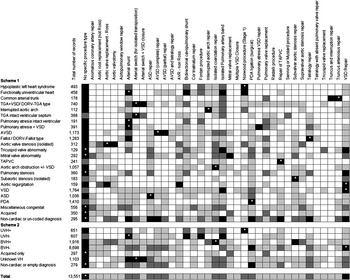
An initial hierarchy was constructed following the example of the Wren studies,Reference Wren and O'Sullivan 21 which place primary diagnoses in the descending order of complexity. The Central Cardiac Audit Database specific procedure algorithm 11 gives a hierarchy that has been subject to various stages of refinement by a group of clinicians and, in ordering diagnoses, we aimed for consistency with this work. The decision about which primary diagnosis is most important is very clear in certain scenarios, but in others may be subjective, relating to the overall management strategy, rather than a particular operation, which may be one of a series. Therefore, the panel of clinicians modified the primary diagnosis hierarchy further following an iterative process in which a version of the hierarchy was applied and resulting tabulations of the attributed primary diagnosis categories against related defined “specific procedures” were reviewed. Anomalies in the hierarchy were identified on the basis of detection of incongruous matching between diagnoses and procedures. The final tabulation of matching between specific procedures and diagnosis groups for first operations in the database since 2004 is shown in Figure 1. When incongruities were noted, these were explored by revisiting the individual codes within the anomalous records, leading to further revisions of the hierarchy. This process was repeated for three versions of the hierarchy, at which point no further obvious incongruities between diagnosis categories and specific procedures were noted that could not be attributed to coding errors (final hierarchy is presented in Table 1).
Combinations of specific procedure and primary diagnosis categories for first operation in the database from 2004. Each cell in this tabulation represents a possible combination of specific procedure and primary diagnosis category. Many combinations do not occur in our data set (white cells). Pale grey cells indicate that a small proportion (<2%) of records with a given primary diagnosis category had that specific procedure. Dark grey (2–10%) and black (>10%) indicate more commonly occurring combinations. The most commonly occurring specific procedure for a given primary diagnosis category is marked with a (*). Such tabulations were used to identify incongruous combinations of diagnosis category and procedure during the iterative development of the schemes. This final tabulation indicates where diagnostic information adds value to procedural information in characterising patients. ASD = atrial septal defect; AVSD = atrioventricular septal defect; DORV = double-outlet right ventricle; PDA = patent ductus arteriosus; TAPVC = totally anomalous pulmonary venous connection; TGA = transposition of the great arteries; VSD = ventricular septal defect.

Scheme 2: Mapping International Paediatric Congenital and Cardiac Codes to diagnostic groups defined by functional ventricle number and aortic obstruction
Again, the methods used to categorise individual codes are discussed first and then how codes for an individual record were combined.
At the level of the individual diagnosis code
Each individual code was categorised as a “congenital” diagnosis, “acquired” diagnosis, or neither, for example where diagnostic fields contained coding omission or error, or non-cardiac information such as comorbidity code. Congenital codes were then identified that, in isolation, definitively indicated that a patient had either a functionally “univentricular heart” or “biventricular heart”. Note that, for a minority of congenital diagnosis codes, the ventricular structure is ambiguous, for example “inferior vena cava abnormality”, and these codes were defined as such. Finally, those congenital diagnosis codes that unambiguously indicated the presence of aortic arch or systemic arterial obstruction were identified. The International Paediatric and Congenital Cardiac Codes and the allocation of individual attributes, functionally univentricular heart, aortic arch obstruction, etc., are provided as an appendix in the online supplemental materials.
At the level of a record
If any of the individual codes within a record were identified as a congenital or acquired diagnosis, or indicated a functionally univentricular heart or the presence of aortic arch/systemic arterial obstruction, then this attribute was considered to apply to the entire record. However, a record was only labelled a biventricular heart if there was at least one individual code within the record that indicated this and none that indicated a functionally univentricular heart or an unknown/ambiguous number of ventricles.
In prospective use of this scheme, these attributes would almost always be known. For this reason and to reflect better the prevalence of functionally univentricular heart and aortic arch or systemic obstruction, we additionally used procedural data to determine these attributes. Norwood procedure (Stage 1), Fontan procedure, and bidirectional cavopulmonary shunt were taken to imply functionally univentricular heart; Norwood procedure (Stage 1), isolated coarctation repair, interrupted aortic arch repair, truncus and interruption repair, aortic valvotomy, subvalvar aortic stenosis repair, and supravalvar aortic stenosis repair were taken to imply the presence of aortic arch or systemic arterial obstruction.
Any given record within the data set will have one of a large number of possible combinations of these diagnostic attributes, some of which are common and others much rarer. Not all combinations represent a clinically intuitive patient group, and thus, for the purposes of presenting our results in this paper, we grouped combinations into seven clinically intuitive diagnostic groups, including an “acquired only” group and an “Unknown VH” group (see Figure A1 in Online Appendix for details: Congenital Biventricular Heart No Aortic Obstruction, Congenital Biventricular Heart With Aortic Obstruction, Congenital Univentricular Heart No Aortic Obstruction, Congenital Univentricular Heart With Aortic Obstruction, Congenital Ambiguous Type, Acquired Heart Disease and Non-Cardiac or Uncoded Diagnosis).
Presentation of results
The entire development set was used to devise the diagnostic schemes, but only data from 2004 onwards are presented, as diagnostic data quality improved after this date. Only records for surgical interventions are presented. Given the interest in obtaining information about the prevalence of diagnostic groupings in the national database, we only present results for the first record of a patient in the data set. This ensures that the prevalence of each diagnostic category is not skewed by patients who have multiple records in the database.
Results
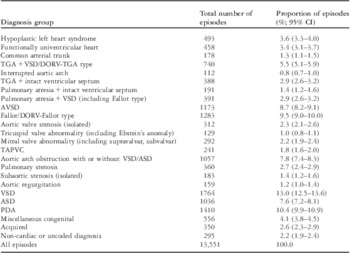
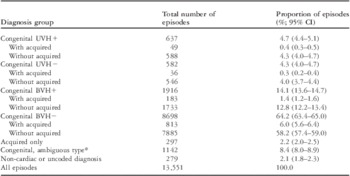
Data quality improved over the era of review, with 9.7% missing diagnosis data between 2000 and 2003 and 0.8% missing diagnosis data after 2006. All data were used for the development of mapping schemes, but a total of 13,551 patient records in or after 2004, which concerned first instances of patients in the data set, are presented. The number and proportion of these patients with each primary diagnosis (Scheme 1) and in each diagnostic group (Scheme 2) are shown in Tables 1 and 2, respectively.
Total number of episodes and proportion of episodes by diagnosis Scheme 1.

ASD = atrial septal defect; AVSD = atrioventricular septal defect; DORV = double-outlet right ventricle; PDA = patent ductus arteriosus; TAPVC = totally anomalous pulmonary venous connection; TGA = transposition of the great arteries; VSD = ventricular septal defect
Categories shaded grey are non-congenital diagnoses
Total number of episodes and proportion of episodes in each diagnostic group (diagnosis Scheme 2) with and without additional acquired lesions.

BVH = biventricular heart; UVH = univentricular heart
Categories shaded grey are non-congenital diagnoses
*Ninety-six of these patients also had an acquired diagnosis. One hundred and seventy-eight patients in this group had an arch obstruction
Scheme 1
The final hierarchy is presented in Table 1, with hypoplastic left heart syndrome at the top, followed immediately by the more complex congenital diagnoses, many of which may be broken down into several constituent defects. “Simple” diagnoses such as ventricular septal defect and patent ductus arteriosus are towards the bottom of the hierarchy so that only patients with such a lesion in isolation are conferred the corresponding primary diagnosis. Further down the hierarchy is “Miscellaneous congenital”, which consists of rarer defects, followed by acquired diagnoses and then the non-cardiac or uncoded diagnosis group. The five most common primary diagnoses were ventricular septal defect (13%), patent ductus arteriosus (10.4%), tetralogy of Fallot (9.5%), atrioventricular septal defect (8.7%), and aortic arch obstruction with or without ventricular septal defect (7.8)%.
There was good face validity between primary diagnoses and the procedures associated with them at record level, illustrated in Figure 1, showing the tabular match between Scheme 1 diagnoses and the “specific procedures”. For example, the most commonly performed specific procedures in patients with a diagnosis of ventricular septal defect were (black and dark grey cells) ventricular septal defect repair (70.9%), isolated pulmonary artery banding (10.7%), “not a specific procedure” (10.0%), and patent ductus arteriosus ligation (2.2%); for hypoplastic left heart syndrome, the most commonly performed procedures were Norwood Stage 1 (74.2%), isolated pulmonary artery banding (5.7%), arterial shunt (2.8%), bidirectional cavopulmonary shunt (2.4%), Fontan (2.8%), and “not a specific procedure” (10.8%). It is important to recall that these data relate to the first instance of a patient in the data set.
Scheme 2
The groups based on Scheme 2 are shown in Table 2. The most common cardiac diagnosis category in Scheme 2 was biventricular heart without aortic arch or systemic arterial obstruction irrespective of any additional acquired diagnoses, accounting for 64.2% of all patients; next was biventricular heart with aortic arch or systemic arterial obstruction at 14.1%, followed by functionally univentricular heart with aortic arch or systemic arterial obstruction at 4.7%, functionally univentricular heart without aortic arch or systemic arterial obstruction at 4.3%, and acquired diagnoses only at 2.2%.
There was good concordance between the two primary diagnosis schemes, with, for example, 100% of patients with hypoplastic left heart syndrome falling into the functionally univentricular heart with aortic arch or systemic arterial obstruction category. Of those patients with an ambiguous number of functional ventricles (8.4% of patients), 58.0% had transposition of the great arteries with ventricular septal defect or transposition-type double-outlet right ventricle. The tabular match between Scheme 2 and specific procedure is shown in Figure 1.
Assessment of schemes
Importantly, there was evidence that the diagnosis categories do add descriptive information where the procedural information is ambiguous with respect to the indication for surgery. For instance, of the 17.0% of all operations classed as “not a specific procedure”, 97.1% were allocated a primary cardiac diagnosis (including acquired) in Scheme 1, with the most common being Acquired at 11.6%. Similarly, in diagnosis Scheme 2, 97.2% were allocated a primary cardiac diagnosis category, including acquired, with the most common being biventricular heart without aortic obstruction at 57.1%. Further specific procedures may benefit from breakdown by diagnosis, for example the Fontan procedure (0.8% of all operations), of which 12.6% were performed in patients with hypoplastic left heart syndrome, 35.1% in patients with functionally univentricular heart, 8.1% in patients with transposition with ventricular septal defect or transposition-type double-outlet right ventricle, 7.2% in patients with pulmonary atresia, intact ventricular septum, and 7.2% in patients with miscellaneous congenital category.
Discussion
To our knowledge, this is the first reported system for grouping paediatric cardiac surgery patients in a large database by diagnosis using individual codes. The schemes developed have been used successfully in identifying diagnostic categories likely to add value to procedural information in developing a risk model for 30-day post-operative mortality. This constitutes an important step towards adjustment for case mix in paediatric cardiac surgery, as procedure-based categorisations such as the “specific procedures” 11 and the Risk Adjustment for Congenital Heart SurgeryReference Jenkins, Gauvreau, Newburger, Spray, Moller and Iezzoni 8 scheme are unable to encompass all types of operations, excluding a diverse category of unspecified or unallocated operations,Reference Kang, Cole, Tsang, Elliott and de Leval 24 and certain operations are used for patients with widely differing diagnoses.Reference Clancy, McGaurn and Wernovsky 23
This grouping of patient records in the data set based on diagnostic information enables for the first time observations based on the frequency or proportions of patients with particular diagnostic features. For example, the proportion of surgical patients with functionally univentricular hearts is estimated to be 9.3%. Note that, although useful, this information provides an incomplete picture as it does not include those who were unfit for intervention or whose families chose palliative care rather than an interventional pathway.
The terms selected to label the primary diagnosis groupings are recognisable to both lay persons who may have an interest in this topic and professionals. This choice is in keeping with the philosophy of the Central Cardiac Audit Database, which incorporates sharing information about outcomes with patient and carer groups and the public.
We note the following features of our work and differences from previous approaches:
-
1) The schemes have been designed for prospective use with congenital cardiac data sets where information is restricted to procedural and diagnostic codes and where there is no access to more detailed patient histories, imaging, or other additional information.
-
2) The Central Cardiac Audit Database contains data from a wide spectrum of ages, and therefore includes acquired diagnostic codes – for example, cardiomyopathy, endocarditis – and developmental congenital diagnostic codes – for example, aortic regurgitation – which represent a different spectrum to previous schemesReference Wren and O'Sullivan 21 , Reference Clancy, McGaurn and Wernovsky 23 that focussed on neonatal and infant conditions.
-
3) There are certain records in the Central Cardiac Audit Database where diagnostic fields contain non-cardiac information such as ambiguous codes, comorbid syndromes, or procedural codes in isolation. In some instances, this represents changing coding conventions, coding omission, or error, which is a limitation of any large data set that relies on a high level of clinician engagement. One of our findings was that data quality in the Central Cardiac Audit Database has improved over time, particularly as institution-specific results were published online.
The leadership of the Central Cardiac Audit Database has long held the aim of analysing long-term outcomes by diagnosis, rather than procedure only, as this carries the following advantages: diagnosis-based outcomes provide more relevant information to patients and carers;Reference Knowles, Griebsch, Bull, Brown, Wren and Dezateux 25 diagnosis-based analyses allow study of the variation in the strategies adopted for the surgical management of a particular diagnosis; and diagnosis-based analyses provide an appropriate way of assessing a service 26 given that the aim of paediatric cardiac surgery is to contribute to good long-term outcomes for a group of patients with a unifying diagnosis. The work reported here represents an initial step towards this aim.
Acknowledgments
This project was funded by the National Institute for Health Research Health Services Research programme (project number 09/2001/03). Visit the website for more information. The views and opinions expressed therein are those of the authors and do not necessarily reflect those of the Health Service Research programme, National Institute Health Research, National Health Service, or the Department of Health.