A central issue for debt management by countries involved in bellicose international competition is to lower borrowing costs and increase future loans capacity by refinancing the debt after a war at a lower interest rate. The English were the first to implement interest reductions in a well-functioning capital market whose prices embodied investors' expectations.Footnote 1 In the eighteenth century, when debt capacity was a key factor in the struggle against France, England used the relations among Parliament, financiers, and its centralized capital market to perfect the method of “lowering the interest rate,” which set a standard for later transformations of the debt from high to low interest rate. France, by contrast, which had started using a similar method in the late seventeenth century, abandoned it in the eighteenth century and subsequently faced higher borrowing costs.
In England, during the period of peace that followed the wars with Louis XIV, the long-term interest rate decreased gradually from 8 percent in 1710 to 3 percent in the mid-1730s.Footnote 2 After 1715 refinancing the debt at a lower cost was a policy priority. England did not rely, by and large, on short-term loans that could be refinanced at a lower rate after the war. The securitization of sovereign debt at the beginning of the century had led to the acceptance of sovereign debt restructuring.Footnote 3 Most of England debts in the first half of the eighteenth century were annuities that paid a fixed income per year and were redeemable: the borrower (the government) was legally entitled to repay the loan at any time.
If the market had been perfect, the government would just have issued new loans at a lower rate and paid the high rate loans off. However, floating of large loans entailed significant costs, as for initial public offerings (IPOs) today.Footnote 4 As Peter Dickson showed, the government could not float these loans without the intermediation of financial agents and large financial institutions.5 Since in the end the holders of old annuities would hold the new ones, it was more efficient to just lower the interest rate on the old annuities than to go through the expense of issuing new ones and paying off the old ones. But it was critical that the lenders accept the interest reduction: Thus holders of old annuities had to be given the option of refusing the reduction and receiving the principal of their annuities in cash.
The context created a coordination game. If only a small fraction of annuity holders rejected the reduction and chose the cash payment instead, the government could raise a relatively small loan and pay them off. That is what occurred in 1750 after Lord Pelham reduced all the 4 percent annuities to 3 percent. But if holders of a substantial part of the annuities elected the cash payment, the government could not finance that payment through a large new loan, the interest reduction would fail and the holders of annuities would keep earning the high interest rate. This risk was quite real because financial institutions like the Bank of EnglandFootnote 6 and the South Sea Company, which controlled directly or indirectly a large quantity of annuities, could lead the coordination of a large number of debt holders.
The government could not simply start the subscription for an interest reduction and then wait to see how many of its creditors accepted the reduction. The cost of failure would have been too high. The lobbies of old annuities and of the interest reduction policy measured their respective powers when such matters came up for debate in Parliament. If enough opponents to reduction seemed to be able to coordinate, renegotiation was abandoned. That is what occurred in 1737 when Lord Barnard first attempted to reduce interest rates. In 1750 Pelham succeeded; aware of Barnard's failure, he offered better incentives for holders of old annuities to accept the interest reduction.
We will see that Barnard also failed because the terms of his interest reduction were far off the market expectations. Investors took into account the possible redemption of 4 percent annuities, both from budget surpluses and from an interest reduction.Footnote 7 Indeed the 4 percent annuity always traded well below 4/3 of the 3 percent annuity price. The difference between the two annuities is the additional payment of L 1 per year for the 4 percent annuity. The price difference between the two annuities thus embodies the market expectations about the length of time this additional payment will be made before the annuity is redeemed. In 1737 the market did not expect a proximate redemption: the 4 percent and 3 percent annuities traded at 112 and 106, respectively, with a difference of 6. Barnard effectively proposed a straight conversion into 3 percent annuities (with the option of the refund at the par of L 100). Had they accepted Barnard's offer, owners of the 4 percent annuities would have suffered a capital loss of 6 percent from one day to the next. They had a powerful incentive to coordinate and oppose the plan. In 1749 Pelham proposed a plan that included an additional payment of about 4 that covered the price difference between the high and low interest annuities. Holders of the old annuity did not suffer a capital loss.Footnote 8
Market expectations were therefore critical for the success of an interest reduction in order to prevent a capital loss on the old annuities that would induce investors to coordinate in making the policy fail. The main purpose of this article is to analyze these expectations in relation to the interest reductions using the daily market prices of the 4 percent and the 3 percent annuities.
Pelham took advantage of the large amount of new loans that were issued in the War of the Austrian Succession (1743–1748). These are described in detail. The cost of borrowing depends on the redeemability of the annuities and is computed in that section. It is lower than the value obtained by standard accounting.Footnote 9
The market expectations about the interest reduction of Pelham in 1749 are analyzed using the market prices of the 3 percent and the 4 percent annuities. One can make two propositions: (1) There was a close agreement between the market expectations about the terms of the interest reduction and the actual terms in Pelham's plan and; (2) The market significantly underestimated the speed at which interest rates would decrease after the war and therefore overestimated the length of time until the interest reduction.
These two propositions are supported by a quantitative analysis. We first establish that the lower bound for the market's expectation of the mean time until the interest reduction was well above the realized value. The variance of the market's probability distribution of the time to the reduction is estimated though a one factor model of asset pricing that considers the 4 percent annuity at a derivative of the 3 percent annuity.Footnote 10 The analysis reinforces the result on the mean by showing the probability of an early interest reduction was very small.
The market prices also shed some light on excessive fluctuations of sentiment during the war. As the market believed the reduction of the interest from 4 percent to 3 percent to be in the distant future, more than 10 years off, it bought contingent annuities from the government at a price that grossly exceeded the ex post payments by the government. Debt holders paid L 12 in 1747 to receive a total of merely L 7 (in coupons of more than 3 percent) from a government who was the winner in that bet.
Failure in 1737
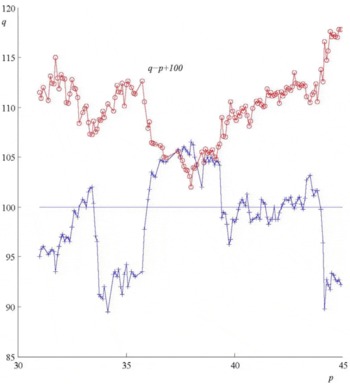
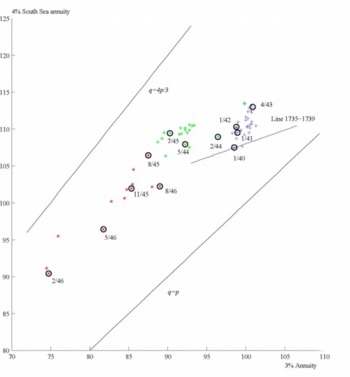
After 1715 the long-term interest rate in England declined, and 3 percent annuities (rather than 4 percent) were issued for the first time in 1726 (L 1,000,000), then again in 1731 (L 800, 000), and in 1736 (L 300, 000). Annuity prices are presented in Figure 1: they remained stable during the first half of 1733, fell to L 93 during the War of the Polish Succession, and recovered rapidly above par at the beginning of 1736, eventually hovering around 105 until March 1737.
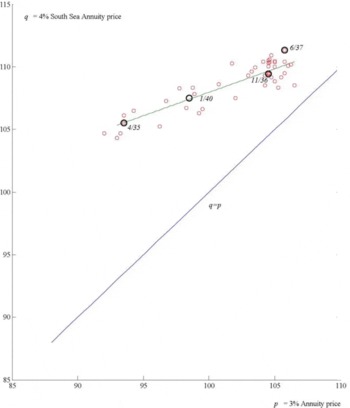
Figure 1 also presents the difference between the prices of the 4 percent and the 3 percent annuities (q and p, respectively). That difference measures the expected discounted value of all future payments in excess of L 3, until the redemption of the 4 percent annuity. Since investors expect a delayed redemption when the interest rate is higher, there is an inverse relation between q − p and p, as can be observed in the figure. The inverse relation is also observed in Figure 2, which presents the price q as a function of p.
Sir John Barnard (1685–1764) was the central figure in the 1737 attempt to reduce the interest rate on government annuities. He was an experienced and successful merchant, Lord Mayor of London, and a Whig Member of Parliament with close ties to small merchants. He opposed the infamous practice of “stock-jobbing.”Footnote 11 He was thus an “opposition Whig” in Walpole's Whig administration. On March 14, 1737 Barnard initiated a debate to “lower the interest rate” on the 4 percent annuities (about L 47 M). On that day, he not only sketched the general conditions of the market and the main lines of his plan, he also described the interest reduction as a coordination game with multiple equilibria.
PRICES BEFORE THE WAR OF THE AUSTRIAN SUCCESSION

THE COORDINATION GAME OF INTEREST REDUCTION
Barnard argued that a voluntary refinancing of the national debt at a lower interest rate would be impossible because of opposition from the Bank of England.Footnote 12 He therefore suggested that the 4 percent annuities be converted into 3 percent annuities. Those who would insist on the legal terms could be paid off at par by issuing a small loan or even with the surplus in the Sinking Fund. Since the 3 percent annuity price was at 105, the par payment would have been inferior. Barnard recognized the existence of a coordination game between the debt holders with multiple equilibria (p. 68):Footnote 13
“I have made the calculation, Sir, upon Old and New South Sea Annuities taken together, for the sake of ease and perspicuity; but it will come out the same, if we make the calculation upon the two, separately; and, therefore, I think there is a great probability in supposing that all the Old South Sea Annuitants will become subscribers for accepting 3 percent upon their capital, for 14 years certain, before Michaelmas next, if we give them an opportunity of so doing; because, if any number of them should subscribe, the loss will fall extremely heavy upon those who do not, which will of course be a prevailing argument with the most obstinate. But suppose no one of them does come in to subscribe, it can be attended with no bad consequence; the government will then have nothing to do but to issue the million at Michaelmas next, and it will be distributed pro rata among the Old South Sea Annuities, according to the direction of Parliament.”Footnote 14
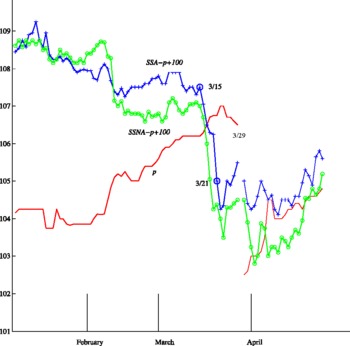
This type of coordination game is similar to a bank run. Suppose that a large fraction of creditors accept the swap to a 3 percent annuity with the current market value of 105. The government can then find the resources to pay the nominal capital to those annuitants who prefer repayment. Thus there is an equilibrium (locally stable) in which the government's interest rate reduction succeeds. There is also an equilibrium where it fails because everyone refuses the exchange and gets a market value above 105. Barnard made no specific proposal that Monday, but his speech had a strong negative impact on the prices of the 4 percent annuities during that week (Figure 3), while the price of the 3 percent annuity rose moderately.
RELATION BETWEEN THE PRICES OF THE 4 PERCENT AND THE 3 PERCENT ANNUITIES BEFORE THE WAR OF THE AUSTRIAN SUCCESSION

BARNARD'S PROPOSAL
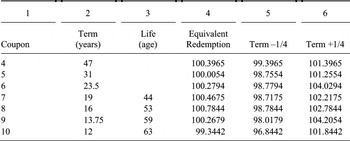
The next Monday, March 21, 1737 Barnard detailed his plan.Footnote 15 Parliament should offer holders of 4 percent annuities to choose one of the following swaps: (1) Repayment at par; (2) A 3 percent annuity (with same capital value), non-redeemable for 14 years; (3) A fixed-term annuity as described in the first two columns of Table 1. For example, a 4 percent annuity could be exchanged for a fixed-term annuity of 19 years at 7 percent; (4) For owners of at least 44 years of age, the exchange for a life annuity as described in columns 1 and 3 of Table 1. For example, the life annuity paid 8 percent for a person of age 53.
PRICES AND PRICE DIFFERENCES AROUND MARCH 1737

Option 1 had to be included, legally, as it was one of the contract terms. Barnard could only hope that few annuity holders would exercise that option. The core of the plan was instead option 2, the swap into 3 percent annuities. The bonus of non-redemption for 14 years was small given the market conditions of the time. Options 3 and 4 addressed the well-known objection of the “widows and orphans” who would live off the coupons of the bonds. The argument is irrelevant if people are rational and transaction costs negligible, but it may be very strong for a rentier who does not touch his capital and lives only off his interest income.
ANNUITIES IN THE BARNARD PROPOSAL

Source:
For columns 1 to 3, Cobbett, Parliamentary History. Computations in columns 4 to 6 are explained in the text.
In the comparison between the fixed-term and life annuities, Options 3 and 4, respectively, some mortality tables were probably used. We now examine the terms of Option 3, and show that Barnard's terms were particularly strict. Indeed they were, in a clever way, similar to the cash payment at par of Option 1.
Barnard proposed in Table 2 a menu of coupons that could suit various individual purposes. It was natural to construct a menu of coupons in integer units as presented in column 1. How were the terms computed for each coupon (in particular the fractional terms for the coupons of L 6 and L 9)? We can reconstruct Barnard's method to illuminate the principles behind his proposal. The coupon in excess of 3 percent was considered repayment of the debt during the terms of the loans. Barnard intended for the cumulated excess payments, compounded at the interest rate, to amount to the par value of the bond.Footnote 16 To verify his parameters, consider the formula for repayment

where r is an interest rate, n is the term of the annuity (column 2), c is the coupon of the annuity (column 1 of the table), and c′ the coupon in the last period. If the term is an integer (as in the first line for c = 4), then c′ = c. If the term is fractional c′ < c; for example, for c = 6, then c′ = c/2 and n = 24 in equation 1.
NEW LOANS ISSUED BY PUBLIC SUBSCRIPTIONS, 1743–1750

Notes:
Additional loans of L 1 million per year were financed against charters for the years 1743, 1744, and 1745. The life annuities are per L 100 and are valued at 16 annual payments. When the value is of 20 payments, the rate is reported with an asterisk. The numbers in columns 4 to 6 are conservative estimates. Other assumptions could raise the values by 0.2 percent or more. For additional details, see the text and the Appendix.
Source:
United Kingdom, Parliamentary Papers (1898); and Grellier, History and Terms.
The previous formula is equivalent to the following equality

which expresses the equality between the sum of the present value of the coupons, c or c′, paid over the maturity of the annuity, discounted at the rate, r, and the present value of the coupons at 3 percent over the same maturity with a final payment of Q.
In equation 1 for Q, fix r = 0.03, the “standard” long-term interest rate at the time. Then consider the following exercise: first, choose a coupon among the integers in column 1 of Table 1 that defines an annuity; then the term n of that annuity (in years, with fractions in quarters admitted) is the one such that the computed value of Q in equation 1 is the nearest to 100. Columns 2 and 3 of Table 1 report n and Q, while columns 4 and 5 present the value of Q when the term is reduced or extended by a quarter of a year. The table shows first that Barnard indeed used equation 1, second that he knew how to compute present values,Footnote 17 third that he chose the value r = 0.03; and in setting the menu of annuities of Table 2, he applied strict, even rigid, principles.Footnote 18
On March 28, 1737 Barnard defended his proposal in the Commons. His arguments and those of his opponents have a very modern tone. Indeed, the proposal was bound to face severe opposition as all the options entailed a significant loss for the holders of the public debt compared to their expectations before the proposal was made (Figure 3). At the same time, Barnard introduced another bill to reduce the excises “that oppress the Poor and the Manufacturers,” to take advantage of the decline of interest costs as annuities were converted from 4 to 3 percent.Footnote 19 Since the coupon in excess of 3 percent was effectively a transfer to debt holders, a reduction in taxes made good sense. But that bill was rejected. In particular, members who wanted to maintain a higher level of taxation in order to reduce the public debt through the Sinking Fund opposed the bill.
THE OUTCOME OF THE GAME
Following the speech, prices of annuities at 4 and 3 percent dropped dramatically. The 3 percent annuity was in fact not traded on March 29, 1737, and its price collapsed the next day (Figure 3).Footnote 20 Barnard's proposal had nothing to do with 3 percent annuities. Why did they crash then? Who gained from the crash? The collapse in annuity prices reduced the value of Option 2 compared to Option 1. Recall the coordination game that was outlined by Barnard himself in his initial speech on March 14. If a sufficiently large fraction of annuity holders preferred Option 1, then that option was the optimal strategy for the remaining creditors. Large institutional players such as the Bank of England and the South Sea Company, were opposed to Barnard. They had the market power to manipulate the prices and tilt the coordination game in their favor, and they showed this power while the debate took place in Parliament.
Remarkably, the price difference between the old South Sea annuity at 4 percent, and the 3 percent annuity, was little affected by the crash (Figure 3).Footnote 21 Indeed, that difference measures the expectation of the payment of the higher coupon of the 4 percent annuities and it would have collapsed if debt holders had anticipated Barnard's success. That spread between the prices of the South Sea Annuity and the 3 percent Annuity reflects the confidence of debt holders in the failure of Barnard's plan. The market price data shows that the interest reduction was a political decision that had to be made within the political agendas of different groups. At the end of April 1737, Barnard's bill failed by a vote of 249 to 134.Footnote 22
DEBT FINANCE IN THE WAR OF THE AUSTRIAN SUCCESSION
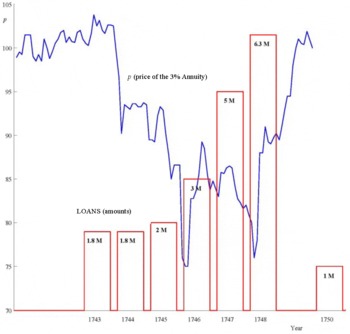
British public finance in the War of the Austrian Succession (1743–1749) is summarized in Figure 4. The price of the 3 percent annuity fell during the war years, with bottoming out around 75, it then recovered rapidly to par by the end of the war. The amount of loans increased in each of the final years of the war. Long-term annuities were issued during the war years, when the long-term interest rate was high.
Some have argued that in eighteenth-century England, wars were financed by short-term instruments. Once peace time had ushered in lower interest rates, the debt was refinanced into long-term annuities.Footnote 23 This view is false for the three wars from 1740 to 1783. During this time, borrowing relied on a limited set of financial instruments, all of which were long term. Short-term debt played a standard intra-year smoothing role, but it was not allowed to accumulate. The best-known short-term instruments were navy bills, at rates of 5 percent and higher. Some accumulation of these bills took place, but their refinancing of L 3 million in 1749 was charged on a loan issued under “war conditions.”Footnote 24 The British national accounts do not show refinancing of short-term debt after the end of the war, except a small L 1 million conversion of the navy victualing bills in 1750, this pales when compared to L 20 million converted into long-term bonds during the war.Footnote 25
PRICES OF THE 3 PERCENT ANNUITY AND AMOUNTS OF LOANS (1741–1749)

A war loan issue was an important affair, just like the IPOs of privatized state companies, and it entailed significant fixed costs. Moreover, the large market that we see today in short-term government bills did not exist at the time. Contemporary accounts from the period emphasized instead that, for the government, it was essential that each single issue be successful, i.e., significantly oversubscribed, as is the case today for investment banks placing IPOs.
The process for a new issue began in the late autumn of each war year when Parliament assessed the amount and broad terms of the loan where upon a bill was passed. The next stage involved winter discussions with the “monied men” and the fine-tuning of the loan's terms to current market conditions. Subscription was paid in monthly installments of 10 to 20 percent, beginning at various times from December to May. The system of gradual payments may have sought to minimize supply shocks to the financial market. In fact, a subscription was equivalent to the purchase of a call option.Footnote 26 Investment bankers reaped huge profits trading these options, buying early, selling later in the year, and using their special relations with the government for inside knowledge to anticipate movements in the financial markets. The growth of the capital market eighteenth-century England was stimulated by the strong incentives provided by the collusion between financiers and government. According to L. S. Sutherland, Simeon Gideon, one of the most prominent financiers, had a capital of L 25,000 in 1729. He doubled it between 1729 and 1740. That capital grew more rapidly at the beginning of the war and took only the three years from 1746 to 1749 to double from L 82,000 to L 156,000. Like others in finance, Gideon had a very good war.
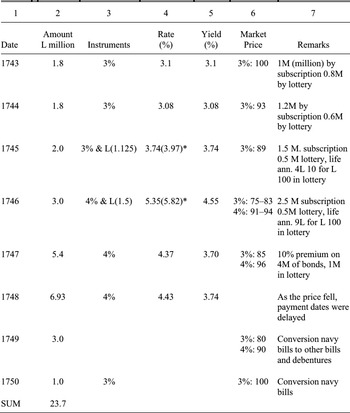
The sizes and types of loans are presented in column 2 and 3 of Table 2.Footnote 27 In 1743 and 1744 L 100 would buy a 3 percent annuity with a face value of L 100 (column 3) and a risky prize. The premia in the lotteries were slightly different in the two years, according to J. J. Grellier. In 1745 L 100 fetched a 3 percent annuity with face value L 100 and a life annuity of L 1.125 per year (to be written on any person of choice with no distinction for age). Details are presented in the Appendix. Life annuities represented less than 5 percent of all liabilities incurred during the war: financing the War of the Austrian Succession relied on 3 percent and 4 percent annuities. Hence they are the main focus of this study.
THE ANNUITIES
The 3 percent annuity would become the workhorse of Georgian England's debt finance. It was redeemable at par, like any other annuity, but market conditions, technical limitations, and policy constraints were such that their probability of redemption was negligible. The reduction of the interest rate on all 3 percent annuity to an annuity below 3 percent would have required an annuity at a rate lower than 3 percent and no debt was ever issued at less than 3 percent in eighteenth-century England. The government could gradually redeem the 3 percent annuity through the budget surplus, but that was a slow process. I will neglect in this article the callable feature of the 3 percent annuities and I will focus on the conversion from 4 percent to 3 percent annuities. In 1751 all the 3 percent debt was consolidated in consols. Abusing chronology slightly, we will use here the term “consol” for 3 percent annuities.
Annuities with a coupon of 4 percent were issued in 1746, 1747, and 1748. The prices of the three annuities were quoted separately but they tended to equalize over time. We will treat them as one financial instrument. In minimizing the number of debt instruments, the government had two objectives: first, the market size for each instrument was inversely related to their number and a small number could thus increase the liquidity of the market and therefore the price of the annuitiesFootnote 28; second, by using only one annuity above 3 percent, the government could reduce the difficulties of an interest reduction. Annuities at 4 percent amounted to two-thirds of the war loans between 1743 and 1748, but of the prewar debt, more than 85 percent was at 4 percent.Footnote 29 In the rest of the article, I will sometimes use the term “bond” for the 4 percent annuities.
THE EX ANTE COST OF LOANS
The ex ante borrowing cost is the interest rate measured by the internal rate of return, or yield, at the time of issuance of a new loan.Footnote 30 Two measures of this cost are presented in columns 4 and 5. Details of the computations are presented in the first section of the Appendix.
Column 4 of Table 2 presents the internal rate of return, as computed by Grellier with the straight accounting method that is still often used.Footnote 31 It assumes that both the 3 percent and the 4 percent coupons are perpetual with no redemption. The actual rates of the annuity are slightly higher than the nominal rate (3 percent or 4 percent) because of the premia that were paid to subscribers when the loan was issued. The accounting method overstates the cost of borrowing because it ignores the redeemability of the loan. For example, in 1747 it generates a rate of 4.4 percent on an initial investment of L 100, which is equivalent to a face value of L 110 of 4 percent annuities. But the actual cost of borrowing was lower because the high coupon would not be paid perpetually, as rationally expected by the market.
A better estimate of the cost of borrowing presented in column 5 is the long-term internal rate of return of the loan, using the equivalent value of the 4 percent annuity in 3 percent annuities, which are taken to be unredeemable. In 1747 the public should have been willing to receive, for L 100, an amount equal to 110 × 96/85 of 3 percent annuities, where 96 and 85 are the prices of the 4 percent and the 3 percent annuities, respectively (column 7). We thus obtain 3.7 percent, which is the yield reported in column 5. (If the 3 percent annuity is not perpetual, we have an upper bound.) Similar computations for the years 1745 and 1746 are presented in the Appendix.
The yields in column 5 illustrate the high cost of life annuities: in 1747 and 1748 the price of the 3 percent annuity was low and the loans were at the highest level (at L 5 and L 6 million, respectively) with no life annuities. Yet their yield was lower than in the two previous years, when the amounts borrowed were less than half as large (Table 2 and Figure 4). Issuing loans through redeemable financial instruments actively traded in the market was much less costly than life annuities ex ante.Footnote 32
WHY NOT REDEEM AT PAR?
In a setting without frictions, the optimal policy for calling a redeemable bond is to do so as soon as its price reaches par.Footnote 33 However, both governments and private firms often delay redeeming callable bonds well past that point. In eighteenth-century England, neither the market nor the government expected that bonds would be redeemed at par because of a number of constraints: (1) The government could redeem the entire 4 percent debt only by issuing new annuities at 3 percent, and that was known to entail large transaction costs. Since the holders of new and old annuities would be the same, it was cost effective to simply reduce the interest of the existing bonds. Although all annuities specified that they were redeemable in cash at par, they had not provision for a reduction of the coupon. Hence the government and annuity holders were competing to capture the rent of the saved transaction costs. At this time, three large companies (the South Sea Company, the East India Company, and the Bank of England) represented a dominant fraction of annuity holders, and they a great deal of bargaining power. The companies initially opposed the interest reduction plan, getting their agreement imposed a delay between announcement and implementation. (2) The success of the interest reduction depended on the subscription by a large fraction of the public to the outcome of the coordination game described in the previous section. In some cases, the government gave an extension to subscribe to the interest reduction and, when success was in sight, it granted the late subscribers terms that were less favorable.Footnote 34 (3) Given the time needed to implement the reduction, the government had to provide a premium that would cover possible price losses of the 3 percent annuity in the short term. Contemporary discussions of the policy emphasized that the 3 percent annuity had been around par for a few months and were likely to stay at that level in the future. The payment of L 4 per face value of L 100 provided some guarantee to this effect.Footnote 35 (4) In eighteenth-century England, public interest rates depended mainly on the government fiscal situation and thus on military expenditures. Reputation was essential during this period of growth in the public debt. The redemption of callable bonds raised issues of asymmetric information, moral hazard, and fairness. An increase of interest rates and a fall of the price of the 3 percent annuity shortly after the conversion would have raised the suspicion of “inside trading” and that the ministry was taking advantage of private information about the future evolution of interest rates. This provides more rationale for some compensation against a possible capital loss on the newly converted debt. The government had to avoid any suspicion that it was taking carrying out the interest reduction and lightening its debt burden just to start new ventures. (5) The interest reduction also raises an issue of moral hazard ex post and fairness, but this argument is more speculative. The 4 percent annuity was called after public finances had stabilized. We will see that the Pelham government had reached this favorable situation sooner after the war's end than the market had anticipated. Did the government issue such annuities with more information than the market? A compensation that was more generous than the strict terms could have alleviated that concern. There may also have been a consensus that creditors should share in the dividends of peace since these had come much sooner than expected, and that the government should not capture all these dividends, even if entitled to do so by a strict application of the contract. In the environment of contingent payments without completely specified contracts, the government spent great efforts on good relations with the financial community (the monied men). It may have wanted to share some of the “peace dividends” with the annuity holders, although these had already made a fast and large capital gain on their holdings.
PELHAM'S INTEREST REDUCTION
In the autumn of 1749, the 3 percent annuity had hovered around par for a few months. The long-term rate was therefore back to 3 percent, and was not expected to increase in the near future. The price of the 4 percent had reached 105. King George II, in his opening speech to the session of the Parliament, made it official that the ministry would seek to reduce interest payments on the entire 4 percent debt, rather than just the annuities issued in the last war. The government of Pelham ruled out an immediate reduction of the rate to 3 percent and instead fixed the renegotiation's terms at the end of November.Footnote 36 It decided that the 4 percent annuities would receive a coupon of 4 percent for the year of 1750, and then 3.5 percent for the following six years during which they were not redeemable. After seven years, there would be no distinction between these annuities and the 3 percent annuities. For a holder of a 4 percent annuity, the interest reduction was equivalent to an immediate conversion into a 3 percent annuity with an additional payment of about L 4 per annuity, paid in installments. That plan was implemented with minor variations for the total 4 percent debt of L 57.7 million. By May 1750 only L 7 million from the L 57.7 million was not converted. The holders of these bonds were paid off by a new loan.
According to Peter G. M. Dickson, the plan was resisted in particular by the large institutional investors.Footnote 37 He further argued that the plan almost fell apart during the winter of 1750. Dickson probably followed the account of Sutherland (“Samson Gideon”), who focused on Samson Gideon and his support of Pelham. Yet the evidence from the market prices that will be presented in the next section tells a different story. It shows that the market expected the complete success of the interest reduction well before its announcement.
MARKET EXPECTATIONS
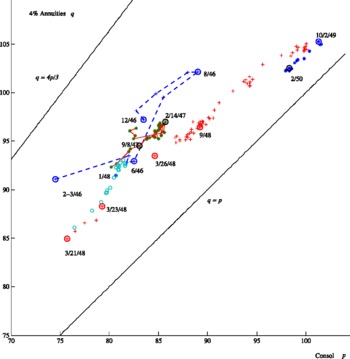
The prices of the 3 percent and the 4 percent annuities were quoted daily, excepting holidays. In Figure 5, the points of coordinates (p, q) represent the weekly averages of these prices, p for the 3 percent annuity and q for the 4 percent annuity. As the figure shows, for all weeks, (p, q) pairs are between the two lines q = p and q = (4/3)p. Moreover, for all the data p < q < 4/3p. The price of the 4 percent annuity, q, is higher than the price of the 3 percent annuity, p, since it pays a higher coupon and is eventually redeemed into a consol with a conversion ratio greater than one. It is, however, much lower than (4/3)p, which is the price of a non-redeemable annuity: at all times, the market expected an interest reduction at some point in the future.
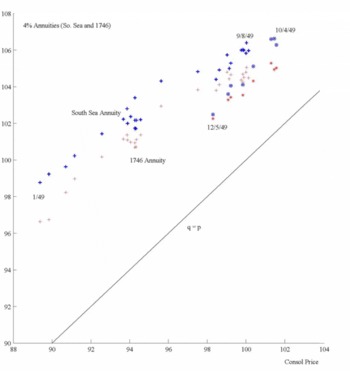
We can take a closer look at the observations after October 2, 1749, that are represented with stars in Figure 5. There is no discontinuity in the observed relation between the levels of q and p, but after October 1, 1749 there is a discontinuity in the schedule between the two prices. The new schedule is a line q = p + h, with h about 4. That is, after October 1, or two months before the official announcement of the interest reduction plan, the market was treating the plan as a fait accompli for the debt issued during the previous war. From that date on, the premium of the 4 percent annuity over the 3 percent annuity is constant and equal to the value that was promised by the government, to be paid after the completion of the subscription to the interest reduction.Footnote 38 Contrary to the evaluation of Dickson, for the annuities that were issued in the war,Footnote 39 the market had already absorbed the interest reduction two months before the official announcement.
Nevertheless, before the summer of 1749, however, the market underestimated significantly the speed at which interest rates would fall, and it also expected the government to reduce the interest on the debt at a much later date. The underestimate of the interest rate's decrease can be observed in the rapid increase of the consol from March 1748, with a price near L 75 to the par in the summer of 1749. On Sunday, April 24, 1748 the peace conference started at Aix-la-Chapelle. Between the previous Friday and the following Tuesday, in the largest jump of the war (except for the days around Culloden, April 27, 1746), the consol rose from 80 to 85 and then stabilized for a while (Figure 5).
THE PRICE OF THE 4 PERCENT ANNUITY IN RELATION TO THE PRICE OF THE 3 PERCENT ANNUITY (February 1746 to February 1750)

A LOWER BOUND FOR THE EXPECTED TIME TO REDEMPTION
At any point in time, the difference q − p is the value of an annuity paying L 1 per year until the time of the interest reduction, which is random. The value of that annuity depends therefore on the expectations about future interest rates, the time of redemption, and the terms of the redemption, and it evolved randomly according to the fortunes of war. At the beginning of 1748 on a bond with L 100 face value, the value of q − p was about L 10. Since future payments are discounted, risk-neutral investors expected to have at least 10 coupons before the interest reduction, including any final payment. The government actually paid less than L 6 per annuity (L 2 before the reduction at the beginning of 1750, and the rest after). In this sense, the market seriously overestimated the speed of the interest decrease, a decrease that was necessary for the reduction of the interest rate on the 4 percent annuities. To refine this back-of-the-envelope computation, I make the following assumptions that are justified by the historical context: (1) The interest reduction would only take place if the 3 percent annuity was near par; (2) before the interest reduction, the short-term interest was at least equal to a “stable” value r⋆ that is the long-term value after the interest reduction; (3) the interest reduction took the form of a conversion of the 4 percent annuity to the 3 percent annuity with additional payments that were equivalent to a lump-sum payment h at the time of the interest reduction; (4) investors were risk-neutral and valued an asset by the expected value of its income.
Let T be the number of years between now and the interest reduction. It is a random variable. We now establish a lower bound for the market expectation about T. Define a unit contingent annuity (UCA) as an annuity that pays L 1 per year as long as the 4 percent annuity is not redeemed. Let V be the market price of that annuity. With risk-neutral investors, it is equal to
![\[
\begin{equation}
\label{eq3}
q - p = V - E\left[{\frac{1}{1 + r_{1} } + \ldots\frac{1}{(1 + r_{1})\ldots(1 + r_{T})}} \right]
\end{equation}
\](https://static.cambridge.org/binary/version/id/urn:cambridge.org:id:binary:20151017014257918-0090:S0022050711001847_eqn3.gif?pub-status=live)
where rt is the short-term (one period) interest rate from period t − 1 to period t. We do not know the expectations about future interest rates at that time and the value of T but the market data enables us, under the previous assumptions, to find a lower bound for the expected value of T.
Let γ be the price of a zero-coupon bond paying L 1 in period T. The value of γ is also the discount factor to the random period T. The 3 percent annuity is equivalent to a portfolio of a = 3 UCAs and one 3 percent annuity delivered at T, which is assumed to be perpetual. Likewise, the 4 percent annuity is equivalent to a portfolio of three assets, an amount b = 4 of UCAs, one 3 percent annuity delivered at time T, and an additional lump-sum payment h delivered at the random time T. The prices p and q of the two assets satisfy therefore the equations

which are solved into

The information conveyed by the prices of the two assets, p and q, is equivalent to the values of V and γ, which have a simple interpretation. For the lower bound on the time to redemption, I will use only the information in the annuity valuation, V. It is shown in Section 2 of the Appendix that under the previous assumptions,
![\[
\begin{equation}
\label{eq5}
E\left[T \right] \geqslant \mathop T\limits^{ - } (V) = - \frac{Log(1 - r^{\ast }V(p,q))}{Log(1 + r^{\ast })}
\end{equation}
\](https://static.cambridge.org/binary/version/id/urn:cambridge.org:id:binary:20151017014257918-0090:S0022050711001847_eqn5.gif?pub-status=live)
For each value set of prices (p, q), which determines V (p, q) in equation 5, the previous equation defines a lower bound on the expected time to redemption. Inversely, a given value of the lower bound  determines a locus of the asset prices (p, q) with the equation

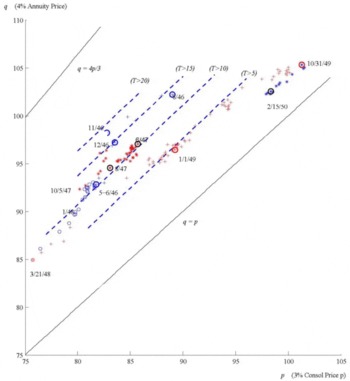
In Figure 6, loci of constant lower bounds are represented by h = 4 (the value that was used in 1749), p∗ = 100, and r∗ = 3 percent. One can observe the overestimation of the expected time to the redemption of the 4 percent bonds. In 1747 the lower bound of the expected value of the time to the reduction, , was 10 years. In 1746 it was 15 years.
The previous computations assume that the value of the premium h is equal to the actual amount that was set by Pelham. There is an equivalence between the length of time to the redemption, T, and the value of h. Pelham did not actually pay a premium, but the delay in the implementation of the reduction was equivalent to the payment of a premium. In general, the payment of a premium h is equivalent to the delay of an interest reduction by h years with no premium at the end.
MINIMUM EXPECTED TIME TO REDEMPTION

These results are robust when the probability of default is positive and when annuity holders are risk averse. A possible default would lower the price of the 3 percent annuity when it is low, for example at 75. When a government implements a partial default (as occurred in France in 1770),Footnote 40 the higher interest rate is reduced first. The selective default would affect first the 1 percent premium paid by the 4 percent annuity over the 3 percent annuity. Hence, such a probability would decrease the observed price difference q − p. A positive probability of default on the bond would increase the values of the lower bound on E[T] in equation 6. When investors are risk averse, the pricing equation 3 should be modified. The issue is beyond the scope of the present article, but it does not have a significant impact on the previous results.
Derivative Pricing
The previous computations provided, under minimal assumptions about the processes of the interest rate and the redemption of 4 percent annuities, some information regarding the mean of the expectations, but not on its distribution. If that distribution has a high variance, annuity holders could still expect with significant probability an early redemption. The distribution of expectations can be characterized in a model of asset pricing that makes stronger assumptions about the interest rate process. These assumptions cannot be made for all the war years, but the historical context and the price data show that they have some validity for the period that began in 1748.
The start of the peace negotiations in April 1748 at Aix-la-Chapelle did not mean the end of uncertainty. The guns of Maurice de Saxe at the siege of Maastricht could be heard a dozen miles away.Footnote 41 The war continued at sea as well until the signing of the peace treaty on October 18, 1748. Long lists of ships captured at sea were printed each month in The Gentleman's Magazine. Nevertheless, April 1748 had simplified the issues that had to be addressed for the computation of expected future prices: the trend for interest rates was definitely downward and the main question was how quickly they would fall.Footnote 42
This new context is reflected in the new relationship that emerged after April between the prices of the 3 percent and the 4 percent annuities in Figure 5. Such a relation appears when both prices are driven by one variable, which is random, in a space of dimension one. That driving variable is the short-term interest rate. It is not observable and remains hidden, but that does not matter. One may assume a random process for the short-term interest rate that is characterized by some parameters such as the variability or the convergence to some value. The process generates, at any time, some distribution about the paths of the interest rate in the future. To each path corresponds a value of the prices of the 3 percent and the 4 percent annuities (the present value of their future payments discounted with the interest rates in the future). The process generates a schedule between the two prices. From the observation of this schedule, one can recover estimates of the parameters of the stochastic process of the short-term interest rate that remains hidden.
The model in Chamley, “Interest Reductions,” assumes that the short-term interest rate follows a random walk with a trend to the long-term value, r∗. Footnote 43 This value is taken as the peacetime interest rate around which the interest reduction takes place. The random process depends on four parameters to be estimated: (1) the rate of convergence of the short-term rate to r∗, (2) the premium that was paid above the 3 percent annuity at the time of the interest reduction, (3) the variance of the process between consecutive periods and, (4) a coefficient of risk aversion.
Following the above intuitive description, there is a relation q = ϕ(p; ζ) between the price of the consol, p and the bond price q, which depends on the vector, ζ, of the four parameters. These parameters are estimated by maximum likelihood: they minimize for all the data points the sum of the squares (qt − ϕ(pt; ζ))2 for all the data points. The estimation period is from April 1748 to the end of May 1749, six months before the official interest reduction. This reduces the contamination by the policy when it was actually implemented and captures instead only the effect of expectations on market annuity prices.
Within the model, we can address the following question: if the price of the consol is 88.95, as it was in November 1748, (with an estimated value of 88.96), what is the probability that the interest reduction will be announced, with the additional payment of L 4, within one year? When the parameters for variance, risk aversion, and the premium, h, are set at their estimated value, and the rate of convergence is at the top of the 1 percent interval of estimation (for the fastest convergence), the answer to the question is 0.2 percent. The model thus confirms that, between the springs of 1748 and 1749, the market was completely taken by surprise (in the sense of 0.2 percent probability) by the rapid fall of the interest rate.
THE OLD DEBT
In 1749 the debt comprised L 12 million at 3 percent and L 58 million at 4 percent.Footnote 44 All 4 percent annuities were subject to the same interest reduction, but among those, about L 44 million had been inherited from the 1720s and were the ones Barnard failed to redeem. The relationship between the prices of 4 percent South Sea annuities and the 3 percent annuity is presented in Figure 7. The regression line summarizes the period between 1735 and 1740 that was analyzed in Section 2. The beginning of the war did not affect the 3 percent annuity, which stayed at par until the end of 1743, it did however increase markedly the price of the 4 percent annuity. Taken together, these two facts imply war did not change expectations about average future interest rate but individuals anticipated a long delay before any interest reduction.Footnote 45
SOUTH SEA 4 PERCENT ANNUITIES, 1740–1745

At the beginning of 1744, with the war in full swing, interest rates increased. The price of the 3 percent annuity fell to around 90 until August 1745. At the same time, the 4 percent annuity held up much better with a high price in relation to the 3 percent annuity: the expected time of redemption was seen to be far off in the future. After the landing of the Pretender in August 1745, the prices of both assets fell significantly. The 3 percent annuity reached its lowest price in the war in February 1746 (about the same level as it would reach again in March 1748). It recovered rapidly after Culloden in April 1745.
At the beginning of 1746, the new 4 percent annuity was introduced. During the war, the South Sea annuity was traded at a price above the price of that 1746 annuity. The difference fluctuated between 0 and 3, with an average of about 2. The market anticipated a pattern somewhat similar to the situation before the war, with a redemption that would come later and/or with a larger compensation for the old debts than for the new ones.
Through the summer of 1749, the market anticipated that the old debt that had resisted the 1737 attempt at redemption would be treated differently from the bonds that had been issued during the war (that is, all the 4 percent annuities issued after 1745 that traded at the same price). The prices in the year 1749 are presented in Figure 8. From October on, the price of the new 4 percent annuity is identical to that of the 3 percent annuity plus a fixed premium, as we have seen before. In October, “old” 4 percent debts sold at a premium of about 2 relative to “new” ones. The reduction of the premium of the old debt is gradual and achieved only at the end of the year. Various lobbying interests may have realized that the coexistence of two large amounts of assets with coupons at 3 percent and 4 percent with a steady long-term interest rate at 3 percent was not sustainable. Not everyone may have come to this conclusion in the summer, but by the end of the year, it had been widely accepted. After January 1, 1750 the old debt was priced similarly to the new debt.
CONCLUSION
Why did Pelham succeed where Barnard failed? His powers of persuasion may have helped, but the evidence points to other explanations. The main difference between the two episodes is the relation between the policy and the market. Barnard had been rigid. His plan had made no allowance for the market's expectations as reflected in the premium of the 4 percent annuity over the 3 percent, and it would have generated a large capital loss on the bondholders. Pelham, on the other hand, gave a premium of L 4 over par that fit market prices and caused limited bondholders' losses. The remarkable fit between the market expectations and the plan is due to the adaptation of Pelham to these expectations. The plan brought no surprise to the market in the autumn of 1749. The surprise had been the rapid fall of interest rates that had taken place before, after the end of the war.
THE SOUTH SEA ANNUITIES (1749)

The second difference between the policies of Barnard and Pelham is that in 1749, the very size of the 4 percent debt made the case for an interest reduction more convincing than in 1737.
Third, the cartel of the main financial institutions had much less market power in 1749 than it did in 1737.Footnote 46 The large companies did not control the L 14 million of new 4 percent annuity that had been issued in the war, nor 3 percent annuities that had expanded from L 2 million to L 10 million during the war which made price manipulation more difficult.
Finally, the fall of the interest rate had been much faster than could be explained by reasonable expectations. The large capital gains just before the interest reduction may have diminished the debt holders' opposition.
Yet despite its success, the 1749 interest reduction may well have convinced the government that such operations were difficult and could succeed only under favorable circumstances. In the next conflict, (the Seven Years War) all loans had a fixed date for the reduction from 4 to 3 percent. England only resumed the issuing of annuities at 4 percent and 5 percent with unspecified date for redemption during the War of American Independence.
Did prices of the government annuities drop “too much” during the wars in view of the subsequent evolutions of short-term rates? Robert J. Shiller analyzed the volatility of long-term interest rates in expectations models of the term structure.Footnote 47 The present study illustrates a different type of excess fluctuation. The main issue at the end of war, as attested by the policy of issuing redeemable annuities, was the speed of convergence of the annuity to its par value. If people expected a slow convergence, then the consol price did not overreact. The expectation about this convergence has been extracted here from the prices of the 3 percent and 4 percent annuities, which provide strong evidence that, in the case of the War of the Austrian Succession, the market overreacted and showed considerable pessimism.
In this context, the debt policy during the War of the Austrian Succession offers an illustration of the ability of marketed, contingent financial instruments to reduce the cost of borrowing. The loans of 1745 and 1746 included non-marketed life annuities, which were more expensive ex ante than later loans. These later loans were cheaper despite the long-term rate being higher in 1747 and 1748, and the amount of the loans being more than twice as large. During the same century, France relied heavily on non-redeemable life annuities and paid a high cost for these.
The contingent feature of the callable annuities enabled the government to take advantage of the pessimism. Simply put, in April 1746 the market paid a price of L 12 for coupon L 1 per year until the call of the 4 percent annuity. It was willing to pay that price because it was pessimistic about future interest rates. Its expectation was that the annuity would pay for about 10 years with a final payment of L 4. In fact, the annuity lasted only for three years. The price of L 12 was much more than the total amount paid on the annuity, ignoring discounting, since the government paid a total of L 7 (L 1 per year from 1746 to 1748, and a total of L 4 after). The government was therefore able to bet with great success against the pessimism of the market.
The policy of Pelham has a modern equivalent. In the early 1980s the British government faced adverse expectations of private investors who were pessimistic about the government's policy and the evolution of interest rates. The enemy was not France, but inflation. Margaret Thatcher was more confident than the market that she would prevail and her government issued inflation indexed bonds. Expecting high coupons for a long time, investors paid high prices to the government, like the buyers of 4 percent annuities in 1747. Inflation came down much sooner than expected (with some help from Paul Volcker). Thus, in the 1980s as in the 1740s, the government bet successfully against excessive market pessimism.Footnote 48
Appendix
Borrowing Costs: 1743–1748
3 percent annuities issued in 1743: An investor who paid L 180 received a 3 percent annuity with face value L 100 and a lottery ticket for another L 80 of 3 percent annuities. The terms of the lottery were better than even odds and adjusted to current market conditions. Grellier (Terms) is vague on these terms: “this profit is variable, but has generally been taken at the average of L 2.5 per ticket,” valued at L 10 each (p. 84). That description refers to all loans “up to the last war” (p. 83). It is possible that Grellier had in mind the most recent loans. For the 1746 loan, Grellier (History) reports a much lower profit margin, L 0.75 per ticket (p. 205). I have used the lower number. For the higher number, the rates of loans with a lottery would have to be increased (e.g., 0.003 in 1744, 0.01 in 1748). The 1744 loan was issued under similar terms.
4 percent annuities issued in 1746: The 1745 loan is similar but 1746 is easier to present. An investor who paid L 600 received a 4 percent annuity with face value L 600 (annual income L 24), and a lottery ticket for a life annuity of L 9. In addition, the subscription included lottery tickets with a premium as in 1743 and 1744. According to Grellier (History), life annuities “were known to be worth 16 years purchase, as it has since appeared that the lives nominated were worth more” (p. 204). I have kept the conservative value of 16 years. The net cost of the cost of acquiring the annual income of L 24 was therefore 600 − (7.5 + (16 × 9)) = 448.5, where 7.5 is an additional prize on lottery tickets (Grellier, History). The rate is 24/449.5 = 0.0535, as reported in the table. If the life annuities were worth 20 years of purchase, instead of 16, the rate is equal to 5.82 percent. The method that was used for the 1745 loan was similar with the 3 percent annuity and a life annuity.
4 percent annuities issued in 1747: There were two loans of L 4.4 million and L 1 million which are consolidated in Table 2. The first loan included, for each payment of L 100, a 4 percent annuity and an additional L 10 ticket for an annuity with the same interest rate (Grellier, Terms). The second loan was a lottery loan (BPP, 1898). In the consolidation, a payment of L 500 provided an annual income of L 21.4 and had an actual cost equal to 500 - 10.5 = 492.5. In 1748 a loan L of 6.3 million been issued like the first tranche of the 1747 loan. Its rate was therefore equal to 100 × 4.4/(100 − 0.75) = 4.43 percent.
In each case, the yield of the loan is the rate of return when the investment is converted to a perpetual. Assuming that the 3 percent coupon rate is perpetual, a 4 percent annuity in 1746 was equivalent to a 3 percent annuity multiplied by the price ratio between the 4 percent and the 3 percent. In 1746 we have a portfolio of a callable 4 percent annuity and a life annuity. The 4 percent component is equivalent to a perpetual payment of 3 × 94/83 = 3.3976 = c, where 94 and 83 are the prices of the 4 percent and the 3 percent annuities in the spring of 1746 (which are more relevant than the prices at the beginning of the year because the payments for the subscription were made in the spring and the summer). The rest of the computation takes into account the premium of the lottery and is the same as for the rate.
The Lower Bound on the Expected Time to Redemption
Using the notation of the text, assume first that the short-term (one period) interest rate follows an arbitrary deterministic path and that agents have a constant marginal utility of consumption. The value of the annuity appears in equation 1 in the text. Following the previous discussion of the redemption policy, we can assume that before the redemption, the interest rate is greater than r∗, the rate at which the redemption takes place (near 3 percent). Hence, for any interest rate path and value of T,
![\[
\begin{array}{l}
v \leqslant E\left[{\frac{1}{1 + r^{\ast }}(\frac{1 - \frac{1}{(1 + r^{\ast })^{T}}}{1 - \frac{1}{1 + r^{\ast }}})} \right] \\
= \frac{1}{r^{\ast }}(1 - E\left[{\frac{1}{(1 + r^{\ast })^{T}}} \right]) \\
\end{array}
\](https://static.cambridge.org/binary/version/id/urn:cambridge.org:id:binary:20151017014257918-0090:S0022050711001847_eqnA1.gif?pub-status=live)
which is equivalent to

where the last inequality is due to the convexity of the exponential e −x and Jensen's inequality. Therefore,
![\[
\begin{equation}
\label{A2}
E\left[T \right] \geqslant - \frac{Log(1 - r^{\ast }V)}{Log(1 + r^{\ast })} = \mathop T\limits^{ - } V
\end{array}
\](https://static.cambridge.org/binary/version/id/urn:cambridge.org:id:binary:20151017014257918-0090:S0022050711001847_eqnA2.gif?pub-status=live)
The Impact of Risk Aversion
If agents are risk averse, equation 3 should be modified. A complete analysis is beyond the scope of the present article and may not be feasible given data limitation. Two effects may work in opposite directions. First, the marginal utility of consumption in future periods, when the interest rate will be lower, is lower than in the present, in the middle of the war. That effect depresses the right-hand side in equation 3, and in order to keep the equality with the observed value of V, the value of T should increase. Second, if the price of the unit contingent annuity (UCA) is negatively correlated with the return of the market, the opportunity to reduce risk increases the demand for the UCA and its price. That effect reduces the value of T in equation 3.
These effects are probably small, however. First, rough approximation of the market is the 4 percent annuity (the sum of the UCA and the 3 percent annuity) because the overwhelming part of the public debt was in that annuity. For the years 1746 and 1747, the correlation is positive and it is negative for the years 1748 to 1749.Footnote 49 Second, if agents were risk averse, it would be hard to explain why lotteries were part of the issuance of new loans. Finally, the estimation of the derivative asset pricing model suggests that agents were close to risk neutral.