Previous research on early language acquisition has stated that nonword repetition abilities are related to vocabulary development. Results in this field have shown that nonword repetition scores at ages 4 and 5 are related to vocabulary level at the same age, i.e. children with a higher vocabulary level showed significantly more accurate repetition abilities compared to children with a lower vocabulary level (Gathercole & Baddeley, Reference Gathercole and Baddeley1989). In addition, these authors found that repetition scores at 4 years of age are good predictors of vocabulary level one year later. These findings that showed a close relationship between repetition abilities and vocabulary level and growth, led to a whole new field of research. For example, Gathercole, Service, Hitch, Adams and Martin (Reference Gathercole, Service, Hitch, Adams and Martin1999), found that scores on The Children’s Test of Nonword Repetition (CNRep) at age 4 correlated with vocabulary development at the same age. The CNRep (Gathercole & Baddeley, Reference Gathercole and Baddeley1996) is a standardized test that has been widely used in this area.
More recently, Hoff, Core and Bridges (Reference Hoff, Core and Bridges2008) carried out two studies with 20 to 24-month-olds. Results showed that nonword repetition performance was significantly correlated to vocabulary level, measured with the MacArthur Communicative Developmental Inventory (MCDI) (Fenson et al., Reference Fenson, Dale, Reznick, Thal, Bates, Hartung and Reilly1993). They concluded that, as early as the age of 2, phonological and lexical developments were closely related. In the same vein, Roy and Chiat (Reference Roy and Chiat2004) obtained significant correlations between performance in nonword repetition and scores in the receptive vocabulary Peabody Picture Vocabulary Test (PPVT) for two to four-year-old-children. In the Spanish language, Mariscal and Gallego (Reference Mariscal and Gallego2013) found similar results to those of Hoff et al. (Reference Hoff, Core and Bridges2008): Their 2 to 4-year-olds’ performance in an experimental nonword repetition task was significantly related to language measures (in this case, the Spanish standardized version of the PPVT). In Dutch, Rispens and Baker (2012) also found significant correlations between nonword repetition abilities and scores in the Dutch standardized version of the PPVT. Thus, it seems that there is sufficient supporting evidence to show the existence of a close relationship between repetition accuracy and vocabulary development in different languages (Stoel-Gammon, Reference Stoel-Gammon2011).
It should be noted that most of the studies mentioned above administered the PPVT as a lexical measure. In this test, children have to match the words that the experimenter produces with a picture (among four different ones). Therefore, children are not required to produce words. However, other studies tested productive levels of vocabulary that parents reported in the MCDI (see, for example, Chiat & Roy, Reference Chiat and Roy2007).
Nonword repetition accuracy is related to differences between typical and atypical language development
Nonword repetition accuracy has been widely used to show differences between typically developing children (TD) and children and adults with language impairment, and fluency and communication disorders (Howell, Reference Howell2010), both in research and clinical contexts (e.g. Coady & Evans, Reference Coady and Evans2008). As early as the 1990s, researchers interested in clinical populations revealed that scores in repetition tasks allowed them to discriminate between children with language difficulties and those with typical language development and it was found that “nonword repetition may have considerable clinical utility as a screening measure for language impairment in children” (Dollaghan & Campbell Reference Dollaghan and Campbell1998, p.1136).
A considerable amount of subsequent research supports this idea. For instance, Thal, Miller, Carlson and Vega (Reference Thal, Miller, Carlson and Vega2005) administered the Nonword Repetition Test (Dollaghan & Campbell, Reference Dollaghan and Campbell1998) to 4-year-old children. Performance was significantly better in the group of children with typical language development compared to the language-impaired group. Chiat and Roy (Reference Chiat and Roy2007) not only found the same result but also revealed that the repetition accuracy of the youngest children in the non-impaired group (aged 2) was similar to repetition accuracy of the oldest children in the language-impaired group (aged 2 and a ½). Most of the studies carried out with children with Specific Language Impairment (SLI) Footnote 1. (DSM–IV–TR) (American Psychiatric Association, 2000) have led to the same results: Their performance in nonword repetition tasks is lower compared to typically developing children (e.g. Conti-Ramsden, Botting, & Faragher, Reference Conti-Ramsden, Botting and Faragher2001; Jones, Tamburelli, Watson, Gobet, & Pine, Reference Jones, Tamburelli, Watson, Gobet and Pine2010). These effects have been replicated in languages other than English (see for example, Aguado, Cuetos-Vega, Domezáin, & Pascual, Reference Aguado, Cuetos-Vega, Domezáin and Pascual2006; and Girbau & Swartz, 2007; for Spanish; Dispaldro, Leonard & Deevy, Reference Dispaldro, Leonard and Deevy2013; for Italian; or Rispens & Baker, Reference Rispens and Baker2012; for Dutch). Additionally, Howell et al. (2017) validated a nonword repetition task applicable across languages such as English, Urdu, Polish and Romanian, showing that nonword repetition is a strong predictor of fluency difficulties.
Nonword repetition in late talking children
Given that nonword repetition accuracy is related to vocabulary growth and helps to differentiate typical from impaired language development, the question that arises is whether nonword repetition abilities can discriminate between typically developing children and late talking children. As has already been mentioned, there is evidence that nonword repetition tasks are useful for discriminating typically developing children from impaired children. However, research with this clinical purpose has been mainly carried out with children who are 4 years old or older, which is the moment in a child’s development when SLI is diagnosed. There is enough evidence to consider that many of these children with SLI already had expressive language difficulties before reaching that age (Bishop et al., Reference Bishop, Holt, Line, McDonald, McDonald and Watt2012). In fact, the literature shows that between 10% and 15% of 2-year-old children show an early expressive delay (Rescorla, Reference Rescorla1989 ). In addition, it has been found that, even though around 50% of these children reach a typical language path by school age (Williams & Elbert, Reference Williams and Elbert2003), the other approximately 50% of the children who showed an expressive language delay by the age of 2, end up presenting language impairments and/or developmental difficulties by that time (Law, Boyle, Harris, Harkness, & Nye, Reference Law, Boyle, Harris, Harkness and Nye2000).
Children who present an early expressive delay (but typical cognitive and motor development, and no genetic disorders) are known in the literature as late talking children (Rescorla & Schwartz, Reference Rescorla and Schwartz1990). Traditionally, researchers and clinicians identify these children because they produce less than 50 words and /or because they do not combine two words in one sentence by two years of age (Dale, Price, Bishop, & Plomin, Reference Dale, Price, Bishop and Plomin2003). The measure that is often used among professionals is the percentile obtained in the vocabulary section of the MCDI (Fenson et al., Reference Fenson, Dale, Reznick, Thal, Bates, Hartung and Reilly1993). Late talking children are most often identified when they are below percentile 20 (Fernald & Marchman, Reference Fernald and Marchman2012), but different criteria have been used, for example; percentile 16 (Stokes, Moran, & George, Reference Stokes, Moran and George2013), percentile 15 (Paul & Jennings, Reference Paul and Jennings1992), percentile 11 (Heilmann, Ellis Weismer, Evans, & Hollar, 2005), percentile 10 (D’Odorico, Assanelli, Franco, & Jacob, 2007; Dale et al., Reference Dale, Price, Bishop and Plomin2003; Ellis Weismer & Evans, 2002) and even percentile 5 (Girolametto, Wiigs, Smyth, Weitzman, & Pearce, Reference Girolametto, Wiigs, Smyth, Weitzman and Pearce2001) Footnote 2 .
In this context, the importance of early detection becomes evident. In this sense, the nonword repetition tasks have also been administered to late talking children, but to a lesser extent. The role of this task for the assessment of late talkers is still pending on more research despite its possible relevance for clinical purposes. Thus, more research is needed in order to study whether repetition abilities are sensitive to vocabulary levels.
Stokes and Klee (Reference Stokes and Klee2009a) recruited a sample of British-English-speaking children (age ranged from 24 to 30 months). Parents completed the MCDI and children were administered the Test of Early Nonword Repetition. Children who scored below percentile 16 in the total vocabulary section of the MCDI (CDI: WS-UK, Klee and Harrison 2001; cited in Stokes & Klee, Reference Stokes and Klee2009a) and/ or did not combine words were considered as late talking children. Results showed that the probability of these late talkers scoring below percentile 16 in the Test of Nonword Repetition was 15 times higher compared to typically developing children. In Italian, D’Odorico et al. (2007) tested a nonword repetition task on 4 and 6-year-old children from whom 16 had been identified as late talkers at the age of 2. Results showed that the percentage of correct syllables repeated was significantly higher in the group of typically developing children, compared to children who had shown an early expressive delay. More recently, Stokes et al. (Reference Stokes, Moran and George2013) found that correlations between nonword repetition abilities and different variables (age, lexical knowledge, and lexical diversity) were much stronger in the late talking children group, compared to that of the typically developing children.
In addition, Gathercole and colleagues (1999) found that early nonword repetition performance predicts vocabulary growth in 4 to 6 year olds. Similarly, Stokes and Klee (Reference Stokes and Klee2009b) found that nonword repetition performance was already a strong predictor of vocabulary scores by the age of 2. In the same line, Bowey (Reference Bowey2001) pointed out that nonword repetition performance remains stable over time. This finding resulted from testing children at 4 years and ten months (time 1) and one year later (time 2). Results showed that vocabulary level at time 1 predicted nonword repetition performance by time 2; and that repetition abilities at time 1 predicted vocabulary level at time 2. Note that the studies just mentioned usually use nonword lists designed for the purposes of the studies, but no standardized tests.
Bearing all these findings in mind, will early productive vocabulary predict nonword repetition abilities in Spanish language? Although different nonword repetition studies have been carried out in this language (Aguado et al., Reference Aguado, Cuetos-Vega, Domezáin and Pascual2006; Ebert, Kalanek, Cordero, & Kohnert, Reference Ebert, Kalanek, Cordero and Kohnert2008; Girbau & Schwartz, Reference Girbau and Schwartz2007; Gutiérrez-Clellen & Simón-Cerejido, 2010; Lázaro, Rujas, Montero, Casla, & Murillo, in press; Mariscal & Gallego, Reference Mariscal and Gallego2013), none of them have a longitudinal perspective nor do they include a group of late talking children. Therefore, it is clear that more evidence in the Spanish language is needed. Research in the Spanish language is relevant because it contrasts with other languages in terms of phonology, which is of major relevance in this respect. Compared to English, the most explored language in studies of typically and late talking children, the Spanish phonological system is less complex, especially the most frequent CV structure. Besides CV, there are many different syllabic structures that are simpler than those of the English language. Generally speaking, Spanish children have to master a CV structure that is even simpler than Italian, a language with which Spanish is usually associated, and therefore it is reasonable to expect different results in this language than those observed in other languages. We consider that the more complex the phonological system is, the easier it will be find differences among typically and late developing children in experimental conditions. In the case of Spanish, differences between late and typically developing children at the age of 2 could be hard to find because of the simplicity of the system. The current study is carried out bearing in mind this cross-linguistic understanding of the word and nonword repetition task.
Variables involved in nonword repetition abilities
Finally, many researchers have explored the role that different variables play in early nonword repetition performance. Thus, according to Roy and Chiat (Reference Roy and Chiat2004) some word-related variables can facilitate or complicate the repetition task (i.e. word status and word length) Footnote 3 . Previous research with samples of typically developing children has shown a word status or lexicality effect: That is, words are easier to repeat compared to nonwords (Hoff et al., Reference Hoff, Core and Bridges2008; Mariscal & Gallego, Reference Mariscal and Gallego2013; Roy & Chiat, Reference Roy and Chiat2004). In addition, a word length effect has been found, meaning that as items increase in number of syllables, the harder the task becomes (Ebert et al., Reference Ebert, Kalanek, Cordero and Kohnert2008; Mariscal & Gallego, Reference Mariscal and Gallego2013; Roy & Chiat, Reference Roy and Chiat2004). Finally, Howell et al. (2017), and McKean, Letts and Howard (2014) have shown that changes in neighbourhood density influences lexical processing.
It seems that these effects persist when examining children with language impairment. Thus, a word status effect has been found (Chiat & Roy, Reference Chiat and Roy2007) and also a word length effect (Aguado et al., Reference Aguado, Cuetos-Vega, Domezáin and Pascual2006; Chiat & Roy, Reference Chiat and Roy2007; Dollaghan & Campbell, Reference Dollaghan and Campbell1998; Gathercole et al., Reference Gathercole, Service, Hitch, Adams and Martin1999) in children with language difficulties from 2 years old on. Specifically, Stokes and Klee (Reference Stokes and Klee2009a) found this last effect in English-speaking late talking children.
The role of these two variables has been well attested in the English language, and to a much lesser extent in other languages. In Spanish, due to the scarcity of previous studies, we consider it relevant to undertake a study controlling these two essential variables. Thus, our next question is to what extent word status and word length interfere in Spanish-speaking late talking children’s repetition abilities. Are nonwords, compared to words, more difficult for these children whose expressive vocabulary is lower? Are three-syllable items more difficult as well?
In this context, it seems that further research is needed to examine: (a) The role that word status and word length play in repetition abilities in languages other than English (that is, with different phonological characteristics); (b) whether these abilities change longitudinally from very early ages (2 years old on); (c) the role that expressive vocabulary level plays in repetition performance (that is, whether repetition performance differs in late talkers and typically developing children); and (d) the predictive value of such abilities over time. Thus, the general aim of this study is to deeply explore word and nonword repetition abilities in monolingual typically and late talking Spanish-speaking children.
Method
Participants
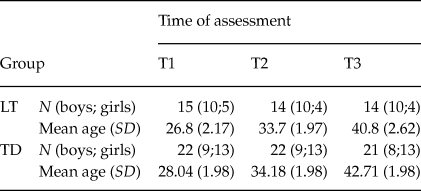
One hundred and forty-six parents were contacted from four different nurseries in Madrid (Spain). They completed the Spanish version of the MCDI (López-Ornat, Gallego, Gallo, Karosou, & Mariscal, Reference López Ornat, Gallego, Gallo, Karosou and Mariscal2005) at the beginning of the study, when the children were between 20 and 24 months old. All families received a report with their MCDI scores but only 37 joined the longitudinal study. These 37 participants were selected considering (1) their willingness to participate in a longitudinal study and (2) their vocabulary scores (percentile in the MCDI).
All children who scored percentile 20 or below and whose parents were willing to participate were recruited (n = 15). Following Fernald and Marchman (Reference Fernald and Marchman2012), those children were considered as Late Talkers (LT) Footnote 4 . In addition, another 23 participants were selected from those who scored percentile 25 or above, that is, those who presented a typical language development (TD).
The 37 participants were followed for 14 months and were assessed at three different moments. Because some families dropped out during the longitudinal study, sample size varies from time 1 to time 3. Sample distribution can be seen in Table 1.
Sample Distribution across the Longitudinal Study

Given that late talking children show expressive delay but comprehension is not affected (Dale, et al., Reference Dale, Price, Bishop and Plomin2003; Rescorla & Schwartz, Reference Rescorla and Schwartz1990), no comprehension standardized tests were administered.
All participants were monolingual Spanish-speaking children (they attended monolingual Spanish-speaking schools and came from monolingual Spanish-speaking families). There was no report of exposure to other languages in the MCDI completed by parents. They had no history of hearing loss and no referral to speech and language therapy services.
Materials
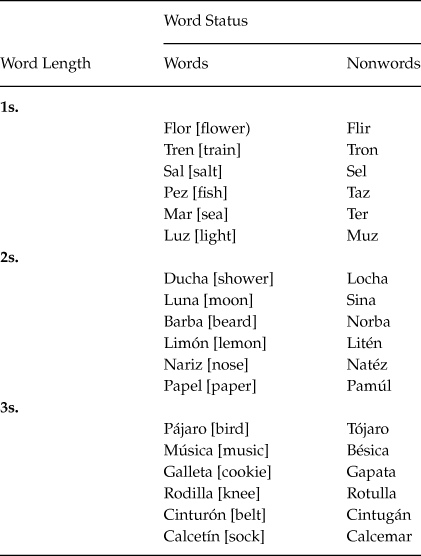
Stimuli were taken from Mariscal and Gallego (Reference Mariscal and Gallego2013). It is not a standardized test but an experimental task developed to use with Spanish speaking participants. Their repetition task included 18 words and 18 nonwords. Both lists included one, two and three syllable-long words and nonwords. Real words were selected from the Spanish version of the MCDI (López-Ornat et al., Reference López Ornat, Gallego, Gallo, Karosou and Mariscal2005) for children aged 1;4 to 2;6 so that they were likely to be words within the children’s experience, although not necessarily in their productive vocabularies. In order to generate the nonwords, Mariscal and Gallego (Reference Mariscal and Gallego2013) followed three criteria:
-
a) Following Roy and Chiat (Reference Roy and Chiat2004), words and nonwords were matched in syllable length and prosodic structure.
-
b) In monosyllabic items, one or two phonemes were substituted (sometimes a vowel, for example tren → tron; sometimes a consonant, luz → muz). Even though Roy and Chiat (Reference Roy and Chiat2004) only changed vowels, in this case, consonants were also substituted in order to keep the level of difficulty of the nonwords balanced. Therefore, consonants and vowels included in nonwords were as frequent as the ones included in the list of words.
-
c) In two and three-syllable-long items, both the consonant and the vowel included in the stressed syllable were substituted.
The appendix includes the lists of words and nonwords.
Design
Children were recruited when they were between 20 and 24-months-old, and were assessed at three different moments (see Table 1). Time range between T1 and T2 was 6 months; time range between T2 and T3 was 8 months. Thus, time is understood as the interval between one moment of assessment and the following and consequently the linguistic development that takes places during these periods.
Procedure
Families signed consent forms to participate in this study, which was approved by the Research Ethical Board of the University that funded this project. Participants were visited at their nurseries and schools and were individually tested in a separate classroom. The word and nonword repetition task was presented live in a play context. The child was introduced to a puppet and asked to help the experimenter to teach him new words by repeating aloud the words that the experimenter was producing. We used two practice items to familiarize the child with the task. Then, the experimenter produced the 18 items in the word list, one at a time. Nonwords were presented in a second session during which the children were requested to teach “silly words” to the puppet. Following Chiat and Roy (Reference Chiat and Roy2007), if a child failed to respond to an item, up to two further opportunities were given. The examiner moved to the next item when the child made no attempt to repeat after the third presentation. Frequent pauses were made, in which children were given stickers to reinforce and encourage participation. The order of presentation of words and nonwords was randomized for each participant. Children’s responses were audio and videotaped for further transcription and analyses.
Coding and reliability
We coded and transcribed the children’s responses in terms of phonological accuracy. We considered the repetition as correct when it was exactly the same as the experimenter’s production. Correct responses scored 1, while incorrect responses scored 0 (Aguado et al., Reference Aguado, Cuetos-Vega, Domezáin and Pascual2006; Roy & Chiat, Reference Roy and Chiat2004). However, according to typical phonological development in the Spanish language (Bosch, Reference Bosch2003), allowances were considered for some errors (substitution and omissions). These phonological allowances included: Consonant group reduction, /r/ substitutions (for other consonants), or /r/, /s/ and /θ/, omissions in final (or coda) position. That is, if a child repeated “ten” instead of “tren” (tain instead of train), the response was considered correct. This criterion has been previously employed in similar repetition tasks in other languages (Chiat & Roy, Reference Chiat and Roy2007; Conti-Ramsden, Reference Conti-Ramsden2003; McKean, Letts, & Howard, 2013). It also included coda omissions in /r/, /s/, /θ/ and replacement of /θ/ by /s/ or /f/.
A second rater coded 15% of the total of children’s responses (including late talking and typically developing participants in T1, T2, T3). Interrater agreement was high (88%; k = .87).
Results
Nonresponses
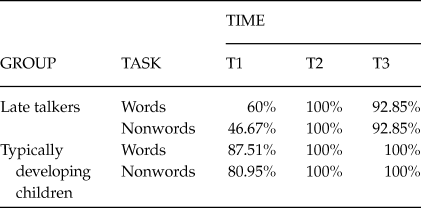
Longitudinal children’s participation (that is, children who were able to complete the task) was high. As Table 2 shows, by T2 and T3 almost 100% of the sample completed the task, including words and nonwords. However, at T1 the number of nonresponses was high. Typically, developing children failed to complete around 13% of the words and around 20% of the nonwords. In the late talking group, these percentages rose to 40% of words and 54% of nonwords that were not repeated.
Children’s Longitudinal Participation in the Word and Nonword Repetition Task

Overall task performance
A 2 (word status) x 3 (word length) x 3 (time) x 2 (group) repeated measures ANOVA revealed a significant effect for all main variables.
Regarding word status, words (M = 3.88) were repeated significantly better compared to nonwords (M = 3.16), F(1, 29) = 80.646; p < .001; η2 = .742.
The word length effect showed significant differences between 1, 2, and 3 syllable items, F(2, 29) = 84.221; p < .001; η2 = .750. Monosyllabic items were better repeated compared to disyllabic, 4.23 vs. 3.56; p < .001, and disyllabic items were better repeated than three-syllable items, 3.56 vs. 2.77; p = < .001.
The time effect revealed significant differences between repeating at T1, T2, and T3, F(2, 29) = 37.22; p < .001; η2 = .571. Repetition at T3 was significantly better compared to repetition at T2, 4.42 vs. 3.90; p = .047, and this was better compared to repetition at T1, 3.90 vs. 2.24; p < .001.
The group effect indicated significant differences between groups with different levels of productive vocabulary, F(1, 29) = 37.68; p < .001; η2 = .574. Late Talkers’ repetition accuracy was significantly lower compared to the typically developing children group’s performance, 2.44 vs. 4.60; p < .001.
In addition, analyses revealed no significant interaction between word status and group. This could be due to the high number of cases in the late talking children group who were not able to correctly repeat one single item at T1. Thus, we carried out another repeated measures ANOVA considering only two times (T2 and T3).
First, results revealed a significant interaction between word status and group F(1, 23) = 11.328; p = .002; η2 = .261. The difference between word, 3.64 vs. 5.26; p < .001, and nonword repetition accuracy, 2.61 vs. 4.94; p < .001, is significantly higher in the LT group, compared to the TD group.
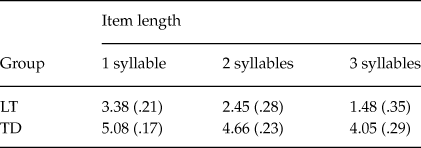
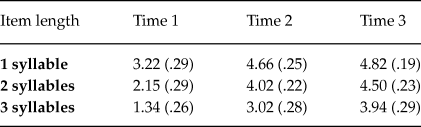
Second, there is a significant interaction between word length and group F(2, 29) = 7.568; p = .001; η2 = .213. The difference between 1, 2 and 3 syllable items is significantly higher in the late talking children group, compared to the typically developing children group (p < .001), as it is shown in Table 3.
Mean (and Mean Standard Error) of Correct Responses according to Group and Word Length

Third, there is a significant interaction between word length and time F(4, 29) = 3.264; p = .014; η2 = .104. That is, improvement with time in repetition abilities becomes more noticeable for longer items. For monosyllabic items, there is a significant difference in performance from T1 to T2, p = .004, but not from T2 to T3, p = 1.000. We found the same pattern for disyllabic items: improvement is significant from T1 to T2, p < .001, but it is not from T2 to T3, p = .221. However, in three-syllable items, improvement is significant from T1 to T2, p < .001, as well as from T2 to T3, p = .004 (see Table 4).
Mean (and Mean Standard Error) of Correct Responses in Word Length x Time Interaction

Time x Group, Word Status x Word Length, and Word Status x Time interactions were non significant.
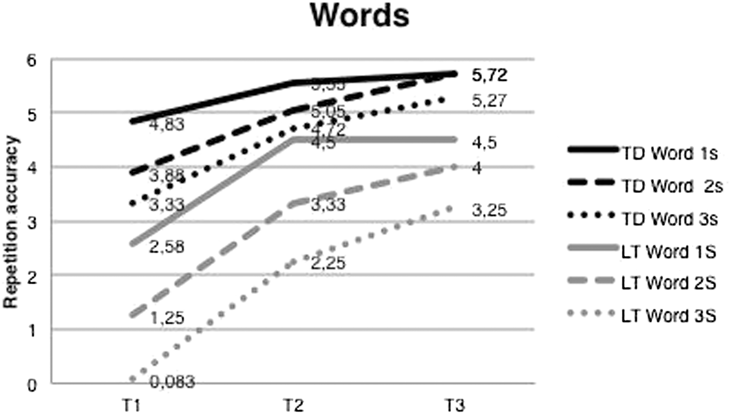
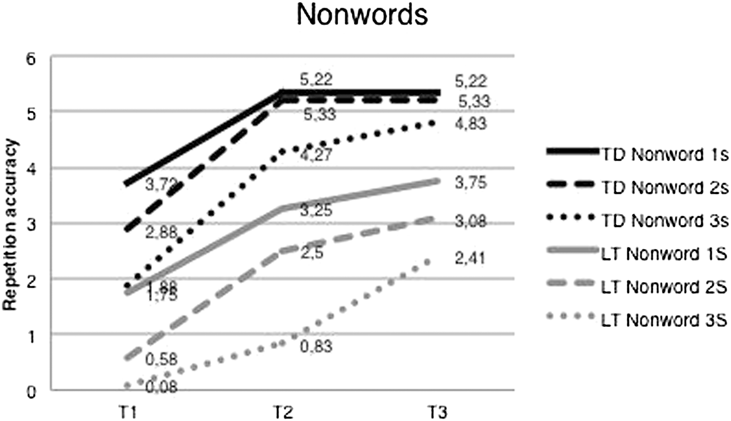
Finally, there is a significant triple interaction between word status x vocabulary x time F(2, 29) = 5.845; p = .005; η2 = .173. Pair wise comparisons show that for LT there are no differences between word and nonword repetition at T1, 1.30 vs. .080; p = .140. This is also the case for TD children at T2, 5.11 vs. 4.94; p = .321. It seems therefore, that for LT children repetition is hard at T1 even when they have to repeat words. Their performance increases from T1 to T2 and this improvement is greater for words compared to improvement for nonwords. By contrast, at T2, TD children can repeat words equally as well as nonwords.
Both for LT and for TD children, there is no difference in word repetition performance between T2 and T3 (3.36 vs. 3.91; p = .378 and 5.11 vs. 5.57; p = .356 respectively).
Figures 1 and 2 include word and nonword repetition performance (frequency of correct repetitions) for both groups across the study.
Word repetition performance (frequency of correct repetitions) for both groups across the study.

Nonword repetition performance (frequency of correct repetitions) for both groups across the study.

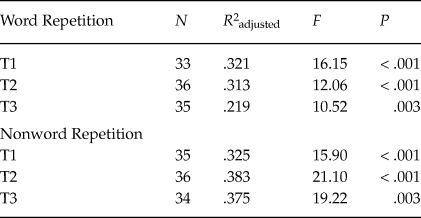
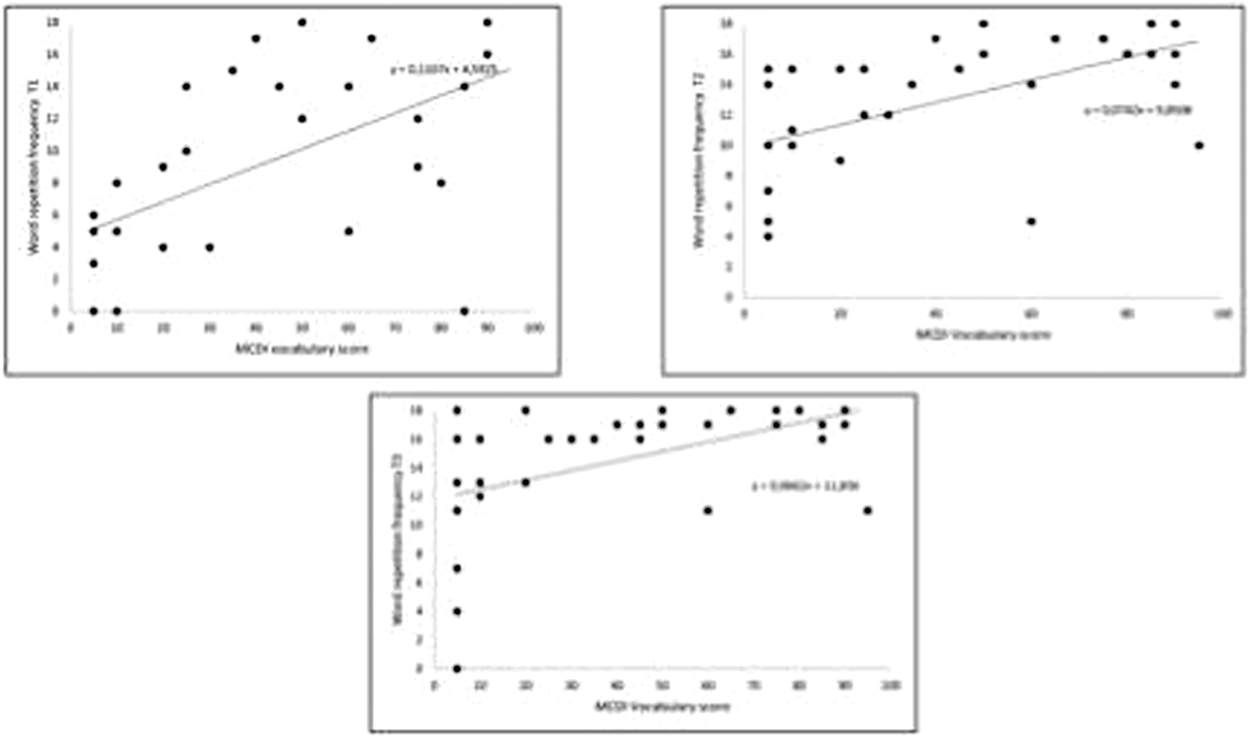
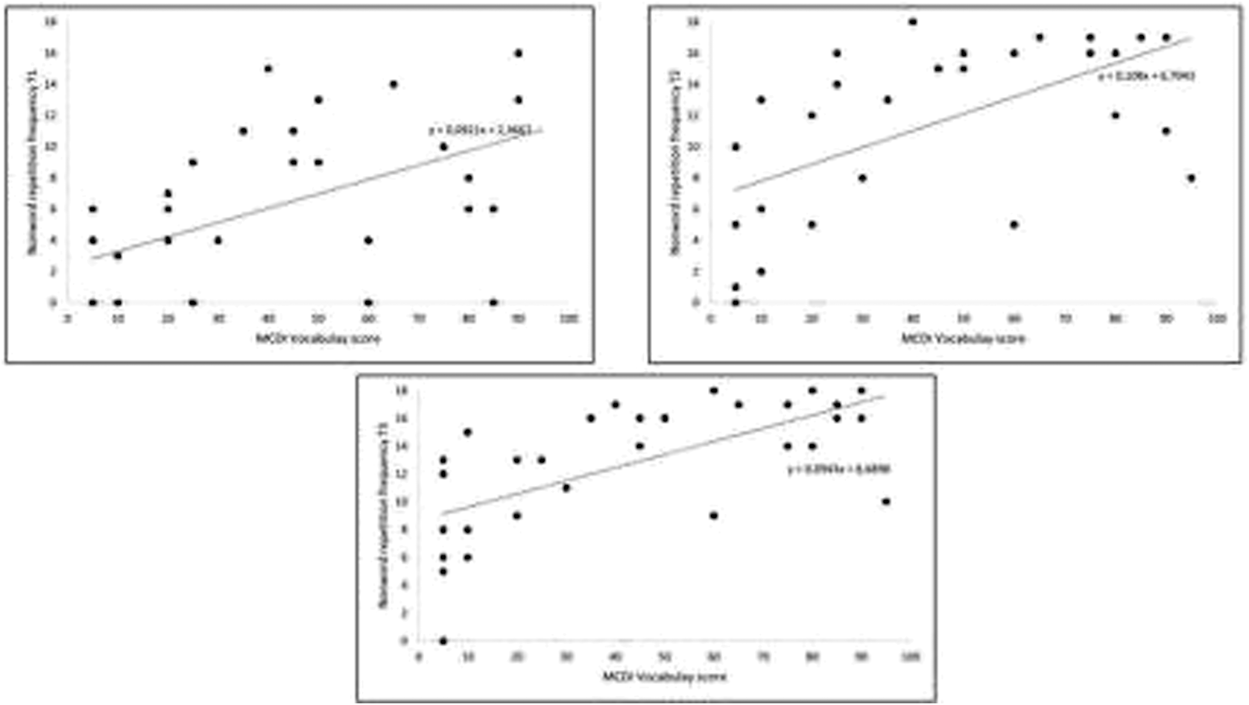
In order to explore the relationship between expressive vocabulary level and repetition abilities, we ran several linear regression analyses. We took word and nonword repetition scores at T1, T2 and T3 as dependent variables and MCDI vocabulary score as a predictor variable. As can be seen in Table 5, we found a positive and significant relationship between vocabulary development at 24 months and word and nonword repetition at T1, T2 and T3. These results suggest that vocabulary development is a good predictor of both word and nonword repetition abilities during the ages studied.
Results of the Regression Analyses with Non and Nonword Repetition as Dependent Variables and MCDI Vocabulary Score at 24 Months as Predictor Variable

Figures 3 and 4 show the scatter plots of word and nonword correct repetition frequencies by MCDI vocabulary score at T1, T2 and T3.
Scatter plots of word correct repetition frequencies by MCDI vocabulary score at T1, T2 and T3.

Scatter plots of nonword correct repetition frequencies by MCDI vocabulary score at T1, T2 and T3.

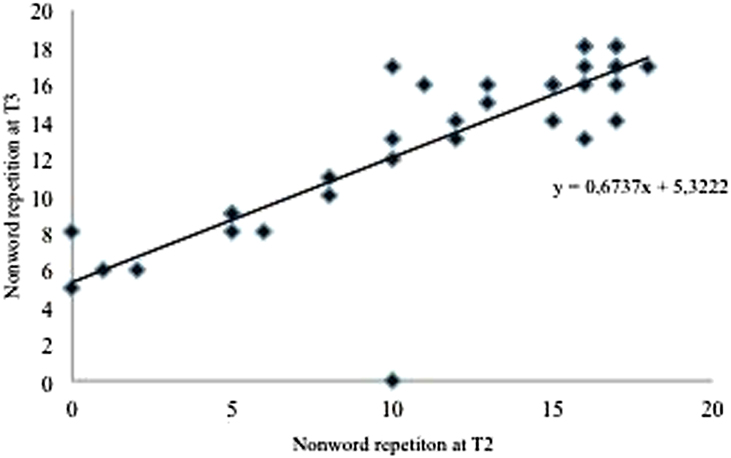
Previous studies found that early nonword repetition abilities are related to language development disorders even by school age (Coady & Evans, Reference Coady and Evans2008). Thus, we explored nonword repetition performance at T2 and its relation to of nonword repetition at T3.
We ran a simple regression analysis, taking nonword repetition performance at T3 as dependent variable and nonword repetition performance at T2 as a predictor variable. Results show a positive and significant relationship between variables. As can be seen in Figure 5, nonword repetition at T2 is a good predictor of nonword repetition performance at T3, R2 adjusted = .659; F(1, 32) = 64.73; p < .001.
Regression analysis: nonword repetition performance at T2 predicts nonword repetition performance by T3.

Discussion
The general aim of this work was to explore word and nonword repetition abilities in two-year-old Spanish-speaking children more deeply. Specifically we wanted to examine the role that different variables play in repetition abilities (i.e. word status and word length); whether these abilities change over time; and how vocabulary level and repetition abilities are related (i.e. if these repetition abilities differentiate late talkers from typically developing children and if early vocabulary predicts further repetition abilities).
In line with our predictions, results showed that word status and word length play a role in repetition accuracy. As has been stated in previous research, word repetition is easier compared to nonword repetition (Hoff et al., Reference Hoff, Core and Bridges2008; Roy & Chiat, Reference Roy and Chiat2004). This result has also been found in the Spanish language (Mariscal & Gallego, Reference Mariscal and Gallego2013). However, in this study we included a late talking children group in addition to a typically developing children group. Results point out that nonwords not only are harder to repeat correctly but that they are especially harder for children with lower expressive vocabularies (LT group). In addition, shorter items are repeated more accurately compared to longer ones: One syllable items are easier to repeat compared to two and three syllable ones; and two syllable items are easier to repeat compared to three syllable ones. This finding is similar to the one obtained by Mariscal and Gallego (Reference Mariscal and Gallego2013) with 34-month-olds. Roy and Chiat (Reference Roy and Chiat2004) reported a similar pattern for two to four-year-olds, even though their nonwords were somehow more different to words. Note that nonwords in our list were very similar to words, so the probability to activate lexical representations was high. Furthermore, the two interactions that we observed pointed out that longer items are especially hard to repeat for the late talking children, and that this length effect becomes weaker over time. Differences between one, two and three syllable items are larger in T1. Differences between one and two syllable items decrease in T2 and T3, while three syllable ones remain harder to repeat throughout the study. This result shows that 1) syllable length is a crucial factor for lexical development, and that lexical representations are not built in an all-or-none fashion. In fact, non-linear patterns show that other variables are also influencing these representations. 2) This nonword list is a useful tool for clinical purposes in early language development in the Spanish language.
Results also show that repetition accuracy improves from T1 to T2 to T3. Specifically, the more noticeable improvement occurs from T1 to T2. This could be due to the low scores that late talking children obtain in T1. At the age of 26 months, these children obtain low scores that seem to improve during the following six months. However, it is important to mention that even if repetition accuracy improves, scores in the late talking children group always remain lower compared to their typically developing peers.
As we mentioned in the introduction, previous research has stated a relationship between vocabulary and repetition abilities. Specifically, it has been found that repetition abilities can discriminate between language impaired and typically developing children by school age (Coady & Evans, Reference Coady and Evans2008). The results of our study are in the same line. First, we obtained a group effect, pointing out that late talking children’s repetition accuracy is significantly lower compared to that of typically developing children. Second, interactions between vocabulary level and word status, and vocabulary level and syllable length, revealed that word status and word length has an effect on the difficulty of the task particularly for the children with lower expressive vocabulary.
Even though there is not much evidence yet, it has already been stated that nonword repetition abilities discriminate between late talking children and typically developing children (see D’Odorico et al., Reference D’Odorico, Assanelli, Franco and Jacob2007 for Italian; see Stokes & Klee, 2009, for English). However, to our knowledge, this is the first time that it has been evidenced in the Spanish language, with children from two years old on, and longitudinally. In addition, results do not only show that early vocabulary levels predict repetition abilities, but also that these early repetition abilities predict further ones. This finding is especially relevant if we consider that difficulties in nonword repetition performance has been used as a clinical marker or at least as a warning sign of possible language impairments (Conti-Ramsden et al., Reference Conti-Ramsden, Botting and Faragher2001).
Results regarding participation provide evidence in the same line. In previous research with children aged 3 or below, Gathercole and Adams (Reference Gathercole and Adams1993) reported 50% of nonresponses; Hoff et al. (Reference Hoff, Core and Bridges2008) reported 22% and Chiat and Roy (Reference Chiat and Roy2007) reported 11,5%. In Mariscal and Gallego (Reference Mariscal and Gallego2013) only 3,8% of the total sample was not able to complete the task. In this sense, as our study includes longitudinal data, it slightly differs. If we only compare children below age 3, we find that there are important differences between groups. Typically developing children’s participation (that is, the number of children who completed the task, even though they made repetition mistakes) is high, even though they are young children. However, around half of the late talking children sample failed to complete the repetition task when they first face it, especially when it includes nonwords. Therefore, we can conclude that repetition tasks are useful tools to test very young children but that if these children show low expressive levels of vocabulary the task becomes harder to complete, which is itself a finding of the present study that is related to variability during early stages of language development (Fenson, et al., Reference Fenson, Bates, Dale, Goodman, Reznick and Thal2000). We consider this to be an important finding as it can be used as an early diagnostic sign in clinical contexts.
Participation rates also raise questions about deeper interpretation of children’s repetitions in different languages that are activating underlying mechanisms (Gathercole, Reference Gathercole2006). It seems clear that they are useful tasks and fair predictors of later lexical development. The reasons why late talking children are reluctant to participate remain unclear, as well as the knowledge that is activated during nonword repetition during earlier stages of development.
The findings in this study bring new evidence regarding word and nonword repetition abilities in Spanish language speaking late talking and typically developing children. To date, there is a great amount of research in this area that has been carried out in other languages such as English (Chiat & Roy, Reference Chiat and Roy2007; Stokes & Klee, 2009) or Italian (D’Odorico et al., Reference D’Odorico, Assanelli, Franco and Jacob2007). In the Spanish language, Mariscal and Gallego (Reference Mariscal and Gallego2013) and Ebert et al. (Reference Ebert, Kalanek, Cordero and Kohnert2008), only tested typically developing children. Aguado et al. (Reference Aguado, Cuetos-Vega, Domezáin and Pascual2006) included a language-impaired sample but children were 5 to 6-year-olds. In addition, this is the first study carried out longitudinally, considering the aforementioned variables.