Introduction
In July 1900, a public hearing took place in Dublin over the city's plans to absorb a number of independent suburban townships that had hindered municipal expansion for decades. As is often the case, the suburbs in question resisted vigorously. Somewhat exasperated, legal counsel representing the city exclaimed that the suburbs reacted as if it were ‘Savoy and Nice, or the Philippines being handed over to the United States. . .It was not a case of the townships being governed as a Crown colony under annexation. The rule would be mutual.’Footnote 1 In his reference to sovereignty and colonization the speaker had, perhaps inadvertently, touched on the central issue at stake. Which country would the residents of the newly annexed districts belong to, Britain or Ireland? Dublin was, at this time, a provincial city within the United Kingdom; its citizens were governed by British law and the municipal and suburban councils all operated under legislation issued from Westminster. But two distinctly different identities had evolved in the city and the surrounding suburbs: membership of the municipal council was overwhelmingly Irish nationalist and Catholic, while the suburban councils had a stronger sense of British identity, endorsed unionist politics and contained many more Protestant members. Despite their shared United Kingdom framework, and the merely administrative nature of the proposed change, the energy behind suburban resistance was surprisingly intense and enduring. For Dublin city hall to take over the administration of the suburbs, or to ‘annexe’ them as the suburban opponents termed it, would mean a profound change in the suburbs’ sense of connection with the state, challenging long-held political assumptions and, they claimed, threatening the Union itself. This article argues that it was these questions of identity politics which fuelled opposition to a ‘greater Dublin’ and, furthermore, that this local dispute has wider significance for urban historians, and historians of Irish and British history, than has previously been recognized.
The Local Government (Ireland) Act, 1898, had radically transformed the situation by bringing Irish councils into line with those in Britain. In an effort to divest itself of the increasingly complex requirements of modern urban life, Westminster had already modernized municipal government in Scotland, England and Wales, streamlining its functions, widening the franchise and greatly enhancing its financial and administrative powers.Footnote 2 Between the 1898 act and the last peace-time local elections in 1914, therefore, a near-uniform municipal government regime operated across both islands of the United Kingdom.Footnote 3 As R.J. Morris has argued, this growth and reform of municipal government and centre–local relationships allows new questions to be asked,Footnote 4 thus an examination of the urban district councils’ (UDCs’) behaviour on either side of the Irish Sea suggests interesting arguments about the role cities played in the identity politics of the United Kingdom.
The role of the city in modern Irish history has recently begun to receive wider scholarly attention. In particular, the urban experience reveals much about the operations of politics and society in the pre-revolutionary era, and in the establishment of both new Irish states.Footnote 5 Viewed from the sub-discipline of urban history, however, the Irish experience appears comparatively infrequently in academic research.Footnote 6 This is understandable given the twin successes of the Gaelic Revival in branding the ‘real’ Ireland as a pastoral landscape, and the Land War of the 1880s in presenting the people as discontented peasants. But the Irish municipal government reforms introduced by Westminster in 1898 had far-reaching effects, inadvertently enabling councils to function as platforms for an anti-state civil society. In exploring the link between elected councils and civil society in Ireland, this research has implications for studies on centre/periphery power structures far beyond Dublin's disputed boundaries.
This article begins by adopting a working definition of civil society, establishing the importance of municipal government in people's daily lives, and examining relevant theoretical approaches by Norton E. Long, Graeme Morton and R.J. Morris to the relationship between civil society, urban government and the state. It will then set out the particular social and political environment in Dublin at the start of the twentieth century, before considering the projection of national identity by municipal councils in Edinburgh and Dublin, two ‘deposed capitals’, in the light of these theories. Municipal behaviour in Edinburgh provides useful insights for understanding the emergence of two distinct civil societies in Dublin, and it points towards the significance of municipal government and nationalist civil society in the revolutionary period in Ireland (1912–23). The primary conclusion is that a unitary definition of civil society is not useful in the Irish context, where two divergent civil societies, and opposing national identities, competed for supremacy. Significantly, this points to the broader relevance of urban government to our understanding of Irish nationalism, and of the tensions within the United Kingdom during the ‘urban reform’ era.
Civil society, city and state – theoretical approaches
Existing scholarship on urban government and civil society has proved useful in understanding the situation in Dublin city and suburbs. In 1969, Norton E. Long, a noted writer on urban politics and administration, considered the role of Canadian municipal government in linking the people and the state.Footnote 7 Based on Aristotle's writings, Long described how we all strive for the ‘good life’ both as individuals and communities. In communities, this ‘good life’ can be described as the ‘common interest’; for example, neighbours might work together to improve the appearance of their area, or villagers may cooperate in fundraising activities to support a local health facility. Above this local arena, the state becomes necessary for the pursuit of the ‘good life’ at a higher level. Only the state can fulfil certain roles such as defending against foreign attack or resolving disputes between communities. In Aristotle's ideal state, the individual, the local community and the state all have the same ethos: a shared understanding of their ‘common interest’ or ‘good life’. Thus, the local community would be ethically articulated with the state and local councils should share the ethos of the state.Footnote 8 There should also be a legal framework tying the state and local council together; a medieval city charter or modern municipal government legislation exemplify this instrumental articulation, as Long terms it.
More recently, Graeme Morton refined the analysis of the classic Victorian philanthropic model of civil society by arguing that a symbiotic relationship exists between it and the state. The state needs the cooperation of civil society if it is to function smoothly, and civil society needs the state if it is to prosper and grow. He argued that an exchange occurs between the two: the state first acknowledges the rights and interest of local community groups in their own areas of expertise – a process he calls enshrinement.Footnote 9 The state then gives these organizations some power; for example, parliament established the Glasgow Police Board in the mid-nineteenth century and invited representatives of the local community to serve on the Board – this Morton describes as empowerment. In exchange, civil society collaborates with the state effectively granting it legitimacy. Thus, civil society underwrites the orderly functioning of state.
A key feature of Morton's argument is that elected municipal government is the link between civil society and the state. Arguing that an appreciation of civil society allows for a better understanding of local political structures, his analysis relies on the mediating role of municipal government between state and civil society: ‘Civil society is sustained through communication and association, but it succeeds because of its self-administration from the municipality.’Footnote 10 In essence, the exchange between the state and civil society takes place in the town hall.
Since the early 1990s, a great deal has been written about civil society, by political scientists, sociologists and historians, so it is necessary to adopt a working definition which will inform the argument. Bronwen Dalton's useful synthesis of historical and contemporary uses of the term examines many definitions, the one selected here is based on that developed by the London School of Economics’ (LSE) Centre for Civil Society:Footnote 11
Civil society refers to the arena of voluntary collective action around shared interests, purposes and values. Its institutional forms are distinct from those of the state, family and market, though in practice, the boundaries between these are often complex and blurred. Civil societies include registered charities, community groups, women's organisations, faith-based organisations, professional associations, trade unions, self-help groups, social movements, business associations, coalitions and advocacy groups.Footnote 12
While acknowledging the challenges involved in using civil society as a concept, in particular the difficult question of whether to include political organizations within it, Dalton argues that the lack of a universally agreed definition is reassuring, reflecting as it does the open, discursive, contentious and dynamic nature of civil society itself.Footnote 13 In the definition above, class plays a significant role, with the middle and upper classes dispensing assistance to worthy members of the lower orders. Volunteers in such organizations, therefore, came into contact with a wider social milieu than they would in their habitual ethnic or religious networks. In theory at least, this interweaving of social groups should have a stabilizing effect, as Alexis de Tocqueville wrote about civil society in the young United States: ‘there is no surer guaranty of order and tranquillity, and yet nothing is more difficult to create’.Footnote 14
Having reviewed the various ways in which researchers and commentators have deployed the concept of civil society, Dalton divides them into two groups – those who present civil society as a collaborative, supportive force and those who see it as an oppositional force (or, to use her evocative shorthand, the ‘Countrywomen's Association’ and ‘Solidarność/Solidarity’). The former understands civil society as encouraging trust and reciprocity, leading to citizen engagement with society and the state; the latter sees civil society as a counterweight to an authoritarian state and is thus a driver of regime change, as occurred in Communist Poland during the 1980s.Footnote 15
Despite outward appearances, in the context of late nineteenth-century Dublin the collaborative, supportive model of civil society with its beneficial mixing of social milieux does not apply. But neither does the oppositional model adequately describe conditions. The situation was more complex, for each voluntary group in step with the state there was another organization hoping for regime change. In short, Dublin had two civil societies, or two pillars within its civil society.
Originating among Dutch and Belgian historians since the 1950s, the concept of ‘pillarization’ has been the subject of much debate, with some commentators arguing that its use should be limited to the specific local and regional politics in these two national contexts.Footnote 16 As with ‘civil society’, a number of possible definitions exist, the most appropriate being from R.J. Morris’ 2006 article on civil society and associational culture. Here, Morris describes a process, evident in Germany in the late nineteenth century, in which networks of social groups and associations coalesced into different groupings, producing a civil society composed of discrete pillars: ‘There was a tendency to pillarization’, he wrote, ‘as Catholics, Calvinists, socialists as well as the liberals created contending networks of associations.’Footnote 17 This is a useful lens for studying the situation in Dublin, where the anti-Catholic penal laws and ‘Protestant Ascendancy’ of the preceding centuries had left deep sectarian and socio-economic divisions analogous to those in Germany.
The present article combines elements from Long's and Morton's theories to create a model for understanding the evolution of Dublin city and suburbs in the early twentieth century; the exchange between the state and civil society (enshrinement, empowerment and legitimization); the mediating role of municipal government in linking civil society to the state; and, finally, the need for instrumental and ethical articulation between the state, municipality and local communities. Morris’ concept of distinct pillars within broader civil society is used to account for the divergent attitudes and behaviour seen in Dublin.
Dublin's historical and political context
During the prosperity of the eighteenth century, Dublin was governed by a small Protestant elite. This group remained in power during the Act of Union in 1800 and through the ensuing political, economic and social decline until the 1840s. Following English and Welsh municipal reforms in 1835, legislation was introduced for Irish cities, broadening the franchise to empower the rising Catholic merchant class.Footnote 18 Immediately, urban and national concerns were conflated. Supporters saw the reforms as completing the process of Catholic emancipation and strengthening the Union by allowing Irishmen full access to British institutions. A Tory opponent, however, warned that the reforms would empower Irish Catholics to create ‘a Parliament assembled in College-green [site of the pre-Union Irish parliament], without the nuisance. . .of a second Hereditary Chamber’. This meant that Dublin municipal council would become a school ‘for treason and rebellion, the last fatal symptoms preceding the dissolution of the Legislative Union between the two countries’.Footnote 19 The 1840 legislation was diluted in the House of Lords, the powers of reformed Irish corporations were strictly defined and control of policing specifically excluded.Footnote 20 Nonetheless, Dublin's Catholic majority soon controlled the municipal council, producing a political arena which felt hostile and alien to the Protestant minority. They responded by creating the new self-governing townships of Rathmines and Pembroke to the south of the city, beyond the reach of the municipal council, where they could live and govern in a manner more suited to their social, political and religious preferences. In common with most cities of the period, this suburban expansion was stimulated by a range of factors such as improving standards of housing, concerns about health and sanitation, and developments in public transport. However, as the subsequent social and political character of Rathmines and Pembroke strongly suggest, changes to the municipal environment in the 1840s were more than merely coincidental. Using the 1840 act, the residents and developers of Rathmines established Rathmines Township in 1847. It was founded in a compact area within a single parish, allegedly for ease of administration. However, this clever use of the new act allowed the formation of a tightly defined zone of valuable housing from which poorer areas were carefully omitted, for fear of the burden they would put on the rates.Footnote 21 Other suburbs soon followed, though perhaps not with the socio-economic precision of Rathmines; these included Pembroke (1863), New Kilmainham (1868), Clontarf (1869) and Drumcondra (1878).
Like suburbs elsewhere, they were distinguished by varying levels of prosperity and social cachet. Rathmines and Pembroke to the south were the most socially elevated, Clontarf to the north-east was semi-rural and respectable. These three shared clear unionist political leanings, their populations included more Protestants than the other suburbs and far more than in the city. North of the city, Drumcondra was a speculative development aimed at middle-income white-collar Catholic clerks and self-employed tradesmen. Kilmainham, to the west, was an industrial district centred on the railways and coach-building works, its residents included skilled craftsmen and specialists from Britain, many of whom were dissenters or free-thinkers in both religion and politics. When compared with these modern, prosperous and healthy suburbs, the city was seen as poor, overcrowded and decayed. Figure 1 shows the encirclement of the city by these independent suburbs. The apparently vacant region to the north-west contained the expanse of the Phoenix Park, while that to the south-west belonged to County Dublin, another administrative region resistant to the city's ambitions.
Dublin city and its independent suburbs, 1890

In the period under examination, the late 1890s and first two decades of the twentieth century, the connection between an individual and their town hall was at its most pervasive. Municipal government really mattered, and new legislation in 1898 dramatically increased its significance in the Irish context. At a meeting of the Association of Municipal Authorities of Ireland in 1913, the Honorary Secretary Mr R. Finlay Heron delivered a paper on ‘An Urban Councillor, his duties and responsibilities’ in which he described the extensive powers of urban councils:
They had the administration of the complicated provisions of Public Health Acts, Acts relating to the housing of the working classes, notification of tuberculosis and other preventable diseases, provision of bath and wash houses, play grounds, public parks, open spaces, technical instruction, public libraries, markets, the Small Dwellings Act; the supply of gas, electricity and water, the maintenance of the public highways, prevention of pollution to streams, inspections of weights and measures and of factories, employment and attendance of children at school, provisions of the Shop Hours Act, storing of explosives, carrying out of the Contagious Diseases Act, Food and Drugs Act, Old Age Pensions. . .regulations in regard to cinematographic exhibitions and numerous other duties.Footnote 22
Some councils sought additional powers, in the form of Private Parliamentary Bills, to improve local infrastructure and expand their services still further. The nature and variety of these services, and the greatly expanded local franchise, created a surprisingly intimate bond between the people and their council. In an era of growing associational culture, local clubs and societies engaged with their town hall in a variety of ways, from requesting the use of a space for a fundraising bazaar to sending a deputation calling for improved road-sweeping. The breadth and depth of this relationship meant that the town hall became the arena in which local civil society expressed its values and identity. With their enhanced democratic mandate, Dublin's independent suburban townships operated like mini-states, but with a more intimate connection to their electorate. This sense of connection, and the perceived inefficiency of Dublin's municipal council, were obstacles to the city's ambitions to absorb the suburbs within its boundaries.
Home Rule within the empire was the dominant issue in Irish politics since the 1880s and the policy was the guiding star of the Irish Parliamentary Party (IPP). This ambition enjoyed widespread support and its representatives held sway on most Irish municipal councils. Outside of unionist north-east Ulster, the Dublin suburban townships of Rathmines and Pembroke were rare bastions of opposition to Home Rule. Sinn Féin, which began its electoral existence as a small but increasingly influential group of radical separatist city councillors, also opposed the IPP's Home Rule policy, but on the grounds that it did not go far enough. In a bitter political atmosphere, the Home Rule Act was passed in 1914 and immediately suspended due to the outbreak of war.Footnote 23 The Easter Rising of 1916, as well as the state's response, transformed municipal politics in Dublin and began the radicalization of many moderate nationalists. In the 1918 general election, and during the Irish War of Independence (1919–21), Sinn Féin emerged as the representatives of an underground revolutionary Irish state. Both the origins of this radical separatism, and the relationships between Dublin's municipal council, local civil society and the two states, are at the heart of this article.
Annexation
Like many cities in the period, Dublin was keen to expand its municipal boundaries to address a number of pressing problems. The city's chronic poverty and severe overcrowding created some of the worst slums, and highest rates of infant mortality, in Europe.Footnote 24 An official report from 1894 noted that ‘One third of the people of Dublin live in single room tenements in which they eat, drink, cook, sleep and often carry on their work for a living.’Footnote 25 The city's finances were insufficient to address the problem. The poor housing stock yielded lower taxes than those collected in the more prosperous suburbs. After prolonged efforts, and despite vocal opposition, the townships of Drumcondra, Clontarf and Kilmainham to the north and west were incorporated into the city in 1901. While this failed to satisfy the city, it stiffened the resolve of the two southern unionist suburbs to remain independent.
To increase municipal revenue significantly, the large villas of Rathmines and Pembroke would need to come under the city's control. However, these two prestigious townships conducted an energetic, expensive and ultimately successful parliamentary defence against the nationalist, Catholic and – as they saw it – inept and corrupt municipal council. Rathmines led the resistance with admirable political dexterity, although occasionally its attitude bordered on the paranoid. In 1871, for example, the municipal council constructed a major water main from its new reservoir in the hills to the south of Dublin through the southern townships to the city. Pembroke, with its strongly Protestant and loyal council, negotiated a water supply at a favourable rate. In contrast, Rathmines insisted on constructing an entirely separate reservoir and mains system to carry canal-water to the township, despite the presence of the new Dublin mains beneath its streets.Footnote 26 Protecting local independence was among the reasons offered for this expensive choice.Footnote 27 Common sense, economic logic and a Royal Commission (the Exham Commission) all argued for a unified Greater Dublin authority.Footnote 28 However, despite the hopes and fears of the city and suburbs, the situation remained that ‘only Dublin in all of Ireland had this particular combination of independent townships abutting a city’.Footnote 29
With the introduction of the Local Government (Ireland) Act, 1898, the suburbs feared that their independence might be carried away on a tide of reform. Annexation was the key topic of debate in the electoral campaigns for the new urban district councils which the act created, overshadowing the stock-in-trade suburban concerns of clean streets, low rates and fiscal rectitude. Opponents complained of higher taxation under municipal rule, but national politics lay behind such local concerns.Footnote 30 The unionist Irish Times described Dublin council's ‘rampant intolerance and grievously higher taxes’. Anxious about the survival of the Union with Great Britain, the editor claimed that the real purpose of annexation was to create Greater Dublin as a ‘Home Rule nest’.Footnote 31 The unionist councils were defended in Westminster by the House of Lords and the Conservative Party, where even the debate over the wide-ranging national reforms of the radical new act could not drown out the dispute over Dublin's local boundaries. Presenting the Bill in the Commons the Irish chief secretary, Gerald Balfour, outlined one of its key benefits: ‘It is extremely desirable for the system of Local Government which we propose to create, that there should be no unnecessary administrative areas; and, secondly, that overlapping of administrative areas should be reduced to a minimum.’Footnote 32 The first question put to the chief secretary was from Edward Carson, member for Dublin University and a prominent Irish unionist, who asked, ‘What happens in the case of townships?’Footnote 33 Despite his earlier comments on the need for more efficient administrative units, Balfour reassured Carson that the townships would remain independent. When a nationalist MP recalled the recommendations of the Exham Commission in favour of annexation, and threatened to amend the Bill in committee stage, the chief secretary made no response and the debate concluded. Dublin's strenuous efforts to absorb its southern neighbours failed. Despite local negotiations, parliamentary support and an official report, two townships sitting on the municipal boundary continued to block the city's urgent need for space and additional tax revenue. Straightforward considerations of building space and finances were less important, apparently, than more complex issues of identity. It is not the local political strategies of boundary expansion or the intensity of the resistance that are the central focus here, but rather their role as symptoms of strained centre–local relationships and broader identity issues.
Having set out the situation on the ground at the turn of the century, we can apply the combined theories of Morton and Long to the situation in and around Dublin – but first a word of explanation about the illustrative framework to be used. While Dublin's electoral and identity politics took place in an Irish context, the city operated in a wider United Kingdom legislative context. Dublin was a provincial city within the UK, which meant that its residents and councillors were aware of developments across the two islands. The municipal and suburban councils compared their policies and practices with those of Belfast, Birmingham, Glasgow and Edinburgh, corresponding with these and other councils on housing and employment contracts, supporting their petitions on electoral reform and receiving their delegates at council meetings.Footnote 34
Edinburgh's historical and political context
The Scottish experience is particularly relevant. Scotland was governed by the same parliamentary structures as Ireland, and reforms in Scottish municipal government legislation in 1889 and 1894Footnote 35 informed the thinking behind the Irish reforms of 1898.Footnote 36 Furthermore, like the Irish the Scots had a strong sense of their own national identity. However, important differences must also be acknowledged. During the nineteenth century, Scottish identity had not crystallized into a unified form, as Gaelic Irish identity had done. Nineteenth-century ethnographers claimed ancestral links between Lowland Scots and the Saxon tribes which settled in southern Britain, while the Gaelic ancestry of Highland Scots marked them out as less suited to the modern industrial age.Footnote 37 This produced a more complex relationship with the Union, in which Britishness reflected a shared Teutonic heritage and Highland identity became a sentimental performance rather than a coherent political nationalism. The origins of urban life in Scotland were also different. Scottish burghs had evolved along different lines from Irish towns and cities, since many were founded by Scottish royal charters which preceded the Union of Crowns in 1603 or of Parliaments in 1707. Since the fifteenth century, the Convention of Royal Burghs had represented the mercantile interests of Scotland's major towns and cities, giving them a corporate voice in national affairs.Footnote 38 Irish town charters, in contrast, were all the product of Norman, or later English, administrative policy, and Irish towns did not act co-operatively until the twentieth century.Footnote 39 Structural and operational differences also existed; Ireland had no parish councils and Scottish burghs had responsibility for their local constabulary, a duty removed from all Irish councils by the end of the nineteenth century.Footnote 40 Dublin had a metropolitan police force paid for out of local taxes but the council had no role in its operation; Belfast's town police force, which had been controlled by the local council, was disbanded in 1864,Footnote 41 therefore all Irish policing was administered centrally from Dublin Castle. But reforms were creating greater similarity in the operations of municipal government in Scotland and Ireland. The introduction of the Local Government Board for Scotland in 1894 removed earlier differences in state supervision. This echoed the structure of the Local Government Board for Ireland, which was established in 1872 and reformed in 1898.Footnote 42
Scotland, like Ireland, had its political and social divisions. Scots enthusiastically seized the valuable opportunities provided by the Union and empire. As the empire expanded, ‘not only engineers but also soldiers and administrators came disproportionately from Scotland’.Footnote 43 However, this British and imperial enthusiasm obscures emerging divisions. In the mid-1840s, during the Disruption of the Church of Scotland, those who favoured maintaining the established church gravitated towards Liberal Unionism.Footnote 44 So too did Orangemen in Glasgow, where local politics were coloured by Irish issues and Irish sectarianism. Partly in response to anti-Catholic sentiment and sectarian disorder in the 1850s and 1860s, urban Scotland's large Irish Catholic community formed their own institutions of civil society, pursuing separate communal activities, forming their own church halls, clubs and associations divorced from the Scottish working class but still loyal to the British state. This could be defined as a Scottish example, or an extension of the Irish model, of pillarization.Footnote 45
The debate surrounding Gladstone's Irish Home Rule Bill of 1886 strengthened the Liberal Unionists, and Scotland – a one-party state since the 1830s – underwent a political division along ideological and ethnic lines.Footnote 46 By the 1890s, a competitive two-party system emerged, with unionist strength most evident in Edinburgh and the more prosperous urban areas.Footnote 47 At the formation of the Scottish Home Rule Association in 1886, Edinburgh's lord provost, Sir George Harrison, had argued that ‘there ought to be more than one national life in the British nation’.Footnote 48 Rather than a call for separation, this was an expression of Scottish unionist-nationalism. While Scottish domestic politics were not monolithic, and debates took place over the nature of the Union, it is Edinburgh's unionist municipal identity and the city's relationship with the state which are of significance here.
Although, at first glance, Edinburgh may not seem comparable to Dublin in its economy, location or culture, the two cities shared some important features. Both were ‘deposed capitals’, to borrow Mary Daly's phrase, and thus played a significant symbolic role in their respective national identities. Both cities were home to national administrative offices, company headquarters and cultural institutions. Along with their parallel symbolic and cultural roles, the cities’ economic and occupational profiles were quite similar. Like a more successful version of Dublin, in 1911 Edinburgh ‘had a well-developed service economy. . .with domestic service sustaining the city's largest category of female employment. The capital was home to lawyers, the real estate and finance industries, and large groups of workers engaged in printing and publishing. . .and food production.’Footnote 49 Crucially, from 1898 Dublin and Edinburgh councils had similar administrative structures and a common legal relationship with the state. Fulfilling Long's theory, they were instrumentally articulated with the state in the same way. With due regard to regional differences, therefore, events in Edinburgh can usefully inform our understanding of the situation in Dublin.Footnote 50
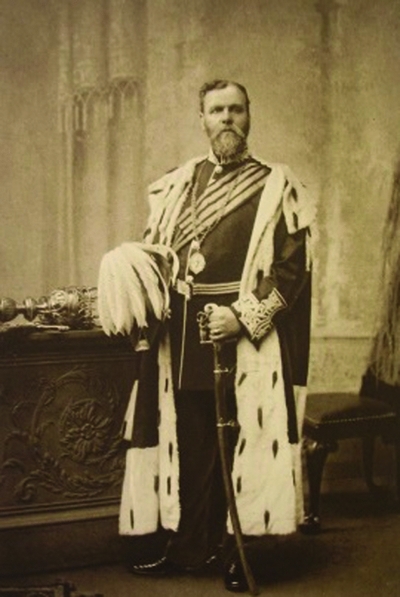
In 1896, the lord provost of Edinburgh laid the foundation stone for the new North Bridge in an impressive display of civic pageantry, which encapsulated the relationship between civil society, the city and the state. The commemorative publication which the city produced shows that freemasonry was an essential expression of Edinburgh's civil society, and a hundred lodges marched from the old Scottish parliament house to the bridge where a masonic ritual was conducted. The relationship between the three elements was neatly embodied by Lord Provost Andrew McDonald, who wore ‘the handsome uniform of the Lord Lieutenant of the City [the Queen's representative] with cocked hat and plumes, his clothing as a member of the Masonic Craft, and his official robe as Chief Magistrate of the City’Footnote 51 (Figure 2). So on this one individual the symbols of state, city and civil society were all arrayed. Council policy demonstrated that Edinburgh's municipal government was ethically articulated with the British state, that it shared the United Kingdom's vision of the ‘good life’. Civil society in Edinburgh was actively promoted by the city council. Through a fund called ‘the Common Good’ the council promoted the city's image and reputation and encouraged the involvement of its citizens in civic life. The council supported civil society by donating small sums to quite humble local societies: horticultural associations, dog-breeders’ and bird-watchers’ clubs, amongst others. It also funded prizes for agricultural and Highland associations, thus promoting the Scottish economy, national consciousness and cultural identity. However, this was never perceived as a threat to Edinburgh's, or Scotland's, place within the Union.Footnote 52 The Common Good fund also sponsored sports prizes for the army and navy, and the military played an important commercial role in municipal life. While not an element of civil society, this military sporting and social activity was encouraged by the council, demonstrating the comfortable relationship between the city and the state. With a confident sense of its Scottish heritage and municipal independence, Edinburgh's civic identity was neither threatened by, nor at variance with, its British identity. The council used the global prestige of the British empire to promote the city's standing internationally, attracting major conferences to town. British and international scientific associations, trade unions and police federations were persuaded to choose the Athens of the North for their annual meetings.Footnote 53
Lord provost of Edinburgh, Andrew McDonald, in his lord lieutenant's robes and civic regalia.

But Edinburgh was not a mere agent of Westminster. The city was able to stand up for its rights and large sums were spent on parliamentary lobbying. Bills affecting the city's boundaries and jurisdiction received the greatest effort and significant investment as these related directly to municipal revenue and autonomy. The city joined with other Scottish councils in 1891 to lobby the chancellor of the exchequer on the appropriation of Scotland's share of the budget surplus. However, ‘antagonism between Edinburgh and London [cannot] be explained as an expression of some emergent Scottish nationalist fervour. . .Edinburgh continued to relish its imperial and international status’.Footnote 54 The royal family's fond regard for Scotland produced a reciprocal affection and the city eagerly celebrated frequent royal visits. Embracing its place in the empire, Edinburgh granted the Freedom of the City to colonial governors of Scottish extraction.
Here we see the ideal relationship in action. The city's civil society shared the ethos of the state and co-operated willingly with it through the mediation of its elected municipal council. The council promoted local voluntary organizations and performed civic pageantry which highlighted Scottishness, while simultaneously endorsing an overarching British identity. At one end of the scale, the council made grants to local clubs; at the other, its members celebrated the city's royal connection. The city's municipal government successfully linked civil society and the state, to the benefit of all parties. Thus Edinburgh engaged in Morton's exchange with the state; it also exemplified the instrumental and ethical articulation described by Long. The city council acted as a supple articulated joint enabling a distinctly Scottish identity within the legal powers delegated to it from Westminster.
Dublin: civil societies, municipalities and the state
Why, then, was Dublin so different? Like Edinburgh, Dublin had many local clubs and societies, it experienced occasional royal visits and had numerous army barracks for the city council to engage with, yet there was never the same easy relationship between city and state. The problem was that Dublin had two civil societies, which were in competition with one another. One was unionist, suburban and predominantly Protestant. This civil society shared the United Kingdom's vision of the ‘good life’ and was linked to the state through the mediation of its own local councils. The other civil society was nationalist, Gaelic, based in the old city and predominantly Roman Catholic. It had a different ‘good life’ in mind, one that the state could not provide for it. Instead of being a flexible link between two entities that wished to act in unison, Dublin city council had the problem of linking a nationalist civil society to a unionist state. Rather than being the forum for Morton's exchange between the state and civil society, Dublin city hall was an arena for disjuncture and conflict.
Civil society comprises a range of organizations with different, and potentially conflicting, aims which, broadly speaking, share a common ethos. However, if a critical mass of organizations gravitate away from the mainstream, social consensus is weakened. As Morris points out, groups within civil society could create ‘contending networks of associations’.Footnote 55 He notes, for example, the existence of an independent Catholic pillar in Germany, separate from the dominant, state-aligned, Protestant civil society of the period. The metaphor of a ‘pillar’ may be too passive to describe Dublin's contending or competing forces. Pillars usually share the burden of supporting a single superstructure, whereas Dublin's disparate civil societies did not seek to support the same state. Morris also argues that the repression which followed 1848, the year of revolutions in Europe, impeded the growth of civil society on the continent. This was countered in the 1860s and 1870s by the ‘explosive rise of subscriber democracies across Europe’. In contrast, he states that the ‘British experience was distinctive in several ways’. In Britain, the emergence of ‘subscriber democracy, a form of association characterized by openness and transparency’, was ahead of that in Europe.Footnote 56 Does Ireland, with its tradition of insurrection and oppression – and its own minor outbreak of revolution in 1848 – fit the European model more closely than the British one? It can be reasonably argued that it does, and that a form of European ‘pillarization’ evolved within Dublin's civil society. The evidence for this assertion is based on three criteria: the religious profile of the general population and their elected councillors; the sectarian identity of many charities and associations; and the level of engagement with cultural nationalism among elected councillors.
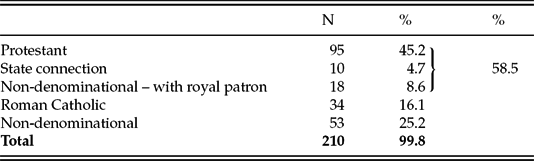
Turning to the first criterion, there is a marked difference in the proportion of Catholics and other Christian denominations, between the populations of the city and suburbs (Table 1). The disparity is even more pronounced when taking into account the religion of local councillors in the region's town halls. Catholics accounted for 81.7 per cent of the city's population and 85.7 per cent of its councillors. Outside the city non-Catholics accounted for 37.6 per cent of the population but 55.9 per cent of all councillors.Footnote 57 The difference in religious demographics between the city and independent suburbs is echoed in the composition of local voluntary organizations, which are taken here as a proxy for civil society or subscriber democracy more broadly. Published annually, Thom's Official Street Directory of Ireland carried lists of ‘charitable and benevolent societies’. These entries named each organization's trustees or board of directors along with any honorary patrons. In many cases, the denominational identity of a voluntary organization can be determined from its name, as with the Society of the Blessed Virgin Queen of Heaven and the Catholic Young Men's Society, or the Retreat for Respectable Protestant Poor and the Hibernian Auxiliary Wesleyan Methodist Ministry Society. The choice of patron is also relevant. Having the deans of both Anglican cathedrals as patrons was a clear marker of identity for the Rest for the Dying on Camden Row, just as listing the Catholic archbishop or the lord mayor of Dublin as a patron demonstrated the Catholic and nationalist identity of other associations.Footnote 58 In 1900, there were 210 charitable organizations listed in Dublin city and suburbs. Based on the societies’ names, stated aims and patronage, 45.2 per cent were identifiably Protestant, 16.1 per cent were Catholic and 33.8 per cent declared themselves as non-denominational (Table 2). However, a quarter of the organizations in this non-denominational category (8.6 per cent) had a royal patron, suggesting an alignment with the state's ethos. The remaining 4.7 per cent had formal links with the state, either providing help for servants of the state or being partly funded from the exchequer. Thus, civil society organizations in Dublin and its suburbs can be divided into three broad categories: those groups identifiably aligned with the state, nobility and Protestant denominations (58.5 per cent), the 16.1 per cent which were Catholic and nationalist, and a firmly neutral category (25.2 per cent).
Religious profession of the people and their elected representatives, Dublin city and suburbs, 1901 (%)

Source: Census of Ireland 1901, Census Tables XXXI and XXXIII; Wallace, ‘Local politics and government in Dublin’, 321.
Charitable and benevolent institutions in Dublin, 1900

Source: Wallace, ‘Local politics and government in Dublin’, 97.
While it may be a strong indicator, religious identity did not equate precisely with political identity. There is evidence, for example, that middle-class Catholics in some suburbs elected unionist councillors and working-class Protestants in the inner city may have supported Labour.Footnote 59 However, levels of engagement with the Gaelic, or Irish, language support the case for pillarization. Cultural nationalism was a powerful force in social and socio-political life in Ireland from the late nineteenth century. Demonstrated by the success of the Gaelic Athletic Association (1884) and the Gaelic League (1893), and in the Abbey Theatre (1904), and the early Sinn Féin movement (1905), the Gaelic Revival expressed the growing self-confidence of nationalist civil society. These social and cultural activities, allied to campaigns for a national university and for the recognition of the Irish language in higher education, illustrate Morton's analysis of civil society being sustained through ‘association and communication’.Footnote 60 A central component of the cultural nationalist movement was the language. The vast majority of the population spoke only English, so Irish had to be acquired. This was achieved through attendance at Gaelic League evening classes for adults, and through an appropriate choice of school for children. The decision to engage actively with the language in this way was a strong indicator of nationalist political identity. In 1901, among the general population of the Dublin region, 4.9 per cent reported some ability to speak Irish on their household census returns (Table 3). While still a tiny minority, this was a sizeable increase on the 1 per cent figure recorded in 1891, reflecting the work of the Gaelic League and the growing interest in Gaelic culture. Despite its stated non-political nature, membership of the League has been seen as an indicator of heightened politicization and ‘members of the Gaelic League in Ireland were now the driving force behind the Irish republican movement’.Footnote 61 A study of local election candidates in the period supports this analysis. Nationalist candidates for local office were almost four times more likely to speak Irish than their adult male neighbours and Labour candidates were almost six times more likely, although the small size of the Labour sample should be noted (Table 3).Footnote 62 In addition, some nationalist candidates who did not speak Irish themselves listed Irish speakers among their households. It is significant that all Irish speakers traced in the candidate group were Roman Catholic. No unionist candidate in the city or suburbs between 1899 and 1914 spoke the language or had Irish speakers in their households.
Irish-speaking candidates by party compared with the regional population, 1901

Source: Wallace, ‘Local politics and government in Dublin’, 320.
Combining the religious profile of the region's population and candidates with the political significance of the Irish language, it can be argued that those individuals actively involved in local politics fell into two groups reflecting the two civil societies described above: urban Catholic-nationalist and Gaelic, and suburban Protestant-unionist. Each civil society was represented by its own district councils and the annexation dispute between these councils was, in effect, a dispute between the two civil societies. The societies and organizations analysed above were predominantly involved in welfare provision for the poorer sectors of society. Class considerations obviously play a role here, with the urban and suburban middle class dispensing aid to the ‘deserving poor’.Footnote 63
These separate pillars in voluntary activism were also reflected in other social interactions. Nationalists imposed a self-denying ordinance prohibiting IPP members from accepting state appointments, which extended to social invitations to Dublin Castle.Footnote 64 While neither ban was ever observed absolutely, a general policy of not fraternizing with the opposition at a ceremonial level was the norm. However, every community needs its celebrations, whether laying the foundation stone for a new bridge or socializing at a gala ball. The presence of ‘the Rt. Hon. the Lord Mayor’ in his gold chain of office, accompanied by aldermen and councillors in their ceremonial robes, added dignity and prestige to such occasions, and celebrations hosted by the lord mayor at the Mansion House drew enthusiastic crowds. At a time when many British cities gave no salary to their mayor, Dublin paid £3,687 per annum out of municipal income, which included a large entertainment allowance.Footnote 65 This drew criticism from unionists and urban reformers who campaigned for spending cuts on such frivolities, particularly at times of economic stress.Footnote 66 However, while it may be little comfort to the ratepayers, these entertainments can be seen as an example of nationalist civil society sustaining itself ‘through communication and association’. These bonding exercises for Dublin's nationalist civil society served a similar symbolic function to events sponsored by Edinburgh's Common Good fund.Footnote 67
Applying the model to Dublin
The introduction of modern urban district councils elected on a broad franchise in the 1898 legislation placed Irish voters and their town halls on the same basis as the rest of the UK. This created the conditions for Morton's exchange between state and civil society to take place in Dublin city and suburbs. A vastly increased electorate, up by 276 per cent across the region (and by over 500 per cent in some inner-city wards),Footnote 68 coupled with voter turnout figures above 70 per cent,Footnote 69 made local councils highly responsive to popular attitudes. But the outcome did not mirror the situation in Britain. Dublin's two civil society pillars behaved quite differently: the suburban councils followed Morton's model while the municipal council found itself caught in a bind.
As in Scotland, England or Wales, Dublin's suburban unionist civil society was enshrined and empowered through its independent district councils; in return they legitimized the state, demonstrating Morton's exchange at work. Rathmines and Pembroke councils behaved more like Edinburgh, or any British city, than Dublin ever did. They presented enthusiastic loyal addresses to any passing royals, offered their town halls for charity performances by military bands and they chose crowns and coronets as symbols on council property.Footnote 70 They were like smaller versions of Edinburgh placed right up against Dublin's city boundary.
The 1898 act produced a different result in the city. Nationalist civil society was enshrined and empowered by the same legislation, its clubs and associations functioned normally and their members interacted with the city council in the usual ways. But Morton's exchange did not function smoothly, the city did not endorse the state's legitimacy. In February 1899, for example, the Wolfe Tone and United Irishmen Memorial Committee asked the municipal council to continue an arrangement allowing them to use the council chamber for their monthly meetings. This committee, formed to mark the centenary of a major republican rebellion against British rule in 1798, had its offices in city hall and signed its request ‘Fraternally yours’. Agreeing to the request, the newly elected council agreed that the objects of the group were ‘of a genuinely patriotic character’ – patriotic to Ireland, of course.Footnote 71 Such nationalist fraternal organizations played a similar role to the Freemasons in Edinburgh's civil society. If a royal visit was imminent, the council tied itself in knots over whether to present an address of welcome or not.Footnote 72 The Freedom of the City was more likely to be presented to an aged Fenian radical, or prominent sponsor of the IPP, than to a colonial governor.Footnote 73 Dublin city council would never have dreamt of sponsoring a prize for a military sports-day and even the death of Edward VII, who was generally well-regarded in Ireland, led to a debate over whether the council should pass a motion of condolence.Footnote 74 Unlike Edinburgh's encouragement of Highland dances, Dublin's support for Gaelic groups was seen by unionists as faintly subversive. At a time when the Gaelic League regularly sought municipal council support for its work, Rathmines and Pembroke UDCs showed no interest in its activities.Footnote 75
Long's ‘ethical articulation’ argument offers additional insights into the situation in the city. Dublin was not a supple joint linking civil society and the state. The region's two civil societies were mutually antagonistic, but they could co-exist as long as the carefully balanced system of separate but equal municipal government was maintained. The heated dispute over expanding Dublin's boundaries can be understood through Long's analysis. All councils in the region, both city and suburban, had the same instrumental articulation with the state – the same legislation covered their functions, finances and franchise. There is no obvious difference when we regard councils simply as administrative machines, but a problem emerges when their mediating role between the state and civil society is taken into consideration. Rathmines and Pembroke's long-running resistance to annexation is significant: why did it matter whether some small districts were incorporated into a larger neighbouring city in Ireland, especially when it happened regularly in Britain? The intensity of this resistance reflects what was really at stake – the identity of suburban civil society and its connection, or articulation, with the Protestant unionist state through Rathmines and Pembroke town halls. At the height of the annexation debate, the editor of the unionist Irish Times denounced the proposed Greater Dublin as a ‘Home Rule nest’ and urged voters to elect councillors who could ‘repel invasion’.Footnote 76 To be annexed by the nationalists in Dublin city hall would sever the suburbs’ ethical connection. It would prevent suburban civil society from engaging in Morton's exchange with the state, placing it under the administration of a municipal council which was increasingly hostile to that state.
If, as Morton argues, civil society succeeds through its self-administration in the local council, then the two civil societies in the Dublin region were both ‘succeeding’ through their own, separate, local councils. Both were instrumentally articulated with the state through the 1898 legislation; however, only the Protestant-unionist civil society was ethically articulated with the state. The strength of the suburban resistance to annexation sprang from the fear that a single nationalist council for an expanded Dublin would break that ethical articulation. Residents of Rathmines and Pembroke feared being represented by a city council which did not share the ethos of the United Kingdom. Such a situation would block access to their vision of ‘the good life’. Nationalist civil society succeeded through its self-administration in city hall. As the new century progressed, nationalists increasingly operated in the happy expectation of Home Rule – the advent of a new ‘state’ with which they were ethically articulated. Nationalist civil society and its elected municipal representatives were, metaphorically, ‘reaching up’ for an ethically articulated Home Rule state, but that state failed to materialize. The catastrophic events of the Great War, Easter Rising and War of Independence delayed its arrival, but they also placed increasing pressure on Dublin city hall. Along with all other cities in the UK, the municipal council struggled with the economic strain of war, but the destruction caused by the 1916 Rising and the increasing political tensions between 1919 and 1922 placed inordinate pressure on the city's administration. It became impossible to act as a flexible joint linking an increasingly alienated and radicalized nationalist civil society to a panicky and militarized UK state.
Conclusion: Irish nationalist civil society in search of a state
Analysing Dublin's patchwork of local councils, and the region's divergent civil societies, through the theories of Morton's exchange and Long's ethical articulation helps to explain the emergence, and more particularly the survival, of the suburban townships. It explains the energy behind both sides of the annexation campaign and it focuses attention on the role of the modernized, democratic local councils in representing their competing civil societies. Given Dublin's role as a ‘deposed capital’, this analytical method also had wider, national, relevance during the War of Independence. Following its electoral success in the 1918 general election, Sinn Féin established an independent parliament, or Dáil, in Dublin in January 1919. When this assembly was declared illegal, the elected representatives and executive of the nascent independent Irish state went into hiding, struggling to maintain essential governmental functions while moving between a series of ‘safe houses’. In these circumstances, it might seem odd that one of the first ministries to be established was the Department of Local Government, headed by the Sinn Féin Dublin city councillor, W.T. Cosgrave. Why would a clandestine network of revolutionaries fighting a vast empire need a Department of Local Government? Whether consciously or not, the fledgling underground government was responding to the ‘ethical articulation’ argument.
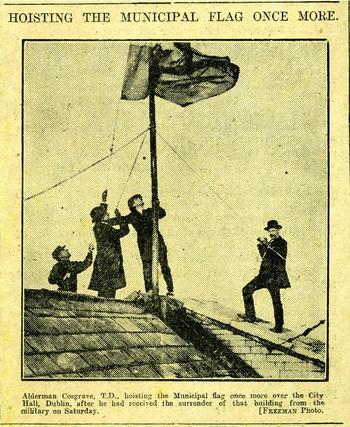
The events of the Irish revolutionary period from 1916 to 1923 provide an interesting test for the model presented here. Mutual distrust and emergency legislation meant that the UK state no longer enshrined or empowered nationalist civil society in large parts of Ireland, and that civil society in turn ceased to legitimize the state – Morton's exchange broke down. The failure of this relationship was evident in the seizure of Dublin city hall by the British army from late 1920 to January 1922 (Figure 3). Admittedly, there were good strategic reasons for the military occupation of a building overlooking the entrance to Dublin Castle, but it has obvious symbolic value for the purposes of this argument. The high-profile killings of municipal leaders in Cork and Limerick are equally emblematic of the rupture between the state and nationalist civil society played out through municipal government.Footnote 77 As the violence of the independence struggle mounted, nationalist civil society became effectively detached from the state. Dublin city council, along with many other nationalist councils around the country, needed a larger entity to which it could attach itself. Councils refused to allow government auditors access to their accounts and local taxes were diverted to the new Dáil. Aside from its obvious economic significance, this refusal also undermined Westminster's claim to authority.Footnote 78 The Dáil's Department of Local Government was the means through which the councils, and thus civil society, could attach themselves to the emerging Irish state. In seeking a relationship with Dublin's municipal council the Dáil was recognizing, or enshrining, the city's nationalist civil society. When the Dáil sought formal allegiance from all local councils, it empowered nationalist civil society, giving it a role in the very foundation of the new state.Footnote 79 In return, Dublin's nationalist civil society joined in legitimizing the regime. Morton's exchange could operate smoothly once more.
British troops barricading Dublin city hall, 1920

W.T. Cosgrave raising the municipal flag above Dublin city hall following the withdrawal of British troops

Dublin city hall was handed back to the council in January 1922 following the truce which ended the War of Independence, and Councillor W.T. Cosgrave, minister for local government, returned to hoist the municipal flag on the roof. In this action, Cosgrave echoes the performance of Lord Provost McDonald in Edinburgh with his three symbolic costumes: through his activism in cultural nationalist circles, Cosgrave represented the majority civil society: he was an elected city councillor and was now a minister in the new government of the Irish Free State. He encapsulated the changed relationship; the exchange between an ethically articulated nationalist civil society and the new state, mediated by municipal government.
De Tocqueville followed his well-known description of civil society as a guarantee of order and tranquillity with a less frequently quoted caveat: ‘If the municipal bodies were made more powerful and independent, the authorities of the nation might be disunited and the peace of the country endangered.’Footnote 80 In the context of just such a powerful and independent municipality, this article has shown how one UK city, with two civil societies, behaved at a crucial moment in the life of the Union and of the future Irish state. Reforms aimed at streamlining the operations of the imperial parliament, which had worked well in Britain, produced unintended consequences in Ireland. It has also illustrated the value of urban history in explaining broader political developments in Irish history and, as a corollary, the utility of Dublin's story in understanding the significance of civil society and municipal government in the operation of the United Kingdom.