The Mesoamerican architectural assemblages known as ballcourts were theaters for public contests, part sacred ritual, part status rivalry, and part recreational sport (see, e.g., Cohodas Reference Cohodas, Scarborough and Wilcox1991; Miller and Houston Reference Miller and Houston1987; Scarborough and Wilcox Reference Scarborough and Wilcox1991; Tokovinine Reference Tokovinine2002; Zender Reference Zender2004). Played with a large rubber ball and variable numbers of competitors, the ballgame had complex symbolism, meanings, and collateral activities. In Aztec Mexico, Spanish chroniclers reported heavy elite wagering—of gold, jade, turquoise, slaves, houses, fields, cacao—on the outcome of ballgames (Voorhies Reference Voorhies2013:106, quoting Sahagún). Similar betting occurred at Caribbean matches (Alegria Reference Alegria1983). Little attention was paid to such activity among the sixteenth-century lowland Mayas, however, when the game may no longer have been played in formal courts.
This report presents the findings of excavations at Ballcourt 2, a small complex at the site of Nixtun-Ch'ich’. The court was used in the Late and Terminal Classic periods (ca. AD 700–950) and possibly into the Early Postclassic. Recovered artifacts suggest feasting as well as gambling.
Nixtun-Ch'ich’ Sector DD Ballcourt (Ballcourt 2)
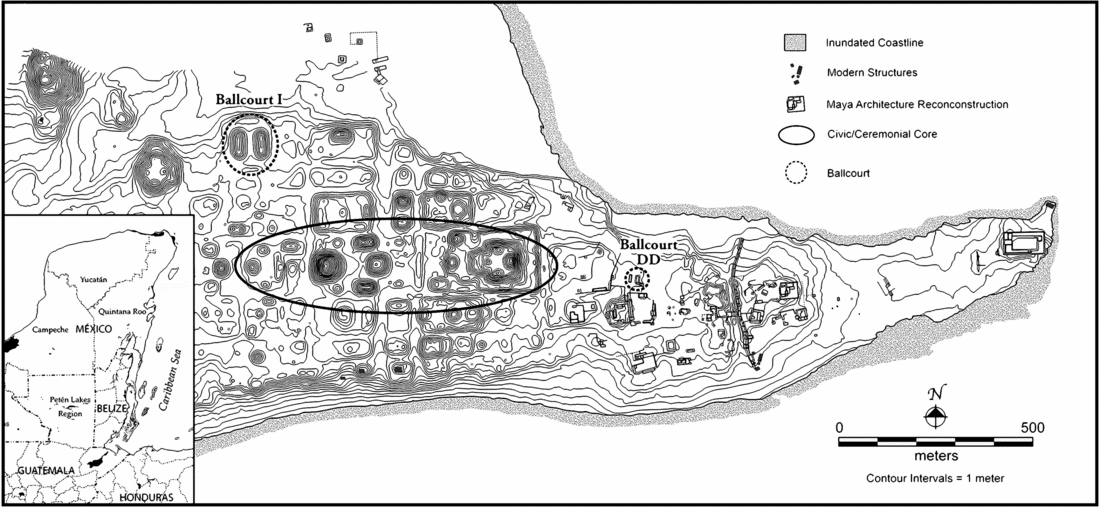
Nixtun-Ch'ich’, on the western edge of Lake Peten Itza in central Peten (Pugh and Rice Reference Pugh and Rice2017; Rice and Pugh Reference Rice and Pugh2017), was occupied from Middle Preclassic times (ca. 800–400 BC), when the site's atypical gridded layout was imposed, into the early eighteenth century AD. It has two ballcourts, both oriented north-south (Figure 1). Ballcourt 1 (in Sector I), unexcavated, has a layout nearly isomorphic to that of the Great Ballcourt at Chich'en Itza’. The largest court in Peten, it is second in size (in the Maya area) only to that northern court.
Map of Nixtun-Ch'ich’ showing the two ballcourts and civic-ceremonial core.

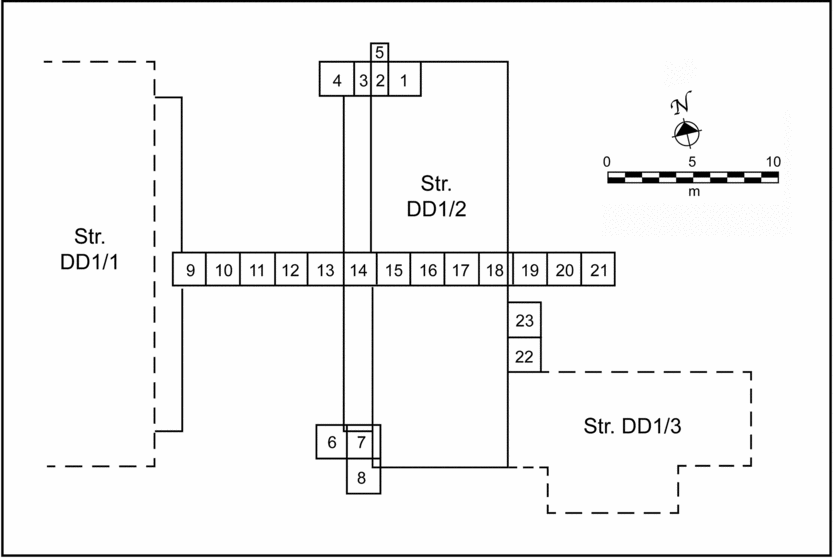
Ballcourt 2 is a much smaller complex in Sector DD (Figure 2). Constructed on the southeast corner of a low platform (Structure DD1), it is an open-ended I-shaped court, oriented about 13° east of north. It comprises two low, parallel mounds: Structures DD1/1 (west; hereafter Structure 1) and DD1/2 (east; Structure 2). Measuring approximately 23.5 m north-south, 12 m east-west, and 2.5 m high, these mounds border a playing alley 10 m wide. A third, lower platform (DD1/3; Structure 3) extends eastward from the southeast corner of Structure 2.
The Sector DD ballcourt (Ballcourt 2) plan, showing numbered excavation units.

Ballcourt 2 resembles Group F at La Trinidad de Nosotros, 8 km northeast near Motul de San José (Moriarty and Foias Reference Moriarty, Foias, Laporte, Arroyo and Mejía2007). The eastern structure of that complex, Structure F-2, has two low platforms extending east from its northeastern and southeastern corners, forming a small patio. Rich Late Classic middens behind Structure F-2 yielded abundant polychrome serving vessels, storage and preparation containers, special forms (incensarios, drums, figurines), lithics (tools and debitage), and faunal remains. No sculptures were recovered, although a small, plain marker was found at the south end of the playing field.
Excavations
Excavations at Nixtun-Ch'ich’ Ballcourt 2 were carried out through surface clearing: removal of humus and collapse (Levels 1–3) down to intact construction or the Structure DD1 platform surface. These operations were undertaken through 23 contiguous 2 × 2 m units in 3 areas (Figure 2): the western corners of Structure 2, a transverse trench, and the interior Structure 2–3 corner. Exposed stonework consisted primarily of large irregular rocks (35–50 cm), likely retaining walls for small-to-medium stone fill. Cut soft-limestone facing blocks were only rarely seen in situ, although they were scattered in structural collapse. As at Trinidad, no sculpture—rings, facades, embedded centerline markers—was found.
Clearing at the west corners of Structure 2 (Units 1–8) revealed that they were built on the poorly preserved plaster surface of the DD1 platform. The shallow, 26 m long, east-west transverse trench (Units 9–21) extended from the east edge of Structure 1, across the playing field, and over Structure 2. The alley floor was the same badly decomposed and uneven platform surfacing, with only a few small patches of plaster remaining. It apparently had never been refurbished.
The eastern face of Structure 1, explored by Unit 9, appeared to have slightly better preservation than Structure 2, with a few dressed facing stones still in place. In Unit 11 in the center of the alley, about 1.3 m of platform construction was excavated in eight levels. Sloping bedrock was leveled with approximately 50 cm of fill: an apple-green (possibly jade) bead was the only artifact in lowest Level 8. Above, Level 7 fill had small quantities of “Pre-Mamom” pottery topped by a disintegrated partial floor. The ~80 cm of fill between this plaster surfacing and the final platform (and alley) floor contained large quantities of Middle Preclassic (Mamom) and earlier pottery (Supplemental Figures 1, 2).
Units 14–18 were placed atop Structure 2. Clearing in Unit 14 revealed that the edge of the bench or apron on the interior wall of the structure began about 50 cm above the playing field, as did that of Structure 1 in Unit 9. With a slope of approximately 11° and a width of 1.7 m, the bench rose to meet the semipreserved facade of the upper tier of Structure 2. Possible wall remnants were noted in Unit 15; large stones formed the summit foundations in Units 16 and 17; and another possible wall lay slightly below, making the upper tier approximately 8 m wide. In Unit 18, lines of large stones suggested stairs at the rear center line or a stepped eastern facade (Supplemental Figure 3). Few artifacts were recovered. Units 19–21 extended east from the base of Structure 2.
Units 22 and 23 were placed in the corner formed by adjoining Structures 2 and 3 and revealed a midden overlying the plaster floor of the Structure DD1 platform. Unit 22 was bounded to the south by the north wall of Structure 3, built not on the plaster floor but instead atop fill or midden, revealing that it was a late addition. More than 25 dressed limestone blocks were recovered, primarily at the base of Level 2 collapse. In both units, Levels 2 and particularly 3 and 4 yielded large quantities of the same pottery found throughout the trench units. Some appeared to be primary breakage and partly reconstructible. In Unit 22, an enormous Middle Preclassic unslipped jar rim, broken but nearly complete, had been placed upside down on the platform floor, perhaps as a pot stand (Supplemental Figure 2g).
Artifacts and Other Materials
The pottery recovered from the surface-clearing and midden was primarily a mix of Late and Terminal Classic types, especially large serving or storage vessels. These include red-slipped incurved-rim bowls or tecomate-like vessels (Supplemental Figure 4c–h) and unslipped jars (Supplemental Figure 4m, n, p). Monochrome red, brown, and black dish fragments were frequently recovered (Supplemental Figure 4a, b, i–l). Uncommon-to-rare types/wares (Supplemental Figure 5a–f) include polychromes (Saxche, Palmar, Zacatal), Altar Fine Orange, Fine Gray, and Yucatecan slate ware and “trickle” decoration. Also recovered were grater bowl fragments, a miniature vessel, a pedestal base with traces of Maya Blue pigment and interior burning (Supplemental Figure 5d), and three distinctive supports of slipped Postclassic dishes or plates.
Preclassic sherds continued to be present in these levels, along with 11 Middle Preclassic anthropomorphic and three zoomorphic (possibly whistle) figurine fragments. Figurines often provide imagery about ballgame costuming, and two early objects from elsewhere at Nixtun-Ch'ich’ show a wrap—probably padding—around the upper torso (Rice Reference Rice2009: Figure 7A, left).
Other varied artifactual and biological materials were found throughout the excavations, but none in concentrations suggesting activity areas. The Middle Preclassic levels in trench Unit 11 included carbonized material (charcoal and possibly incense), several human teeth, fragments of red pigment, and a shell pendant. Abundant faunal remains (unanalyzed) were encountered in the trench, midden, and clearing levels, including teeth and shell. Two stingray spines came from midden Level 4. Small fragments of greenstone were recovered, along with chipped lithics: chert tools (Supplemental Figure 5g) and flakes, and black and green obsidian, including small arrow points (Supplemental Figure 5h), and two cores. Nineteen fragments of manos, metates, and pounders of quartzite, crystalline limestone, vesicular basalt (from the highlands), and pink granite (from Belize) suggested food production. Unusual artifacts included a small black hacha, a long-bone flute with one finger-stop, and a small (9 cm) stone carved into a snail- or shell-like spiral. Occasional fragments of plaster and pigments were noted.
“Gaming Pieces”?
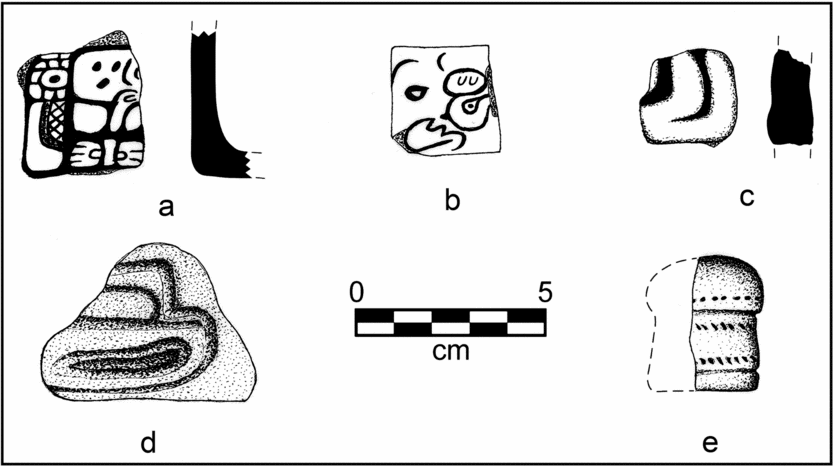
Small shaped sherds and other artifacts recovered in the Ballcourt 2 playing alley and midden are proposed to have been tokens for wagering on the game (Figure 3). They include uncounted tiny (ca. 1 cm2), square, red- and black-slipped sherds from midden Level 4 plus at least 60 worked sherds. Thirty of the latter had been cut from larger fragments and their edges smoothed. Shapes included 9 triangles, 8 quadrilaterals (rectangles, parallelograms, apsidal, 3 lozenges), 4 squares, 1 round, and 6 “irregular.” Two were end-notched rectangles, perhaps fishing net sinkers. Several pieces appear to have been deliberately selected to feature glyphs or other markings: one gray unslipped sherd recovered in the playing alley highlighted a modeled ch'ajom (“scatterer”) glyph (Figure 3a); others isolated similar glyph-like carvings. These artifacts represent pottery types dating from the Preclassic through the Late and Terminal Classic periods.
Possible pottery gaming pieces from excavations at the ballcourt.

At Kaminaljuyu, hundreds of worked sherds suggested an analogy to Aztec counting units, with different shapes representing different quantities: a square = 20, a triangle = 400, and so on (Popenoe de Hatch Reference Popenoe de Hatch, Laporte and Escobedo1997). Many were recovered from a midden near Mound B-VI-2 and could have tallied trade or tribute goods, crop production, and other transactions. At Topoxte Island in Lake Yaxha, 1,042 secondary artifacts of pottery displayed many of the same shapes, including 535 disks (possibly perforated as spindle whorls) and 77 possible notched sinkers (Hermes and Calderón Reference Hermes, Calderón and Wurster2000:203–205). Because the island lacked a ballcourt, these artifacts might have been used as at Kaminaljuyu, or in gaming other than ballplay, for example as place markers in the equivalent of board games such as patolli. Elsewhere, worked sherds were scrapers or polishers in making pottery (e.g., López Varela et al. Reference López Varela, van Gijn and Jacobs2002), which seems unlikely in Ballcourt 2. Another possible use comes from festivities in modern Chamula, Chiapas, where pottery fragments may be symbolic tribute and admission tokens to public rituals (Gossen Reference Gossen and Gossen1986:246).
I propose that at Nixtun-Ch'ich’ Ballcourt 2, the worked sherds were tokens for wagers on the outcome of the contest, different shapes or colors representing different kinds or quantities of goods wagered. Figurine fragments and other recovered small objects (stone ball, beads, hacha) also could have been gambling tokens.
Discussion and Conclusions
The Sector DD Ballcourt 2 at Nixtun-Ch'ich’ was explored through approximately 88 m2 of surface clearing and a test sounding 1.8 m deep below surface. The latter revealed that the DD1 platform, constructed in the Middle Preclassic, was originally about 1.3 m high. Although it is tempting to speculate that a Preclassic ballcourt was built on this surface, the platform neither conforms to the orientation of the Middle Preclassic site grid nor lies on its central axis. Partial clearing of Structure 2 surfaces suggests the court was a Late/Terminal Classic construction.
The midden of Ballcourt 2 was not as rich as those behind the court at Trinidad. This might be a consequence of several factors: its Terminal Classic rather than Late Classic date; its size, location, and functions relative to the Sector I ballcourt; different stations or affiliations of the participants; or still other circumstances. We know virtually nothing of the relations between the large, unexcavated Sector I court and the smaller “junior varsity” Ballcourt 2. Regardless, it might be significant that both were atypically sited: neither lay in the civic-ceremonial center of Nixtun-Ch'ich’.
The removal of dressed limestone blocks from the facades and their presence at the base of Level 2 refuse is a puzzle. Perhaps this resulted from natural collapse of poorly bonded facing stones, or from violence after a lost match. Perhaps the stones fell or were removed in conjunction with the late addition of Structure 3. Perhaps, as in other Postclassic communities in the Petén lake basins, cut soft-limestone facing blocks were removed from Classic structures and incorporated into prominent settings in later buildings (Cecil and Pugh Reference Cecil and Pugh2018). Nearby Postclassic construction and occupation include a residential compound and a massive open hall structure that incorporated cut limestone blocks into its lower front edge. Or, perhaps the structures were terminated. Termination of ballcourts is unusual: they were “enduring structures. . . .To destroy a court was to challenge the underpinnings of society itself” (Scarborough Reference Scarborough, Scarborough and Wilcox1991:144). Because Maya ballgames were sacrosanct intra- and inter-site public rituals, their structures were less likely to fall victim to secular squabbles and violence. Regardless, disassembly of the facades did not mean that the Sector DD court was completely decommissioned. Postclassic artifacts in Level 2 refuse above the fallen dressed stones suggest that the facility continued to be used after despoliation. Spanish chroniclers in the area do not mention ballgame play.
Acknowledgments
Fieldwork funded by NEH grant RZ-50520-06 was carried out under permissions granted by IDAEH in Guatemala City and the landowner. Excavations were directed by Bethany Myers; the description and profiles here are taken from her report and field notes. Thanks to Don Rice for preparing publication figures.
Data Availability Statement
Excavation data summarized herein may be made available for research purposes by contacting the author.
Supplemental Materials
For supplementary material accompanying this paper, visit https://doi.org/10.1017/laq.2018.30.
Supplementary Figure 1. Preclassic pottery, primarily from Unit 11, Level 4: a, unnamed Ainil (orange) ridged; b, c, Xpokol Incised; d, unnamed Ainil (orange) modeled; e, Guitara Incised; f, unnamed black-and-orange dichrome; g, unnamed Chunhinta (black) ridged; h, Tierra Mojada Resist; i, j, Chunhinta Black; k, Desprecio Incised.
Supplementary Figure 2. Preclassic pottery, primarily from Unit 11, Level 4: a, Chunhinta Black; b, c, e, Candelaria Cream; d, Masa Incised; f, g, Brisas Unslipped.
Supplementary Figure 3. Tentative reconstruction of profile of Structure 2 revealed in the axial trench. Tiers or steps in the eastern face were suggested by large stone placements, but their north-south extent is unknown. The lowest two tiers appear to have vertical walls.
Supplementary Figure 4. Late and Terminal Classic pottery, primarily from the midden behind Structure 2: a, b, Tinaja Red; c–e, g, Cameron Incised; f, h, Chaquiste Impressed; i–l, Infierno or Achote Black; m–p, Cambio Unslipped.
Supplementary Figure 5. a–f, Late and Terminal Classic pottery: a, Bambonal Plano-relief; b, Tumba Black-on-orange; c, Trece Gatos Incised (black on gray); d, pedestal base with interior burning; e, red/orange polychrome support; f, unslipped gouge-incised; g, broken chert axe; h, arrow points.