


Introduction
Transdiagnostic cognitive behavioural therapy (T-CBT) is a new line of treatment from the cognitive behavioural school that focuses on the shared underlying cognitive, behavioural, and/or emotional processes across different disorders (Harvey et al., Reference Harvey, Watkins, Mansell and Shafran2004). It enables the therapist to conceptualize the common processes maintaining several presenting problems in one model and target these processes through evidence-based strategies (Newby et al., Reference Newby, McKinnon, Kuyken, Gilbody and Dalgleish2015).
Over the past decade, a number of transdiagnostic treatments have been developed with different focuses, contents and processes of delivery. Over the years, efforts to classify these treatments have also been discussed. Newby et al. (Reference Newby, McKinnon, Kuyken, Gilbody and Dalgleish2015) classified transdiagnostic treatments into two broad approaches. The first is broad spectrum transdiagnostic CBT, which targets common processes underlying difficulties and applies a core set of generic CBT principles. Examples of this approach are Barlow and colleagues’ unified treatment for emotional disorders (Barlow et al., Reference Barlow, Farchione, Sauer-Zavala, Latin, Ellard, Bullis, Bentley, Boettcher and Cassiello-Robbins2011) and Norton’s transdiagnostic group CBT for anxiety disorders (Norton, Reference Norton2012). The second approach is third-wave CBT, such as mindfulness-based stress reduction (MBSR; Kabat-Zinn et al., Reference Kabat-Zinn, Maisson, Kristeller, Peterson, Fletcher, Pbert, Lenderking and Santorelli1992), acceptance and commitment therapy (ACT; Hayes et al., Reference Hayes, Strosahl and Wilson1999) and, most recently, the method of levels therapy (MOL; Mansell et al., Reference Mansell, Carey and Tai2012). This new approach of cognitive and behavioural treatment focuses on changing patients’ perspectives and relationships with their cognition and emotion, unlike traditional CBT, which focuses on changing dysfunctional cognition, behaviour and emotion.
Regarding the broad spectrum of transdiagnostic treatment, Clark and Taylor (Reference Clark and Taylor2009) differentiated between two main approaches. One is pragmatically driven using clinical experiences to select evidence-based interventions suitable for a number of disorders, such as the work of Erickson et al. (Reference Erickson, Janeck and Tallman2009). The other approach is theory driven and develops models of understanding what and how specific cognitive and behavioural processes are involved in a range of disorders (Mansell et al., Reference Mansell, Harvey, Watkins and Shafran2009). Mansell and colleagues (Mansell et al., Reference Mansell, Harvey, Watkins and Shafran2009) differentiated between four transdiagnostic approaches based on the focus and breadth of their theoretical model. These are: limited rage multiple process; symptoms based; universal single process; and universal multiple process. In the limited range multiple-process account, a range of cognitive and behavioural processes maintain a range of psychological conditions that are wider than the original model. Examples of this approach are the transdiagnostic approach for eating disorders by Fairburn et al. (Reference Fairburn, Cooper and Shafran2003); the unified protocol for anxiety and mood disorders of Barlow et al. (Reference Barlow, Allen and Choate2004); a model of mood swings by Mansell et al. (Reference Mansell, Morrison, Reid, Lowens and Tai2007); and the model of hallucinations and delusions by Morrison (Reference Morrison2001).
In the symptoms-based account, the mechanism behind a specific symptom is identified regardless of the diagnosis, e.g. the work of Bentall (Reference Bentall2003) and Persons (Reference Persons1986) on the psychological mechanism behind delusions and hallucinations. In the universal single process, a specific or multiple processes underlie the difficulties across all or most disorders. Examples of these approaches are the Ingram (Reference Ingram1990) model, which identifies self-focused attention as maintenance factors in psychopathology, and the model of Manselll (Reference Mansell2005), which identifies goal conflict as the underlying mechanism of psychopathology. Based on systematic review of evidence, Harvey and colleagues (Harvey et al., Reference Harvey, Watkins, Mansell and Shafran2004) identified 13 definite transdiagnostic processes shared across disorders, such as selective attention, selective memory, emotional reasoning, recurrent thinking and avoidance behaviour, all of which should be targeted in transdiagnostic treatment.
The effectiveness of the transdiagnostic approach has been examined in a number of meta-analyses and systematic reviews (Andersen et al., Reference Andersen, Toner, Bland and McMillan2016; García-Escalera et al., Reference García-Escalera, Chorot, Valiente, Reales and Sandín2017; Newby et al., Reference Newby, McKinnon, Kuyken, Gilbody and Dalgleish2015), and the overall findings suggest that T-CBT is effective in the treatment of emotional disorders when compared with control conditions (Andersen et al., Reference Andersen, Toner, Bland and McMillan2016; Farchione et al., Reference Farchione, Fairholme, Ellard, Boisseau, Thompson-Hollands and Carl2012; Norton and Hope, Reference Norton and Hope2005). It is also as effective as disorder-specific CBT (Newby et al., Reference Newby, McKinnon, Kuyken, Gilbody and Dalgleish2015; Norton and Barrera, Reference Norton and Barrera2012). Studies have also examined the efficacy of different formats of delivery, such as group, computerized or online forms of delivery. It is not yet clear which format is best, but randomized control trials have shown that group T-CBT (Erickson et al., Reference Erickson, Janeck and Tallman2007) and online T-CBT (Johnston et al., Reference Johnston, Titov, Andrews, Spence and Dear2011) are more effective than waitlist control.
In a previous trial (Alatiq and Al Modayfer, Reference Alatiq and Al Modayfer2019), we examined the feasibility of using T-CBT to treat adult emotional disorders among a Saudi sample as a way to improve training opportunities and increase the application of CBT in clinical settings. T-CBT was chosen because it offers the flexibility to address a wide range of disorders and co-morbid conditions and therefore increases access to psychological intervention (Clark and Taylor, Reference Clark and Taylor2009). The application of T-CBT also has the potential to decrease the treatment gap in countries with limited resources by building the capacity of the mental health workforce through training that focuses on one protocol, thereby improving the quality and applicability of training and supervision.
The result of our previous trial was promising, as all patients who completed the T-CBT as planned showed large effect sizes from the pre- to post-assessments for all outcome measures. The study also showed that those who chose to disengage from treatment still showed a medium effect size for the functional disability measure. This finding was particularly important, as 55% of patients decided to disengage from treatment. Although this initial evidence was promising regarding the potential benefit of T-CBT for patients and services, it was not without limitations. One of the major limitations we faced was that CBT as a model of treatment was not suitable for certain groups of patients, mainly for patients who did not accept the CBT formulation as appropriate for their main difficulties and for patients whose main concern could not be explained by the cognitive and behavioural model. For these groups, counselling sessions were offered.
Therefore, in this study, I aimed to replicate the findings from the previous trial for patients who completed the therapy as planned and patients who disengaged from therapy. Another aim was to compare the group who received the T-CBT with the group who received counselling sessions. This comparison between the two interventions was not intended to identify the superior intervention but rather to explore the outcomes and variables related to receiving these interventions in a real clinical setting.
Method
Design and procedure
The data were collected as part of routine service monitoring and quality assurance efforts. The participants were patients seen in the clinical psychology unit at King Abdulaziz Medical City in Riyadh. Patients typically undergo assessment during their first visit to determine the type of service they require and ensure that the service suits their current needs. All the patients reported here were patients who were assigned to T-CBT or counselling sessions. The protocol for the transdiagnostic approach was described in detail in our previous trial (Alatiq and Al Modayfer, Reference Alatiq and Al Modayfer2019). Patients were informed that their data might be used for research and educational purposes. Approval and ethical considerations were obtained from the local IRB.
Participants
The participants involved in this study were patients who were referred to the clinical psychology unit for psychotherapy for a wide range of difficulties. There were no strict criteria for accepting or declining a referred patient; the only patients who were declined were those with current active psychosis. All referred patients were seen in the intake clinic, where initial assessments of the patients’ current difficulties were conducted. Decisions on the assignment of the patients to clinicians were then made.
Of the 276 patients referred for psychological interventions, 167 were initially assigned to CBT. A total of 109 patients were evaluated as not suitable for CBT and were offered counselling sessions. Eight patients attended a few sessions of counselling and were then considered ready for CBT; therefore, they were included in the CBT group analysis. The final sample included 175 patients receiving T-CBT and 101 patients receiving counselling.
The study sample consisted of all eligible patients seen in 2018 and 2019 who completed the treatment as planned and were discharged from services or who had decided to disengage from treatment. Of the 276 patients in total, 110 (39.9%) completed the treatment plan and provided a post-assessment profile, which we refer to as discharged patients in this report. One hundred and sixty-six (60.1%) patients did not attend their last appointment and/or did not make further appointments; these patients are referred to as disengaged patients.
Measures
To measure the baseline level of symptom severity and establish therapeutic outcome measures, the following self-report questionnaires were administered during the intake assessment (pre-assessment) and upon the patient’s discharge from services (post-assessment).
Symptom Checklist-90-Revised (SCL-90-R)
This instrument is designed to screen for a wide range of psychological complications and symptoms of psychopathology. The SCL-90-R is a multidimensional questionnaire consisting of nine subscales of primary symptom dimensions, and it produces two total scores: the grand total (GT), ranging from 0 to 360, and the positive symptom total (PST), ranging from 0 to 90. It also yields two global indexes for the assessment of overall psychological distress, namely, the global severity index (GSI) and the positive symptom distress index (PSDI), which range from 0 to 4 (Derogatis, Reference Derogatis1977). The Arabic version of the questionnaire, which has good psychometric properties, was used in this study (Albuhairi, Reference Albuhairi2005).
Ferrans and Powers’ Quality of Life Index (QLI)
The QLI is used to assess an individual’s satisfaction level with the main aspects of life. It consists of four domains: health and functioning, psychological/spiritual, social and economic and family. The scale measures the respondent’s level of satisfaction with each aspect and evaluates it against his/her perceived level of importance of the aspect. The final overall score ranges from 0 to 30, with higher scores suggesting higher quality of life (Ferrans and Powers, Reference Ferrans and Powers1985).
Patient Health Questionnaire (PHQ-9)
The PHQ-9 is a widely used self-report questionnaire to determine the presence and severity of depression. The PHQ-9 consists of nine items, and the total score ranges from 0 to 27 (Spitzer et al., Reference Spitzer, Kroenke, Williams and Löwe2006).
Generalized Anxiety Disorder (GAD-7)
The GAD-7 is a widely used self-report questionnaire for anxiety symptoms. The questionnaire consists of seven items mainly designed for screening, diagnosing and measuring generalized anxiety disorder. The total score on the GAD-7 for the seven items ranges from 0 to 21 (Kroenke et al., Reference Kroenke, Spitzer and Williams2001).
Sheehan Disability Scale (SDS)
This brief, 3-item self-administered questionnaire is designed to measure functional impairment in three main domains: work/school, social life and family life. For each scale, patients rate the extent to which these domains are impaired by their symptoms from 0 to 10 (Sheehan, Reference Sheehan1983).
To monitor improvement on a session-to-session basis, three of the measures (PHQ-9, GAD-7 and SDS) were administered at the beginning of each therapy session. The data used in this report for the monitoring assessments were from the last therapy session.
Treatment description
Transdiagnostic cognitive behavioural therapy (T-CBT)
I developed the protocol based on the existing literature on this intervention (e.g. Barlow et al., Reference Barlow, Farchione, Bullis, Gallagher, Murray-Latin, Sauer-Zavala and Ametaj2017 and Norton, Reference Norton2012). The protocol follows the principles of recognizing and targeting the primary underlying cognitive and behavioural processes, such as mindfulness awareness and emotional avoidance (Barlow et al., Reference Barlow, Farchione, Bullis, Gallagher, Murray-Latin, Sauer-Zavala and Ametaj2017), as well as exposure and response prevention (Norton, Reference Norton2012). The protocol also follows the same approach of providing psychoeducation and socialization to treatment at the start of the therapy and working on relapse prevention at the end of the therapy.
However, the protocol was designed to be case formulation-driven. It has broad elements of focus rather than step-by-step manuals or specific modules to follow. The focus of therapy is selected based on the case formulation and hypothesis, which is developed and shared with the patients. The broad elements of focus are as follows: assessment and case formulation; psychoeducation and awareness; cognitive approach; behavioural approach; termination and relapse prevention. For a full description of the protocol and cultural adaptation, see our previous study (Alatiq and Al Modayfer, Reference Alatiq and Al Modayfer2019).
Counselling sessions
It is not easy to define counselling sessions in the same way as CBT as counselling as a form of psychological intervention can follow many approaches and modalities, such as humanistic, psychodynamic or systematic counselling. The counselling intervention used in this study follows a more integrative approach that includes various elements of different theories. A primary theoretical basis used for this integrative choice is the three-stage model developed by Clara Hill (Reference Hill2014). In this model, the process of counselling follows three stages: exploration, insight, and action. In the exploration stage, therapists try to facilitate the exploration of emotions and provide space for patients to think through their issues. Therapists here use humanistic skills such as active listening, use of empathy and validation and encourage the expression of concern or emotions. They avoid giving direct advice or solutions and instead encourage patients to explore options and find ways around the current situation. In the insight stage, the goal is to find a new understanding and construct a new meaning. The therapist uses psychodynamic skills such as challenge discrepancies, interpretation and immediacy. According to the model, some patients might only need the work of the exploration stage. Others may need insight to help them make sense of their issues. Insight by itself can lead to long-lasting change; however, other clients may lack the skills needed to make change and to develop new ways. When insight alone does not provide the expected outcome, the therapist needs to move to the action stage. In the action stage, the therapist and client explore ideas of change, feeling in relation to change and obstacles that block change. We can say that once the patients are in the action stage, they are ready for CBT.
Therapists
The therapists involved in this study included two masters-level psychologists, one psychologist with a postgraduate diploma in CBT, and three psychologists with a bachelor’s degree in psychology. All had five to seven years of experience working in the psychology unit. All psychologists are familiar with CBT and the counselling model of therapy through their educational background and work experience in the psychology unit. As part of this work, they received one week of intensive training on the use of the T-CBT protocol, and a one-week training course on the integrative form of counselling based on the three-stage model (Hill, Reference Hill2014).
All therapists continued to receive individual and group supervision on a weekly basis. Competencies for T-CBT were measured using the Cognitive Therapy Rating Scale (CTRS) (Young and Beck, Reference Young and Beck1980) and audio recordings were used to assess the therapists’ skills in sessions. Although the plan called for weekly audio recordings for each therapist, the patients’ refusal to allow recording prevented this. The alternative was for at least three audiotapes for each therapist to be collected. Adherence to counselling sessions was not assessed formally as in the CBT. However, in supervision sessions, the appropriate use of humanistic and psychodynamic skills are discussed. Immediate feedback and reflection are used to further develop and monitor therapy skills.
Results
Sample description
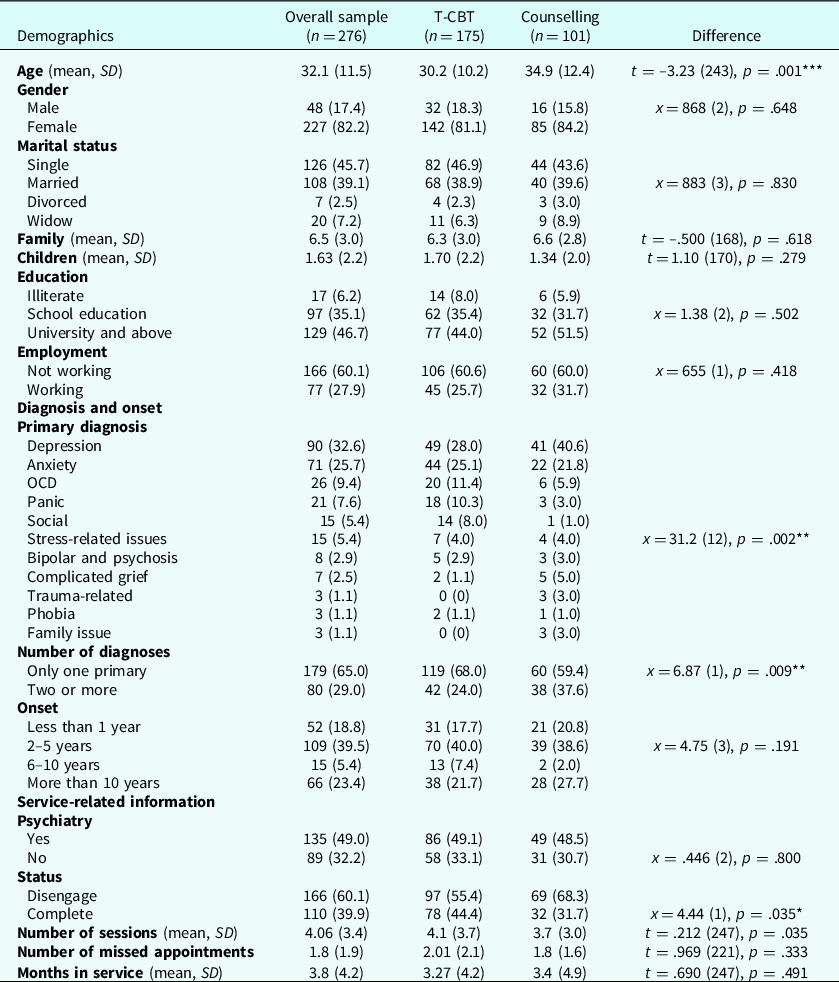
Table 1 shows all the demographic data for the sample as well as information about the diagnoses and the services received. As shown in Table 1, there were no significant differences between the patients in the T-CBT group and the patients in the counselling group for most demographic variables, except for age. The T-CBT group was significantly younger than the counselling group (x = 3.23 (243), p = .001).
Demographics, diagnoses and service-related information

Results are presented as numbers (%) unless stated otherwise. *Significant at p < .05; **significant at p < .01; ***significant at p < .001.
Regarding the primary diagnosis, there was a significant difference between the groups (x = 31.2 (12), p = .002). The T-CBT group had more patients with anxiety (25 vs 21%), OCD (11 vs 5.9%), panic disorder (10 vs 3%) and social anxiety (8 vs 1%) as their primary diagnosis and fewer patients with depression (28 vs 40%), complicated grief (1 vs 5%), trauma-related issues (0 vs 3%) and family-related issues (0 vs 3%). There was also a significant difference between the groups in the number of primary diagnoses (x = 6.87 (1), p = .009), with the T-CBT group having more patients with one primary diagnosis (68 vs 60%).
Regarding the services received, the T-CBT group had more patients who completed the treatment plan (44.4%) than the counselling group (31.7%) (x = 4.44 (1), p = .035). However, the groups did not differ in the number of sessions, number of missed appointments or length of months receiving services.
Baseline assessments
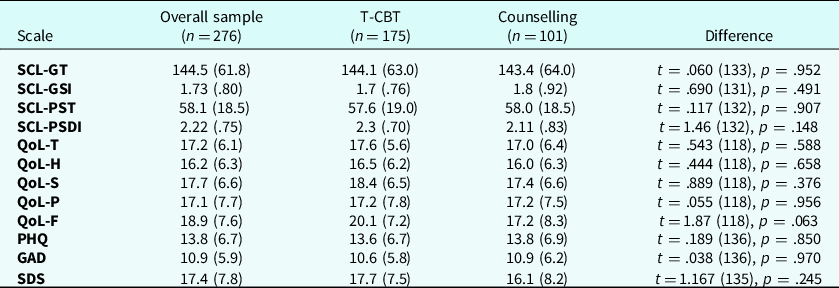
Table 2 shows all the baseline assessment measures for the overall sample as well as the groups. There were no significant differences between the groups in any of the baseline assessment measures. However, there was a non-significant trend of difference in family-related quality of life, which was lower in the counselling group than in the T-CBT group (t = 1.87 (118), p = .063) (score 17.2 vs 20.1).
Baseline assessments

Results are presented as mean (SD) unless stated otherwise.
Pre- and post-assessment
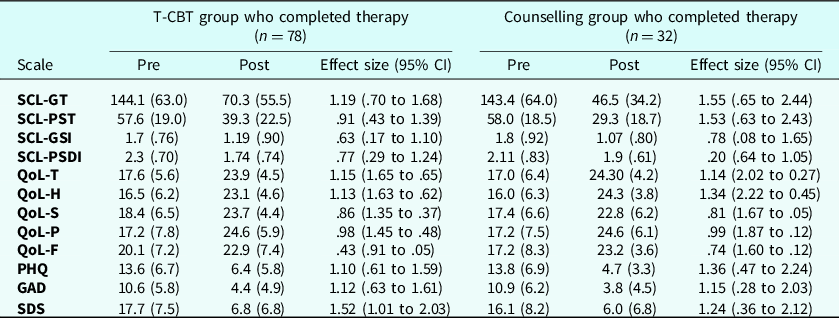
Table 3 shows the differences in the effect sizes (Cohen’s d) between the pre-assessment and post-assessment for patients who completed the treatment plan and provided a post-assessment profile. For the T-CBT group (n = 78), the results indicated medium to large effect sizes (range: 0.43 to 1.52) for all measures. For the counselling group (n = 32, the result also indicated large effect sizes (range: 0.74 to 1.55) and one small effect size for the SCL-PSDI (0.20).
Pre- and post-assessment

Effect size according to number of sessions
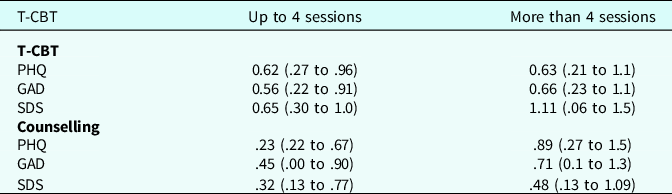
The results showed a mean number of sessions of four for the T-CBT and counselling groups. Table 4 shows the effect size between patients who received the average number of sessions and those who received more. For T-CBT, the results showed improvement in effect size with more sessions only for dysfunction measures that moved from medium to large (0.65 to 1.11). For the counselling group, improvement with more sessions was observed for depression only (.23 to .89).
Effect size according to number of sessions

Results by status (discharged and disengaged)
When comparing the group who completed the treatment and discharged from those who disengaged from the services on baseline variables, the only difference was the number of missed appointments. Those who disengaged missed more appointments in general than the group who completed the treatment. For T-CBT, the number of missed appointments was 2.2 for disengaged and 1.1 for discharged (F = 3.38 (149), p = .001). For counselling it was 2.1 vs 1.2 (F = 2.24 (90), p = .028).
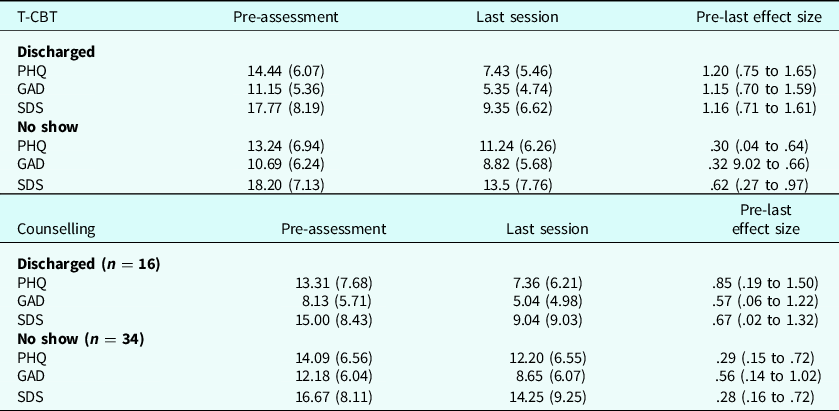
Table 5 shows the PHQ, GAD and SDS results from the pre-assessment to the last therapy session assessment for both groups, discharged vs disengaged. The results indicate that patients who completed the treatment had a larger effect size for the T-CBT and medium to large effect size for the counselling group (T-CBT: 1.20, 1.15 and 1.16; counselling: .85, .57 and .67). For the patients who decided to disengage from the therapy, T-CBT showed a medium effect size for all three measures (0.30, 0.32 and 0.62). For the counselling group, only the measure of anxiety was in the medium range (0.56).
Result by status (discharged vs disengaged)

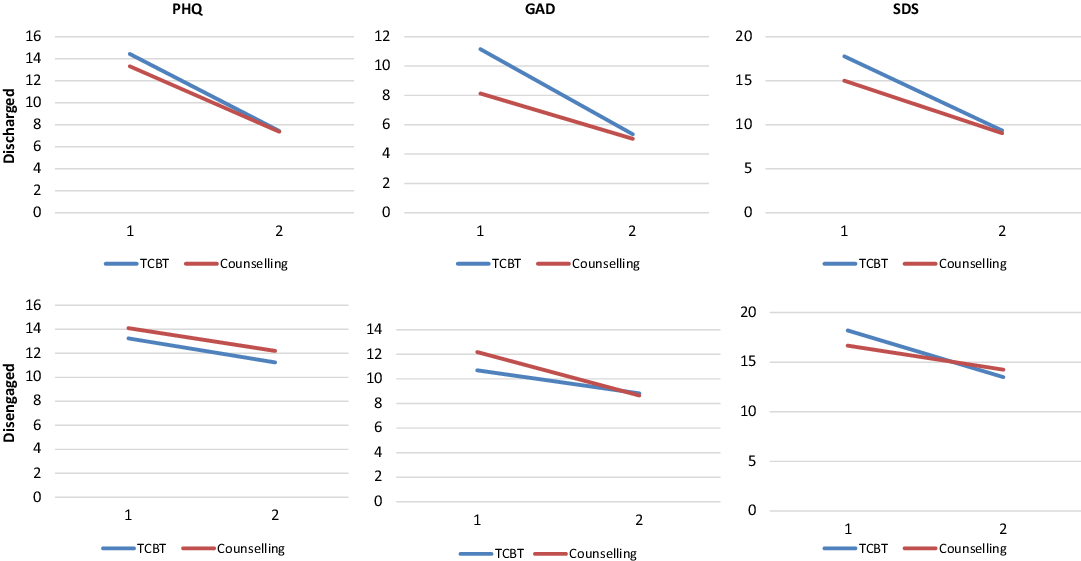
Profile plots of participants’ scores for all three measures over time are shown in Fig. 1. All the groups had a reduction in symptoms according to all measures between the pre-assessment (Time 1) and last session assessment (Time 2). The largest change was observed for the T-CBT patients who completed the programme and were discharged properly from treatment. However, for the disengaged group, there was a clear crossover pattern for the SDS, with the T-CBT group having the highest score at Time 1 and the lowest score at Time 2.
Profile plots for all three measures (PHQ, GAD and SDS) as measured at Time 1 and Time 2 (pre-assessment vs last session) according to status (discharge vs disengaged) and group (T-CBT vs Counselling).

Reason for disengaging from therapy
A subsample of patients (n = 15) was randomly selected to ask them about the reason they disengaged from the treatment. A research assistant who was not the patients’ main therapist made the call to allow non-biased responses. The reasons the patients provided were as follows: four had booking issues, three moved away, two had transportation issues and two reported doing well. Four of the patients in the subsample could not be contacted to record a reason for disengagement.
Discussion
In this study, I aimed to replicate the results previously found in a naturalistic trial on the effect of T-CBT on adult emotional disorders in Saudi Arabia. A secondary aim was to compare outcomes and explore the differences between T-CBT and counselling sessions. The data were collected as part of service development and quality assurance efforts; therefore, there was no strict protocol for acceptance criteria or allocation processes. This methodology provided opportunities to measure the effect of services, as conducted in real clinical settings.
T-CBT replication findings
The overall results of this study confirm the initial evidence on the applicability and feasibility of applying T-CBT adapted to Saudi patients. The analyses showed large effect sizes for almost all outcome measures (general symptoms, quality of life, depression, anxiety and level of dysfunction) for patients who completed the treatment as planned and provided proper post-assessment profiles. Another finding that I was interested in replicating was the effect for patients who disengaged from therapy. In the initial trial, the group showed a medium effect size only for the measure of dysfunction. However, in the current study, there was a medium effect size not only for dysfunction but also for measures of depression and anxiety. This is particularly important, as we continue to have a higher percentage of patients disengaging from therapy.
Not attending or disengaging from therapy is a major concern for mental health services worldwide. Studies have reported a range in the mean drop-out rate, from 5.6% in randomized trials of CBT (Butler et al., Reference Butler, Chapman, Forman and Beck2006) to 47% for a meta-analysis that included naturalistic studies (Wierzbicki and Pekarik, Reference Wierzbicki and Pekarik1993). Studies have identified several factors that are associated with non-attendance, such as age or level of severity of symptoms (Binnie and Boden, Reference Binnie and Boden2016). However, none of these factors was evident in this study, and the only factor differentiating the disengaged group from the discharged group was the number of missed appointments. This suggests that patients who disengaged have a history of non-attendance, which was found previously in Neal et al. (Reference Neal, Hussain-Gambles, Allgar, Lawlor and Dempsey2005). As patients reported, the reasons why they disengaged from therapy were mainly outside of their control, such as transportation, moving away and becoming busy. If the patients who attended minimal sessions experienced improvement in mood and daily function, then a brief T-CBT intervention might be better designed for those with commitment difficulties.
Number of sessions
The average number of sessions found in this study was only four, with a range between one and 20. In a secondary analysis of over 3000 patients who attended psychological services across the UK, it was found that for patients who attended more than the mean number of sessions (18 or 20 sessions in comparison with the mean of 8.5 sessions), CBT was more effective, leading to a recovery rate of 62.25% of patients (Pybis et al., Reference Pybis, Saxon, Hill and Barkham2017). However, in this study, patients who had more than an average number of sessions (4 sessions) of T-CBT, which was 33% of the group, showed a larger effect size only in the level of dysfunction but not mood symptoms. This again emphasizes the effect of this type of intervention on the level of dysfunction.
Comparison between T-CBT and counselling
When comparing the outcome measures between the two groups, the study found the same effect for patients who attended the counselling sessions and completed the treatment as planned. It was mentioned in the introduction that the intention was not to compare the two interventions in terms of superiority. I did not intend to measure which is better, as we know from previous clinical trials that finding differences between counselling and CBT is quite difficult (Ward et al., Reference Ward, King, Lloyd, Bower, Sibbald, Farrelly and Addington-Hall2000). In a recent large study with over 3000 patients comparing CBT with generic counselling as conducted within psychological services in the UK, the therapy type was not a significant predictor of improvement (Pybis et al., Reference Pybis, Saxon, Hill and Barkham2017). The authors instead suggested that the focus should be on examining the variation and factors within these interventions for better decisions and planning.
However, these findings need to be interpreted in light of the differences between the groups. The counselling group differed from the T-CBT group in the primary diagnosis. More patients in the T-CBT group had a primary diagnosis of anxiety, OCD, panic disorder and social anxiety, while the counselling group had more patients with depression and complicated grief and family-related issues. Therefore, when I compared the two interventions, I compared the effect of the interventions on different conditions. CBT is the first-line treatment for major psychiatric disorders, as supported by evidence-based data and clinical guidelines. However, for family-related issues or complicated grief, the evidence for CBT is less prominent.
In my protocol, the main reason to determine whether the patient would be offered T-CBT or counselling depended very much on the patient’s main complaints and preference. If the main complaint could be explained by the CBT model and the patient accepted that model, then he/she was offered T-CBT. However, many family-related issues cannot be explained by purely cognitive and behavioural processes, and therefore more patients were offered counselling for their difficulties. Therefore, it is fair to say that I did not compare the same intervention on the same conditions but rather interventions that suited the clients’ main concerns.
Regarding depression, although guidelines suggest that CBT should be the first line of treatment for depression and that counselling might be provided only when first-line intervention is not effective, in the current study, more patients with depression as a primary diagnosis received counselling sessions rather than T-CBT. This is in line with the study of Pybis et al. (Reference Pybis, Saxon, Hill and Barkham2017), which also found that clinicians received more referrals of patients experiencing depression for counselling than for T-CBT. The therapy selection process might suggest that clients either did not accept the CBT model of their condition or had other issues that made T-CBT unsuitable for them. To confirm this further, the counselling group had more than one diagnosis, whereas those in the T-CBT group had only one, which might be an additional complication for patients with depression as the primary diagnosis that leads to the selection of counselling over T-CBT.
Another difference between the groups was found regarding age. The counselling group had older patients than the CBT group. It might be that older patients have difficulties accepting the active approach of CBT and be more accepting of the generic style of counselling. There is no evidence to suggest that CBT is not suitable for older adults, but modification might be needed (Hyer et al., Reference Hyer, Kramer and Sohnle2004). This is an important factor that needs to be considered when designing services, and it is possible that we need to modify the approach to match all groups’ needs and preferences.
Another major difference between T-CBT and counselling was that more patients in the T-CBT group completed the treatment and were properly discharged from services, while in the counselling group, more patients disengaged from therapy. This is a difference in favour of T-CBT, and it might be related to the commitment and goal sharing approach between the patients and therapists in T-CBT that differs from the free structure that is expected in counselling. Having a specific plan with structured therapy might encourage patients to follow the initially established plan. This is a hypothesis that needs to be explored in studies that examine patients’ accounts and preferences for therapy.
Transfer form counselling to T-CBT
In the initial group distribution, there were eight patients who were initially offered counselling sessions and became ready to join the T-CBT group after a few sessions of counselling. It has been clinically observed that for some clients, the CBT model might not be accepted immediately, and some work regarding general counselling skills focusing on exploring feelings and insight might help facilitate the more active approach to intervention that is needed for CBT. However, the counselling group had fewer sessions and more disengagement from therapy, which might prevent more patients from transferring to T-CBT with time. Future research should examine intervention crossover in more detail.
Transdiagnostic mechanism of recovery
The current finding of no significant difference between the two groups leads to the question of what transdiagnostic mechanism of recovery might be working in each group and are these mechanisms distinctive to each intervention or shared between them. This is a question that has long been debated among psychotherapists. Since the ‘Dodo bird verdict’, which refers to the claim that different psychotherapy modalities are effective despite their different focus and components (Rosenzweig, Reference Rosenzweig1936), researchers have debated this claim. We know now that there are common factors that are shared among different psychotherapy schools and modalities, and these factors are in the area of client characteristics (e.g. having a positive expectation and hope about therapy); therapists’ quality (e.g. warmth and empathetic understanding); change process (e.g. opportunity for expressing emotion, fostering insight/awareness, practising new skills); and treatment structure (e.g. use of techniques, participation or interaction) (Grencavage and Norcross, Reference Grencavage and Norcross1990).
Interventions in this study were delivered by the same therapies, which suggests that the therapeutic factors were controlled for in this study. Additionally, both T-CBT and counselling sessions include similar mechanisms of change that foster insight and a better understanding of one’s own self and difficulties and facilitate emotional expression. However, the main difference lies in the active engagement of the client in developing new skills and practising these skills.
In unpublished data on the same service at KAMC-R, the psychologists were asked to rate their perspectives about their own style in psychotherapy using a list of processes. The most common processes that the psychologists used were in the following order: (1) provide the patients with information about their symptoms, (2) encourage exploration of feeling, and (3) provide alternative ways to understand experiences. These top-used processes can well be part of both counselling and T-CBT and therefore could be considered shared processes of recovery. However, challenging irrational beliefs, challenging maladaptive behaviour, and use of homework and techniques are distinct features of T-CBT.
Disengaged groups
With regard to the effect size of treatment, T-CBT and counselling both showed large effect sizes for patients who completed the therapy as planned. However, for the group who decided to disengage from treatment, the pattern was in favour of T-CBT. The group who attended T-CBT had medium effect sizes for all three measures, while the counselling group showed medium effect sizes only for the measure of anxiety. In fact, the level of dysfunction was almost double in the T-CBT group than in the counselling group for those who disengaged from therapy.
In general, CBT works to change maladaptive behaviour and cognition, which is directly linked to current difficulties; therefore, it is not surprising that the immediate effect was more prominent for the level of dysfunction. This has an important implication for services; if we know that patients can experience a medium effect for function with as few as four sessions of T-CBT, we can start to design a short intervention that focuses directly on daily dysfunction. If this were the goal and focus of treatment from the start, it might lead to more commitment and a larger effect.
This is also an advantage of T-CBT over disorder-specific manualized treatment. Manualized treatments have less room for modifying interventions to fit clients’ individual needs which may lead to early disengagement from treatment. In contrast, T-CBT that allows for an individualized treatment plan, based on each patient’s underlying transdiagnostic mechanisms, can increase patient engagement because each session is relevant and meaningful to the clients.
Conclusion
To summarize, this study confirmed the initial evidence of the applicability of T-CBT in Saudi Arabia. Even when patients disengaged from therapy, the study confirmed a moderate effect on the level of dysfunction and added a moderate effect on mood symptoms. When comparing T-CBT with counselling, we found that T-CBT was provided for patients who were younger and had one major psychiatric disorder as the primary diagnosis. More patients in the T-CBT group completed the treatment, and those who disengaged showed a larger effect size for the level of dysfunction. This suggests that the improvement of dysfunction among disengaged patients is specific to T-CBT. The results have implications for clinical services as well as future research in this area. However, this study was conducted at the same service site as the previous study, and multi-site clinical trials are needed for generalizability. Additionally, there is a lack of information about patient feedback on therapy. Thus, future research can aim to examine patients as well as clinicians’ perspectives of interventions.
Acknowledgements
I would like to thank the psychologists involved in this study for their commitment.
Financial support
There was no financial support for this study.
Conflicts of interest
The author declares no conflicts of interest.
Ethical statement
The author has abided by the Ethical Principles of Psychologists and Code of Conduct as set out by the APA. The study was reviewed and approved by the IRB at King Abdullah International Medical Research Centre (KAIMRC), KSA.
Data availability
Data are available upon request from the author.
Key practice points
-
(1) Initial evidence that T-CBT is suitable for clients with emotional disorders in Saudi Arabia is confirmed.
-
(2) An effect of T-CBT on the level of dysfunction is shown for patients who disengaged from T-CBT sessions only and not counselling.
-
(3) Patients who were offered counselling sessions were older, had difficulties with depression, family issues and complicated grief, and were more disengaged from services.



Comments
No Comments have been published for this article.