

Archaeologists have embraced the Internet for a variety of purposes, from public engagement through social media to the provision of digital access to museum collections via websites. However, the sharing of primary data on open-access, digital platforms—a subset of a direction that has been termed Participatory Network Scholarship (Veletsianos and Kimmons Reference Veletsianos and Kimmons2012)—remains poorly developed. There are notable exceptions; for example, several online databases have been, or are currently being, developed for Maya hieroglyphs (Alvarado Reference Alvarado2001; Macri Reference Macri2008; Mathews and Bíró Reference Mathews and Bíró2015; Peabody Museum of Archaeology and Ethnology 2015; Sidorov et al. 2001) and codices (Vail Reference Vail2013). These resources are routinely cited by scholars and available to the public at large. Of course, there are also good reasons that much archaeological data is not networked to this extent; web-based databases of archaeological site locations and reports are usually maintained with restricted access to protect archaeological resources. But there remains a great deal of less sensitive archaeological data that could be more effectively shared via the web to facilitate access by, and interaction among, scholars and avocational archaeologists alike.
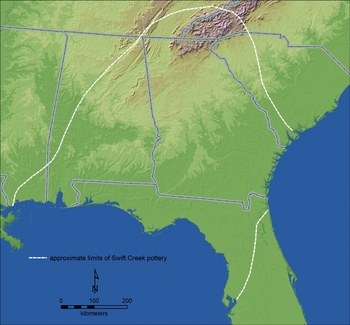
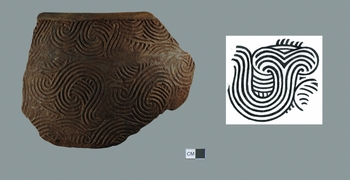
We describe the development of an open-access database for paddle designs and design fragments reconstructed from the surfaces of Swift Creek Complicated Stamped ceramics, a type of pottery that was widely produced, used, and deposited throughout Georgia, eastern Alabama, and northern Florida in the Middle and Late Woodland periods between ca. cal A.D. 100 and 800 (Stephenson et al. Reference Stephenson, Bense, Snow, Anderson and Mainfort2002; Williams and Elliott Reference Williams, Elliott, Williams and Elliott1998) (Figure 1). Swift Creek Complicated Stamped pottery preserves truly unique evidence of social interactions. The characteristic stamped designs were created by impressing a paddle carved with renditions of various fauna, flora, faces, and seemingly abstract patterns into a clay vessel before firing (Snow Reference Snow, Stephenson, Williams and Elliott1998) (Figure 2). Where these designs are sufficiently clear and distinct, we can reconstruct the paddle designs and trace connections between sites. Complicated stamping yields nuanced temporal control among contexts because paddle-matching vessels are presumably contemporaneous at the level of decades or even less (Stephenson and Snow Reference Stephenson and Snow2004). In most cases, the stamping appears to have been accomplished with wooden paddles,Footnote 1 and the identification of cracks and wear patterns in the paddles from the stamped sherds provides additional certainty of matches, and in rare cases even the relative age of the paddle (Snow Reference Snow, Stephenson, Williams and Elliott1998). Paddle matches thus allow archaeologists to trace social interactions across sites with a high degree of spatial and temporal resolution (Ashley and Wallis Reference Ashley and Wallis2006; Broyles Reference Broyles1968; Kirkland Reference Kirkland2003; Snow Reference Snow1975, Reference Snow1977, Reference Snow, Williams and Elliott1998; Snow and Stephenson Reference Snow, Stephenson, Williams and Elliott1998; Stephenson et al. Reference Stephenson, Bense, Snow, Anderson and Mainfort2002; Stoltman and Snow Reference Stoltman, Snow, Williams and Elliott1998; Wallis Reference Wallis2011; Wallis et al. Reference Wallis, Boulanger, Ferguson and Glascock2010; Wallis et al. Reference Wallis, Pluckhahn and Glascock2016).
The approximate extent of Swift Creek Complicated Stamped pottery.

Swift Creek Complicated Stamped sherd from the Kolomoki site (Vessel Lot 9ER1-127) and corresponding paddle design reconstruction (Design TJP29). Photograph by Thomas J. Pluckhahn, illustration by Katrina Heller.

However, the identification of Swift Creek paddle matches has been hindered by the limited accessibility and fragmented nature of the dataset of reconstructed designs. We begin by describing the history of research on Swift Creek pottery designs, laying the foundation for the need for a centralized database of design reconstructions. We then provide an overview of the publicly accessible database that we have created in conjunction with our research program on social interaction in a portion of the Swift Creek world.
SWIFT CREEK DESIGN RESEARCH AND THE NEED FOR NETWORKED SCHOLARSHIP
The interpretive potential of Swift Creek pottery has been recognized for many years. The type was formally defined by Jesse Jennings and Charles Fairbanks (Reference Jennings and Fairbanks1939), based on Arthur R. Kelly's (Reference Kelly1938; Kelly and Smith Reference Kelly and Smith1975) work at the Swift Creek type site (9BI1) near Macon, Georgia. Kelly and his wife Rowena Kelly initiated the first studies of the designs on Swift Creek pottery in the 1930s (Williams and Elliott Reference Williams, Elliott, Williams and Elliott1998:7), although their work remains mainly in the form of unpublished notes and illustrations (documents on file at the University of Georgia Laboratory of Archaeology, Athens). The first systematic work on Swift Creek designs was initiated by Bettye Broyles in 1959 (Williams and Elliott Reference Williams, Elliott, Williams and Elliott1998:7). In a brief but important article published nearly a decade later, Broyles (Reference Broyles1968) illustrated a number of complete designs reconstructed from the fragments on sherds recovered from sites in the lower Chattahoochee River Valley, principally Kolomoki (9ER1), Mandeville (9CY1), Fairchild's Landing (9SE5), and Hare's Landing (9SE14). She noted connections between sites based on paddle matches. Broyles also observed intrasite patterns in the distribution of designs; for example, she suggested that some designs from Kolomoki were restricted to mound contexts and others to middens. Additional designs reconstructed by Broyles appeared in Joseph Caldwell's (Reference Caldwell and Smith1978) belated report summarizing excavations at the Fairchild's Landing and Hare's Landing sites and in Smith's (Reference Smith1975) dissertation summarizing earlier excavations at Mandeville.
As Williams and Elliott (Reference Williams, Elliott, Williams and Elliott1998:7) note, “Broyles's work provided the inspiration for all later work on Swift Creek designs.” The majority of this subsequent work has been conducted by Frankie Snow, who has published a number of reconstructed designs (Snow Reference Snow1975, Reference Snow1977, Reference Snow, Williams and Elliott1998; Snow and Stephenson Reference Snow, Stephenson, Williams and Elliott1998) and has made a number of other illustrations available to interested researchers in manuscript form (Snow Reference Snow2007). Much of Snow's work has focused on using paddle design matches to establish connections between sites. Additional designs have occasionally been reconstructed by other researchers, largely toward the same ends (Ashley Reference Ashley1992, Reference Ashley, Williams and Elliott1998; Ashley et al. Reference Ashley, Stephenson and Snow2007; Ashley and Wallis Reference Ashley and Wallis2006; Jones and Tesar Reference Jones and Tesar1996; Tesar Reference Tesar2009; Tesar and Jones Reference Tesar and Jones2009; Wallis Reference Wallis2011; Wallis et al. Reference Wallis, Boulanger, Ferguson and Glascock2010; Wallis and O'Dell Reference Wallis and O'Dell2011). Rebecca Saunders (Reference Saunders1986, Reference Saunders, Williams and Elliott1998), among others, has focused on the intra- and intersite distribution of individual design elements, without attempting to reconstruct entire paddle designs.
Despite the considerable insights generated by this body of research, the fuller interpretive potential of Swift Creek pottery has arguably remained elusive. Many reconstructed designs are unpublished. Further, the published designs are scattered across publications and reports of varying accessibility. An initial attempt at rectifying these issues was initiated in 2007 by a loosely organized group of researchers (including ourselves) known as the Swift Creek and Weeden Island Focus Team (SWIFT). SWIFT eventually produced a database comprised of published and unpublished reconstructed designs. The database, housed on the server of the University of Georgia Laboratory of Archaeology, has been employed by Karen Smith and James Knight (Reference Smith and Knight2012, Reference Smith and Knight2014) to understand the process by which Swift Creek designs were constructed.
While the SWIFT database was a great step forward, it has several limitations. Because of concerns over copyright and intellectual property (Swift Creek designs have obvious potential for T-shirts, tattoos, and the like), access is limited to members of the group (Wallis Reference Wallis, Joyce and Gillespie2015). Further, the designs that are included in the database have been reconstructed and drawn using disparate methods. For example, Snow and Broyles routinely extrapolated from observable design fragments to whole designs. Both also regularly “cleaned” the lines on their renderings of the irregularities that were present either in the carved wooden paddles or their impressions on the vessel surface. In addition, the published drawings are not reproduced at scale. Nor does the database include scaled photographs of the sherds that were used to reconstruct the designs. These limitations make it impossible to positively match a sherd with a given design illustration and the sherds or vessel from which it was drawn.
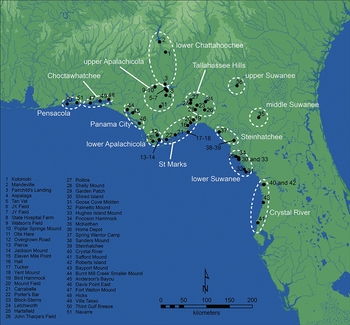
In 2010, with assistance from the Wenner-Gren Foundation and the National Science Foundation, we began a research program directed toward identifying, through integrated forms of materials analysis, patterns of social interaction across a portion of the Swift Creek world. Our research integrates five methods of analysis: (1) Neutron Activation Analysis (NAA), (2) petrographic analysis, and (3) digital imaging of paddle stamp designs as complementary methods for determining vessel provenance; (4) technofunctional (i.e., technological) analysis to identify patterns of vessel production and use; and (5) absolute dating to develop an absolute chronology of designs and paddle matches. We have examined collections of Swift Creek pottery from 51 sites along the Gulf Coast and adjacent interior portions of Florida and Georgia, from modern-day Tampa on the south to Pensacola on the west and the smaller Georgia city of Fort Gaines on the north (Figure 3).
Study sites and site clusters.

A significant component of this research has been the development of a database to manage the information generated by our research. It is our hope that this database, housed on the servers of the Florida Museum of Natural History and accessible from the Museum's website (http://www.flmnh.ufl.edu/swift-creek/), will serve as a platform for scholars working with the designs on Swift Creek pottery. Toward this end, in this article, we present an overview of the database.
DESCRIPTION OF THE DATABASE
Overall Relationship Structure
The database was designed by the authors and created in Microsoft Access by the senior author. It was subsequently developed for the web by Andrew Smith and other staff in the Office of Museum Technology at the Florida Museum of Natural History.
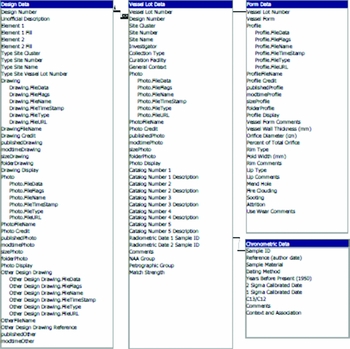
Figure 4 is a relationship report showing the relationships among the constituent tables. The primary field that integrates the tables in our database is the “vessel lot,” a term we use to represent either a unique vessel or one or more sherds that are presumed to represent a unique vessel. This contrasts with the SWIFT database, where the individual paddle design is the key field. For our purposes, the vessel lot has an immediate practical advantage over paddle design as a structuring feature of the database. Swift Creek potters—or, more precisely, paddle-carvers—sometimes produced paddle designs that are identical save for a few very small variations; these slight variations may be impossible to distinguish at the level of individual sherd or design fragments.
Relationship report showing structure of the database.

Structuring the database on the vessel lot also reflects our research focus on the context of social interaction, rather than simply establishing that a connection existed between particular locations. Since the same paddle may have been used to stamp multiple pots, and since both pots and paddles may have moved across the landscape, a focus on the vessel lot—in combination with sourcing data on the vessel or sherds—is essential for differentiating the nature and direction of movement. Likewise, the focus on vessel lot facilitates understanding of the multiple contexts (e.g., mound or village) in which a paddle design may be represented. The vessel lot also provides chronological control, since dates are obviously obtained either directly from sherds (thermoluminescence) or on materials found in association (radiocarbon dating of soot on the vessel surface or organic remains from the same context), and not on the paddle designs themselves. Finally, the focus on the vessel lot permits understanding of the range of vessel forms on which a given paddle design may have been impressed. The vessel lot field links the various tables and corresponding forms that comprise the database: vessel lot (provenience) data, vessel form data, sourcing data, and chronometric data. We describe each of these in turn.
The vessel lot table in our database captures a number of provenience-based attributes that require little or no elaboration: name of the investigator, site number and name, curation facility, accession or catalogue number(s), general context (e.g., surface, feature, excavation level), and specific context (e.g., test unit and level). The table also includes a field for “site cluster.” For the present extent of our sample, we divide the study area into 13 site clusters roughly correlated with distinct portions of major river valleys and adjacent coastlines (see Figure 3). This site clustering, which can easily be expanded to include vessel lots from other areas, will be useful in identifying the predominant directions of paddle matches and interaction, within river valleys, between river valleys, or along the coasts.
Perhaps of less intuitive value, the vessel lot table also records information on the nature of the investigation (i.e., professional or avocational). This is so that we, or other researchers who use the database in the future, may restrict the data to collections produced from investigations that can be reasonably assumed to conform to accepted ethical standards.
Each vessel lot is tied to a single paddle design (Snow [Reference Snow, Williams and Elliott1998:71] reports the identification of one example of a vessel bearing two paddle designs, but none have been identified in our sample). When a vessel lot matches a previously reconstructed paddle design, it is assigned to the same paddle design number, and the strength of the match is ranked on an ordinal scale (as described in more detail below). For vessel lots that match a previously reconstructed design, we include a photograph of the matching sherds with the vessel lot table.
We have thus far recognized more than 1,300 individual vessel lots for our study area. We recognize that the definition of a vessel lot is not always straightforward. Sometimes when analyzing a pottery collection from a particular site, a paddle design is represented only on body sherds that do not allow differentiation of vessel form beyond general categories, and thus the presence of more than one vessel cannot be ruled out. In such cases, it is sometimes possible to reasonably infer the presence of distinct vessels from production attributes (such as temper or coring) or from the representation of the design on sherds from widely separated proveniences. However, we generally take a conservative approach, identifying separate vessel lots from sherds that share paddle designs only when there is compelling evidence.
Our vessel lot table also includes summary data for NAA and petrographic analysis. Specifically, we have employed the groupings for these variables developed by Wallis and colleagues (Wallis et al. Reference Wallis, Gilmore, Cordell, Pluckhahn, Ashley and Glascock2015). At this time, we have retrieved NAA data for 512 sherds (representing an equal number of vessel lots) from our study area. Petrographic analysis has been conducted on 247 sherds (also representing an equal number of vessel lots).
The design table records unique paddle designs or fragments of paddle designs, each of which is given a unique design number (we have generally used our initials, followed by a sequential number). We also provide a field for design name (Snow has until recently preferred to name, rather than number, his design reconstructions). Drawings of the designs and photographs of representative sherds are uploaded so that these can be easily viewed.
The work of reconstructing paddle designs from sherds can be done with imaging and GIS software, georeferencing lands and grooves from adjoining areas of a paddle stamp (Wallis and O'Dell Reference Wallis and O'Dell2011). However, for the purposes of design reconstruction, we prefer hand drawing. Variation in the amount of pressure applied, and the degree of rocker-stamping, overstamping, and subsequent smoothing before drying and firing, all lead to disparities in the impressions recorded on vessel surfaces. To our knowledge, no electronic means of imaging has been employed that can see through the range of variation in stamping execution as well as the human eye. Until better automated methods are developed, we argue that overstamped and smoothed surfaces often require an artist's reconstruction to best approximate the image that would have appeared on a carved wooden paddle. In studying Swift Creek iconography, therefore, we find it easier to compare reconstructed drawings rather than photographs of sherds or composite images from sherds.
There is no standardized method for drawing paddle designs. Broyles preferred to make rubbings of sherds using graphite and tissue paper, and then use these rubbings as the basis for her ink drawings. Wallis and O'Dell (Reference Wallis and O'Dell2011) have summarized the methods that were utilized for our project, which generally follow the procedures developed by Frankie Snow. The majority of our designs each come from a single sherd. However, when more than one sherd with the same design is present, the sherds with the clearest stamp markings are used as the basis for each reconstruction. At select points, the lands and grooves of a design are measured directly from the sherd with calipers and recorded to the nearest millimeter. Using these measurements as a guide, each design element is recreated to scale on graphing paper and the scale is continuously checked via calipers or protractor. Graphite is used to make the initial sketch, which, in some cases, is gradually added to and fleshed out as more sherds bearing the same design are identified from other proveniences. After completing the sketches for each design or partial design from the entire site assemblage, the designs are then transferred onto tracing paper with archival ink. Points used are no greater than .45 mm in width to maintain accuracy in measurements throughout the transfer process. In keeping with the format established by Frankie Snow (Reference Snow1975, Reference Snow1977, Reference Snow, Williams and Elliott1998, Reference Snow2007), the raised lines of the design (i.e., “lands”) are darkened and the grooves are left white (although, in some cases, we have drawn them in the opposite manner and then reversed the image in Photoshop). The transfers are then digitally scanned and organized according to site.
These standardized drawings are also a useful tool for initially identifying potential design matches between vessels; however, drawings can rarely be used as definitive evidence of paddle matches. The identification of paddle matches requires sherd-to-sherd comparison or at least high-resolution images to locate diagnostic elements of paddle stamp impressions. For this reason, we take high-resolution digital images of the sherds with a low angle light to accentuate lands and grooves. We have also scanned some of the larger and more diagnostic sherds with a NextEngine 3D scanner, although we have not yet incorporated the resulting point clouds into the database. More advanced methods such as this will probably prove fruitful in the future. Indeed, pattern recognition algorithms run on digital images (e.g., Zhou et al. Reference Zhou, Yu, Smith, Wilder, Yu and Wang2016) may eventually replace the laborious process of identifying design matches through comparison of sherds.
When a vessel lot is identified with a previously reconstructed design, we also include information on the strength, or confidence, of this match using an ordinal scale. A match strength of 1 represents a definitive match, based on the identification of several matching design elements of equal proportions, or at least one distinctive design element of equal proportions. A match strength of 2 represents a probable match and would be assigned to a case where sherds have at least one matching design element, but either this is not an especially distinctive element or the proportions are not quite exact (the same paddle design may leave impressions of slightly differing size due to paddle wear, the angle of application, or smoothing of the impressions). Finally, a match strength of 3 represents a possible match and would be used where the matching element is not distinctive and the proportions are not quite exact.
We have so far recorded slightly more than 1,134 unique paddle designs or fragments of paddle designs, some of which duplicate designs already reconstructed by Snow, Broyles, and others. This is probably only a small percentage of the total number of individual paddles that were made and used by Swift Creek potters in our study area. In the case of some of the sites in our sample with smaller collections of Swift Creek pottery, we may have completely inventoried the paddle designs that are present. However, in most cases, the collections are so large that we could only selectively search for sherds that are large enough to identify previously unknown paddle designs, or at least large enough to match with known paddle designs. However, even with large collections, we have sometimes reached a point where sherds were consistently recognized as redundant with known designs, giving us some hope that the universe of Swift Creek paddles is not as infinite as it might sometimes appear.
Most of the designs in our database are fragmentary. This is another point of departure from the SWIFT database, where the emphasis is on complete or nearly complete designs. The inclusion of fragmentary designs is consistent with our emphasis on the identification of interaction, rather than design studies, since even portions of a design can be used to infer matches if they are sufficiently diagnostic. As with the definition of vessel lots, deciding what constitutes enough of a paddle design to include in the database is not always straightforward. For sites with extensive collections of Swift Creek pottery, where reasonably complete paddle designs are relatively common, we have tended to omit design fragments representing less than an estimated 25 percent of the total design, unless a distinctive element was present. For sites with more modest collections of Swift Creek pottery, we have been more willing to record smaller design fragments.
As noted above, there have been several attempts to deconstruct paddle designs into their constituent elements. Working with Swift Creek assemblages from the coast of Georgia, Saunders (Reference Saunders1986, Reference Saunders, Williams and Elliott1998) identified 10 design groups based on combinations of major elements (such as teardrops, ladders, circles, diamonds). Saunders avoided “motifs,” by which she appears to mean complete paddle designs, because most of the sherds in her sample were fragmentary. Smith and Knight (Reference Smith and Knight2012, Reference Smith and Knight2014), on the other hand, use whole paddle designs in the SWIFT database to reconstruct the process by which designs were constructed: beginning with the definition of the design field with guidepoints and the addition of guidelines and bandwork to form core elements, and ending with the addition of secondary elements and filler to complete the design. Given our focus on the identification of paddle matches, as well as our inclusion of fragmentary designs, we chose to focus on elements. However, we draw our descriptions of elements from Smith and Knight to include circle, teardrop, triangle, figure-D, diamond, square, oval, ogive, spiral, arch, and long loop. Our database includes fields for two elements; where more than two are present, we generally list the two most distinctive. For each of these element fields there is an accompanying field to describe the fill: solid (the element consists of a single land), open (the element is a single land defining a groove), concentric (the element is repeated internally), parallel horizontal/vertical lines (Saunders's “ladders”), converging/diverging lines (e.g., a sunburst). We suggest that this approach facilitates the identification of paddle matches from sherds, since the corpus of reconstructed designs and designs fragments can be limited to only those with closely related elements.
Our research has included technofunctional analysis to identify patterns of vessel production and use. Technofunctional analysis is conducted in accordance with the protocols established by Hally (Reference Hally1983, Reference Hally1986). The petrographic groupings mentioned above provide one measure of technofunction. The vessel form table records other technofunctional data for vessel lots that include whole vessels or rim sherds, which number slightly more than 400 at present.
The size and shape of vessels, particularly the openness of the vessel profile, orifice diameter, and volume, have proven to be general predictors of patterns of use in ethnographic studies (Smith Reference Smith1988). For vessel lots that include whole vessels or rim sherds, we draw the profile, scan these drawings, and upload the images to the database. The vessel form is identified to the extent that is possible (limited by the size of the rim). We employ the vessel form categories described by Wallis (Reference Wallis2011), which in turn are based principally on Willey (Reference Willey1949). These are applicable to the study area, but may need to be expanded or revised if the database is to incorporate vessels from the northern portions of the Swift Creek culture area. To assist with identification of vessel form and function, we also record orifice diameter.
Definitive evidence of use comes only from use-alteration (Arthur Reference Arthur2002; Hally Reference Hally1983, Reference Hally1986; Skibo Reference Skibo1992). The comparison of functional suitability of a vessel, based on form, and evidence of use, in use-alteration, is an effective way to identify potential contextual transformations in the ways that vessels were used. Thus, we also record the presence or absence of use-wear on rim sherds. Specifically, we note evidence for mend holes, fire clouding, sooting, and attrition.
Some aspects of technological style or design choice may reflect distinct learning communities and fields of interaction (Dietler and Herbich Reference Dietler, Herbich and Stark1998). In particular, the shaping stage of vessel manufacture, which depends on ingrained motor habits, has proven to be particularly conservative and resistant to change in a way that corresponds to social identities in many ethnographic studies (Arnold Reference Arnold and Shimada1998:358; Gosselain Reference Gosselain2000; Reina and Hill Reference Reina and Robert1978:230; Rice Reference Rice, van der Leeuw and Pritchard1984; van der Leeuw et al. Reference van der Leeuw, Papousek and Coudart1992). On the Atlantic coast, Wallis (Reference Wallis2011) observed patterned spatial variation in rim thickness that may have corresponded with conservative, kin-based networks of learning and corroborated the chemical and mineralogical identification of nonlocal vessels. Consistent with this goal, we also record vessel wall thickness (for consistency, we have measured this at a point 3 cm below the lip), rim form, and lip form.
To develop a chronology of designs and paddle matches, we relied on two chronometric dating methods: thermoluminescence of sherds and radiocarbon dating of either soot from sherds or other carbon found in association. The chronometric data table records the results of these analyses, including sample number, date, and uncertainty. We also provide a text field for observations, such as the association between the dated material and the sherd.
Cyber Infrastructure
The Swift Creek database is served to the museum website through a web application authored in the CodeIgniter PHP web framework using a MySQL database backend. The data that are presented in this application are sourced from the Microsoft Access Swift Creek collection database. As a security best practice, the web portal and the collection database are isolated from one another, both logically and physically. In order for the two to remain in sync, an ETL (Extraction, Transform, and Load) tool was created to enable on-demand updating of the web portal from the collection database. This tool consists of a local Windows batch file (.bat) that authorized users (e.g., the authors) execute. This batch file further calls two PHP scripts that connect to both the source database and the public web portal, compares the two sources, and pushes updates or insertions that it finds in the source data to the web portal database. Further, any image file assets that are new are transferred via SFTP (Secure File Transfer Protocol) from the collections database file assets to the web portal's server.
We refer to the database as “open-access” in reference to the fact that it is digital, web-based, and freely accessible (i.e., not by subscription or through a paywall), a usage consistent with the publishing world. The database and its content are licensed by a Creative Commons Attribution-NonCommercial (CC-BY-NC) 4.0 International Public License (https://creativecommons.org/licenses/by-nc/4.0/legalcode), which allows users to share and adapt the content under the condition that they provide attribution. We hope to eventually make the database more fully accessible by allowing researchers to enter their own data; however, in its present form, the data need to be entered by someone with access to the source database.
Navigating the Database
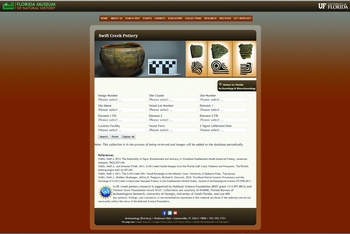
Figure 5 is a screenshot for the homepage of the database. There are 12 searchable fields, all with dropdown menus that permit searches for particular values or “all.” Not all of the variables described above for the database are presently available from the web portal. Perhaps most conspicuously, the NAA and ceramic petrographic groupings are still in development and not yet accessible via the web portal, but could be made available on request.
The database homepage (http://www.flmnh.ufl.edu/swift-creek/?).

A search for a particular vessel number returns results that identify, at a minimum, the associated design number; the name and number of the site where the vessel lot was identified; the site cluster with which that site is associated; the curation facility for the vessel or sherds; the elements and element fill; an image of the design drawing; and a photo of representative sherds from which the design was drawn. If the vessel lot is comprised of a vessel or vessel fragment of sufficient size for form analysis, the form, rim type, and orifice diameter will also be returned. Likewise, if the vessel lot has one or more associated chronometric dates, the query will also return the sample identification number, sample material, dating method, years before present (1950), and reference. The same results are returned for a search for a particular design number, although here the output will include multiple vessel lots if the design has been identified on what is presumed to represent another, distinct vessel.
Searching by a particular cluster will return a list of all the designs that have been identified in that region, as well as the vessel lots that are associated with these designs. Similar results are obtained by searching by site number, site name, or curation facility. One may also query the database by vessel form to identify all of the designs and vessel lots that have been identified for a particular vessel form.
Finally, but perhaps of greatest utility for many researchers in the region, the database includes two searchable fields for elements and fill that may facilitate the identification of paddle matches. For example, searching for a particular type of element, such as a circle, will result in a list of designs for which this element has been identified, along with the photograph and drawing and corresponding information regarding site, site cluster, vessel lot, etc. Searching for a particular element and fill, such as “circle” and “concentric,” will narrow the results to designs with concentric circle, or “bullseye,” elements.
SUMMARY
The database we have described provides an open-access, digital platform for the sharing of primary data regarding Swift Creek pottery. We view this database not only as a critical component of our own research, but also as a platform for collaboration among researchers that will facilitate broad syntheses of the region, consistent with the goals of Participatory Network Scholarship (Veletsianos and Kimmons Reference Veletsianos and Kimmons2012). Of course, another potential benefit of an open-access database is that it may inspire scholarship on topics other than those we have envisioned, perhaps on finer points of Swift Creek art. For example, Swift Creek designs may be relevant to scholars with interests in symmetry (Pluckhahn Reference Pluckhahn2007), design (Smith and Knight Reference Smith and Knight2012, Reference Smith and Knight2014), and iconography (Snow Reference Snow1975, Reference Snow, Williams and Elliott1998). In addition, the database itself may be of interest to researchers in other areas of the world with traditions of paddle-stamped pottery, as well as similar decorative traditions in other media such as paint. In this sense, we hope the database will serve not only as a tool for understanding prehistoric social networks, but also as a networking platform for contemporary scholars with interests both within the region and beyond.
Acknowledgments
This material is based upon work supported by the National Science Foundation under Grant No. 1111497. Additional support was provided by the Wenner-Gren Foundation, the Florida Museum of Natural History, and the Department of Anthropology at the University of South Florida. The database includes artifacts curated by the Florida Bureau of Archaeological Research, the Florida Museum of Natural History, the University of Georgia Laboratory of Archaeology, the University of South Florida, the National Museum of the American Indian, and Valdosta State University. We gratefully acknowledge these institutions, as well as the Georgia Department of Natural Resources and the U.S. Army Corps of Engineers for providing access to collections. For assistance with Swift Creek design illustrations, we thank Amanda O'Dell, Katrina Heller, and Chelsea Locke. Three anonymous reviewers provided thoughtful comments, for which we also express our gratitude. Alexander Delgado provided assistance with the Spanish abstract. Finally, we thank Andrew Smith and the staff in the Office of Museum Technology at the FLMNH for developing the web application and especially Taylor Wilson for his efforts in troubleshooting the program and helping to describe the technical aspects of the export process.
Data Availability Statement
The open-access database that we describe in this paper includes pottery curated at five principal repositories: the Florida Bureau of Archaeological Research, the Florida Museum of Natural History, the University of Georgia Laboratory of Archaeology, the University of South Florida, and the National Museum of the American Indian. Access to the collections was granted by these institutions, as well as by the Georgia Department of Natural Resources and the U.S. Army Corps of Engineers. Paper records of the data incorporated into the database are curated at the University of South Florida and the Florida Museum of Natural History.