Mechanical circulatory support is an invaluable tool in the care of children with severe refractory cardiac and or pulmonary failure.Reference Jacobs1 Two forms of mechanical circulatory support are currently available to neonates, infants, and smaller children, namely extracorporeal membrane oxygenation and use of a ventricular assist device, with each technique having unique advantages and disadvantages. The intra-aortic balloon pump is a third form of mechanical support that has been successfully used in larger children, adolescents, and adults, but has limited applicability in smaller children.Reference Jacobs1 As the field of mechanical circulatory support has evolved in children, the indications for use have expanded, and outcomes have improved. When combined with an active programme for transplantation, mechanical circulatory support can have a significant impact on survival. The majority of the experience in children utilizes extracorporeal membrane oxygenation.Reference Duncan2 The summary provided in January of 2007 by the Extracorporeal Life Support Organization3 reported 6,556 cases of cardiac failure in neonates and children, accounting for 19% of all cases recorded since 1989. For such cardiac failure in neonates and children, almost three-fifths survive to separation from extracorporeal membrane oxygenation, and just over two-fifths survive to be discharged. In this review, we discuss the current experiences with extracorporeal membrane oxygenation and ventricular assist devices in children with cardiac disease.
Extracorporeal membrane oxygenation
Techniques
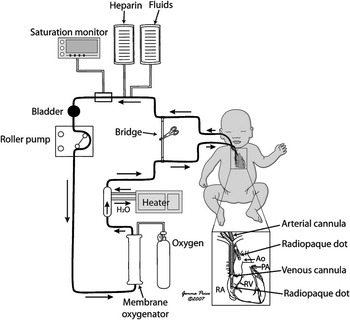
Systems for extracorporeal membrane oxygenation generally consist of a silicone membrane or hollow fiber oxygenator, a heat exchanger, a bladder, and a roller or centrifugal pump (Fig. 1). Venoarterial extracorporeal membrane oxygenation is usually required, since a majority of patients need cardiac support. Cannulation is transthoracic, with direct cannulation of the right atrium and aorta via a median sternotomy, cervical with cannulation of the right internal jugular vein and right carotid artery, or rarely the femoral approach is used. Because distension of the left heart can impede myocardial recovery, it is important to decompress the left atrium, either by balloon atrial septostomy,Reference Koenig, Ralston, Kimball, Meyer, Daniels and Schwartz4 or by placement of an additional drainage catheter in the left atrium that can be placed by the percutaneousReference Aiyagari, Rocchini, Remenapp and Graziano5 or transthoracic route.
Extracorporeal membrane oxygenation uses venoarterial bypass with a membrane oxygenator. This technique allows both haemodynamic and pulmonary support. Systems generally consist of a silicone membrane or hollow fibre oxygenator, a heat exchanger, a bladder, and a roller or centrifugal pump.

Indications
The indications for extracorporeal membrane oxygenation can be divided into two groups, those involving or not involving cardiac surgery. The indications related to cardiac surgery are:
• Pre-operative stabilization
• Failure to wean from cardiopulmonary bypass
• Low cardiac output syndrome in the post-operative period
• Cardiopulmonary arrest
The indications in the absence of cardiac surgery are:
• Cardiopulmonary arrest
• Myocarditis and cardiomyopathy
• Pulmonary hypertension
• Intractable arrhythmias
• Respiratory indications
Cardiac surgical extracorporeal membrane oxygenation for pre-operative stabilization
Mechanical circulatory support is occasionally required in neonates who present with profound cyanosis, and or cardiogenic shock. Examples include patients with obstructed totally anomalous pulmonary venous connection, and tetralogy of Fallot with absent pulmonary valve syndrome. Such patients may present close to death, and require preoperative stabilization with extracorporeal membrane oxygenation. Pulmonary hypertension refractory to conventional therapy can occur in neonates with transposed arterial trunks, and there are several reports of the successful use of extracorporeal membrane oxygenation for pre-operative stabilization.Reference Chang, Wernovsky, Kulik, Jonas and Wessel6, Reference Luciani, Chang and Starnes7 Another example is the neonate with severe Ebstein’s malformation of the tricuspid valve and functional pulmonary atresia with ductal-dependant flow of blood to the lungs that has a circular shunt from a wide open duct. Such a patient will benefit from extracorporeal life support while the pulmonary vascular resistance declines.Reference Di Russo, Clark, Bridges, del Nido, Wessel and Laussen8
Cardiac surgical extracorporeal membrane oxygenation for post-cardiotomy support
The role of extracorporeal membrane oxygenation to provide post-cardiotomy support for children with severe cardiopulmonary dysfunction after surgery for congenital cardiac disease is well established. Mechanical circulatory support may be required in the postoperative period, either due to the inability to separate from cardiopulmonary bypass, or a progressive low cardiac output syndrome due to a number of factors, such as ventricular dysfunction, pulmonary hypertension, or intractable arrhythmias. In this group of patients, it is imperative to rule out residual anatomic reasons with echocardiography and, if necessary, cardiac catheterization. Booth and colleaguesReference Booth, Roth and Perry9 have demonstrated that cardiac catheterization can be safely performed in children while on extracorporeal life support. The majority of patients requiring extracorporeal membrane oxygenation immediately after cardiopulmonary bypass remain cannulated via the median sternotomy with an atrial cannula and an arterial cannula in the aorta. Patients requiring support later in their post-operative course are more likely to be cannulated via the right internal jugular vein and right carotid artery. Bleeding is a major complication of extracorporeal membrane oxygenation after cardiac surgery. Re-exploration of the mediastinum is often necessary when transthoracic cannulation is used, increasing the risk of displacement of the cannula and infection.
Numerous publications have documented the experiences in individual centres.Reference Alsoufi, Shen and Karamlou10–Reference Morris, Ittenback and Godinez17 The combined experiences of these centres demonstrate that extracorporeal membrane oxygenation can allow survival of many children with congenitally malformed hearts and refractory cardiopulmonary dysfunction, with between onethird and three-fifths of patients surviving. Walters and colleaguesReference Walters, Hakimi, Rice, Lyons, Whittlesey and Klein16 reviewed 73 children with congenitally malformed hearts placed on extracorporeal membrane oxygenation. The patients were analyzed in three groups, those receiving support preoperatively, those who could not be weaned from cardiopulmonary bypass and were converted to support immediately after repair, and those cannulated postoperatively after an initial period of clinical stability. Overall survival for all patients was 58%. Survival to discharge was only 23% in patients who could not be weaned from cardiopulmonary bypass, compared to 69% in patients who were cannulated postoperatively after an initial period of clinical stability. These results support the theory that extracorporeal membrane oxygenation is most effective if initiated at some interval after being successfully weaned from cardiopulmonary bypass. Morris and colleaguesReference Morris, Ittenback and Godinez17 reported on the use of extracorporeal membrane oxygenation in 137 children seen from January 1995 to June 2001, with an overall survival to discharge of 39%. In this series, two-thirds required extracorporeal membrane oxygenation in the post-operative period. In this cohort, risk factors for mortality were age below 1 month, male gender, longer duration of mechanical ventilation before support, and development of renal or hepatic dysfunction while on support. Functionally univentricular physiology and failure to separate from cardiopulmonary bypass were not associated with an increased risk of mortality. Cardiac physiology and the indications for support were not associated with the incidence of death.
Extracorporeal cardiopulmonary resuscitation
As the familiarity and experience with extracorporeal membrane oxygenation has grown, new indications have evolved, including emergent resuscitation. This utilization has been termed extracorporeal cardiopulmonary resuscitation. del Nido and colleaguesReference del Nido, Dalton, Thompson and Siewers18 initially described the use of rapid resuscitation with extracorporeal membrane oxygenation after cardiopulmonary arrest. Limitations in available therapeutic modalities, combined with the effectiveness and familiarity of extracorporeal membrane oxygenation, have compelled most paediatric centres to use a conventional setup for cardiac support and emergency resuscitation. Although effective in providing pulmonary support, conventional extracorporeal membrane oxygenation may not be the best method of providing post-cardiotomy or emergent cardiopulmonary support. Extended times for cardiopulmonary resuscitation are a limiting factor in the effectiveness of any rescue during acute cardiac and or pulmonary failure, though prolonged effective cardiopulmonary resuscitation does not preclude survival and favourable neurologic outcomes.Reference Posner, Osterhoudt, Mollen, Jacobstein, Nicolson and Gaynor19 In these populations, extracorporeal membrane oxygenation has several limitations, including the prolonged times to set up the equipment, varying from 45 to 60 minutes, the large volumes needed for priming, from 450 to 800 millilitres, the increased postoperative loss of blood, and its unwieldiness during transport. In a retrospective study by Dalton and colleagues,Reference Dalton, Siewers and Fuhrman20 all patients with times of cardiopulmonary resuscitation less than 15 minutes survived, while only just over half survived when those times were greater than 42 minutes. Some centres have resorted to maintaining pre-primed circuits for allotted periods of time in an attempt to overcome the problem of prolonged setup. Use of these pre-primed circuits accepts the added risk of infection should the circuit become contaminated, and the expense of not using the circuit during the allotted time span.
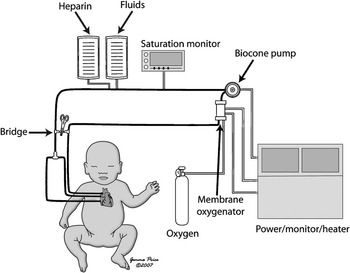
Due to the limitations of conventional circuits, some centres have developed novel systems for cardiopulmonary support. Duncan and colleaguesReference Duncan, Ibrahim and Hraska21 described a fully portable circuit that is maintained vacuum- and carbon dioxide-primed at all times. When needed, the circuit is primed with crystalloid, and can be ready for use within 15 minutes. In their experience of 11 children suffering full cardiopulmonary arrest, the median duration of resuscitation duration was 55 minutes, with two-thirds surviving to discharge. Ojito and colleaguesReference Ojito, McConaghey, Jacobs and Burke22 developed a modified miniaturized system suitable for neonates. The circuit was designed to accelerate the set-up, reduce the priming volume, eliminate the need for priming with blood even in neonates, and simplify transport. This system consists of a preassembled completely heparin-coated (Carmeda® Bio-Active Surface) circuit, a centrifugal blood pump, a Minimax® hollow fiber oxygenator, a Bio-Probe flow probe, and a BioTrend Oxygen Saturation and Hematocrit Monitor (Fig. 2), which can be assembled and primed in less than five minutes. Complete Carmeda® coating reduces the requirements for heparin in an effort to reduce postoperative loss of blood and the need for aggressive heparinization in the immediately post-resuscitated patient. Studies by Jacobs and colleagues,Reference Jacobs, Ojito and McConaghey23 and Hannan and colleagues,Reference Hannan, Ojito, Ybarra, O’Brien, Rossi and Burke24 have demonstrated the safe and effective implementation of this technology, with lower haemorrhagic complications involving the central nervous system, and survival to discharge of 48% and 54%, respectively. The potential disadvantages with this system include a limited durability for the oxygenator and an increased potential for air embolism. Advantages over conventional extracorporeal membrane oxygenation for children with congenital malformed hearts and refractory cardiopulmonary dysfunction include rapid set-up time with a bloodless prime, decreased postoperative loss of blood, and simplified transport.
This system for cardiopulmonary support in children consists of a preassembled completely heparin-coated (Carmeda® Bio-Active Surface) circuit, a centrifugal blood pump, a Minimax® Plus membrane oxygenator, a Bio-Probe flow probe, and a BioTrend Oxygen Saturation and Hematocrit Monitor. A Biomedicus external drive unit and a Minimax oxygenator bracket are attached directly to the patient’s bedside where the system can be assembled and primed in less than five minutes.

The literature supporting emergent cardiopulmonary support is mounting.Reference Thourani, Kirshborm and Kanter15, Reference Morris, Wernovsky and Nadkarni25–Reference Allan, Thiagarajan, Armsby, del Nido and Laussen27 The outcomes after initiation of support during active compressions of the chest following in-hospital cardiac arrest was reported by Morris and colleagues.Reference Morris, Wernovsky and Nadkarni25 Onethird of their cohort survived to discharge, with neither age, weight, or duration of compressions before extracorporeal cardiopulmonary resuscitation correlating with survival. No patient who received greater than 30 minutes of resuscitation without extracorporeal cardiopulmonary support survived, while one third of those receiving greater than 30 minutes of cardiopulmonary resuscitation survived with the use of extracorporeal support. Early neurologic assessment was unchanged compared to admission in half of the survivors, even when the duration of resuscitation was prolonged to greater than 60 minutes. In this series, children with isolated cardiac disease were more likely to survive following support than children with other medical conditions. A recent study by Alsoufi and colleagues26 presented a retrospective review of 80 consecutive children with a median age of 150 days, ranging in age from 1 day to 17.6 years, who were treated with venoarterial extracorporeal cardiopulmonary resuscitation as treatment for cardiac arrest refractory to conventional cardiopulmonary resuscitation. The authors report that three-tenths of their cohort had favourable outcomes, defined as hospital survival with grossly intact neurological state. Neither age, weight, sex, cardiac versus non-cardiac aetiology, duration of cardiopulmonary resuscitation, site of cannulation site, nor timing or location of extracorporeal membrane oxygenation proved to be a significant predictor of favourable outcome. The authors concluded that “Lack of predictors of poor outcome support aggressive attempts to initiate extracorporeal cardiopulmonary resuscitation in all patients followed by subsequent assessment of organ salvage.”26 A study by Allen and colleaguesReference Allan, Thiagarajan, Armsby, del Nido and Laussen27 reviewed the use of emergent cardiopulmonary support in patients undergoing cardiac catheterization over a period of 8 years. Indications for support included catheter-induced complication, severe low cardiac output syndrome and hypoxaemia. During cannulation, almost nine-tenths of their patients were undergoing compressions of the chest, with a median duration of cardiopulmonary resuscitation of 29 minutes. Just over four-fifths survived to discharge, with 5 needing cardiac transplantation. Of 19 patients who received cardiopulmonary resuscitation during cannulation, four-fifths survived to discharge, but almost half sustained neurologic injury. There was no significant difference between survivors and non-survivors in terms of age, weight, duration of cardiopulmonary resuscitation, duration of extracorporeal membrane oxygenation support, pH, or lactate levels.
Myocarditis and cardiomyopathy
Children with acute fulminant myocarditis can benefit greatly from mechanical circulatory support with eventual myocardial recovery. Similar to the experience in adults, survival is also excellent in children. Hence in children with acute myocarditis, persistent low cardiac output syndrome despite escalating inotropic support should be an indication for mechanical circulatory support. The Extracorporeal Life Support Organization reports that survival with myocarditis is highest for any diagnostic group, with almost three-fifths being successfully weaned from extracorporeal membrane oxygenation.3 Extracorporeal membrane oxygenation is the mechanical support of choice in these patients because of the speed with which it can be instituted and its easy reversibility. In this subgroup of patients, extracorporeal membrane oxygenation may be used as a bridge to recovery or transplantation. In a retrospective study by Duncan and colleagues,Reference Duncan, Bohn, Atz, French, Laussen and Wessel28 the technique was used in 12 patients with clinical, laboratory or endomyocardial biopsy-proven myocarditis as a bridge to recovery or transplantation, with just over four-fifths surviving. Deaths in this cohort of patients were secondary to post-support nosocomial infections. In more heterogeneous groups, Chen and colleaguesReference Chen, Yu and Huang29 and Asaumi and colleaguesReference Asaumi, Yasuda and Morii30 demonstrated a survival to discharge of almost three-quarters for patients with fulminant myocarditis treated with extracorporeal membrane oxygenation.
Extracorporeal membrane oxygenation can also be used as a bridge to transplantation in children with irreversible myocardial dysfunction.Reference del Nido, Armitage and Fricker31–Reference Gajarski, Mosca and Ohye33 This includes patients with dilated cardiomyopathy, restrictive cardiomyopathy, endstage congenital cardiac disease, and chronic graft dysfunction after transplantation.
Extracorporeal membrane oxygenation can also be used after heart transplantation. Indications for support in this setting include failure to separate from cardiopulmonary bypass and progressive low cardiac output syndrome in the immediate post-operative period, along with circulatory collapse due to rejection or graft vasculopathy later in the course.Reference Kirshbom, Bridges, Myung, Gaynor, Clark and Spray34, Reference Hoffman, Spray, Gaynor, Clark and Bridges35 Right heart failure and or pulmonary hypertension are often responsible for the inability to separate from cardiopulmonary bypass, and hence extracorporeal membrane oxygenation is the mechanical support of choice.
Galantowicz and colleaguesReference Galantowicz and Stolar36 examined the role of the technique as an adjunct to paediatric cardiac transplantation, using it as a bridge to transplantation in one-fifth of patients, in two-fifths to facilitate resuscitation of the cardiac allograft in the immediate postoperative period, while in just under onethird, it complemented therapy for severe rejection in the late postoperative period. Of the patients, three-fifths survived, all demonstrating normal function of the cardiac allograft. The Extracorporeal Life Support Organization has reported an overall survival of from onethird to two-thirds for this population.3
Pulmonary hypertension refractory to medical therapy
Selected patients with pulmonary hypertension refractory to medical therapy will benefit from extracorporeal life support.Reference Dhillon, Pearson, Firmin, Chan and Leanage37 A classic example is pre-operative stabilization of obstructed totally anomalous pulmonary venous connection when the patient is close to death, and in the post-operative period when the pulmonary vascular resistance may be transiently elevated. In this group of patients, it is important to rule out any residual pulmonary venous obstruction as a cause of pulmonary hypertension.
Mechanical support is controversial for patients with irreversible pulmonary hypertension, such as primary pulmonary hypertension, as the likelihood of survival as a bridge to lung transplantation or heart-lung transplantation is minimal.
Intractable arrhythmias with haemodynamic compromise
In select patients with malignant tachyarrhythmias and bradyarrhythmias, a short trial of mechanical support may be warranted to prevent circulatory collapse while medical therapy is being optimized, or prior to an attempt at radiofrequency ablation. Patients who have benefited from the use of mechanical support for this indication include those with lethal arrhythmias secondary to acute myocarditis or cardiomyopathy, supraventricular tachycardia, junctional ectopic tachycardia or ventricular tachycardia after cardiac surgery, and recalcitrant supraventricular tachycardia in the setting of Ebstein’s malformation.Reference Walker, McLeod, Brown, Franklin, Goldman and Davis38–Reference Pastuszko, Gruber and Wernovsky40 It is important to rule out residual lesions or coronary ischaemia in the post-cardiotomy patients. Extracorporeal membrane oxygenation has mostly been used for this indication, though there are occasional reports of the effective use of ventricular assist device as well.Reference Pastuszko, Gruber and Wernovsky40
Respiratory failure
Patients with congenital cardiac disease can develop respiratory failure due to parenchymal lung disease from viral infections, such as respiratory syncytial virus, adenovirus, and so on, or due to severe tracheobronchomalacia as seen in the severest form of tetralogy of Fallot with absent pulmonary valve syndrome. Patients with cyanotic disease who develop parenchymal lung disease can be supported with venovenous extracorporeal membrane oxygenation as a bridge to recovery or surgical palliation.Reference Imamura, Schmitz and Watkins41 Extracorporeal membrane oxygenation can also be used to provide short-term ventilatory support to allow time for definitive tracheal surgery in infants and children, in whom it would otherwise not be possible to achieve adequate gaseous exchange because of major airway disease and disruption as seen with long segment tracheal stenosis.Reference Goldman, Macrae and Tasker42
Extracorporeal membrane oxygenation in patients with functionally univentricular circulation
Many centres previously considered a functionally univentricular circulation to be a contraindication to extracorporeal membrane oxygenation, but improved results have been achieved recently with this complex subset of patients.Reference Pizarro, Davis, Healy, Kerins and Norwood43 Indications for extracorporeal life support in these children include inability to separate from cardiopulmonary bypass, low cardiac output refractory to conventional therapy, cardiopulmonary arrest, thrombosis of the shunt, and elective support. Techniques for oxygenation often require modifications in these patients. Jaggers and colleaguesReference Jaggers, Forbess and Shah44 among others have clearly demonstrated that the aorto-pulmonary shunt can be left open, as long as the flows are adjusted to maintain adequate systemic blood pressure, tissue perfusion, and gas exchange. Importantly with this strategy, patients may require increased flow through the pump of 150 to 200 millilitres per kilogram per minute due to a significant runoff via the shunt to the pulmonary bed. In these patients, if is often possible to isolate the membrane and thus utilize the circuit as a ventricular assist device. Mechanical ventilator support, and or sweep gas, should be adjusted to maintain adequate gas exchange.
The registry of the Extracorporeal Life Support Organization recently reported the outcome of extracorporeal life support used in neonates for cardiac indications from 1996 to 2000.Reference Hintz, Benitz and Colby45 Of the 740 neonates who were placed on extracorporeal life support for cardiac indications, 118 had hypoplastic left heart syndrome. There was no significant difference in survival between these patients and those with other defects. For patients with hypoplastic left heart syndrome, placement on extracorporeal life support, at greater than 15 days of age and shorter duration of extracorporeal life support, was significantly associated with better survival. Allan and colleaguesReference Allan, Thiagarajan, del Nido, Roth, Almodovar and Laussen46 reviewed their experience with the support of infants with shunted functionally univentricular circulations. Almost half survived to discharge. Patients cannulated for hypoxaemia, particularly with thrombosis of the shunt, had markedly improved survival compared with those supported primarily for hypotension or cardiovascular collapse. Survival did not differ depending on anatomic diagnosis. Ravishankar and colleaguesReference Ravishankar, Dominguez and Kreutzer47 examined the use of extracorporeal membrane oxygenation following the first stage of reconstruction for hypoplastic left heart syndrome and its variants. Almost two-fifths of their cohort survived to hospital discharge. Non-survivors had longer cardiopulmonary bypass time, need for support less than 24 hours after the initial reconstruction, and longer duration of support. All those with an acutely thrombosed shunt were early survivors. Half of their early survivors remained alive at a median follow-up of 20 months. Initiation of “non-elective” mechanical support in the early post-operative period after the first stage of Norwood reconstruction, therefore, is associated with poor outcome. This is likely secondary to irreversible myocardial ischaemia, and or residual haemodynamic issues such as obstruction in the aortic arch. Extracorporeal life support, nonetheless, can be life saving in infants with a functionally univentricular circulation with otherwise fatal conditions. It is particularly useful in potentially reversible conditions such as acute thrombosis of the shunt and transient depression of ventricular function.
Ungerleider and colleagues recently reported a role for use of “routine” mechanical ventricular assist device after the initial stage of reconstruction in an attempt to simplify post-operative management and improve hospital survival.Reference Ungerleider, Shen and Yeh48 They used a ventricular assist device after modified ultrafiltration, using the cardiopulmonary bypass cannulas in the right atrium and neo-aorta. Mean duration of mechanical support was 3 plus or minus 0.1 days, and almost nine-tenths survived to discharge. They also reported an improved early neurodevelopmental outcome. Routine mechanical support after the Norwood operation is a novel approach that addresses the increased cardiac output demands in the immediate post-operative period, and simplifies post-operative care, albeit that it will likely increase cost and the need for additional personnel.
There is very limited experience with mechanical support in patients with cavopulmonary connections.Reference Dalton, Siewers and Fuhrman20, Reference Klein, Shaheen, Whittlesey, Pinsky and Arciniegas49 The registry of Extracorporeal Life Support reported survival for one-quarter of patients with this physiology. In the largest retrospective study, Booth and colleaguesReference Booth, Roth, Thiagarajan, Almodovar, del Nido and Laussen50 reported on their institutional experience following bidirectional Glenn and Fontan operations. Only 1 patient with a bidirectional Glenn anastomosis survived, albeit with severe neurological damage. In those with the Fontan circulation, half survived to discharge, and onethird are alive at follow-up. Their report highlights some of the technical difficulties in this challenging group of patients. Patients with cavopulmonary connections are difficult to resuscitate effectively with conventional cardiopulmonary resuscitation. During resuscitation, the increase in intrathoracic pressure may restrict effective flow of blood to the lungs and oxygenation, as well as increasing cerebral venous pressure that may further limit cerebral perfusion. The cannulation of the patient with a bidirectional Glenn shunt is particularly challenging because of the separation of the systemic venous drainage, thus requiring placement of multiple venous cannulas. It is particularly important to achieve adequate and early decompression of the superior caval vein to maximize cerebral perfusion pressure, and thus potentially improve neurological outcome.
Principles of management on extracorporeal membrane oxygenation
While on extracorporeal membrane oxygenation, adequacy of systemic perfusion should be continuously assessed using the usual parameters such as urine output, acid-base status, mixed venous oxygen saturation, serum lactate, serum creatinine, and liver enzymes. As previously stated, one should evaluate for adequate left atrial decompression using serial chest radiographs and bedside echocardiography. Every effort should be made to minimize afterload using vasodilators such as milrinone. When using a membrane oxygenator, ventilator settings should be optimized to prevent lung injury but avoid atelectasis. In order to assess the neurologic state, every attempt should be made to avoid neuromuscular blockade. In infants with an open fontanelle, daily ultrasonic examinations of the head should be performed for the first 2 to 3 days to evaluate for intracranial haemorrhage. Daily blood cultures should be obtained from the circuit to monitor for infections. A continuous infusion of heparin is used for anticoagulation, aiming for a target activated clotting time of 180 to 220 seconds using the Kaolin® method. With the advent of Carmeda®-coated circuits, anticoagulation can be delayed 24 hours and maintained with a lower activated clotting time, particularly in the presence of significant post-operative bleeding. If there is no significant myocardial recovery over 3 to 5 days, the patient should be evaluated for cardiac transplantation and implantation of a ventricular assist device should be considered for long-term support as a bridge to transplantation.
Long-term follow-up
Data regarding neurodevelopmental outcomeReference Hamrick, Gremmels and Keet51, Reference Ibrahim, Duncan, Blume and Jonas52 of long-term survivors of extracorporeal membrane oxygenation is emerging. Ibrahim and colleaguesReference Ibrahim, Duncan, Blume and Jonas52 reported on 37 children who survived mechanical circulatory support, 26 with extracorporeal membrane oxygenation and 11 with a ventricular assist device, who were followed for an average of more than 4 years. Only one patient died in either group. Four-fifths of children in both groups were reportedly in excellent general condition, and ventricular function by echocardiographic evaluation was normal in all the survivors of extracorporeal membrane oxygenation, and nine-tenths of those surviving after use of the assist device. More than three-fifths of children supported with extracorporeal membrane oxygenation had moderate to severe neurologic impairment, whereas only one-fifth of those surviving having had a ventricular assist device demonstrated the same degree of neurologic impairment. These results may suggest an advantage for use of the ventricular assist device, possibly because of decreased requirements for anticoagulation, with less risk for intracranial haemorrhage. These results must be interpreted with caution, as the group supported with extracorporeal membrane oxygenation had a greater proportion of critically ill neonates, with more complex underlying cardiac conditions.
Ventricular assist devices
Although extracorporeal membrane oxygenation has become a standard of care for many paediatric centres, its use is limited to those patients who require only short-term cardiopulmonary support. Mechanical support devices have become standard therapy for adults with cardiac failure refractory to maximal medical management. Several devices are readily available in the United States of America for adults, but there are fewer options available to children. Over the last few years, substantial progress has been made in paediatric mechanical support.Reference Duncan53 Ventricular assist devices are being used with increasing frequency in children with cardiac failure refractory to medical therapy for primary treatment as a long-term bridge to recovery or transplantation.Reference Blume, Naftel and Bastardi54 Mechanical circulatory support should be anticipated, and every attempt must be made to initiate support “urgently” rather than “emergently” before the presence of dysfunction of end organs or circulatory collapse. In an emergency, these patients can be resuscitated with extracorporeal membrane oxygenation and subsequently transitioned to a long-term ventricular assist device after a period of stability. Destination therapy, defined as intracorporeal insertion of a ventricular assist device with the goal of “permanent support”, is currently not an option in children.
Pulsatile devices
Experience in children with long-term pulsatile devices is growing.Reference Hetzer, Potapov and Stiller55–Reference Schmid, Debus and Gogarten57 These devices offer univentricular or biventricular support. Children do not require mechanical ventilation, and are able to be mobilized out of the intensive care unit on relatively low-levels of anticoagulation. Some disadvantages include thromboembolic complications, infection, and cost. The Berlin Heart, or EXCOR, is a paracorporeal pneumatically-driven pulsatile ventricular assist device. The blood pumps, available in a variety of sizes, have a transparent polyurethane housing which divides an air chamber and blood chamber by a triple layer membrane. Inlet and outlet mechanical valves are tri-leaflet, and all surfaces of the pump are coated with a Carmeda® BioActive Surface coating. In the United States of America, the Berlin Heart is not currently approved by the federal Food and Drug Administration. It is available, however, for use under a compassionate protocol as a bridge to transplantation. A review of the current data from the world-wide experience using the Berlin Heart in children shows that in Europe, the United States of America, Canada, Argentina and China, 282 children have been supported on this device (Robert Krosolowitz, Berlin Heart, AG, Berlin, Germany, personal communication). Of these, about one third was supported in North America. The mean age in this population is 4.1 years. The mean period of support in North America is 46 days, and 57 days world-wide. Of the patients, seven-tenths were placed on the device for dilated cardiomyopathy, myocarditis or complex congenital cardiac disease. Almost half of all patients were subsequently transplanted, with one-eighth currently weaning, and another eighth currently on the device. Just over one-quarter died whilst on the device, with the outcome unknown in a very small proportion.
The MEDOS-HIA VAD, another paracorporeal, pneumatically driven blood pump, is available in Europe in three sizes for the left ventricle, providing stroke volumes of 10, 25 and 60 millilitres, and three sizes for the right ventricle, giving volumes of 9, 22.5, and 54 millilitres. This system has also been successfully used for long-term support and bridge to transplantation.Reference Kaczmarek, Sachweh and Groetzner58 The Thoratec Ventricular Assist System, Abiomed’s AB5000 Circulatory Support System, and HeartMate are pulsatile assist devices that can be used in larger children and adolescents.Reference Reinhartz, Stiller, Eilers and Farrar59 Due to size, these systems are not practical for use in children with a body surface area smaller than 0.8 metres squared. Sharma et al.Reference Sharma, Webber and Morell60 reviewed their experience with pulsatile ventricular assist devices as a bridge to heart transplantation in 18 patients over a period of 15 years. Diagnoses included dilated cardiomyopathy, myocarditis, and ventricular failure after cardiac surgery. Biventricular devices were used in just over half, with only left ventricular assist devices used in the remainder. The mean duration of support was 57 days, with eventual successful transplantation being achieved in just over three-quarters. Complications included bleeding requiring re-operation, stroke and device-related infection. Over four-fifths of the patients remained alive at 1 and 5 years after orthotopic cardiac transplantation.
Axial flow devices
Although the experience with these ventricular assist devices is limited in children, they have been used successfully in those aged from 5 to 16 years with a body surface area of greater than or equal to 0.7 meters squared. Advantages of axial pumps include their small size, the relatively ease of implantation and explantation, low rates of infection, and continuous flow that minimize formation of thrombus. Disadvantages include non-pulsatile flow, the limitation of size for children, and larger-sized ventricular apical cannulation. The MicroMed DeBakey VAD® was designed as a miniaturized heart pump to provide flow of up to 10 litres per minute. The implantable pump weighs less than four ounces, and contains only one moving part, the impeller. In the United States of America, this device was approved in February, 2004, under the humanitarian device exemption, and has been used successfully to bridge several children to cardiac transplantation.Reference Fraser, Carberry and Owens61 The Jarvik-2000 is a similar intravascular assist device made of titanium, measuring 25 millimetres in diameter, and 55 millimetres in length. The impeller rotates at 8,000 to 12,000 revolutions per minute, generating a flow of 3 to 6 litres per minute. It is currently under evaluation in young animals.Reference Kilic, Nolan and Li62
A comparison of extracorporeal membrane oxygenation and ventricular assist devices
Despite recent advances in the technology for ventricular assist, extracorporeal membrane oxygenation remains the most common system used for circulatory assist in children. Its advantages include its familiarity among practitioners, its ability to provide biventricular support and respiratory support, its universal availability across all ages of children, and its relative low cost. Unlike in adults, in whom pure left ventricular failure is the common indication for mechanical support, cardiopulmonary support is more commonly required in children due to a combination of pulmonary dysfunction, pulmonary hypertension, and right ventricular dysfunction. This is particularly true in the immediate post-operative period. Extracorporeal life support is obviously the mechanical support of choice for rapid deployment during cardiopulmonary arrest. There are a number of disadvantages, including the need for a dedicated team of specialists, immobilization, requirement for intensive care monitoring, and risks of bleeding, thrombosis, infection, and multiorgan failure. These attendant disadvantages increase over time and hamper the use of extracorporeal membrane oxygenation for long-term support. The advantages of ventricular assist devices include less trauma to blood cells, decreased need for anticoagulation, and decreased risk of infection. Implantable devices allow greater mobility for cardiac rehabilitation and have chronic support capability as a bridge to transplantation. Their disadvantages include the need for transthoracic cannulation, while extracorporeal membrane oxygenation can be initiated with peripheral cannulation. In addition, biventricular support with ventricular assist devices requires four cannulas, whereas extracorporeal membrane oxygenation provides biventricular support with two cannulas.
Summary
A variety of forms of mechanical circulatory support are available for children with cardiopulmonary dysfunction refractory to conventional management. These devices require extensive resources, both human and economic. Extracorporeal membrane oxygenation can be effectively used in a variety of settings to provide support to critically-ill patients with cardiac disease. Careful selection of patients and timing of intervention remains challenging. Special consideration should be given to children with cardiac disease with regard to anatomy, physiology, cannulation, and circuit management. Even though exciting progress is being made in the development of ventricular assist devices for long-term mechanical support in children, extracorporeal membrane oxygenation remains the mainstay of mechanical circulatory support in children with complex anatomy, particularly those with a functionally univentricular circulation, and those needing rapid resuscitation.