





Introduction
In democratic countries, political parties are usually expected to represent voters, meeting their demands and fulfilling the electoral promises made during electoral campaigns. However, when elected to public office, parties often face multiple pressures to behave responsibly. At times, the duties of government may conflict with voters’ demand for representation, generating a trade-off that has been called the ‘responsibility–responsiveness dilemma’ (Mair Reference Mair and Mair2014), which can potentially lead to a crisis of representation.
Since the 1980s, several elements ranging from the globalization of the economy to the internationalization of policy parameters, the growing role of agencies, bureaucracies, international treaties, and supranational organizations, as well as the de-alignment and the cartelization of political parties, contributed to binding the hands of traditional parties, widening the gap between responsiveness and responsibility.
In this context, mainstream parties, forced to take responsible (but often unresponsive) choices, started to face competition from new types of actors, such as niche (e.g., Ibenskas and Polk Reference Ibenskas and Polk2026; Meyer and Miller Reference Meyer and Miller2015) and populist parties (e.g., Rooduijn, Pirro, Halikiopoulou et al. Reference Rooduijn, Pirro, Halikiopoulou, Froio, Van Kessel, De Lange, Mudde and Taggart2024; Zulianello, Albertini and Ceccobelli Reference Zulianello, Albertini and Ceccobelli2018), which put their emphasis on responsiveness. Challenged by these niche and populist (irresponsible but responsive) rivals, while dealing with the everyday constraints put on responsiveness, traditional parties felt compelled to explain and justify their (nonresponsive) choices to voters, seeking to convince them of the necessity of responsible policymaking to contain potential electoral backlash resulting from unmet voter demands.
It is not by chance that the trade-off between responsiveness and responsibility is echoed in public debates, particularly but not solely in times of crisis. Ruling politicians often claim that their policies are designed to live up to their responsibilities or appeal to the sense of responsibility of citizens and political actors while engaging in responsible policymaking (for examples related to the Eurozone crisis, see: Karremans and Lefkofridi Reference Karremans and Lefkofridi2020). In doing so, politicians may refer to the supreme national/public interest, or to national unity/solidarity and the pursuit of the common good, emphasizing the importance of duties, over rights, and calling for public-spiritedness to discourage egoistic and irresponsible behavior, to the advantage of the whole community.
Going beyond the implementation of responsible policymaking, the present article focuses on the rhetoric of responsibility to investigate which elements affect parties’ propensity to adopt such an electoral strategy in party manifestos. We argue that the rhetoric of responsibility is used either by parties that trade responsiveness for vote-maximizing strategies, to explain and justify their deviation from their traditional standpoints (Ceron, Scopelliti and Grechanaya Reference Ceron, Scopelliti and Grechanaya2025; Gunderson Reference Gunderson2024), or by parties that want to claim credit (retrospectively) for their responsible actions. Accordingly, we hypothesize that such a strategy will be emphasized more by parties that are moderating their policy positions (Johns and Kölln Reference Johns and Kölln2020), trying to win the support of new moderate voters (on a policy ground), while appealing to the loyalty and the sense of responsibility of traditional partisans, to retain their support (Karreth, Polk and Allen Reference Karreth, Polk and Allen2013; Somer-Topcu Reference Somer-Topcu2015). Additionally, we argue that large incumbent parties, which have led the cabinet’s policy agenda (Sagarzazu and Klüver Reference Sagarzazu and Klüver2017b; Spoon and Klüver Reference Spoon and Klüver2017), can use this strategy to claim credit for the governmental duties faced during their office term, particularly under favorable economic conditions. Conversely, populist and niche parties, which focus their attention on being more responsive toward the voters (Abou-Chadi and Stoetzer Reference Abou-Chadi and Stoetzer2020; Bergman and Hjermitslev Reference Bergman and Hjermitslev2025; Werner and Giebler Reference Werner and Giebler2019), will be less prone to emphasize responsibility.
To test our hypotheses, we combine LLMs and semisupervised topic models, focusing on digitized manifestos made available by the Comparative Manifesto Project (MARPOR/CMP: https://manifesto-project.wzb.eu/). Through the manifestoberta LLM we classified the natural sentences of party manifestos into the 56 categories of the MARPOR/CMP coding scheme. We applied the Seeded-LDA (Watanabe and Baturo Reference Watanabe and Baturo2024), a semisupervised topic model that classifies sentences into predefined topics, to refine one of these heterogenous coding categories, by selecting only sentences that align with our concept of responsibility rhetoric. As a robustness check, we also replicate this measurement using an LLM, asking OpenAI to perform the same task, splitting the original MARPOR/CMP category into subunits.
In total, we analyzed up to 1,927 manifestos from 586 parties across 38 countries, 5 continents, and 22 different languages, all related to election campaigns held between 1980 and 2021. The results support our hypotheses and are robust to different operationalizations of the dependent variable.
The contribution of this article is twofold. On the one hand, this article presents an efficient methodological strategy (based either on semisupervised text analysis or on LLMs) suitable for digging into the content of party manifestos further, splitting heterogenous MARPOR/CMP categories that contain references to multiple topics into smaller and more specific subcategories. On the other hand, by investigating the usage of responsibility rhetoric, it provides substantive results that engage (directly or indirectly) with several streams of literature, ranging from political representation to responsiveness and ideological congruence, moderation, and party competition, as well as niche and populist parties.
Theoretical framework
Responsibility versus responsiveness
For a long time, scholars focused on political parties as chief actors in the chain of representation, linking voters with parliaments, cabinets, and policy outputs. Indeed, one of the main tasks of political parties was deemed to represent the preferences of voters and specific interest groups, proposing alternative policy platforms to win votes, trying to get access to public offices and to enact public policies in line with their electoral manifesto and with the promises made to voters during the election campaign. In a few words, parties were expected to represent voters and to respond to them. When elected to public office, however, parties also face multiple pressures to behave responsibly. At times, the duties of government may conflict with voters’ demand for representation, generating a trade-off that has been called the ‘responsibility–responsiveness dilemma’ (Mair Reference Mair and Mair2014). As Peter Mair (Reference Mair and Mair2014) argued, the potential gap between responsiveness and responsibility has always existed, even though in recent decades, and particularly since the 1980s, several elements contributed to widening the gap and such a growing tension between responsiveness and responsibility has generated a so-called crisis of representation.
Indeed, processes such as the globalization of the economy, including that of financial markets (Ezrow and Hellwig Reference Ezrow and Hellwig2014) that are essential for sovereign debt financing, the internationalization (and Europeanization, for the European Union [EU] countries) of policy parameters, the de-alignment and the cartelization of political parties, the growing relevance of international treaties, supranational organizations and networks (e.g., the European Union or other regional networks, the United Nations, the World Trade Organization, the World Health Organization, etc.) as well as (local, national, and international) agencies and bureaucracies (including courts, central banks, credit rating agencies), have increased the constraints that parties face once in office, binding their hands and reducing their leeway and the opportunity to fulfill the electoral mandate, responding to voters’ demands.
Forced to deal with these constraints, and to stick to a responsible style of policymaking, parties seem less able to represent the interests of voters and to enact the alternative policy platforms proposed during the election campaign.Footnote 1 This entails a detachment from the idea of responsiveness, making it harder and harder to bridge the gap between responsibility and responsiveness, but even to justify their (nonresponsive) political actions, persuading voters to accept the responsible policies as a necessary element of everyday politics (Mair Reference Mair and Mair2014).
As a reaction to such a crisis of representation, over the years new models of parties emerged. In particular, scholars investigated the rise of niche (e.g., Bergman and Hjermitslev, Reference Bergman and Hjermitslev2025; Ibenskas and Polk Reference Ibenskas and Polk2026; Meyer and Miller Reference Meyer and Miller2015) and populist parties (e.g., Rooduijn, Pirro, Halikiopoulou et al. Reference Rooduijn, Pirro, Halikiopoulou, Froio, Van Kessel, De Lange, Mudde and Taggart2024; Zulianello, Albertini and Ceccobelli Reference Zulianello, Albertini and Ceccobelli2018), sometimes also called ‘anti-establishment’ or ‘anti-cartel’ parties, which criticized the cartelization of politics and accused the political elites of having betrayed the interests of voters, making the case for restoring the focus on responsiveness (even by getting rid of internal and external constraints).
Challenged by competition from niche and populists (irresponsible but responsive) rivals, while dealing with the everyday constraints put on responsiveness, traditional parties had to justify their (non-responsive) choices and to convince voters about the need for responsible policymaking, to contain the potential electoral damage due to the failure of meeting voters’ demands. In this regard, the present article aims to investigate the propensity to adopt the rhetoric of responsibility as an electoral strategy in party manifestos.
But what exactly is responsibility? For several years this term was used interchangeably to refer to different unrelated concepts (ranging from accountability to coherence or efficiency), generating ambiguity around its interpretation. In recent years, several studies have contributed to clarifying its conceptualization.
Notably, Mair (Reference Mair2009; Reference Mair and Mair2014) provided a summary of the main definitions that scholars assigned to that concept, and he started to highlight some elements related to a conventional notion of responsibility, which includes acting within the boundaries of accepted practices, following legal and procedural rules, and acting from a sense of duty. This also implies a moral responsibility toward the country and toward the future as well as the avoidance of recklessness in policymaking (thus avoiding making unfeasible promises during election campaigns, as irresponsible populists instead would do), in favor of prudent and professional behavior, suitable to deal with and solve the major problems faced by the country.
In this regard, responsibility can also entail delivering unpopular policies (Mair Reference Mair, Streeck and Schafer2013), especially in times of crisis. Indeed, the public debate around austerity largely relied on the need for responsible policies, widely emphasized by policymakers to justify the adoption of such economic measures (Karremans and Lefkofridi Reference Karremans and Lefkofridi2020), often with a crucial role played by technocrats and experts (it is not by chance that responsibility has been investigated with respect to technocracy too: Caramani Reference Caramani2017). At the same time, policymakers also asked citizens to show their sense of responsibility and their public-spiritedness, leaving aside their selfish particularistic interests (Caramani Reference Caramani2017) in favor of an alleged common good, and accepting sacrifices in the short term to prioritize the long-term welfare of the whole country.
Interestingly, these elements perfectly match with the minimal definition of responsibility provided by Bardi and colleagues (Reference Bardi, Bartolini and Trechsel2014a; Reference Bardi, Bartolini and Trechsel2014b), who define it as the necessity to consider ‘the long-term needs of their people and countries’ (rather than the short-term demands of voters, public opinion, or interest groups) and ‘the claims of audiences other than the national electoral audience’ (Bardi, Bartolini and Trechse Reference Bardi, Bartolini and Trechsel2014b: 237).
Analogously, several scholars agree that responsibility basically refers to the long-term national interest (Goetz Reference Goetz2014; Karremans and Damhuis Reference Karremans and Damhuis2020; Karremans and Lefkofridi Reference Karremans and Lefkofridi2020; Powell Reference Powell2004: 99), up to the point that parties emphasizing responsibility seem less focused on ‘representing interests of the citizens to the state’ and more on ‘representing interests of the state to the citizens’ (Mair Reference Mair2009: 6).
Summing up, we consider responsibility as a multifaceted concept that includes several elements directly or indirectly mentioned in all these recent definitions. More in detail, we argue that responsibility refers to the duties of ruling the country (namely, the everyday responsibilities of office), with a focus on the (internal or external) constraints and commitments that tie the hands of parties, such as domestic constitutional constraints, international constraints (e.g., treaties), prior policy commitments and agreements (including those enacted by past governments), budget constraints, and courses of action imposed by national or international agencies and institutions.
The need for meeting budget constraints or pursuing the national interest (for instance by preserving the traditional long-standing international geopolitical alliances of the country) and the common good (if there is a common good, by definition, there is no viable policy alternative), forces parties to stick to certain shared positions, irrespective of their ideological stances. This limits the room for discretionary maneuvers in policymaking and obliges parties to take specific political actions that are often, although not always, incompatible with the demands for responsiveness.
In fact, although Mair (Reference Mair2009) points to the trade-off between responsibility and responsiveness, in some contexts these two elements align, and we may observe a ‘responsive responsibility’. For instance, during the COVID-19 pandemic, the lockdowns and the efforts to provide vaccines or social and financial help to citizens were widely approved by voters, generating a rally around the flag effect (Bremer, Kuhn, Meijers et al. Reference Bremer, Kuhn, Meijers and Nicoli2024).
Responsibility rhetoric: theory and hypotheses
Although responsibility may (or may not) be associated with specific policy positions, this article focuses on the rhetoric of responsibility, rather than on responsibility in terms of concrete policy outcomes. We examine how responsibility rhetoric is used to justify (or to support) political positions, irrespective of whether these positions can actually be considered responsible. In this regard, we analyze responsibility rhetoric independently of parties’ viewpoints, bearing in mind that different parties can credibly argue that different policies are responsible. Nevertheless, we expect some parties to rely on this rhetoric more than others (Ceron, Scopelliti and Grechanaya Reference Ceron, Scopelliti and Grechanaya2025).
Indeed, in the effort to explain and justify (unwanted and/or unpopular) political choices, parties can resort to the rhetoric of responsibility. In doing so, we expect them to underline the country’s national interest, and more in general the public interest, emphasizing the duties (over the rights), the importance of national unity and national solidarity, the collective responsibility of all, and the need to show public-spiritedness, avoiding to pursue particularistic interests in favor of the common good of the whole national community, even when this requires accepting the short-term costs associated with unpopular polices (sometimes linked with external constraints or supranational commitments), avoiding egoistic protests and irresponsible antisocial behavior (especially in troubled times).
Indeed, during election campaigns, parties can exploit political communication strategies to bridge the gap between responsibility and responsiveness. Mair (Reference Mair2009: 15) argued that these strategies were definitely used in the past as parties always justified the evasion of election promises citing ‘difficult circumstances’ and ‘inauspicious developments’ and tried to convince their reluctant partisan voters to continue supporting the party, despite the lack of responsiveness toward them, through appeals to ‘popular loyalty and trust’ (i.e., exactly the same rhetoric discussed above).
Although Mair was more skeptical about the idea that such strategies could still be effective today (as the gap between responsibility and responsiveness is getting larger), other scholars (e.g., Lefkofridi and Nezi Reference Lefkofridi and Nezi2020) believe that parties can still succeed in doing so, for instance through ambiguity and position blurring (Somer-Topcu Reference Somer-Topcu2015), reshaping the political agenda (Greene Reference Greene2016), emphasizing valence elements rather than positional ones, and depoliticizing the responsible policy (Lefkofridi and Nezi Reference Lefkofridi and Nezi2020).
Taking our cue from this, we argue that the rhetoric of responsibility, as defined so far, can be used by parties to explain and justify policy shifts away from their long-standing positions, trying to persuade (traditional) voters to re-align behind the new (responsible but unresponsive) political course.
Since the 1980s, the ties between mainstream party organizations and their core voters were significantly weakened, and the process of cartelization of political parties (Katz and Mair Reference Katz and Mair1995) brought many of them to shift away from their traditional long-standing positions to address a wider electorate.
In doing so, parties often moderate their policy stances as an attempt to adopt vote-maximizing platforms and increase their votes share. Indeed, some studies suggest that policy moderation can help parties to win more votes, not only in two-party systems (e.g., Downs Reference Downs1957), but also in multiparty systems (Abou-Chadi and Stoetzer Reference Abou-Chadi and Stoetzer2020; Adams, Merrill and Grofman Reference Adams, Merrill and Grofman2005; Adams and Somer-Topcu Reference Adams and Somer-Topcu2009; Johns and Kölln Reference Johns and Kölln2020; Lo, Proksch and Slapin Reference Lo, Proksch and Slapin2016), at least in the long run (Adams and Somer-Topcu Reference Adams and Somer-Topcu2009).Footnote 2
However, policy moderation is not exempt from risks. In fact, moderating the party position may also be a damaging strategy as party activists, members, and core voters could feel betrayed by such a shift and may react negatively, withdrawing their support (Aldrich Reference Aldrich1983; Gunderson Reference Gunderson2024; Karreth, Polk and Allen Reference Karreth, Polk and Allen2013; Somer-Topcu Reference Somer-Topcu2015).
Aware of such a potential backfire effect, we argue that parties that are moderating their policy platforms can resort to the rhetoric of responsibility to explain and justify this gap in responsiveness toward their traditional core voters. By doing that, they can try to convince these voters about the ineluctable need for such policy change, hoping to preserve their electoral support.
In this regard, combining policy moderation with responsibility rhetoric can help parties to appeal broadly (Somer-Topcu Reference Somer-Topcu2015), trying to win the support of new moderate voters (on a policy ground, as these voters will feel ideologically closer to the party after its policy shift), while appealing to the loyalty and the sense of responsibility of traditional partisans, to retain their support.Footnote 3 As such, we hypothesize what follows.
Hypothesis 1 (H1): Parties that are moderating their policy platforms will put more emphasis on the rhetoric of responsibility, compared with other parties.
The flip side of this hypothesis involves the role of populists and niche parties. As discussed above, the rise of these parties was considered as a reaction to the process of cartelization of politics, with mainstream parties that started to be challenged by such antiestablishment rivals (Mair Reference Mair2009).
Due to societal changes and reshuffles in the structure of party systems (including the dynamics of de-alignment, moderation, and centripetal competition outlined so far), some voters were (or felt) no longer represented by established parties, thus switching their vote choice to these alternative competitors (Werner and Giebler Reference Werner and Giebler2019).
In this context, it has been argued that these parties can help to close a representational gap for citizen groups that other parties (allegedly) fail to represent, providing an answer to the unmet substantive policy preferences of such voters (Werner and Giebler Reference Werner and Giebler2019).
It is not by chance that, over the years, scholars have witnessed an increasing electoral support for populist parties, which propose policy alternatives that are usually focused on short-term commitments, rather than on the long-term effectiveness and sustainability of their policies; in this regard, such parties are often considered to be over-responsive but irresponsible (Mair Reference Mair2009).
Recent empirical studies based on different perspectives (for a review: Werner and Giebler Reference Werner and Giebler2019) found that populist parties (especially right-wing ones: Plescia, Kritzinger and De Sio Reference Plescia, Kritzinger and De Sio2019) seem at least slightly more responsive than their mainstream counterparts, contributing to closing the gap opened by societal and party system developments, with some positive (albeit small and limited) effects in terms of political representation (Werner and Giebler Reference Werner and Giebler2019). Responsiveness is indeed the core representation feature for populist parties, as they maximize the emphasis on it while rejecting the idea of responsibility (Caramani Reference Caramani2017).
Besides populism, nicheness was identified as a key variable in the study of party responsiveness (Bergman and Hjermitslev Reference Bergman and Hjermitslev2025; Ibenskas and Polk Reference Ibenskas and Polk2026). Several studies compared niche and mainstream parties, showing that the policy shifts of mainstream parties are in line with the centripetal general electorate model of party competition, as these parties focus on the preferences of the general public (Adams, Clark, Ezrow et al. Reference Adams, Clark, Ezrow and Glasgow2006). Conversely, niche parties tend to respond to shifts in the mean position of their supporters (Bergman and Hjermitslev Reference Bergman and Hjermitslev2025; Ezrow, De Vries, Steenbergen et al. Reference Ezrow, De Vries, Steenbergen and Edwards2011; see also: Abou-Chadi and Stoetzer Reference Abou-Chadi and Stoetzer2020).
Such responsiveness of niche parties toward their partisan voters is often linked to the policy-seeking nature of these parties, whose activists and core voters are strongly policy motivated and highly resistant to ideological compromises (Adams, Clark, Ezrow et al. Reference Adams, Clark, Ezrow and Glasgow2006; Bergman and Hjermitslev Reference Bergman and Hjermitslev2025). As such, the implementation of responsible (but unresponsive) policymaking would be detrimental to their electoral performance and references to the rhetoric of responsibility should be avoided in their party manifestos.
Hypothesis 2 (H2): Niche and populist parties will put lower emphasis on the rhetoric of responsibility, compared with other parties.
Lastly, another element that can affect parties’ propensity to emphasize responsibility in their manifestos refers to their incumbency status. Ruling parties must face the burdens of office and must deal with government duties, so that the alleged responsiveness–responsibility dilemma will potentially constrain them (Lefkofridi and Nezi Reference Lefkofridi and Nezi2020). Affected by such constraints, the incumbent parties may have more incentives to exploit the rhetoric of responsibility.
Indeed, it has been argued that, forced to downplay their representative role, ruling parties shift to enhancing their governing role, shaping their campaign in a retrospective way to focus on their past performance and emphasizing responsibility (Mair Reference Mair2009), claiming credit for the governmental duties faced during their office term and arguing that their policies are designed to live up to those responsibilities (Karremans and Lefkofridi Reference Karremans and Lefkofridi2020).
However, not all ruling parties equally share the burdens. The ‘policy compromises that office entails because of responsibility are likely to be more dire for some parties and not for others’ (Lefkofridi and Nezi Reference Lefkofridi and Nezi2020: 338), so are the incentives to emphasize responsiveness over responsibility, or vice versa.
Recent studies have proved that joining a governing coalition can be damaging for small junior partners, as, during the legislative term, they are often forced to make more compromises, aligning with the position of larger ruling parties (Green-Pedersen, Mortensen and So Reference Green-Pedersen, Mortensen and So2018; Sagarzazu and Klüver Reference Sagarzazu and Klüver2017b; Strøm, Müller and Bergman Reference Strøm, Müller and Bergman2008). Consequently, voters misperceive the true position of smaller ruling parties (e.g., Adams and Bernardi Reference Adams and Bernardi2019; Fortunato Reference Fortunato2021; Spoon and Klüver Reference Spoon and Klüver2017). This can generate wide electoral losses in the following elections (Fortunato Reference Fortunato2021; Greene, Henceroth and Jensen Reference Greene, Henceroth and Jensen2021; Klüver and Spoon Reference Klüver and Spoon2020), given that voters negatively evaluate such wide compromises and consider them as a representative failure, arguing that these junior parties cannot be trusted and are unable to represent their voters (Fortunato Reference Fortunato2021; Nonnemacher and Spoon Reference Nonnemacher and Spoon2025).
To cope with this, junior coalition members must take action to remind the voters of their true position. Ruling parties with small supporter bases should not move away from their core programmatic stances (Lefkofridi and Nezi Reference Lefkofridi and Nezi2020). Instead, they should campaign to distance themselves from their coalition partners (Sagarzazu and Klüver Reference Sagarzazu and Klüver2017a) and to restore their political brand, signaling their willingness to be responsive to their voters. As such, they will have incentives to deemphasize responsibility rhetoric.
Conversely, ruling parties with a large electoral support can more directly claim credit for the responsible actions taken while in office, and they can use the responsibility rhetoric for that purpose.
Hypothesis 3 (H3): Large ruling parties will put more emphasis on the rhetoric of responsibility compared with small ruling parties and the opposition.
Relatedly, in terms of credit claiming, we argue that the main incumbent parties can more easily defend their retrospective behavior when the economy is performing well (in line with the literature on retrospective voting), using such rhetoric to claim credit for their responsible policymaking.
Hypothesis 4 (H4): The main ruling parties will put more emphasis on the rhetoric of responsibility, compared with their junior partners and the opposition, particularly under favorable economic conditions.
The rhetoric of responsibility: data and methods
Dependent variable
We analyze party manifestos, measuring the share of sentences related to the rhetoric of responsibility adopted by each party (our dependent variable). For this purpose, we focus on digitized manifestos made available by the Comparative Manifesto Project (MARPOR/CMP: https://manifesto-project.wzb.eu/), and we take advantage of one category of their coding scheme, ‘606 Social Harmony’, which contains several elements associated with our definition of rhetoric of responsibility outlined above.
Such category contains, among other things, references to ‘Appeal for national effort and solidarity; need for society to see itself as united; appeal for public-spiritedness; decrying anti-social attitudes in times of crisis; support for the public interest’ (Volkens Reference Volkens2002: 33; see also: Klingemann, Volkens, Bara et al. Reference Klingemann, Volkens, Bara, Budge and McDonald2006).
Indeed, these elements fit well with our concept of responsibility rhetoric (Ceron, Scopelliti and Grechanaya Reference Ceron, Scopelliti and Grechanaya2025), which focused on the country’s national and public interest, on national unity/solidarity, on emphasizing duties (over rights), and on public-spiritedness, avoiding pursuing particularistic interests through egoistic protests and irresponsible antisocial behavior in favor of the common good of the whole national community.
However, over the years, other references, such as ‘calls for solidarity with and help for fellow people, familiar and unfamiliar’, ‘favorable mention of the civil society’, and more recently ‘appeals to grassroots movements of social change’, were added to the category 606. These additional elements that lay outside our definition of responsibility rhetoric, increased the heterogeneity of such category, which was accordingly renamed as Civic Mindedness (see the online Supplementary Material for details on the evolution of the definition of this category over time). To cope with this, we needed to find a way to distinguish sentences referring to the former attributes (which are in line with our target), from sentences more related to the latter features included in such a coding category.Footnote 4
To do that, we propose a methodological approach that exploits LLMs and semisupervised topic models to split MARPOR/CMP categories into smaller subunits. This solution can be suitable to divide heterogeneous coding categories that contain references to several nonunique topics by separating sentences related to each subtopic from those related to different ones. Although in the present article we adopt such a strategy to detect responsibility rhetoric within the ‘Social Harmony/Civic Mindedness’ category, the same strategy can be potentially extended to other MARPOR/CMP categories to get in depth knowledge on more specific and peculiar elements.
In this specific case, we proceed as follows. To start with, we considered all the manifestos (annotated or not) made available in a ‘machine-readable’ digital format by MARPOR/CMP. Then, we applied standard preprocessing techniques to clean manifestos (although keeping the punctuation), and we split the texts into natural sentences (through the function ‘corpus_reshape’, R package Quanteda, version 4.2.0). Notice that the analysis of MARPOR/CMP data through natural sentences or quasi-sentences leads to similar results (Däubler, Benoit, Mikhaylov et al. Reference Däubler, Benoit, Mikhaylov and Laver2012).Footnote 5
Third, we classified these natural sentences into the 56 categories of the MARPOR/CMP coding scheme, by applying the manifestoberta LLM. This LLM is based on multilingual XLM-RoBERTa large models, which were fine-tuned on over 1.7 million manually annotated statements in the Manifesto Corpus (Burst, Lehmann, Franzmann et al. Reference Burst, Lehmann, Franzmann, Al-Gaddooa, Ivanusch, Regel, Riethmüller, Weßels and Zehnter2024). We applied the manifestoberta context model, which incorporates the surrounding text of a statement to enhance the classification performance.Footnote 6 The manifestoberta assigns to each sentence a probability of belonging to each of the 56 coding categories. Based on such probability, we classified each sentence into the category with the highest probability, provided that such probability was at least equal to 35%. This threshold was selected to ensure a high correlation between the LLM classification of the natural sentences and the outputs based on the original hand-coding of quasi-sentences by Manifesto coders, on a number of outcomes of interests, while minimizing the rate of unclassified sentences.Footnote 7 More in detail, we find that the position of parties on the well-known RILE left-right scale, estimated through the manifestoberta, was highly correlated (0.82) with the actual value of the RILE in the MARPOR/CMP dataset. Analogously, the salience of the seven policy domains was correlated (on average: 0.78) when comparing our manifestoberta analysis with the MARPOR/CMP hand-coded data.
Overall, we focused on manifestos written in 22 different languages that allowed us to analyze 38 countries all over the world.Footnote 8 We restricted our analysis to elections held since the 1980s, for both theoretical and empirical reasons. Empirically, in our analysis the performance of manifestoberta classification was higher for documents written after 1980, probably due to the limited number of annotated statements available for the previous decades, compared wth those available afterward. Theoretically, as we recalled in our framework, since the 1980s, many processes such as the globalization of the economy, the growing relevance of nonstate forms of governance, the political dealignment, and the cartelization of parties have started to reshape party organizations, changing the traditional structure of party systems (Caramani Reference Caramani2017; Katz and Mair Reference Katz and Mair1995; Mair Reference Mair2009).
Once all the natural sentences were classified, we applied a semisupervised topic model, the Seeded-LDA (Watanabe and Baturo Reference Watanabe and Baturo2024), which classifies sentences into predefined topics, based on a small number of seed words (seed dictionaries) that provide ex-ante information on the ideal content of each topic. Accordingly, to split the category 606 into two components, we created two seed dictionaries (per each of the 22 languages included in the analysis). As an alternative, we also translated all the manifestos to English, applying to all of them the same two English seed dictionaries; the results are highly correlated (0.89) with the estimates based on the original languages and all our findings remain the same (see Table A2, Supplementary Material); while applying the Seeded-Sequential LDA (Watanabe and Baturo, Reference Watanabe and Baturo2024), we also find highly correlated estimates (0.96).
The seed dictionaries were created based on words that already appeared, with the highest frequency, within the original MARPOR/CMP 606 category, distinguishing between words more associated with one subtopic or the other. As such, the first subtopic estimated through the Seeded-LDA is associated with our concept of responsibility rhetoric (and the seeds used herein were indeed related to words such as ‘responsibility’, ‘crisis’, ‘common good’, ‘national unity/solidarity/cohesion’, ‘public interest’). The second subtopic is linked with unrelated and residual elements, such as bottom-up activism or individual volunteering, which were included into the original 606 category but did not align with our concept (its seeds referred to words such as ‘volunteering’, ‘associations’, ‘civil society’, ‘charity’, and ‘participation’).
Notice that all these seeds are words that were actually included in the quasi-sentences that the Manifesto coders classified into the original 606, suggesting that this category has been used to catch different concepts, including some elements explicitly related to the rhetoric of responsibility. See the Supplementary Material (Table A5) for the full list of seeds.
Indeed, while looking at our classification, we found that our measurement of the rhetoric of responsibility encompasses statements that are coherent with our definition, for instance: ‘The activities required to achieve the common good are not the exclusive responsibility, but rather an unavoidable duty of the government’ (National Action Party, Mexico, 1985); ‘We all have a responsibility for the future’ (Venstre, Denmark, 1987); ‘I want, above all, to govern in a way that brings our country together, that unites our nation in facing the tough and dangerous challenges’ (Labour, UK, 1997); ‘We must also say unpopular things, [and] close the chapter on pipe dreams’ (Union of the Centre, Italy, 2013); ‘We have not only rights, but also duties’ (Hungarian Socialist Party, Hungary, 2014); and ‘It [is] essential to work seriously on a broad call for agreement to establish a strategic direction, inspired by a long-term vision, capable of guiding the national destiny beyond the governments in power, with the joint effort of the entire society’ (Federal Consensus, Argentina, 2019).
To validate the Seeded-LDA we compared its output with that of manual coding, based on a subsample of 200 statements. We find a substantial agreement between the two measures (Cohen’s kappa = 0.70; agreement = 85%). Furthermore, we also replicate this analysis using an LLM. In particular, we relied on a high-standard and widely used artificial intelligence, asking OpenAI (GPT-4o-mini) to perform the same task, splitting the original 606 sentences into the two distinct categories defined above. These estimates are highly correlated (0.81) with the Seeded-LDA, even though the Seeded-LDA seems to slightly outperform OpenAI’s evaluation, against the benchmark of manual coding.Footnote 9 As a robustness check, we performed our empirical analysis using two versions of the dependent variable, built through Seeded-LDA and OpenAI. Figure 1 shows the summary of our methodological approach.
The methodological approach adopted to measure responsibility rhetoric.

Overall, we analyzed 1,927 manifestos from 586 parties across 38 countries and five continents (even though our main findings hold the same while focusing on the Western World alone, or while controlling for regional dummies: see Table A3, Supplementary Material). Overall, the percentage of quasi-sentences falling into the original 606 category, in our sample, corresponds to the average value of all the coding categories (1.73%). In turn, the subtopic referring to the responsibility rhetoric (0.78%) represents the median category in terms of size, making it a valuable communication strategy in party manifestos,Footnote 10 used with an emphasis comparable to that of ‘Political Corruption’ (category: 304) and higher than pacifism (106), ‘Protectionism’ (positive and negative: 406, 407) or Euroskepticism, and criticism of Latin American integration (110).
On average, we notice some differences across countries (see Figure 2; countries in gray are not included in the analysis). The responsibility rhetoric was used more in some countries (Bolivia, Finland, France, Germany, Hungary, Latvia, South Africa, and Sweden) and less in others (Canada, Czech Republic, Denmark, Portugal, and Uruguay). Over time we found no specific trends (see Figure 3), even though we observed some spikes in specific years, particularly next to global recessions, such as in 1982–1983 (during the early 1980s recession and after a big jump in the unemployment rate of the US), 1994–1995 (during the 1994 bond market crisis), 2001–2003 (i.e., after the September 11 attacks), and from 2008 until 2014 (years marked by the Great Recession, worldwide, and by the European sovereign-debt crisis).
Average level of responsibility rhetoric across countries.

Average level of responsibility rhetoric over time.

Overall, the responsibility rhetoric seems more widely used by the main ruling party (1.09%), compared with junior partners in coalition governments (0.76%) and the opposition (0.72%), and by mainstream parties (0.82%), particularly the Christian Democrats (1.25%), compared with populists (0.55%), nationalists (0.37%), or the Greens (0.59%). Lastly, given that our analysis focuses on quasi-sentences falling into the original 606 category, it does not allow us to identify the exact policy topics associated with responsibility rhetoric. However, examining the correlation between the level of responsibility rhetoric and the percentage of quasi-sentences in each of the seven MARPOR/CMP domains, and by considering the uncertainty of the manifestoberta classification, by checking the domain of the category rated with the second-highest probability, for sentences classified as 606, it appears that responsibility rhetoric is more strongly associated with democracy and societal issues, than with foreign policy or the environment.
Main independent variables and controls
To test our hypotheses, we rely on the following variables. The impact of moderating the policy platform (H1) has been tested using two alternative measures of moderation. Following Adams and Somer-Topcu (Reference Adams and Somer-Topcu2009), to create the variable Directional Moderation, we first recorded any absolute shift on the well-known left–right RILE scale in the party manifesto at time t compared to its value at time t-1. We then multiply these shifts by +1 if the party at time t-1 was a left-wing party, or by -1 if it was a right-wing party. This variable accounts for a directional idea of party competition so that adjustments on the RILE scale contribute to signaling that parties are moving away from their traditional left–right stances (in an opposite direction). As such, Directional Moderation takes positive values, the more left-wing parties shift toward the right or the more right-wing parties shift toward the left,Footnote 11 whereas it is negative when left-wing (right-wing) parties adopt a more extreme position on the same left (right) side.
As an alternative, we measured Moderation based on the difference between the absolute value of RILE at time t-1 compared to t. Positive values indicate that the party was more extreme at time t-1 and has now moderated its policy platform: the higher the value, the higher the moderation. Conversely, negative values indicate that the party was less extreme in the past than it is now as it has moved to a more extreme position.
Alongside the two moderation measures described above, we also consider two alternative operationalizations of moderation that locate parties relative to the vote-weighted center of gravity (WCOG) of the party system rather than the theoretical center of the RILE scale (0).
To test H2, we use the dummy variable Populist, which takes the value of 1 for parties listed as populists by ‘The PopuList’ (Rooduijn, Pirro, Halikiopoulou et al. Reference Rooduijn, Pirro, Halikiopoulou, Froio, Van Kessel, De Lange, Mudde and Taggart2024); we filled missing values (both back in time or across space, for non-European countries) by classifying parties as populist by analogy with this list or based on country-specific academic studies (e.g., Zulianello, Albertini and Ceccobelli Reference Zulianello, Albertini and Ceccobelli2018); furthermore, the variable Nicheness (Meyer and Miller Reference Meyer and Miller2015) records the extent to which parties emphasize specific niche policy areas, neglected by their competitors. Notice that these two variables are only weakly correlated with each other (0.05).
We test H3 through the interaction between the dummy variable Incumbent, which takes the value of 1 if a party was in government in the last cabinet before the election, and the variable Party Size, which records the share of votes won by each party in the previous election. In addition, we will double check H3 through a categorical variable, Incumbency Status, that contrasts parties in single-party governments and the main partner in coalition governments (Main Ruling Party, MRP) with the Junior Coalition Partners (JCPs) or the opposition. This variable will also be used to assess H4, in interaction with the state of the economy.
We include in our models the following control variables. The variable Left-Right, based on the RILE, accounts for the position of parties on that ideological scale. Notice that in the original MARPOR/CMP RILE scale, the category 606 was considered as a right-wing category and thus would appear both inside our dependent and independent variables. To avoid this, we excluded it from the RILE while measuring the Left-Right scale and the ideological moderation.Footnote 12
The variable Clarity captures the programmatic clarity of party manifestos (Giebler, Lacewell, Regel et al. Reference Giebler, Lacewell, Regel and Werner2018) and can account for the level of ambiguity adopted by parties, as ambiguity can be another alternative strategy suitable to maximize votes while avoiding the potential costs of moderating their platform (Somer-Topcu Reference Somer-Topcu2015). This variable is built by exploiting the fact that the MARPOR/CMP coding scheme contains 13 pairs of antipodal policy (i.e., it contains both a positive and a negative category for the same policy area), covering several crucial political issues, such as, foreign policy (special relationships), military, European Union/Latin American integration, internationalism, constitutionalism, political centralization, economic protectionism, welfare state, national way of life, education, multiculturalism, morality, and labor groups. This index measures the ratio of the absolute difference between positive and negative statements divided by the overall proportion of positive and negative statements made by each party in 13 different policy areas, weighted by salience and party size (Giebler, Lacewell, Regel et al. Reference Giebler, Lacewell, Regel and Werner2018). The index ranges from 0 (full programmatic ambiguity) to 1 (full programmatic clarity). Analogously, we also control for the effective number of manifesto issues (Greene Reference Greene2016), through the variable Issue Diversity, which is higher when parties devote attention to multiple topics.Footnote 13
Lastly, given that the tension between responsiveness and responsibility, and therefore the need to justify responsible action, can matter more in times of crisis (Mair Reference Mair, Streeck and Schafer2013; Karremans and Lefkofridi Reference Karremans and Lefkofridi2020), we control for a couple of variables that account for such contexts. The dummy variable Technocratic Caretaker takes the value of 1 for technocratic cabinets and nonpartisan caretaker governments. It follows McDonnell and Valbruzzi’s (Reference McDonnell and Valbruzzi2014) classification extending it beyond the European context (given that technocracy played a role also in other areas, such as Latin America: Caramani Reference Caramani2017). Finally, GDP Growth reports World Bank data on the level of economic growth in each country. Descriptive statistics for the variables used herein are provided in the Supplementary Material (Table A1).
Analysis and results
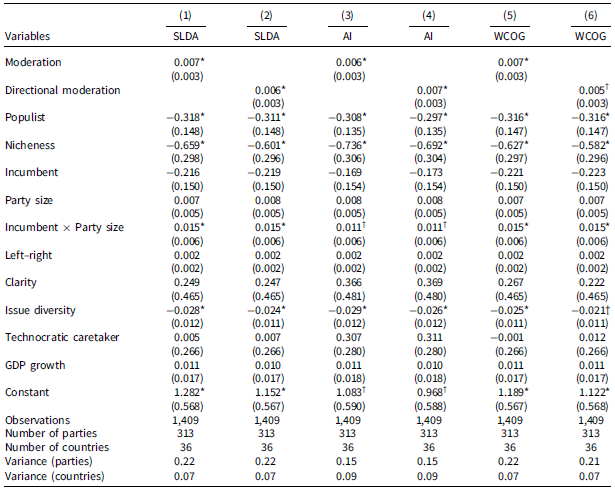
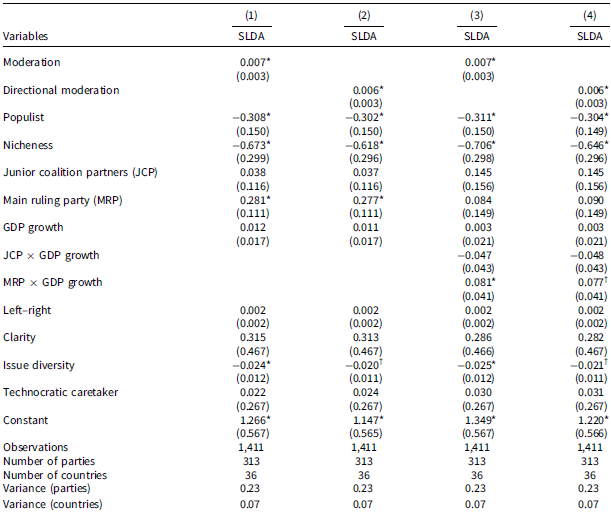
Tables 1 and 2 report the results of the analysis. Given that our observations (manifestos) are nested in parties and countries we fit a multilevel linear model to account for this hierarchical structure of the data.Footnote 14 In Table 1 we provide six models. Models 1 and 2 display the results for the dependent variable built via Seeded-LDA. Models 3 and 4 display the results for the dependent variable based on Artificial Intelligence. As a robustness check, in Models 5 and 6, we replicate the first two models using alternative measures of moderation that locate parties relative to the vote-WCOG of the party system rather than the theoretical center of the RILE scale (0). In Table 2 we provide four additional models, to reassess H3 (Models 1 and 2) and to test H4 (Models 3 and 4) based on the Incumbency Status of parties and on the interaction between Incumbency Status and GDP Growth.
Multilevel linear model of responsibility rhetoric

Table 1. Long description
The table presents the results of multilevel linear models analyzing responsibility rhetoric. It includes six models with different dependent variables and moderation measures. The columns represent different models, labeled as SLDA, SLDA, AI, AI, WCOG, and WCOG. The rows list various variables such as Moderation, Directional moderation, Populist, Nicheness, Incumbent, Party size, Incumbent x Party size, Left-right, Clarity, Issue diversity, Technocratic caretaker, GDP growth, and Constant. Each cell contains values and standard errors for these variables across the models. The table also includes summary statistics like the number of observations, number of parties, number of countries, and variance for parties and countries.
Standard errors in parentheses. Significance: ***p < 0.001, **p < 0.01, *p < 0.05, † p < 0.1.
Multilevel linear model of responsibility rhetoric (with incumbency status)

Table 2. Long description
A table with six models displaying results of a multilevel linear model analysis of responsibility rhetoric. The table has four columns labeled (1), (2), (3), and (4), each representing different models. The rows are labeled with variables such as Moderation, Directional moderation, Populist, Nicheness, Junior coalition partners (JCP), Main ruling party (MRP), GDP growth, JCP × GDP growth, MRP × GDP growth, Left-right, Clarity, Issue diversity, Technocratic caretaker, and Constant. Each cell contains values and standard errors in parentheses. The table includes observations, number of parties, number of countries, and variance for parties and countries. Notable trends include significant values for Moderation, Populist, Nicheness, Main ruling party (MRP), and Constant across different models.
Standard errors in parentheses. Significance: ***p < 0.001, **p < 0.01, *p < 0.05, † p < 0.1.
To start with, in line with H1, the effect of moderation remains positive and significant across all operationalizations. Parties that are moderating their policy platforms make more use of the rhetoric of responsibility. In relative terms, a one-standard deviation increase in moderation boosts responsibility rhetoric by 12%, compared with the average value of the dependent variable in our sample.
We also found support for H2. Populists and niche parties de-emphasize responsibility. Compared with the average value of responsibility rhetoric, being a populist party contributes to reducing its usage by approximately 41%,Footnote 15 whereas a one-standard deviation increase in Nicheness reduces responsibility by 16% (in Model 1).
The results also indicate that being in government increases the Responsibility Rhetoric compared with opposition parties. However, this effect is significant only for large ruling parties (with more than 26% of votes), whereas, as we hypothesized, smaller incumbents tend to avoid responsibility statements (similarly to the opposition).Footnote 16 In line with the expectations, the results provide support for H3 across all the models. Figure 4 depicts the marginal effect of Incumbent for different levels of Party Size (with the 95% confidence interval).
Marginal effect of incumbent on responsibility rhetoric, for different levels of Party Size (with 95% confidence interval).

The results shown in Table 2 further corroborate H3, suggesting that ruling parties in single-party governments and the larger member in coalition governments put more emphasis on responsibility, whereas JCPs do not differ from opposition parties. Furthermore, the results provide support for H4. Figure 5 depicts the marginal effect of Main Ruling Party for different levels of GDP Growth (with 95% confidence interval; reference category: opposition). It shows that being the Main Ruling Party leads to a higher emphasis on responsibility rhetoric compared with the opposition, especially under favorable economic conditions (to claim credit), whereas being a JCP does not make any difference.Footnote 17
Marginal effect of main ruling party on responsibility rhetoric, for different levels of GDP Growth (with 95% confidence interval).

Turning to the controls, we found that the Responsibility Rhetoric is not associated with the overall parties’ positions on the Left-Right scale (we also tested the interaction between moderation and left–right ideology, but this interaction was not statistically significant either). Interestingly, these results contrast with the MARPOR/CMP team’s expectation that right-wing parties resort to this rhetoric more than others.Footnote 18 One might have expected that left-wing parties would experience greater tension between responsibility and responsiveness because of contemporary economic turmoil (e.g., in the case of austerity), which could force them to appeal more strongly to responsibility to compensate for their inability to keep electoral pledges. However, the antagonization of free-market pillars (i.e., internationalization and globalization) is not distinctive of the left. The contemporary right is also a bearer of grievances produced by the free market, including, for instance, concerns about ‘made-in’ production or national small- and medium-sized enterprises (Polk and Rosén Reference Polk and Rosén2024).
Furthermore, in the Supplementary Material (Table A2), we also controlled for the level of extremism on the Left-Right scale to account for the fact that the preferences of moderate parties can be linked with a responsible policymaking (thereby increasing their propensity to make responsibility statements) and moderate parties also have less opportunity to moderate their platforms further (Zur Reference Zur2021). However, we find no difference between moderate or extreme parties, per se, in the usage of responsibility rhetoric. What matters then is not the overall position of parties but rather their process of moderation, as discussed in our theoretical framework.
The results also indicate that parties with a broader agenda make fewer references to responsibility. Surprisingly, the variable Technocratic Caretaker does not appear to have an effect. However, when we minimize the number of missing cases by assigning the value of 0 to moderation and Party Size to parties that did not compete in the previous election (see the Supplementary Material, Table A4),Footnote 19 thus increasing the number of election campaigns taking place under a nonpartisan caretaker or technocratic government, the overall level of responsibility rhetoric increases, probably because the public debate focuses on the emergency faced by such ad-hoc incumbent cabinets.
Conclusion
The emphasis on responsible policymaking and the rhetoric of responsibility are often echoed in political debates. This can occur in times of crises (when parties have to adjust their behavior to meet exogenous and unexpected emergencies, which may require them to be less responsive toward their own voters) or, for related reasons, in periods in which democratic politics drifts toward technocracy (with experts providing technocratic solutions to challenges that can go beyond the traditional left–right cleavage). In recent years, such rhetoric has been used, for instance, to justify unpopular policy choices during the Eurozone crisis, as well as during the COVID-19 emergency.
However, the emphasis on responsibility can become a viable electoral strategy, more in general, whenever parties deviate from their policy promises, as well as when they want to claim credit for the responsibilities assumed and managed during their office term.
Indeed, this strategy can date back at least to the 1980s, when the gap between responsiveness and responsibility started to widen, and parties justified the evasion of election promises citing ‘difficult circumstances’ and ‘inauspicious developments’ (Mair Reference Mair2009: 15), or claimed that their policies were designed to live up to the responsibilities of ruling the country (Karremans and Lefkofridi Reference Karremans and Lefkofridi2020). Thus, such rhetoric is not a novelty, and it is not by chance that, as a reaction to the alleged crisis of representation, niche and populist parties arose, putting their emphasis on responsiveness, even at the expense of responsibility.
In light of this, the present article has investigated the rhetoric of responsibility in party manifestos, to detect which elements affect parties’ propensity to use such electoral strategy. We hypothesized that the rhetoric of responsibility is used either by parties that trade responsiveness for vote-maximization strategies, to explain and justify their deviation from their traditional standpoints, or by parties that want to claim credit, retrospectively, for their responsible actions.
We framed responsibility rhetoric as the emphasis on elements such as the supreme national/public interest, national unity/solidarity, the importance of duties over rights, and the pursuit of the common good, calling for public-spiritedness to discourage egoistic and irresponsible behavior, to the advantage of the whole community.
Accordingly, we measured it by focusing on digitized party manifestos made available by the MARPOR/CMP and we combined LLMs (the manifestoberta LLM, as well as OpenAI) and semisupervised topic models (Seeded-LDA), to split one of the MARPOR/CMP coding categories, selecting only sentences that align with our concept of responsibility rhetoric. We built our measure of responsibility rhetoric through the Seeded-LDA, first, and we replicated the analysis asking OpenAI to perform the same classification task.
Summing up, the findings support our hypotheses and are robust to different operationalizations of the dependent variable. From a theoretical point of view, on the one hand, we found that responsibility rhetoric was used by large incumbent parties (and most notably by parties in single-party governments and by the main partner in coalition governments), which have led the cabinet’s policy agenda, and can use this strategy to claim credit for their responsible actions, particularly under favorable economic conditions. Conversely, junior partners in coalition governments (similarly to opposition parties) tend to avoid such rhetoric, as an attempt to differentiate themselves from the past coalition partners (on a policy ground), enhancing the focus on responsiveness, to avoid being punished for the policy compromises made during the previous coalition government.
On the other hand, the results suggest that the rhetoric of responsibility is used by parties that shifted away from their traditional ideological stances (thus becoming less responsive toward their traditional core voters) and adopted more moderate vote-maximizing positions. By exploiting the responsibility rhetoric, these parties seek to explain and justify to their traditional voters the deviation from past positions, appealing to their loyalty and their sense of responsibility to retain their support, while potentially winning the support of new moderate voters, on policy grounds. In this regard, the rhetoric of responsibility can be another strategy, besides ambiguity, that allows parties to make broader appeals (Somer-Topcu Reference Somer-Topcu2015), while reducing the potential electoral loss due to the alienation of traditional core voters, who could feel betrayed by the moderation of the party’s past policy stances.
Conversely, populist and niche parties, which focus their attention on responsiveness, will be less prone to emphasize responsibility. As such, the rhetoric of responsibility can represent the flip side of populist rhetoric (potentially pushing mainstream parties to slip toward technocracy: Caramani Reference Caramani2017). It could be even more so if responsibility is perceived by voters as a valence attribute, at least in some specific contexts. In this regard, future studies could investigate the emphasis on responsibility during crises and could assess whether voters, during emergencies, would reward responsible policymaking or responsible rhetoric irrespective of their ideological leaning and irrespective of the concrete policy choices that such responsible policymaking would require to take.
Partially related to this, one potential limitation of the present study is that the original 606 category is not a policy issue, per se, but rather captures normative and value-based (valence) rhetoric. Although this feature confirms that it is well suited to study responsibility rhetoric, it also casts doubt on the reliability of this category in manual coding. Indeed, some studies have pointed to the risk of misclassification (Mikhaylov, Laver and Benoi Reference Mikhaylov, Laver and Benoit2012), particularly for non-policy-related categories. Despite its limited reliability, the 606 was among the few RILE categories with a decent to fair level of reliability (Mikhaylov, Laver and Benoi Reference Mikhaylov, Laver and Benoit2012: see Table 2 and footnote 8 therein). Future research could assess whether the use of LLMs and artificial intelligence can help improve reliability.
Nevertheless, it is remarkable that responsibility rhetoric is systematically associated with a variety of parties’ attributes concerning incumbency, size, ideological strategies, and populism. This further highlights the role of non-policy attributes in political competition.
Another potential limitation of our study is that, due to the measurement strategy that we adopted, we did not investigate the link between each responsibility appeal and specific policy issues. In this regard, future research could dig further into responsibility rhetoric, to identify the specific policy topics on which such rhetoric is deployed, and to investigate the relationship between responsibility and policy issues (and its effects).
From a methodological point of view, our strategy allowed us to measure a new concept, responsibility rhetoric, which has been seldom investigated empirically so far. We did so by providing two novel methodological approaches suitable for splitting MARPOR/CMP categories into smaller subunits. Interestingly, the two different approaches that we adopted led to similar substantive results, and this can imply that traditional text analysis techniques may still represent a viable option to perform the specific and well-defined tasks for which they were designed (without entailing additional costs), even though LLMs and artificial intelligence have the potential to go beyond, opening up new avenues for research that involves classification tasks.
Notice that the methodological solutions applied herein can be potentially extended to other MARPOR/CMP categories that contain references to several nonunique topics, separating sentences related to each subtopic from those related to different ones. This would make it possible to get in depth and more specific knowledge on the content of party manifestos without the need for further manual coding or annotation.
Supplementary material
The supplementary material for this article can be found at https://doi.org/10.1017/S1475676526101674
Data availability statement
The dataset and the replication material will be available at: https//andreaceron.com
Acknowledgments
The authors wish to thank the anonymous reviewers for their thoughtful and constructive feedback and the journal’s editor for the invaluable assistance throughout the review process.
Funding statement
This work has been developed under the framework of the PRIN 2020 Project DEMOPE DEMOcracy under PressurE (Prot. 2020NK2YHL), funded by the Italian Ministry of University and Research.
Competing interests
None.
Use of AI
The authors used OpenAI (GPT-4o-mini) to support a methodological task described in the article. The AI-assisted procedure was designed, supervised, and verified by the authors. All methodological decisions, validation procedures, interpretation of the results, and conclusions remain the responsibility of the authors. The authors also used generative artificial intelligence (ChatGPT) to assist with language editing and improve the readability of the article.




 Open access

