Introduction
Thrips (Thysanoptera) are economically important agricultural and horticultural pests worldwide, and most species (90%) belong to Thripidae (Morse and Hoddle, Reference Morse and Hoddle2006; Reitz et al., Reference Reitz, Gao, Kirk, Hoddle, Leiss and Funderburk2020; ThripsWiki, 2022). Their outbreak in the field can cause great economic loss not only due to direct crop damage but also due to vectors transmitting plant viruses as well as the imposed quarantine restrictions (Cannon et al., Reference Cannon, Matthews and Collins2006; Reitz, Reference Reitz2009; Yeh et al., Reference Yeh, Tseng, Chang, Wu and Tsai2014). Megalurothrips usitatus (Bagnall) is a major pest of legumes and is especially damaging to cowpea (Fan et al., Reference Fan, Tong, Gao, Wang, Liu, Zhang and Yang2013; Tang et al., Reference Tang, Liang, Han, Fu, Qiu, Zhang, Wu and Liu2015a). Frankliniella intonsa (Trybom) is a polyphagous pest (Raspudić et al., Reference Raspudić, Ivezić, Brmež and Trdan2009; Ding et al., Reference Ding, Lin, Tuan, Tang, Chi, Atlıhan, Özgökçe and Güncan2021). It can cause serious damage during the flowering period in cowpea. They synergistically cause devastating damage to cowpea, seriously restricting the healthy and sustainable development of the cowpea industry in China. They mainly cause premature abscission by damaging flower buds and flowers and reduce merchandise value because of pericarp scabbing caused by feeding on pods (Tang et al., Reference Tang, Guo, Ali, Desneux and Zang2022).
Cowpea is a crop with cyclic inflorescences. M. usitatus and F. intonsa mainly damage the flower and fruit stages of cowpea; therefore, they share a common ecological niche. We hypothesized that these two closely related thrips would exhibit interspecific competition and even species displacement. A recent study supported the occurrence of interspecific competition between these two thrips and revealed that interspecific competition was mainly mediated by the use of spinetoram (Fu et al., Reference Fu, Tao, Xue, Jin, Liu, Qiu, Yang, Yang, Gui, Zhang and Gao2022). Apart from this extrinsic factor, some intrinsic factors, such as species characteristics, are also basic components of population ecology research. Previously, Qiu et al. (Reference Qiu, Liu, Li, Fu, Tang and Zhang2014) investigated the biological characteristics of M. usitatus at several constant temperatures. Ullah and Lim (Reference Ullah and Lim2015) compared the influence of constant (27.3°C) and fluctuating (23.8–31.5°C, with an average of 27.3°C) temperatures on the life-history characteristics of F. intonsa. Since the data were collected under different experimental designs, it is difficult to compare the characteristics of the two thrips species. Considering that both thrips species are important pests of cowpea, studying the life-history characteristics of these two thrips species on cowpea fruits (pods) under the same environmental conditions will help better understand their interspecific relationship.
The life table method is a useful tool for researching population ecology as well as pest management because it can accurately reflect the population parameters of target organisms, such as their survival, development, longevity and fecundity (Chi and Liu, Reference Chi and Liu1985; Chi et al., Reference Chi, Güncan, Kavousi, Gharakhani, Atlihan, Özgökçe, Shirazi, Amir-Maafi, Maroufpoor and Roya2022). The traditional life table considers only female insects, ignoring the differences between female and male insects and the influence of the sex ratio, and does not consider the developmental differences between individuals (Huang and Chi, Reference Huang and Chi2012; Chi et al., Reference Chi, You, Atlıhan, Smith, Kavousi, Özgökçe, Güncan, Tuan, Fu, Xu, Zheng, Ye, Chu, Yu, Gharekhani, Saska, Gotoh, Schneider, Bussaman, Gökçe and Liu2020; Ding et al., Reference Ding, Lin, Tuan, Tang, Chi, Atlıhan, Özgökçe and Güncan2021). The age-stage, two-sex life table approach makes up for the deficiency of the traditional life table approach. It integrates both the age-stage and two-sex factors well, which makes the demographic parameters more accurate (Chi and Liu, Reference Chi and Liu1985; Chi et al., Reference Chi, Güncan, Kavousi, Gharakhani, Atlihan, Özgökçe, Shirazi, Amir-Maafi, Maroufpoor and Roya2022).
The development of insect populations is mainly influenced by the natural environment. For example, weather parameters, including temperature and humidity, greatly affect the incidence of insects in the field (Madankar et al., Reference Madankar, Magar and Aware2016; Patel and Patel, Reference Patel and Patel2016; Devi and Mahadevappa, Reference Devi and Mahadevappa2021); however, dynamic changes in the natural environment cannot be completely simulated in the laboratory. Therefore, we estimated the life-history characteristics of two economically important thrips, M. usitatus and F. intonsa, on cowpea under natural environmental conditions, including summer and winter regimes. Age-stage, two-sex life table theory was employed to analyse and compare the demographic parameters of the two thrips species using the computer program TWOSEX-MSChart (Chi, Reference Chi2022). The population growth of both thrips species was calculated using the computer program TIMING-MSChart (Chi, Reference Chi2022) (accessed on 29 September 2022). The life table parameters produced by TWOSEX-MSChart and TIMING-MSChart were used to analyse the bioecological characteristics of these two thrips species and to further reveal their inherent competitive advantages.
Materials and methods
Tested insects and daily fluctuating temperatures
M. usitatus and F. intonsa adults were identified according to the methodology described in a monograph on thrips taxonomy by Han (Reference Han1997) and collected from a vegetable planting farm (19°51′N; 110°2′E) in Chengmai county, Hainan province, China. They were reared at room temperature for more than one generation on cowpea pods using the mature rearing technology we established previously (Tang et al., Reference Tang, Yan, Fu, Wu, Liu and Lu2015b) and then used for experiments. To simulate the field environment as realistically as possible, the experiments were carried out in an outdoor net room. The temperatures throughout the experiment were recorded daily at 1 h intervals using an intelligent hygrothermograph (LYWSD03 MMC, Xiaomi Technology Co., Ltd, Beijing, China). The average temperature was calculated from hourly temperature measurements, and a temperature diagram was drawn under two experimental stages, with an average temperature of 28.4°C in the summer regime and 22.7°C in the winter regime (fig. S1). The relative humidities of the summer and winter experiments were approximately 85 and 80%, respectively. Under natural light, the photoperiods in summer and winter were approximately 13L:11D h and 11L:13D h, respectively.
Development and juvenile survival
Adult thrips of the next generation were allowed to lay eggs on cowpea pods for 12 h before being removed. A total of 120 newly hatched nymphs were randomly selected, and each nymph was transferred into a 5 ml centrifuge tube using a fine hair bush. Beforehand, absorbent paper was added as the pupation substrate, and a cowpea pod (≈2 cm) was provided as food. Each tube was sealed with a cotton ball to prevent thrips from escaping and for ventilation. The cowpea pods were replaced with fresh ones every 3 days. Development and survival were checked every 12 h. The juvenile instars were identified by the technique described by Zhang et al. (Reference Zhang, Wu, Li, Zhang, Xu and Zhu2007). The egg duration was instead measured by recording the time when the nymph appeared because thrips eggs were oviposited into the pod tissue and were not visible, but egg survival could not be checked (Van Rijn et al., Reference Van Rijn, Mollema and Steenhuis-Broers1995; Zhang et al., Reference Zhang, Wu, Li, Zhang, Xu and Zhu2007; Park et al., Reference Park, Kim and Lee2010).
Longevity and reproduction
Newly emerged (<6 h) male and female thrips were mated in a centrifuge tube (1.5 ml), and a total of 30 pairs of newly emerged adults were chosen for this experiment. Based on sexual size dimorphism, the males and females of both thrips were identified (Blanckenhorn et al., Reference Blanckenhorn, Dixon, Fairbairn, Foellmer, Gibert, van der Linde, Meier, Nylin, Pitnick, Schoff, Signorelli, Teder and Wiklund2007; Stillwell and Davidowitz, Reference Stillwell and Davidowitz2010). New cowpea pods were added daily until both sexes died. The number of nymphs hatched from the replaced pod was recorded as the daily fecundity, and the numbers of females and males reared from nymphs were used to calculate the sex ratios of the offspring (Tang et al., Reference Tang, Yan, Fu, Wu, Liu and Lu2015b). The durations of preoviposition, oviposition and postoviposition, fecundity and adult longevity were also recorded.
Life table analysis
Data from the experiments were analysed according to the two-sex life table method (Chi and Liu, Reference Chi and Liu1985; Chi et al., Reference Chi, You, Atlıhan, Smith, Kavousi, Özgökçe, Güncan, Tuan, Fu, Xu, Zheng, Ye, Chu, Yu, Gharekhani, Saska, Gotoh, Schneider, Bussaman, Gökçe and Liu2020, Reference Chi, Güncan, Kavousi, Gharakhani, Atlihan, Özgökçe, Shirazi, Amir-Maafi, Maroufpoor and Roya2022). The computer program TWOSEX-MSChart based on age-stage, two-sex life table theory was used to calculate demographic parameters, such as developmental duration, survival rate, longevity and fecundity (Maisnam et al., Reference Maisnam, Johnson, Rachana and Varatharajan2019). The bootstrap technique with 100,000 resamplings was used to estimate the variances and standard errors (Efron and Tibshirani, Reference Efron and Tibshirani1993; Maisnam et al., Reference Maisnam, Johnson, Rachana and Varatharajan2019). The paired bootstrap test in the TWOSEX-MSChart program was used to assess the significance of differences between parameters (P ≤ 0.05) (Wei et al., Reference Wei, Chi, Guo, Li, Zhao and Ma2020). All figures were created using SigmaPlot 12.0 (Systat Software Inc., San Jose, CA, USA).
The life table data for the populations of M. usitatus and F. intonsa were used to project population growth by using the computer program TIMING-MSChart (Maisnam et al., Reference Maisnam, Johnson, Rachana and Varatharajan2019).
Results
Life table parameters of both thrips species under summer and winter regimes
The developmental durations of the egg, prepupal and pupal stages of F. intonsa were significantly shorter than those of M. usitatus under both summer and winter conditions. The developmental time of the nymphal stage of F. intonsa was significantly longer than that of M. usitatus in summer, and in winter, the opposite was true. For F. intonsa, due to shorter developmental times in each immature stage (except for the nymphal stage in summer) than for M. usitatus, the total preadult period of F. intonsa was significantly shorter than that of M. usitatus (table 1).
Demographic parameters (means ± SE) of M. usitatus and F. intonsa reared on cowpea pods under summer and winter regimes

A paired bootstrap test (B = 100,000) based on the confidence interval of differences between treatments was used for comparison. Means in a row followed by different lowercase letters are significantly different (P < 0.05).
The female adult longevity of F. intonsa (25.77 and 32.85 days, respectively) were significantly longer in summer than those of M. usitatus (21.14 days), whereas there was no significant difference in these two parameters between the two thrips species in winter. Different results were found for males, the adult longevity (16.20 days) of M. usitatus males were significantly longer than those of F. intonsa males (13.66 days) in winter, while there was no significant difference in summer (table 1). A significantly longer total preoviposition period of M. usitatus (9.32 and 17.60 days) was found compared to that of F. intonsa (8.07 and 14.71 days) in summer and winter, respectively, and a significantly shorter oviposition period was found for M. usitatus (18.29 days) than for F. intonsa (22.34 days) in summer. However, there were no significant differences between the fecundities of F. intonsa and M. usitatus in summer or winter, but a larger female ratio was found for F. intonsa (66.67%) than for M. usitatus (50.83%) in winter (table 1).
The population parameters obtained in this study indicated that R 0, r, λ and gross reproduction rate (GRR) of F. intonsa were significantly higher than those of M. usitatus, although R 0 and GRR were not significantly different between the two thrips in summer (table 2). The mean generation time (T) of F. intonsa was significantly shorter than that of M. usitatus in both summer and winter.
Population parameters (means ± SE) of M. usitatus and F. intonsa reared on cowpea pods under summer and winter regimes

A paired bootstrap test (B = 100,000) based on the confidence interval of differences between treatments was used for comparison. Means in a row followed by different lowercase letters are significantly different (P < 0.05).
Age-stage and age-specific survival rate and fecundity of both thrips species
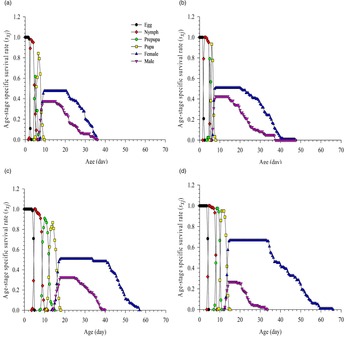
The age-stage survival rate (sxj) significantly differed between M. usitatus and F. intonsa in both summer and winter, although evident overlaps were seen between the stages. In summer, adult F. intonsa females survived for 41 days, which was longer than the survival time of M. usitatus (28.5 days). In winter, F. intonsa females not only survived longer (53.5 days) but also had a higher maximum survival rate (66.67%) than M. usitatus females (survival time: 43 days, maximum survival rate: 50.83%). Overall, adult females had much longer longevity than adult males (fig. 1).
Age-stage-specific survival rate (sxj) of M. usitatus and F. intonsa on cowpea pods: (a) summer × M. usitatus, (b) summer × F. intonsa, (c) winter × M. usitatus and (d) winter × F. intonsa.

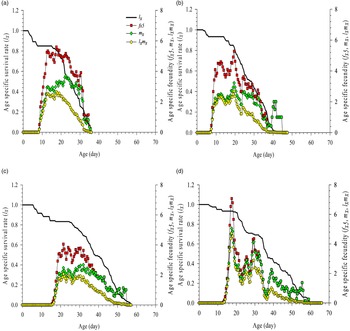
The age-specific survival rate (lx), age-specific fecundity (fx 5) (the age-specific fecundity of both thrips species at the fifth stage (female)), age-specific fecundity of the population (mx) and age-specific net reproductive rate (lxmx) of M. usitatus and F. intonsa in summer and winter are presented in fig. 2, and the maximum fx 5, mx and lxmx values were 5.60, 3.29 and 2.66 at the age of 17.5 days for M. usitatus and 5.28, 3.22 and 2.68 at the age of 19.5 days for F. intonsa in summer, while the maximum fx 5, mx and lxmx values were 4.05, 2.47 and 2.06 at the age of 21.5 days for M. usitatus and 7.08, 5.05 and 4.72 at the age of 17.5 days for F. intonsa in winter, respectively. Similar fx 5, mx and lxmx values were observed for F. intonsa and M. usitatus in summer, but higher fx 5, mx and lxmx values were observed for F. intonsa than for M. usitatus in winter. In general, the results indicated obvious intraspecific and interspecific specificity (fig. 2).
Age-specific survival rate (lx) and fecundity (fx 5, mx, lxmx) of M. usitatus and F. intonsa on cowpea: (a) summer × M. usitatus, (b) summer × F. intonsa, (c) winter × M. usitatus and (d) winter × F. intonsa. Note: fxj is the age-stage-specific fecundity. Here, j represents the fifth stage (egg, nymph, prepupal, pupa, female) of both thrips species, the female stage.

Life expectancy and reproductive value of both thrips species
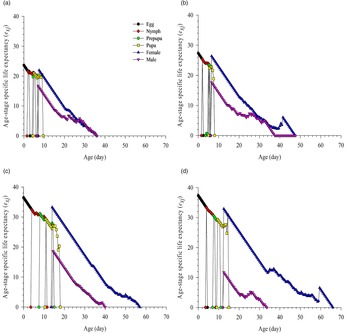
In both the summer and winter regimes, the life expectancy values (exj) of F. intonsa were significantly greater than those of M. usitatus, whether for thrips developed from newly laid eggs or adult females and males, except for the opposite was observed for adult males in winter. Overall, the winter exj values of both F. intonsa (except for males) and M. usitatus were higher than those in summer, and the exj values of females were higher than those of males (fig. 3).
Age-stage-specific life expectancy (exj) of M. usitatus and F. intonsa on cowpea: (a) summer × M. usitatus, (b) summer × F. intonsa, (c) winter × M. usitatus and (d) winter × F. intonsa.

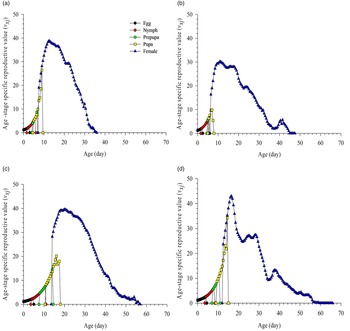
The reproductive values (vxj) of both F. intonsa and M. usitatus first gradually increased with age, reaching peaks at the ages of 11 days (30.22 day−1) and 12.5 days (38.86 day−1) in summer and at the ages of 16.5 days (42.99 day−1) and 20 days (39.59 day−1) in winter, respectively, and then decreasing with age (fig. 4). The vxj of adult females dramatically increased when they started oviposition, but the pattern of decline was different between the two thrips species, with a gradually decreasing pattern in M. usitatus and a fluctuating decreasing pattern in F. intonsa in both summer and winter (fig. 4).
Age-stage-specific reproductive value (vxj) of M. usitatus and F. intonsa on cowpea: (a) summer × M. usitatus, (b) summer × F. intonsa, (c) winter × M. usitatus and (d) winter × F. intonsa.

Population projection of both thrips species
The life table data (i.e., survival, development and fecundity) collected from the experiments were used to project the population growth of the two thrips species, M. usitatus and F. intonsa. The results from the population projection based on the computer program TIMING-MSChart showed that the population of F. intonsa grew faster than the population of M. usitatus, both in summer and winter (fig. S2). Starting with an original population of ten eggs, after 30 days, the population of F. intonsa will grow to 12,005 and 198 eggs, 6339 and 122 nymphs, 2322 and 325 pupae and 3277 and 61 adults in summer and winter, respectively. The population size of M. usitatus was 4872 and 166 in the egg stage, 2897 and 149 in the nymph stage, 1775 and 95 in the pupa stage and 823 and 7 in the adult stage in summer and winter, respectively.
Discussion
Thrips are important crop pests in agricultural ecosystems. Similar to small pests such as aphids, whiteflies and spider mites, they are typical ‘r-strategist’ insects with the main characteristics of a short developmental time and high fecundity. Once the environmental conditions are suitable, their populations will expand rapidly and cause devastating damage to crops. Understanding the population dynamics of pest species is important for effectively mitigating their damage to crops. In this study, we evaluated the biology of two important thrips, M. usitatus and F. intonsa, on cowpea at room temperature in the winter and summer seasons, and the results demonstrated that both thrips pests had a short developmental time and high fecundity with significant seasonal specificity (table 1). Both thrips species had faster development and higher fecundity in summer compared with winter. These characteristics enable them to be destructive and economically important to cowpeas under summer conditions. In the field, yield losses and merchandise value reductions are mainly due to crowds of thrips feeding and ovipositing on flowers or pods in summer. Environmental temperature is a key factor for ectotherms, which significantly affects their growth, development, behaviour, various physiological functions and other life activities (Colinet et al., Reference Colinet, Sinclair, Vernon and Renault2015; Sanchez-Guillen et al., Reference Sanchez-Guillen, Cordoba-Aguilar, Hansson, Ott and Wellenreuther2016; González-Tokman et al., Reference González-Tokman, Córdoba-Aguilar, Dáttilo, Lira-Noriega, Sanchez-Guillen and Villalobos2020), subsequently regulating their occurrence, distribution and damage (Maisnam et al., Reference Maisnam, Johnson, Rachana and Varatharajan2019). Previously, most studies focused on evaluating the effects of temperature on the biology of thrips under constant temperatures (Gaum et al., Reference Gaum, Giliomee and Pringle1994; Li et al., Reference Li, Fail, Wang, Feng and Shelton2014; Ullah and Lim, Reference Ullah and Lim2015; Cao et al., Reference Cao, Yang, Li, Zhang, Wang, Li and Gao2019; Maisnam et al., Reference Maisnam, Johnson, Rachana and Varatharajan2019; de Souza et al., Reference de Souza, de Souza and Zawadneak2021), and a few involved fluctuating temperatures (Ullah and Lim, Reference Ullah and Lim2015; Cao et al., Reference Cao, Yang, Li, Zhang, Wang, Li and Gao2019). However, neither constant temperature nor artificially fluctuating temperature can well reflect actual environmental changes. Thus, the data generated from life tables under these artificial environmental conditions could not well reflect the ecological characteristics of the research target population. Based on this hypothesis, in our study, we compared the life table parameters of M. usitatus and F. intonsa under two different natural environmental regimes. Under similar average temperatures, the total preadult period of F. intonsa was significantly shorter at natural temperature (28.4°C, fig. S1) than at constant temperature and fluctuating temperature (27.3°C) (Ullah and Lim, Reference Ullah and Lim2015). Other important life table parameters, such as adult longevity, preoviposition and oviposition period, and fecundity, also showed an intraspecific advantage in the natural environment compared with fluctuating temperature or constant temperature (Ullah and Lim, Reference Ullah and Lim2015). Similarly, shorter developmental time and higher fecundity were also found for M. usitatus under natural temperature when compared to constant temperature (Tang et al., Reference Tang, Yan, Fu, Wu, Liu and Lu2015b). More comprehensive population parameters also showed a greater intraspecific advantage under natural temperatures than under fluctuating temperatures and constant temperatures, with higher values of R 0, r and λ and a lower value of T than those reported in the literature at a similar temperature (Tang et al., Reference Tang, Yan, Fu, Wu, Liu and Lu2015b; Ullah and Lim, Reference Ullah and Lim2015). However, there were some inconsistent findings in which constant temperature had a more positive effect on population development than fluctuating temperature (Wang et al., Reference Wang, Xue and Lei2014; Cao et al., Reference Cao, Yang, Li, Zhang, Wang, Li and Gao2019). Therefore, compared with natural temperature conditions, constant temperature may lead to under- or overestimation of the values of numerous life table parameters, thus affecting the accuracy of population dynamics monitoring and its application in integrated pest management (Elliott and Kieckhefer, Reference Elliott and Kieckhefer1989; Wang et al., Reference Wang, Xue and Lei2014; Zhao et al., Reference Zhao, Xiao, Zhang and Wang2015).
Two or more insect species in the same niche may undergo interspecific competition. According to previous studies, the interspecific competition between insects can be affected by many factors, including biotic factors and abiotic factors, such as environmental conditions, host range, insecticide sensitivity, aggregation pheromones and natural enemies (Reitz and Trumble, Reference Reitz and Trumble2002; Atakan and Uygur, Reference Atakan and Uygur2005; John et al., Reference John, Göran and Wittko2013; Gao and Reitz, Reference Gao and Reitz2017; Zheng et al., Reference Zheng, Fu, Liu, Lin and Chen2022). The faster the developmental rate was, the higher the immature survival rate and female ratio of F. intonsa in this study, indicating its competitive advantage over M. usitatus on cowpea pods in both summer and winter. Our results are consistent with those of previous studies (Qiu et al., Reference Qiu, Liu, Li, Fu, Tang and Zhang2014; Ullah and Lim, Reference Ullah and Lim2015) and highly consistent with findings in other thrips, such as Frankliniella occidentalis (Gaum et al., Reference Gaum, Giliomee and Pringle1994), Thrips palmi (Yadav and Chang, Reference Yadav and Chang2012, Reference Yadav and Chang2014; Yang et al., Reference Yang, Sun, Chi, Kang and Zheng2020), and Thrips tabaci (Woldemelak et al., Reference Woldemelak, Ladányi and Fail2021). However, the sex ratio is significantly affected by temperature and host (Gaum et al., Reference Gaum, Giliomee and Pringle1994; Yang et al., Reference Yang, Sun, Chi, Kang and Zheng2020; Woldemelak et al., Reference Woldemelak, Ladányi and Fail2021). Population projection in this study also showed that F. intonsa had a greater competitive advantage (fig. S2). However, this is seemingly incongruent with observations in the field: M. usitatus occurs more extensively on cowpea than F. intonsa (Tang et al., Reference Tang, Liang, Han, Fu, Qiu, Zhang, Wu and Liu2015a; Fu et al., Reference Fu, Tao, Xue, Jin, Liu, Qiu, Yang, Yang, Gui, Zhang and Gao2022). The interspecific competition between F. intonsa and F. occidentalis on lentil bean pods also showed a similar pattern (Yang et al., Reference Yang, Qiao, Lu, Li, Liu, Gao and Zhang2022), indicating that the interspecific competition between the two thrips species was not completely mediated by reproductive advantages (Reitz and Trumble, Reference Reitz and Trumble2002). One plausible explanation could be that the use of insecticides has disrupted this interspecific competition owing to sublethal effects (Desneux et al., Reference Desneux, Decourtye and Delpuech2007). A recent study illustrated that the use of spinetoram drives M. usitatus to displace F. intonsa (Fu et al., Reference Fu, Tao, Xue, Jin, Liu, Qiu, Yang, Yang, Gui, Zhang and Gao2022). Previous results showed that M. usitatus had different degrees of resistance to insecticides (Tang et al., Reference Tang, Zhao, Fu, Han, Yan, Qiu and Liu2016, Reference Tang, Zhao, Fu, Qiu, Wu, Li and Liu2018). The asymmetric interference of insecticides on interspecific competition is also reflected in the displacement of Liriomyza sativae by Liriomyza trifolii (Zhang et al., Reference Zhang, Xing, Lei and Gao2017). The pest occurrence pattern caused by differential insecticide susceptibilities will also change with the adjustment of insecticides. Due to the cyclic inflorescence of cowpea, the pods need to be continuously picked at maturity (Tang et al., Reference Tang, Guo, Ali, Desneux and Zang2022). Almost no chemical insecticide safety interval is in line with the cowpea picking interval (usually 1–2 days). Thus, the risk of exceeding the standard rate of pesticide residues caused by chemical control of cowpea pests is more prominent. However, with increasing attention to the problem of pesticide residues in cowpea, there will be a trend to reduce the use of chemical pesticides. The reduction in insecticide use is bound to affect the field occurrence of two thrips regulated by insecticide sensitivity. With a competitive advantage, F. intonsa is likely to become the dominant species of thrips on cowpea in the future. Therefore, it is necessary to prepare for the comprehensive management of F. intonsa in advance. Natural enemies may be another important regulator of the interactions between the two thrips species (Ding et al., Reference Ding, Lin, Tuan, Tang, Chi, Atlıhan, Özgökçe and Güncan2021). In addition, the local specific cropping systems based on wide and narrow host spectra may be another important factor in regulating the occurrence of the two thrips on cowpea. In summary, the occurrence of the two thrips on cowpea is the result of a variety of factors. However, the regulatory effect of chemical insecticides on thrips populations is strong and cannot be ignored.
In conclusion, we compared the biological, demographic, reproductive and population parameters of two economically important thrips species, M. usitatus and F. intonsa, which are sympatric pests of cowpea in southern China and have the same ecological niche, under summer and winter natural environmental conditions using the age-stage, two-sex life table method. Overall, the results of this study showed that F. intonsa had a faster developmental time, a longer adult longevity, a longer preoviposition and oviposition period and a larger female ratio, which resulted in higher values of R 0, r, λ and GRR and a lower T value, although there were no differences in fecundity between the two thrips species. Therefore, F. intonsa showed a competitive advantage over M. usitatus. The information from this study can advance our understanding of the bioecology of these two major thrips species on cowpea and further our understanding of the competition between the two thrips species.
Supplementary material
The supplementary material for this article can be found at https://doi.org/10.1017/S0007485323000238.
Acknowledgements
This study was partially funded by the Natural Science Research Program of Guizhou University (202202).
Conflict of interest
The authors declare no conflict of interest.