1. Introduction
Following on from my state-of-the-art article on Language Awareness and language learning (Svalberg Reference Svalberg2007), in this paper I will discuss specific research tasks which are centrally concerned with different aspects of language awareness (LA): ‘explicit knowledge about language, and conscious perception and sensitivity in language learning, language teaching and language use’.Footnote 1 The overall argument is that research is needed into how LA is constructed by language learners and teachers through engagement with language (Svalberg Reference Svalberg2007; Reference Svalberg2009). I will sometimes refer specifically to awareness of grammar (form-meaning) but hope the paper will stimulate ideas for research into other LA aspects of language learning and teaching. The absence of other issues and areas (such as LA and multilingualism, intercultural LA, critical LA, LA and language policy) is a function of the personal nature of the paper and the limitations of space.
I will start by arguing that LA research should take a holistic approach. Then I will briefly discuss the engagement with language (Svalberg Reference Svalberg2009) construct and how research might provide insights into this process. A separate section is dedicated to how to investigate the effects of anxiety on LA. I move on to noticing and attention and the question of whether, and how, visual input enhancement can affect LA. Finally, I discuss research into teacher language awareness. The ultimate purpose of all the research tasks suggested here is the provision of a basis for improved LA practice in language classrooms.
2. Language Awareness and complexity
Classrooms and other language learning contexts are complex. The term complexity describes a situation where several independent variables come together and interact in ways that are neither random nor very predictable. Weather systems are complex in this sense, and so is classroom language learning. Since the behaviour of a complex system is not random, it is amenable to understanding through research. Its lack of predictability, on the other hand, makes this a challenging task. The context includes the independent variables, which in language education research – including LA – used to be considered background information. Increasingly, context is viewed as an essential part of what is being studied. This is one important aspect of complexity research (e.g. Larsen-Freeman Reference Larsen-Freeman1997, Larsen-Freeman & Cameron Reference Larsen-Freeman and Cameron2008). Perhaps the most accessible complexity framework is the ecological approach advocated by van Lier (Reference van Lier2004; see also Kramsch & Steffensen Reference Kramsch, Steffensen, Duff and Hornberger2008). Van Lier (Reference van Lier2004: 205) clarifies: ‘ecology is not a single method or even a theory, it is more of a world view and a way of working, and it can motivate a wide variety of research and practice’. In this world view, the language learner is seen as part of a complex, multi-layered ecosystem.
Ecological research (and teaching) strives to take in as many layers and inter-relationships within that system as possible. The interaction between the learner and the environment takes place through the learner's perceptions and actions and creates (positive or negative) conditions for learning, which are in environmental linguistics called affordances. Teachers, along with tasks and materials, form part of the eco system, and thus contribute to affordances.
The complexity of the system is modelled by Bronfenbrenner (Reference Bronfenbrenner1979, cited in van Lier Reference van Lier2004: 208–210) as a series of nested systems (micro-, meso- and exo-systems). For example, a phenomenon might be studied at the classroom level, at the school level and at the wider social level (e.g. government policy). The relationships and interactions between the systems are central to an understanding of the whole.
In the research tasks suggested below I have tried to indicate, however briefly, how an ecological approach might be adopted. My suggestions are intended to bring the research tasks to life and stimulate research ideas, but should be adapted to the reader's research context. It may be possible to carry out some of the suggestions only in part, or by collaborative research. If these ideas stimulate the reader's own research ideas, they will have fulfilled their purpose.
3. Engagement with language
LA is cross-disciplinary, but all LA research focuses on LA as process or as product, or sometimes both. More precisely, it may focus on the engagement with language (EWL) process through which LA is constructed (Svalberg Reference Svalberg2009) or the resulting or pre-existing LA itself in the form of language and language-related knowledge, beliefs and attitudes. EWL has cognitive, affective and social dimensions and is influenced both by the immediate context and by factors more distant in place or time. As such, it is complex in the sense discussed above.
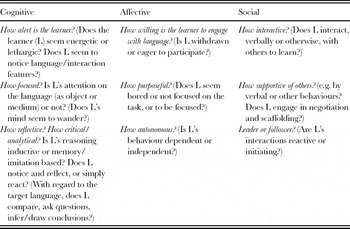
How does the teacher or researcher know if a learner is engaged with language? The questions in Table 1 can be a useful starting point. They propose that a fully engaged individual is, for example, attentive, has a positive attitude towards (the) language/s and what it/they represent/s, and is willing to interact, for example to reflect on (the) language/s with peers.
Criteria for identifying engagement with language (EWL) (adapted from Svalberg Reference Svalberg2009: 247)

It is important to understand why learners engage, or why they do not. Task design can be expected to play an important role. An LA approach to language learning/teaching is likely to make use of what has been called consciousness raising (CR) tasks. The purpose of a CR task is that the learner should ‘arrive at an explicit understanding of some linguistic property or properties of the target language’ by carrying out a task on some L2 data (Ellis Reference Ellis1997: 160). In other words, CR is one way of generating EWL. Referring to Sharwood Smith (Reference Sharwood-Smith1981), Eckerth (Reference Eckerth2008: 12) explains:
Rather than L2 explicit knowledge per se, it is the potential effect of such knowledge on input perception, language processing, and output monitoring which can be conducive to second language acquisition, an effect which has been referred to as consciousness raising.
The general issues in LA are how explicit knowledge comes about as a result of CR tasks and to what extent such knowledge results in improved understanding, performance and/or change in language attitudes.
CR tasks are not, however, homogeneous in nature. Takimoto (Reference Takimoto2006) reported significant learning gains through CR tasks, carefully structured so that the learners would arrive at specific, correct answers regarding a particular target feature (forms of request). Eckerth's (Reference Eckerth2008) two types of CR tasks were more open-ended. One was a text reconstruction task (also called a dictogloss) in which the learners listen to a text twice, taking notes the second time, and then attempt in pairs to reconstruct the text on the basis of their notes, memory and knowledge of the language. The second task was text repair, which involved converting a string of base forms into accurate and coherent text (e.g. he get back we if be problem > He will get back to us if there is a problem). It could not be predicted what the students would notice and discuss, and hence what learning opportunities (affordances) might arise. The study included both a detailed analysis of the students’ interaction (e.g. the hypotheses they formed), and a measure of the learning effect in pre/post and delayed post-tests. The delayed post-tests included non-targeted language features which the students had spontaneously noticed and discussed during task completion. Part of the test was thus tailor made (Swain Reference Swain, Cook and Seidlhofer1995) for each dyad. In the task-based interaction the learners did not reinforce each others’ incorrect hypotheses, but they did correct some erroneous hypotheses and made significant gains on the targeted language features. On the non-targeted features they appeared to make learning gains both during the task and subsequently.
Research Task 1: There is plenty of scope for further research into learners’ interactions during CR tasks to improve our understanding of learning opportunities in an EWL context, and their effects.
Investigate learners’ CR task-based interaction to understand and improve the degree and quality of EWL.
Possible research questions in relation to a specific task design include: How actively did the students participate in the CR work, and how well did they focus on the task (e.g. number of turns, length of on-task talk)? What learning opportunities arose, and how? How were they noticed, made use of or ignored? How did the students evaluate the CR task as a language learning experience? How did they perceive the CR task in terms of relevance, interest, enjoyment?
Detailed analysis of language related episodes – that is, how the learners talk about language – (e.g. Fortune Reference Fortune2005; Swain Reference Swain and Byrnes2006; Swain et al. Reference Swain, Lapkin, Knouzi, Suzuki and Brooks2009) could help answer some of these questions. Video-recordings of the interaction would allow stimulated-recall interviews with the learners, both to check the researcher's interpretation of the interaction and to help answer the remaining questions.
Research Task 2: In order to interpret the psychological/affective and social aspects of EWL it is useful to draw on research on group work, whether related to the language classroom (Kramsch Reference Kramsch1985; Lockhardt & Ng Reference Lockhardt and Ng1995; Tocalli-Beller Reference Tocalli-Beller2003; Tocalli-Beller & Swain Reference Tocalli-Beller and Swain2005) or other educational contexts.
In her study of group work in mathematics, Barron (Reference Barron2003) analyzed quantitative data on turn-taking, and the type of response made to correct suggestions from peers. A particularly useful insight was that collaborating learners ‘must simultaneously attend to and develop a content space (consisting of the problem to be solved) and a relational space (consisting of the interactional challenges and opportunities)’ (p. 310). The combination of the two is the dual-problem space. With my own M.A. students I have found that issues such as friendships, interactional styles and cultural schemata have an impact on their task-based interaction.
Investigate how learners manage the dual-problem space during CR tasks, and seek explanations.
A research question for this task might be: To what extent do shared vs. mixed background knowledge, language and culture affect relational and content space management in group CR tasks?
This could be investigated by varying the composition of groups. For example, in a class of international students, start by grouping students as far as possible in homogeneous groups. At a later stage in the research, switch to heterogeneous groups. Quantitative data can show turn-taking patterns, amount of talk on- or off-task, nature of talk (e.g. acceptance/rejection/negotiation of proposals/views; instances of interpersonal conflict). Qualitative in-depth analysis of how on-task negotiations or interpersonal conflicts are managed can be combined with interviews. Background data on the participants’ language/s, previous training and experience would be needed and the CR task group work would be recorded. A small number of stimulated-recall interviews can provide rich data. The researcher and the learner can both pause at what they feel are significant episodes, to let the student talk about what happened and what they were thinking, the reasons for their decisions and so on.
To find explanations of why on-task negotiations and interpersonal conflicts are managed the way they are, the analysis can consider different levels:
• Individual – Prior experience of working in a group/this type of task
• Group – Attitudes to the task/to group work/to the group; relationships between group members (e.g. friendships, issues of trust)
• Course/class (e.g. assessment washback; other competing coursework)
• Wider society (e.g. home/work).
Interaction on a specific task, at a specific time, can be affected by these factors at different times: for example, before the course (years of experience as a learner/as a teacher) and after the course (perceived relevance to future practice; perceptions of the ‘ideal self’ – see Dörnyei & Ushioda 2009).
On a smaller scale, an Action Research (AR) approach is also possible. Different cycles of an AR study could focus in more detail on one of the levels above, or specific issues within a level, as justified by emerging findings.
4. Affective aspects of language awareness: Anxiety
Among the many specific aspects of EWL which warrant examination is the effect of anxiety. In the language learning literature, this has already been widely researched (Horwitz & Young 1991; MacIntyre & Gardner Reference MacIntyre and Gardner1991a, Reference MacIntyre and Gardner1991b; Ariza Reference Ariza2002; Ohata Reference Ohata2005; Ewald Reference Ewald2007; Brown Reference Brown2008). Different types of anxiety have been distinguished, including trait anxiety (a tendency of certain individuals towards anxiety), situational anxiety (triggered by an event or situation) and (foreign) language anxiety (anxiety provoked by the process of learning or using the language), and scales of anxiety have been constructed (Horwitz & Young 1991; MacIntyre and Gardner Reference MacIntyre and Gardner1994). (See also MacIntyre & Gardner Reference MacIntyre and Gardner1991a, Reference MacIntyre and Gardner1991b, Reference MacIntyre and Gardner1994 for reviews of anxiety research.) Although, as Oxford (Reference Oxford and Arnold1999: 61−62) points out, some researchers acknowledge that anxiety can have both negative and positive effects, it is usually regarded as negative: researchers such as Ewald (Reference Ewald2007: 314) talk of how to ‘relieve anxiety’. The issue is, however, more complex than this would suggest.
Using an ethnographic approach, Spielmann & Radnofsky (Reference Spielmann and Radnofsky2001) found that the term ‘anxiety’ did not adequately describe what they found and opted for the alternative tension. The context of the study was a full immersion, residential, L2 French-only college course in a US environment (Vermont). The authors found that tension, either cognitive or affective, was not always perceived negatively. They concluded that it can be euphoric, dysphoric or neither. What would usually be referred to as ‘anxiety’ is, in the Spielmann & Radnofsky scheme, affective dysphoria (p. 263). A neutral state of tension is what has been called flow (p. 262, citing Csikszentmihalyi Reference Csikszentmihalyi2000) and is related to states of complete, effortless absorption in a creative or learning process. I would argue that EWL is one such process.
Research Task 3: In the Vermont study, materials and activities had a stronger positive effect on learners than either a non-threatening environment, or the level of difficulty and expectation. The findings suggest that the learning effect of CR might actually be enhanced by tasks that produce a measure of tension.
Investigate to what extent tension hinders or facilitates EWL and the creation of LA, and explore how/why.
In a grounded, ethnographic approach, the researcher might start without specific research questions and build up a case study or parallel case studies over an extended period of time, such as a semester. The participating learners keep a diary where they reflect on their EWL, and the researcher can then periodically discuss the diary entries with the learners to clarify and gain further insights into their affective states. In this approach, the classroom activities/tasks might be those normally used in that classroom rather than specifically chosen or designed.
Research task 3 can also be approached using an interventionist methodology. One way of varying the tension during a challenging CR task is to provide or withhold an answer key. Another is to contrast a challenging with a less challenging CR task. For example, the task may relate to L2 data in the form of an authentic text in one group, and a simplified version of the same text in another. Research data could include recorded task-based peer interaction as well as pre- and post-tests, in a quasi-experimental design.
It is worth considering that EWL is affected not only by factors inside the classroom but also, crucially, by learners’ individual needs, expectations and circumstances. For example, a learner who is used to the transmission mode of teaching/learning might see it as the teacher's job to provide answers and could find it particularly difficult to accept open-ended tasks. These and other aspects could be explored in a survey and/or interviews, and the findings related to observation and test data.
5. Cognitive aspects of language awareness: Visual input enhancement
Noticing and attention are fundamental concepts in LA. A body of research starting with Schmidt & Frota (Reference Schmidt, Frota and Day1986) and Schmidt (Reference Schmidt1990) has shown their importance for language learning but, twenty years later, research is still needed in natural classroom settings.
It is clear that attention facilitates learning but also that it is a limited resource. Visual input enhancement (VIE, or textual enhancement) is a technique which attempts to direct language learners’ attention to specific target features. It usually consists of formatting (e.g. underlining, bold text, italics or capitals) to make target features stand out from the surrounding text and increase the likelihood of learners noticing them. A very useful review of VIE research is included in Simard (Reference Simard2009).
In her own experimental study, Simard (Reference Simard2009) compared the effects on learner intake of different types of textual enhancement (e.g. bold, italics, underlining, capitals, colour and different combinations of these) in reading texts. She found that different enhancement conditions had different effects. In particular, using capitals for the target feature or a combination of three enhancements (bold, capitals and underlining) increased learner intake. The author points out that she relied on pre- and post-test data and did not monitor the participants’ noticing during the task. To investigate noticing in more depth, on-line protocols could be used to replicate and extend the study (Language Teaching Review Panel 2008).
Typically, the effect of VIE on learning (if any) is small. Lee & Huang (Reference Lee and Huang2008) carried out a synthesis and meta-analysis of sixteen VIE experimental and quasi-experimental research studies starting in 1991. They found that ‘VIE had very small-sized overall effects on learners’ grammar learning’ (d = 0.22) and the effects were ‘not statistically trustworthy’ (p. 321).
The VIE studies in Lee & Huang (Reference Lee and Huang2008) had limitations. Though some treatments took place over several hours, others were as short as 30 minutes or did not specify the length of treatment. The research participants tended to be intermediate learners, and from a limited set of L1s – mostly typologically European.
Research Task 4: As Lee & Huang (Reference Lee and Huang2008) point out, ‘the VIE domain is still a young area of research’ (p. 313), and the number of researchers is small. There is scope both for conceptual and approximate replication of studies (as indicated above) and for completely new VIE research. In either case, it would be useful to investigate the use of VIE in a wider range of contexts and language settings.
From an LA perspective, the failure of VIE in existing studies to have more than a very minor effect on learning is perhaps not surprising. The learners were not required to actively interact with the VIE; in other words, any noticing produced by VIE did not lead to EWL. It would be worth finding out if adding an element of EWL could enhance that effect.
Test the relative effects of VIE only compared to VIE plus related CR tasks, and seek explanations.
In the language learning classroom, EWL could be triggered by a CR task, such as asking the learners to deduce a rule from enhanced portions of a text. A quasi-experimental study could compare one treatment with another: enhanced input only (e.g. passive verb groups underlined) in one group, enhanced input plus CR task in the other (e.g. deduce the rule for formation of passives). The learning effect of the two treatments would be investigated by pre- and post-tests, and a delayed post-test.
Research Task 5: A modified VIE technique often used in classrooms is to ask the learners themselves to identify the target feature by underlining, circling, or highlighting instances of it in text input. This involves them in language analysis, and thus EWL, and results in a visually enhanced text (for examples of this kind of CR task, see Svalberg Reference Svalberg2005). The task may be individual or collaborative and can also include a stage of class discussion or teacher checking. I will refer to VIE already provided in the input as ‘ready-made’ and VIE carried out by learners as ‘learner-produced’.
Test the relative effects of ready-made VIE compared to learner-produced VIE, and seek explanations.
Research could build on Lee (Reference Lee2007) – which compared the effects of ready-made VIE and topic familiarity on acquisition of form (as measured by a correction task) and on comprehension (through free recall) – by replacing the topic-familiarity variable with learner-produced VIE.
The ability of quantitative studies to provide insights into not only whether but how and why EWL results in learning is limited, but combined with other data, such as close analysis of task-based interaction or student interviews, such studies can add to our in-depth understanding.
6. Teacher Language Awareness (TLA)
There is a considerable literature on language teachers’ subject knowledge, or teacher LA. Thornbury (Reference Thornbury1997: x) defines TLA as ‘the knowledge that teachers have of the underlying systems of the language that enables them to teach effectively’. Most of the research is concerned with the grammar aspects of TLA. Andrews (Reference Andrews2001, Reference Andrews2003) shows the close relationship between TLA and pedagogical content knowledge, and Andrews (Reference Andrews2007) points out that teachers’ EWL is a key feature of their procedural LA. In other words, teachers’ EWL has the potential to substantially enhance pedagogic practices. In what follows I will assume that TLA includes knowledge of grammar terminology, classifications and rules and an ability to apply this knowledge, for example in identifying learner errors and providing useful explanations to students.
Do language teachers need this kind of LA? Borg (Reference Borg2003a; Reference Borg2003b) reaches the conclusion that explicit grammar teaching is still being practised around the world. Both teachers and learners tend to value some kind of form-focused instruction (Schultz Reference Schultz2001). Borg & Burns (Reference Borg and Burns2008), however, found that teachers of English to adults in 18 countries preferred to integrate grammar into skills teaching. This could mean teaching grammar in context, perhaps picking up on grammar points which emerge from student errors or from a text used for skills work. The need to contextualize and the reactive nature of such an approach place high demands on teachers’ grammar awareness.
A number of research studies have, however, found the TLA of both language teacher trainees and language teachers wanting. The 82 teacher trainers in Andrews’ (Reference Andrews, Bygate, Tonkyn and Williams1994) questionnaire survey considered that at least half of their trainees had insufficient grammar knowledge. Wray (Reference Wray, Bennet and Carré1993) and Andrews (Reference Andrews1997) identified problems with poor grammar knowledge and deficient grammar explanations. A number of studies have revealed similar gaps in TLA among teachers and teacher trainees in the UK (Williamson & Hardman Reference Williamson and Hardman1995; Cajkler & Hislam Reference Cajkler and Hislam2002; Hislam & Cajkler Reference Hislam, Cajkler and Bartels2005), Hong Kong (Andrews & McNeill Reference Andrews, McNeill and Bartels2005), and Malaysia (Elder, Erlam & Philp Reference Elder, Erlam, Philp, Fotos and Hossein2007). Teacher education in many parts of the world fails to produce teachers with adequate grammar-related TLA.
Against this one might argue that teachers learn about grammar most effectively on the job. Borg (Reference Borg2003a) cites a number of studies showing that teachers’ content knowledge develops both through education and experience. This is, however, not the case for all teachers. The TLA of the three Hong Kong EFL teachers in Andrews (Reference Andrews2006) had changed little in about nine years of practice.
Andrews (Reference Andrews1997) points out that teachers need not only declarative grammar knowledge but also the ability to apply it for teaching purposes. The question is how this can be achieved. Borg (Reference Borg2003a) concludes that ‘increasing language teachers’ explicit knowledge about grammar through teacher education will not automatically lead to more effective instruction’ (pp. 101−102) and suggests that ‘teachers’ self-perceptions of their knowledge of grammar motivate their pedagogical decisions’ (p. 103). Andrews & McNeill (Reference Andrews, McNeill and Bartels2005: 159) emphasize the role of EWL:
We have become increasingly convinced that the extent and the adequacy of language teachers’ engagement with language content in their professional practice is a crucial variable in determining the quality and effectiveness of any L2 teacher's practice.
Research Task 6: There is much research and development work to be done to find effective ways of helping teachers become confident in engaging with grammar.
Investigate how to develop student teachers’/practising teachers’ grammar-related TLA and analytical skills.
I see this task as generating intervention studies of some kind. There are a number of potentially useful pedagogical models, such as Borg (Reference Borg1994), Wright (Reference Wright, Trappes-Lomax and Ferguson2002), Kumaravadivelu (Reference Kumaravadivelu2006a; Reference Kumaravadivelu2006b) and Andrews (Reference Andrews2007: Chapter 9). All are concerned with developing the language awareness of teachers and making them autonomous learners/language investigators. Tasks from resource books such as Wright (Reference Wright1994), Bolitho & Tomlinson (Reference Bolitho and Tomlinson1995) and Thornbury (Reference Thornbury1997) might be adapted for research purposes.
The study could adopt a quasi-experimental design or, alternatively, take the form of an in-depth case study of a single group. If the participants are student teachers, their grammar knowledge and analytical skills would be tested before and after the course. By exploring the participants’ EWL during the course in some depth, through observation and/or interviews, the researcher might be able to explain the effect (or lack of it) of the intervention. A follow-up study after a year of teaching could show to what extent the teachers had used their grammar TLA in their practice, and whether they had continued to develop it.
Research Task 7: The pedagogical choices teachers make are not only influenced by their knowledge, skills and confidence: contextual factors can be decisive. Borg (Reference Borg2003b) points out that we need a better understanding of the relationship between teacher cognition, practice and context.
Investigate the relationship ‘teacher cognition – practice – context’ in relation to the teaching of grammar.
Better understanding of teachers’ contexts could make an important contribution to teacher education.
Acknowledging the complexity of the issues, research task 7 could usefully combine, for example, survey data with interviews, plus a few in-depth case studies. It would need to consider factors that might limit the teacher's free choice of what to teach and how to teach it, such as curriculum specifications, course books, students’ tests/examinations, class size, seating, plus subjective aspects such as expectations (those of parents, students and the school). The teachers’ background (education, training, L2 learning/use), TLA (language proficiency, knowledge about grammar including metalanguage and the ability to apply it), beliefs and attitudes (about grammar, grammar teaching/learning) and actual practice would be included. Observation and stimulated-recall interviews (Borg Reference Borg2006; Mullock Reference Mullock2006) could help build up in-depth case studies.
7. Conclusion
To have an impact on language learning/teaching, LA research in the next ten years needs to provide a much richer picture of how LA is constructed (the EWL process), how it is applied in language learning classrooms in a wide variety of contexts, and how it affects language learning.
I have argued that LA research should embrace the complexity of classrooms. That includes many aspects which it has not, regrettably, been possible to discuss in this paper, such as multilingualism and intercultural communication. An ecological approach has been recommended. Mixed method, multi-layered studies are needed in order to explore both the ‘how and why’ of the engagement process and the ultimate effect of LA interventions on learning outcomes.
There is also room for further theory building in LA. To give only a couple of examples of questions that might be asked: What is the relationship between EWL and the learner's/language user's beliefs about knowledge and about themselves? (Dweck Reference Dweck2000). How does LA relate to social attitudes such as tolerance and inclusivity (which the LA movement espouses)?
In language teaching, the use of communicative and integrated skills approaches and authentic materials has arguably increased the demands made on teachers’ LA. I have suggested research which might help teacher education respond to this challenge.
Acknowledgements
I am grateful to the reviewers for their insightful comments and constructive advice.
Agneta M.-L. Svalberg lectures and supervises on M.A. and Ed.D. programmes in Applied Linguistics & TESOL in the School of Education at the University of Leicester. Before entering tertiary education, she worked as an EFL teacher in different parts of the world. She has published on Language Awareness and has a particular interest in tense, modality and aspect, the learning and teaching of grammar, and peer interaction.